Untangling the Mystery of Virtual Digital Assets

– Shreyan Srivastava (finserv@vinodkothari.com)

An Insight into Crypto, Tokens and NFTs

Background

The Union Budget Speech 2022-23 created quite a stir in the cryptocurrency industry once again, as the Hon’ble Finance Minister proposed a 30% blanket taxation on virtual digital assets (“VDAs”). Given the plethora of terms existing such as ‘virtual currencies’, ‘digital currencies’, ‘cryptocurrencies’, ‘NFTs’, ‘altcoins’ and so on, the question arises as to what these individual terms entail and which ones fall under the category of ‘VDAs’ and where does the Central Bank Digital Currency (“CBDC”) fall under the maze of these new terms.

The Finance Bill, 2022 appears to provide some clarity through the proposed clause 2(47A) of the Income Tax Act by defining VDAs. To that effect, the current article is dedicated to clearing the confusion with respect to CBDCs and VDAs, arguing that for anything to qualify as a VDA it needs to progressively fulfil the criteria of asset → digital → virtual. Read more

Budget 2022: Government to roll out battery swapping policy for EVs

Electric Vehicles slowly getting into priority list of the Government

Qasim Saif | Manager <finserv@vinodkothari.com>

­­­With a growth of more than 100% in sales of Electric vehicles (EVs) from FY21 to FY22 and 9,13,532 EVs currently registered since FY12 and expected sales of 14.8 million EVs by FY30, a comprehensive framework and government support to the industry is no longer an option rather a necessity.

Read more

Non-Performing Assets: A Solution at Last?

– Shreyan Srivastava (resolution@vinodkothari.com)

Background

In India, Non-Performing Assets (“NPAs”) have been a chronic plaque in the economy for decades. Although recent reports indicate that the Gross NPA (“GNPA”) and Net NPA (“NNPA”) have been systematically declining, in comparison to other economies, the country still faces a high volume of NPAs. For this reason, for the last several budgets, economic policies in India have been tailored to provide relief from the existing NPAs and to provide mitigatory steps to reduce the rate of such NPAs.

In this article, we discuss the current situation of NPAs in the country and assess the feasibility of the steps taken by the Government to mitigate, control and resolve the same, specifically through measures introduced by the Union Budget 2021-22[1] leading upto the Union Budget 2022-23[2] and the extent of the reliefs they provide.

A Two-Decade History

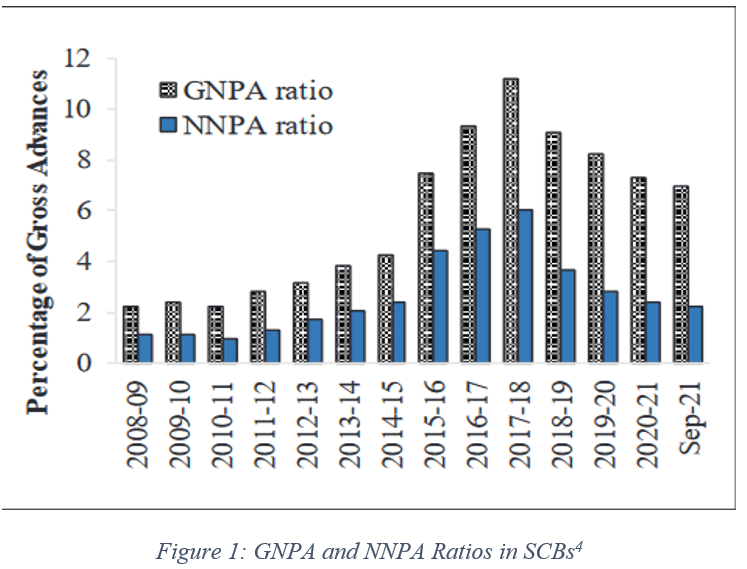
As illustrated in Figure 1, from the fiscal year of 2008-09, both Gross NPA (“GNPA”) and Net NPA (“NNPA”) for Scheduled Commercial Banks (“SCBs”) were following an upward trend with a slight dip in 2010-11. The highest NPA was recorded for the financial year of 2017-18, following which a structural decline was observed despite the overwhelming impact of the pandemic on all economic sectors in 2020.[3]

As per data provided by the RBI, there has been a constant decline of Net and Gross NPA Ratios in Scheduled Commercial Bank ever since the fiscal year of 2018-19:-

  • As of September-end 2021, the NNPA ratio sits at 2.2% compared to 6% in 2017-18.
  • As of September-end 2021, the GNPA ratio sits at 6.9% compared to 11.2% in 2017-18.

Similarly, the NNPA and GNPA ratios for NBFCs stood at 6.55% and 2.93% and 6.55% for September-end 2021.

A large portion of this declining rates of GNPA and NNPA ratios can be attributed to various available resolution mechanisms, including the Insolvency and Bankruptcy Code (IBC), SARFAESI Act, Debt Recovery Tribunals, etc, which have proved to be useful to certain extent. However, there still remains a large stock of legacy NPAs which are yet to be resolved. As per a report issued by RBI[5], in F.Y. 2019-20, the total amount of NPAs recovered was merely 23% of the total NPAs worth a whopping Rs. 7,42,431 crores.

The Indian Council for Research on International Economic Relations (“ICRIER”) studied Asset Management in various foreign jurisdictions such as the United States, Sweden, Italy and Indonesia all of which had instituted a centrally owned Asset Management Company (“AMC”) during a financial crisis with a sunset clause. Thus, once the financial crises had been lifted the AMC would be dissolved via its sunset clause.

Union Budget 2021-22: Creation of the Bad Bank

The need for a government owned ARC to manage the NPA problem on a large scale was identified as early as 2017 by the ICRIER and recognising the same the Governor of the RBI: Shri Shaktikanta Das observed: “If there is a proposal to set up a bad bank, the RBI will look at it”.[6] Subsequently, the Finance Minister of India during the Union Budget Speech of 2021-22 stated:

“An Asset Reconstruction Company Limited and Asset Management Company would be set up to consolidate and take over the existing stressed debt and then manage and dispose of the assets to Alternate Investment Funds and other potential investors for eventual value realization”.[7]

Soon after the Union Budget of 2021-22, the Government incorporated the National Asset Reconstruction Company Limited (“NARCL”) under the Companies Act, 2013 and registered the same with the RBI. The NARCL is essentially the first government owned ARC in India, set up in a manner similar to Asset Management Companies in the foreign jurisdiction, and is owned primarily by public sector banks.

As provided in its mandate, the Indian Debt Resolution Company Limited (“IDRLC”) was set up to act as the operational entity designed to manage the NARCL such that while the latter would offer the purchase stressed assets of the lead bank and acquire them, the IDRLC would engage with the management (market professionals and turnaround experts) and value addition of such assets. Thus, what was born was a unique Public-Private Partnership of NARCL-IDRLC with the mandate to mitigate the NPA problem in the economy.

The NARCL had proposed to acquire stressed assets worth Rs 2 lakh crore in a phased manner in the proportion of 15% Cash and 85% in Security Receipts (SRs), all the while operating within the existing framework for ARCs as issued by the RBI.[8]In fact, the NARCL had already planned for Phase I with fully provisioned assets of about Rs. 90,000 crores expected to be transferred to NARCL before the end of the current financial year of 2021-22.[9] From what is understood, NARCL shall focus on the legacy assets, worth Rs. 500 crores or more, which are generally not targeted by the privately owned ARCs.

However, despite being proposed a year back, NARCL was only made live on 27th January, 2022, merely 4 days prior to the Union Budget 2022-23. Hence, we are currently in a very nascent and premature stage to gauge if at all the public-private relationship would give the expected results.

The National Bank for Financing Infrastructure and Development

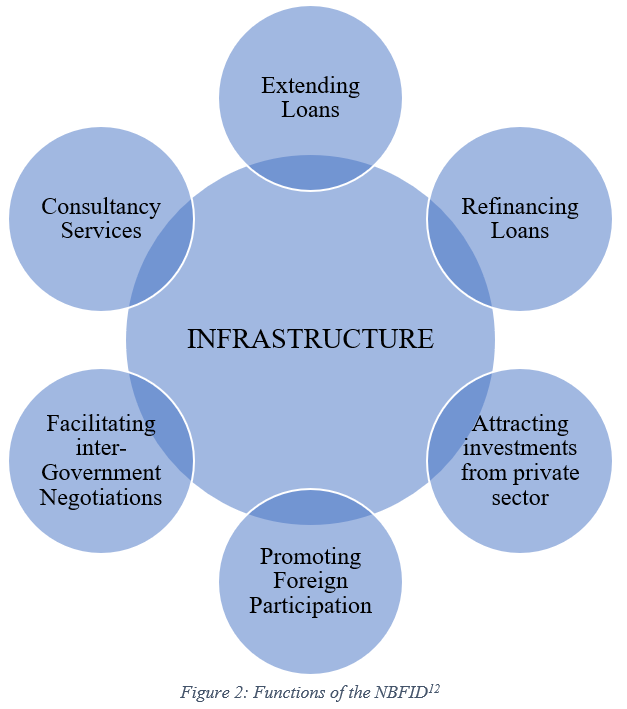
With the NARCL due to begin their operations of Phase I, the Ministry of Finance issued a notification on 28th January 2022 (close to the Union Budget Speech of 2022-23) which formally established the National Bank for Financing Infrastructure and Development (“NBFID”).[10]As elaborated by the PRS India, the NBFID is to operate as a corporate body with authorised share capital of one lakh crore rupees which can only be held by selected public sector enterprises.[11] Its mandate would be to directly or indirectly lend, invest, or attract investments for infrastructure projects as selected by the Central Government located entirely or partly in India. The various sectors have been identified in Figure 2 below: –

Thus, unlike any other jurisdictions, India appears to adopt a three-fold sectoral approach to rectify their NPA problem:

  • Private Sector: Private ARCs registered with the RBI.
  • Public-Private: The NARCL-IDRLC
  • Public: The NBFID.

Concluding Remarks

While the Union Budget 2021-22 had formally recognised the commencement of the NBFID and NARCIL, its performance and efficacy is yet to be investigated. Moreover, what makes the NBFID stand out from its government owned AMC counterparts in foreign jurisdictions is the lack of a sunset clause given that it targets the Infrastructure Sector. Similarly, not much can be said about the NARCL-IDRLC which is also due to begin its Phase I sometime before 31st March 2022.

[1] https://www.indiabudget.gov.in/budget2021-22/doc/Budget_Speech.pdf

[2] https://www.indiabudget.gov.in/doc/Budget_Speech.pdf

[3] https://www.indiabudget.gov.in/economicsurvey/doc/echapter.pdf#page=55

[4] https://www.indiabudget.gov.in/economicsurvey/doc/echapter.pdf#page=55

[5] https://rbi.org.in/Scripts/PublicationReportDetails.aspx?UrlPage=&ID=1188

[6] 39th Palkhivala Memorial Lecture

[7] https://www.indiabudget.gov.in/budget2021-22/doc/Budget_Speech.pdf

[8] https://pib.gov.in/PressReleseDetailm.aspx?PRID=1755466

[9] https://pib.gov.in/PressReleseDetailm.aspx?PRID=1755466

[10] https://egazette.nic.in/WriteReadData/2021/226210.pdf

[11] As per PRS India: the shares may be held by: (i) central government, (ii) multilateral institutions, (iii) sovereign wealth funds, (iv) pension funds, (v) insurers, (vi) financial institutions, (vii) banks, and (viii) any other institution prescribed by the central government.

[12] https://prsindia.org/billtrack/the-national-bank-for-financing-infrastructure-and-development-bill-2021

Strategic Disinvestment in Public Sector

The Economic Survey 2020-21 had laid a significant emphasis on the importance of utilising private-industry expertise to its optimal level- the same has also been reflected in the Finance Bill, 2021. The Bill proposes to facilitate strategic disinvestment of public sector company by relaxing the provisions of section 2(19AA) and section 72A of the Income Tax Act, 1961 (‘Act’) for amalgamations and demergers by PSUs.

Extant Conditions under the IT Act, 1961

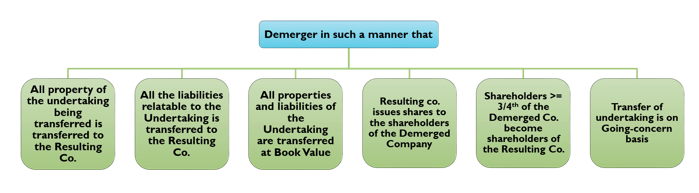
The extant provisions of section 2(19AA) of the Act defines that “demerger”, in relation to companies, means the transfer by a demerged company of its one or more undertakings to any resulting company. It further enlists certain conditions, which if fulfilled render the demerger as tax-neutral for all parties involved. It provides that an arrangement shall be termed as a “demerger” if:

Section 72A, on the other hand lays down conditions relating to carry forward and set off of accumulated loss and unabsorbed depreciation allowance in amalgamation or demerger. However, such exemption is subject to fulfilment of certain conditions, viz.

While tax neutrality and the carry forward of losses acts as a motivator of entering into such transactions, fulfilment of such conditions is not ensured in all cases. Hence, with a view to motivate PSUs to enter into such disinvestment arrangements, the Finance Bill, 2021 has introduced to bring certain relaxations to the table, discussed below-

Proposals under Budget 2021

The Union Budget, 2021 proposes the following relaxations to the PSUs-

  1. Change in the definition of demerger as provided u/s 2 (19AA) of the Income Tax Act, 1961

The Finance Bill, 2021 proposes to insert an explanation in the definition of demerger provided u/s 2 (19AA) to clarify that the reconstruction or splitting up of a PSU shall be deemed to be a demerger, if:

  • Such reconstruction or splitting up has been made to transfer an asset of the demerged company to the resultant company; and
  • the resultant company is a PSU on the appointed date[1] indicated in the scheme approved by the Government or any other body authorised under the provisions of the Companies Act, 2013 or any other Act governing such PSUs in this behalf; and
  • fulfils such other conditions as may be notified by the Central Government in the Official Gazette

As a result, PSUs shall not be required to follow the stringent conditions of section 2 (19AA), and be entitled to avail the benefit of tax-neutrality. Effective from 01.04.2021, this proposed amendment will be applicable to demergers effected on and from 01.04.2021.

  1. Proposed Amendments in section 72A of the IT Act

Amendments proposed in section 72A (1) propose to extend the benefit the extend the benefit of set off and carry forward of losses to PSUs and erstwhile PSUs. The Union Budget, 2021 proposes to-

  • Substitute clause (c) to provide that the provision of section 72(A) (1) shall also apply in case of amalgamation of one or more PSU, or companies with one or more PSUs;
  • To insert a clause (d) to provide that section 72A (1) shall also be applicable to amalgamation of an erstwhile PSU, if
  • the share purchase agreement entered into under strategic disinvestment restricted immediate amalgamation of the said public sector company;
  • the amalgamation is carried out within five year from the end of the previous year in which the restriction on amalgamation in the share purchase agreement ends
  • To insert a proviso to clause (d) to provide that in case of amalgamation involving an erstwhile PSU, allowance for unabsorbed depreciation of the amalgamated company shall not be more than the accumulated loss and unabsorbed depreciation of PSU as on the date on which the PSU ceases to be a public sector company as a result of strategic disinvestment.

Similar to amendments in section 2(19AA), These amendments will also take effect from 1st April, 2021 and will accordingly apply to the assessment year 2021-22 and subsequent assessment years.

Way Forward

It is likely that a significant number of PSUs will intend to opt for business arrangements, in view of the relaxations provided. With a view to encourage reorganisation and involvement of private-expertise,  the proposed amendments are expected to act as a catalyst to the disinvestment targets, to achieve optimal utilisation of resources.

[1] The date on which the Scheme shall be reflected in the books of the companies.

Corporate law reforms: Union Budget 2021-22

-Pammy Jaiswal and Abhishek Saraf (corplaw@vinodkothari.com)

Driving with the mantra of ease of doing business!

Introduction

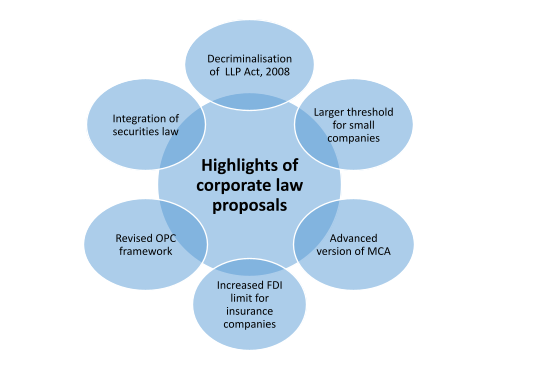
While the Union Budget for the FY 2021-2022 was focused on infrastructure development, the Hon. Finance Minister in her Budget Speech also mentioned about several significant changes in the area of corporate laws. Changes have been proposed to decriminalize the LLP Act, 2008, increase in the threshold of the definition for small companies, introduction of an updated version of the MCA, changes in the OPC framework, increase in the FDI limits in an insurance company, etc.

We have covered each one of these below for the sake of understanding the relevance of these proposals.
Decriminalization of offences under Limited Liability Act, 2008 (LLP Act)

Considering the fact that the Government has completed taking its steps for decriminalization of offences by amending the Companies Act, 2013, Finance Minister in her speech mentioned that it is now the time for decriminalization of the offences under the LLP Act. Having said that it is important to note that the Government has already started taking tangible steps for giving effect to this proposal. The Company Law Committee (CLC) has presented/issued its Report of the Company Law Committee on Decriminalization of the Limited Liability Partnership Act, 2008 to the Ministry of Corporate Affairs on 4th January, 2021 for decriminalization of certain compoundable offences and shifting them to the In-house Adjudication Mechanism. The said CLC Report is open for public recommendations till 2nd February, 2021.

The said Report proposes to decriminalize 12 offences and 1 penal provision has been proposed to be omitted. The motive behind the same is to de-clog the courts or the NCLTs thereby reducing their burden from non-serious matters. Further, the Report not only contains changes in the LLP Act for decriminalization of offences but also travels much beyond. Some of the other major changes in this regard consists of introduction of explicit provisions for issuance of secured NCDs by LLPs, restricting the merger of LLPs with companies, introduction of accounting standards for certain classes of LLPs, etc. Besides this, the Report also introduces changes in the definition of business of LLPS, alignment of the reference with that of the Companies Act, 2013 (CA, 2013) and much more.

Our detailed article on the same can be accessed from here

Revision in the definition of Small Company

Section 2(85) of the CA, 2013 defines the term ‘small company’ as any company other than public company having paid up share capital not exceeding fifty lakh rupees and turnover not exceeding two crore rupees. It has been proposed in the Budget, to revise the definition of Small Companies by increasing the thresholds for paid up share capital from “not exceeding fifty lakhs rupees” to “not exceeding two crore rupees” and turnover from “not exceeding two crore” to “not exceeding twenty crore rupees”.

Some of the relaxations to the small companies under the CA, 2013 include:
Cash Flow Statement not required to be given under the financial statements;
One board meeting in each half of calendar year is sufficient as compared to four board meetings in a financial year with a gap of not more than 120 days between two board meetings;
Abridged director’s report;
Statutory auditors are not required to report about adequacy of internal controls and their operational effectiveness.
Small Companies or any of their officer in default are subject to lesser penalties under section 446B of the CA, 2013 for non-compliance of any provisions of the CA, 2013.

The increase in thresholds will bring more than 2 lakh additional companies under the definition of ‘small company’ which can have a lower compliance burden including lower penalties for violations and lower filing requirements. Therefore, this proposal can surely be seen as an important drive for ease of doing business.

Changes in One Person Companies (OPC) regulatory framework

Currently, the CA, 2013 provides that an OPC cannot convert itself into any other kind of a company unless a period of 2 years have elapsed since the date of its incorporation. The only relaxation is that if during the said period of 2 years the threshold limits of paid-up share capital exceeds Rs. 50 lacs and the average annual turnover during the relevant period exceeds Rs. 2 crore then the conversion can take place before the expiry of 2 years.
Government has proposed to remove the monetary limit and convert itself into any other kind for the purpose of motivating the growth of OPCs which is mostly done by start-ups.
Further, for the purpose of relaxing the eligibility of persons for forming OPCs, the Government also proposes to ease the residential requirements for the person setting up an OPC from 182 days to 120 days in India. Furthermore, it has also been proposes to allow Non-Resident Indians to operate OPCs in India.

MCA21 Version 3.0

The Ministry has proposed to revamp the MCA portal by launching MCA21 Version 3.0 in the financial year 2021-22. The new version will be using data analytics, artificial intelligence and machine learning drive and will have additional modules for e-scrutiny, e-Adjudication, e-Consultation and Compliance Management.

Strengthening of NCLT framework

It has been proposed to strengthen the NCLT framework to ensure faster resolution of cases. In light of the new normal and increased emphasis on Digital India, e-Courts has been proposed to be implemented.

Further, with a similar intent and to further provide an alternate mode of debt resolution, a separate framework is also proposed for the cases involving the MSMEs.

Increased FDI in insurance companies

The main proposal for insurance companies in the Budget is to increase the permissible FDI limits such companies from the current 49% to 74%. Further, the said increased limit has been proposed with several safeguards with respect to ownership and control which includes:

majority of Directors on the Board and Key Managerial Persons (KMP) to be resident of India;
independent directors- atleast 50% of the directors to be independent directors; and
specified percentage of profits being retained as general reserve.

Further, it is also imperative to mention about the IRDA (Indian Owned and Controlled) Guidelines) which currently provides a limit of 49% of foreign shareholding in an Indian insurance company. Considering the aforesaid proposal, the said limit will be changed to reflect the increased limit. Further the said Guidelines also talks about various control safeguards by Indian promoters and provides the following modes of exercising control in an Indian insurance company:
Virtue of shareholding; (or)
Management rights; (or)
Shareholders agreements; (or)
Voting agreements; (or)
Any other manner as per the applicable laws.

Our article on FDI norms for insurance sector can be accessed from here
Our article on IRDA Guidelines on Indian owned and controlled can be viewed here

Securities Market Code

The Budget has proposed to consolidate the provisions of following laws relating to securities market into a rationalized single Code to be termed as “Securities Market Code”
SEBI Act 1992,
Depositories Act 1996,
Securities Contracts (Regulation) Act 1956, and
Government Securities Act 2007

Stamp duty proposed to be exempted on certain Govt. sale transactions

The Finance Bill has proposed to insert a new section 8G to the Indian Stamp Act, 1899 with respect to stamp duty exemption in case of strategic sale, disinvestment, etc., of an immovable property as discussed hereunder:
Transaction involving: Strategic sale or disinvestment or demerger or any other scheme of arrangement
Purpose of Transaction: Execution of any instrument for conveyance or transfer of a business or asset or right in any immovable property;
Transferor entities: Government Company, its subsidiaries, unit or joint venture
Transferee entities: Another Government Company or the Central Government or any State Government
Nature of benefit: Transaction shall be exemption from stamp duty if carried out with the approval of the Central Government.
Nature of Government companies covered: Those covered under Section 2(45) of the Companies Act, 2013.
Gap in the proposed amendment: The definition of a ‘Government Company’ under Companies Act, 2013 does not cover companies or body corporates established under a special statute such as SBI, LIC, UTI etc. These body corporates, like government companies, are public sector enterprises owned and controlled by the Government.

While the intention of the Government is to exempt stamp duty in case of exchange of assets between public sector enterprises, there still remains an anomaly whether the said exemption will be applicable in case of conveyance of property, by or to public sector enterprises that do not fall under the definition of Government Company.

Conclusion

Besides various proposals of the Union Budget for the FY 2021-2022, the corporate law proposals, as can be observed from aforesaid discussions, have been introduced to allow ease of doing business. While the changes have been proposed, the final set of changes once in place will allow witnessing the ease of doing mantra as intended by the Government.