Decoding Supreme Court ruling in Jindal Equipment Leasing Consultancy Services Ltd. v. Commissioner of Income Tax Delhi-II, New Delhi
– Sourish Kundu | corplaw@vinodkothari.com
One of the most common modes of corporate restructuring is merger, and one of the most crucial aspects in assessing the commercial viability of a proposed merger is its tax implications. Typically, in a merger, the shareholders of the transferor company are issued shares of the transferee company in order to avail the exemption under section 70(1)(f) of the IT Act, 2025 [corresponding to section 47(vii) of the IT Act, 1961]. The said provision grants exemption in case of scheme of amalgamation in respect of the transfer of a capital asset, being shares held by a shareholder in the transferor company, where (i) the transfer is made in consideration of the allotment of shares in the transferee company (other than where the shareholder itself is the transferee company) and (ii) the amalgamated company is an Indian company.
However, a recent Supreme Court ruling in the matter ofJindal Equipment Leasing Consultancy Services Ltd. v. Commissioner of Income Tax Delhi-II, New Delhi [2026 INSC 46] has opened a new avenue for debate w.r.t the taxation on receipt of shares of the transferee company in a scheme of amalgamation. In this case, the Supreme Court ruled that the exemption as provided under section 47(vii) of the IT Act, 1961 [corresponding to section 70(1)(f) of the IT Act, 2025] shall not be available to shareholders of the transferor company who are not perceived as “investors”, that is to say long term investors as opposed to traders, in the transferor company. And accordingly, any notional gain in a share swap deal pursuant to an amalgamation shall be taxed u/2 28 of the IT Act, 1961 [corresponding to section 26 of the IT Act, 2025].
In this article, we decode the nuances of the ruling, the impact it is expected to have in the sphere of merger deals and other related concerns.
Difference between capital and business assets
So far, the common understanding of consideration in case of amalgamations was that an amalgamation is merely a statutory replacement of one scrip for another, with no real “transfer” or “income” until the new shares are actually sold for cash, or in other words, mere substitution of shares in the books of the involved entities. However, the Apex Court in the instant judgement has now effectively set a different precedent for those holding shares as stock-in-trade, i.e. current investments.
The Court clarified that while Section 47(vii) provides a safe harbor for investors (treating mergers as tax-neutral corporate restructuring), this exemption does not extend to “business assets”, a.k.a. stock in trade. For a trader and investment houses, shares held in stock-in-trade represent “circulating capital”, and the objective of holding them is not capital appreciation, but conversion into money in the ordinary course of business. Therefore, replacing shares of an amalgamating company with those of an amalgamated company of a higher, ascertainable value constitutes a “commercial realisation in kind”.
The 3 pillar test for taxability
The SC applying the doctrine of real income emphasised in Commissioner of Income-Tax v. Excel Industries Ltd. and Anr. [(2013) 358 ITR 295 (SC)], established a three-pillar test, which is to be applied on a case to case basis to determine if allotment of shares pursuant to a merger triggers taxation of business income u/s 28 of the IT Act, 1961:
Cessation of the Old Asset: The original shares must be extinguished in the books of the assessee.
Definite Valuation: The new shares must have an ascertainable market value.
Present Realisability: The shareholder must be in a position to immediately dispose of the shares and realise money.
This test was further elaborated by two situations viz. allotted shares being subject to a statutory lock-in, which hinders the disposability of the asset, and allotted shares being unlisted, which cannot be said to be realisable, since no open market exists to ascribe a fair disposal value.
Additionally, the SC also held that the trigger is the date of allotment of the shares of the amalgamated entity, and neither the “appointed date” nor the “date of court sanction” or what is called as “effective date” in the general parlance, as no tradable asset exists in the shareholder’s hands until the scrips are actually issued.
Critical Concerns
While the ruling provides reasonable clarity on the treatment of shares received as a result of amalgamation, when the same is held in inventory, it leaves several operational questions unanswered, leaving a gap to determine the commercial feasibility of these deals.
Treatment of profits and losses alike
If the Revenue can tax “notional” gains arising from a higher market value at allotment, correspondingly assessees should be allowed to book notional losses, if any on such deals as well. In cases where a merger swap ratio or a market dip results in the new shares being worth less than the cost of the original holding, the taxpayer should, by the same logic, be entitled to claim a business loss u/s 28 of the IT Act, 1961, or in other words, if the substitution is a “realisation” for profit, it must be a “realisation” for loss as well.
Increase in cost of acquisition
A major concern is the potential for double taxation. If the assessee is taxed on notional gain, being the difference between the cost of acquisition of the original shares and the FMV of the shares of the transferee company on the date of allotment, such FMV should logically become the new cost of acquisition. If an assessee is taxed on the difference between the book value and the FMV at the time of allotment, but the increased cost of acquisition is not allowed, the same appreciation gets taxed twice. It is first taxed as business income at the time of allotment and again at the time of the actual sale.
Determination of the nature of shares as “stock in trade” vs “capital asset”
This issue remains prone to litigation, that is, who determines the nature of the investment, whether it is current or non-current? Will it be determined basis the books of account of the investor?
A CBDT circular lays down certain principles along with some case laws to distinguish between shares held as stock-in-trade and shares held as investments, and decide the treatment of shares held by the investing company. Further, factors such as intention of the party purchasing the shares, [discussed by Lord Reid in J. Harrison (Watford) Ltd. v. Griffiths (H.M. Inspector of Taxes); (1962) 40 TC 281 (HL)], and method of recording the investments [highlighted in CIT v. Associated Industrial Development Co (P) Ltd (AIR1972SC445)], are considered as the deciding factors for making a demarcation between treating an asset as capital asset or stock-in-trade.
As highlighted in the instant case, while the initial classification is made by the companies in the financial statements, the AO is empowered to overlook the same, and determine whether the shares were held as stock-in-trade or as capital assets, as without that determination, the taxability or eligibility for exemption u/s 47 could not be ascertained.
It should be noted that the line between a long-term strategic investment and a trading asset is often thin, and the Jindal ruling places the burden on the Revenue to prove the stock status and the “present realisability” of the shares.
Conclusion
Proving by contradiction, the Apex Court has added that: “If amalgamations involving trading stock were insulated from tax by judicial interpretation, it would open a ready avenue for tax evasion. Enterprises could create shell entities, warehouse trading stock or unrealised profits therein, and then amalgamate so as to convert them into new shares without ever subjecting the commercial gain to tax. Equally, losses could be engineered and shifted across entities to depress taxable income. Unlike genuine investors who merely restructure their holdings, traders deal with stock-in-trade as part of their profit-making apparatus; to exempt them from charge at the point of substitution would undermine the integrity of the tax base”
Discussing the concept of “transfer”, “exchange” and “realisability”, the SC has affirmed that mergers do not entail a mere replacement of shares of one company with that of another, as for persons holding the same as stock-in-trade cannot be said to be a continue their investment, instead the new shares being capable of commercial realisation gives rise to taxable business income. The Jindal Equipment ruling seems to effectively end the assumption of automatic tax neutrality for all merger participants, subject to fulfillment of applicable conditions prescribed in the IT Act. As a result, if the tax officers believe that the shareholders hold the shares as stock in trade, and could cash out the same at the next possible instance, the assessee shall be under the obligation to pay tax even without encashing any gain in actuals. Further, the tax implications in such cases shall not be at the special rates prescribed for capital gains.
https://vinodkothari.com/wp-content/uploads/2023/06/vinod-kothari-logo.png00Staffhttps://vinodkothari.com/wp-content/uploads/2023/06/vinod-kothari-logo.pngStaff2026-01-14 02:41:322026-01-14 14:31:59From Capital Assets to Stock-in-Trade: Taxing "Notional" Gains in Amalgamations
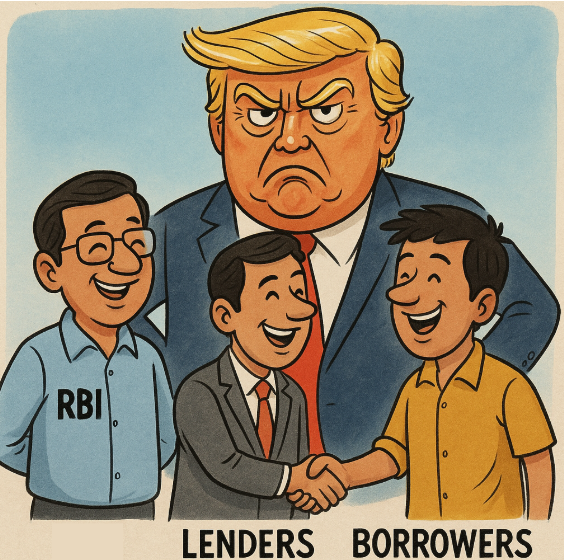
Call it Trump relief! The RBI announced relief measures on the 14th Nov to help the exporters of certain specified items, who may have availed export credit facilities from a regulated lender, whereby all regulated entities (REs) “may” provide a moratorium, from 1st September 2025 to 31st December, 2025. The grant of such a relief shall be based on a policy, consisting of the criteria for grant of the subject relief, and such criteria shall be disclosed publicly. Not only this, REs shall also make a fortnightly disclosure of the reliefs granted to eligible borrowers on a RBI format on Daksh portal.
The Reserve Bank of India (Trade Relief Measures) Directions, 2025 (‘Directions’) are applicable to NBFCs and HFCs as well. This is accompanied with amendment to Foreign Exchange Management (Export of Goods and Services) (Second Amendment) Regulations, 2025 for extension of the period for both realization/repatriation of export value (from 9 to 15 months) and the shipment of goods against advance payment (from 1 to 3 years).
Highlights:
Whether your company grants an export credit or not, if your borrower is the one who has availed export credit for export of specified goods or services, the borrower may approach you for the moratorium.
Are you bound to grant the moratorium? Answer is, no. However, basis a policy which is publicly hosted, you will consider the eligibility of the borrower. The relevant factors on which the eligibility will be examined may also form a part of the policy, and ideally, should include the extent of dependence on exports of specified items to the USA, tariff-based disruption in the cashflows, alternative markets and transitioning possibilities, etc.
Effective: Immediately.
Actionables: (a) Framing of policy to consider the eligibility of affected borrowers; (b) Hosting the policy on public website; (c) Creating mechanism for receiving and transmission of borrower requests for the moratorium and giving timely responses to the same (d) RBI fortnightly reporting.
What is the intent?
To mitigate the disruptions caused by global headwinds, and to ensure the continuity of viable businesses.
Tariff impositions by the USA are likely to impact several exporters. There may be a ripple effect on penultimate sellers or other segments of the economy as well, but the intent of the Trade Relief Directions seems limited to the direct exporters only.
Which all regulated entities are covered?
The Directions are applicable to following entities:
Commercial Banks
Primary (Urban) Co-operative Banks, State Co-operative Banks and Central Co-operative Banks
NBFCs
HFCs
All-India Financial Institutions
Credit Information Companies (only with reference to paragraph 16 of these Directions).
Does it matter whether the RE in question is giving export credit facilities or not? In our view, it does not matter. The intent of the Directions is to mitigate the impact of trade disruptions. Of course, the borrower in question must be an exporter, must have an export credit facility outstanding as on 31st Aug 2025, and the same must be standard.
If these conditions are met, then the RE which holds the export credit, as also other REs (of course, the nexus between the trade disruption and the servicing of the credit facility will have to be seen) should consider the borrower for the purpose of grant of relief.
Relief may or may not be granted.
Policy on granting relief
The consideration of the grant of relief will be based on a policy.
Below are some of the brief pointers to be incorporated in the policy:
Purpose and Scope: define which loan products, sectors, or borrower categories are covered; effective period for granting relief
Eligibility Criteria for borrowers
Assessment criteria for relief requests received from the borrowers
Authority responsible for approving such request
Relief measures that can be offered to borrowers
Impact on asset classification and provisioning
Disclosure Requirements
Monitoring and Review: Authority which is responsible for monitoring such accounts; periodicity of review
How is the assessment of eligible borrowers to be done?
In our view, the relevant information to be obtained from the candidates should be:
Total export over a relevant period in the past, say 3 years
Break up of export of “impacted items” and other item
Of the above, exports to the USA
Gross profit margin
Impact on the cashflows
Information about cancellation of export orders from US importers
Any damages or other payments receivable from such importers
Any damages or other payments to be made to the penultimate suppliers
Alternative business strategies – repositioning of markets, alternative buyer base, etc
Cashflow forecasts, and how the borrower proposes to pay after the Moratorium Period.
What sort of lending facilities are covered?
Please note the following from the preamble: “mitigating the burden of debt servicing brought about by trade disruptions caused by global headwinds and to ensure the continuity of viable businesses”. Therefore, clearly, the relief intended here is one where “trade disruptions” create such a burden on debt servicing, which may impact the viability of the business.
From this, it implies that the entity in question must be a business entity, and the loan in question should be a business loan.
In our thinking, the following facilities seem covered:
Export credits of all forms, including packing credit, funded as well as unfunded, letters of credit, etc.
Buyer’s credit or facilities for inward acquisitions/purchases by an exporter
Cash credits, overdrafts or working capital related facilities, intended for export business of impacted items.
Term loans relating to an impacted business
Loans against property, where the end use is working capital
Eligible and ineligible borrowers:
Eligible borrowers:
Borrowers who have availed credit for export
Borrower had an outstanding export credit facility from a RE as of August 31, 2025 (However, in case the borrower has a sanctioned facility pending disbursement as on Aug 31, the same shall not be eligible)
Borrower with all REs was/were classified as ‘Standard’ as on August 31, 2025
In our view, the following borrowers/ credit facilities are not eligible for the relief:
Individuals or borrowers who have not borrowed for business purposes
Home loans or loans against specific assets or cashflows, where the debt servicing is unconnected with the cash flows from an export business
Loans against securities or against any other financial assets
Gold loans, other than those acquired for business purposes
Car loans, loans against commercial vehicles or construction equipment, unless the borrower is engaged in export business and the cashflows have a nexus with such business
Borrower is engaged in exports relating to any of the sectors specified
Borrower accounts which were restructured before August 31, 2025
Accounts which are classified as NPA as on August 31, 2025
Consider a borrower who is not an exporter himself, but an ancillary supplier, supplying to a trading house. Will such a penultimate exporter be covered by the Relief Directions? In our view, the answer is negative, as the “eligible borrowers” are defined to mean an exporter.
Impacted items and impacted markets
The list of impacted items broadly covers a wide spectrum of manufacturing and export-oriented sectors, including marine products, chemicals, plastics, rubber, leather goods, textiles and apparel, footwear, stone and mineral-based articles, jewellery and precious metals, metal products, machinery, electrical and electronic equipment, automobiles and auto components, medical and precision instruments, and furniture and furnishing items.
Is it mandatory that the borrower shall be exporting to USA? While the Directions do not specifically mandate that the borrower shall be exporting to the USA, the concerned REs should, as part of their assessment, evaluate whether the borrower genuinely requires such relief measures and, in our view, should consider the extent to which the borrower depends on exports of the specified items to the USA.
Why have HFCs been covered?
Generally speaking, the servicing of home loans is not supposed to be based on business cashflows, and therefore, the impact of trade disruptions on servicing of a home loan does not seem easy to establish.
However, HFCs grant other credit facilities too, including LAP or business loans. Therefore, there is no carve out for HFCs as such. HFCs are also expected to prepare the policy referred to above and be sensitive to requests from impacted borrowers.
Is the moratorium retrospective?
Yes, clearly, the moratorium is retrospective, as it covers the period from 1st September to 31st December. This is the range over which the moratorium may be granted; of course, the decision as to how much moratorium, within the above maximum range, is warranted in the particular case, is that of the lender. Let us call the agreed moratorium as the Moratorium Period.
If the moratorium is granted from 1st Sept., then any payments which were due for the period covered by the Moratorium Period will not be taken as having fallen due. This will have significant impact on the loan management systems:
Considering that we are already in the middle of November, the day count for any payments due during the part of the Moratorium Period will be set to zero. In other words, day count will stop during the Moratorium Period. Thus, if an account was showing a DPD status of 60 days as on Aug 31, 2025, the DPD count will remain at a standstill till the moratorium period is over.
However, in case a borrower has made payment during the moratorium period, will the DPD count decrease or will it remain the same?
The RBI Directions state that the days past due (DPD) count during the moratorium period will be excluded. However, this does not imply that a borrower who makes payments during this period should be denied the corresponding benefit. In our view, if a payment is received from the borrower, the DPD count should accordingly be reduced.
Any payments already made during the part of the Moratorium Period already elapsed may be taken towards principal, or may be held to be adjusted against the future dues of the borrower, after the Moratorium Period. This should also, appropriately, be captured in the policy.
Further, for accounts for which the CIC reporting has already been done on or after Aug 31, 2025, and the lender decides to extend the moratorium benefit, it must be ensured that the DPD count is revised so as to reflect the status as on Aug 31, 2025.
Do lenders have to necessarily grant moratorium, or grant partial interest/principal relief?
The RBI Directions do not mandate REs from granting such relief measures. Accordingly, the concerned RE will need to assess individual cases based on the sectors, the need for such relief and the extent to which such relief may be granted.
Lenders may grant full moratorium during the Moratorium Period, or may grant relief as may be considered appropriate.
Do lenders take positive actions, or simply respond to borrower requests?
The lenders must establish a policy for granting such relief measures prior to extending any relief, as the authority to do so will be derived from this policy. As discussed above, the discretion to grant relief rests with the concerned RE; therefore, each request submitted by a borrower must be evaluated on an individual basis.
For this purpose, the following information must be obtained from the borrowers seeking relief:
The concerned sector and how the same has been impacted necessitating such relief
Information relating to the current financial condition of the business of the borrower
Facilities taken and outstanding with other REs
Non-compounding of interest during the Moratorium Period:
Para 9 (iii) provides that while interest will accrue during the Moratorium Period, but the interest shall be simple, that is, shall not be compounded.
This may require REs to tweak their loan management systems to stop the compounding of interest during the Moratorium Period.
However, the actual population of affected borrowers for a particular RE may be quite limited. Hence, REs may do manual or spreadsheet-based adjustments for affected borrowers, instead of making adjustments to their LMS itself.
Recomputation of facility cashflows after Moratorium:
During the moratorium period, as per the RBI directive, the lender can only accrue simple interest. Accordingly, the IRR of the credit facility will have a negative impact unlike the covid moratorium where the compound interest loss was compensated by the central government.
Further, it has also been provided that the accrued interest may be converted into a new term loan which shall however be repayable in one or more installments after March 31, 2026, but not later than September 30, 2026. Accordingly, the accrued interest should anyhow be received by September 30, 2026.
Similar moratoriums in the past
Moratorium on loans due to COVID-19 disruption: Refer to our write-up here.
Moratorium 2.0 on term loans and working capital: Refer to our write-up here.
https://vinodkothari.com/wp-content/uploads/2023/06/vinod-kothari-logo.png00Staffhttps://vinodkothari.com/wp-content/uploads/2023/06/vinod-kothari-logo.pngStaff2025-11-15 11:57:082025-11-15 13:49:41RBI Trade Relief Directions: How is your company impacted?
The identity of a corporate entity may undergo various changes, either pursuant to merger, demerger, sale of one or more divisions or undertakings, conversion into LLP etc. Usually, in corporate restructuring, the assets and liabilities forming part of an undertaking are shifted to another undertaking, say, the successor entity. Generally, these kind of transactions are covered under the ambit of Related Party Transactions (“RPTs”) under the provisions of Companies Act, 2013 (“Act”) and SEBI Listing Regulations given that the restructuring involves related party(s) and RPTs have always been an evergreen and ever-evolving aspect of corporate functioning that has been put to guardrails by the law makers by involving specific disclosures and approvals.
However, MCA vide its General Circular No, 3O/2O14 dated July 17, 2014has provideda relaxation to unlisted companies from the applicability of section 188 of the Act for the transactions arising out of corporate restructuring since the same are being dealt under the specific provisions of the Act. On the other hand, for listed companies Regulation 23 of Listing Regulations requires seeking prior approval of Audit Committee/Shareholders, as applicable, for RPTs and no relaxations have been granted by SEBI to listed companies in this specific regard. This gives rise to doubt whether a transaction under a scheme of corporate restructuring will qualify as an RPT or not.
Accordingly, in the present write-up, the following issues have been dealt with:
Identification of a transaction under a corporate restructuring as an RPT;
Rationale for segregation of an RPT from a scheme; and
Process for approval and disclosure of RPTs arising out of corporate restructuring.
Identification of a Transaction
Definition of RPT is not the subject matter of this write-up as the same has been dealt with by us in several of our write-ups along with FAQs which can be accessed athttps://vinodkothari.com/article-corner-on-related-party-transactions/. Instead of diving into the details, let’s simply understand that any transaction involving a transfer of resources, services or obligations between parties falling under the following matrix will be considered as an RPT.
A and B Limited (‘B’) are related parties with A holding a 51% stake in B’s share capital;
B holds a 20% stake in C Limited (‘C’); and
A holds 0.33% in C.
A scheme of arrangement has been proposed between these companies, under which an undertaking of Company A will be transferred to Company C. As consideration for this transfer, shares of Company C will be issued to the shareholders of Company A.
This arrangement involves two distinct transactions:
Transfer of Undertaking: The first transaction involves the transfer of an undertaking (a bundle of assets and its related liabilities) from Company A to Company C, in exchange for shares of Company C. This constitutes a “transfer of resources” as defined under Regulation 2(zc) of the SEBI (Listing Obligations and Disclosure Requirements) Regulations, 2015, and therefore qualifies as an RPT.
Issuance of Shares and Dilution of Shareholding: A key aspect of the scheme is the issuance of shares by Company C to the shareholders of Company A. As a result of this issuance, the shareholding of Company B in Company C will be diluted, falling below the 20% threshold.
This raises a question: Does such dilution constitute an RPT?
For a transaction to be classified as a related party transaction, there must be a transfer of resources, services, or obligations between related parties. In this case, while Company B and Company C are related parties, there is no actual transfer of resources, services, or obligations between them as part of this transaction. The dilution of shareholding occurs as a consequence of the share issuance, not due to a direct transaction between B and C.
Conclusion:
Therefore, while the transfer of the undertaking qualifies as an RPT, the dilution of Company B’s shareholding in Company C does not constitute a related party transaction and hence does not require separate approval under the SEBI Listing Regulations.
Transfer of an undertaking under a scheme of demerger
A Limited (“A”), a diversified conglomerate with operations across multiple sectors, owns B Limited (“B”), its wholly owned subsidiary engaged in automobile manufacturing. Recently, B expanded into the electric vehicle (EV) segment. Following a strategic review, B has decided to demerge its EV business from its core automobile operations.
As part of this restructuring, the EV undertaking will be transferred to C Limited (“C”), a newly incorporated, wholly owned subsidiary of A. Post-demerger, C will become the Resultant Company, focusing exclusively on the EV business.
RPT Implication
The transfer of the EV business from B to C constitutes a transaction between two wholly -owned subsidiaries of the same listed entity (A) and hence, there cannot be said to be any effective transfer of resources so as to be considered as an RPT.
However, since company C will be incorporated after the approval of the scheme by the shareholders a question may arise as to when the approval needs to be placed between the shareholders for RPT. Since, a pre approval of RPT is mandatory the approval has to be taken beforehand from the shareholders
Exemption from Approval
Since both B and C are wholly owned subsidiaries of A, there is no effective change in ownership or effective transfer of resources. Accordingly, this transaction falls under the exemption provided in Regulation 23(5) of the SEBI Listing Regulations, which exempts RPTs between wholly owned subsidiaries of a listed entity from the approval requirements.
Conclusion
While the transfer qualifies as an RPT under the SEBI Listing Regulations, it is exempt from the approval process due to the continued ownership within the same shareholders thereby resulting in no change of resources. This allows the company to realign its structure without involving regulatory hindrances. Also refer to our write up on RPTs: Wholly-owned but not wholly-exemptto understand the application of RPT Controls for transactions with Wholly Owned Subsidiary.
Scheme of arrangement involving Creditors
A Limited (‘A’) is a Listed Company;
A Limited (‘A’) and B Limited (‘B’) are related parties with A holding a 51% stake in B’s share capital;
B holds 20% stake in C Limited (‘C’); and
A holds 0.33% in C.
C is facing a severe liquidity crunch and thereby, C is unable to service/ settle the o/s debt obligations. As a result, a scheme of arrangement has been proposed in which an undertaking of C will be transferred to B. Further, the consideration for the present arrangement as is required to be disbursed by B shall be used for servicing the remaining creditors of C (i.e., the creditors belonging to the remaining undertaking of C)
This arrangement involves two distinct transactions:
Transfer of Undertaking: The first transaction involves the transfer of an undertaking from Company C to Company B, in exchange for shares of Company B used to discharge its liability. This constitutes a “transfer of resources” as defined under Regulation 2(zc) of the SEBI (Listing Obligations and Disclosure Requirements) Regulations, 2015, and therefore qualifies as a RPT.
Issuance of Shares to creditors: A key aspect of the scheme is the issuance of shares by Company B to the creditors of Company C against their outstanding loans to C. The transaction is between two unrelated parties, However, one may argue that the purpose and effect of this is to benefit C (by way of reducing its outstanding debt obligations) which is a related party of B and from A’s perspective this will be a transaction between a subsidiary (B) and a person, the purpose of which is to benefit a related party of the subsidiary (C).
There will be two kinds of creditors in the above scenario:
Creditors pertaining to the demerged undertaking: After the transfer of undertaking to company B all the liabilities pertaining to the undertaking will also be transferred, as a result, the creditors of company C will become creditors of company B, thereby removing the doubts of C being benefited by this transaction.
Other Creditors: At the time of receiving the consideration, these creditors will still be creditors of company C, thereby benefiting C by reducing its outstanding debt obligations and accordingly will constitute an RPT. However, separate approval can be avoided and clubbed alongside approval sought under point 1 above.
Dilution of director’s shareholding under a Scheme
A Limited (‘A’) is a listed company;
A and B Limited (‘B’) are related parties with B being a WOS of A;
Mr. X (Independent Director of B) holds a 2% stake in C Limited (‘C’); and
A and C have entered into a scheme of arrangement whereby an undertaking of C is transferred to A.
The transaction between A and C will qualify as an RPT because:
The first party to the transaction is the listed company itself (A), and
The second party (C) qualifies as a related party of the subsidiary (B) in terms of Section 2(76)(v) of the Companies Act, 2013.
With respect to the dilution of Mr. X’s shareholding in C, as a result of the scheme, it is clarified that this will not pose any concern, as already discussed earlier in this article.
Transfer of undertaking under a scheme of amalgamation
A and B are peer entities, with A being backed by foreign promoters who wish to divest one of their business verticals. Scheme of amalgamation has been proposed for both entities to merge their operations, with the business being run through a newly incorporated entity i.e. C. All of A’s resources related to this vertical will be transferred to C and both A and B will become shareholders in the newly formed company with A holding 40% and B holding 60%. B will be dissolved as a result of this scheme.
In the above scenario, C will be an associate company of A and accordingly will be considered as a related party of A. However, if we take a broader view this transaction is between A and B with both being an unrelated party. This scheme will definitely affect the shareholders of A and approval of shareholders for the scheme will be a prerequisite for this transaction. However, from the RPT angle this does not seem to fundamentally affect the shareholders as the transaction is between two unrelated parties.
Despite the above facts, this transaction will be governed by the provisions of regulation 23 and will have to follow a separate approval process, independent of the scheme approval, as this falls under the RPT matrix. Alternatively this transaction would not have been required to take a separate approval if the transfer of undertaking was between A and B removing C from the scenario.
Transfer of undertaking in a Scheme of Merger
A Limited and B Limited are related parties, with B forming part of the promoter group of A. A Limited operates in the Agriculture sector, while B Limited is primarily engaged in marketing and logistics services, assisting A in distributing and promoting its agricultural outputs globally. A proposal has been placed to merge the operations of B into A.
Since the transfer of resources occurs between A and B, which are related parties, the transaction qualifies as an RPT as there is transfer of resources of B into A.
Decoding the underline basis for considering the RPT angle in scheme of arrangements
The first checkpoint for a transaction to be categorised as an RPT is transfer of resources, services and obligations with the involvement of a related party either at the level of the listed entity or of its subsidiary. Further, the following takeaways can be understood from the casses discussed above:
A scheme of arrangement can involve transactions that qualify as RPTs for one or more parties directly participating in the scheme.
Even if a listed company is not a direct party to the scheme, it may still be subject to RPT regulations if its subsidiary is a party to the scheme and is transacting with a related party of the listed entity or its subsidiary.
Under a scheme of Corporate Restructuring resources are generally transferred from the transferror company to the transferee company. For instance, in a scheme of merger, both assets and liabilities, which qualify as “resources” and “obligations” respectively, are transferred from one entity to another, typically in exchange for shares of the transferee company and/or for a cash consideration.
It is important to carefully consider the meaning of “transfer” in the context of a scheme of arrangement. The concept should not be limited to the movement of assets and liabilities between two separate legal entities but also the receipt of consideration which results in a change in shareholding or even control.
In a scheme involving two WOS of a listed company, there may be a transfer of resources from one WOS to another. However, since both entities are ultimately owned by the same parent, there is no real change in the ownership or even an effective transfer of resources. Hence, these cases remain outside the purview of an RPT.
In the case of a transfer of an asset by a subsidiary, which is not a WOS, in which the listed entity holds a 51% stake to an associate company in which the listed entity holds only a 20% stake, the transaction results in a change in partial ownership of the asset outside the listed entity’s structure. Although the transfer may occur between two investee entities of the listed company, it effectively leads to divestment of a portion of economic interest. Hence, results in a transfer of resources. Therefore it is suggested that the RPT implications must be independently evaluated for each party, including listed entities with indirect exposure through subsidiaries.
Once a transaction is identified as a RPT the primary concern that arises is whether it has been undertaken on an arm’s length basis. A natural question that follows is whether the fair valuation requirement under Section 230(2) of the Companies Act, 2013 is sufficient to satisfy this test. While the section mandates the submission of a valuation report covering all properties, assets, and shares involved in a scheme, it is important to note that a scheme of arrangement is structurally distinct from a plain bilateral transaction. A scheme often involves strategic, composite, or long-term considerations that may justify deviations from pure fair value. Therefore, the assessment of arm’s length nature, both in terms of properties transferred and the consideration offered, must be undertaken in the context of the terms and conditions of the scheme as a whole, rather than simply putting the share exchange ratio for approval under the RPT agenda.
One of the major reasons for evaluation of a scheme from RPT perspective is its separate approval. This ensures that the scheme is not used as a turnaround for an RPT approval which would not have been approved, had it been proposed outside the framework of scheme. Following are two key reasons supporting the requirement of separate shareholders approval for a RPT:
Exclusion of Related Parties from Voting:
The law prohibits related parties from voting on RPTs. If we assume that approval of the overall scheme automatically includes approval of the RPT, it would allow related parties to influence the vote—undermining the very purpose of this restriction.
2. Exclusion of Related Parties from Voting:
The minimum information required to be presented to shareholders for approving an RPT may not be adequately disclosed if the approval process is merged with that of the scheme. This compromises transparency and does not ensure that shareholders are fully informed about the transaction.
Approval of transactions qualified as RPT
SEBI vide its master circular no. SEBI/HO/CFD/POD-2/P/CIR/2023/93 dated June 20, 2023has specified the requirements that listed companies have to comply before submission of any scheme of arrangement to NCLT for its approval. However, an issue which goes unanswered in the aforesaid circular is whether a separate approval of Audit Committee/Shareholder is required for an RPT arising out of a scheme or will the approval of a scheme from the shareholders which includes a RPT will suffice and be considered as a due compliance of Regulation 23 of SEBI Listing Regulations.
This matter was placed before SEBI for Discussionin its Board meeting dated September 28, 2021, However, no decision has been notified yet.
For listed companies, the following are two key reasons supporting the requirement of separate shareholders approval for a RPT:
Exclusion of Related Parties from Voting:
The law prohibits related parties from voting on RPTs. If we assume that approval of the overall scheme automatically includes approval of the RPT, it would allow related parties to influence the vote—undermining the very purpose of this restriction.
Disclosure Requirements:
The minimum information required to be presented to shareholders for approving an RPT may not be adequately disclosed if the approval process is merged with that of the scheme. This compromises transparency and does not ensure that shareholders are fully informed about the transaction.
The position of unlisted companies is clear in this regard as the Ministry has already issued a clarification, However, SEBI has not provided any relaxations of similar nature to the listed entities. Therefore, it can be said that RPTs under a scheme of arrangement will require a separate approval of the Audit Committee or/and shareholders, as applicable, independent from the approval of the scheme by the shareholders.
Audit Committee: Under the provisions of Regulation 23 of the SEBI Listing Regulations and the relevant sections of the Companies Act, the Audit Committee must approve any transaction involving related parties before it is executed. This ensures transparency and compliance with regulatory requirements.
It is important to note that even if a transaction is not directly entered into by the listed entity but occurs as part of a corporate restructuring scheme involving a subsidiary and it’s the subsidiary who is entering into a transaction with any related party, the prior approval of the listed entity’s Audit Committee is still required. Specifically, if the transaction exceeds the threshold limits defined in Regulation 23(2) of the SEBI Listing Regulations, the Audit Committee’s approval must be obtained before proceeding.
The approval of the committee in case a transaction is not material may be taken in the same meeting which is held for consideration of the scheme before it is submitted to the stock exchanges.
Shareholders’ Approval: In case the transaction under a scheme of arrangement reaches the materiality threshold of Regulation 23 of Listing Regulations, the same will have to be approved by the shareholders of the Company before submission of scheme to NCLT.
A pertinent point to note is that in this case the company has to seek shareholders approval two times, one before submission of scheme to NCLT for RPT and the other for the Scheme at the meeting called by NCLT.
Conclusion
In schemes involving corporate restructuring, especially when related parties are involved, the primary legal considerations are fairness, transparency, and ensuring that the rights of minority shareholders and creditors are not prejudiced. It is crucial for the entities to provide independent fairness opinions, detailed disclosures, and valuations.
[1]A being a listed company all the RPTs have to be identified from A’s perspective
https://vinodkothari.com/wp-content/uploads/2023/06/vinod-kothari-logo.png00Staffhttps://vinodkothari.com/wp-content/uploads/2023/06/vinod-kothari-logo.pngStaff2025-06-03 19:58:202025-08-01 00:49:34Dissecting RPT controls in a corporate restructuring
The provisions related to the carry forward and set-off of business losses in the context of corporate restructuring have been a critical aspect of corporate taxation. The Budget 2025[1] proposes certain amendments concerning carry forward of losses in cases of amalgamation, pursuant to which mergers shall not be used for evergreening of losses. That is to say, the benefit of carry forward shall be limited to eight years from the onset of losses, and not eight years from the merger.
https://vinodkothari.com/wp-content/uploads/2023/06/vinod-kothari-logo.png00Staffhttps://vinodkothari.com/wp-content/uploads/2023/06/vinod-kothari-logo.pngStaff2025-02-01 17:12:122025-02-01 17:39:04Budget 2025: Mergers not to be used for evergreening of losses
https://vinodkothari.com/wp-content/uploads/2023/06/vinod-kothari-logo.png00Staffhttps://vinodkothari.com/wp-content/uploads/2023/06/vinod-kothari-logo.pngStaff2024-09-12 19:33:192024-09-21 10:22:15MCA enabled fast track route for cross border mergers and added additional requirements in IEPF Rules
From a little-known word and a preserve of a select few finance professionals, the term Special Purpose Acquisition Companies (SPACs) is today a buzzword. The regulators across the globe are taking necessary actions to enable SPACs to raise money from investors – jurisdictions like the US, UK and Malaysia lead from the front. Having a sound regulatory framework is important because if investors are keen towards SPACs, and the regulators do not enable it, it is quite likely that the country will not be a friendly destination for SPACs. Hence, India’s securities regulator SEBI has recently constituted an Expert Group for examining the feasibility of SPACs in India, and the International Financial Services Center Authority (IFSCA) has issued IFSCA (Issuance and Listing of Securities) Regulations, 2021[1] which provides a regulatory framework for listing of SPACs within its jurisdiction.
In this write up, the authors take a look at the global legislative measures, and also outline the various changes in the regulations that may be needed in India to enable to make India a SPAC-friendly jurisdiction.
https://vinodkothari.com/wp-content/uploads/2023/06/vinod-kothari-logo.png00Staffhttps://vinodkothari.com/wp-content/uploads/2023/06/vinod-kothari-logo.pngStaff2021-08-18 12:53:312021-08-18 12:59:15Creating regulatory eco-system for SPACs in India
The concept of Special Purpose Acquisition Companies (‘SPACs’) has gained significant attention and importance in India in recent times – from a subject preserved to select classes, the surge in transactions over 2020, has made it pave its way to every investor’s dictionary. And with all the spotlight that SPACs have attracted, the numbers seem to only lend to the hype. To begin with, the global SPAC IPO proceeds in 2020 alone is estimated to be $83 billion USD[1] with a total of 251 listings. This figure is further projected to grow to a massive 711 listings in 2021 with an average IPO size of USD 294.5 Million as on 15th August, 2021[2].
Globally, SPACs have become the investment vehicle of choice, more-so by startups looking for funding; and the US has been the flag bearer of the SPAC industry, leading from the front. Following shortly behind are economies like UK, Malaysia and Canada; and while India is playing catch-up, it seems to be speeding up quick enough, at least on the regulatory front.
For the uninitiated, a SPAC, often referred to as a Blank-check Company or a Shell Company, is a non-operating company with the admitted intent (read: special purpose) of acquiring of a potential target within a stipulated timeline[3].
In this article, while dealing with the basic regulatory framework via-a-vis SPACs, the author seeks to analyse the motivation(s) behind such transactions from all perspectives – the acquirer’s, the acquiree’s and the investors’.





 Reload document
  Open in new tab