The format of the “return on deposits” and on “exempted deposits”, that is, form DPT-3 has been amended pursuant to the notification of the Companies (Acceptance of Deposit) Amendment Rules, 2022 (“Amendment Rules”) on 29th August, 2022. While the same has been made applicable immediately, the revised format will be actually relevant for the filing of form DPT-3 for FY 2022-23, since the due date for filing DPT-3 for FY 2021-22 has already expired on 30th June, 2022. It is interesting to note that while most of the changes pertain to the “return of deposits”, the same does not have any practical significance in India. However, there is specifically one addition w.r.t. the money received by a company, but not considered as deposit, i.e., exempted deposits.
The Energy Conservation (Amendment) Bill, 2022 (“Bill”) seeks to provide a regulatory framework for carbon markets in India. The Bill was passed in the Lok Sabha on 8th August, 2022, and has been passed in the Rajya Sabha on 12th December, 2022. The President’s asset is all that is required to bring the carbon markets within the statutory framework of India. However, there is still a long way to go before carbon markets are implemented in India, which will require notification of the procedures and rules governing the same. Further, the carbon markets in other countries are still developing in a phased manner, identifying the gaps in the existing system and modifying accordingly. India cannot be an exception to the same. However, the concept of “carbon credits” is not unknown to India since there are several entities in the country which are already generating tons of carbon credits. This article seeks to delve upon the legal aspects of carbon credits markets around the world, the consequences of not exporting the same, and the tax implications upon sale of the generated credits. As we study the existing carbon markets around the world, some learnings from these markets may be taken into consideration for the developing carbon market in India.
https://vinodkothari.com/wp-content/uploads/2023/06/vinod-kothari-logo.png00Payal Agarwalhttps://vinodkothari.com/wp-content/uploads/2023/06/vinod-kothari-logo.pngPayal Agarwal2022-08-31 18:06:512023-01-13 15:08:44Emission law amendments: Laying the framework for Carbon trading market in India
https://vinodkothari.com/wp-content/uploads/2023/06/vinod-kothari-logo.png00Staffhttps://vinodkothari.com/wp-content/uploads/2023/06/vinod-kothari-logo.pngStaff2022-08-31 15:21:392022-09-07 15:53:09Discussion on the new regime on Overseas Investment
It is quite common for entities to have subsidiaries in India and outside India in order to undertake business activities. The norms for incorporating a subsidiary in India is mainly governed by provisions of Companies Act, 2013 (‘CA, 2013’) and also the FDI norms for investment in the non-debt instruments, where the investment is being made by a person resident outside India. Similarly, the norms for incorporating a subsidiary outside India is mainly governed by provisions of CA, 2013 and also ODI norms for investment in the non-debt instruments. Additionally, there is a concept of restriction on layers of subsidiaries, prescribed under CA, 2013 and also under the new regime, which has raised cause of concern as well as confusion among India Inc., which is intended to be addressed by the author in this article.
RBI, effective from August 22, 2022 notified norms on Overseas Investment (‘OI’) in the form of OI Rules, OI Regulations and OI Directions. Read our article on the overview of the OI norms here. Our presentation can be accessed here.
https://vinodkothari.com/wp-content/uploads/2023/06/vinod-kothari-logo.png00Vinita Nair Dedhiahttps://vinodkothari.com/wp-content/uploads/2023/06/vinod-kothari-logo.pngVinita Nair Dedhia2022-08-29 15:19:022022-09-23 11:39:50Lost in Layers: lower threshold for subsidiaries under ODI norms raises concern
Investments by Indian entities outside India is a very common phenomenon and several companies have presence outside India by virtue of forming a Joint Venture (‘JV’) and Wholly Owned Subsidiaries (‘WOS’). While the intent is to permit investment overseas, however, with reasonable fetters to ensure that money is not siphoned outside India. Hence, the prescribed limits along with approval and reporting requirements.
With the enforcement of amendment proposed in Finance Act, 2015 in October, 2019[1] powers vested with Central Government (CG) and Reserve Bank of India (RBI) with respect to permissible Capital Account Transaction were revisited. Power to frame rules relating to Non-Debt instruments (‘NDI’) were vested with CG and to frame regulations relating to debt instruments were vested with RBI. The scope of NDI inter alia covers all investment in equity instruments in incorporated entities: public, private, listed and unlisted; acquisition, sale or dealing directly in immoveable property.
Maintenance of Structured Digital Database (“SDD”) has been mandatory since April 1, 2019 in view of the relevant provisions under the SEBI (Prohibition of Insider Trading) Regulations, 2015 (‘PIT Regulations’) reproduced below. The provisions inter-alia stipulates the responsibility, the details to be captured in the SDD, manner of maintenance and the preservation period. The entities have been maintaining for the last 3 years, however, since quarter ending June 30, 2022 the entities are additionally required to submit a compliance certificate, based on the email received from the stock exchanges where its securities are listed, duly certified by the Compliance Officer. We have been given to understand that this submission will be mandated on a quarterly basis and the same will henceforth required to be submitted duly certified by a practising company secretary. As on date, no SEBI circular or Exchange circular has been issued in this regard.
The last date for submission for the immediately preceding quarter was August 9, 2022. Based on the client queries received in this regard, format of the compliance certificate provided by the stock exchange and the views from the representatives of SEBI and stock exchanges as expressed in seminars from time to time, we intend to highlight certain points of concerns for your kind consideration.
Relevant provisions of Law:
Reg. 3 (5) and (6) of PIT Regulations:-
(5) The board of directors or head(s) of the organisation of every person required to handle unpublished price sensitive information shall ensure that a structured digital database is maintained containing the nature of unpublished price sensitive information and the names of such persons who have shared the information and also the names of such persons with whom information is shared under this regulation along with the Permanent Account Number or any other identifier authorized by law where Permanent Account Number is not available. Such database shall not be outsourced and shall be maintained internally with adequate internal controls and checks such as time stamping and audit trails to ensure non-tampering of the database.
(6) The board of directors or head(s) of the organisation of every person required to handle unpublished price sensitive information shall ensure that the structured digital database is preserved for a period of not less than eight years after completion of the relevant transactions and in the event of receipt of any information from the Board regarding any investigation or enforcement proceedings, the relevant information in the structured digital database shall be preserved till the completion of such proceedings.
https://vinodkothari.com/wp-content/uploads/2023/06/vinod-kothari-logo.png00Team Corplawhttps://vinodkothari.com/wp-content/uploads/2023/06/vinod-kothari-logo.pngTeam Corplaw2022-08-22 19:21:462022-09-23 11:55:40Structured Digital Database: some emerging concerns
‘Corporate governance’ (‘CG’) is difficult to define but easy to describe. It is understood by the principles and practices that are comprised in it, under regulations, standards and best practices. Corporate governance continues to evolve, for reasons not difficult to understand. First, companies, over time, have become immensely powerful in an ever-integrated and networked economy. Two, experience with operation of companies over time have given precedents of misuse of managerial power, conflicts of interest, opacity in reporting, lack of balance in meeting diverse stakeholder needs, and lately, ESG concerns. Every major corporate scandal leads to a fresh thinking on corporate governance principles, which is quite understandable for an adaptive process. The key objectives of corporate governance are accountability, transparency, objectivity, responsibility, etc. Globally, the concept of CG has been explained widely, just as under the OECD Principles on Corporate Governance[1] explains it to be ‘a set of relationships between a company’s management, its board, its shareholders and other stakeholders. Corporate governance also provides the structure through which the objectives of the company are set, and the means of attaining those objectives and monitoring performance are determined.’ Further, the UK Corporate Governance Code 2018[2] also refers to the definition coined by the Cadbury Committee which defined the aforesaid term to mean ‘the system by which companies are directed and controlled. Boards of directors are responsible for the governance of their companies. The shareholders’ role in governance is to appoint the directors and the auditors and to satisfy themselves that an appropriate governance structure is in place.’
https://vinodkothari.com/wp-content/uploads/2023/06/vinod-kothari-logo.png00Pammy Jaiswalhttps://vinodkothari.com/wp-content/uploads/2023/06/vinod-kothari-logo.pngPammy Jaiswal2022-08-11 11:07:412024-07-10 13:43:00Governance by technology: The future of corporate governance
The Energy Conservation (Amendment) Bill, 2022 (the “Bill”) has been passed by both houses of the Parliament (Lok Sabha: 8th August, 2022 and Rajya Sabha: 12th December, 2022), proposing amendments to the Energy Conservation Act, 2001 (“the Act”). The Bill seeks to bring the mandatory carbon credit markets in India. The Bill provides a legislative inclusion to the formulation of a carbon credit trading scheme [clause (w) of Section 14 of the Energy Conservation Act, 2001] . The scheme will be launched by the Central Government and the contours of the scheme will be known only when the scheme is announced. However, it is clear that with the passing of this Bill, the country is all set to launch carbon credit markets in India.
https://vinodkothari.com/wp-content/uploads/2023/06/vinod-kothari-logo.png00Payal Agarwalhttps://vinodkothari.com/wp-content/uploads/2023/06/vinod-kothari-logo.pngPayal Agarwal2022-08-10 23:07:232023-01-13 15:09:51Emission law amendments to trigger carbon credit trading in India
SEBI (Prohibition of Insider Trading) Regulations, 2015 (‘PIT Regulations’) inter-alia prohibits trading by a Designated Person (‘DP’) when the trading window is closed. Despite the express prohibition, there are instances of deliberate or inadvertent trades by the DPs that results in violation of the Code of Conduct to regulate, monitor and report trading by its DPs and immediate relatives of DPs followed by disciplinary action by the listed entity, reporting of violation to the Stock Exchange (‘SE’) and followed with SEBI proceeding against the DP for the violation. This causes reputational loss for the listed entity as well as the DP and loss of investor confidence on the internal controls and systems prevalent in the listed entity. There is also a practice followed by certain financial sector entities where the demat account of DPs are opened with the SEBI registered depository participants in the group and trading in the said security of the listed entity is locked/ freezed during the trading window closure period. In case of financial results the closure period commences the 1st day immediately following the end of quarter (for e.g. Oct 1, Jan 1, April 1 and July 1) and ends after 48 hours post disclosure of financial results.
SEBI vide Circular dated August 05, 2022 (‘original circular’), had proposed a framework for restricting trading by DPs by freezing PAN at security level during the Trading Window Closure (‘TWC’) period making it applicable on listed companies that are a part of Nifty 50 or Sensex 30 commencing from declaration of financial results for quarter ending September 30, 2022
On similar lines, on June 28, 2023, BSE and NSE issued a circular extending the requirement phase wise in case of financial results to rationalize the compliance requirement and to prevent inadvertent non-compliances of provisions of PIT Regulations. While the phase was indicated in the circular and was to apply to all listed entities effective April 1, 2023, the details of companies covered under the obligation for quarters ending September 30, 2023 and December 31, 2023 was to be indicated by way of a separate circular.
Present Circular
On July 19, 2023, SEBI issued a circular (‘present circular’) on similar lines of BSE and NSE specifying the companies covered for freezing their PAN which has been discussed in this article. In order to provide further clarity on the practical implications, BSE and NSE issued the FAQs on the subject on March 28, 2024 (‘SE FAQs’).
Applicability of the present circular
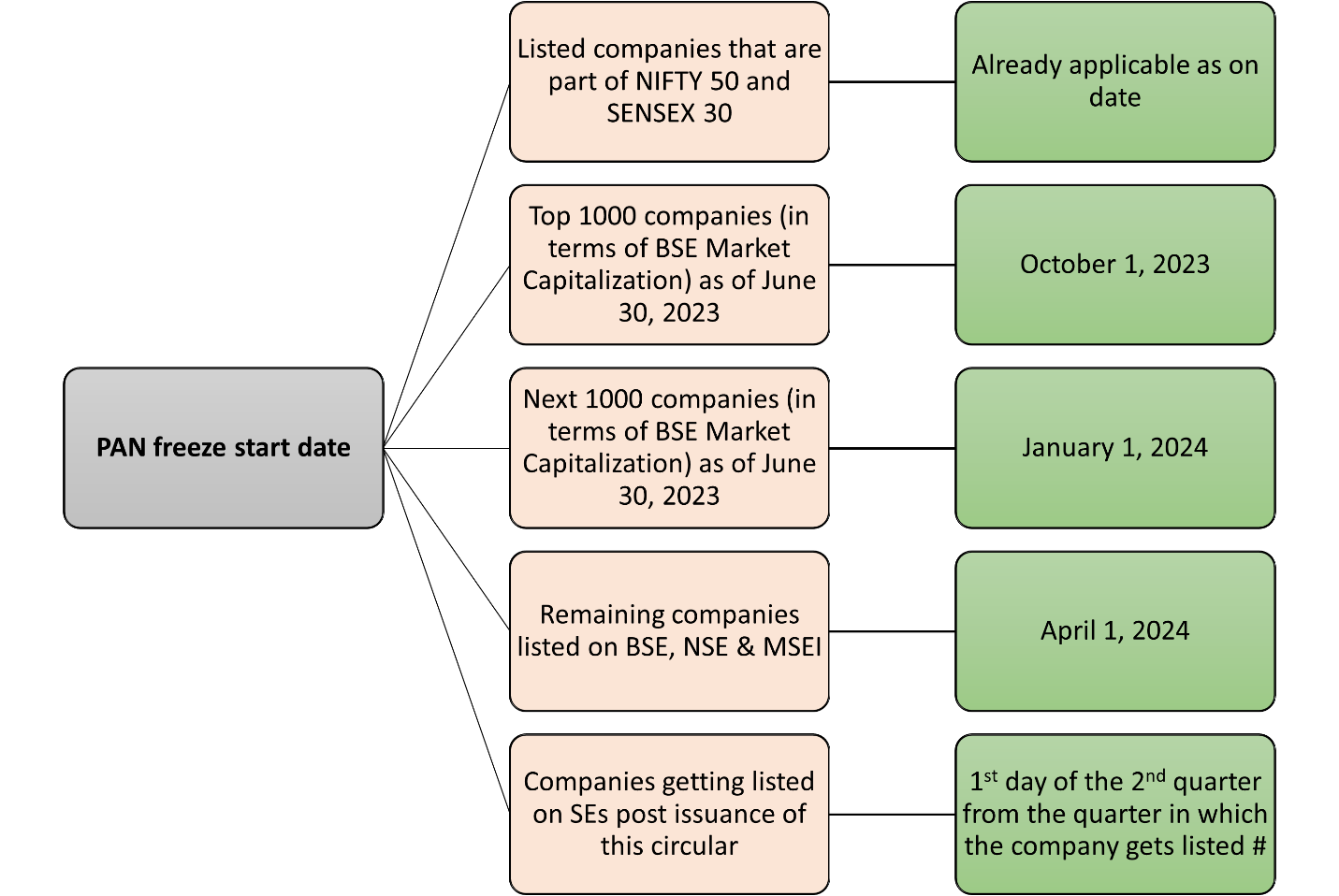
This Circular will be applicable for on-market transactions, off-market transfers and creation of pledge in equity shares and equity derivatives contracts (i.e. Futures and Options) of listed entities in a phased manner as explained in figure 1 below.
Figure 1: Applicability of provision relating to freezing of PAN
# Illustration: For a company getting listed during October 01 to December 31, 2023, PAN of DPs should be frozen at security level as per prescribed framework latest from April 01, 2024.
For trading in derivatives, the SE FAQs states that the listed company will be required to educate the DPs about freezing of PAN at ISIN level. Consequently, all open positions in the derivative segment should be squared off before the commencement of TWC.
Process for implementing through Designated Depository (‘DD’)
In terms of SEBI Circular dated May 28, 2018, listed companies were required to select one of the depositories as a Designated Depository (‘DD’) for disclosing the details of the company for the purpose of implementing system driven disclosures in the capital market. Further in terms of SEBI Circular dated September 09, 2020, for further automating the system driven disclosures, listed companies were required to submit PAN of promoters/ promoter group, DPs and directors (hereinafter collectively referred to as entities) to the DD and for PAN exempt investors, the demat account number(s) were required to be provided. Further, In case of any subsequent changes in the directors/ employees of the listed company, the companies were required to provide the information of the changes to the depositories on an immediate basis and not later than 2 working days.
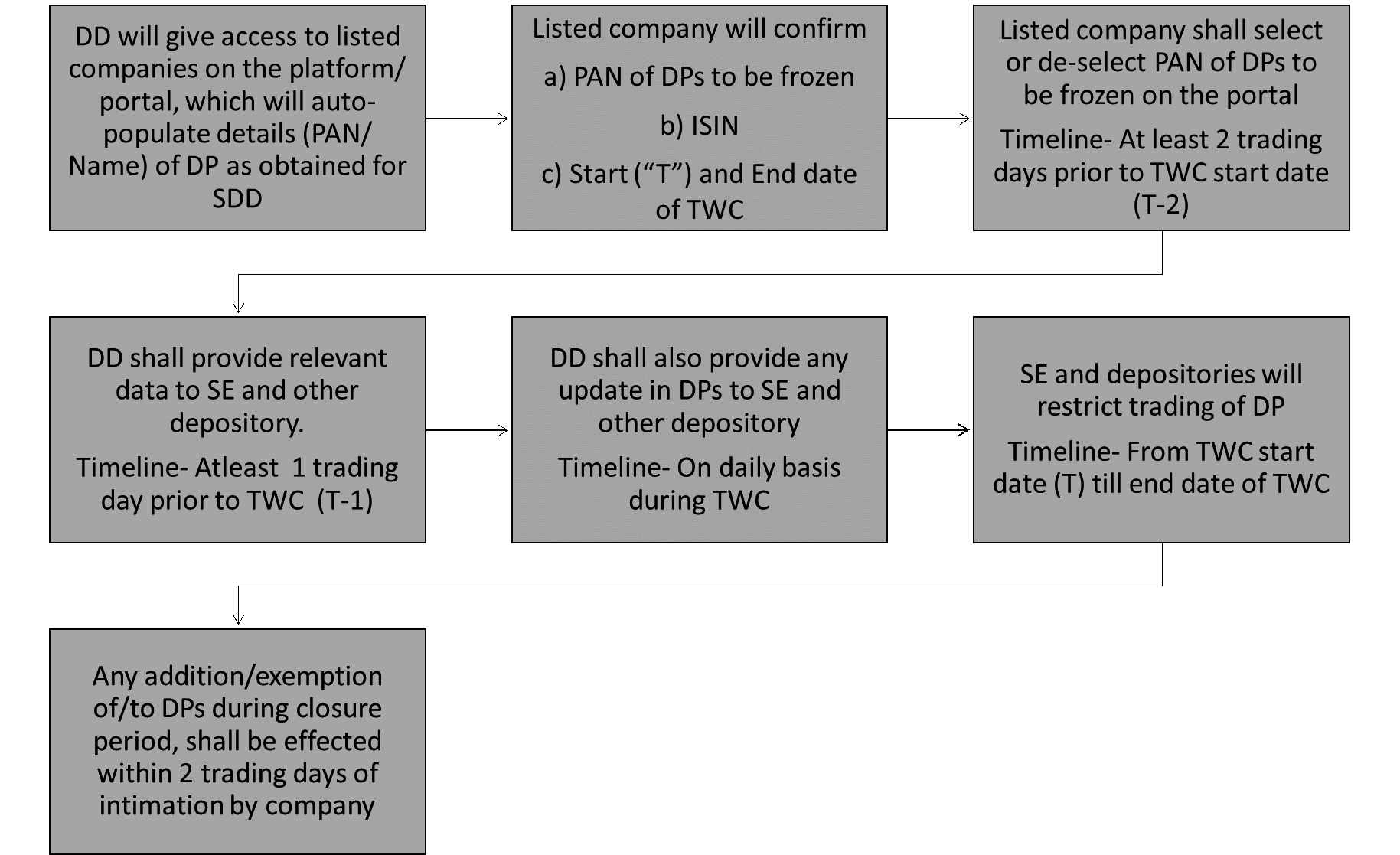
The original circular prescribed the following procedure for prohibiting trading during TWC as explained in figure 2 below.
Figure 2: Procedure of prohibiting trading during TWC
Quarterly reporting by Depositories
The present circular requires quarterly reporting by the depositories giving details of number of listed entities on which the requirement is applicable and that appointed the depository as a DD, number of PAN of DPs provided for the freeze, total number of accounts in which PAN-ISIN level freeze was levied for the quarter and total number of exemptions given to DPs.
Accordingly, the DDs are expected to keep a track of all the quantitative data to be able to report at the end of quarter.
Disclosure of TWC to stock exchange
The PIT Regulations are silent on the requirement to disclose TWC period to the stock exchange.The relevance of TWC is for DPs and not the general public at large. The circular of BSE dated February 03, 2014 as well as that of NSE dated December 18, 2013 also provided for disclosure of the TWC period at the time of disclosing the price sensitive information. The original circular provides that after the listed company enters the TWC period, the DD shall disclose the TWC period and other details received from the listed company to the SE and other depository atleast 1 trading day prior to the commencement of TWC.
Presently, the scope of the original circular and the present circular is limited to TWC for financial results. However, going forward, if this mechanism is adopted for various trading window closures for all DPs or few of them, SEBI will have to reconsider the requirement of informing about TWC to SE or anywhere in public domain as it signals the world at large about the existence of UPSI within the company.
The stock exchanges also rolled out XBRL format for public comments w.r.t informing about TWC to the stock exchange. In our view, the requirement of intimation of TW closure period is unwarranted and should be done away with in entirety in order to avoid creation of a false market for reasons discussed below:
Right from the germination of UPSI till its disclosure to the stock exchange, its confidentiality is required to be maintained, and hence, the TW is closed for the DPs who are having access to such UPSI. There is no requirement of ‘intimation’ of TW closure to the stock exchange at the time of generation of UPSI as TW closure is for DPs (insiders) and not outsiders. When the information is in a shape concrete enough to be disclosed, the listed entity will do a disclosure under Regulation 30. Before the information is made public, the TW is closed. In that case, how can the listed entity go public on TW closure before the information is itself public, this is in contradiction with the requirement of law. 3.
If the listed entity discloses that its TW has been closed stating the purpose of the TW closure (as indicated in the proposed format) this itself is sufficient to convey a message to the market that a UPSI has, in fact, originated in the organization, leading to speculations, market rumour, attempt to procure the information and fluctuations in the price of the listed security, thereby, defeating the very purpose of TW closure.
Applicability of the restriction to off-market trades
PIT Regulations permit off-market inter-se transfer between insiders who were in possession of the same unpublished price sensitive information without being in breach of regulation 3 and both parties had made a conscious and informed trade decision.
The system provides for the flexibility to the listed company to exempt the transaction by de-freezing the PAN of such DP in the system. In such cases, the restriction shall be removed within 2 trading days from the date of receipt of request from the listed company.
For example, if the listed company provides exemption to any DP on April 3, 2024, then the change i.e. de-freeze shall be effected on or before April 5, 2024. The restrictions shall be re-introduced automatically post lapse of the exemption period or completion of the transaction by the DP.
Determination of TWC period and alteration to the same
The original circular mandates listed companies to specify the TWC period atleast 2 trading days before the TWC start date. While the period within which the financial results are to be approved are provided in the Listing Regulations, it is likely that the company may not be certain about the Board meeting date for approval of the financial results and therefore, not in a position to specify the end date for TWC. In such cases, the SE FAQs have clarified that the end date is modifiable. The listed entity can put a notional end date initially and once the board meeting date is decided it can be modified on the basis of T-2 days.
Compliance in case of companies having stricter TWC period
Some companies follow the practice of a stricter TWC period where the TW is closed much prior to the end of quarter. For e.g. for the financial results of the quarter ended March 2024, the TWC would be closed from 15th March, 2024. Presently, the portal freezes the PAN from the 1st day of the month following the end of quarter. In such cases, theSE FAQs provide that the listed companies will be required to close the TW internally by sending intimations to the DPs.
Applicability of the restriction to creation of pledge on equity shares
Para 4 (3) of Schedule B to PIT Regulations expressly permit pledge of shares for bonafide purposes such as raising of funds subject to pre-clearance by the compliance officer during the trading window closure period. However, the original circular restricts the same.. Further, with regard to invocation of pledge, the SE FAQs provides that pledge invocation is not allowed in the tenure of PAN freeze, unless pledge is created before the TWC period.
The meaning of DPs under PIT Regulations includes promoters and it will be quite challenging for business if the ability to pledge the shares is prohibited during the result declaration period. Hence, in order to allow pledge of shares, the listed company will have to specifically exempt such DP by updating in the system, on a case to case basis.
Further, the Supreme Court ruling in the matter of PTC India Financial Services Limited v. Venkateshwar Kari and Another[1] highlighted the modus operandi in case of pledge and also reiterated the need of aligning laws like SEBI’s Takeover Regulations – see para 11.8 of the said ruling. We have also discussed the relevance of PIT Regulations in the context of pledge in another article[2]. This needs to be revisited by SEBI.
Conclusion
The SE FAQs provide further clarity for the entire regime. This will certainly help in minimising the instance of violations on account of trading during TWC period. The mechanism will work well in case of TWC for financial results, however, may require a re-look in case extended to all TWC for all UPSI.
https://vinodkothari.com/wp-content/uploads/2023/06/vinod-kothari-logo.png00Vinita Nair Dedhiahttps://vinodkothari.com/wp-content/uploads/2023/06/vinod-kothari-logo.pngVinita Nair Dedhia2022-08-10 14:51:542024-03-30 19:02:21Trading window restrictions get hardwired as trading freeze at PAN level for DPs
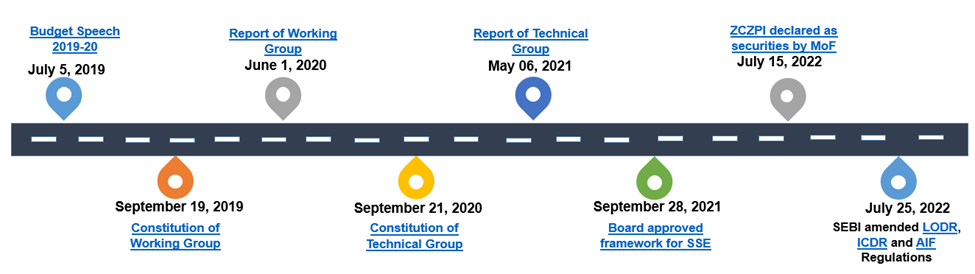
The discussions around the concept of social stock exchanges (“SSEs”) were first initiated in India with the 2019-20 Budget Speech[1] of the Finance Minister, followed by the Working Group Report of SEBI dated 1st June, 2020 (“WG Report”) and Technical Group Report dated 6th May, 2021 (“TG Report”), and public comments thereon. On the basis of the WG Report and TG Report, SEBI in its meeting held on 28th September, 2021 approved a broad framework for establishment of SSEs in India (“SSE Framework”), and an updated status on the action matrix was also released in the meeting held on February, 2022. The concept of SSEs has been incorporated in the rulebook vide the notification of SEBI (Issue of Capital and Disclosure Requirements) (Third Amendment) Regulations, 2022 (“ICDR Amendment Regulations”), SEBI (Listing Obligations and Disclosure Requirements) (Fifth Amendment) Regulations, 2022 (“LODR Amendment Regulations”) and SEBI (Alternative Investment Fund)(Third Amendment) Regulations, 2022 (“AIF Amendment Regulations”), respectively (see timeline below).
Figure 1: Evolution of the concept of SSEs
In this write-up, we focus on understanding the basic concept of SSEs in India, how the Indian version of SSEs is different from the global counterparts, whether SSEs will be used for investing by impact investors or for those searching for avenues of responsible philanthropy, and what are the potential benefits of listing and participation in SSEs.