RBI Guidelines at odds with the Companies Act on appointment of Auditor

A comparative analysis between the Companies Act, SEBI Guidelines and SEBI Circular dated 18th Oct. 2019

– Ajay Kumar K V | Manager (corplaw@vinodkothari.com)

Introduction

The Reserve Bank of India has issued Guidelines[1] for Appointment of Statutory Central Auditors (SCAs)/Statutory Auditors (SAs) of Commercial Banks (excluding RRBs), UCBs and NBFCs (including HFCs) under Section 30(1A) of the Banking Regulation Act, 1949, Section 10(1) of the Banking Companies (Acquisition and Transfer of Undertakings) Act, 1970/1980 and Section 41(1) of SBI Act, 1955; and under provisions of Chapter IIIB of RBI Act, 1934 for NBFCs, on 27th April 2021.

The Guidelines provide for appointment of SCAs/SAs, the number of auditors, their eligibility criteria, tenure and rotation as well as norms for ensuring the independence of auditors.

However certain provisions of these Guidelines are either completely different or stringent as compared to the provisions of the Companies Act, 2013 (Act). Further, in case of listed entities the question would arise whether the SEBI circular CIR/CFD/CMD1/114/2019[2] dated 18th October 2019 shall be applicable, where the existing auditor is ineligible to continue as the auditor of the company and a new auditor is to be appointed.

In this write up, we have discussed the requirements under both RBI Guidelines as well as the Act.

Read more

MCA circular on excess spent done by contribution to PM-Cares

-raises more questions than it settles.

Nitu Poddar, Senior Associate ( corplaw@vinodkothari.com )

Setting off excess-spent on CSR

Pursuant to Rule 7(3) of the CSR Rules, 2014, a company is allowed to take benefit of the excess amount (more than the requirement under section 135(5) spent by it on CSR activities upto three succeeding financial years. This provision has come into effect from January 22, 2021.

Accordingly, the common view that has formed is that only amount that is spent in excess on and from January 22, 2021 can be set off against the CSR obligations of three succeeding year. However, the second view, and the more appropriate one is, even amount spent in excess before Jan 22, 2021 may also be set-off against the CSR obligations of a year, subject to such excess spent is done within three years of taking such set-off. That is to say, any excess spent done in FY 2019-20, 2018-19, 2017-18 could have been set-off in FY 2020-21.

The reason for the second view is that, all that the provisions of Rule 7(3) allows is “setting off “the excess spent, which is being done post January 22, 2021. 

Clarification Circular by MCA:

MCA, on May 20, 2021, has issued a Circular, purportedly clarifying the following:

  1. Any amount spent in excess during FY 2019-20;
  2. On March 31, 2020;
  3. By contribution to the PM-Cares

may be set off against the CSR obligation for FY 2020-21 (only) subject to the following conditions:

  1. Unspent amount, if any, of the previous years, should have been factored;
  2. CFO and statutory auditor to certify that such amount was
    1. contributed on 31.03.2020;
    2. pursuant to the appeal by the MCA.
  3. Details of such contribution to be disclosed separately in the CSR Report and Board’s Report. 

Issues arising from the Circular

The MCA Circular rather raises several questions and leave then unanswered:

  1. What about the contribution done prior to 31.03.2020?;
  2. What about the excess spent done in any other activity as mentioned in schedule vii?;
  3. What about the excess spent done in FY 2018-19 and 2017-18?
  4. Why a certificate from statutory auditor? This is not required for any other excess spent done neither is this part of Rule 7(3).

The Circular seems to support the view of the ICSI, as mentioned in Q-47 of the FAQ released on April, 29, 2020, which says that only excess spent done after January, 22, 2021 may be allowed to set-off in subsequent years. However, taking such view would may not be the correct interpretation of the applicability of the provisions.


Our other resources on CSR can be accessed at : https://vinodkothari.com/csr/

Funding through crowdfunding platform: whether qualifies to be CSR?

-Platforms different from implementing agency

-Pammy Jaiswal, Partner and Sachin Sharma, Executive (corplaw@vinodkothari.com)

Crowdfunding Platforms

Crowdfunding platforms are digital platforms which solicit funds for various ventures. They pave way for easy accessibility to a vast network of people through social media. Individuals, charities or companies can create a campaign for specific causes for contribution from anyone, either a corporate, or an association, or an individual. Two broad classes of crowdfunding platforms are: investment-based, which consists of stocks, royalties, and loans, where the funders are investors in a campaign and can obtain monetary benefits. The other is donation-based, where funders do not expect monetary compensation. They fund a campaign because they support its cause. For understanding the concept on crowdfunding in detail, kindly refer to our article here.

Crowd sourcing has become an important aspect for carrying out CSR activities[1]. Around 27% of the crowdfunding campaigns are initiated to cover medical expenses. Several crowdfunding platforms are running parallelly across India as well as the world. Some of the Indian crowdfunding platforms include Impactguru, Milaap, Ketto, etc. As the world is under the grip of COVID- 19, these platforms are playing their remarkable role in sourcing funds for COVID-19 relief through several campaigns. Till now, Ketto has raised ₹324.60cr for its COVID relief campaigns whereas Milaap has raised ₹182.47Cr and Impact Guru has raised ₹61.46cr for their COVID relief campaigns. Further, crowdfunding platforms are not only popular in India but also across the world. Several global platforms are also working to raise funds for various projects/ campaigns. Global Giving collection in its Coronavirus Relief Fund has moved to $13,363,987.

 Growth in transactions of crowdfunding platforms

The crowdfunding platforms have attained greater visibility and importance in India as well as globally as per the statistics[2] given below-


The first figure corresponds to the Indian position and the second figure pertains to global statistics.

What is an ‘Implementing Agency’ (IA)

The term IA has not been defined under the CSR provisions (section 135 of the Companies Act, 2013 as well as the rules made thereunder), however, the report on CSR activities uses the term IA for carrying out CSR indirectly.

IA, as the name suggests is an implementation tool for the entity to carry out its CSR activities. As per Rule-4(1) of the Companies (Corporate Social Responsibility Policy) Rules, 2014, section 8 companies, registered public trusts, and registered societies (collectively, called ‘entities’) can be referred to as IAs. The nature or activities of an IA can be distinguished from that of a beneficiary through a very thin line. Our article containing the detailed discussion on the same can be read here.

While carrying out CSR activities through an IA, there are several things that a company needs to consider after the amendment under the CSR provisions have been notified on 22nd January, 2021. They include:

  • IA which includes a section 8 company, public charitable trusts, or a society either formed by the company or otherwise needs to be registered under section 12A and 80G of the IT Act;
  • All IAs, are required to register themselves with MCA by filing e-form CSR-1; and
  • IAs which include a section 8 company, public charitable trusts, or a society not formed by the company require a track record of three years in carrying out similar CSR projects.

Crowdfunding platform working as a connecting point

Crowdfunding Platforms simply acts as connecting point between CSR contributors and CSR opportunities. It neither gets into implementation nor acts as agent for implementation, it acts merely as a connection point.

Deprived of the crowd sourcing mechanism, each company would have to look for its own sources for their CSR activity which will be a very inefficient way for carrying out CSR. India is a vast country and therefore huge number of CSR opportunities are present where each company would like to carry out its CSR obligations strategically so as to fulfil their CSR objectives. Crowdfunding platforms have filled up the information asymmetry and plays a role of an information bridge similar to what media does. Since it does not go into the implementation role at all, there is nothing wrong in routing/ using such platforms for carrying out CSR activities.

How is a crowdfunding platform different from being an IA?

An IA is regarded to work as an extended arm of the company in carrying out CSR activities. The whole purpose of involving an IA is to relieve the company from using its time to identify reliable projects and programs wherein the funds may be used or allocated. Another reason to involve an IA for carrying out CSR is that the company may not have the requisite expertise and experience to shortlist the authentic activities or entities where the money can be spent.

Having said that, on the other hand, a crowdfunding platform does not work as an extended arm of the company, rather, it is a voluntary body which acts a connecting point between the IA/ beneficiary and the company. It does not have the liberty to allocate the money in the project of its own choice, rather, the fund giver chooses the exact project or IA where it wants the money to be used.

Further, to be eligible to carry out CSR activities as an IA, registration with the MCA and under IT Act (except for govt entities and those set up under an Act of Parliament or State Legislature) is necessary while crowdfunding platforms may be relieved from such mandatory requirement considering its role as a connecting point between the fund raiser and the fund giver. Therefore, crowdfunding platforms cannot be regarded as IA.

The third point of difference between the two is when a CSR activity is routed through the IA, monitoring and utilisation report is required to be supplied by such IA to the Company. Whereas, when funds are contributed through crowdfunding platform, the ultimate beneficiary or IA which takes the funding, is liable to provide a utilisation report to the fund giver.

Features of the crowdfunding platform which distinguishes it from an IA

As discussed above, a crowdfunding platform acts as a medium to connect the contributor and the contribute. If it also relevant to understand the extent these crowdfunding platforms differ from an IA.

We have gone through the websites of several crowdfunding platforms and have presented a tabular presentation of areas where they are different from becoming an IA.

Basis Ketto[1] ImpactGuru[2] Milaap[3] Role of IAs
Accountability It shall not in any manner be responsible or held accountable for any transaction between the Users. No obligation to become involved in disputes between any Users, or between Users and any third party arising in connection with the use of the Site Assume no responsibility to verify whether the Donations are used in accordance with any applicable laws, and such responsibility rests solely with the Champion or Charity, as applicable Accountable to the companies donating the funds.
Utilisation of funds It is merely an intermediary and does not interfere in the transaction between Donors / Contributors and Campaigner Not responsible in any way whatsoever towards the end utilization of funds Facilitates the Donation transaction between Champions and Donors, but is not a party to any agreement between a Champion and a Donor, or between any user and a Charity. It decides the areas and entities where funds are to be allocated
Obligations or liabilities wrt funds collected Does not hold any right, title or interest over the funds or rewards or have any obligations or liabilities in respect of such providing the same to the Donor / Contributor Does not take any responsibility for making sure that the project for which the funds are raised through its Site is completed and made available to the Funders No control over the conduct of, or any information provided by a Champion or a Charity, and Milaap hereby disclaims all liability in this regard Liable if the same remains unspent or not spent within the permitted activities. Utilisation reports have to be shared signifying the utilisation of funds for permitted activities
Liability for correctness of information on the platform Not liable Not liable Not liable Liable
Responsibility for success/ outcome of the project Not liable Not liable Not Liable Liable
Verification whether funds are used as per applicable laws or fund-raising purpose Responsibility on the Campaigner Responsibility on the Campaigner Responsibility on the Campaigner Responsibility on the IA

Safeguards/ points of consideration in funding through the platform

  1. Funds are going to the beneficiary directly:

The fund is put directly from the crowdfunding platform to the beneficiary’s account and no third party is involved here. In this, it becomes a case of direct CSR activity. Utilisation report is required.

  1. Funds are going to another IA (registered):

Where the funds raised by crowdfunding platform goes to an entity registered as an IA with MCA, monitoring as well as utilization report will be required

  1. Funds are going to another IA (registered) which itself carries out CSR activities:

Where the fund raiser is a registered IA, however, carries out the CSR activities itself, it will be a case of direct CSR and not through an IA.

Conclusion

 Crowdfunding platforms are emerging as promising sources for business houses to fulfil their CSR goals. These platforms should be expected and at the same time be bound by the mandatory registration provisions with the MCA since their role is not be act as an IA but a mere platform where fund raisers and fund givers can meet.

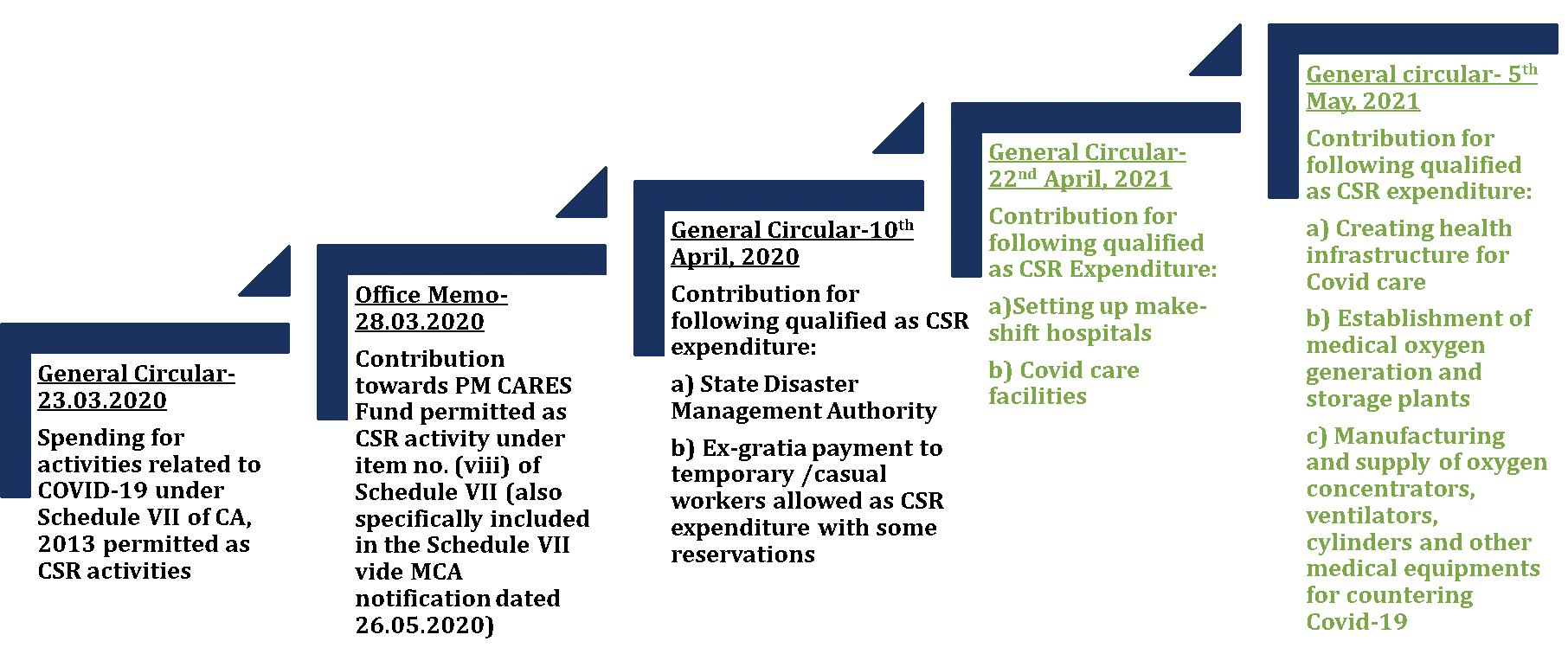
Ministry of Corporate Affairs (MCA) vide several circulars have brought several relaxations and broad based the activities under Schedule VII in relation to COVID-19 and health care.

Looking at the ongoing era of the pandemic, it has become very common for several digital platforms to come forward and act as source of link between the agencies/ beneficiaries and the corporates for several activities which are also covered under Schedule VII of the Companies Act, 2013.

Our other resources on CSR can be read here

[1] Read more here

[2] https://www.statista.com/outlook/dmo/fintech/alternative-financing/crowdfunding/worldwide?currency=INR

[1] https://www.ketto.org/terms-of-use.php

[2] https://www.impactguru.com/terms-of-use

[3] https://milaap.org/about-us/terms-and-conditions

Whether expense towards Corporate Environment Responsibility (CER) be eligible as CSR spending?

Nitu Poddar, Senior Associate (corplaw@vinodkothari.com)

Introduction

Since the amendment in the CSR provisions on 22.01.2021, even the existing eight year old provision has gained substantial attention and deliberation by the stakeholders. This article is to discuss yet another topic on CSR which is “whether amount spend towards Corporate Environment Responsibility (CER[1]) stipulated as specific condition under Environment Clearance by the Ministry of Environment, Forest and Climate Change (MoEFCC) can be included as a CSR project?” In other words, whether CER obligations can be merged with CSR obligations or are these two mutually exclusive.

What is CER?

Industrial sectors (specified in the Environment Impact Assessment (EIA) Notification 2006 dated September 14, 2006[2]) which have direct environmental footprint are required to take prior Environment Clearance (EC) from the MoEFCC before setting up any new project / expansion / modernisation of an existing project / change in the product-mix.  While granting such EC, the Ministry puts certain conditions (requirements) on the applicant (referred as Project Proponent (PP) in two categories – specific conditions and general conditions – implementation of which, if unsatisfactory, the EC may be revoked. One of such specific condition imposed by the MoEFCC while granting EC is that the applicant should undertake CER / ESC which is to be based on the local needs and should be restricted to the affected areas around the proposed project.

As per Office Memorandum[3] (OM) No. F. No. 22-65 / 2017-IA.III of MoEFFC dated May 01, 2018,

Some of the activities which can be carried out in CER, are infrastructure creation for drinking water supply, sanitisation, health, education, skill development, roads, cross drains, electrification including solar power, solid waste management facilities, scientific support and awareness to local farmers to increase yield of crop and fodder, rain water harvesting, soil moisture conservation works, avenue plantation, plantation in community areas, etc.

Unlike CSR, CER is based on project cost and not profits made by the proposed project.  The obligation of CER is within the range of 2.5% – 5% of the project cost.

Why CER?

The MoEFCC, in its Office Memorandum (OM) No.J-11013/25/2014-IA.I dated August 11, 2014, discussed that since the CSR obligation is based on profits, there might be cases where the proposed project is yet to make profit. In such case, since the project will have already created impact on the society and environment, it is required to commit towards the same, irrespective of profits, through CER commitment. Further, as per the 2018 OM, all the activities proposed under CER is also required to be monitored and reported bi-annually and also posted on the website of the company.

Anomaly created by different OMs and correspondences of MoEFCC

Considering that the activities undertaken pursuant to CER are akin to the one of the activities prescribed under schedule VII of the Companies Act, 2013 – specifically “ensuring environmental sustainability” among others, it is intuitive to say that expenditure towards CER should be includes as compliance of CSR commitment.

However, on perusal of several OMs and summary record of meeting of the Expert Appraisal Committee (EAC), formed under MoEFFC, one may have to re-think on the above ratio. The relevant extracts of the OMs and summary record are reproduced below for perusal:

  1. [4]2014 OM:
  1. ….In case these activities (or some of these activities) are proposed to be covered by the project proponent under CSR activities, the project proponent should commit providing for the same. In either case, the position regarding the agreed activities, their funding mechanism and the phasing should be clearly reflected in the EC letter.

Author’s Comment: This indicates that overlap might be acceptable provided the commitment is clear from the beginning.

  1. [5]Summary record of 2nd meeting of EAC – 2015 –

The Member Secretary has informed the Committee that presently the Expert Appraisal Committee has been insisting for earmarking either 2.5% of the total cost of the project or 5% of the total cost of the project towards Enterprises Social Commitment / Corporate Social Responsibility, depending upon the size of the project. In this context, copy of Office Memorandum No. J-11013/25/2014-IA.I dated 11.08.2014 issued by the Ministry regarding guidelines on Environment Sustainability and CSR related issue was circulated. Deliberating on the issue, the Committee was of the view that the name of ‘Enterprises Social Commitment’ or ‘Corporate Social Responsibility’ in respect of environment clearance should be in the first place considered for replacement by the name ‘Environmental Conservation Support Activities’.

Author’s Comment: From this discussion, it seems that the terms ESC / now CER and CSR have been used interchangeably and therefore CER and CSR commitment can overlap.

However, in the same paragraph, the decision taken by the EAC has been recorded as follows:

The Committee unanimously agreed for uniform earmarking 2.5% of the capital cost of the project towards Environmental Conservation Support Activities, in addition to the committee’s  [this seems to be a typo error- should be “company”] commitment under the Companies Act.

Author’s Comment: This indicates that CER and CSR are two independent commitments and responsibility of the company and both have to be individually followed and fulfilled.

In one of the scrutiny and deliberation as discussed in the summary records, in the matter of Expansion of Cement Plant, Clinker (1.8 MTPA to 2.6 MTPA) at Village Rauri, Tehsil Arki, District Solan, Himachal Pradesh by M/s Ambuja Cement Ltd. [F. No. J-11011/986/2008-IA-II (I)], one the specific condition was as follows:

  1. At least 5 % of the total cost of the project shall be earmarked towards the Enterprise Social Commitment based on Public Hearing Issues and item-wise details along with time bound action plan shall be prepared and submitted to the Ministry’s Regional Office at Dehradun. Implementation of such program shall be ensured accordingly in a time bound manner.

The project proponent mentioned that they have already spent an amount of 3.01%, 4.06% and 2.57% of the net profit after tax (PAT) towards CSR activities in the year 2012, 2013 and 2014 respectively in compliance of the Companies Act 2013. It has been requested to consider the proposal to waive-off the Specific Condition No. XV, as mentioned above.

The Committee noted that the expenditure of 5% of the total cost of the project towards ESC was prescribed for a period of 5 years. Based on the discussions, held the Committee decided that instead of waiving off the specific condition, it is recommended to extend the implementation period of 5 years for implementing ESC activities to a period of 10 years, which the proponent had also agreed to.

Author’s Comment: This again seems to indicate that MoEFCC is not inclined to mix the CER commitment with the CSR commitment.

  1. [6]Summary record of 2nd meeting of EAC – 2016 –

In all the ECs being granted, as a part of specific condition, the CER commitment has been recorded as below:

At least 2.5% of the total cost of the project shall be earmarked towards the Enterprise Social Commitment based on Public Hearing issues, locals need and item-wise details along with time bound action plan shall be prepared and submitted to the Ministry’s Regional Office. Implementation of such program shall be ensured by constituting a Committee comprising of the proponent, representatives of village Panchayat and District Administration. Action taken report in this regard shall be submitted to the Ministry’s Regional Office.

In addition to the above provision of ESC, the proponent shall prepare a detailed CSR Plan for the next 5 years including annual physical and financial targets for the existing-cum-expansion project, which includes village-wise, sector-wise (Health, Education, Sanitation, Skill Development and infrastructure etc) activities in consultation with the local communities and administration. The CSR Plan will include the amount of 2% retain annual profits as provided for in Clause 135 of the Companies Act, 2013 which provides for 2% of the average net profits of previous 3 years towards CSR activities for life of the project. A separate budget head shall be created and the annual capital and revenue expenditure on various activities of the Plan shall be submitted as part of the Compliance Report to RO. The details of the CSR Plan shall also be uploaded on the company website and shall also be provided in the Annual Report of the company.

Author’s Comment: The view of keeping CER and CSR as two independent commitments seems to being continued.

  1. [7]2018 OM (supersedes 2014 OM) –. Relevant extracts have been reproduced:

(I) The cost of CER is to be in addition to the cost envisaged for the implementation of the EIA/EMP which includes the measures for the pollution control, environmental protection and conservation, R&R, wildlife and forest conservation/protection measures including the NPV and Compensatory Aforestation, required, if any, and any other activities, to be derived as part of the EIA process. 

XXX

(IV) The proposed activities shall be restricted to the affected area around the project.

(VI) The entire activities proposed under the CER shall be treated as project and shall be monitored. The monitoring report shall be submitted to the regional office as a part of half-yearly compliance report, and to the District Collector. It should be posted on the website of the project proponent.

XXX

Author’s Comment: The provision with respect to commitment of any particular CER activity as CSR, as was present in the 2014 OM, has been dropped.

  1. [8]Minutes of 53rd meeting of EAC (Infrastructure-2) held in 2020:

While presenting the parameters of the Project to obtain EC, Tamil Nadu Waste Management Limited, represented as follows:

(xi) The CER fund shall be allocated as per the MoEF&CC office memorandum F.no.22- 65/2017-IA.III dated, 1st May, 2018, which is around Rs. 0.48 Crores which shall be utilized over a period of 3 years. The CSR budget will be allocated as per rules prescribed by the Government of India / Companies Act 2013.

  1. [9]Standard EC Conditions – MoEFCC OM No. F.No. 22- 34/2018-IA.III dated 9th August 2018:

7. Corporate Environment Responsibility

XXX

  1. The company shall have a well laid down environmental policy duly approve by the Board of Directors. The environmental policy should prescribe for standard operating procedures to have proper checks and balances and to bring into focus any infringements/deviation/violation of the environmental / forest /wildlife norms/ conditions. The company shall have defined system of reporting infringements / deviation / violation of the environmental / forest / wildlife norms / conditions and / or shareholders / stake holders. The copy of the board resolution in this regard shall be submitted to the MoEF&CC as a part of six-monthly report.

iii. A separate Environmental Cell both at the project and company head quarter level, with qualified personnel shall be set up under the control of senior Executive, who will directly to the head of the organization.

  1. Action plan for implementing EMP and environmental conditions along with responsibility matrix of the company shall be prepared and shall be duly approved by competent authority. The year wise funds earmarked for environmental protection measures shall be kept in separate account and not to be diverted for any other purpose. Year wise progress of implementation of action plan shall be reported to the Ministry/Regional Office along with the Six Monthly Compliance Report.
  2. Self environmental audit shall be conducted annually. Every three years third party environmental audit shall be carried out.

Author’s Comment: Looking at the elaborative independent requirements / compliance in respect of CER, the view about the intent of the Ministry to keep CER independent of CSR gets stronger

Provisions of Companies Act, 2013

It is also pertinent to note that pursuant to Rule 2(d)(vi) of the Companies (Corporate Social Responsibility Policy) Rules, 2014 ,“activities carried out for fulfilment of any other statutory obligations under any law in force in India” is excluded from the definition of CSR. The idea behind this exclusion seems to be that what a company is obligated to spend as a part of its statutory obligation is anyway a mandatory condition. Such statutory compliance, even if it results into a spending, cannot be regarded as CSR spending. An example may be payment of taxes many of which are dedicated to infrastructure activities. Swachh Bharat Cess is specifically towards cleanliness. However, one cannot take such an expense as a spending towards CSR. Hence, (CSR) responsibility and statutory obligations cannot be inter-mixed.

Difference between CSR and CER

While already discussed above, the difference in CER and CSR is being highlighted:

  1. CSR spending is profit-linked whereas CER spending is project cost-linked. Hence, CER may, at times be applicable even before the company has started making profits.
  2. Another major difference between EC-triggered spending and CSR spending is that there is a wide range of activities which may qualify as CSR. However, the EC forces these activities to be focused and restricted around village/social development in the areas affected by the project only. In that sense, the EC forces the entity to give back to the local area where the company has an environment footprint.

Conclusion

While it would have been rational to include CER under CSR, but this seems to be grey in terms of clarity, both legally and practically. There are two school of thought that is being endorsed – one, that the CER and CSR are two different statutory obligation under two different ministries and therefore should be honoured independently; the other, and more logical argument is that both the commitment are meant to return back to the society and environment on which the company has left its footprint. Accordingly, taking a view that CER and CSR commitments are mutually independent would be putting the company to double compliance for a single objective. Considering that CER is applicable, irrespective of profit, the same should ideally be aligned with CSR plan of the company where section 135 of Companies Act, 2013 is applicable.

While this question may lurk until there is any explicit clarity from either of the ministries, from the bi-annual disclosure on compliance report being submitted by the companies, it seems that India Inc is divided on this matter.


[1] CER has also been termed as Enterprise Social Commitment (“ESC”) in several ECs granted to applicants. Later, in the Office Memorandum (OM) No. F. No. 22-65 / 2017-IA. .III of MoEFFC dated May 01, 2018, the terms CER was used.

[2] https://parivesh.nic.in/writereaddata/ENV/EnvironmentalClearance-General/18.pdf


[3] http://environmentclearance.nic.in/writereaddata/public_display/circulars/OIEBZXVJ_CER%20OM%2001052018.pdf


[4] http://environmentclearance.nic.in/writereaddata/OMs-2004-2021/158_OM_11_08_2014.pdf


[5] http://environmentclearance.nic.in/writereaddata/Form-1A/Minutes/0_0_21122122412101Final-MinutesoftheMeeting,2ndEAC,28th30thDecember2015EACmeeting.pdf


[6] https://environmentclearance.nic.in/writereaddata/Form-1A/Minutes/23062016PBRL5BUAMinutesofthe7thEAC30thMay-Final.pdf


[7] http://environmentclearance.nic.in/writereaddata/public_display/circulars/OIEBZXVJ_CER%20OM%2001052018.pdf


[8] http://www.environmentclearance.nic.in/writereaddata/Form-1A/Minutes/01082020DHCMPRSFFinalMinutes53rdEAC(Infra-2).pdf


[9] http://environmentclearance.nic.in/View.aspx?rid=30


Role of Nominee Directors : Balance is the Key

-Megha Mittal & Ajay Kumar

[corplaw@vinodkothari.com]

The idea that directors owe a fiduciary duty towards the company has been deep instilled in the very being of the corporate world – not only in spirit, but also in law. Section 166 of the Companies Act, 2013 (‘Act’) provides that “a director shall act in good faith in order to promote the objects of the company for the benefit of its members as a whole, and in the best interests of the company, its employees, the shareholders, the community and for the protection of environment.” While section 166 of the Companies Act, 2013 sets out the duties of a director towards the company and its stakeholders in general, one must note that a company also has certain specific set of stakeholders, say lenders, whose interests must also be taken care of – enter “Nominee Directors.”

Nominee directors are usually appointed by financial institutions or investors, generally referred to as nominators, on the board of the borrower company for the purpose of representing and safeguarding their interest thereof. However, regardless of its appointment by a specific stakeholder, a Nominee Director is not relieved of his general duties as a director of the company inter-alia duties under section 166 of the Act. This dual role of a Nominee Director has given way to years of debate with respect to a Nominee Director’s actions affecting the company vis-à-vis its nominator.

While much has been deliberated on this state of pseudo-conflict, the conundrum has now come to rest as the Hon’ble Supreme Court, in its landmark judgement in Tata Consultancy Services Limited v. Cyrus Investments Private Limited & Ors. clarified that while a nominee director is entitled to take care of the interests of the nominator, he is duty bound to act in the best interests of the company and not fetter his discretion.[1]

In this article, we shall throw light on the role and nature of Nominee Directors, and discuss their rights, duties and actions in case of conflict, in light of the Apex Court’s order in Tata Consultancy vs. Cyrus Investments (supra).

Read more

MCA introduces a cartload of additional disclosures in the Financial Statements

-The amendments to be applicable from FY 2021-2022 onwards!

Shreya Masalia and Harsh Juneja | Executives

With the ever-increasing stringency in the regulatory framework and disclosure requirements under various provisions of law, MCA, vide notification dated March 24, 2021[1] has further prescribed a list of numerous additional disclosure required in the financial statements by amending schedule III to the Companies Act, 2013. The amendments have been brought to bring more transparency by providing for various disclosures including dealing with struck off companies, details of benami property, undisclosed income etc. which shall be applicable from FY 2021-22.

Since the amendments have been brought in Division I, II and III of Schedule III, accordingly, the same will be applicable to the companies which need to comply with the Companies (Accounting Standards) Rules, 2006 as well as the Companies (Indian Accounting Standards) Rules, 2015 including NBFCs.

This Article is an attempt to cover all the major new inclusions that the companies will have to disclose henceforth.

Disclosures to be made to the notes of the Balance sheet under various Divisions of Schedule III

  1. Statement on changes in equity

Prior to the amendment, the companies including NBFCs required to prepare financial statements as per IND AS were required to disclose only balance at the beginning and end of the reporting period along with changes during the current year. Post the amendments in Sch. III, disclosure shall be made regarding the changes in equity due to prior period errors and restated balance at the beginning of the reporting year and similarly disclose the same for the previous reporting period. Additionally, the details of other equity shall also be given for prior reporting period.

  1. Disclosure of shareholding of all promoters

Currently, only the shareholding of the shareholders holding more than 5% of the shares is required to be disclosed in the Balance Sheet. After the amendments, a company shall now be required to disclose the shareholding of all promoters. The details shall include change in shareholding taken place during the year. The meaning of the promoter has to be taken from the definition provided in the Act which is different from the definition provided in the SEBI (ICDR) Regulations, 2009. This change has been made to all companies covered under all three Divisions of schedule III.

  1. Loans and advances to promoters, directors, key managerial persons (KMP) & related parties

Where the company makes any loan and advances to the promoters, directors, KMPs and other related parties either jointly or severally and such loan/ advances so given are either in the nature of a loan/ advance repayable on demand or without any specific terms or period of repayment, the details of such loans shall be disclosed separately in the financial statements along with the amount of loan and % to total loans and advances. The related parties are those parties as defined under sec. 2(76) of the Act.

It is pertinent to note here that while related party disclosures are already required under applicable accounting standards, this may, to some extent, tantamount to be an overlapping of disclosures.

  1. Ageing Schedule of trade payables and trade receivables

Companies that failed to make payment to companies under MSME Act, 2006 or which had made any delayed payments to MSME were required to disclose the principal and interest due at the end of the FY, amount of interest paid for delay in payment in the current year, interest accrued and unpaid during the year and amount of interest further remaining to be paid in succeeding years in their balance sheet.

Companies covered under all 3 divisions will henceforth be required to provide ageing schedule for trade payables due for the periodicity of 1 year, 1-2 year, 2-3 year & more than 3 years. These include trade payables to MSMEs, disputed dues to MSMEs, and other dues and disputed dues. Similarly, disclosures shall also be made where no due date of payment is specified. Information for unbilled dues is also required to be disclosed separately.

Similarly, companies will also be required to disclose the ageing schedule of its trade receivables i.e. including undisputed and disputed trade receivables considered good and doubtful with ageing classified as less than 6 months, 6 months to 1 year, 1-2 years, 2-3 years and 3 years or more along with disclosures separate disclosure for information of unbilled dues. These undisputed and disputed trade receivables which are further categorized into good and doubtful.

  1. Disclosure related to funds borrowed from banks and financial institutions

Where the company has borrowings from banks or financial institutions on the basis of security of current assets, it shall disclose whether the quarterly returns or statements of current assets filed by it with the banks or financial institutions are in agreement with the books of accounts. Further, where there is any material mismatch/ discrepancies between the two, then a summary of reconciliation and reasons of material discrepancies needs to be adequately disclosed. This amendment shall be applicable to all the companies covered under the scope of three Divisions of Schedule III. It clearly states that an auditor must find the differences between these statements filed by the company with the books of accounts and if there is any difference, then a reconciliation statement needs to be prepared.

In addition to the above, where funds borrowed by a company from a bank or a financial institution for a specific purpose has not used for the same purpose, a disclosure providing details of utilisation of funds shall also be required to be provided.

  1. Revaluation of property

The reconciliation of gross and net carrying amount of both intangible and tangible assets at the beginning and end of the reporting period, along with other separate disclosures related to additions, disposals, acquisitions, depreciation, impairment, etc shall also disclose separately details related to the amount of change due to revaluation, where there is a change of more than 10% in aggregate of the net carrying amount of the asset.

The company is also required to disclose whether the plant, property or equipment has been revalued by a registered valuer as defined under rule 2 of Companies (Registered Valuers and Valuation) Rules, 2017.

  1. Disclosure of Ratios

The amendment requires the companies covered under division I and II of schedule III to disclose the following ratios:

(a) Current Ratio,

(b) Debt-Equity Ratio,

(c) Debt Service Coverage Ratio,

(d) Return on Equity Ratio,

(e) Inventory turnover ratio,

(f) Trade Receivables turnover ratio,

(g) Trade payables turnover ratio,

(h) Net capital turnover ratio,

(i) Net profit ratio,

(j) Return on Capital employed,

(k) Return on investment.

The company shall explain the items included in the numerator and denominator for computing the above ratios and an explanation shall be provided for any change in the ratio by more than 25% as compared to the preceding year. To note, amongst these, various ratios such as current ratio, debt-equity ratio, net profits ratio, etc. were required to be disclosed by equity listed entities in their Board’s report under Management Discussion and Analysis Report as per regulation 34(3) r.w. Schedule V to SEBI( Listing Obligations and Disclosure Requirements), 2015.

In addition to the above, NBFCs that need to comply with Ind AS covered under division III of schedule III are required to disclose the following ratios:

(a)Capital to risk-weighted assets ratio (CRAR)

(b) Tier I CRAR

(c) Tier II CRAR

(d) Liquidity Coverage Ratio

However, as per annex XVI of Master Direction – NBFC-ND-SI and NBFC-DI Directions, 20163 , all deposit taking NBFCs and NBFC – non-deposit taking having asset size of INR 500 crore are already required to disclose their CRAR, tier I CRAR and tier II CRAR  as a part of their balance sheet. Similarly, NBFCs as covered under para 15B read with annex III of Master Direction – NBFC-ND-SI and NBFC-DI Directions, 2016 are already required to provide disclosures related to LCR in the prescribed format.

Though these amendments are aimed at increasing disclosure requirements, this addition seems more repetitive in nature rather than being informational.

Disclosures required in an attempt to curb money laundering

  1. Details of Benami Property held

Where any proceedings have been initiated or pending against the company for holding any benami property, the company shall disclose various details of the property including the reasons of not disclosing the same in the books of accounts, details of the proceedings against the company including its nature, status and the views of the company on the same. This amendment covers the companies under the scope of all three divisions of schedule III.

  1. Relationship with Struck off Companies

Where the company has any transaction with companies struck off under section 248 of the Act, or under section 560 of the Companies Act, 1956, it shall disclose the name of struck off company, the nature of transactions with this company, balance outstanding and relationship with the struck off the company. The transaction can be in the nature of investment in securities, receivables, payables, shareholding of the struck-off company in the company and any other outstanding balances.

  1. Disclosures related to conduit lending and borrowing

The amendments in the Companies (Audit and Auditors) Rules, 2014 dated March 24, 2021[2] requires the management of the company to give a representation that, except as otherwise disclosed in the notes to accounts, the company has neither employed nor is itself acting as a “conduit entity” for any financial transaction. To align schedule III with the same, additional disclosures are required to be made by the company w.r.t. disbursement of funds by way of advance, loan, investment, guarantee or security by the company to any person/ entity being an ultimate beneficiary through any intermediary. Similarly, disclosure shall also be made about any receipt of funds in the aforesaid manners by the company as an intermediary for further disposal of the same to any person/ entity being ultimate beneficiary. The details shall include the date, amount, details of the intermediary and the ultimate beneficiary including a declaration to the effect that it is in compliance with the Foreign Exchange Management Act, 1999 and Companies Act, 2013 and does not violate the provisions of Prevention of Money Laundering Act, 2002 in respect to the aforesaid transactions.

For an in-depth understanding of the concept and the amendment, refer our separate article[3] covering various aspects of the same.

  1. Wilful Defaulter

A company categorized as a wilful defaulter by any bank or financial institution will be required to disclose details regarding the date of declaration as a wilful defaulter and the amount and nature of defaults.

  1. Title deeds of property not held in the company’s own name

If any the title deed of any immovable property (other than in case of lease where the agreement is duly in favour of lessee) is not held in the name of the company, the details related the same is required to be disclosed in the financial statements. This disclosure shall not be required for properties held on lease where the lease agreements are duly executed. In case of joint holding of such property, the disclosure shall be made to the extent of the company’s share thereon.

The details of the disclosure includes the gross carrying value, name of the person in whose name property is held, whether such person is a promoter/ director or relative of promoter/director or an employee of the company, since when the property is held by the person and details for the same. If such property is under dispute the same shall also be disclosed.

Other miscellaneous disclosures:

  1. Depending upon the Total income of the company the financial statements are to be mandatorily rounded off to the nearest unit as mentioned in the schedule. Prior to the amendment, the same was to be adopted on a voluntary basis for companies preparing their financials as per Companies (Accounting Standards) Rules, 2006 and the nearest unit was based on the turnover of the company. The amendment aligns all the divisions of schedule III making it mandatory for all companies to round off their financial statements based on their total income.
  2. In case of revaluation of any plant, property & equipment, the disclosure w.r.t the fact that the valuation has been done by a registered valuer as defined under the Companies (Registered Valuers and Valuation) Rules, 2017.
  3. Disclosures related to ageing of capital work in progress (CWIP) and any other CWIP which has exceeded its originally planned cost or completion schedule. Details of projects where activity has been suspended shall be disclosed separately.
  4. Disclosures related to ageing of intangible assets and along with any other intangible asset which has exceeded its originally planned cost or completion schedule. Details of projects where activity has been suspended shall be disclosed separately.
  5. Details and reasons of pending registration of creation/ or satisfaction of charge with the Registrar of Companies beyond statutory time period.
  6. A company in non-compliance with the number of layers prescribed under clause (87) of section 2 of the Act read with Companies (Restriction on Number of Layers) Rules, 2017 shall disclose the same.
  7. A disclosure to effect that the books of accounts of the company are in accordance with the approved scheme of arrangement and accounting standards in case the competent authority has approved the same.

Disclosures to be given in the Profit and Loss statements:

  1. Disclosures related to CSR

Where the company is covered under section 135 of the Companies Act, 2013 (Act), the disclosures shall be made similar to the disclosures in the Board’s Report as required under then Act. In addition to that, a disclosure regarding the details of related party transactions such as, contribution to a trust controlled by the company in relation to CSR expenditure as per relevant Accounting Standards shall also be made.. Where a provision is made with respect to a liability incurred by entering into a contractual obligation, the movements in the provision during the year should be shown separately. The term “provision” shall be construed as a liability. The provision shall be estimated on the basis of past CSR events already conducted by the company.

  1. Details of Crypto Currency or Virtual Currency

Where the company has traded or invested in Crypto Currency or Virtual Currency during the financial year, the following needs to be disclosed:

(a) profit or loss on transactions involving Crypto currency or Virtual Currency

(b) amount of currency held as at the reporting date,

(c) deposits or advances from any person for the purpose of trading or investing in Crypto Currency/ virtual currency.

The Amendment has now mandated the companies to prepare a separate set of accounts for all their transaction involving Crypto Currency or Virtual Currency.

  1. Undisclosed Income

Details of any transactions not recorded in the books of accounts that has been surrendered or disclosed as income during the year in the tax assessments under the Income Tax Act, 1961, shall be disclosed unless there is immunity for disclosure under any scheme. Further, the company shall also state whether the previously unrecorded income and related assets have been properly recorded in the books of account during the year.

Conclusion

As discussed above, the intent of law seems to bring more transparency in reporting by corporates. Though certain disclosures may lead to repetition of information in various places, to avoid the same cross referencing may be done. Surely, the amendments will curb the problem of inadequacy of information in the books of accounts of the company.


[1] http://www.mca.gov.in/Ministry/pdf/ScheduleIIIAmendmentNotification_24032021.pdf

[2] http://www.mca.gov.in/Ministry/pdf/AuditAuditorsAmendmentRules_24032021.pdf

[3] https://vinodkothari.com/2021/03/changes-in-auditors-report-and-financial-statements-to-reveal-camouflaged-financial-transactions/


Changes in Auditors’ Report and Financial Statements to reveal camouflaged financial transactions

Team Corplaw, Vinod Kothari & Company [corplaw@vinodkothari.com]

[This version: 25th March, 2021]

Accountants and auditors will have to grapple with a ton of new details and disclosures while preparing financial statements and audit reports, come financial year 2021-22. MCA brought, vide separate notifications dated 24th March, 2021 amendments in the Companies (Audit and Auditors) Rules,2014 (“Audit Rules”), the Companies (Accounts) Rules, 2014 (“Accounts Rules”) and Schedule III of the Companies Act.

While Schedule III changes will require wide ranging disclosures [to be covered by a separate write up], the amendments in Audit Report Rules  and Accounts Rules require the following new disclosures: 

  • Camouflaged lending or investment, that is, where out-bound or inbound loans, advances and investments are intended to be routed through a conduit entity, masking the identity of the ultimate beneficiary
  • Compliance with respect to payment of dividend
  • The need for accounting software to maintain an audit trail, that is, edit log, of the primary entries, possibly with a view to enable the detection of any changes in primary entries
  • Gaps in valuations of securities, so as to reflect the valuations at the time of borrowing money, and at the time of OTS

We briefly discuss these.

Applicability – scope and date

  • The changes as will be discussed below will be applicable on the Auditor’s Report and Board’s Report from the financial year 2021-22 and onwards
  • Since statutory audit is a mandatory requirement for all the companies, the changes in the Auditor’s Report shall be applicable on all companies.
  • From the language of the amendments, it is apparent that the changes are applicable only for the annual financial statements; neither are they applicable to interim financial statements, nor to special purpose financial statements.
  • An important question will remain whether the required management representation and the auditors’ check will pertain to transactions done during the financial year 2021-22 and thereafter, or does it pertain to opening balances of transactions as on 1st April, 2021. In absence of any suggestion as to retroactivity, it should be logical to assume that the required management representation and the auditors’ checking should pertain to the transactions done during the financial year.
  • The changes in relation to Board Report shall be applicable on all the companies, since the Board Report is a mandatory requirement for all.
  • The requirements of audit trail and edit log are applicable on companies maintaining their accounts in the electronic form. However, practically, all companies maintain accounts in electronic format, so the same can be said to be applicable on all companies.

Camouflaged lending and investment:

What is the offence?

The issue under consideration is “camouflaged investments”. By using the term camouflage investments, we mean those transactions which are undertaken by a company for some identified beneficiary. However, the transaction does not take place between the company and the ultimate beneficiary directly, but is masked by the inclusion of an intermediary acting as a conduit entity (an entity acting on the instructions of the company for channelizing the funds to any other entity identified by the company).

These transactions mask the identity of the real beneficiary. In a world where financial transactions are regularly used for carrying illicit transactions, money-laundering transactions or other suspicious activities, it is important that the trail of financial transactions is transparent. Hence, if the identification of the end beneficiary is consciously being masqueraded, there is a concern. The proposed amendments are a means to address this issue.

What is the MCA intending to do?

The MCA, vide the amendment notification, is aiming to unveil the ultimate beneficiary behind the camouflage financing. Though investment through “conduit entities” is not barred by law, the same needs to be adequately disclosed in the notes of accounts of the company. Therefore, MCA, vide its amendment notification, requires the management of the company to give a representation that, except as otherwise disclosed in the notes to accounts, the company has neither employed, nor is itself acting as a “conduit entity” for any financial transaction.

Is it illegal to have investments via conduits?

Several laws refer to indirect lending or investment –

  • Sec 185 of the Act prohibits both direct and indirect loans, investments, guarantees or security to the directors and other specified entities.
  • Under the FEMA Regulations, the definition of “foreign equity holder” includes those equity holders having minimum 51% of indirect equity holding
  • Sec 186 (1) also refers to investment “through” one or more layers of subsidiaries, which is again a case of indirect investments.
  • In many commercial transactions, it is understood that the recipient is acting as a conduit – for example, lending through a fintech platform
  • Special purpose vehicles, which are well allowed to operate under various laws, are intended to be conduits only
  • Use of conduits is commonplace practice in many commercial transactions

Hence, while it is not illegal on the face of it, the use of a masquerading entity camouflages the real nature of the financial transaction. It acts as a subterfuge and hence, creates opacity. In the context of PMLA, these transactions may also be hiding the real identity of the real beneficiary.

Hence, it is important to ensure that the identity of the real beneficiary, if so targeted by the lender or investor, is disclosed.

What sort of transactions will be covered?

There are several elements in the camouflage rule that need to be understood:

There are 3 legs of the transaction: a source transaction, a conduit or intermediary transaction, and an ultimate beneficiary transaction.

The source transaction may be

  • Investments,  
  • Advances, or
  • Loans

At the source stage, the money has come as a result of any borrowing, issue of shares or share premium or any other source or kind of funds. Since these expressions are wide enough, it does not matter what the source of the funds at the source level is.

The intermediary transaction may be by way of

  • Loan or advance
  • Investment
  • Provision of any guarantee or security

The ultimate beneficiary is the end beneficiary of the source transaction.

The following points may be noted about the scope of the Camouflage rule:

  1. Commercial transactions are not covered: Notably, the transactions covered by the rule are financial transactions, in the nature of loans, advances or investments. Real sector transactions such as sales, purchases, services, including payment and collection services, etc., are not covered by the rule. 
  2. Non-discretionary transactions as regards the intermediary: In order to attract the offence of the camouflage rule,the source must have identified the ultimate beneficiary. This is clear from the words: “identified in any manner whatsoever by or on behalf of the company”. Thus, if the intermediary had the discretion in identifying the beneficiary, this rule is not attracted. Hence, the identification of the beneficiary is done by the source, and without any discretion on the part of the intermediary.
  3. Pre-contemplated transfer to the ultimate beneficiary: Next important element is the existence of an understanding with the intermediary that the funds passing through the intermediary are intended by the ultimate beneficiary. This is clear from the words “with the understanding, whether recorded in writing or otherwise”. The form of the understanding or the formal nature of the understanding also doesn’t matter, but the understanding must have been there.
  4. Direct nexus: This suggests that the flow of funds from the source of the intermediary, and from intermediary to the ultimate beneficiary must be part of the same transaction, showing a clear nexus.
  5. The intent of camouflaging the chain financial transaction is present: It is only when the real nature of the transaction is sought to be garbed, and the transaction purports to be a financial transaction with the intermediary, whereas the real intent is to provide funding to the ultimate beneficiary. For example, if a special purpose vehicle collects money from the investors, it is evident on the face of the transaction that the money is intended to go to another beneficiary. There is no garbing of the identity of the end beneficiary. These transactions are explicit and transparent transactions. The whole intent of the camouflage rule is to eliminate opacity. If the transaction was itself transparent, the rule has no relevance at all.

There are several interconnected financial transactions that abound in the world of finance. Hence, it will remain a matter of intrigue as to what all transactions may be regarded as falling under the offence of the camouflage rule. There are several questions that arise in this respect:


  • Does a time gap matter?


For instance, the transaction by the source to the intermediary happens on 1st of 1st month, and the transaction by the intermediary to the beneficiary happens on 1st of 4th month. There may be a suggestion as to the existence of an understanding between the parties, but the very fact that there is a gap of time between the two legs of the transactions helps to create some opacity. It may be noted that the whole purpose of the camouflage disclosures is to pierce  through the opacity and create transparency. Hence, if the gap in timing is merely a device to create opacity, it should not matter.


  • Does a change in nature of the instrument at the intermediary level matter?


For example, the transaction from the source to the intermediary may be by way of loans. The transaction from the intermediary to the ultimate beneficiary may be by way of investment in shares. The terms of the two investments obviously differ. The first may have a limited tenure. The second one may be perennial. The entire approach has to be driven by substance over form – if the substantive view of the transaction suggests the two inter-connected transactions being part of the same chain, it will be wise to disclose the same.


  • Does the infusion of some extent of funds by the intermediary matter?


For example, the source may have contributed Rs 1000. The intermediary may add another Rs 100 of its own, and transfer Rs 1100. To the extent of Rs 1000, there may still be a chain financial transaction requiring disclosure, while the remaining Rs 100 may be an independent transaction by the intermediary.


  • Does the existence of a trust or fiduciary or agency relationship matter?


There are numerous transactions where a servicing agent, collecting agent, paying agent, etc acts merely as a conduit. This is the explicit nature of the transaction itself. Same goes with fiduciary transactions where the trustee or fiduciary discloses on the face of it that the trustee is merely a stop-over. However, trusts with undisclosed principals, while doing financial transactions, may be hit by the rule.

Duty of the auditor

The provisions are not just casting a responsibility on the directors, but the auditors are also required to substantiate the statement of the directors by applying their audit procedures. While the auditors can have ways and means to identify the instances of “outward” surrogate lending well, how the auditors can assure there are no instances of “inward” surrogate lending will require some new auditing methods.

Reasons of such reporting requirement

The amendments can be looked upon as a way to ensure that the companies do not use masquerades for the purpose of distinguishing the identity of the ultimate beneficiary of the funds.  These might be to also check the instances of money laundering and terrorism financing.

Impact of the change

Though no specific punishments have been specified, on a conjoint reading of Sections 447 and 448 of the Act, it seems that the directors may be liable for fraud in cases of active concealment of material information or making mis-statements deliberately. 

Since the Auditors are required to substantiate that there are no material mis-statements made by the directors as aforesaid, where the auditor fails to prove his innocence, he might also be penalised in cases of material misstatement.

Other additional disclosures required to be made in the Auditor’s Report

Compliance of Section 123 of the Act with respect to declaration/payment of dividend

The amended Audit Rules require the auditor to report on compliance with Section 123 of the Act by the company where it has declared/paid dividend. This has been done to ensure that the companies pay dividend on the basis of their profits and satisfies all the necessary conditions, and not when the companies may be suffering losses and it is practically impossible to pay dividend to its members.

Proper maintenance of audit trail at all times during the financial year

The auditors are also required to report on the maintenance of the audit trails and edit logs by the companies who opt to maintain their books of accounts in electronic mode. A discussion of the same is given in the later part of the write-up.

Accounting in electronic form – maintenance of audit trail

With effect from 1st April, 2021 the companies that maintain their accounts electronically by means of accounting software shall be required to ensure that the software is capable of maintaining audit trail and edit logs, and the same is not disabled at any point of time. The auditors are also required to report on the proper maintenance of such systems as discussed earlier.

Impact of the change

The compulsory maintenance of audit trail is a way to ensure the fabrication of books and any subsequent overwriting in the books of accounts. Through the audit trails, any person scrutinising the books of accounts can very easily track what changes have been made to the accounts and can require the company to explain the reasons thereof.

Additional disclosures in the Board’s Report

Applications/proceedings under IBC

Vide the amendments, the directors will be required to report the applications initiated or proceedings pending under IBC. Though the language of the law is not very clear on this, the understanding is that the directors will be required to report on the applications initiated or the proceedings pending against the company. Where such an application or proceedings are pending, the Board’s Report is also required to contain the status of the same as at the end of the year.

Impact of the change

The aforesaid amendment may be said to be an additional reporting requirement to keep the members, the real owners of the company as well as other stakeholders of the company updated about the current status of the company. The “insolvency” is a serious matter and shall not come as a shock to the stakeholders of a company, when the same is announced publicly at a later point of time.

Diabolical valuations of assets 

Another very interesting insertion in the Board’s report is the details including the reason for the differences between the valuations of the company done at the time of one-time settlement and that at the time of taking loans from banks or other financial institutions. This is with a motive to ensure why there is a difference in valuation of the assets of the company at the time of one-time settlements v/s at the time of borrowing funds from the banks and financial institutions.  

Reason of the change

The change is to ensure that the company has not inflated the value of their books at the time of seeking loans from the banks and financial institutions, nor has it deflated the same at the time of proposing one-time settlement.

We understand that there may be various reasons for the differential valuation, like difference in time period and resultant depreciation, amortization etc, or due to varying market forces. Whatever be the reasons, the same needs to be adequately captured in the Board’s Report for the company. 


[The version above is a work in progress and we will continue to develop it further. Please do come back to this page. Please feel free to post your comments/questions in the space below.]