Addressing subsequent applicability of Section 139(2) of the Companies Act

Whether existing auditor needs to vacate immediately?

Abhishek Saraf | Manager (corplaw@vinodkothari.com)

Background

On and from the enforcement of the provisions of the Companies Act, 2103 (the “Act”), statutory auditor of a company is required to be appointed for a fixed term of 5 consecutive years (except in the case of appointment of first auditor and appointment of auditor in Government Company). The said requirement is different from the provisions of corresponding section 224 and 224A of the erstwhile Companies Act, 1956 (“Act, 1956”) where a statutory auditor was appointed year on year basis.

In addition to the introduction of a minimum tenure of 5 years, the Act also brought the concept of mandatory rotation of the statutory auditors so appointed so to ensure the auditors do no develop too much familiarity with the auditee. In fact, the Report[1] of the CII Task Force on Corporate Governance also discussed on the proposal of the rotation of auditors as well as audit partners to discourage any sort of an affinity between the auditors and the company.

The provisions relating to mandatory rotation of the statutory auditors have been provided under section 139(2) of the Act.

Section 139(2) of the Act states that-

“(2) No listed company or a company belonging to such class or classes of companies as may be prescribed, shall appoint or re-appoint 

(a) an individual as auditor for more than one term of five consecutive years; and

(b) an audit firm as auditor for more than two terms of five consecutive years:

…..”

Section 139(2) of the Act provides for a mandatory rotation of statutory auditors for the following classes of companies:

(i) Listed companies

(ii) Unlisted public companies having paid up share capital of INR 10 crores or more;

(iii) Private companies having paid up share capital of INR 50 crores or more; and

(iv) Companies having paid up share capital of below threshold limit mentioned in (ii) and (iii) above, but having public borrowings from financial institutions, banks or public deposits of INR 50 crores or more.

Once the bar on re-appointment applies; there is a mandatory cooling-off period of 5 years where the outgoing auditor should not be in any way be related to the incoming auditor.

Further, the requirement of appointment of auditors for a minimum tenure as well as the rotational requirement has been exempted for certain classes of companies which have been mentioned below:

Exemption from minimum tenure of 5 years Exemption from rotational provisions
 

·         All companies in case of appointment of first auditor


·         Government companies


·         One person company


·         Small companies

Application of rotational requirements during the transitional period

From the date of enforcement of section 139 of the Act, i.e., 1st April, 2014, companies were given a time period of three years to comply with sub-section (2) of the Act. However, considering the practical difficulties, MCA vide its Companies (Removal of Difficulties) Third Order, 2016 amended the transitional provisions of Section 139(2) of the Act to allow companies to comply with the provisions relating to rotation of auditors not later than date of the 1st AGM of the company held after 3 years from the date of commencement of the Act.

With this amendment, it was clarified that the auditor who has utilized the tenure of 5 years or 10 years, as applicable may continue the office till the conclusion of AGM held for the FY ended 31st March 2017 and the company shall appoint new auditor in accordance with section 139 (1) in the same AGM.


Treatment in case of subsequent applicability of rotational provisions

It is to be noted that the third proviso to sub-section (2) of section 139 contained the provisions to address the first-time applicability on companies on and from the commencement of the said section. It was given to allow smooth transition from the old regime to the new regime. The proviso specifically provided 3 years’ time from commencement of the Act which has expired long back.

Another situation that requires to be addressed is the fate of the auditors of the companies which subsequently get covered under sub-section (2) of section 139.

In this regard, it is important to note the language of the said sub-section states the following:

No listed company or a company belonging to such class or classes of companies as may be prescribed, shall appoint or re-appoint XXX

Addressing the said issue, the view expressed in Ramaiya[2] is that the auditor will have to vacate his office at the next forthcoming AGM of the company, even if the existing term is not complete.

However, we will hold a different view on the same based on the following reasons:

  • It is to be noted that the appointment or re-appointment of statutory auditors is done for a fixed term which should not be of more than 5 consecutive years and the provisions does not mentions for appointment for any specified years and further has done away with ratifying the appointment every year[3].
  • Secondly, as the language suggests, the provisions of the Section 139(2) is applicable only at the time of  appointment or re-appointment.
  • If the existing term, which was in accordance with Section 139 (1) of the Act, is not complete, there is no case of appointment or reappointment. Hence, it is only when the existing term is complete that the question of rotation will arise.
  • Furthermore, mandatory rotation of statutory auditor as per Section 139(2) of the Act cannot be equated with ineligibility to be appointed as an auditor of a company under Section 141(3) of the Act, which sinks in immediately.

Concluding Remarks

In view of the rationale given above, it can be concluded that since the question of rotation will arise only at the time of appointment or re-appointment which again can only be seen only after the completion of the tenure of 5 years, therefore, the interpretation of requiring the continuing auditor to vacate its office at the ensuing AGM post first time applicability does not seem to be correct.

[1] To view the Report, click here

[2] Page 2473 of A Ramaiya Guide to the Companies Act (19th Edition)

[3] The requirement to ratify was done away with vide the Companies (Amendment) Act, 2017 w.e.f. 7th May, 2018.

Our other relevant articles –

  1. https://vinodkothari.com/2021/06/rbi-guidelines-at-odds-with-the-companies-act-on-appointment-of-auditor/
  2. https://vinodkothari.com/2021/04/faqs-appointment-of-statutory-auditors/
  3. https://vinodkothari.com/wp-content/uploads/2019/05/Concept-of-Retiring-Auditors-under-Act-2013-1.pdf
  4. https://vinodkothari.com/2018/05/alignment-of-audit-auditors-rules-with-amendment-act-2017/

RPT provisions in India and other countries

RPT-provisions-in-India-and-other-countries

Other ‘I am the best’ presentations can be viewed here

Our other resources on related topics –

  1. https://vinodkothari.com/article-corner-on-related-party-transactions/

An overview of the regulatory framework of dividends

An overview of the regulatory framework of dividends

Other ‘I am the best’ presentations can be viewed here

Our other resources can be accessed here –

  1. https://vinodkothari.com/wp-content/uploads/2020/02/Note-on-declaration-on-interim-dividend_revised-converted.pdf
  2. https://vinodkothari.com/wp-content/uploads/2018/01/Article-on-SS-3.output.pdf
  3. https://vinodkothari.com/2021/06/dividend-restrictions-on-nbfcs/
  4. https://vinodkothari.com/2016/07/faqs-on-dividend-distribution-policy/

Unspent CSR & Role of IAs

Loader Loading…
EAD Logo Taking too long?

Reload Reload document
| Open Open in new tab

Download as PDF [1.65 MB]

Other ‘I am the best’ presentations can be viewed here

Business Responsibility and Sustainability Reporting

Business Responsibility and Sustainability Reporting

Other ‘I am the best’ presentations can be viewed here

Our other resources on related topics –

  1. https://vinodkothari.com/2021/06/brsr-reporting-actions-and-disclosures-required-for-business-sustainability/
  2. https://vinodkothari.com/wp-content/uploads/2020/08/Cartload-of-details-in-BRSR.pdf
  3. https://vinodkothari.com/2020/08/brr-in-process-to-become-a-fully-loaded-electronic-form/
  4. https://vinodkothari.com/2016/01/global-overview-of-business-responsibility-reporting/

Our resource center on Business Responsibility and Sustainable Reporting can be accessed here –
https://vinodkothari.com/resource-center-on-business-responsibility-and-sustainable-reporting/

Structuring of debt instruments

Structuring of debt instruments

Other ‘I am the best’ presentations can be viewed here

Our other resources on related topics –

  1. https://vinodkothari.com/2017/04/understanding-compulsorily-convertible-debentures/
  2. https://vinodkothari.com/2021/03/presentation-corporate-bonds-debentures/
  3. https://vinodkothari.com/2021/06/centralised-database-for-corporate-bonds-debentures/
  4. https://vinodkothari.com/2020/04/covid-19-and-debenture-restructuring/
  5. https://vinodkothari.com/2020/11/sebis-stringent-norms-for-secured-debentures/
  6. https://vinodkothari.com/2021/08/consolidation-sebi-non-convertible-securities/
  7. https://vinodkothari.com/2021/08/checklist-for-issuance-of-listed-debt-securities-on-private-placement-basis/
  8. https://vinodkothari.com/2013/03/on-the-meaning-of-deposit-f-or-deposit-regulations/
  9. https://vinodkothari.com/2019/01/mca-requires-reporting-of-what-is-not-a-deposit/
  10. https://vinodkothari.com/wp-content/uploads/2019/06/FAQs-DPT-3_VKC_28.06.2019.pdf

A Regulatory Affair: Fair Value Discovery in Preferential Share Issues

Payal Agarwal, Vinod Kothari and Company ( payal@vinodkothari.com )

The recent cases of intervention by the stock market regulator and stock exchanges in preferential allotment of listed companies have brought to fore an important but fundamental point. That is,  with a price band fixed under the SEBI (Issue of Capital and Disclosure Requirements) Regulations, 2018 (‘ICDR Regulations’), and considering the liquidity in listed (and frequently traded) shares, whether there is a need for an independent valuation report, has become a question of great interest. Since the issue is currently under litigation will want to say that it will be interesting to see the evolution of jurisprudence on this important issue. While the issue is of relevance to minority shareholders, but it also touches a key issue in valuation as to whether there is a fair value beyond the quoted value of a company whose shares are not infrequently traded.

Further, there might be scenario, where a preferential allotment triggers an open offer under SEBI (Substantial Acquisition of Shares and Disclosure Requirements) Regulations, 2011 (“SAST Regulations”).  The SAST Regulations provides formula for determining offer price, which establish a clear nexus between the price of shares offered under preferential allotment and price of shares under open offer as per SAST Regulations. Given that the pricing of open offer is influenced by the pricing under preferential allotment, should the price under the ICDR Regulations be accepted or fair valuation of shares should be sought in order to ensure fair compensation to shareholders?

At this stage of discussion, it becomes important to look into the relevant provisions and the meaning of “fair value” and understand how fair it is to have a preferential allotment without ascertainment of such fair value by an independent valuer.


Regulatory provisions with respect to preferential allotment

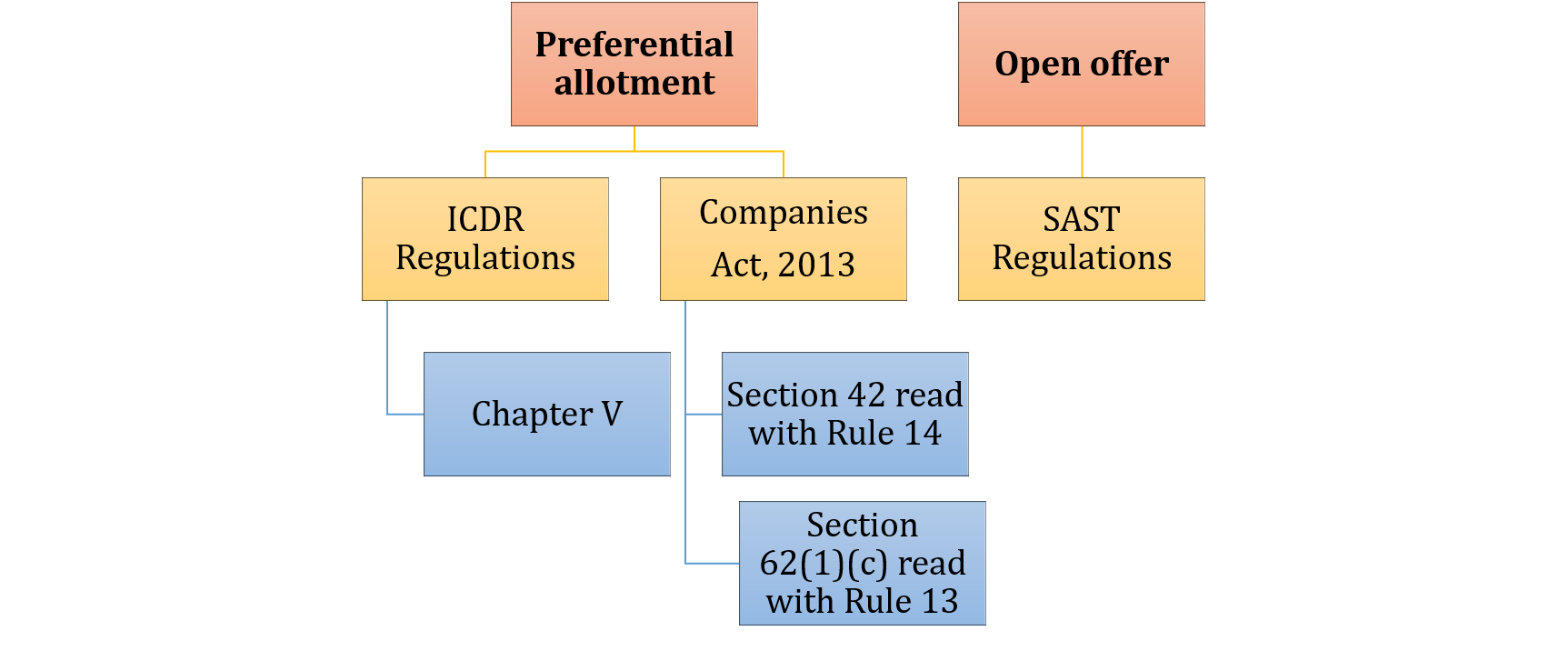
Preferential allotment in listed companies are governed by the following provisions –

  • Section 42 of the Companies Act, 2013 [“Companies Act”], read with Rule 14 of Companies (Prospectus and Allotment of Securities) Rules, 2014
  • Section 62(1)(c) of the Companies Act. read with Rule 13 of Companies (Share Capital and Debentures) Rules, 2014
  • Chapter V of ICDR (Regulation 164)

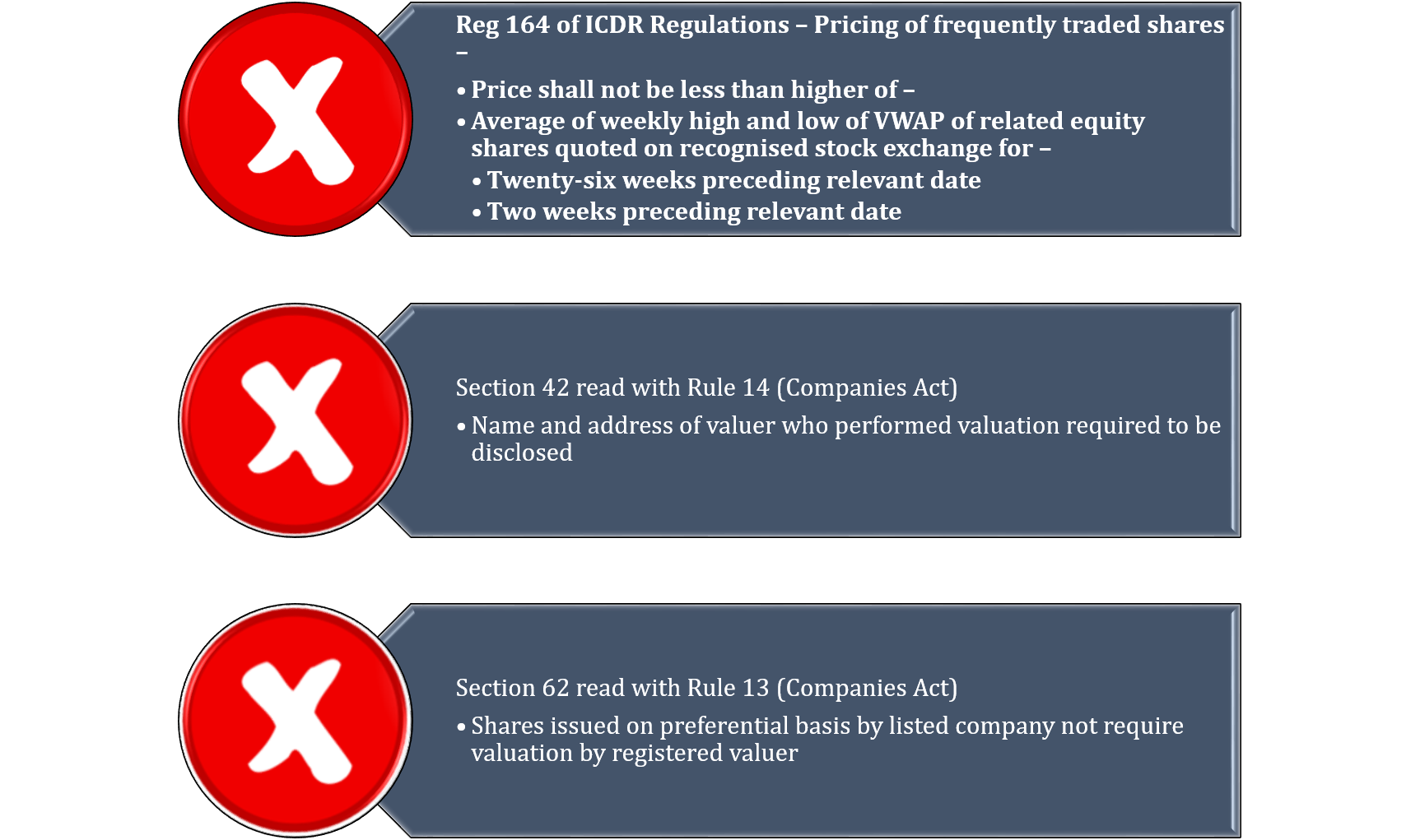
Preferential offers under section 62(1)(c) can be made to any person, if so authorised by a special resolution passed in general meeting if the price of such shares is determined by way of a valuation report of a registered valuer. However, if one goes through allied Rule 13 of SCD Rules, it becomes clear that the companies whose shares are listed on a stock exchange are not required to obtain a valuation report from a registered valuer. The said rules clearly bring out a distinction between preferential offers made by a listed company versus those made by unlisted companies. Sub-rule (2) specifically states that for companies whose shares are listed on a recognised stock exchange, the requirements under the relevant SEBI regulations (ICDR Regulations) will apply, while the unlisted companies will be governed by the provisions of the Companies Act; and sub-rule (3) states that the price under the preferential allotment shall not be less than the price determined on the basis of valuation report of registered valuer. Hence, it becomes clear that in case of a listed company, as per section 62 and rule 13, there is no requirement of a valuation report, per se. Instead, the legislature has left it to be regulated by SEBI regulations. Therefore, one will have to look for what ICDR says.

Reg. 164 of ICDR lays the floor limit of the price, which is to be calculated as the higher of average of weekly high and low of volume weighted average price of related equity shares quoted on a recognised stock exchange for –

  1. 26 weeks preceding the relevant date
  2. 2 weeks preceding the relevant date

The Regulation does not call for an independent valuation report. This must be read in contradistinction to regulation 165, which deals with pricing of infrequently traded shares. Reg. 165 rather specifically requires an independent valuation.

Requirement of independent valuation under regulatory provisions


The above clearly demonstrates that the regulations have consciously exempted listed entities from seeking an independent valuation where listed shares are frequently traded. The regulations, in fact, draw a timeframe to extract weighted averages of the market prices to ensure that the fluctuations in prices, if any, are ironed out and the resultant price is the even price at which the market has transacted during that period. This, admittedly and reasonably too, is based on the assumption that ‘market’ is the best reflection of a fair price which a willing seller and a willing investor are ready to deal in. This view can also be substantiated with similar stipulations in other laws and valuation standards.

Meaning of fair valuation under various applicable laws

Meaning of fair value under applicable accounting standards –


Ind AS 113 deals with the fair valuation of equity shares.  This Ind AS defines fair value as the price that would be received to sell an asset or paid to transfer a liability in an orderly transaction between market participants at the measurement date, and thus considers fair value to be “a market based measurement and not an entity specific measurement.”

Clause 18 of the Ind AS 113 provides, “If there is a principal market for the asset or liability, the fair value measurement shall represent the price in that market.”

Meaning of fair value under the Income Tax Rules

Rule 11UA (1)(c) of the Income Tax Rules provides for the fair value of shares listed in a stock exchange.

It renders the transaction value of such shares to be the fair value in case the transaction has been done through stock exchange. Otherwise, the fair market value of such shares are taken to be –

“(a)the lowest price of such shares and securities quoted on any recognized stock exchange on the valuation date, and

(b)the lowest price of such shares and securities on any recognized stock exchange on a date immediately preceding the valuation date when such shares and securities were traded on such stock exchange, in cases where on the valuation date there is no trading in such shares and securities on any recognized stock exchange”

Meaning of fair value under the Valuation Standards

Rule 18 of the Companies (Registered Valuers and Valuation) Rules, 2017 requires the registered valuer to follow such valuation standards as prescribed by the Central Government. For valuation with effect from 01st July, 2018, all registered valuers are mandatorily required to apply the ICAI Valuation Standards in their valuation assignments for the purposes of the Companies Act, 2013.

The definition of ‘fair value’ under ICAI Valuation Standard (101) is the same as that in IndAS 113, that is, fair value is the price that would be received to sell an asset or paid to transfer a liability in an orderly transaction between market participants at the valuation date. IVS 101 further states that fair value assumes that the price is negotiated in a free market. The ICAI Valuation Standards recognises three approaches for valuation, being – market approach,  income approach, and cost approach.

Where the assets to be valued are traded in active market, the market approach is followed for valuation purposes.

Paragraphs 18-20 gives guidance over the valuation as follows –

“18. A valuer shall consider the traded price observed over a reasonable period while valuing assets which are traded in the active market.

  1. A valuer shall also consider the market where the trading volume of asset is the highest when such asset is traded in more than one active market.
  2. A valuer shall use average price of the asset over a reasonable period. The valuer should consider using weighted average or volume weighted average to reduce the impact of volatility or any one time event in the asset.”

The stipulations as above clearly reflect that for quoted shares, fair valuation is based on quoted prices only. Given that IVS too refers to ‘traded prices’, a registered valuer would rely on such traded prices to arrive at a fair value. It may be reiterated that ICDR uses a ‘range’ of time so as to spread out the fluctuations in prices, which has been similarly captured in the IVS.

One may argue that the price of a company’s shares can be tampered with, by the company as per its whims and wishes. However, for a listed company, whose every information is readily available on public domain, does such an argument hold good? In view of the strict regulatory surveillance constantly placed by SEBI and stock exchanges on listed companies, this does not seem to be a possible scenario.

Valuation in respect of infrequently traded shares

The aforesaid logic and arguments may not hold good in case of shares that are infrequently traded or are unlisted. As indicated above, the applicable rules/regulations and standards prescribe a different methodology to arrive at fair values of such shares. For instance, regulation 165 of ICDR requires the minimum price in case of infrequently traded shares to be determined on the basis of valuation as per applicable parameters. Also, the SAST Regulations requires the offer price in case of infrequently traded shares to be determined by way of valuation taking into account various valuation parameters such as comparable trading multiples, book value and such others.

To reiterate, such distinction made out between frequently traded and infrequently traded shares clearly buttresses the views here.

Conclusion

The chances of a listed company acquiring a fair deal without falling into the formalities of fair valuation does not seem to be a scarce event. Listed companies are well governed under the provisions of ICDR Regulations as regards pricing of shares under preferential allotment. To ensure shareholder protection, ICDR already prescribes a minimum threshold based on average quoted prices. The prices depend on the market price of related equity shares quoted and traded on stock exchanges. Further, fair value of equity shares depend on market value of such shares and there does not seem to be chances of much disparity among the price under ICDR versus that as determined by way of fair valuation.


Re-appointment of Independent Directors: An Analysis

Sharon Pinto, Manager, corplaw@vinodkothari.com

Introduction

Proxy advisors are entities that undertake research on corporate governance norms and practices followed across different corporates. They formulate their policies based on their research and appropriately established benchmarks. The proxy advisory firms play a role in strengthening the corporate governance as investor clients access the reports and recommendation of the said advisory firms while forming their opinions. As investors due to their vast shareholding may not be privy to the working of the company, they may rely on the analysis done by the proxy advisors and their recommendations. We have discussed the scope of guidelines issued by proxy advisors in a separate article[1].

While such reports and guidelines as mentioned above can act as a guidance for the investors to take a sound decision, the legal standing of the report can be considered a hiccup in the said process as the same does not obtain regulatory approval. We have discussed the scope and legal validity of such guidelines in a separate article.[2]

One such guideline has been issued w.r.t. re-appointment of Independent Directors under Section 149 (10) of the Companies Act, 2013 (‘the Act’). The said contention has been a question of interpretation with different practices being followed by various companies. In this article we have discussed the interpretation of the said provision while stating the process of re-appointment of Independent Directors (‘IDs’).

Pre-requisites for appointment of IDs

Section 149 (6) of the Act read with Rule 5 of the Companies (Appointment & Qualification of Director) Rules, 2014 states the criteria that shall determine the independence of the director proposed to be appointed. In case of an entity with its specified securities listed on the stock exchange, the conditions set forth by Regulation 16 (1) (b) of SEBI (Listing Obligation and Disclosure Requirements) Regulations (‘SEBI Regulations’) shall also be fulfilled in order to be eligible for appointment as an ID. The said provisions under the Act and SEBI Regulations entail certain pecuniary limits which are necessary to ascertain any monetary relationship of the director with the company, which may affect their independence. As the given criteria is a pre-requisite at the time of appointment of a director, it shall also be mandatory to be fulfilled at the time of re-appointment. Thus, if an ID continues to be eligible as per the said conditions, they shall be proposed to be re-appointed for a second term in the company.

Pursuant to the SEBI (Listing Obligation and Disclosure Requirements), 2021 (Third Amendment Regulations), the criteria of independence prescribed under Regulation 16 (1) (b) has been revised aligning the same with the provisions of the Act. However, while the Act provides for the period of 2 immediately preceding financial years for determining whether the person or his relatives have any material pecuniary relationship with the company, the revised SEBI Regulations now prescribe for a period of 3 immediately preceding financial years for determination of the same.

Further, the conditions prescribed under the Act relating to holding of any interest or security, indebtedness, any guarantee or security provided in connection to indebtedness of a third person or any other pecuniary relationship with the company or its holding or subsidiary or associate company have also been inserted in the SEBI Regulations, which provide for stricter period of compliance of the said conditions. While, the relatives may be employees in the entities stated above, they are prohibited from holding the position of a KMP. As the criteria of independence is to be observed even in the case of re-appointment, these conditions will ensure the independence of the ID.

In addition to the criteria of independence, the existing IDs of the company are required to abide by the code of conduct prescribed under Schedule IV of the Act. Any breach of the code by the directors shall make them ineligible for continuing in the position of ID of the company.

Performance Evaluation

The re-appointment of an existing director for a second term, in addition with the establishment of their independence shall also be subject to performance evaluation. The Act under Section 178 (2) states that the Nomination and Remuneration Committee (‘NRC’) of the company shall formulate a criteria for determining the qualifications, positive attributes, independence for appointment of a director. Further the committee shall also establish a criteria for the evaluation of performance of the Board as well as individual directors. Thus on the basis of such performance evaluation and establishment of independence and possession of requisite skills by the director, the NRC shall recommend the appointment or in case of an existing director, re-appointment of the said director to the Board.

SEBI[3] has detailed an elaborated process to be followed by NRC for selection of ID, including more transparent and enhanced disclosures regarding  the  skills  required  for  appointment  as  an  ID  and  how  the proposed candidate fits into that skillset. As per the Third Amendment Regulations, the said additional disclosures stating the skills and capabilities required for the role and the manner in which the proposed person meets the requirements, will be required to be provided in the notice in the case of re-appointment of an ID. Thus, NRC of the company will be required to undertake an assessment determining whether the person proposed to be re-appointed as the ID possesses the skills required for the position in addition to performance evaluation even in the case of re-appointment.

SEBI under Regulation 17 (10) of the SEBI Regulations has stated that the performance evaluation of the IDs shall be done by the entire Board of Directors where the concerned ID shall not participate in the said discussion. The Board shall consider performance of the director in addition to fulfilment of independence criteria similar to the provisions stipulated under Companies Act, 2013 as discussed above. Thus the director proposed to be re-appointed has to satisfy the afore-mentioned dual conditions.

Process of re-appointment

Section 149 (10) of the Act has specified the process of reappointment of an ID. It states that a director shall be eligible for re-appointment by passing of a special resolution. Thus we may infer that in order to be re-appointed as an ID, a special resolution is required to be passed. Regulation 17 (11) of SEBI Regulations provides for stating recommendation of the Board for every for every special item of business in the explanatory statement annexed to the notice. As discussed above, Board on the basis of performance evaluation carried out and the recommendation of the NRC shall recommend the re-appointment of the ID. Criteria of independence being a pre-requisite for such re-appointment as established herein, the director shall be considered as an additional independent director until approval of shareholders is obtained at the general meeting of the Company.

Further, SEBI vide its consultation paper on Independent Directors[4] had proposed prior approval of shareholders for appointment and re-appointment of IDs, while stating that the existing procedure entails proposal of candidate by the NRC and appointment/re-appointment by Board which is subsequently approved by shareholders by an ordinary resolution in case of appointment whereas special resolution in case of re-appointment. Accordingly, seeking prior approval of shareholders is not a pre-requisite at present.

After end of first tenure of the ID, the office of director shall cease. Accordingly, Board will approve appointment as additional director till ensuing AGM and propose re-appointment as an ID for second term of upto 5 consecutive years.

As discussed above, re-appointment after the end of the tenure is required to be considered akin to fresh appointment of the person, thereby necessitating the confirmation with criteria of independence, assessment of skills and capabilities and the manner in which such appointee continues to meet the requirements of the company. Therefore, the Board has a power to appoint the person as an additional ID, whose appointment shall thereafter be approved at the general meeting.

Timeline for re-appointment

In order to understand the timeline in the case of re-appointment, we will have to consider the revised Regulation 17(1C) SEBI Regulations. Regulation 17 (1C) provides for approval of appointment of a person as a director of the company to be done within the next general meeting or 3 months, whichever is earlier. Since, re-appointment on account of end of term results into fresh appointment, the same shall also apply in case of re-appointment of an ID. Further, Regulation 25 (2A) has now provided for a special resolution to be obtained in case of appointment as well as re-appointment. The same prescribes for the mode of obtaining approval but is silent on the timeline, to be followed, requiring reference to Regulation 17 (1C). For a better understanding of the same, let us look at the following cases.

Case 1: Re-appointment of a person as an ID before the end of his/her tenure:

  1. The NRC of the company will be required to follow the due process for evaluation of the person for re-appointment as stipulated under the revised provisions and recommend the same to the Board.
  2. The Board will thereafter confirm on the skills and capabilities as required for the position and that the proposed appointee possesses the same and provide disclosure of the same to the shareholders in the notice for re-appointment.
  3. At the ensuing general meeting the company may re-appoint the person as ID for a second term by passing a special resolution with effect from the date immediately following the last day of the current tenure.

Case 2: Re-appointment of a person as an ID post the end of tenure:

  1. Since the tenure of the ID has been terminated, the office of the ID will stand vacated and the Board will be required to appoint the person as an Additional Director (Non-executive, ID category).
  2. The process as mentioned under points a & b above in relation to assessment of the candidate and requisite disclosures to be done will be required to be followed.
  3. As per Regulation 17(1C), shareholder approval for the re-appointment will be required to be obtained within 3 months of appointment by the Board as an additional ID or next general meeting, whichever is earlier.

Effect of re-appointment by the Board

The provisions of the Act mandate the shareholders to approve appointment of IDs at general meeting but does not mandate appointment from the date of general meeting. ‘Independent Director’ is the nature of directorship and ‘Additional Director, Non-Executive’ is the category of directorship. It cannot be inferred that the said director was not independent from the date of Board resolution appointing him as Additional Director till the date of general meeting. Therefore, the effective date of appointment can be considered from the date of Board resolution or any subsequent date prescribed by the Board.

The recent changes in the provisions as stated above will result in reducing the gap between appointment of an ID on the Board of the company and approval of the said appointment by shareholders. While it is seen that some companies take up the re-appointment of the IDs by way of postal ballot before the end of tenure in case there exists a gap between the AGM and the end of term, the same shall be construed as a good governance practice, as prior approval of shareholders has not been mandated by law on account of the same not being specifically stated. Thus in case of re-appointment post end of tenure, the same cannot be viewed as a violation of provisions.

Conclusion

The ambit of proxy advisors in India is as prescribed under SEBI regulations and guidelines issued in this regard. While they may issue guidelines based on the best governance practices as established by them and recommend the same to the investors, there is a need to incorporate a check for discerning the nature and scope of such guidelines, so the investor may have a clear view of the propositions put forth. With the process of appointment of IDs being enhanced in the manner specified above, in addition to the newly inserted disclosure requirements, will make the appointment/re-appointment process of IDs more transparent and effective while ensuring greater conformity of their independence.


Related presentation – https://vinodkothari.com/2021/08/ensuring-board-continuity-and-balance-of-capabilities/

[1] https://vinodkothari.com/2021/06/scope-of-proxy-advisors-to-issue-general-voting-guidelines/

[2] https://vinodkothari.com/2021/07/proxy-advisors-corporate-decision-making/

[3] https://www.sebi.gov.in/media/press-releases/jun-2021/sebi-board-meeting_50771.html

[4]https://www.sebi.gov.in/reports-and-statistics/reports/mar-2021/consultation-paper-on-review-of-regulatory-provisions-related-to-independent-directors_49336.html

Scope of Proxy Advisors to issue general voting guidelines

Sharon Pinto, Manager, corplaw@vinodkothari.com

Introduction

The right to vote on decisions of the Company is one of the most significant rights of the investors. Proxy advisors are entities that enable shareholders to function this right effectively. They undertake research on corporate governance practices across various entities and formulate their policies in order to establish benchmarks of the best practices. Based on the said benchmarks, the proxy advisors also provide voting recommendations to the client investors. SEBI had formulated a working group[1] for determining issues relating to proxy advisors in November, 2018 and reviewing the existing provisions of SEBI (Research Analysts) Regulations, 2014 (‘SEBI Regulations’), that govern proxy advisory entities in India.

We have in our previous articles deliberated the concept of proxy advisors and their role in corporate democracy[2] as well as analysed the above-mentioned report of the working group[3] [4]. In recent times, there has been huge hue and cry regarding the certain voting recommendations put forth by proxy advisors. As the advisors have significant influence over institutional investors and may thus affect the voting results, it is necessary to understand the legal ambit of such guidelines and recommendations issued by these entities.

In this article we have discussed the scope of proxy advisors while ascertaining the legal validity of their opinions. The guidelines issued on re-appointment of ID have been discussed in a separate article.

Scope of Proxy Advisors

  1. International practices

1.USA

Investment advisors are required to be registered with the United States Securities and Exchange Commission (‘SEC’) under the Investment Adviser Act of 1940 and Rules[5] made thereunder. Rule 204A-1 of the said Act has prescribed that the investment advisors establish, maintain and enforce a written code of ethics that, at a minimum, includes:

“(1) A standard (or standards) of business conduct that you require of your supervised persons, which standard must reflect your fiduciary obligations and those of your supervised persons;

(2) Provisions requiring your supervised persons to comply with applicable Federal securities laws;

(3) Provisions that require all of your access persons to report, and you to review, their personal securities transactions and holdings periodically as provided below;

(4) Provisions requiring supervised persons to report any violations of your code of ethics promptly to your chief compliance officer or, provided your chief compliance officer also receives reports of all violations, to other persons you designate in your code of ethics; and

(5) Provisions requiring you to provide each of your supervised persons with a copy of your code of ethics and any amendments, and requiring your supervised persons to provide you with a written acknowledgment of their receipt of the code and any amendments.”

Institutional Shareholder Services (‘ISS’) is a registered investment advisor which provides general proxy voting guidelines[6] on various resolutions put forth at the meetings of investors. However, the following disclaimer forms part of the document:

“The Information has not been submitted to, nor received approval from, the United States Securities and Exchange Commission or any other regulatory body. None of the Information constitutes an offer to sell (or a solicitation of an offer to buy), or a promotion or recommendation of, any security, financial product or other investment vehicle or any trading strategy, and ISS does not endorse, approve, or otherwise express any opinion regarding any issuer, securities, financial products or instruments or trading strategies.”

Similar guidelines and policies have been issued by Glass Lewis & Co.[7] stating that these proxy voting guidelines are grounded in corporate governance best practices, which often exceed minimum legal requirements. Accordingly, unless specifically noted otherwise, a failure to meet these guidelines should not be understood to mean that the company or individual involved has failed to meet applicable legal requirements.

  1. Australia

Proxy advisers in Australia hold Australian financial services (AFS) licenses for only a portion of the services they provide – giving advice to wholesale investors on votes that relate to dealings in financial products. Providing voting recommendations on other matters (such as director elections and remuneration reports) does not require an AFS licence.

Further, as per the provisions of Section 912A of the Corporations Act, 2001 proxy advisors shall:

  • do all things necessary to ensure that the financial services are provided efficiently, honestly and fairly;
  • have adequate arrangements in place for the management of conflicts of interest that may arise wholly, or partially, in relation to activities undertaken in the provision of financial services;
  • have adequate resources (including financial, technological and human resources) to provide the financial services and to carry out supervisory arrangements;
  • maintain the competence to provide those financial services.

ASIC in its ‘Review of proxy advisor engagement practices’[8] has stated that a draft report shall be provided to the Company for fact-checking or where clarification is sought from the company, proxy advisers should endeavour to provide sufficient time for the company to consider the request and respond. Further, if it is intended that a draft report will be provided to the subject company, proxy advisers may wish to consider doing this in a controlled way, for example, without communicating recommendations or opinions that would be included in the final report. This may reduce disagreements between proxy advisers and companies as to whether errors reported by companies relate to fact or opinion. In case proxy advisors propose to recommend ‘against’ recommendations, ASIC has recommended that they shall notify companies of such recommendations and explain the reasons for those recommendations, to assist companies in understanding concerns held by the proxy adviser and responding to investors in the context of those concerns.

Further, proxy advisors are recommended to disclose the following in their reports:

  1. the nature, extent and outcome of engagement with the subject company;
  2. a summary of the subject company’s view on a particular issue where that view is different from the proxy adviser’s, or any additional information that has been provided by the company as a result of engagement.

At present, there is no prior engagement of the proxy advisors with the client. Similar provisions have been stated under SEBI Regulations and procedural guidelines which are applicable to proxy advisors operating in India, which state that the report shall be provided to the company and the client at the same time.

However, as per the consultation paper issued by The Treasury in April 2021[9], it has been recommended that the proxy advisors in Australia shall provide the report to the corporate entities prior to issuing of the same to clients. Further, communication with the company prior to issue of report in order to diminish any factual errors or mis-interpretation has also been proposed.

  1. Europe

The discussion paper on proxy advisory industry[10] issued by European Securities and Market Authority (ESMA), state that European proxy advisors generally tend not to develop their own guidelines but follow client’s policies or general recommendations. The voting policies and guidelines prepared are based on the relevant corporate governance standards. In the majority of cases these policies are usually formulated through a bottom-up process where information is collected from a diverse range of market participants (including issuers) through multiple channels. This policy can be fully adapted to local circumstances in a given country, or can incorporate more general beliefs about what constitutes good governance. Corporate governance codes, listing rules, company law, local regulations, new market trends, practices and academic research are used to create a set of guidelines against which corporate disclosures can be benchmarked. Moreover, it is a common practice for proxy advisors to integrate feedback from clients and, if available, issuers.

It further states that, certain proxy advisor may hold roundtables with various industry groups or other experts are also a way of receiving information and hearing different perspectives. Some proxy advisors are open for discussion about their policies and guidelines throughout the year while others are only open for discussion after the general meeting session. Proxy advisors, have to make sure voting policies and guidelines are sufficiently flexible to be applicable to the circumstances of each jurisdiction, sector and issuer. There may be issues arising on the accuracy, independence and reliability of the ultimate voting recommendations/proxy advice.

  1. United Kingdom

Proxy advisors that have their registered office or head office in United Kingdom or European Economic Area or in Gibraltar or provide proxy advisor services through an establishment located in the United Kingdom, are governed by the Proxy Advisors (Shareholders’ Rights) Regulations, 2019[11].

Following are the some of the provisions prescribed under the said regulations:

  • Where proxy advisors provide services in accordance with a code of conduct, they shall disclose the following:
  1. a reference to the code of conduct, by means of which any person may readily view it;
  2. a report on the manner in which the code of conduct has been applied; and
  3. in case of any deviation from any of the recommendations contained in the code of conduct, a statement which specifies the recommendations concerned, explains the reason for departing from them, and indicates any measures adopted instead of them.

Further, where the proxy advisors where no such code of conduct has been adopted, the proxy advisors must provide a clear and reasonable explanation for not doing so.

  • The proxy advisors are also required to provide the following disclosure w.r.t. assurance about accuracy and reliability of information:
  1. the essential features of the methodologies and models applied for the provision of those services;
  2. the main sources of information used for the provision of those services;
  3. the procedures put in place to ensure that firm’s research, advice and voting recommendations are of an adequate quality and are prepared by staff who are suitably qualified to prepare them;
  4. whether national market, legal, regulatory and company-specific conditions have been taken into account, if yes how;
  5. the essential features of the voting policies applied for each market;
  6. whether there is a dialogue with the company which is the object of research, advice or voting recommendations, or with persons who have a stake in that company, if yes, the extent and nature of the dialogue; and
  7. policy regarding the prevention and management of potential conflicts of interest.
  • Functioning of proxy advisors in India

Proxy advisors are governed by SEBI Regulations. The entities functioning as proxy advisors or research analysts are required to obtain a certificate of registration from the Board under these regulations. The regulations have stipulated the following w.r.t. contents of the report published by the advisory firms:

  1. Research analyst or research entity shall take steps to ensure that facts in its research reports are based on reliable information and shall define the terms used in making recommendations, and these terms shall be consistently used.
  1. Research analyst or  research  entity that  employs  a  rating  system  must  clearly  define the meaning  of  each  such  rating  including  the  time  horizon  and    benchmarks  on  which  a  rating  is based.
  2. If a research report contains either a rating or price target for subject company’s securities and the research analyst or research entity has assigned a rating or price target to the securities for at least one  year,  such  research  report  shall  also  provide  the  graph  of  daily  closing  price  of  such securities for the period assigned or for a three-year period, whichever is shorter.

Further, the procedural guidelines issued by SEBI for proxy advisors[12] states that the report of the proxy advisors shall be shared with its clients and the company at the same time. The timeline for receiving comments from the Company may be defined by the proxy advisors and all comments/clarifications received from the company, within timeline, shall be included as an addendum to the report. It also states that if the company  has  a  different  viewpoint  on  the  recommendations  stated  in  the  report  of  the  proxy advisors, then proxy advisors, after taking into account the said viewpoint, may either revise the recommendation in the addendum report or issue an addendum to the report with its remarks, as considered appropriate.

Similar to the regulatory provisions in USA, the proxy advisors registered in with SEBI shall abide by the code of conduct prescribed under Regulation 24 of SEBI Regulations.

As the views of proxy advisors are based on the best corporate governance practices and research thereon, they are required to clearly  disclose  in  their  recommendations the  legal requirement  vis-a-vis higher  standard  they  are  suggesting if  any, and  the rationale behind the  recommendation  of higher standards.

Legal position of guidelines issued by proxy advisors

  1. Research oriented

Proxy advisors undertake extensive research of the corporates to determine and set benchmarks. As evident from the global scenario and the working of proxy advisors in India as discussed above, one can opine that such guidelines are formed on the basis of the research undertaken by the said entities.

2.Interpretation of law

The said guidelines are a manifestation of the best governance practices that the companies may strive to achieve, which may at times exceed the prescribed legal requirements. They form the basis of opinions of the proxy advisory firms and are specifically the views of the issuing firms. Thus, the opinions of the advisory firms may be subject to other interpretations.

3.Generality of policies

Due to the generality of the guidelines issued, certain factual or practical factors may not be considered if the said guidelines are applied to the agenda items of various companies. The case to case specific factors, company or director backgrounds, etc may not be considered while applying the policies and hence may not depict a comprehensive view of the decision of the company.

4. Lack of overview by regulator

Since, these guidelines are not subject to approval of regulators, they are solely the opinions of the proxy advisory firms. Hence, a deviation from these guidelines cannot be construed as non-compliance of the prescribed laws. There is thus a need for including a statement to the said effect to establish a comprehensive standing of the recommendation or guidelines issued.

Safeguards against misleading statements

The procedural guidelines[13] issued by SEBI state that in case the proxy advisors have provided their recommendation based on higher standard, the rationale and such higher standard along with the legal requirement shall be clearly stated in the report published. Further, they shall provide their to the clients and the company simultaneously and are required to add as an addendum to their report, the comments and clarification received by the company in case of difference of opinions.

The report of the Working Group stated above recommended that if the proxy advisors have a different interpretation from the company and the same is not on the basis of factual errors, the proxy advisors are not obligated to publish both view-points, in case the company has enough resources to publish their response.

In case of any dispute arising between the proxy advisor and the corporate, which is a violation of the code of conduct prescribed under the SEBI (Research Analyst) Regulations, 2014, the same may be referred to SEBI. However, the same shall not be a means to refute the interpretation of the proxy advisor, rather only cases of misuse of power in violation of the said code of conduct can be reported to SEBI. However, there is no statutory requirement prescribed for including a disclaimer in the report of the proxy advisor stating that the views mentioned in the report are solely of the advisory firm and there may exist other interpretations as the said report is not sanctioned by any regulator.

Conclusion

It is necessary that the investors take an independent view bearing into mind the scope of the guidelines while considering the voting recommendations of the proxy advisors. They must also be aware of the scope of policies issued by the advisory firms. While the concept of proxy advisors acts as a tool for strengthening corporate governance and enabling investors to take sound investment decisions, there is a need for establishing better safeguards for portraying a clear picture to the investors so that they may formulate independent views.

[1]https://www.sebi.gov.in/reports/reports/jul-2019/report-of-working-group-on-issues-concerning-proxy-advisors-seeking-public-comments_43710.html

[2]https://vinodkothari.com/wp-content/uploads/2017/03/Dance_of_Corporate_democracy-_rise_of_proxy_advisors-1.pdf

[3] https://vinodkothari.com/wp-content/uploads/2020/08/SEBI-prescribes-stricter-regime-for-proxy-advisors.pdf

[4]https://vinodkothari.com/wp-content/uploads/2019/08/SEBI-revisits-the-regulatory-framework-for-Proxy-Advisors.pdf

[5]https://www.ecfr.gov/cgi-bin/text-idx?SID=e0ff318417c1a2b70a9ea2ce5f0307aa&mc=true&node=pt17.5.275&rgn=div5

[6] https://www.issgovernance.com/file/policy/active/asiapacific/Asia-Pacific-Regional-Voting-Guidelines.pdf

[7] https://www.glasslewis.com/wp-content/uploads/2020/11/US-Voting-Guidelines-GL.pdf?hsCtaTracking=7c712e31-24fb-4a3a-b396-9e8568fa0685%7C86255695-f1f4-47cb-8dc0-e919a9a5cf5b

[8] https://www.asic.gov.au/media/4778954/rep578-published-27-june-2018.pdf

[9] https://treasury.gov.au/sites/default/files/2021-04/c2021-169360_consultation_paper.pdf

[10] https://www.esma.europa.eu/sites/default/files/library/2015/11/2012-212.pdf

[11] https://www.legislation.gov.uk/uksi/2019/926/made

[12] https://www.sebi.gov.in/legal/circulars/aug-2020/procedural-guidelines-for-proxy-advisors_47250.html

[13] https://www.sebi.gov.in/legal/circulars/aug-2020/procedural-guidelines-for-proxy-advisors_47250.html
CEOs as deemed Managers: Ascertaining their true role and liability

Sharon Pinto, Manager, corplaw@vinodkothari.com 

Introduction

The Board of directors of a Company typically comprises of executive and non-executive directors. The Board is supported by the Key Managerial Personnel (‘KMP’) and senior management i.e. personnel of the company who are members of its core management team excluding Board of Directors comprising all members of management one level below the executive directors, including the functional heads. KMPs have been defined under Section 2 (51) of Companies Act, 2013 (‘Act’/ ‘CA, 2013’) to include Chief Executive Officer (‘CEO’) or Managing Director (‘MD’) or Manager, thus placing them on the same pedestal while differentiating the said posts on the basis of mere nomenclature. Due to the said differentiation in nomenclature, it is often seen that companies have a practice of regarding the person designated as CEO different from Manager of the company. Thus, the person holding a position at the head of the organisational hierarchy, is interpreted to not be the Manager on account of only being designated as CEO of the company. The result of this rationale / categorisation results in avoidance of the restrictions and procedures for appointment and remuneration as enlisted under the Act under Section 196 and 197 which specifically prescribe that the terms of appointment shall be placed before the shareholders, for a Manager in case of appointment of a CEO.

The position of a ‘Manager’ in the corporate organisational structure has been around for decades. It has been defined under Companies Act, 1956 which can also be seen in the Companies Act, 2013. In recent times, corporates have developed a pattern of designating the head of the corporate organisation, with substantial powers of the management, as CEO who is often a professional, rather than designating the said person as Managing Director or Manager and appointing them on the Board. A few examples of such corporates which have the CEO as the head of the organisation include Microsoft, Pepsico, Google Inc, etc.

We have in our previous article[1] deliberated on the various combinations of KMP positions that can legally be held by two different individuals. In this article we shall discuss the concept of CEO and analyse whether the same is different from the positions of a Manager and MD.

Concept of CEO

  • Companies Act

The term CEO was not mentioned under Companies Act, 1956. It was included and defined under the Act, 2013 and formed part of the definition of KMP. As per the Report of JJ Irani Committee[2], as KMPs play a significant role of formulating and executing company policies. Thus, in order to provide a legal recognition to KMPs and also to define their liabilities arising out of such a position held, the committee recommended the following to be identified as KMP:

  1. Chief Executive Officer (CEO)/Managing Director
  2. Company Secretary (CS)
  3. Chief Finance Officer (CFO)

The committee further recommended key managerial personnel including WTDs and MDs shall not be in whole time employment of more than one company.

The report of the Company Law Committee[3] dated February 2016, recommended that a whole time KMP may hold more than one position in the company in order to reduce cost of compliance and to facilitate optimum utilisation of their skills and competencies. The committee further recommended flexibility in appointing other officers of the company in whole-time employment as KMP, pursuant to which the definition of KMP was expanded to include ‘such other officer, not more than one level below the directors who is in whole-time employment, designated as key managerial personnel by the Board’ under its ambit.

Section 2 (18) of the Act defines a CEO as ‘an officer of a company, who has been designated as such by it.’ Thus the position of CEO is designation oriented and the role is not specifically defined under the Act. Therefore, a person performing the role of any other KMP as specified under the Act, may be designated as a CEO.

  • Listing Regulations

Regulation 2 (1) (e) of SEBI (Listing Obligations and Disclosure Requirements) Regulations, 2015 (‘Listing Regulations’), have defined CEO as the person so appointed in terms of the Act. The erstwhile Listing Agreement vide Clause 49 (IX) stated as follows:

“The CEO, i.e. the Managing Director or Manager appointed in terms of the Companies Act, 1956 and the CFO i.e. the whole-time Finance Director or any other person heading the finance function discharging that function shall certify to the Board that:”

In order to harmonize the provision with the newly inserted definition of KMP under Companies Act, 2013, the said clause was amended[4] as follows:

“The CEO or the Managing Director or manager or in their absence, a Whole Time Director appointed in terms of Companies Act, 2013 and the CFO shall certify to the Board that :”

The above-mentioned provision also specifies that CEO shall be the officer so designated by the Company, who may have the role of a Manager or a Managing Director on line with the specification under the Act.

Analysis of the role and function of CEO, Manager, MD

The Act under Section 2 (53), defines Manager as ‘an individual who, subject to the superintendence, control and direction of the Board of Directors, has the management of the whole, or substantially the whole, of the affairs of a company, and includes a director or any other person occupying the position of a manager, by whatever name called, whether under a contract of service or not’. Whereas an MD is defined under Section 2(54) as ‘a director who, by virtue of the articles of a company or an agreement with the company or a resolution passed in its general meeting, or by its Board of Directors, is entrusted with substantial powers of management of the affairs of the company and includes a director occupying the position of managing director, by whatever name called. In Regina v. Boal, (1992) BCLC 872 (CA[5]), it was held that assistant general manager of its bookshop, had responsibility for the day to day running of the shop but had been given no training in management, health and safety at work or fire precautions. Thus only those who were in a position of real authority, who had both the power and the responsibility to decide corporate policy would be construed to be ‘Manger’ for the purpose of the Act. It also needs to be noted that the person occupying the position of a ‘Manager’ should be under the superintendence of the Board.

Thus, the definition of Manager can be construed to be function based, irrespective of the designation of the individual. The same has been held in the SC judgment of Ramchandiram Mirchandani v. The India United Mills Ltd., AIR 1962[6] wherein the apex court held that the definition of the word “manager” is very wide, and whatever be the nomenclature employed by the parties, if large powers of management of substantially the whole business of the company are vested in a person then that person becomes the manger. In Basant Lal v. The Emperor[7] it was held that it was held that a person who is not in charge of the entire business of the company cannot be deemed to be a manager. In the case of Commissioner Of Income-Tax, Kerala Vs.Alagappa Textile (Cochin) Ltd. 1980[8], the Supreme Court held that Manager must be an individual, having the management of the whole or substantially the whole affairs of the company, subject to the superintendence, control and directions of the Board of Directors in the matter of managing the affairs of the Company. The key difference between a Manager and an MD is that an MD has substantial powers of management and is also on the Board of the company, while a Manager has the management of whole or substantially the whole of the business of the Company. There are judicial precedents that indicate that while both enjoy substantial powers of management, the source from which this power arises is different. In case of manager his power is natural and in case of an MD, it has to be entrusted by the Board in him.

On perusal of the above roles of the MD and Manager, basis the provisions, it is evident that an individual who has been entrusted with whole or substantial powers of management, shall be said to be performing the role of a Manager. Further, if the said individual is a director of the company he may be designated as the MD. However, companies may choose to designate the individual otherwise i.e. CEO of the company, if the said role and powers of management rest with the concerned officer. Thus, one can opine that the person who is at the top of the corporate hierarchy, with whole or substantially whole powers of the management and affairs of the company, in cases where not explicitly designated as ‘Manager’ shall be deemed to be a Manager of the company. CEO is a designation and the position of Manager is based on function. Merely, by not designating an individual as a Manager, compliance under the provisions of the Act cannot be avoided.

Compliances relating to appointment and remuneration

As per the analysis stated above, the procedure and restrictions relating to the appointment of a Manager shall be applicable to a CEO who holds such a position of a deemed Manager of a company. Thus, the company is required to comply with the provisions of Section 196 for appointment of such a person. The term of the deemed Manager shall not exceed 5 years at a time, wherein the re-appointment shall be done not less than 1 year before the end of the term. Further, the appointee shall have to satisfy the criteria and conditions specified in sub-section 3 of Section 196 in order to get appointed. As per the said provisions, the terms of the appointment and remuneration will be subject to approval of shareholders. Further, Part I of Schedule V has set forth certain conditions to be fulfilled in order to be appointed as a Manager. In case of appointment in variance of these conditions, the company in addition to approval by shareholders, is also required to obtain approval from the Central Government by stating the rationale of appointing such a person.

Similarly, the provisions relating to managerial remuneration specified in Section 197 read with Part II of Schedule V as applicable to a Manager shall be applicable to a deemed Manager. Thus the deemed Manager shall be entitled to remuneration as per the limits specified in this regard under Section 197 subject to approval of shareholders. Therefore, while determining the cap of total managerial remuneration i.e. 11% of the net profits of the company, the remuneration paid to CEO who plays the role of deemed Manager will also be required to be included. If there is an increase in the said cap, it will require approval from the shareholders of the company. Further, the said provisions also place a bar on the individual limits of remuneration paid to the Manager, which shall not exceed 5% of net profits of the company in case of not more than one MD/WTD/Manager and 10% of total remuneration payable to more than one MD/WTD/Manager. If the company wishes to pay in excess of the limits thus prescribed it may do so by obtaining approval of the shareholders in the form of a special resolution.

In case the company has inadequate or no profits, it is required to abide by the limits prescribed under Part II of Schedule V subject to approval of shareholders. Further, in case the company wishes to pay in excess of the said thresholds, the shareholders approval will be required to be obtained in the form of a special resolution.

The above-mentioned provisions of the Act do not cover the appointment and remuneration of KMPs other than MD, WTD and Manager. Since the CEO is considered to be different from Manager, their appointment and remuneration in many cases are not approved by the shareholders of the Company. However as per the analysis stated above, in case of a CEO having substantial powers of the management and being on the head of the organisational hierarchy, there is a need that their terms of appointment and remuneration to be paid is placed before the members of the company.

Circumstances which would result in consideration as deemed Manager under the Act

Particulars of cases Whether Manager under the Act Rationale
Branch Manager × A Branch Manager does not have whole or substantial powers of the management of the company in addition to not being under the superintendence of the Board.
Factory Manager × Similar as in the case of a Branch Manager, a Factory Manager has limited powers relating to a specific unit of the company.
CEOs appointed for specific business verticals of the company × As the powers and responsibility of the said CEO would be limited to the specific business division of the company and would not entail overseeing the overall affairs of management.
CEO where the company has a separate MD or Manager × In case the company has an MD, the powers of the MD shall include substantial control over the management and affairs of the company as per Section 2 (54) of the Act.
CEO where the company does not have an MD or Manager In case of no MD/Manager, the CEO shall be the deemed Manager of the company on account of having whole or substantially whole powers over the affairs of the company.
Person designated as CEO and MD A Manager as defined under Section 2 (53) includes a director occupying the position of a Manager, by whatever name called.

Conclusion

The intent of defining KMPs of the company separately under the Act was to ascertain the legal liability and to define their roles on account of them being the visionary and executive authority carrying out the policies and functions of the company. With power comes responsibility and it is lucid from the discussion above that the person having the requisite powers would be subject to the restrictions and procedures prescribed under the provisions in this regard, irrespective of the designation assigned to the post.


Kindly find below additional resources on the above-discussed topic:

  1. https://vinodkothari.com/?s=remuneration
  2. https://vinodkothari.com/wp-content/uploads/2018/10/Appointment-and-Remuneration-of-Managerial-Personnel.pdf
  3. https://vinodkothari.com/wp-content/uploads/2019/09/Manangerial-Remuneration_IMTB-_26.08.pdf
  4. https://vinodkothari.com/2018/09/managerial-remuneration-a-five-decades-old-control-cedes/
  5. https://vinodkothari.com/2018/10/applications-with-cg-for-managerial-remuneration/
  6. https://vinodkothari.com/wp-content/uploads/2018/09/Defaulter-companies-to-seek-lenders-nod-to-pay-managerial-remuneration-1-1.pdf

[1]https://vinodkothari.com/wp-content/uploads/2017/03/The_Combinations_of_KMP_positions_in_a_Company_Unravelling_a_mystery.pdf

[2] https://www.mca.gov.in/bin/dms/getdocument?mds=TRnXREiyG027hEwjF77x3w%253D%253D&type=open

[3] https://www.mca.gov.in/Ministry/pdf/Report_Companies_Law_Committee_01022016.pdf

[4] https://www.sebi.gov.in/sebi_data/attachdocs/1410777212906.pdf

[5] http://www.uniset.ca/other/cs4/1992QB591.html

[6] https://indiankanoon.org/doc/106177/

[7] https://indiankanoon.org/doc/879077/

[8] https://indiankanoon.org/doc/1799476/