
Remunerating in a lean year: Statutory amendments for minimum remuneration to independent directors now effective
Payal Agarwal | Executive (payal@vinodkothari.com)
Highlights

Introduction
Independent directors (IDs) are a crucial part of corporate governance structure; however, their remuneration is currently solely by way of sitting fees and a “profit-linked” commission[1]. Profit is something which is completely dependent on business models, a whole matrix of internal and external factors, and something like a Covid-crisis will evidently leave a whole lot of companies in India and elsewhere into the red. In these circumstances, how do companies remunerate independent directors, to reward them for the time they spend and the responsibilities they shoulder.
To resolve this difficulty, amendments were made vide the Companies (Amendment) Act, 2020.While most of the sections of the Amendment Act were made effective on 28th September 2020, the sections relating to remuneration of NEDs and IDs were not been made applicable since the same was required to be adequately supplemented by corresponding amendments in Schedule V of the Act as well. However, just before the Covid-ravished FY 2021 was to end, MCA has put into effect the amended sections 149(9) and Section 197(3) and simultaneously brought amendments in Schedule V of the Act.
Effects of the amendments
These amendments will enable companies to adequately remunerate their NEDs and IDs for their efforts. Contrary to the rigidity in the erstwhile provisions, which had a complete bar on payment of remuneration to NEDs and IDs in absence of profits, these amendments enable companies to pay minimum remuneration to NEDs and IDs even at times of losses/ inadequate profits. Note that there always was a provision for minimum remuneration in case of EDs.
Applicability
- Private companies are not covered by the ceilings of managerial remuneration. Hence, private companies are completely outside the purview of the restriction.
- Public companies, both listed and unlisted, will be covered by the amendment.
- The amendment is of enabling nature. It does not mandate companies to remunerate their NEDs and IDs. So, companies may, if they so desire, remunerate their IDs and NEDs in the year of inadequate profits, or losses.
- The amendment applies to all NEDs and IDs.
- The amendment pertains to the “profit-linked” commission. That does not mean the commission as originally proposed had to be profit-linked. Even if the commission was a fixed amount, it will still be covered by the ceiling given in second proviso to sec. 197 (1). Hence, any commission is necessarily profit-linked.
- The amendment is effective immediately. That means companies may make use of the amended provisions for FY 2020-21.
- The amendment does not lead to an automatic variation in the remuneration policy or shareholders’ resolution. In essence, the amendments are of enabling nature: within the ambit of the amended provisions, companies may take corporate action to remunerate their NEDs and IDs. The actions have to be taken by the companies in question, which may include remuneration policy, appropriate shareholder resolutions, etc.
Amendments to Schedule V – maximum limits on remuneration of “other directors” specified
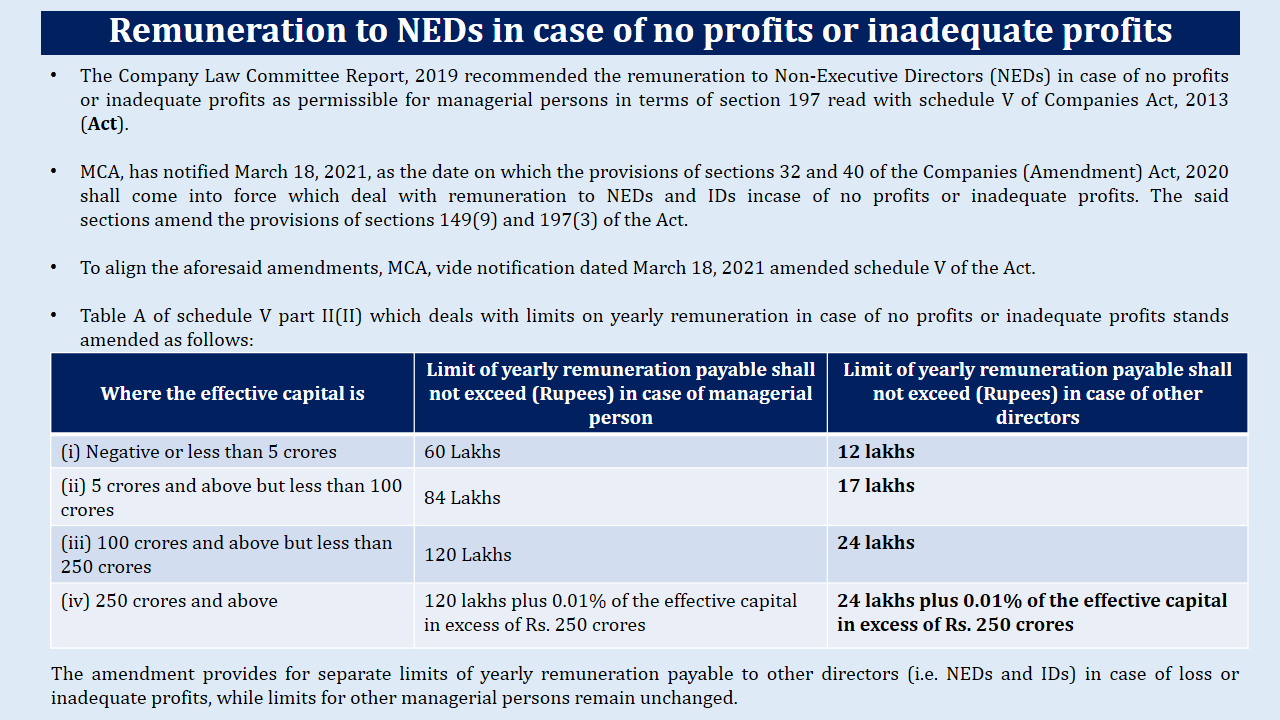
Part II of Schedule V of the Act deals with the remuneration of “managerial personnel”. In this connection, please note that “managerial personnel” refers to managing director, manager and whole-time director of the company. Now, with the present amendment to the Schedule, part II has become applicable on the “other directors” as well. The term “other directors” has been clarified in the amendment notification itself by way of an explanation which states,
“For the purposes of Section I, II and III (relevant parts that have been amended) the term “or other director” shall mean a non-executive director or an independent director.”
Section II of Part II of the Schedule specifies maximum remuneration that can be paid to a director, be it a managerial personnel or otherwise. For directors other than the managerial personnel, the remuneration has been specified at an amount almost 1/5th of that permissible to the managerial personnel.
The result of bringing IDs within the scope of Schedule V is that whereas the IDs would have been receiving very low remuneration in comparison to their roles and responsibilities in an organisation due to inadequacy of profits, the IDs will have a chance of getting a fair remuneration.
Questions relevant to the amendments
Various questions arise out of the amendments, such as –
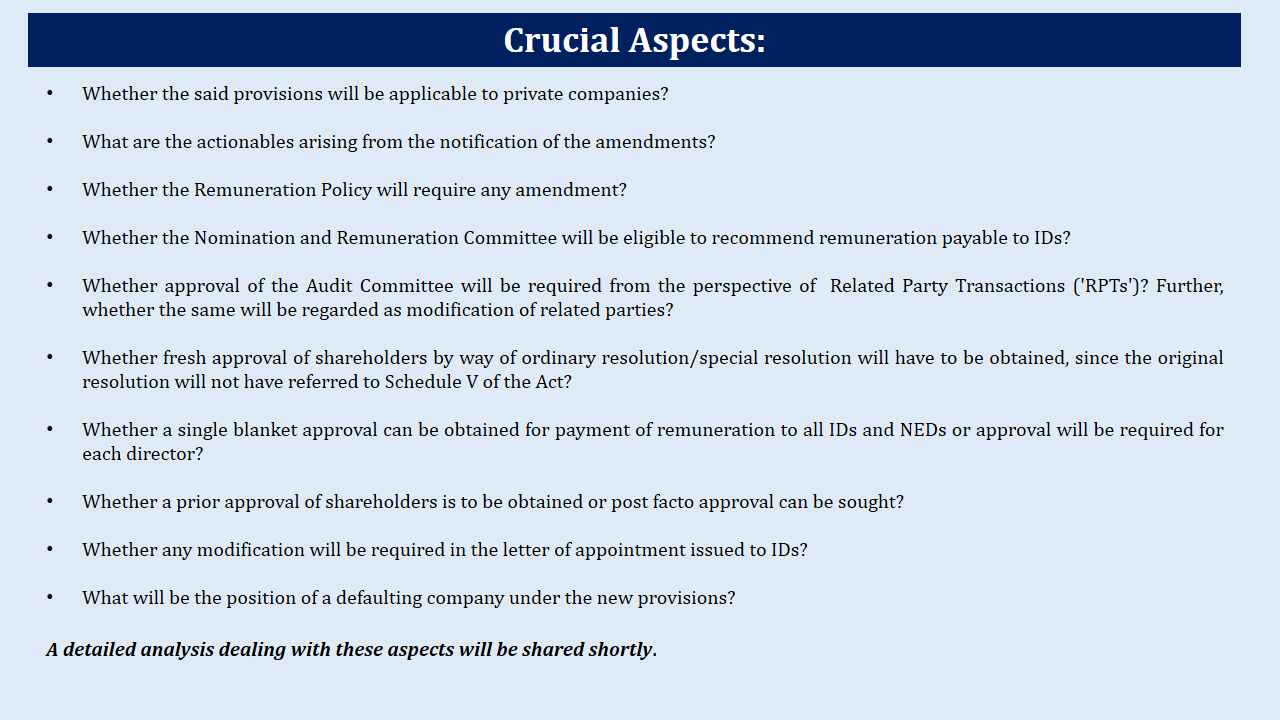
- Will the amendments require modification in existing remuneration policy?
- Can the NEDs and IDs be paid remuneration in excess of those specified in Schedule V?
- Whether a single approval can suffice for the remuneration of all NEDs and IDs or such resolutions will have to be approved separately for the individual directors?
- Whether NRC will be eligible to recommend remuneration payable to IDs?
- Whether a prior approval of shareholders will be required or whether post facto approval may be obtained?
Answers to these and other relevant questions revolving around the aforesaid amendments has been dealt with in our detailed FAQs and can be accessed here.
Conclusion
The role of non-executive and IDs is very crucial to a company. The professional expertise of NEDs in their specific fields brings requisite value to a company. Considering the role played by IDs in effectively balancing the conflicting interest of the company and its stakeholders and bringing independent judgement to the Board’s decisions, it would be unfair if they are not paid adequately for the efforts put by them in the effective conduct of business.
Further, in the present scenario, amidst the economic breakdown worldwide, many companies may not be able to earn the profits as expected, or might be facing losses as well. In such circumstances, the aforesaid amendments were a necessity.
However, the erstwhile provisions had no scope of payment of remuneration to them in case of loss. With the aforesaid amendments coming into force, the companies will be able to compensate their non-executive and IDs well, even in case of no/inadequate profits.
Our other articles on the related topics can be read here –
[4] https://vinodkothari.com/2020/03/remunerating-neds-ids-in-low-profit-yrs/
[5] https://vinodkothari.com/wp-content/uploads/2019/09/Manangerial-Remuneration_IMTB-_26.08.pdf
[1] SEBI has recently in its consultation paper on review of regulatory framework applicable to IDs suggested that profit-linked commissions should be barred and shall be substituted by higher sitting fees or issue of stock options. Please refer to our article for broader understanding of the same.
MCA notifies abridged annual return for small companies after 4 years
Carries out corrective changes in MGT Rules
By CS Aisha Begum Ansari, Assistant Manager, Vinod Kothari & Company
Introduction
Four years after proposing amendment in Section 92 (1) of Companies Act, 2013 (‘Act’), Ministry of Corporate Affairs (MCA) notified the amendment in Companies (Amendment) Act, 2017[1] with effect from March 5, 2021.
The aforesaid amendment provided for following under Section 92 (1) & (3):
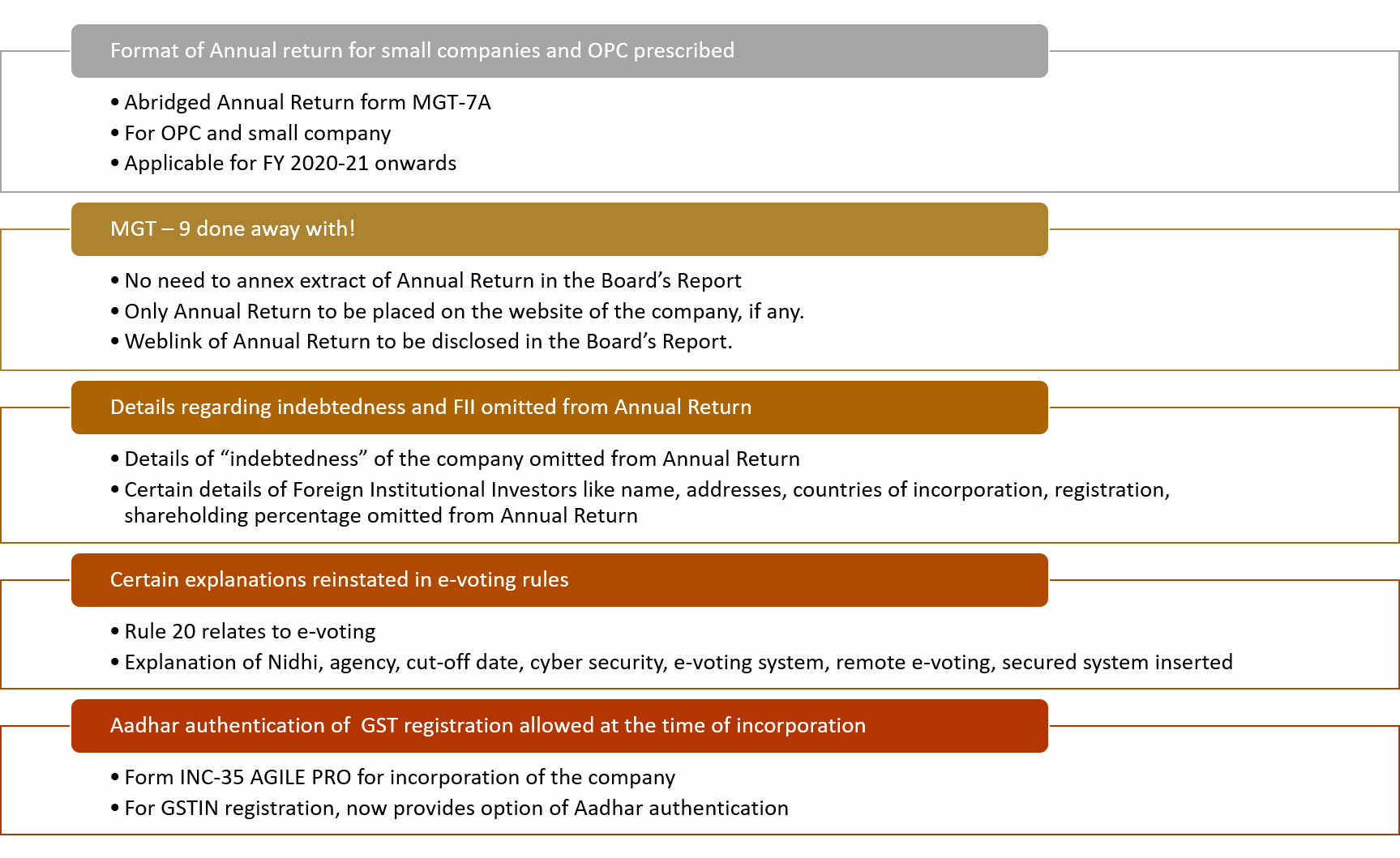
- Empowering Central Government to prescribe an abridged form of annual return for One Person Company (OPC) and Small Companies[2];
- Deletion of requirement to furnish details of indebtedness in the annual return;
- Deletion of requirement to furnish details indicating names, addresses, countries of incorporation, registration and percentage of shareholding of Foreign Institutional Investors;
- Doing away with the requirement of annexing extract of annual return to the Board’s report and mandating companies to place a copy of annual return on their website and provide the link of the same in the Board’ report.
While the amendment in relation to point 4. above was already notified with effect from August 28, 2020; MCA notified amendment in Companies (Management and Administration) Rules, 2014[3] (‘MGT Rules’) giving companies the option to annex extract of annual return in case of inability to place a copy of annual return on the website. Section 92 (3) of the Act post amendment did not provide any specific power to prescribe rules, however, MCA had amended Rule 12 of MGT Rules.
Further, in 2016 while amending MGT rules[4] in relation to voting by electronic means, MCA inadvertently deleted the explanations provided in sub-2 of Rule 20 that defined terms viz, agency, cut-off date, remote e-voting etc.
Corrective amendments in MGT Rules
MCA, on 5th March, 2021[5] notified amendments in MGT Rules to carry out corrective changes and to insert format of abridged annual return subsequent to notification of amendment in Section 92 (1) of the Act. The synopsis of the amendments are as mentioned below:
Insertion of abridged annual return in Form MGT-7A and revision of Form MGT-7
Rule 11(1) of MGT Rules have been substituted prescribing separate format of annual return for OPC and small companies which shall be filed in Form No. MGT-7A from the financial year 2020-21 onwards. Other companies to continue to file annual return in Form MGT-7.
MCA has also revised the format of Form MGT-7 for filing the annual return by companies other than OPC and small companies.
Form MGT-7 v/s Revised Form MGT-7
| Sr. No. | Para & Field No. | Information required in revised Form MGT-7 which was not required under erstwhile Form MGT-7
(For Companies other than OPC & Small Companies) |
| 1. | Para IV Field (i) (d) | 1. Bifurcation of shares held in demat and physical form.
2. Requirement of mentioning ISIN of equity shares of the Company; |
| 2. | Para IV Field (iv) | Following rows are deleted:
1. Secured Loans (including interest outstanding/accrued but not due for payment) excluding deposits; 2. Unsecured Loans (including interest outstanding/accrued but not due for payment) excluding deposits; 3. Deposit. |
| 3. | Certification part | Following new certification are required to be confirmed, (seems relevant only for private companies).
1. The company has not, since the date of the closure of the last financial year with reference to which the last return was submitted or in the case of a first return since the date of incorporation of the company, issued any invitation to the public to subscribe for any securities of the company. 2. Where the annual return discloses the fact that the number of members, (except in case of one person company), of the company exceeds two hundred, the excess consists wholly of persons who under second proviso to clause (ii) of sub-section (68) of section 2 of the Act are not to be included in reckoning the number of two hundred. |
Revised Form MGT-7 and Form MGT-7A
| Sr. No | Para & Field No. | Information required to be provided in Form MGT-7A which was not required under Form MGT-7
(For OPC & Small Companies) |
| 1. | Para I Field vi | Whether Form is filed for OPC or Small Co. [New Insertion]
|
| 2. | Para III | Particulars of associate companies including joint ventures. (not applicable for OPC) [Substituted by deleting holding and subsidiary Companies] |
| 3. | Para IV (ii) | Details of shares/Debentures Transfer since closure date of last financial year (or in the case of the first return at any time since the incorporation of the Company) (not applicable for OPC-Newly Inserted) |
| 4. | Para IV (iv) | Securities (other than shares and debentures) (not applicable to OPC-Newly Inserted) |
| 5. | Para VIII Field A | Members/Class/Requisitioned/CLB/NCLT/Court Convened Meetings (not applicable to OPC-Newly Inserted) |
| 6. | Para VIII Field B | Board Meetings (not applicable for OPC-Newly Inserted) |
| 7. | Para VIII Field C | Attendance of Directors (not applicable for OPC-Newly Inserted) |
| 8. | New attachment | List of Directors [Newly Inserted] |
| 9. | Certification part | Following new certification are required to be confirmed.
1. The company has not, since the date of the closure of the last financial year with reference to which the last return was submitted or in the case of a first return since the date of incorporation of the company, issued any invitation to the public to subscribe for any securities of the company. 2. Where the annual return discloses the fact that the number of members, (except in case of one person company), of the company exceeds two hundred, the excess consists wholly of persons who under second proviso to clause (ii) of sub-section (68) of section 2 of the Act are not to be included in reckoning the number of two hundred (seems relevant only for small companies). |
| 10. | Information not required to be provided in Form MGT-7A which was required in Form MGT-7 | 1. Whether shares listed on recognized Stock Exchange(s);
2. CIN of the Registrar and Transfer Agent; 3. Details of stock split/consolidation during the year (for each class of shares); 4. Secured Loans (including interest outstanding/accrued but not due for payment) excluding deposits; 5. Unsecured Loans (including interest outstanding/accrued but not due for payment) excluding deposits; 6. Deposit; 7. Details of directors and key managerial personnel; 8. Committee Meetings; 9. Number of CEO, CFO and Company secretary whose remuneration details to be entered |
Deletion of extract of annual return
Realizing that amended Section 92(3) of the Act did not provide any prescriptive power to MCA, Rule 12 has been substituted to provide that Annual Return is required to be filed with the Registrar upon payment of specified fees. While, the requirement to file Annual Return with the Registrar along with timelines has been provided in Section 92 (4), Rule 12 still provides a generic statement.
So, the positions stands clarified that companies will be required to upload the annual return on the website, if any, and provide the link thereof in the Board’s report.
Explanations relating to e-voting restored
Rule 20 of MGT Rules deals with voting through electronic means wherein it mandates the companies whose equity shares are listed on recognized stock exchange and who have not less than 1000 members to provide the facility of e-voting to the members in the general meeting. It exempted Nidhi companies from the requirement of providing e-voting facility to its members.
The original text of Rule 20 explained the following terms:
- Agency
- Cut-off date
- Cyber security
- Electronic voting system
- Remote e-voting
- Secured system
- Voting by electronic means
The above terms were omitted vide Companies (Management and Administration) Amendment Rules, 2016[6]. MCA has restored the same with the present amendment. Accordingly, the cut-off date will be not earlier than seven days before the date of general meeting, which was previously specified in the Rules.
Conclusion
The present amendment brings clarity and settles all questions relating to annual return and e-voting. Annexing extract of annual return is past. Whole of the annual return in Form MGT-7 or Form MGT – 7A as applicable, is required to be uploaded on the website of the company and web-link of the same to be provided in the Board’s Report.
[1]http://ebook.mca.gov.in/notificationdetail.aspx?acturl=TTbtgoimZaEriqvC1uq63cVI1aUKrmySF7pn3LWSIhRnwlDT+xFtqSRh8eE9YDYmTZpXWl/g6A+Dx/OT8agtKUclWEhfgK03TlnWLOuiGw6K1VTDhD8p3mpQTiLgy2ewBHNyAHD0wK1NTYvNTxvKE72myo++ycxQaipOFSzBIY4coKGinwHEcAFWj2Fn6hr6
[2] “small company” means a company, other than a public company whose paid-up share capital does not exceed two crore rupees and turnover as per profit and loss account for the immediately preceding financial year does not exceed twenty crore rupees
[3]http://ebook.mca.gov.in/notificationdetail.aspx?acturl=6CoJDC4uKVUR7C9Fl4rZdatyDbeJTqg3z9mihm9CxHHzu82fmWlMKzy8jPS04vbR
[4]http://ebook.mca.gov.in/notificationdetail.aspx?acturl=6CoJDC4uKVUR7C9Fl4rZdatyDbeJTqg3DZ3eKuS27Ryli2KQpdUJBX7LNlkBrkXwnB0Mo6W4iI/tFsp4nH5DYuXMxD09O4auZIWA0g9jbZU=
[5] https://www.mca.gov.in/Ministry/pdf/CompaniesMgmtAdminAmndtRules_05032021.pdf
[6]http://ebook.mca.gov.in/notificationdetail.aspx?acturl=6CoJDC4uKVUR7C9Fl4rZdatyDbeJTqg3DZ3eKuS27Ryli2KQpdUJBX7LNlkBrkXwnB0Mo6W4iI/tFsp4nH5DYuXMxD09O4auZIWA0g9jbZU=
Our other videos and write-ups may be accessed below:
Relating to above topics:
YouTube:
https://www.youtube.com/channel/UCgzB-ZviIMcuA_1uv6jATbg
Other write-up relating to corporate laws:
https://vinodkothari.com/category/corporate-laws/
MCA updates brings changes to the Annual Return
MCA eases some requirements for OPCs and small companies
Companies (Management and Administration) Amendment Rules, 2021 notified
Companies (Incorporation) Third Amendment Rules, 2021 notified
ESG concerns in corporate governance in India
Sikha Bansal, Partner (sikha@vinodkothari.com) and Payal Agarwal, Executive (payal@vinodkothari.com)
Introduction
ESG (where, E stands for Environment, S for Society, and G for Governance) is a term that has earned a lot of attention in the recent years. Related terms used are ESG investing, ESG reporting, ESG rating, etc. – all focussing on and circumscribing same factors.
The ESG analysis is sought as a measure of responsible investing, and goes beyond the traditional method of using only financial factors for evaluation of an investment or potential investment. ESG, in essence, recognises financial relevance of various non-financial elements which impact business in several ways. With sustainable development being the desirable result of whatever we do, efforts have been made to incorporate ESG issues in the analysis of the business performance as a whole.
In context of the same, we have tried identifying ESC concerns in India, in relation to corporate businesses. While in India, we have already something called ‘business responsibility reporting’, we need to see if this sufficiently captures the spirit of ESG and where it stands vis-à-vis global practices.
What is ESG?
Before we go on to the question why we need ESG, we need to understand what ESG, and also, why and how it has assumed so much of importance.
The emergence of ESG dates back to earlier years of 2000s. A report titled “Who Cares Wins: Connecting Financial Markets to a Changing World”[1], highlighted the emerging ESG issues and made several recommendations, including – (i) financial institutions should commit to integrating environmental, social, and governance factors in a more systematic way in research and investment processes, (ii) the companies a leadership role by implementing environmental, social and corporate governance principles and polices and to provide information and reports on related performance in a more consistent and standardised format, and (iii) investors shall explicitly request and reward research that includes environmental, social and governance aspects and to reward well-managed companies. Further, the report recommended that the financial analysts shall not only focus on ESG risks and risk management, but also consider ESG issues as a potential source of competitive advantage. The report also identified the following drivers through which good management of ESG issues can contribute to shareholder value creation[2].
Later, UNEP FI, in its 2005 Report[3], highlighted the distinction between ‘value-driven’ vs. ‘values-driven’ investment, and observes, “ESG considerations are capable of affecting investment decision-making in two distinct ways: they may affect the financial value to be ascribed to an investment as part of the decision-making process and they may be relevant to the objectives that investment decision-makers pursue.” This report noted that, the movement towards mainstream consideration of ESG issues in investment decision-making is a response of variety of factors, including, increasing evidence of the nexus between performance on ESG issues and financial performance, reputational concerns, consumer pressure, public opinion, introduction of corporate environmental reporting obligations, etc.[4]
Some institutional investors believed that environmental, social and governance (ESG) issues were not relevant to portfolio value, and were therefore not consistent with their fiduciary duties. However, in report titled “Fiduciary Duty in the 21st Century’[5], issued by UN agencies and PRI[6], it was clarified that the assumption is no longer supported, and that, failing to consider long-term investment value drivers, which include environmental, social and governance issues, in investment practice is a failure of fiduciary duty. The said report identifies critical importance of incorporating ESG standards into regulatory conceptions of fiduciary duty, for mainly three reasons – firstly, ESG incorporation is an investment norm; second, ESG issues are financially material; and thirdly, policy and regulatory frameworks are changing to require ESG incorporation.
Presently, there are several organisations, projects and reports focussing on ESG issues. These organisations may be governmental as well as independent. For instance, Global Reporting Initiative (GRI)[7] has formulated several standards[8] for sustainability reporting. See also, OECD (2017), Investment governance and the integration of environmental, social and governance factors.
Pillars of ESG
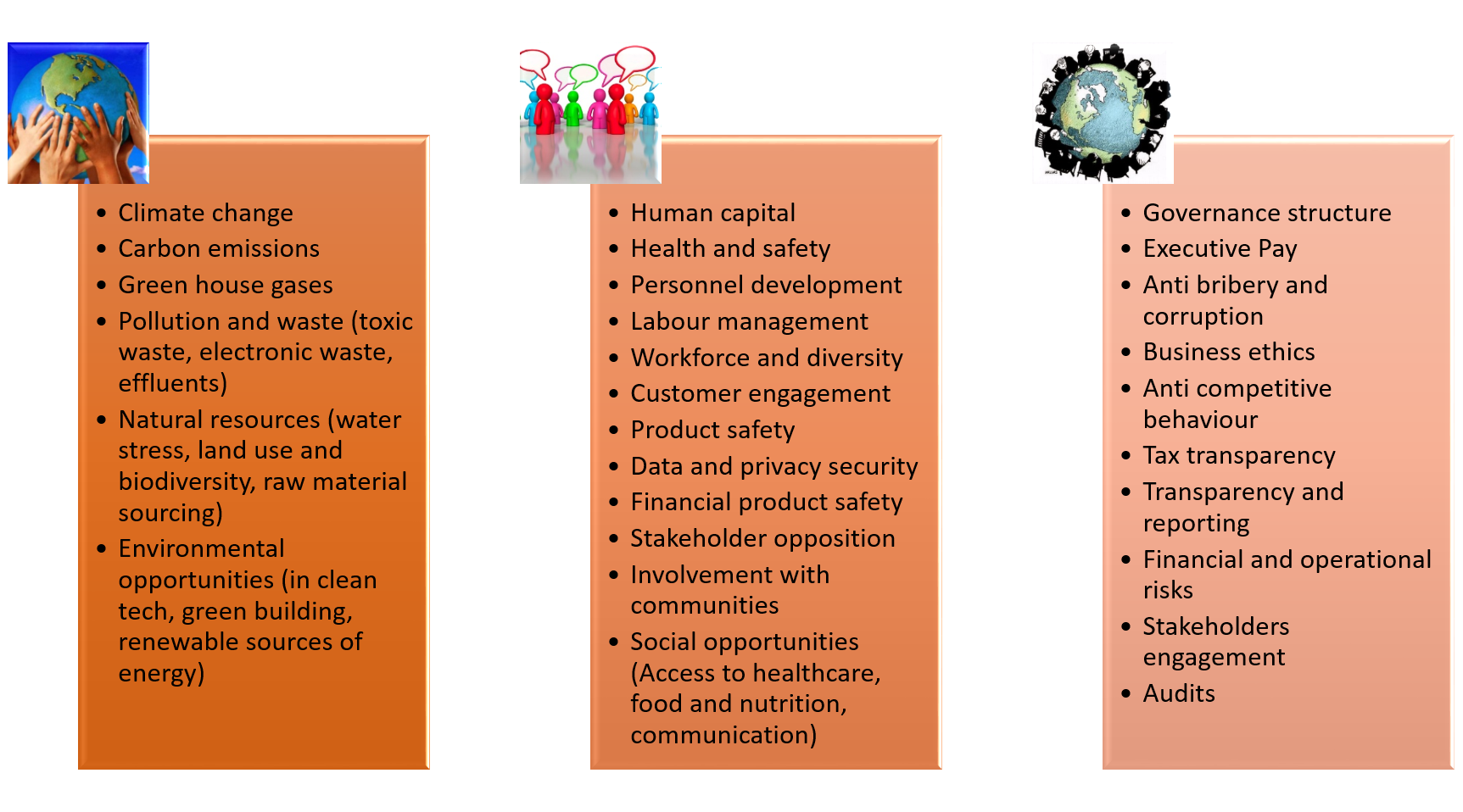
ESG, as stated above, has 3 pillars – Environmental, Social and Governance Each of these pillars comprises of several factors which would be a ‘parameter’ in ESG analysis.
- “environmental” pillar focusses on creating a sustainable environment, where parameters such as impact of a company’s activities on the climate, company’s liability towards the environment, creating eco-friendly products, etc are checked and measured;
- “social” aspect focusses on creating value for the society, by laying emphasis on the human rights issues, workplace health and safety, labour training and management, interaction with communities, customer relationship etc;
- “governance” aspect covers issues on the corporate governance of a company and has two main elements: corporate structures, and corporate behaviour.
We have compiled a list of such factors[9] as below –
ESG Reporting
EU law requires large companies to disclose certain information on the way they operate and manage social and environmental challenges. EU’s directive, 2014/95/EU also called the non-financial reporting directive (NFRD), acknowledges that disclosure of non-financial information is vital for managing change towards a sustainable global economy by combining long-term profitability with social justice and environmental protection and lays down the rules on disclosure of non-financial and diversity information by large companies[10]. The Directive amends the accounting directive 2013/34/EU (by inserting Article 19a) so as to mandate inclusion of non-financial statement containing information to the extent necessary for an understanding of the undertaking’s development, performance, position and impact of its activity, relating to, as a minimum, environmental, social and employee matters, respect for human rights, anti-corruption and bribery matters, etc.
It further provides, “Where the undertaking does not pursue policies in relation to one or more of those matters, the non-financial statement shall provide a clear and reasoned explanation for not doing so.”
The EU has issued its guidelines to help companies disclose environmental and social information, and published guidelines on reporting climate-related information. Also, EU has also launched a public consultation on the review of the NFRD[11].
The OECD Report of 2017[12] compiles ESG reporting requirements (voluntary as well as mandatory) across the world by institutional investors, and by way of corporate disclosures. The report observes that the reporting requirements are usually voluntary (“comply or explain”) and are not prescriptive on the methods or metrics to be used.
The Financial Reporting Council (FRC) of UK released a discussion paper – “A Matter of Principles: The Future of Corporate Reporting” (2020). The discussion paper proposes a network of interconnected reports based on objectives rather than a single comprehensive annual report. The proposals include 3 reports – Business report, the full Financial Statements and a new Public Interest Report. It also focuses on widening the definition of materiality so that it does not remain limited to accounting standards only, but covers other wider range of activities that affect a company significantly. Section 6 of the this Report deals extensively with non-financial reporting, stated to include information relating to employees, suppliers, customers, the community, the environment and human rights.
In a study, “The consequences of mandatory corporate sustainability reporting: evidence from four countries (2015)”, it has been observed that even though the regulations often allowed companies, via comply or explain clauses, to choose not to make greater disclosure, there was a 30%-50% average increase in ESG disclosure as a result of the regulations being introduced (albeit from a low starting base). The greatest increase came in the first year of the regulations coming into force. All three types of disclosure – environmental, social and governance – increased. The findings, therefore, suggest that, contrary to popular belief that an increase in disclosure regulation imposes significant costs on companies and, therefore, has a negative impact on shareholders, the reality is that improved disclosure creates value for companies, not destroys it.
ESG Rating
Investors, institutional institutions, etc. would generally make use of ESG information for investment decisions through ESG ratings provided by ESG rating agencies[13]. This assessment and measurement often forms the basis of informal and shareholder proposal-related investor engagement with companies on ESG matters[14]. ESG factors can provide valuable insights into possible current and future environmental and social risks and opportunities for corporate entities, given the impact and dependence entities have on the environment and society. These ESG issues in turn have the potential to lead to a direct or indirect financial impact on the entity’s profits and investment returns[15].
See Boffo, R., and R. Patalano (2020), “ESG Investing: Practices, Progress and Challenges”, OECD Paris, for an elaborate discussion on ESG rating and indices and the methodologies adopted for the same. The paper also compiles ESG Criteria as used by major index providers as follows[16] –
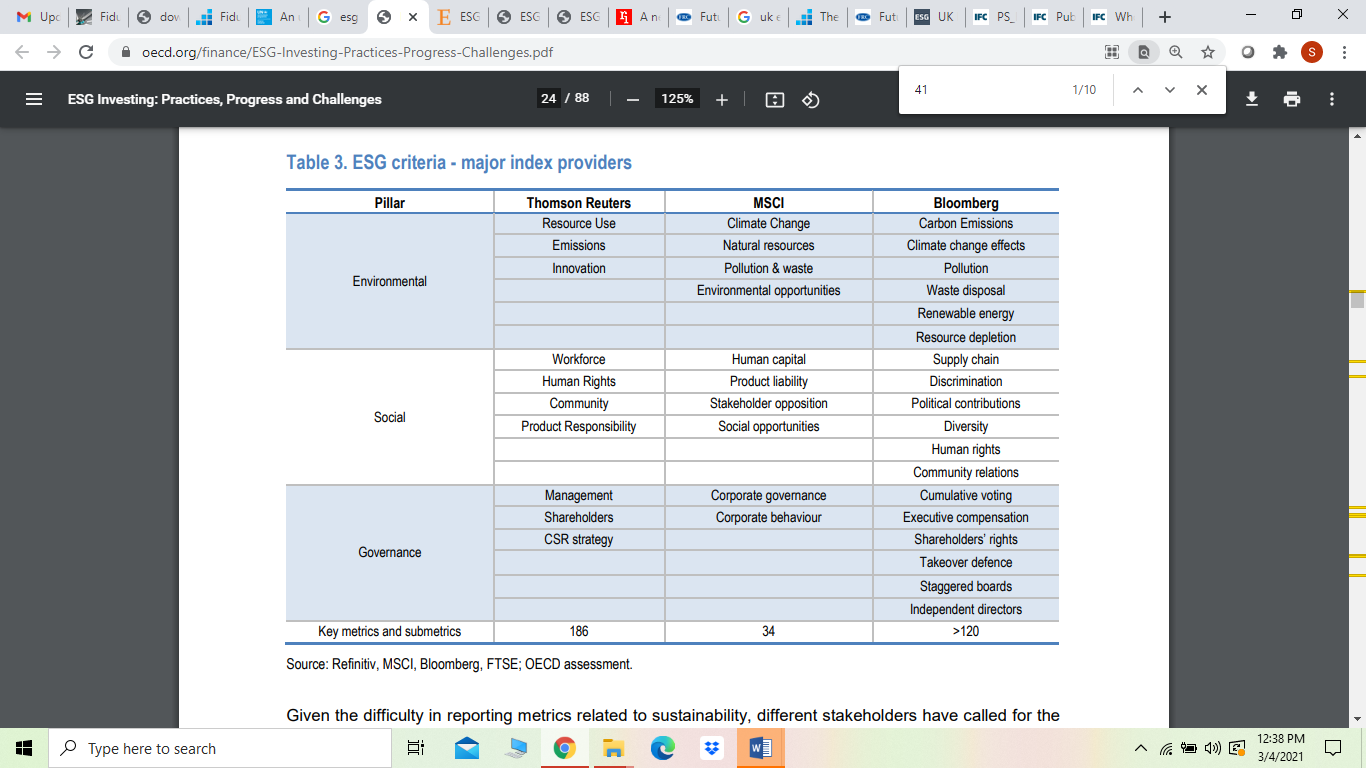
Even though there are countries where ESG Reporting has been initiated as a voluntary or mandatory measure, the requirement of ESG rating has not been found to be mandated in any country by way of explicit regulations on the same. However, institutional investors, proxy advisor firms etc., are largely using these ratings while making investment decisions as part of making socially responsible investment.
ESG in Indian Context
The Indian legislation has been trying to cover the various aspects of ESG in a fragmented manner.
For instance, the board’s report shall disclose the conservation of energy, technology absorption, etc.[17] The aspects have to be dealt with in detail – the company shall disclose steps taken or impact on conservation of energy, steps taken to utilise alternate sources of energy, capital investment in energy conservation equipments, efforts towards technology absorption, etc. Besides, a director owes a fiduciary duty towards the community as well as for the protection of the environment[18]. Also, CSR activities include various socio-economic activities, required to be disclosed separately in the annual report[19]. However, the closest requirement is that of Business responsibility Reports (BRR) which has been mandated from ESG perspective only, as discussed below.
What is Business Responsibility Report (BRR)?
BRR or Business Responsibility Report can be said to be the foremost step in India in promoting non-financial reporting in India, on a mandatory basis. The initiative was one of the responses to India’s commitment towards the United Nations Guiding Principles on Business & Human Rights (UNGPs) and Sustainable Development Goals.
The BRR is based on the 9 principles in line with the ‘National Voluntary Guidelines on Social, Environmental and Economic Responsibilities of Business’ (NVG)[20] issued by MCA. The guidelines state that the companies should not be just responsible but also socially, economically and environmentally responsible. Through such reporting, the guidelines expect that businesses will also develop a better understanding of the process of transformation that makes their operations more responsible. The NVG were further revised and the MCA formulated the ‘National Guidelines on Responsible Business Conduct’ (NGRBC)[21]. The said guidelines stipulated that the businesses should –
- conduct and govern themselves with integrity in a manner that is Ethical, Transparent and Accountable,
- provide goods and services in a manner that is sustainable and safe,
- respect and promote the well-being of all employees, including those in their value chains,
- respect the interests of and be responsive to all their stakeholders,
- respect and promote human rights,
- respect and make efforts to protect and restore the environment,
- when engaging in influencing public and regulatory policy, should do so in a manner that is responsible and transparent,
- promote inclusive growth and equitable development, and
- engage with and provide value to their consumers in a responsible manner.
The Securities and Exchange Board of India (SEBI), in 2012[22], through its listing conditions mandated the top 100 listed entities by market capitalisation to file BRR from ESG perspective. This was extended to top 500 companies in FY 2015-16[23]. The coverage has been extended to 1000 companies now[24]. In the year 2020, MCA issued Report of the Committee on the Business Responsibility Reporting, and SEBI issued a Consultation Paper on the format for Business Responsibility and Sustainability Reporting (BRSR, suggesting that BRR shall be renamed as BRSR). See our detailed analysis of the recommendations made in these reports.
See also, our earlier article on BRR. The eventual development in BRR framework is shown below –

BRR – Identifying ways to improve
ESG has no statutory definition, per se. We have tried identifying possible factors, based on various reports, indices, etc. which would reflect a holistic ESG perspective of an entity.
How effective is the present framework of BRR can be understood by way of the following table:
BRR vs ESG – Hits and Misses
| Hits | Misses |
| Climate change | Carbon emissions |
| Resource use , sustainable sourcing | Green building |
| Environmental protection and restoration | Biodiversity and land use |
| Renewable energy | Discharge of effluents |
| Water use | ————- |
| Energy efficiency | ————— |
| Clean tech | —————- |
| Safety of employees, customers | Privacy and data security |
| Skill upgradation training | Financial product liability |
| Labour management | ———— |
| Practice against child labour, sexual harassment, forced labour | ———— |
| Protection of human rights | ————- |
| Satisfactory redressal of customer complaints | ———— |
| Stakeholder engagement | ———— |
| Ethics and bribery | Board structure |
| Anti competitive behaviour | Executive pay |
| Unfair trade practices | Codes and values |
| —————– | Tax transparency |
Most of these gaps in the present BRR format are covered under the proposed BRSR. The BRSR has provisions for reporting on the carbon emissions of a company, discharge of other effluents by the company, and reporting relating to the privacy and data security of the customers etc. Also, the BRSR defines the scope of reporting for every item very precisely.
However, matters such as financial product liability and various aspects of governance still needs a dedicated space.
NSE Study of BRR Reporting in India
A study of NSE, while conducting the ESG analysis of Indian companies, has checked the disclosures provided under the BRR framework by the companies as part of its ESG analysis.
Some significant findings of the study has been pointed below:
- Among the nine principles, the least number of sample companies responded positively for disclosures on principle 7 (i.e., public advocacy). It had the lowest score on all four measures.
- One of the recurring reasons for not framing a policy on the principle 7 is that there is no specific/ formal policy on public advocacy. However, companies have stated that they indirectly covered aspects of principle 7 under other policies. This may be attributed to the fact that in India, advocacy, if at all done, is done in a non-transparent manner.
- The second worst response was with respect to the principles relating to ‘respect and promoting human rights’ and ‘engagement and providing value to customers and consumers’. Once again, probably, these concepts are yet to be assimilated in our system.
- Higher positive responses were found across principle 1 (ethics), principle 3 (employees), principle 4 (stakeholder), principle 6 (environment), and principle 8 (growth and equitable development – social responsibility). This can be attributed to the fact that some of these policies flow from various legal mandates in India. Hence, most companies have formal policies to comply with the law on these principles.
The study highlights that companies have largely scored better on policy disclosures followed by governance factor, compared to environment and social factors. This can be attributed to the fact that governance reforms have transformed into laws by various regulatory agencies within India, in the last two decades. Similarly, many policies have been mandated to be prepared by regulatory authorities. Hence, companies have scored higher on policy disclosure parameters.
Closing Thoughts
The BRR Reporting in India, in terms of key areas, goes a long way in presenting a holistic ESG scenario. Some structural changes in the extant format may facilitate better reporting.
Further, the Indian companies are found to perform well in the governance related matters, in comparison to the environmental and social factors, admittedly for the presence of various statutory requirements and regulatory supervision on the governance requirements of a company. However, the companies need to improve their environmental and social scores as well.
[1] December, 2004. The Report was a joint initiative of financial institutions which were invited by United Nations Secretary-General Kofi Annan to develop guidelines and recommendations on how to better integrate environmental, social and corporate governance issues in asset management, securities brokerage services and associated research functions. See also, “Who Cares Wins” : One Year On” – A Review of the Integration of Environmental, Social and Governance Value Drivers in Asset Management, Financial Research and Investment Processes, published by the International Finance Corporation.
[2] Refer, page 12 exhibit 9 of the said Report
[3] A legal framework for the integration of environmental, social and governance issues into institutional investment”
[4] Refer, page 24 of the said Report.
[5] The website is https://www.fiduciaryduty21.org/ . The report has been last updated in the year 2019.
[6] Principles of Responsible Investing (PRI) is a United Nations-supported initiative, launched in 2006 by UNEP Finance Initiative and the UN Global Compact.It is a network of international investors working together to put the six Principles for Responsible Investment into practice. The PRI were devised by the investment community and reflect the view that environmental, social and governance (ESG) issues can affect the performance of investment portfolios and therefore must be given appropriate consideration by investors if they are to fulfill their fiduciary (or equivalent) duty. In implementing the Principles, signatories contribute to the development of a more sustainable global financial system.
[7] GRI was founded in Boston in 1997 following public outcry over the environmental damage of the Exxon Valdez oil spill. The aim was to create the first accountability mechanism to ensure companies adhere to responsible environmental conduct principles, which was then broadened to include social, economic and governance issues. The first version of what was then the GRI Guidelines (G1) published in 2000 – providing the first global framework for sustainability reporting. The following year, GRI was established as an independent, non-profit institution. In 2016, GRI transitioned from providing guidelines to setting the first global standards for sustainability reporting – the GRI Standards.
[8] The GRI standards can be accessed here https://www.globalreporting.org/standards/
[9] The list is a compilation of the various factors identified by various organisations and reports such as, PRI, MSCI Research, NSE-SES report on ESG analysis of 50 Indian companies, etc.
[10] EU rules on non-financial reporting only apply to large public-interest companies with more than 500 employees. This covers approximately 6,000 large companies and groups across the EU.
[12] OECD (2017) Investment governance and integration of environmental, social and governance factors
[13] Some well- known ESG rating providers include: (a) Dow-Jones Sustainability Index, (b) S & P Global Ratings, (c) MSCI ESG Research etc.
[14] https://corpgov.law.harvard.edu/2017/07/27/
[15] S&P Global Ratings: Exploring Links To Corporate Financial Performance
[16] Source: Boffo, R., and R. Patalano (2020), “ESG Investing: Practices, Progress and Challenges”, OECD Paris
[17]Companies Act, 2013, section 134(3)(m), read with rule 8 of the Companies (Accounts) Rules, 2014
[18] Ibid, section 166.
[19] Ibid, section 135 read with Companies (Corporate Social Responsibility Policy) Rules, 2014.
[20] 2011. A refinement of earlier Corporate Social Responsibility Voluntary Guidelines 2009, released by the Ministry of Corporate Affairs in December 2009.
[21] 2019. See Press Release.
[22] CIR/CFD/DIL/8/2012 dated 13th August, 2012
[23] See update, and notification.
[24] See notification.
Corpus contributions: Whether CSR?
Ajay Kumar K V | Vinod Kothari and Company
corplaw@vinodkothari.com
Introduction
Corporate Social Responsibility (‘CSR’) is a concept whereby an entity integrates its business with the social goals in order to achieve a socio-economic balance. In India, section 135 of Companies Act, 2013 (‘Companies Act’) and the rules made thereunder govern CSR activities to be mandatorily undertaken by companies which fulfill the criteria as specified in the said Act. The CSR norms have recently undergone substantial changes[1].
When the CSR provisions were initially notified, corpus contribution to specific funds & activities was considered to be CSR expenditure under the extant CSR Rules (see, Rule 7 before amendments). The term ‘contribution to corpus’ led to confusion among the industry and MCA came out with a clarification letter (No. 05/01/2014- CSR) dated 18th June, 2014[2] clarifying that the contribution to Corpus of a Trust/ society/ section 8 companies etc. will qualify as CSR expenditure as long as (a) the Trust/ society/ section 8 companies etc. is created exclusively for undertaking CSR activities or (b) where the corpus is created exclusively for a purpose directly relatable to a subject covered in Schedule VII of the Act.
However, the CSR rules, in their present form, do not mention the term ‘corpus’ anywhere. As such, the question is whether corpus contribution is still an eligible CSR expenditure.
What is ‘corpus’?
‘Corpus’, in the context of trusts, etc. would generally mean contributions in the nature of capital. The courts and tribunals have opined that corpus specific voluntary contributions are of capital nature and hence are not taxable at the hands of the trust. In Sukhdeo Charity Estate v. Commissioner of Income-Tax[3], the Rajasthan High Court observed as follows:
“”Corpus” is a Latin word and the English meaning of it is a “body”. In Random House Dictionary, college edition, page 301, one of the meanings of “corpus” is “a principal or capital sum, as opposed to interest or income”. Similar is the meaning of the word “corpus” in Black’s Law Dictionary, 5th edition, page 310, Thus, a capital amount in the form of money, movable or immovable property and the donations received by a charitable trust for specific purposes may be said to be corpus or remained any capital in a fund in contrast to income.”
The Technical Guide[4] issued by the Institute of Chartered Accountants of India observes specific features of ‘corpus’ in the context of non-profit organisations (NPOs). The Technical Guide also discussed various kinds of ‘funds’ as may be maintained by the NPOs – restricted funds, unrestricted funds, etc. Restricted funds are subject to certain conditions set out by the contributors and agreed to by the NPO when accepting the contributions. The restriction may apply to the use of the moneys received or income earned from the investment of such moneys or both. Funds, the use of which is subject to legal restrictions, are also considered as restricted funds.
See also, exposure draft on Uniform Accounting & Reporting Framework for NGOs[5] which also makes similar observations.
Corpus contribution under Income Tax Act
Voluntary contributions to trusts, etc. are made taxable vide the definition of income under Section 2(24) (iia) of the Income Tax Act which reads as under-
“2(24)(iia) Voluntary contributions received by a trust created wholly or partly for charitable or religious purposes or by an institution established wholly or partly for such purposes or by an association or institution referred to in clause (21) or clause (23), or by a fund or trust or institution referred to in sub-clause (iv) or sub-clause (v) or by any university or other educational institution referred to in sub-clause (iiiad) or sub-clause (vi) or by any hospital or other institution referred to in sub-clause (iiiae) or sub-clause (via) of clause (23C) of section 10 or by an electoral trust.”
As per Section 12 of the Income Tax Act, any voluntary contributions received by a trust created wholly for charitable or religious purposes or by an institution established wholly for such purposes (not being contributions made with a specific direction that they shall form part of the corpus of the trust or institution) shall for the purposes of section 11 be deemed to be income derived from property held under trust wholly for charitable or religious purposes.
It is a settled legal proposition, in case of a registered Trust under the Income-Tax Act, the corpus specific voluntary contributions are outside the scope of income as defined in section 2(24)(iia) of the Act due to their “capital nature”.
See, Sukhdeo Charity Estate v. Commissioner of Income-Tax (supra). In ITO v. Shri Sachyaya Mataji Trust [ITA No.538/Jodh/2013,] dated 09/05/2014[6], the Jodhpur bench of ITAT held that if a voluntary contribution is made with a specific direction, it shall be treated as capital of the trust for carrying on its charitable or religious activities. Then such an income falls under section 11(1) (d) as is not liable to tax. If the intention of the donor is to give that money to a trust to keep in trust the account in deposit and utilise the income therefrom for carrying on a particular activity, it satisfies the definition part of the corpus. The assessee would be entitled to the benefit of exemptions from payment of tax.
On an analysis of the above case laws and the provisions of the Income Tax Act, ‘corpus’ would include sums given with specific directions.
Thus voluntary contribution made with a specific direction as in the case of a CSR project contribution is a capital receipt for the Trust and hence not taxable as income. The money received in these funds has a specific purpose and not available for conducting activities that are ancillary to the main objects of the trust.
Corpus Contribution and CSR
The above discussion brings in more clarity with respect to the term ‘corpus contribution’. Corpus contribution, as is generally understood, is a contribution of capital nature, given with specific directions. In respect of CSR, since it has a specific purpose and is mandated by the law, it can be termed as corpus contribution.
The objective of CSR is broad and restricting CSR to only projects/programmes to be undertaken by the company (either directly or through implementing agencies) would narrow down the benefits which CSR provisions intend to offer. As such, fund contributions (of course, subject to certain conditions), should qualify as CSR Expenditure.
In Technical Guide on Accounting of CSR Funds by Third Parties [February, 2021][7], para 26 states as follows –
“26. The third parties i.e. section 8 company, or a registered trust or registered society may receive Corpus donation, which could be a CSR expenditure in the hands of the donor company if the required conditions are complied with. Corpus donations are with a specific direction regarding the use of the funds and characteristically capital in nature. MCA in General Circular No.21/2014 dated 18th June 2014 has clarified that contribution to Corpus of a Trust/ society/ section 8 companies etc. will qualify as CSR expenditure . . .”
Therefore, note that, such corpus contribution will still be subject to the 2 conditions as stated in the MCA Circular of 2014 (see, above). Also, there must be clear directions on the part of the company to the said entity as regards activities to be undertaken, modalities of fund utilisation, etc. and the company shall use appropriate monitoring and reporting measures to satisfy itself that the funds have been utilised for the specified activity/activities.
Here, one should also distinguish between fund contribution to an entity and making disbursement of funds to an implementing agency. In our earlier article titled ‘Understanding the borderline between implementing agencies and beneficiaries’[8], we have discussed distinguishing features of an ‘implementing agencies’, and ‘beneficiaries’ and the consequential impact of the same on the CSR compliances by the company. In case of fund contribution, the entity shall rather be a ‘beneficiary’ and not an ‘implementing agency’.
Conclusion
Basis discussions above, one may view that corpus or fund contributions should qualify as CSR expenditure provided that, the following conditions are fulfilled –
- (a) the entity is created exclusively for undertaking CSR activities or (b) where the fund/corpus is created exclusively for a purpose directly relatable to a subject covered in Schedule VII of the Act.
- the company gives specific directions to the entity with respect to activities, etc. to be undertaken, and for utilisation of the funds so contributed;
- the entity provides proper fund utilisation reports to the company such that the company can assess impact of the contributions and satisfy itself that the funds have been actually used for the specified activities.
The above conditions are in addition to the overarching regulatory requirements of having a CSR committee, and a well-defined CSR policy, etc. Any corpus/fund contribution proposed to be made shall be subject to overall regulatory requirements.
[1] Read our various articles on https://vinodkothari.com/csr/
[2] https://www.mca.gov.in/Ministry/pdf/General_Circular_21_2014.pdf
3 https://resource.cdn.icai.org/60115csr48973tg.pdf
[3] https://indiankanoon.org/doc/1153358/
[4] See Technical Guide on Accounting for Not-for-Profit Organisations here: https://kb.icai.org/pdfs/PDFFile5b279c36d4ec27.59253395.pdf
[5] https://www.icai.org/post.html?post_id=6832
[6] https://indiankanoon.org/doc/71326209/?type=print
[7] ICAI: https://resource.cdn.icai.org/62997csr50957tg-csrfunds.pdf
[8] https://vinodkothari.com/2021/02/understanding-borderline-between-implementing-agencies-beneficiaries/
SEBI’s move to allow stock options to independent directors – Whether a threat to independence?
Aanchal Kaur Nagpal (corplaw@vinodkothari.com)
It is said that when morality has a fight against profit, it is rarely that profit loses. Humans are always looking for more and quite often give in to their greed. This is the underlying rationale when it comes to safeguarding the independence of an independent director– to cut off anything that would lure them to compromise the interests of the company.
At the same time, given the crucial role they play in corporate governance and the increasing expectations for ensuring a balance between stakeholders’ interests and ensuring an independent insider’s view on the company’s affairs, they need to be sufficiently compensated for the time they spend and the risk-taking they do as directors.
While adequate compensation is crucial, there is a fine line to be drawn between ‘compensation’ and ‘pecuniary interest’. A balance is required to be maintained where IDs are paid remuneration in fair proportion to the value they bring to an organization while also not compromising their ability to pass an independent judgement.
Currently, IDs receive remuneration in the form of sitting fees and profit-linked commission[1] subject to certain limits. Currently, they are not permitted to receive stock options under the Companies Act as well as LODR regulations. It is felt that a stock option will put the ID to a position of a shareholder, and there may, therefore, be an alignment of the interest of the IDs with those of the shareholders. This is presumed to threaten the independence of IDs. However, SEBI, vide its Consultation Paper on Review of Regulatory Provisions related to Independent Directors dated 1st March, 2021[2] (Consultation Paper) , has proposed a radical change to the conventional remuneration structure of IDs in India by allowing stock options to be granted to IDs.
In this article, the author attempts to analyse whether SEBI’s move to allow grant of options to IDs as a form of their remuneration, will truly threaten the sanctity of their independence.
We have analyzed the Consultation Paper at length in our article.
Law regarding ESOPs to IDs in India
As discussed above, ESOPs are not permitted to be granted to independent directors. The prohibition comes from both – the Companies Act as well as LODR regulations. According to regulation 17(6)(d), Independent directors shall not be entitled to any stock option. As per section 149(9) of the Companies Act, 2013, notwithstanding anything contained in any other provision of this Act, but subject to the provisions of sections 197 and 198, an independent director shall not be entitled to any stock option and may receive remuneration by way of fee provided under sub-section (5) of section 197, reimbursement of expenses for participation in the Board and other meetings and profit related commission as may be approved by the members.
Therefore, it is established, that currently, Indian laws expressly and absolutely prohibit granting stock options to independent directors. Further, voting power of more than 2% being held by an ID along with his/her relatives is also prohibited. However, this is in case of listed entities and prescribed unlisted public companies.
The problem regarding remuneration to IDs vs remuneration to EDs
Remuneration to IDs
Currently, the following provisions are existent with respect to remuneration to IDs –
- According to section 149(9) of the Companies Act, 2013,
Notwithstanding anything contained in any other provision of this Act, but subject to the provisions of sections 197 and 198, an independent director shall not be entitled to any stock option and may receive remuneration by way of fee provided under sub-section (5) of section 197, reimbursement of expenses for participation in the Board and other meetings and profit related commission as may be approved by the members.
- As per section 197(5) of the Companies Act, 2013 read with rule 4 of the sitting fees to any director for attending Board or Committee meetings or for any other purpose, as may be decided by the Board, should not exceed Rs. 1 lakh. Further, IDs should not be paid sitting fees that is less than that paid to other directors.
- As per section 197(1)(ii) of the Companies Act, 2013,
The remuneration payable to directors who are neither managing directors nor whole-time directors shall not exceed, –
(A) one per cent. of the net profits of the company, if there is a managing or whole-time director or manager;
(B) three per cent. of the net profits in any other case.
- A director or manager may be paid remuneration either by way of a monthly payment or at a specified percentage of the net profits of the company or partly by one way and partly by the other.
The diagram below sums up remuneration that may be paid to an ID:
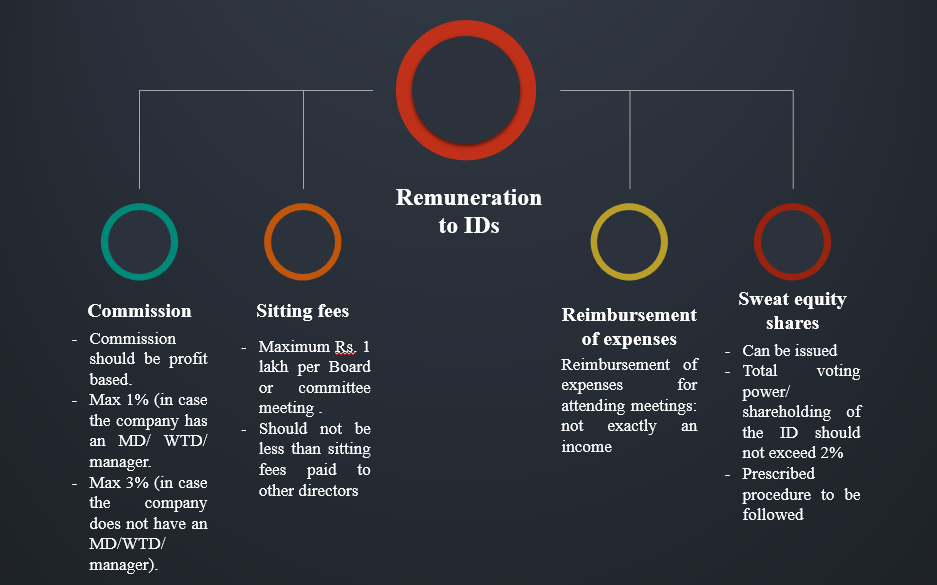
Thus, the sources of remuneration to IDs have been limited along with further restrictions to the amount of remuneration permitted to be paid. Whereas in case of executive directors, the permissible amount of remuneration is much higher along with lesser restrictions.
The role of both counterparts is paramount and none of the two can undermine the role of the other. However, the compensation received by IDs has been lower than that paid to executive directors. Although the latter are involved in the day to day management of a company’s affairs, the former pitch in their rich expertise, knowledge and unbiased view. Therefore, there should be a way to align or proportionate the remuneration drawn by IDs with executive directors.
However, on the contrary, executive directors are included in the definition of ‘officer in default’ and have a higher liability than that of IDs.
International Practices
As per the Cadbury Committee Report,
On fees, there is a balance to be struck between recognising the value of the contribution made by nonexecutive directors and not undermining their independence. The demands which are now being made on conscientious non-executive directors are significant and their fees should reflect the time which they devote to the company’s affairs. There is, therefore, a case for paying for additional responsibilities taken on, for example, by chairmen of board committees. In order to safeguard their independent position, we regard it as good practice for non-executive directors not to participate in share option schemes and for their service as non-executive directors not to be pensionable by the company.
According to National Foundation for Corporate Governance[3]
To secure better effort from non-executive directors, companies should: • Pay a commission over and above the sitting fees for the use of the professional inputs. The present commission of 1% of net profits (if the company has a managing director), or 3% (if there is no managing director) is sufficient. • Consider offering stock options, so as to relate rewards to performance. Commissions are rewards on current profits. Stock options are rewards contingent upon future appreciation of corporate value. An appropriate mix of the two can align a non-executive director towards keeping an eye on short term profits as well as longer term shareholder value.
UK
According to UK Corporate Governance Code[4] (para 34),
Remuneration for all non-executive directors should not include share options or other performance-related elements.
In exceptional cases where equity is granted, companies should gain shareholder approval prior to grant and the acquired shares should be held for at least 1 year from the director’s departure from the Board.[5]
Thus, in UK, the same is discouraged and not prohibited. The UK Corporate Governance Code represents key corporate governance recommendations of best practice for companies and does not have a statutory force.
The International Corporate Governance Network allows equity-based remuneration to non-executive directors. [6]
Australia
As per Australian Corporate Governance Principles and Recommendations – (only recommendatory and not mandatory)
Equity-based remuneration to non-executive directors: it is generally acceptable for non-executive directors to receive securities as part of their remuneration to align their interests with the interests of other security holders. However, nonexecutive directors generally should not receive options with performance hurdles attached or performance rights as part of their remuneration as it may lead to bias in their decision-making and compromise their objectivity.
France
According to the Corporate Governance Code of listed corporations by Afep-Medef[7], the principles for determination of compensation of non-executive directors, state that it is not desirable to award variable compensation, stock options or performance shares to non-executive directors. If, despite this, such awards are granted, then the Board must justify the reasons for this and the director cannot be considered to be independent.
USA
In USA, no express guidelines were found to prohibit share options to independent directors.
However, compensation policies of various companies filed with the SEC include stock options, restricted stock units and equity compensation granted to independent directors or outside directors (directors that are not employees of the Company).
Policies can be viewed here –
- https://www.sec.gov/Archives/edgar/data/1382911/000119312510046002/dex101.htm#:~:text=A%20person%20who%20is%20an,after%20the%20Public%20Trading%20Date
- https://www.sec.gov/Archives/edgar/data/1500217/000119312511005952/dex1045.htm#:~:text=Cash%20Compensation.,for%20service%20on%20the%20Board.&text=An%20Independent%20Director%20serving%20as,of%20%2410%2C000%20for%20such%20service
- https://www.sec.gov/Archives/edgar/data/1651308/000110465918039210/a18-14700_2ex10d5.htm
- https://www.sec.gov/Archives/edgar/data/1375151/000137515113000005/exhibit103-independentdire.htm
- https://www.sec.gov/Archives/edgar/data/1016281/000119312512105896/d290680dex1024.htm
- https://www.sec.gov/Archives/edgar/data/1002047/000119312512275547/d328654dex1065.htm
- https://www.sec.gov/Archives/edgar/data/1419625/000119312516706728/d76087dex1026.htm
What can be seen is that global governance norms have mixed views with respect to stock options to IDs.
Are IDs really independent in the first place?
There are various contentions that can question whether IDs are in fact independent at all.
Appointed by the Board
IDs are appointed by the Board of Directors. Although the appointment requires the approval of the shareholders as well, IDs are nominated by the Board or the Nomination Committee. The nomination is then recommended to the shareholders for their approval. Additionally, where promoters hold majority stake in a company, such appointment may be approved and dominated by them. Thus, expecting and ID to be independent of persons who are in fact behind his/ her appointment is a question in itself. Thus, if an ID truly requires to be independent, then he/ she should be appointed by an independent third party. Various changes have also been proposed with respect to appointment, reappointment and removal of IDs, which have been discussed in our article at length.
Profit related commission
IDs are paid commission that should be related to the profit. Thus, their income is dependent on the progress/ growth of the Company making the independent director ‘interested’ in the Company.
The cons of ESOPs
While the global precedence does not expressly prohibit ESOPs, there still lies an anomaly whether ESOPs would make an ID interested in a company.
Additional methods for fair compensation are needed on one hand but on the other, the independence of an ID cannot be compromised. If ESOPs are granted, IDs will become interested as shareholders and would dwell upon the short-term prosperity of a company since share price at the end of the vesting period would be what would matter to them. They would therefore compromise a long-term return along with interest of other stakeholders. There would be too much pressure on short-term performance mostly compromising the long-term good of the company.
Profit related commission to IDs
Profit related commission is contingent in nature and is a way of sharing risks and rewards. Such commission depends and is proportionate to the profitability of the other party and thus aligns the interests of the parties involved the arrangement.
Indian laws allow IDs to be paid by way of profit related commission. The same can be paid up to a maximum of 1% of the profits of the company in that financial year. This means that the amount of income of the ID, in the form of commission, will directly depend on the amount of profit in that financial year. If the company performs better in a particular financial year, the profit will be higher and in turn the proportionate commission of the ID in that financial year will be higher. This shows that the interests of the ID will be rather short term than long term. The ID will only be concerned about the short-term performance of the company for the years he is an ID since his income would be directly dependent on the same, irrespective of any event hampering or damaging the Company in the long run. Therefore, the permissible form of remuneration to IDs by Indian laws, in reality, adversely affects the independence of an ID.
Profit related commission versus ESOPs
Consequently, there arises a question on how the defense of independence can be used against ESOPs alone if IDs are allowed to receive profit related commission.
ESOPs, as compared to commission, would be a better way to remunerate IDs, when it comes to protecting the interests of Company. Where profit related commission makes the ID interested in the short term performance of the Company, ESOPs provide a longer performance goal. Stock options ensure a balance between the short term and medium term performance of a company.
Profit related commission depends directly on the immediate preceding year (i.e. just one year) while ESOPs depend on a relatively longer time frame (more than one year at the least- tenure of the ESOPs can be decided and controlled by the company).
Thus, if companies are allowed to pay profit related commission to IDs, restrictions on allow ESOPs are unwarranted considering the fact that the latter would be a preferred option to align the interests of the IDs with the medium term performance of a company.
Here, the intention behind granting such ESOPs would be to enable IDs to focus on the medium term/ long term performance of the company rather than retention which is usually the rationale behind ESOPs.
However, the maximum limit for granting such ESOPs as well as maximum shareholding should be monitored to avoid IDs from holding huge stakes in companies. Further, ESOPs with longer vesting periods should be allowed, where the exercise period falls after the expiry of tenure of the ID, to ensure ID’s focus on the long term growth of the company.
SEBI’s Consultation Paper to allow stock options –
SEBI contended that linking remuneration to profit or performance linked commission ensures that IDs have ‘skin-in-the-game’ which may encourage short-termism and lead to conflicts between the interests of the IDs and the overall interest of the Company. A better approach would be to instead permit ESOPs to IDs with a long vesting period (say, 5 years,) as this would ensure alignment of interests of the company and IDs. The rationale is that remuneration to IDs should be on the basis of their value and time-commitments to the company, without linking the same to the profits thereof. This would lead to IDs getting a fixed fee, without having any stake in the long-term growth of the company.
Additionally, the limit on the sitting fees to IDs, is also proposed to be increased.
Accordingly, recommendations will be sent to MCA for modification of the existing remuneration structure under the Companies Act as well.
Conclusion
Thus, SEBI is headed in the right direction to allow ESOPs to IDs and is highly welcomed. This would ensure that IDs are rightly compensated for the value they offer while also ensuring that long term interest. However, various checks should be placed by regulators for monitoring the same so as to safeguard the independence of the ID.
[1] While the existing requirement under sections 149(9) and 197(3) of the Companies Act, in case of remuneration to non-executive directors, was to pay them upto a percentage of profits, the amendments made by CAA 2020 (section 32) have delinked the compensation and the profits, permitting companies to pay remuneration by way of “minimum remuneration”, that is, irrespective of adequacy of profits (proviso to section 149(9) inserted and amendment to section 197(3))
[2] https://www.sebi.gov.in/reports-and-statistics/reports/mar-2021/consultation-paper-on-review-of-regulatory-provisions-related-to-independent-directors_49336.html
[3] http://www.nfcg.in/UserFiles/ciicode.pdf
[4] https://www.frc.org.uk/getattachment/88bd8c45-50ea-4841-95b0-d2f4f48069a2/2018-UK-Corporate-Governance-Code-FINAL.PDF
[5] You may check pay pratices in Europe through this report- https://infokf.kornferry.com/rs/494-VUC-482/images/191206-KF%20-%20NED%20report%202019%20-%20LR%20SPREAD%20mail.pdf
[6] https://www.icgn.org/sites/default/files/ICGN%20NED%20Guidelines%20%282010%29_%20Oct%202013print2_0.pdf
[7] https://afep.com/wp-content/uploads/2018/06/Afep-Medef-Code-revision-June-2018-ENG.pdf
