Buyback taxation rationalised with limited relief to promoter shareholders

– Finance Bill 2026 omits deemed dividend treatment on buyback consideration 

– Payal Agarwal, Partner | corplaw@vinodkothari.com

Our quick bytes on Union Budget 2026 can be accessed here – https://vinodkothari.com/2026/02/quick-bytes-on-union-budget-2026/

The recent Finance Bill 2026 brings relief to investors in the form of changes in taxation for buyback consideration. With the omission of sub-clause (f) from Section 2(40) of the Income Tax Act, 2025 [dealing with deemed dividend], the position as it existed prior to 1st October, 2024, has been restored, except for additional tax rates in case of promoter shareholders. 

  • Applicability of the amended provisions 
    • For any buyback of shares on or after 1st April, 2026 
  • Existing provisions on taxability of buyback 
    • Included u/s 2(40)(f) of IT Act 
    • The entire amount paid by the company taxable as “dividend” 
    • Tax payable by shareholders 
    • Entire buyback consideration taxable as dividend 
    • TDS provisions as applicable to dividends apply 
    • Taxable at slab rates as applicable to respective shareholders, with a flat surcharge @ 15%
    • Entire cost of acquisition in respect of shares bought back to be booked as “capital loss” [section 69 of IT Act]
    • Such capital loss may be set off against capital gains subsequently
      • As per section 111 of IT Act, the set-off is available for a period of 8 AYs immediately after the AY in which loss arises 
  • Amended provisions on taxability of buyback 
    • Buyback consideration not to be treated as deemed dividend [omission of clause (f) to Sec 2(40)]
    • Difference between consideration received and cost of acquisition taxable as capital gains [S. 69(1)]
      • In the hands of the recipient shareholder
    • In case of promoter shareholders, tax payable at higher rates depending on whether promoter is a domestic company or not
      • Effective rate of 22% in case of domestic company and 30% in case of persons other than domestic company 
  • Meaning of promoter 
    • In case of a listed company,
      • As per Reg 2(1)(k) of SEBI (Buy-Back of Securities) Regulations, 2018
        • Refers to the definition of promoter under SEBI (Issue of Capital and Disclosure Requirements) Regulations, 2018 
    • In any other case
      • As per Section 2(69) of the Companies Act, 2013, or 
      • A person who holds, directly or indirectly, more than 10% of the shareholding in the company
  • Example to understand taxability under old regime v/s new regime 
Particulars Price per shareNo. of shares Amount (Rs.)
Total cost of acquisition Rs. 50 1005,000
Shares tendered and accepted for buybackRs. 80403,200
Tax under old regime (effective 1st Oct, 2024)Rs. 80403,200 as dividend @ applicable tax slabs
Tax under new regime (effective 1st Apr, 2026)Rs. (80-50) = Rs. 30401,200 as capital gains @ short-term/ long-term capital gain rates 
  • Intent of the amendments 
    • The extant tax regime on treating buyback consideration as deemed dividend resulted in taxing a “receipt” as income, without factoring the cost incurred in such receipts. See our article on the same here. The amended tax regime restores back the past position, by treating the difference between the buyback consideration and cost of acquisition as capital gains. 
    • Additional tax rates have been proposed for promoters, in view of the distinct position
    • and influence of promoters in corporate decision-making, particularly in relation to buy-back transactions.

See our other resources on buyback – https://vinodkothari.com/2024/08/resource-centre-on-buyback/

From Capital Assets to Stock-in-Trade: Taxing “Notional” Gains in Amalgamations

Decoding Supreme Court ruling in Jindal Equipment Leasing Consultancy Services Ltd. v. Commissioner of Income Tax Delhi-II, New Delhi

– Sourish Kundu | corplaw@vinodkothari.com

One of the most common modes of corporate restructuring is merger, and one of the most crucial aspects in assessing the commercial viability of a proposed merger is its tax implications. Typically, in a merger, the shareholders of the transferor company are issued shares of the transferee company in order to avail the exemption under section 70(1)(f) of the IT Act, 2025 [corresponding to section 47(vii) of the IT Act, 1961]. The said provision grants exemption in case of scheme of amalgamation in respect of the transfer of a capital asset, being shares held by a shareholder in the transferor company, where (i) the transfer is made in consideration of the allotment of shares in the transferee company (other than where the shareholder itself is the transferee company) and (ii) the amalgamated company is an Indian company.

However, a recent Supreme Court ruling in the matter of Jindal Equipment Leasing Consultancy Services Ltd. v. Commissioner of Income Tax Delhi-II, New Delhi [2026 INSC 46] has opened a new avenue for debate w.r.t the taxation on receipt of shares of the transferee company in a scheme of amalgamation. In this case, the Supreme Court ruled that the exemption as provided under section 47(vii) of the IT Act, 1961 [corresponding to section 70(1)(f) of the IT Act, 2025] shall not be available to shareholders of the transferor company who are not perceived as “investors”, that is to say long term investors as opposed to traders, in the transferor company. And accordingly, any notional gain in a share swap deal pursuant to an amalgamation shall be taxed u/2 28 of the IT Act, 1961 [corresponding to section 26 of the IT Act, 2025].

In this article, we decode the nuances of the ruling, the impact it is expected to have in the sphere of merger deals and other related concerns.

Difference between capital and business assets

So far, the common understanding of consideration in case of amalgamations was that an amalgamation is merely a statutory replacement of one scrip for another, with no real “transfer” or “income” until the new shares are actually sold for cash, or in other words, mere substitution of shares in the books of the involved entities. However, the Apex Court in the instant judgement has now effectively set a different precedent for those holding shares as stock-in-trade, i.e. current investments.

The Court clarified that while Section 47(vii) provides a safe harbor for investors (treating mergers as tax-neutral corporate restructuring), this exemption does not extend to “business assets”, a.k.a. stock in trade. For a trader and investment houses, shares held in stock-in-trade represent “circulating capital”, and the objective of holding them is not capital appreciation, but conversion into money in the ordinary course of business. Therefore, replacing shares of an amalgamating company with those of an amalgamated company of a higher, ascertainable value constitutes a “commercial realisation in kind”.

The 3 pillar test for taxability

The SC applying the doctrine of real income emphasised in Commissioner of Income-Tax v. Excel Industries Ltd. and Anr. [(2013) 358 ITR 295 (SC)], established a three-pillar test, which is to be applied on a case to case basis to determine if allotment of shares pursuant to a merger triggers taxation of business income u/s 28 of the IT Act, 1961: 

  1. Cessation of the Old Asset: The original shares must be extinguished in the books of the assessee.
  2. Definite Valuation: The new shares must have an ascertainable market value.
  3. Present Realisability: The shareholder must be in a position to immediately dispose of the shares and realise money.

This test was further elaborated by two situations viz. allotted shares being subject to a statutory lock-in, which hinders the disposability of the asset, and allotted shares being unlisted, which cannot be said to be realisable, since no open market exists to ascribe a fair disposal value.

Additionally, the SC also held that the trigger is the date of allotment of the shares of the amalgamated entity, and neither the “appointed date” nor the “date of court sanction” or what is called as “effective date” in the general parlance, as no tradable asset exists in the shareholder’s hands until the scrips are actually issued.

Critical Concerns

While the ruling provides reasonable clarity on the treatment of shares received as a result of amalgamation, when the same is held in inventory, it leaves several operational questions unanswered, leaving a gap to determine the commercial feasibility of these deals.

  1. Treatment of profits and losses alike

If the Revenue can tax “notional” gains arising from a higher market value at allotment, correspondingly assessees should be allowed to book notional losses, if any on such deals as well. In cases where a merger swap ratio or a market dip results in the new shares being worth less than the cost of the original holding, the taxpayer should, by the same logic, be entitled to claim a business loss u/s 28 of the IT Act, 1961, or in other words, if the substitution is a “realisation” for profit, it must be a “realisation” for loss as well.

  1. Increase in cost of acquisition

A major concern is the potential for double taxation. If the assessee is taxed on notional gain, being the difference between the cost of acquisition of the original shares and the FMV of the shares of the transferee company on the date of allotment, such FMV should logically become the new cost of acquisition. If an assessee is taxed on the difference between the book value and the FMV at the time of allotment, but the increased cost of acquisition is not allowed, the same appreciation gets taxed twice. It is first taxed as business income at the time of allotment and again at the time of the actual sale.  

  1. Determination of the nature of shares as “stock in trade” vs “capital asset”

This issue remains prone to litigation, that is, who determines the nature of the investment, whether it is current or non-current? Will it be determined basis the books of account of the investor? 

A CBDT circular lays down certain principles along with some case laws to distinguish between shares held as stock-in-trade and shares held as investments, and decide the treatment of shares held by the investing company. Further, factors such as intention of the party purchasing the shares, [discussed by Lord Reid in J. Harrison (Watford) Ltd. v. Griffiths (H.M. Inspector of Taxes); (1962) 40 TC 281 (HL)], and method of recording the investments [highlighted in CIT v. Associated Industrial Development Co (P) Ltd (AIR1972SC445)], are considered as the deciding factors for making a demarcation between treating an asset as capital asset or stock-in-trade.

As highlighted in the instant case, while the initial classification is made by the companies in the financial statements, the AO is empowered to overlook the same, and determine whether the shares were held as stock-in-trade or as capital assets, as without that determination, the taxability or eligibility for exemption u/s 47 could not be ascertained.

It should be noted that the line between a long-term strategic investment and a trading asset is often thin, and the Jindal ruling places the burden on the Revenue to prove the stock status and the “present realisability” of the shares.

Conclusion

Proving by contradiction, the Apex Court has added that: “If amalgamations involving trading stock were insulated from tax by judicial interpretation, it would open a ready avenue for tax evasion. Enterprises could create shell entities, warehouse trading stock or unrealised profits therein, and then amalgamate so as to convert them into new shares without ever subjecting the commercial gain to tax. Equally, losses could be engineered and shifted across entities to depress taxable income. Unlike genuine investors who merely restructure their holdings, traders deal with stock-in-trade as part of their profit-making apparatus; to exempt them from charge at the point of substitution would undermine the integrity of the tax base”

Discussing the concept of “transfer”, “exchange” and “realisability”, the SC has affirmed that mergers do not entail a mere replacement of shares of one company with that of another, as for persons holding the same as stock-in-trade cannot be said to be a continue their investment, instead the new shares being capable of commercial realisation gives rise to taxable business income. The Jindal Equipment ruling seems to effectively end the assumption of automatic tax neutrality for all merger participants, subject to fulfillment of applicable conditions prescribed in the IT Act. As a result, if the tax officers believe that the shareholders hold the shares as stock in trade, and could cash out the same at the next possible instance, the assessee shall be under the obligation to pay tax even without encashing any gain in actuals. Further, the tax implications in such cases shall not be at the special rates prescribed for capital gains.

Read more:

Understanding “Undertaking” in the Context of Investment Demergers

Budget 2025: Mergers not to be used for evergreening of losses

Rentals on finance leases: To deduct it all or just the interest slice? 

Tax accounting standard ICDS IX raises an unanswered question

– Chirag Agarwal | Assistant Manager (finserv@vinodkothari.com)

While leasing in India has developed much lesser as compared to other countries12, there is an interesting and growing line of business in India – CTC leasing, that is, lease of assets offered to employees of large companies with the rentals forming part of the employee’s CTC. The key to the tax neutrality of a CTC lease to the employer is the full deductibility of the lease rentals, as the rentals replace what would otherwise have been the employment benefit expense. But if the lease is intrinsically a financial lease, is it that the employer will still be able to expense the rentals, particularly after tax accounting standard ICDS IX, providing that the interest component of a financial lease will be treated as a cost of borrowing? CTC leasing practices in the past may have depended on some tax rulings, which pertain to the period before the applicability of the ICDS  – hence, the question is still an open one.

CTC leasing of passenger cars alone is nearly Rs 6000 crores annual volume business in India, constituting roughly 1% of passenger vehicles sold in the country.

In this article, we explore:

  • What is a financial lease? Is there a concept of financial lease, from the lessee perspective, now that accounting standards have eliminated the distinction from the lessee perspective?
  • Why is a financial lease equivalent to a borrowing transaction?
  • Why is the tax neutrality of a CTC lease to an employer important? 
  • Past rulings that may or may not hold the answer?
  • So, is ICDS IX decisive?
  • So, if ICDS IX does not apply, does ICDS I (substance over form) apply?

What is a Financial Lease and its accounting from the perspective of a lessee?

Finance Lease is an alternative to taking a loan. In this type of lease, all major risks and benefits of owning the asset are passed from the lessor to the lessee. The lessor only provides finance and keeps the legal ownership. At the end of the lease, the ownership of the equipment usually gets transferred to the lessee.

In Asea Brown Boveri vs IFCI, the Supreme Court quoted the following para from Vinod Kothari’s book Lease Financing and Hire Purchase, with approval specifying the features of a financial lease: 

“1. The asset is use-specific and is selected for the lessee specifically. Usually, the lessee is allowed to select it himself.

2. The risks and rewards incident to ownership are passed on to the lessee. The lessor only remains the legal owner of the asset.

3. Therefore, the lessee bears the risk of obsolescence.

4. The lessor is interested in his rentals and not in the asset. He must get his principal back along with interest. Therefore, the lease is non- cancellable by either party.

5. The lease period usually coincides with the economic life of the asset and may be broken into primary and secondary period.

6. The lessor enters into the transaction only as a financier. He does not bear the costs of repairs, maintenance or operation.

7. The lessor is typically a financial institution and cannot render specialized service in connection with the asset.

8. The lease is usually full-pay-out, that is, the single lease repays the cost of the asset together with the interest.”

As per AS 19, in a financial lease, the rent paid is divided into two parts, i.e., finance charges and capital recovery. 

With Ind AS 116, this changed. Under Ind AS 116, the lessee will need to show all leases as a “right of use asset” (ROU Asset) along with a liability to pay rent over time.

In this case, only the lessor needs to classify leases as financial or operating. For the lessee, there is no such difference and the asset will simply be recorded as a ROU asset. This position is supported by Para 61 of Ind AS 116 which states “A lessor shall classify each of its leases as either an operating lease or a finance lease.”. Further, Paras 22 to 60A, which deal specifically with lessee accounting, do not mention any requirement for classifying leases into finance or operating categories.

Why is a financial lease equivalent to a borrowing transaction?

A financial lease is considered similar to a borrowing transaction because, in substance, it functions like a loan. The lessor recovers the full cost of the asset along with a financing return through lease rentals, while the lessee gains the right to use the asset and repays the cost over time. The lessor’s primary risk relates to the lessee’s repayment capacity rather than the asset’s residual value, making it economically similar to a borrowing arrangement rather than a traditional lease.

Why is the tax neutrality of a CTC lease to an employer important? 

The entire CTC leasing model is based on the taxation benefit, where the employer claims the entire lease rental as a deduction while computing income under “Profits and Gains from Business or Profession.” This also benefits the employee since the taxable value under perquisites is comparatively lower than if the same amount were paid as direct salary. 

However, if we were to say that the employer, as the lessee, cannot claim full deduction for the lease rental, the employer would likely prefer paying the equivalent amount directly as salary. This is because salary expenses are fully deductible, making direct salary payments more tax-efficient in such a scenario for the employer.

There is yet another way the neutrality to the employer is impacted: the employer books an ROU assset and a related OTP liability; however, that may still be okay considering the employees’ interest. However, losing a tax benefit may be an added cost.

So, is ICDS IX decisive?

ICDS IX deals with borrowing costs, which defines the same as, 

are interest and other costs incurred by a person in connection with the borrowing of funds and include:

(iv) finance charges in respect of assets acquired under finance leases or under other similar arrangements.

Hence, as per ICDS IX, the interest component of a financial lease will be treated as a cost of borrowing, and the deduction can be claimed only for the interest portion which is relevant only for the lessee.

However, as discussed above, under Ind AS 116, there is no difference between FL/OL for the lessee.  Accordingly, ICDS IX should not apply here. 

So, if ICDS IX does not apply, does ICDS I (substance over form) apply?

It may be noted that the ICAI Technical Guide on ICDS warrants that substance should prevail over the form (ICDS I). 

Hence, if we say that ICDS IX does not apply whether ICDS I should also not apply in case of financial lease? In our view, the substance of the lease would definitely matter. Even if the accounting distinction does not matter, if the transaction of lease is so structured so as to be equivalent to a loan, the deductibility of entire lease rentals would not be allowed. 

Hence, to get the benefit of deductibility, the lease shall be a true lease. The following may be considered as essential features of a true lease:

Past rulings that may or may not hold the answer?

The Supreme Court in its decision in the case of ICDS Limited Vs CIT (350 ITR 527) held that in a leasing transaction, the lessor would be entitled to claim depreciation under section 32 of the IT Act on the leased assets. On the other hand, the lessee would be entitled to claim the entire lease rentals as a deduction while computing its total income.

Similarly, in the case of Wipro Ge Healthcare Private Limited vs Assistant Commissioner Of Income Tax, 2023, it was held that the assessee is entitled to claim a deduction on account of lease rentals paid as it is a revenue expenditure on the ground that the assessee is only a lessee and the lessor is the owner of the assets leased.

A similar judgment was passed in the case of Tesco Bangalore Private Limited vs Deputy Commissioner Of Income Tax, on 23 May, 2022.

However, the case laws relate to the assessment year before the introduction of ICDS IX and hence the same cannot be relied upon now.

Thus, tax treatment of leases for lessees is still a grey area. While Ind AS 116 has made accounting simple by removing the difference between operating and finance leases, the taxability of leases still remains a question because of ICDS IX. 

Therefore, there is a need for a clear guideline by the IT dept that finally settles this question. 

Footnotes:

  1. We have discussed the evolution of leasing in India in this publication: https://www.ifc.org/content/dam/ifc/doc/mgrt/evolution-of-leasing-in-india-aug-30-2019.pdf ↩︎
  2. See India chapter in WLY 2023 volume: https://www.world-leasing-yearbook.com/wp-content/uploads/2023/12/India_WLY.pdf ↩︎

Union Budget 2025: Key Highlights and Reforms focusing on Financial Sector Entities

Loader Loading…
EAD Logo Taking too long?

Reload Reload document
| Open Open in new tab

Download as PDF [334.04 KB]

Bye bye to Share Buybacks

– Finance Bill 2024 puts buybacks to a biting tax proposal w.e.f. 1st October, 2024

-Team Corplaw | corplaw@vinodkothari.com

Among the tax law changes proposed by Finance Bill, 2024, the one on share buybacks, explained as one intended to remove tax inequity, is perhaps the most unexplainable.  The proposed change, by introduction of a new sub-clause (f) to section 2 (22) [deemed dividend], and simultaneous amendments to sec. 46A and sec. 115QA, not only shifts the tax burden from companies to shareholders, but surprisingly, brings to tax the entire amount paid on buyback, irrespective of the excess realised by the shareholder. It  leaves the cost of shares to be claimed as capital loss and set off against potential capital gains, of course only if such gains arise  within the prescribed timelines for carry forward and set off.

Buyback of shares is the only way a company seeks to scale down its capital. The proposed amendment makes it impossible for companies to reduce their capital base by returning capital not needed, as the only other way is through reduction of share capital, which is subject to shareholders’, creditors’, and NCLT approval. It is surprising that this amendment by the very same Budget which proposes to introduce the novel concept of “variable capital companies”.

Read more

Emission law amendments: Laying the framework for Carbon trading market in India

– Payal Agarwal, Vinod Kothari & Company (payal@vinodkothari.com)

This version: 23rd December, 2022

The Energy Conservation (Amendment) Bill, 2022 (“Bill”) seeks to provide a regulatory framework for carbon markets in India. The Bill was passed in the Lok Sabha on 8th August, 2022, and has been passed in the Rajya Sabha on 12th December, 2022. The President’s asset is all that is required to bring the carbon markets within the statutory framework of India. However, there is still a long way to go before carbon markets are implemented in India, which will require notification of the procedures and rules governing the same. Further, the carbon markets in other countries are still developing in a phased manner, identifying the gaps in the existing system and modifying accordingly. India cannot be an exception to the same. However, the concept of “carbon credits” is not unknown to India since there are several entities in the country which are already generating tons of carbon credits. This article seeks to delve upon the legal aspects of carbon credits markets around the world, the consequences of not exporting the same, and the tax implications upon sale of the generated credits. As we study the existing carbon markets around the world, some learnings from these markets may be taken into consideration for the developing carbon market in India.

Read more

Complete Guide to Sale and Leaseback Transactions

A guide to concepts, taxation, and accounting aspects of sale and leaseback transactions.


– Qasim Saif (finserv@vinodkothari.com)


Contents

Sale and Leaseback transaction. 2

Advantages to the Lessee. 2

Unlocking value, the hidden value of asset 2

Tax Benefits. 2

Legal issues in SLB: 3

Taxation of SLB transactions. 3

Direct Tax Aspect 3

Goods & Service Tax. 5

The Sale. 5

The Lease. 5

Place of supply. 6

Disposal of Capital Asset 6

Example of GST Calculations on Sale and Leasebacks. 6

Sale of Asset 7

Leasing of asset 7

Accounting of Sale and leasebacks. 7

Criteria for Sale. 8

Transfer of asset does not qualify as sale. 10

Transfer of asset qualifies as sale. 10

Sale at Fair Value. 10

Sale at a discount or premium.. 10

Example of Sale and Leaseback Accounting under Ind AS 109. 11

Calculations. 11

Rental Schedule. 11

Accounting Entries at Inception. 12


Sale and Leaseback transaction

A Sale and Leaseback (SLB) is a special case of application of leasing technique. Lease is a preferred mode of using the asset without having to own it. In case of leases, the lessee does not own the asset but acquires the right to use the asset for a specified period of time and pays for the usage.

SLB is a simple financial transaction which allows selling an asset and then taking it back on lease. The transaction thus allows a seller to be able to use the asset and not own it, at the same time releasing the capital blocked by the asset.
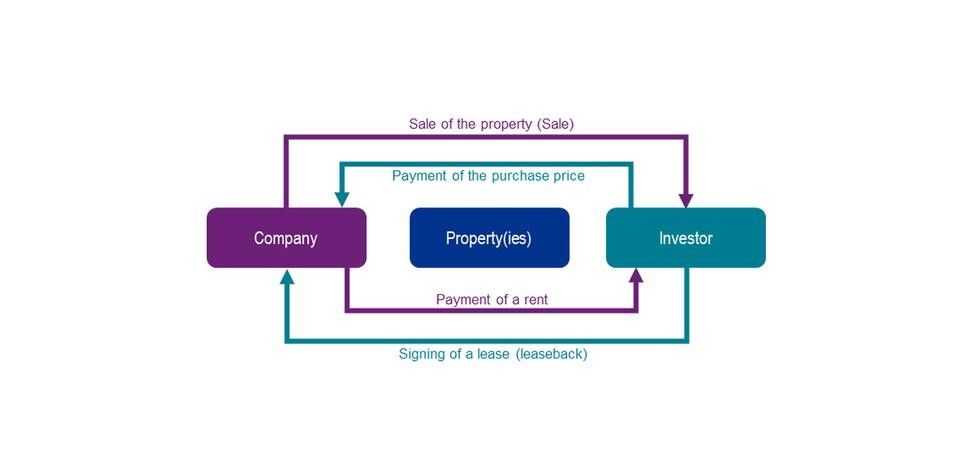
SLB allows the lessee to detach itself with legal ownership yet continuing to use the asset as well. In effect there is no movement of asset however on paper there is a change in the title of the asset.

Sale and Leaseback transactions are globally common in the Real estate investment trusts (REITs) and Aviation industry.

Advantages to the Lessee

Unlocking value, the hidden value of asset

As is evident from the mechanics of SLB above, SLB results in taking the asset off the books of the lessee and results in upfront cash which could be used for paying off existing liabilities. Hence this does not impact the existing lines of credit the lessee may be availing.

SLB can help entities raise finance for an amount equal to fair market value of the asset which may be significantly higher than its book value. Though there might be taxation challenges attached to it in Indian context. Nevertheless, SLB may bring about a financial advantage as well wherein a high-cost debt can be substituted with a low-cost lease liability.

Most of the assets considered for SLB have been used by the lessee for a substantial period of time and the value of the physical assets may be insignificant. Hence SLB is sometimes referred to as junk financing.

Tax Benefits

SLB may sometimes lead to tax benefits as well (we shall see this in detail in the sections below). This has been one of the major drivers of SLB transactions in India and has its own downsides as well. One of the major pitfalls to SLB is the danger of excess leveraging; the lessee may tend to overvalue the asset. Considering that SLB is a mode of asset-backed lending but the asset has may not have much value and the lessee may exercise discretion on the application of funds poses threat of misuse of the product.

Legal issues in SLB:

The legal validity of SLB was discussed by the U.S Supreme Court in the landmark ruling of Frank Lyon and Company[1]. In Frank Lyon’s case the bank took the building on SLB. Under the lease terms the bank was liable to pay rentals periodically and had the option to purchase the building at various times at a consideration based on its outstanding balance. The bank took possession of the building in the year it was completed and the lessor claimed deductions on depreciation, interest on construction loan, expenses related to sale and lease back and accrued the rent from the bank.

The Commissioner of Internal Revenue denied the claims of the petitioner on the grounds that the petitioner was not the owner of the building and the sale and leaseback was a mere financing transaction. The Hon’ble Court held that –

Where, as here, there is a genuine multiple-party transaction with economic substance that is compelled or encouraged by business or regulatory realities, that is imbued with tax-independent considerations, and that is not shaped solely by tax-avoidance features to which meaningless labels are attached, the Government should honor the allocation of rights and duties effectuated by the parties; so long as the lessor retains significant and genuine attributes of the traditional lessor status, the form of the transaction adopted by the parties governs for tax purposes.

The fundamental principle is that the Court should be concerned with the real substance of the transaction rather than the form of the same. If there are reasons to believe that the form of the transaction and its real substance are not aligned, the Court must not be simply concerned by the form of the transaction nor by the nomenclature that the parties have given to it.

In India too, the legality of SLB transactions have been questioned in several cases; sometimes the transactions have come out clean while in some cases, SLBs were considered an accounting gimmick.

The legality of SLB transactions and analysis of various judicial pronouncements on the same, have been discussed in detail in our write up “Understanding Sale and leaseback

Taxation of SLB transactions

Tax aspects specifically direct tax acts as a major motivation behind such transactions, SLB provides a creative playground for finance professionals to structure transactions in a manner that can lead to substantial benefit to the entity, and taxation acts as a major tool at their disposal.

Direct Tax Aspect

Though tax benefits have been a motivator for SLB transaction, the same has also been the reason for near wipe-out of SLB from Indian markets.

During the 1996-98 period one of the most infamous cases was the sale and leaseback of electric meters by state electricity boards (SEBs). For SEBs it made perfect sense as it amounted to cheap borrowing by the cash starved SEBs who had practically no other source of borrowing.

For leasing companies and others looking for a tax break, it was a perfect deal as there was 100% write off in case of assets costing Rs 5000 or less. Thus, an electric meter will qualify for 100% deduction. Several SEBs had undertaken such transactions in those days. Obvious enough the sole motive was tax deduction no one would care about the value, quality, existence etc of the meters. In some cases, the asset was bought on 30th March to be used only for a day, assets revalued heavily at the time of sale to leasing companies etc. Lease of non-existing assets such as electric meters, computers, glass bottles, tools, etc, lure of depreciation allowances caused the tax authorities to come down hard on sale and leaseback transactions calling them tax evading transactions. The whole fiasco of such sham transactions resulted in leasing going off the market completely. The burns of the past continue to linger even after a decade and half since SLB transactions were completely written off.

The most significant consideration in lease transactions is the depreciation claim. For tax purposes, depreciation is calculated on the block of the assets and not on the written down value of each asset separately.

Section 2(11) of the Income Tax Act, 1961 (IT Act) defines block of assets to mean

“”block of assets” means a group of assets falling within a class of assets comprising—

(a) tangible assets, being buildings, machinery, plant or furniture;

(b) intangible assets, being know-how, patents, copyrights, trade-marks, licences, franchises or any other business or commercial rights of similar nature, in respect of which the same percentage of depreciation is prescribed.”

The sale proceeds of the assets sold are deducted from the written down value of the block. In case of SLB transaction, assets are sold at higher than written down value, and the gain made on such a sale results in reduction in depreciable value of the block of assets. The reduction in depreciation will be allowed over a number of years. Similar would be the case in case the asset was sold at less than written down value, sale consideration would be reduced from the block of the assets.

Once the asset is sold and taken off the books of the lessee, the lessee is able to account for an immediate accounting profit without having to pay tax on it instantly. As under the block concept of depreciation, when the lessee sells the capital assets, the sale proceeds including the profits on sale are allowed to be deducted from the block of assets and hence there is no immediate tax on the accounting profits.

Also, typically the asset is recorded on historical costs which may be lower than the intrinsic value of the asset. SLB sometimes allows the entities to unlock the appreciation in value. However, it is not always necessary that the asset would have appreciated value. In some cases, the asset may have become junk completely.

To avoid the same revenue has introduced following provisions in the IT act, in order to restrict undue benefits being passed by use of sham SLB transactions:

Section 43 (1) provides for treatment of sale and lease back transactions for tax purposes, the relevant extracts are reproduced below –

“Explanation 3.—Where, before the date of acquisition by the assessee, the assets were at any time used by any other person for the purposes of his business or profession and the Assessing Officer is satisfied that the main purpose of the transfer of such assets, directly or indirectly to the assessee, was the reduction of a liability to income-tax (by claiming depreciation with reference to an enhanced cost), the actual cost to the assessee shall be such an amount as the Assessing Officer may, with the previous approval of the Joint Commissioner, determine having regard to all the circumstances of the case.”

“Explanation 4A.—Where before the date of acquisition by the assessee (hereinafter referred to as the first mentioned person), the assets were at any time used by any other person (hereinafter referred to as the second mentioned person) for the purposes of his business or profession and depreciation allowance has been claimed in respect of such assets in the case of the second mentioned person and such person acquires on lease, hire or otherwise assets from the first mentioned person, then, notwithstanding anything contained in Explanation 3, the actual cost of the transferred assets, in the case of first mentioned person, shall be the same as the written down value of the said assets at the time of transfer thereof by the second mentioned person.

Explanation 3 and 4A of Section 43 (1) restricts the consideration at which the lessor purchases the assets to written down value of the asset as appearing in the books of the lessee before it was sold and taken back on lease. The explanation explicitly states that the sale value for such sale and lease back transactions will be ignored and depreciation will be allowed on the first seller’s depreciated value. Take, for instance, A purchased machinery for Rs. 10 crores from B, though the WDV in the books of B is Rs. 2 crores. A can claim depreciation on Rs. 2 crores and not on Rs. 10 crores.

The said provisions removes any motivation for the lessor to carryout transactions at inflated values. Hence preventing junk financing to enter into SLB transactions.

Goods & Service Tax

Pre-GST indirect taxation regime acted as a major road block in the development of leasing industry as a whole, the legal differentiation as well as non-availability of credit among central and state taxes made leasing transactions costly.

Introduction of GST is playing a key role in development of leasing industry, from a stage where it had nearly become extinct. We have further discussed GST implications on leasing.

The Sale

The first leg of the transaction would involve sale of Assets by lessee to lessor.

In terms of section 7(1)(a) “all forms of supply of goods or services or both such as sale, transfer, barter, exchange, licence, rental, lease or disposal made or agreed to be made for a consideration by a person in the course or furtherance of business;”

The taxability under GST arises on the event of supply accordingly the sale of capital assets for a consideration would fall under the ambit of supply and accordingly GST shall be levied.

The Lease

The second part of transaction would lease back that is when the asset is leased back from buyer -lessor to seller lessee. The leaseback would be subject to GST like any other lease transaction.

The term lease has not been defined anywhere in GST Act or Rules. To classify a lease transaction as either supply of goods or supply of service, we have to refer Schedule II of the CGST Act, 2017 where in clear guidelines for classification of a transaction as either “supply of goods” or “supply of services” has been enumerated, based on certain parameters: –

  • Any transfer of the title in goods is a supply of goods;
  • Any transfer of right in goods or of undivided share in goods without the transfer of title thereof, is a supply of services;
  • Any transfer of title in goods under an agreement which stipulates that property in goods shall pass at a future date upon payment of full consideration as agreed, is a supply of goods.
  • Any lease, tenancy, easement, licence to occupy land is a supply of services;
  • Any lease or letting out of the building including a commercial, industrial or residential complex for business or commerce, either wholly or partly, is a supply of services.

Place of supply

Undoubtedly, the SLBs do not involve movement of goods, the seller lessee continuous to be in possession of leased asset even after the sale. Hence, In the case of such sale, there is no physical movement of the asset from the premises of the lessee to the premises of the lessor. The ownership gets transferred in the premise of the lessee.

In terms of Section 10(1)(c) of the IGST Act, the place of supply of goods where the supply does not involve movement of the said goods whether by the supplier or the recipient shall be the location of such goods at the time of delivery to the recipient. Accordingly, the place of supply in this case will be same as the location of the supplier. Accordingly, the sale of the asset will be considered as an intra-state supply as per Section 8 of the IGST Act and will be subjected to CGST + SGST.

Disposal of Capital Asset

Applications of GST on disposal of capital assets is one of the major deterring factors of in SLBs. Section 18(6) of the CGST Act,2017 state that:

In case of supply of capital goods or plant and machinery, on which input tax credit has been taken, the registered person shall pay an amount equal to the input tax credit taken on the said capital goods or plant and machinery reduced by such percentage points as may be prescribed or the tax on the transaction value of such capital goods or plant and machinery determined under section 15, whichever is higher:”

Entry no. (6) Of Rule 44 of CGST Rules, 2017: Manner of Reversal of ITC under Special Circumstances which reads as under: –

“The amount of input tax credit for the purposes of sub-section (6) of section 18 relating to capital goods shall be determined in the same manner as specified in clause (b) of sub-rule (1) and the amount shall be determined separately for input tax credit of central tax, State tax, Union territory tax and integrated tax:”         

“……………..Clause (b) of sub rule 1 of same rules states that :

(b) for capital goods held in stock, the input tax credit involved in the remaining useful life in months shall be computed on pro-rata basis, taking the useful life as five years………….”

Generally, the lessor procures the capital Assets at WDV due to Income tax Act implication. In that case WDV as per Income tax act would be the transaction value.

Example of GST Calculations on Sale and Leasebacks

Let’s consider a numerical example: an Entity A enters into SLB arrangement with an Entity B. A sells its machinery to B for Rs. 5,00,000/- as on 31st May 2021. The entity had purchased the asset for Rs. 6,00,000/- as on 31st March 2019.

B then leases back the asset to A for a yearly rental of Rs, 1,00,000/- for 3 years term with a purchase option at the end of 4th year at Rs. 2,50,000. (Assumed to be exercised)

(GST @ 18%)

Sale of Asset
Disposal of assets

On disposal asset, GST will be charged on the selling price of the asset. However, the amount to be deposited to the government with respect to this sale transaction shall be higher of the following:

  1. GST on the sale consideration;
  2. ITC reversed on transfer of capital asset or plant and machinery based on the prescribed formula

Portion of ITC availed on the asset, attributable to the period during which the transferor used the asset:

6,00,000 * 18% * (5% * 8) = 43200

Remaining ITC = (6,00,000 * 18%) – 43200 = 64800

GST on the selling price = 500000 * 18% = 90000

Therefore, GST to be paid to the government is 90000, that is higher of the two amounts discussed above.

Leasing of asset

As mentioned above GST shall be chargeable to lease rental, at the rate similar to that charged on acquisition of leased asset. Accordingly, Entity B shall charge GST on rentals for an amount of Rs. 18,000/- (Rs. 1,00,000/- * 18%).

Further GST shall also be charged on sale of asset at the end of lease tenure for an amount of Rs. 45,000/-(2,50,000*18%).

Accounting of Sale and leasebacks

IAS 17 covered the accounting for a sale and leaseback transaction in considerable detail but only from the perspective of the seller-lessee.

As Ind AS 116/IFRS 16 has withdrawn the concepts of operating leases and finance leases from lessee accounting, the accounting requirement that the seller-lessee must apply to a sale and leaseback is more straight forward.

The graphic below shows how SLB transactions should be accounted for:

Criteria for Sale

IFRS 16/Ind AS 116 state that

“ An entity shall apply the requirements for determining when a performance obligation is satisfied in Ind AS 115 to determine whether the transfer of an asset is accounted for as a sale of that asset.”

Accordingly, when a seller-lessee has undertaken a sale and lease back transaction with a buyer-lessor, both the seller-lessee and the buyer-lessor must first determine whether the transfer qualifies as a sale. This determination is based on the requirements for satisfying a performance obligation in IFRS 15/Ind AS 115 – “Revenue from Contracts with Customers”.

The accounting treatment will vary depending on whether or not the transfer qualifies as a sale.

The para 38 of Ind AS 115/IFRS 15- Performance obligations satisfied at a point in time, provides ample guidance on determining whether the performance obligation is satisfied.

The para states that:

“If a performance obligation is not satisfied over time in accordance with paragraphs 35– 37, an entity satisfies the performance obligation at a point in time. To determine the point in time at which a customer obtains control of a promised asset and the entity satisfies a performance obligation, the entity shall consider the requirements for control in paragraphs 31–34. In addition, an entity shall consider indicators of the transfer of control, which include, but are not limited to, the following:

(a) The entity has a present right to payment for the asset—if a customer is presently obliged to pay for an asset, then that may indicate that the customer has obtained the ability to direct the use of, and obtain substantially all of the remaining benefits from, the asset in exchange.

(b) The customer has legal title to the asset—legal title may indicate which party to a contract has the ability to direct the use of, and obtain substantially all of the remaining benefits from, an asset or to restrict the access of other entities to those benefits. Therefore, the transfer of legal title of an asset may indicate that the customer has obtained control of the asset. If an entity retains legal title solely as protection against the customer’s failure to pay, those rights of the entity would not preclude the customer from obtaining control of an asset.

(c) The entity has transferred physical possession of the asset—the customer’s physical possession of an asset may indicate that the customer has the ability to direct the use of, and obtain substantially all of the remaining benefits from, the asset or to restrict the access of other entities to those benefits. However, physical possession may not coincide with control of an asset. For example, in some repurchase agreements and in some consignment arrangements, a customer or consignee may have physical possession of an asset that the entity controls. Conversely, in some bill-and-hold arrangements, the entity may have physical possession of an asset that the customer controls. Paragraphs B64–B76, B77–B78 and B79–B82 provide guidance on accounting for repurchase agreements, consignment arrangements and bill-and-hold arrangements, respectively.

(d) The customer has the significant risks and rewards of ownership of the asset—the transfer of the significant risks and rewards of ownership of an asset to the customer may indicate that the customer has obtained the ability to direct the use of, and obtain substantially all of the remaining benefits from, the asset. However, when evaluating the risks and rewards of ownership of a promised asset, an entity shall exclude any risks that give rise to a separate performance obligation in addition to the performance obligation to transfer the asset. For example, an entity may have transferred control of an asset to a customer but not yet satisfied an additional performance obligation to provide maintenance services related to the transferred asset.

(e) The customer has accepted the asset—the customer’s acceptance of an asset may indicate that it has obtained the ability to direct the use of, and obtain substantially all of the remaining benefits from, the asset. To evaluate the effect of a contractual customer acceptance clause on when control of an asset is transferred, an entity shall consider the guidance in paragraphs B83–B86.”

It shall be noted that no single criteria can be taken as a determining factor for concluding that sale has taken place. Each criterion should be individually assessed every case. Needless to say, substance of the transaction should be adjudge based on principles set.

The criteria set out in the para 38 specified above can be summarised as follows:

  • There is a present right to payment has been established.
  • The legal tittle of the asset is transferred. It shall be noted that this shall not conclusively determine sale, rather a to be considered in consonance with another criterion.
  • Physical possession of the asset has been transferred. Now this is a matter of discussion, as under SLB, the possession never leaves the seller. However, in our view even in case of symbolic transfer of possession the criterion can be said to be satisfied subject to the condition that buyer-lessor has an ability to direct the use of asset. Hence, an entity should ensure that the buyer-lessor is not bound by sale agreement or otherwise to leaseback the asset.
  • Significant risk and reward attached to ownership are transferred to the buyer
  • The buyer has accepted the asset

Transfer of asset does not qualify as sale

If the transfer does not qualify as a sale the parties account for it as a financing transaction. This means that:

  • The seller-lessee continues to recognise the asset on its balance sheet as there is no sale. The seller-lessee accounts for proceeds from the sale and leaseback as a financial liability in accordance with Ind AS 109/IFRS 9. This arrangement is similar to a loan secured over the underlying asset – in other words a financing transaction
  • The buyer-lessor has not purchased the underlying asset and therefore does not recognise the transferred asset on its balance sheet. Instead, the buyer-lessor accounts for the amounts paid to the seller-lessee as a financial asset in accordance with Ind AS 109/IFRS 9. From the perspective of the buyer-lessor also, this arrangement is a financing transaction.

Transfer of asset qualifies as sale

Where the transfer qualifies as sale, there can be further two situations:

  1. Sale at Fair value
  2. Sale at discount or premium.
Sale at Fair Value

If the transfer qualifies as a sale and is on fair value basis the seller-lessee effectively splits the previous carrying amount of the underlying asset into:

  • a right-of-use asset arising from the leaseback, and
  • the rights in the underlying asset retained by the buyer-lessor at the end of the leaseback.

The seller-lessee recognises a portion of the total gain or loss on the sale. The amount recognised is calculated by splitting the total gain or loss into:

  • an unrecognised amount relating to the rights retained by the seller-lessee, and
  • a recognised amount relating to the buyer-lessor’s rights in the underlying asset at the end of the leaseback.

The leaseback itself is then accounted for under the lessee accounting model.

The buyer-lessor accounts for the purchase in accordance with the applicable standards (eg IAS 16 ‘Property, Plant and Equipment’ if the asset is property, plant or equipment or IAS 40 ‘Investment Property’ if the property is investment property). The lease is then accounted for as either a finance lease or an operating lease using IFRS 16’s lessor accounting requirements.

Sale at a discount or premium

The accounting methodology shall remain the same, However, Adjustments would be required to provide for the discounted or premium price.

These adjustments would be as follows:

  1. a prepayment would be recorded in order to provide for adjustment in regard to sale at a discount
  2. Any amount paid in excess of fair value would be recorded as an additional financing facility and accounted for under Ind AS 109.

Example of Sale and Leaseback Accounting under Ind AS 109

A sample spreadsheet calculations for the below example can be accessed here

Calculations


Particular Amount Remarks
Sale considerations ₹ 10,00,000.00
Carrying Amount ₹ 5,00,000.00
Term 15 year
Rentals/year ₹ 80,000.00 year
Fair Value of Building ₹ 9,00,000.00
Incremental borrowing rate 10%
PV of rentals ₹ 6,08,486.36
Additional Financing ₹ 1,00,000.00 Sale Consideration
– Fair Value
Payments towards Lease Rentals ₹ 5,08,486.36 PV of Rentals
– Additional Financing
Ratio of PV of rentals and
Payment towards lease Rentals
16%
Yearly payments towards Add. Financing ₹ 13,147.38 Rental X Ratio
Yearly payments towards Lease Rental ₹ 66,852.62 Rental – Payment toward Add. Fin.
ROU of Asset ₹ 2,82,492.42 Carrying Amount X
[Payments towards Lease Rentals/Fair Value of Building]
Total Gain on sale ₹ 4,00,000.00 Fair Value – Carrying Amount
Gain recognised Upfront ₹ 1,74,006.06 Total Gain X [(Fair Value of Building-Payments towards Lease Rentals)
/Fair Value of Building]


Rental Schedule


NPV NPV
₹ 5,08,486.36 ₹ 1,00,000.00
Year Lease Rentals Additional Financing
0
1  ₹ 66,852.62  ₹ 13,147.38
2  ₹ 66,852.62  ₹ 13,147.38
3  ₹ 66,852.62  ₹ 13,147.38
4  ₹ 66,852.62  ₹ 13,147.38
5  ₹ 66,852.62  ₹ 13,147.38
6  ₹ 66,852.62  ₹ 13,147.38
7  ₹ 66,852.62  ₹ 13,147.38
8  ₹ 66,852.62  ₹ 13,147.38
9  ₹ 66,852.62  ₹ 13,147.38
10  ₹ 66,852.62  ₹ 13,147.38
11  ₹ 66,852.62  ₹ 13,147.38
12  ₹ 66,852.62  ₹ 13,147.38
13  ₹ 66,852.62  ₹ 13,147.38
14  ₹ 66,852.62  ₹ 13,147.38
15  ₹ 66,852.62  ₹ 13,147.38


Accounting Entries at Inception


Buyer-Lessor
Building  ₹            9,00,000.00
Financial Asset  ₹            1,00,000.00
       Bank  ₹         10,00,000.00
*Lease accounted as per Finance or operating lease accounting
Seller-Lessee
Bank  ₹          10,00,000.00
ROU  ₹            2,82,492.42
          Building  ₹            5,00,000.00
          Financial Liability  ₹            6,08,486.36
         Gains on Asset Transfer  ₹            1,74,006.06


[1] 435 U.S. 561 (1978)

Gov’s Attempt to Make Slump Sale ‘Fair’

-Yutika Lohia ( finserv@vinodkothari.com )

Introduction

The income tax laws of the country has been witnessing dynamic changes over the years. The tax authorities are understanding the bottlenecks within their current tax system and proposing changes to mobilize revenue, promote investments and also to cope up with the present gaps.

On the other hand, with such dynamicity in laws, income tax or otherwise, companies often find themselves struggling to keep at par with the economy, and hence taking the restructuring route – slump sale being one option. The authorities are identifying the areas where there has been loss of revenue to the government and accordingly making changes in the tax laws.

Slump sale is one of the modes of business restructuring process and attracts capital gain under section 50B of the IT Act. Prior to Finance Act 2021, full value of consideration was the lumpsum value agreed between the buyer and seller considered while computing capital gains.  Post Finance Act 2021, a new clause was inserted in sub section 2 of section 50B of the IT Act, where “Fair market value of the capital assets as on the date of transfer, calculated in the prescribed manner, shall be deemed to be the full value of the consideration received or accruing as a result of the transfer of such capital asset.”

The IT Department has introduced new rule for computation of fair market value of capital assets which shall be the full value of consideration while computing capital gains in case of a slump sale. The rules are an anti abuse measures to restrict the practice of sale of business at under value.

In this write up, we shall discuss the changes made by Finance Act 2021 in case of a slump sale, new rule for computation of fair market value of capital asset and its implications.

Widening the scope of slump sale by Finance Act 2021

Definition of slump sale

Prior to Finance Act 2021, the Indian Tax Law defined slump sale as transfer of one or more undertaking as a result of sale for a lump sum consideration without values being assigned to individual assets and liabilities.

However, the Finance Act 2021, extended the scope of “slump sale” under section 2(42C) of the IT Act and inserted an Explanation to the said section so as to provide that the word “transfer” shall have the same meaning assigned to in section 2(47) of the IT Act.

Earlier the definition of “slump sale” considered only those transfer where there was monetary consideration and transfer like exchange with property or shares were not covered under the scope of slump sale. Therefore, to widen the definition, the Finance Act 2021 covered those transactions which were just not restricted to sale and but also covered all kinds of transfer.

Fair Market value Computation

Earlier for computing capital gains in case of a slump sale, net worth of the undertaking was reduced from full value of consideration. The Finance Act 2021, amended the capital gain computation provision and introduced the Fair Market Value approach. To say, full value of consideration shall be replaced by the fair market value of the undertaking.

Net worth Computation

For computation of net worth, a new clause has been added where cost of goodwill which has not been acquired by the taxpayer by purchase from previous owner has to be taken at NIL

Notification issued by CBDT

The Central Board of Direct Taxes vide its Notification dated 24th May, 2021 has notified a new rule i.e., Rule 11UAE of the Income Tax Rules 1962, for computation of fair market of capital assets in case of a slump sale.

Rule 11UAE has introduced two methods of fair market value calculation i.e., FMV1 and FMV2 and higher among the two shall be considered while computing capital gains for slump sale transaction.

  • FMV1 shall be the fair market value of the capital assets transferred by way of slump sale
  • FMV2 shall be the fair market value of the consideration received or accruing as a result of transfer by way of slump sale

The fair market value of the capital assets under sub-rule (2) and sub-rule (3) shall be determined on the date of slump sale and for this purpose valuation date referred to in rule 11UA shall also mean the date of slump sale

The two FMVs shall be determined in accordance with the formula discussed below.

FMV1 approach

As per sub rule (2) of Rule 11UAE, we may call it adjusted NAV approach where book value of all assets other than jewellery, artistic work, shares, securities and immovable property shall be considered.

FMV1 = A+B+C+D-L, where,

A= book value of all the assets (other than jewellery, artistic work, shares, securities and immovable property) as appearing in the books of accounts of the undertaking or the division transferred by way of slump sale as reduced by the following amount which relate to such undertaking or the division, —

  • any amount of income-tax paid, if any, less the amount of income-tax refund claimed, if any; and
  • any amount shown as asset including the unamortised amount of deferred expenditure which does not represent the value of any asset;

B = the price which the jewellery and artistic work would fetch if sold in the open market on the basis of the valuation report obtained from a registered valuer;

 C = fair market value of shares and securities as determined in the manner provided in sub-rule (1) of rule 11UA;

 D = the value adopted or assessed or assessable by any authority of the Government for the purpose of payment of stamp duty in respect of the immovable property; L= book value of liabilities as appearing in the books of accounts of the undertaking or the division transferred by way of slump sale, but not including the following amounts which relates to such undertaking or division, namely: —

  • the paid-up capital in respect of equity shares;
  • the amount set apart for payment of dividends on preference shares and equity shares where such dividends have not been declared before the date of transfer at a general body meeting of the company;
  • reserves and surplus, by whatever name called, even if the resulting figure is negative, other than those set apart towards depreciation;
  • any amount representing provision for taxation, other than amount of income-tax paid, if any, less the amount of income-tax claimed as refund, if any, to the extent of the excess over the tax payable with reference to the book profits in accordance with the law applicable thereto;
  • any amount representing provisions made for meeting liabilities, other than ascertained liabilities;
  • any amount representing contingent liabilities other than arrears of dividends payable in respect of cumulative preference shares.

FMV2 approach

As per sub rule (3) of Rule 11UAE, FMV2 i.e.  shall be the fair market value of the consideration received or accruing as a result of transfer by way of slump sale determined in accordance with the formula-

FMV2 = E+F+G+H, where,

E = value of the monetary consideration received or accruing as a result of the transfer;

F = fair market value of non-monetary consideration received or accruing as a result of the transfer represented by property referred to in sub-rule (1) of rule 11UA determined in the manner provided in sub-rule (1) of rule 11UA for the property covered in that sub-rule;

G = the price which the non-monetary consideration received or accruing as a result of the transfer represented by property, other than immovable property, which is not referred to in sub-rule (1) of rule 11UA would fetch if sold in the open market on the basis of the valuation report obtained from a registered valuer, in respect of property;

H = the value adopted or assessed or assessable by any authority of the Government for the purpose of payment of stamp duty in respect of the immovable property in case the non-monetary consideration received or accruing as a result of the transfer is represented by the immovable property.

Further the expression “registered valuer” and “securities” shall have the same meaning as per Rule 11U of the Income Tax Rules.

Conclusion

This new Rule 11UAE will not only capture monetary consideration but also non-monetary consideration received for transfer of undertaking. Also, the new rule considers revaluation of assets and liabilities made in the books.

Prior to Finance Act 2021, the consideration of slump sale was the amount agreed between the buyer and the seller. Since the consideration was not based on any mechanism, the transfer would take place at a lower price and this often resulted in tax leakage.

To curb all the tax loop holes and prevent tax leakage in merger and acquisition transactions, the income tax laws has been modified and a new concept has been introduced where fair market value for capital assets shall computed as per Rule 11UAE for consideration value in case of a slump sale.

Now the seller will have to pay tax on the fair market value as computed as per Rule 11UAE even if the actual consideration received is less than the fair market value of capital assets. Also, this rule will put a challenge where the undertaking is transferred at a true sale value.


Corporate Restructuring- Corporate Law, Accounting and Tax Perspective

Resolution Division 

(resolution@vinodkothari.com)

Restructuring is the process of redesigning one or more aspects of a company, and is considered as a key driver of corporate existence. Depending upon the ultimate objective, a company may choose to restructure by several modes, viz. mergers, de-mergers, buy-backs and/ or other forms of internal reorganisation, or a combination of two or more such methods.

However, while drafting a restructuring plan, it is important to take into consideration several aspects viz. requirements under the Companies Act, SEBI Regulations, Competition Act, Stamp duty implications, Accounting methods (AS/ Ind-AS), and last but not the least, taxation provisions.

In this presentation, we bring to you a compilation of the various modes of restructuring and the applicable corporate law provisions, accounting standards and taxation provisions.

https://vinodkothari.com/wp-content/uploads/2020/11/Corprorate-Restructuring-Corporate-Law-Accounting-Taxation-Perspective.pdf

Important Rulings -Section 56 (2) (viia), 56 (2) (x) and 56 (2) (viib) of Income Tax Act 1961

– Qasim Saif and Mahesh Jethani

finserv@vinodkothari.com

Section 56(2) (viia)

  • When shares of closely held company received without consideration or for inadequate consideration
  • Where shortfall in consideration as compared to Fair Market Value (FMV) exceeded Rs. 50,000
  • Recipient is:

(a) Firm

(b) closely held company

  • Then, FMV of such shares exceeding Rs. 50,000/- after reducing the value of consideration paid, if any, was considered as – Income from other Sources.

Section 56(2) (x)

Section 56(2)(vii)/(viia) is inoperative with effect from 1-4-2017

Clause (x) is inserted in section 56(2) to provide that the specified receipts [same as provided in Sec. 56(2)(vii)] will be taxable as income in the hands of any person, under the head ‘Income from Other Sources’

Sub-Clause (c) of Clause (x) of Section 56-Taxation of any property other than Money and Immovable Property: –

  • If received without consideration, the aggregate fair market value of which exceeds fifty thousand rupees, the whole of the aggregate fair market value of such property shall be considered Income from Other Source
  • If there is inadequate consideration whereby the difference between FMV and consideration exceeds Rs.50,000/- then difference in FMV and consideration will be considered as IFOS

Property means the following capital asset of the assessee –

(i) immovable property being land or building or both;

(ii) share and securities;

(iii) jewellery;

(iv) archaeological collections;

(v) drawings;

(vi) paintings;

(vii) sculptures; or

(viii) any work of art.

(ix) Bullion

Reason for amendments

The Memorandum to the section explains the following-

“The existing definition of property for the purpose of this section includes immovable property, jewellery, shares, paintings, etc. These anti-abuse provisions are currently applicable only in case of individual or HUF and firm or company in certain cases. Therefore, receipt of sum of money or property without consideration or for inadequate consideration does not attract these anti-abuse provisions in cases of other assessee.”

Thus, it appears that through insertion of new provision, the scope of the existing anti-abuse provision is widened to make it applicable to all assessee and also clubbing section 56(2)(vii) & section 56(2) (viia).


Important Rulings on Section 56(2) (viia) and 56(2) (x)


Taxability of the credit to the general reserve by the amalgamated company

Aamby Valley Ltd vs. ACIT (ITAT Delhi)

Date: 22nd February 2019.

Background:

Section 56(2) (viia) is an anti-abuse provision which applies only to cases of bogus capital building and money laundering. It does not apply to an amalgamation where shares are allotted at alleged undervaluation.

Increase in general reserves due to recording of assets of amalgamating company at FMV not give rise to any real income to the assessee. It is capital in nature

Judgement and conclusion:

This is an important judgement by Tribunal which deals with the taxability of the credit to the general reserve by the amalgamated company of the fair valuation of the assets received under the scheme of amalgamation. The Tribunal held that the transaction does not give rise to real income to the assessee and it thus cannot be treated as a business profit.

Provisions of Section 56 (2) (viia) will not be applicable if fair value of the shares received was not higher than the sacrifice suffered by taxpayer under the composition reorganisation scheme, as there is no incremental benefit to the shareholder.

Reserve directly credited to general reserve and not in P&L cannot be subjected to MAT.

Raising of Tax related Objection by RD when Income Tax Authority did not raise the same.

Casby Cfs Private Limited vs Casby Logistics Private Limited (Bombay High Court)

Date: 19th March 2015

Background:

In the instant case the question of law is that whether the RD could raise tax-related objections to the scheme of amalgamation though the ITA raised no objections? Whether the scheme was liable to be rejected based on the RD’s aforesaid objections?

One of the issue that was pointed out that the scheme was devised to evade capital gain tax by virtue of using the device of beneficial ownership and scheme, transferee is acquiring shares without consideration which will attract section 56 (2) (viia)

Judgement and conclusion:

Since the court was required to ensure that the scheme did not contravene any Act, the RD was not only entitled to, but was duty-bound, to bring to the HC’s notice any provision in the scheme that contravened any law. This included the Income tax law and aimed to ensure that the company did not use the HC sanction as a shield to protect itself from consequences of contravention of the law

That the ITA did not object did not prevent the RD from raising objections or making such observations with regard to the scheme as he/ she deemed fit, including those pertaining to tax laws

The HC has held that the RD is entitled to raise objections pertaining to income tax in a merger scheme, even though no objections were raised by the tax authorities.

Application of Section 56(2)(viia)/56 (2) (x) in case of Buy Back

Vora Financial Services P. Ltd vs. ACIT (ITAT Mumbai)

Date:29th June 2018

Background:

Section is a counter evasion mechanism to prevent laundering of unaccounted income under the garb of gifts. The primary condition for invoking the section is that the asset gifted should become a “capital asset” and property in the hands of recipient. If the assessee-company has purchased shares under a buyback scheme and the said shares are extinguished by writing down the share capital, the shares do not become capital asset of the assessee-company and hence s. 56(2) (viia) cannot be invoked in the hands of the assessee company

Judgement and conclusion:

A combined reading of the provisions of sec. 56(2)(viia) and the memorandum explaining the provisions show that the provisions of sec. 56(2)(viia) would be attracted when “a firm or company (not being a company in which public are substantially interested) “receives a property”, being shares in a company (not being a company in which public are substantially interested)”.

Therefore, it follows the shares should become “property” of recipient company and in that case, it should be shares of any other company and could not be its own shares. Because own shares cannot be become property of the recipient company.

Accordingly, Tribunal was of the view was that the provisions of sec. 56(2) (viia) should be applicable only in cases where the receipt of shares become property in the hands of recipient and the shares shall become property of the recipient only if it is “shares of any other company”. In the instant case, the assessee herein has purchased its own shares under buyback scheme and the same has been extinguished by reducing the capital and hence the tests of “becoming property” and also “shares of any other company” fail in this case.

The tax authorities are not justified in invoking the provisions of sec. 56(2) (viia) for buyback of own shares.

Valuation of Share to be done as per Rule 11UA

Minda SM Technocast Pvt. Ltd vs. ACIT (ITAT Delhi)

Date: 7th March 2018

Background:

Section 56(2)(viia) read with Rule 11UA, The “Fair Market Value” of shares acquired has to be determined by using the values of the underlying assets and not their market values

In the present case, the assessee has acquired shares of TEPL at Rs.5 per shares. The assessee claimed to have valued the shares of TEPL as per the provisions of Rule 11UA of the Rules. AO was of the view that the assets are to be valued at the fair market value which will increase the value of shares to 45.72 and difference Rs. 40.72 being subjected to tax.

Judgement and conclusion:

“Fair Market Value” of a property, other than an immovable property, means the value determined in accordance with the method as may be prescribed”

On the plain reading of Rule 11UA, it is revealed that while valuing the shares the book value of the assets and liabilities declared by the TEPL should be taken into consideration. There is no whisper under the provision of 11UA of the Rules to refer the Fair Market Value of the land as taken by the Assessing Officer as applicable to the year under consideration. Therefore, ITAT was of the view that the share price calculated by the assessee of TEPL for Rs. 5 per shares has been determined in accordance with the provision of Rule 11UA.

Applicability of section in case of “Gift” by one company to another.

Gagan Infraenergy Ltd vs. DCIT (ITAT Delhi)

Date: 15th May 2018

Background:

Huge volume of shares in a company were transferred by assessee to another company without any consideration and without any proper documentation being executed as per law, giving it name of “Gift”.

Question raised: Will the said transaction be covered by section 56(2)(viia) or is exempt from tax u/s 47(iii) of the Income Tax Act, 1961 (the Act)

Judgement and conclusion:

After considering all the facts and circumstances of the case, it is held that the AO has correctly observed that gift by a corporation to another corporation is a strange transaction as there cannot be a gift between artificial entities/persons. The submissions filed by the Appellant are considered and not found to be tenable.

The assessee has to establish to the hilt, the factum, genuineness and validity of the transaction, the right to enter into such transaction especially when, revenue challenges its genuineness. There is no agreement/document that has been executed between group companies forming part of family realignment. To postulate that a company can give away its assets free to another even orally, can only be aiding dubious attempts at avoidance of tax payable under the Act unless it is supported by documentary evidence

It has been vehemently contested by authorities. CIT (DR) contented that transaction has been effectuated for avoiding payment of tax and to get out of the ambit of section 56 (2) (viia) of the Act. Hence benefit of exemption under section 47 (iii) can not be granted.


Application of Section in case of Bonus Issue

Commissioner of Income-Tax vs Dalmia Investment Co. Ltd (Supreme Court)

Date:13th March 1964

Background

There has been a constant flip flop by the CBDT on the issue that whether the provisions of the given section would apply on fresh issue of shares. As the ambiguity prevails the highly celebrated case can be referred for determining applicability of section on Bonus Issue.

Judgement and Conclusion

The apex court in the given case while adjudicating the issue of taxability on transfer of shares held that the Bonus shares were acquired “Without Payment of price and not without consideration” hence it can be implied that Section 56(2) (viia) would not apply in case of bonus issue.

Whether it is valid in law to assess the difference between the value of the shares allotted to the taxpayer and the consideration paid by it, as the taxpayer’s income?

Sudhir Menon HUF vs. ACIT (ITAT Mumbai)

Date: 12th March 2014

Background:

Section 56(2)(vii) (c) (ii) provides that where an individual or a HUF receives any property for a consideration which is less than the FMV of the property, the difference shall be assessed as income of the recipient. The section does not apply to the issue of bonus shares because there is a mere capitalization of profit by the issuing-company and there is neither any increase nor decrease in the wealth of the shareholder as his percentage holding remains constant. Similar view can be taken while considering rights issue as well.

Judgement and conclusion:

Since Right Shares are allotted on the basis of original holding, it cannot be said that same have been allotted at a price less than the fair market value without consideration. Therefore, provisions of Section 56(2)(x) of the Act are not applicable. Moreover, in view of specific provisions of Section 55(2)(aa)(iii) cost of acquisition of these shares will be taken to be the actual price paid by the shareholder and same is not to be adjusted by the amount of deemed income in terms of section 49(4) of the Act, applicability of provisions of section 56(2)(x) is not intended. However it shall be noted that in case the right is assigned to a person the given section would apply.

Valuation of share can be done only on basis of FMV and Not Market Value:

DCIT Mumbai vs Ozoneland Agro Pvt Ltd (ITAT Mumbai)

Date: 2nd May 2018

Background

A.O. observed that two persons transferred their shares to the assessee at Rs.75.49 per share whereas, on the same day all the other shareholders transferred their shareholdings to the assessee at Re.1 per share. He observed that when the market rate is Rs.75.49/share, the assessee has purchased the shares at less than the market price i.e., Re.1 per share and therefore, the transactions attract provisions of section 56(2) (viia) of the I.T. Act.

The assessee however argued that under section 56(2)(viia) FMV as calculated under Rule 11U is to be considered and not market price. And FMV of the shares were negative and hence the section has no applicability in the given case.

Judgement and Conclusion

The Tribunal on due consideration ruled that the action of AO was outside the ambit of law and only FMV under Rule 11U can be considered and not Market price. Hence dismissing appeal by the AO.

Application of Section on acquisition of shares before 1st July 2010.

M/S Nathoo Ram Nityanand Timber vs Department of Income Tax (ITAT Lucknow)

Date: 30th August 2016

Background

In the given case the assessee had acquired shares prior to notification of section 56(2) (viia), that is before 1st July 2010 however the said case came into consideration after the notification of said section the Assessing officer, reassessed the income of assessee giving impact of section 56 (2)(viia). Which was challenged by the assessee

Judgement and Conclusion

The ITAT upheld the argument forwarded by the assessee and ruled that in case transaction had been undertaken before the notification that is to say before 1st July 2020 that income would not be readjusted based on provisions of section 56(2)(viia).

Section 56 (2) (viib)

Where a company, not being a company in which the public are substantially interested, receives, in any previous year, from any person being a resident, any consideration for issue of shares that exceeds the face value of such shares, the aggregate consideration received for such shares as exceeds the fair market value of the shares:

Explanation. – For the purposes of this clause,—

(a)  the fair market value of the shares shall be the value—

(i)  as may be determined in accordance with such method as may be prescribed; or

(ii)  as may be substantiated by the company to the satisfaction of the Assessing Officer, based on the value, on the date of issue of shares, of its assets, including intangible assets being goodwill, know-how, patents, copyrights, trademarks, licences, franchises or any other business or commercial rights of similar nature,

whichever is higher

Important Ruling on Section 56(2) (viib)


Discretion of Assessee to choose method of Valuation

Cinestaan Entertainment P. Ltd vs. ITO (ITAT Delhi)

Date: June 27, 2019 

Background:

The assessee has the option under Rule 11UA (2) to determine the FMV by either the ‘DCF Method’ or the ‘NAV Method’. The AO has no jurisdiction to tinker with the valuation and to substitute his own value or to reject the valuation. He also cannot question the commercial wisdom of the assessee and its investors.

Judgement and Conclusion:

It is a well settled position of law with regard to the valuation, that valuation is not an exact science and can never be done with arithmetic precision.

Also, an important angle to view such cases, is that, here the shares have not been subscribed by any sister concern or closely related person, but by an outside investors like, Anand Mahindra, Rakesh Jhunjhunwala, and Radhakishan Damani who are one of the top investors and businessman of the country and if they have seen certain potential and accepted this valuation, then how AO or Ld. CIT(A) can question their wisdom.

Read our related write ups on the subject –