Probably the first in India, green securitisation has finally found an entry with the recent issuance of pass-through certificates backed by residential rooftop solar loan receivables in India. The loans were originated by a ‘green-only’ NBFC focussed on climate-positive lending. The present issuance is in the form of green collateral securitisation – since the securitised receivables qualify as ‘green’. Further, given the activities of the originator, it seems that the same may qualify to be a green capital securitisation, with the freed capital of the originator being utilised towards creation of green assets.
Notably, as per a recent publication of Climate Policy Initiative, the Global Landscape of Climate Finance 2025, India has been ranked as the leading country in the South Asia region in terms of mobilisation of climate finance (as per the data for 2023). Green securitisation may act as a catalyst to the growth of green finance in India. See a whitepaper on the same here.
A broader concept in the context of climate finance is sustainable securitisation, our whitepaper on the same can be accessed here. The recent guidelines of SEBI also permits the issuance and listing of sustainable securitised debt instruments, based on the recommendations of the Working Group constituted for the review of SEBI (Issue and Listing of Securitised Debt Instruments and Security Receipts) Regulations, 2008, chaired by Mr. Vinod Kothari. An article on the concept of sustainable SDIs may be accessed here.
The evolution of Electronic Trading Platform (‘ETPs’) is rooted in the market’s need for speed, efficiency, and enhanced transparency in dissemination of trade information. Traditional floor based trading methods struggled with sluggish processes, limited data dissemination, and inefficiencies that couldn’t pace with a global financial landscape. In response, industry players and regulators recognised the need for a digital overhaul, a system that could streamline trade execution, provide real-time market data, and foster a more accurate price discovery mechanism. This led to the emergence of specialised platforms, such as those designed for government securities trading, where primary dealers are entrusted with membership and operations. One such platform is ETP.
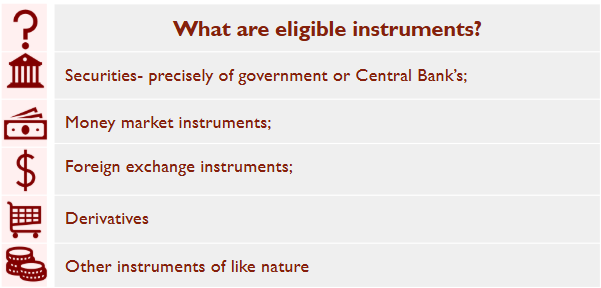
An ETP is a computarised system that facilitates the buying, selling and management of a wide range of financial instruments (listed down below). These platforms enable real-time market data dissemination, order execution, and efficient trade processing. For instance, in India, platforms such as the NDS-OM (Negotiated Dealing System – Order Matching) are well-known examples that specialize in government securities (g-sec) trading. Other entities include various bank-operated ETPs such as BARX operated by Barclays Investment Bank (international) and proprietary systems developed by financial institutions such as 360TGTX operated by Three Sixty Trading Networks (India) Pvt. Ltd.
Entities operating ETPs facilitating transactions in eligible instruments,under the New ETP Directions,
Grandfathering clause:
Any entity already authorised under the Erstwhile ETP Directions shall deemed to have been authorised under the New ETP Directions, or
any action already taken under the Erstwhile ETP Directions “shall be deemed to have been taken” under the New ETP Directions.
In practical terms, operators need not re-submit applications, seek fresh authorisations or revisit past actions as long as compliant under the Erstwhile ETP Directions.
Effective Date:
Effective immediately i.e. from June 16, 2025.
All about Electronic Trading Platforms (‘ETPs’)
Before going ahead to analyse the changes let us understand what ETPs are. ETPs are electronic systems, other than recognised stock exchanges, on which transactions in eligible instruments are contracted. But why would someone prefer trading on ETP rather than other exchanges/ platforms such as stock exchanges? ETPs offer eligible entities multi-instrument trading platforms (dealing with money-market, G-Secs, FX, swaps etc.) with tailored tenures and faster settlement process while stock exchanges cater to listed equities and futures with standardised contracts, retail participation and fixed trading hours.
Who operates these electronic systems?
Any entity as defined in the New ETP Directions incorporated in the form of a company and authorised by the RBI in this regard can operate an ETP. Currently, there are 12 authorised ETP operators under the Erstwhile ETP Directions who shall continue to operate under the New ETP Directions.
Types of ETP: Single Dealer Platform v. Multi-Dealer Platform
Basis
Single Dealer Platform
Multi-Dealer Platform
Seller
A single bank or financial institution
Several banks and financial institutions
Pricing
Tailored pricing from one provider.
Competitive pricing with options from several liquidity providers.
Liquidity
Low
High
Liquidity source
Provided by a single bank or institution.
Aggregated liquidity from multiple banks/institutions.
Customisation
Tailored interfaces and services designed for specific clients.
More standardized interfaces across multiple dealers; less tailored.
Execution quality
Stable and consistent execution within one controlled environment
Best execution can be sought across multiple quotes and providers
Suitability
Clients who value a close banking relationship and prefer a dedicated, controlled trading environment
Clients who want to compare and execute trades across a range of prices and liquidity providers
Example
NDS-OM, operated by Clearcorp Dealing Systems (India) Ltd., provides a secondary market platform for government securities owned by RBI
360TGTX, operated by Three Sixty Trading Networks (India) Pvt. Ltd., provides a platform for trading in FX Spot, Forwards, Swaps and Options
Players on ETP
Primary Dealers- In 1995, the RBI introduced the system of PDs in the Government Securities (G-Sec) Market. The objectives of the PD system are to strengthen the infrastructure in G-Sec market, development of underwriting and market making capabilities for G-Sec, improve secondary market trading system and to make PDs an effective conduit for open market operations (OMO).
The RBI currently extends various facilities to the PDs to enable them to fulfill their obligations, including memberships of electronic dealing, trading and settlement systems (NDS platforms/INFINET/RTGS/CCIL).
PDs are classified as below:
Standalone Primary Dealers- NBFC-ML
Bank Primary Dealers- Scheduled Commercial Banks and Central Banks- National and International
Basis
Standalone Primary Dealer
Bank Primary Dealers
Entity Structure
Operate as independent legal entities, often registered as NBFCs or as dedicated subsidiaries/joint ventures.
Operate as a departmental function within a scheduled commercial bank (or its branch, including foreign banks).
Regulatory Framework
RBI guidelines
RBI Guidelines and bank specific norms
Business focus
Primarily focused on government securities trading and related activities, often with more flexibility to diversify (e.g., underwriting, trading derivatives).
The primary dealer function is one element of a larger suite of banking services and is more integrated with the bank’s overall operations.
Operational Independence
Greater operational autonomy, being solely focused on the government securities market
Functions as an integral part of the bank’s operations, with decisions influenced by the broader business strategy of the bank
PDs registered with RBI
SBI DFHI Limited
Bank of Baroda, Bank of America
Traders
Analysis of Change
Having understood the nomenclature, we may proceed to analyse the changes and what they mean for Regulated Entities. The primary change and intent of the Draft Directions was to curb unregulated entities and platforms, specifically offshore platforms dealing with foreign exchange trading involving inshore/ domestic investors. Please note that foreign exchange instruments have been a part of eligible instruments, however, due to not being defined, the question whether such offshore ETPs would be covered, was always a question. The Draft Directions recommended certain changes, however, the major change was bringing offshore ETPs under the domain of RBI. However, the finalised New ETP Directions do not deal with this aspect.
While the RBI largely accepted the foundational architecture proposed in the draft, it has revised certain provisions to provide clarity in many areas, especially around risk and operational aspects which are now expressed in more precise terms along with addition of new provisions around enforcement and transitional mechanisms.
Highlights of Major Changes:
Expanded applicability to include outsourcing entities under the purview of the New ETP Directions in essence
Carve out to single dealer banks and Standalone Primary Dealer (‘SPD’)
Transition to an electronic application process: Moving away from physical submission, the application process is now streamlined through the PRAVAAH portal
Quarterly and annual reporting requirements for the operators introduced mandating regular updates thereby tightening regulatory oversight
Framework for data preservation and sharing post-authorisation
Comparison at a Glance:
Area
Erstwhile ETP Directions
New ETP Directions
Implications
Application process for authorisation
Physical submission
Through PRAVAAH Portal of RBI
Streamlining the process, enhancing accessibility, efficiency, and real-time tracking for applicants as well as regulators
Quarterly reporting
No such requirement
Quarterly reporting on functioning of ETPs by Operators (details covered below)
Operators to provide periodic updates on operational performance, ensuring regulatory oversight
Annual Reporting
No such requirement
Annual reporting on compliance of the New ETP Directions and terms and conditions prescribed (details covered below)
Operators to yearly confirm their adherence to updated regulatory guidelines and contractual conditions
Eligibility Criteria
Did not apply to ETPs operated by SCBs
Apply to all the entities including SCBs operated ETPs (except exemption covered below)
Banks must now play by the same rulebook as other operators, additionally Public Sector Banks shall have to incorporate (or spin off) a Companies Act vehicle, infuse requisite capital and adhere to technological standards. Until now, Public Sector Banks that operate an ETP slipped neatly around the RBI’s “company‐only” eligibility gate. The New ETP Direction takes away that privilege. From the day the change takes effect, every ETP, bank-owned or not must meet the same bar
Preservation, access and use of data
Did not have a provision for treatment of data in the event of cancellation of authorisation
Specifies the requirement to share data, along with form and manner, with the RBI or any agency in the event of cancellation of authorisation as may be called upon by the RBI or any other agency.
Enhanced regulatory oversight and post-termination accountability on operators
Definition of ‘Entity’
“….an agency formed as a ‘company’ and incorporated under the Companies Act, 2013 (or earlier acts)”
“….any person, natural or legal.”
Language of the New ETP Directions seems to widen the scope of entity, however reading the impact along with para 6(f)(iii), it only brings the outsourcing entities under the widened scope
Grandfathering Rule
Not needed (first issue)
All licenses/actions under Erstwhile ETP Directions shall be treated as valid
No fresh registration required
Exemption
ETPs operated by banks for their customer on a bilateral basis as long as no market is being created for the securities
Carve out to SCBs (including branches of Foreign Banks operating in India) and SPDs wherein the bank or the SPD operating the electronic system is the sole quote/price provider and a party to all transactions contracted on the system.
Banks and SPDs can operate proprietary trading platforms without the full weight of the standard compliance requirements set for multi-dealer platforms. This can streamline their internal processes and reduce regulatory and technological burdens.Acting as the sole quote provider makes these institutions both the operator and counterparty. This can improve execution speed and reduce inter-dealer friction.A single market maker model may lead to faster execution but can constrain competitive pricing, potentially resulting in wider spreads if the operator does not face rival pricing pressures from other dealers.While banks and SPDs gain efficiency due to lesser compliances, they must remain vigilant about disclosure and transparency requirements to avoid any adverse effects on market integrity.Banks and SPDs may develop more tailored platforms, exclusive systems to capture niche market segments.Synchronization with global norms that treat single-dealer platforms as an extension of the dealer’s book and not that of an exchange.
Reporting Requirements:
These new requirements shall have to be complied with along with the existing reporting requirements under the Erswhile ETP Directions from the effective date of the New ETP Directions. Accordingly, the first quarterly report shall be required to be submitted on or before 15th July, 2025 and the annual report shall be submitted on or before 30th April, 2026. The manner of reporting by ETP operators as per the New ETP Directions has been listed below:
Reporting Requirement
Reporting Authority
Frequency
Format
Timeline
New
Functioning of the platform, including but not limited to the following points:Events resulting in disruption of activities, during the quarter, if anyInstances of market abuse, during the quarter, if anyDetails about any material change in trading procedure or technology carried out during the quarter
On or before 15th day of the month following the quarter
Compliance with the New ETP Directions and terms and conditions prescribed at the time of authorisation
RBI
Annually
Not specified
on or before the 30th of April of the succeeding financial year
Data relating to activities on the ETP
RBI
Post cancellation of authorisation
As may be prescribed
As may be prescribed
Existing
Transaction information
Trade repository or trading platform
As may be prescribed
As may be prescribed
As may be prescribed
Other report, data and/or information as required by RBI
RBI
As may be prescribed
As may be prescribed
As may be prescribed
Data/information
Any agency as required by Indian Laws
Not specified
Not specified
Not specified
Event resulting in disruption of activities or market abuse
RBI
Event-based
Not specified
Not specified
Conclusion:
By introducing defined protocols for risk management, data governance and reporting, the updated framework seeks to close existing regulatory gaps. Key provisions of the New ETP Directions include, amongst others, a clear exemption for single–dealer platforms and a streamlined application process via the PRAVAAH portal. These measures ensure legal continuity. Ultimately, this transformative framework not only reinforces the integrity of the trading ecosystem but also cultivates an environment conducive to innovation.
https://vinodkothari.com/wp-content/uploads/2023/06/vinod-kothari-logo.png00Staffhttps://vinodkothari.com/wp-content/uploads/2023/06/vinod-kothari-logo.pngStaff2025-06-23 19:18:342025-06-23 19:33:47Master Direction on ETPs: Key Changes & Compliance Guide
Project loans, used to finance large infrastructure and industrial ventures like highways, power plants and railways etc., are fundamentally different from regular business or personal loans. Unlike typical loans that are repaid from either the borrower’s existing operations and balance sheet (in case of the former) or the borrower’s own credit worthiness (in case of the latter), project loans are forward-looking: they primarily rely on cash flows of the project, generated onlyafterthe project becomes operational. Because of this, delays in project completion due to various factors such as land acquisition issues and regulatory delays which may be beyond the control of the developer are common. These may arise from. Such delays, though being routine and not necessarily indicating borrower’s stress, triggered adverse asset classifications under the existing rules.
When the RBI introduced its 2019 prudential framework to enable early recognition and time bound resolution of stressed assets, it excluded such project loans from its scope (see para 25). As a result, these continued to be governed by old norms, specifically para 4.2.5 of the 2015 IRCAP and later, para 3 of Annex III under the RBI SBR Directions. However, these norms did not reflect the unique risks faced by project finance especially during the construction phase.
To address these issues, the RBI released the Draft Project Finance Directions in May 2024, proposing a dedicated regulatory framework tailored to project loans. The Project Finance Directions(‘Directions’) have been issued on 19 June, 2025. This article explores the need for such a framework, the changes brought in the regulatory regime, and their impact on borrowers and lenders.
Project finance vs other kinds of finance
In corporate lending, credit decisions are primarily based on the borrower’s balance sheet strength, existing cash flows and overall financial health. where the lender primarily assumes credit risk
In contrast, in project finance, repayments as well as the primary security depend primarily on the successful implementation and projected cash flows of a specific project, rather than the borrower’s overall financial position. Accordingly, the lender takes two different risks:
Project riski.e. the risk that the project may face commencement delays due to factors like regulatory bottlenecks, land acquisition issues or construction delays and;
Credit riski.e. the risk of inadequacy of cashflows to make the scheduled contractual payouts.
Importantly, in project finance, delays in cashflows often happen due to non-credit factors linked to project execution, mainly project delays. As a result, automatic downgrading of classification due to any project delay may not only fail to provide a true risk profile of the loan but also cause increased provisioning burden on the lender.
Overview of the Directions
The Directions deal with the following broad aspects:
Classification of projects and project finance;
Prudential requirements for extending project loans including:
Provisioning requirements;
Conditions for sanction, disbursement and monitoring.
Resolution and restructuring of project loans
Either due to stress;
Extension/ delays in DCCO.
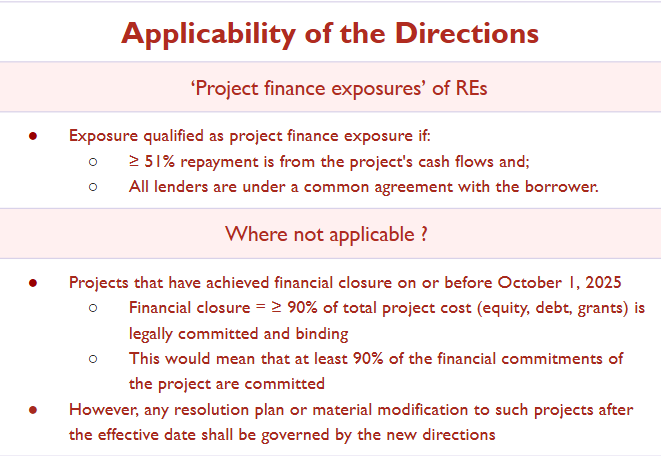
Applicability
Classification of ‘project’ and ‘project finance’
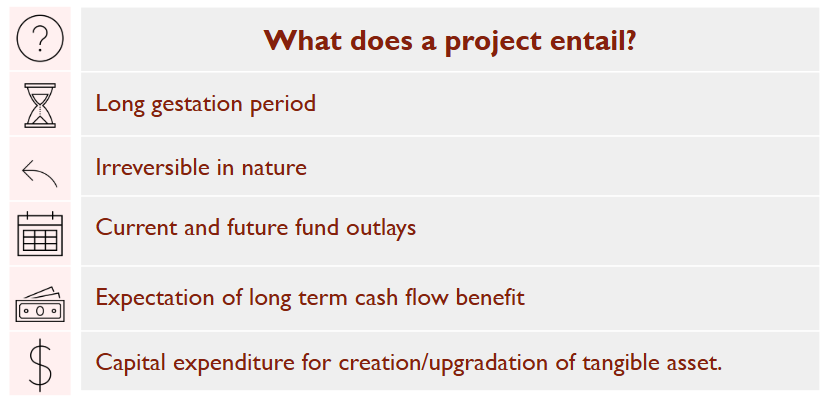
Under the Directions, a project is defined as to involve capital expenditure for the creation, expansion or upgradation of tangible assets or facilities, with the expectation of long-term cash flow benefits [see para 9(l)], with the following features:
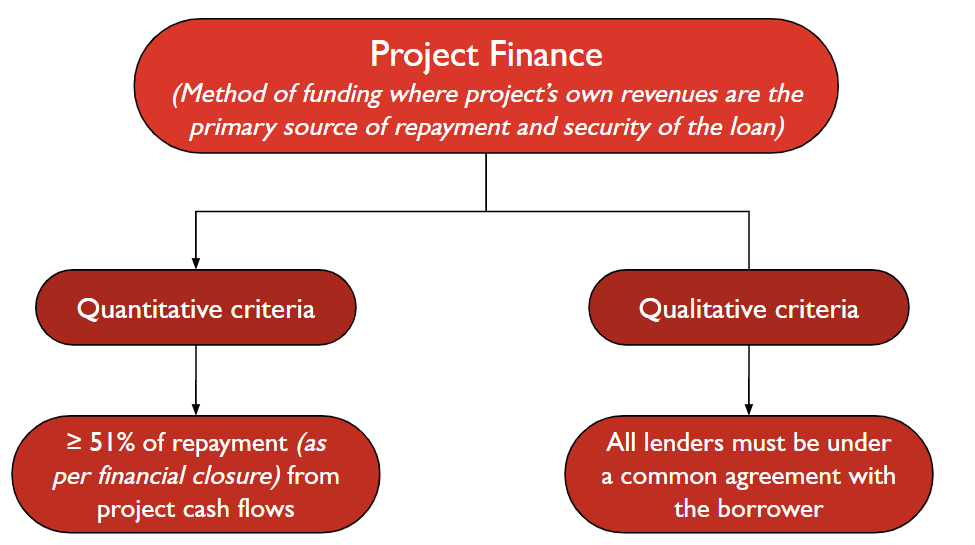
Project finance is a method of funding where the project’s cash flows/ revenue own revenues are the primary source of repayment as well as the and security for the loan [see para 9(m)].
It can be:
Greenfield (new project);
Brownfield (existing project enhancement).
To qualify as project finance under the Directions:
Note: Loan terms can differ across lenders if agreed by all parties
The earlier definition of project finance under the SBR Directions was generic and vague, referring merely to a “project loan” as any term loan extended for setting up an economic venture. The Directions have provided more clarity on what would be considered as project finance and have linked it to the definition of project finance under the Basel Framework, while also providing a quantitative threshold of 51%.
Project finance envisages the lender’s exposure in a project, which is typically in the process of being set up. The repayment will be from the project cashflow i.e. the payout structure is connected with the commencement of commercial operations of the project. The lending is based on the projected cash flows of the project rather than the balance sheet of the developer. It is distinct from asset finance, where loans are backed by existing assets generating income. Further, project finance differs from a working capital loan/general corporate purpose loan where the latter is towards financing the working capital needs of the developer entity based on the overall health of the entity.
Would it mean that project loans cannot have any other collateral and must solely rely on the project as the security? The answer is negative since the threshold specified allows to have other/ additional collateral, say, personal guarantee of the developer etc., however, the primary security shall be the project cashflows.
Other important terminology
DCCO
The Date of Commencement of Commercial Operations (DCCO) is a key milestone in project finance, marking the transition from construction to operational phase when a project begins to generate revenue.The Directions recognises three forms of DCCO. [see Para 9(e) to (m)]
CRE and its sub-category CRE-RH
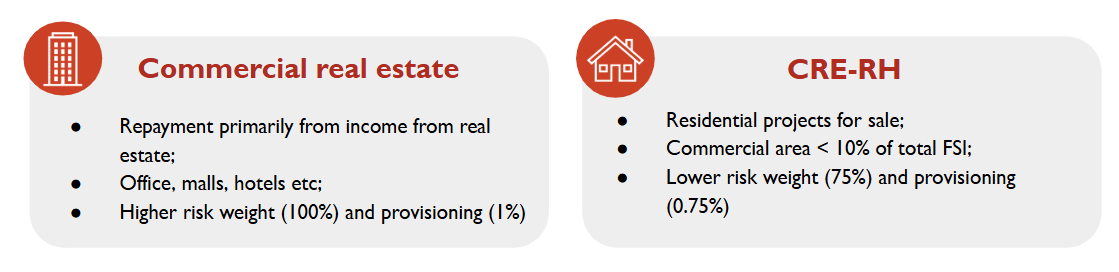
Defined in Directions on Classification of Exposures as Commercial Real Estate Exposures, CRE refers to loans or exposures where repayment primarily depends on income generated by the real estate asset itself. This typically includes office spaces, malls, warehouses, hotels and multi-family housing complexes that are leased or sold in the open market. Since CRE is a sub-head of project finance, it also follows similar characteritics of project finance i.e.both repayment of the loan and recovery in case of default are closely tied to the cash flows from the real estate asset such as rental income or sale proceeds. [see para 9(b)]. The definition is aligned with the definiton of income-producing real estate (IPRE) under Basel norms. Our article discussing CRE can be assessed here. https://vinodkothari.com/2023/04/commercial-real-estate-lending-risks-and-regulatory-focus/
Commercial Real Estate – Residential Housing (CRE-RH) [see para 9(c)]
Since residential housing projects generally pose lesser risk and volatility compared to commercial properties, the RBI created a distinct sub-category within CRE called CRE-RH vide notification dated June 21, 2013. CRE-RH includes loans given to builders or developers for residential housing projects meant for sale.To classify as CRE-RH, the project must be predominantly residential and commercial components like shops or schools should not exceed 10% of the total built-up area (FSI). If the commercial area crosses this 10% threshold, the entire project will be CRE. This distinction isn’t just semantic, it has regulatory benefits. Since CRE-RH are subject to lower risk due to various reasons such as diversified cash flows and lower dependency on a single occpnt, RBI has assigned lower capital risk weights i.e. 75% to CRE-RH compared to standard CRE 100% and lower provisioning provisioning requirements (0.75% vs. 1%).
Prudential requirements
Provisioning requirements
In the context of project finance, where risks vary across different phases of a project’s lifecycle, a one-size-fits-all provisioning approach throughout the project life may not be relevant. .
Under the SBR, provisioning norms made no distinction between the construction and operational phases of a project. A uniform provisioning rate was applied i.e. 0.75% for CRE-RH and 1% for CRE while other loans were provisioned at 0.4% irrespective of whether the project was just starting construction or had already begun generating revenue. This approach, while simple, failed to reflect the heightened risks associated during the construction phase , such as delays, cost overruns, or regulatory hurdles.
To address this gap, the Draft Directions, proposed a conservative approach calling for a 5% provision during the construction phase and 2.5% during the operational phase, with the operational rate reducible to 1% if following conditions were met:
the project demonstrated positive net operating cash flows sufficient to service all current repayment obligations, and
there was a minimum 20% reduction in long-term debt from the level outstanding at the time of achieving DCCO.
These draft norms were considered overly harsh, particularly for long-gestation infrastructure projects where cash flows stabilise gradually.
Taking stakeholder feedback into account, the Directions adopted a more balanced g structure as follows:
Project type
Construction Phase
Operational phase – after commencement of repayment interest and principle
Commercial real estate (CRE)
1.25%
1%
CRE – Residential Housing
1%
0.75%
Other projects
1%
0.40%
DCCO deferred projects:
Additional provisioning to be maintained depending on the type of project:0.375% per quarter for infra projects0.5625% per quarter for non-infra projects
NPA project finance accounts
As per extant instructions
Provisionig for existing projects
Continued to be governed by extant norms;If resolution is done for any fresh credit event or change in terms occur after the effective date of these directions, then provisioning as per these Directions
RBI’s draft proposal for lower risk-weights for high quality infrastructure projects
The RBI has issued a draft amendment to the Scale Based Regulations, 2023 on 27th October, 2025, proposing a lower risk weight framework for ‘High-Quality Infrastructure Projects’. Once finalised, the provisions would be applicable from April 1, 2026, or from an earlier date when adopted by an NBFC in entirety. The intent of the amendment is to recognise and incentivise lending to stable, well-performing infrastructure projects by prescribing reduced risk weights for such exposures. Under the draft, “High-Quality Infrastructure Projects” are defined as infrastructure projects meeting all of the following conditions:
The project has completed at least one year of satisfactory operations post achievement of the actual DCCO;
The exposure is classified as ‘standard’ in the books of the lender;
The obligor’s revenue depend on one main primary counterparty, which shall be the Central Government or a Public Sector Entity, and the contractual terms ensure certainty of payment, such as through availability-based1 or take-or-pay arrangements2;
The contractual provisions offer strong creditor protection such as escrow of cash flows, legal first charge on project assets and other appropriate safeguards in case of early termination;
The obligor has adequate internal or external funding arrangements to meet current and future working capital or other funding needs, as assessed by the lender;
The obligor is restricted from undertaking actions detrimental to creditors, such as raising additional debt secured by the project’s cash flows or assets without lender’s consent.
Projects meeting all of the above criteria will qualify as high-quality infrastructure assets and will attract lower risk weights, as follows:
50%, where the obligor has repaid at least 10% of the sanctioned amount;
75%, where the obligor has repaid at least 5% but less than 10% of the sanctioned amount.
If a project subsequently fails to meet any of the qualifying conditions, it will cease to be treated as a high-quality asset and will instead attract the standard risk weight of 100% applicable to regular infrastructure exposures.
Conditions of project finance
The onus is on the lender to ensure that the following conditions are met before extending any project finance. These conditions will ensure that the facility is structured prudently and is aligned with the implementation as well as cash flows of the project, thereby mitigating both credit as well as project risk. The requirements are more or less similar to the earlier Directions.
Repayment schedule during operational phase is designed to factor initial cash flows
Repayment tenor, including the moratorium period, if any, shall not exceed 85% of the economic life of a project.
This means there is a mandatory 15% tail period i.e. if the project has an economic life of 20 years and the loans are to be repaid in 17 years, the last 3 years are the tail period.Tail period gives comfort to the lender that in case of any default or delay in repayment by the time of maturity, there is still some period left to recover dues from the project cash flows after the scheduled loan maturity.
Would this mean that a borrower cannot obtain a top-up loan after the expiry of 85% of the loan tenure?
The requirement applies to loans with all kinds of tenures, either short or long.
One borrower, multiple lenders
If a project is financed by more than one lender, RBI mandates that the DCCO, whether original, extended or actual, shall be the same across all lenders. This will ensure that:
DCCO is uniform across all lenders
Project progress as well as any delays are uniform across all lenders
Uniform asset classification, preventing any lender from having a different provisioning status.
To ensure balanced risk sharing, the Directions have put consortium lending limits (Para 15): Where projects are under-construction:
Aggregate exposure of all lenders is ≤ ₹1,500 crore: each lender shall hold at least 10% of total exposure;
For projects with exposure > ₹1,500 crore: each lender must hold at least 5% or ₹150 crore, whichever is higher.
These caps essentially require participating lenders to hold sufficient skin in the game and thereby promote responsible credit appraisal as well as avoid risk from being concentrated in a few lenders, especially where other lenders have negligible exposure and hence, less incentive to ensure monitoring.
Inter-lender transfer
These minimum exposure norms will not apply to operational phase projects;
In design or construction phase, lenders are permitted buy/sell exposure only under syndication arrangements as per TLE, and within the exposure limits
In operational phase, exposures can be freely transferred as per TLE norms.
This may be because construction and pre-operational stages are inherently more uncertain and riskier, and therefore, the regulator requires lenders who are willing to remain committed and not exit easily to avoid creating instability.
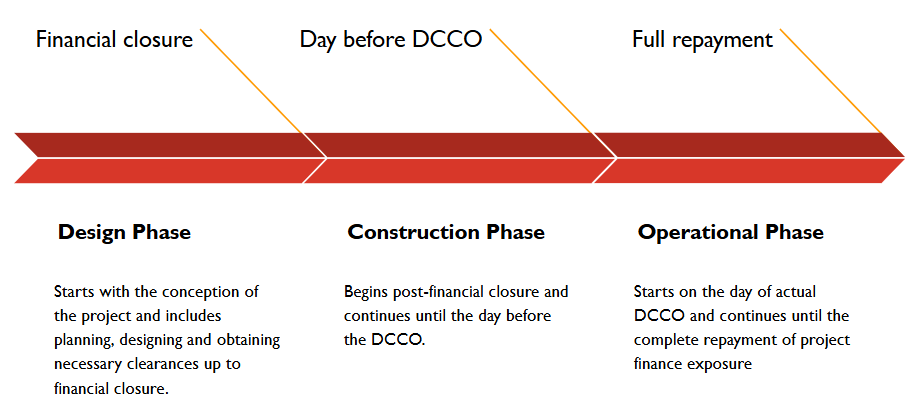
Project lifecycle – 3 different phases
A project has been divided into 3 phased viz Design, Construction and Operational.
Why does this classification matter?
The regulatory framework treats each phase differently for various risk, compliance and prudential reasons.
Disbursement discipline (Para 21)
Disbursal of funds must be linked to project completion milestones i.e. completion of phases.
Lenders must also track progress in equity infusion and other financing sources as agreed at financial closure
Asset classification (Para 22 & 29)
In design and construction phases, loans can be classified as NPA based on recovery performance, as per IRACP norms.
Once an account is classified as NPA, it can only be upgraded after demonstrating satisfactory performance during the operational phase
Resolution trigger (Para 23)
If any credit event (e.g., default) occurs with any lender during the construction phase, a collective resolution process is triggered
Provisioning norms (Para 32)
Provisioning rates are higher for projects under construction
Once the project enters the operational phase, provisioning reduces, reflecting lower credit risk.
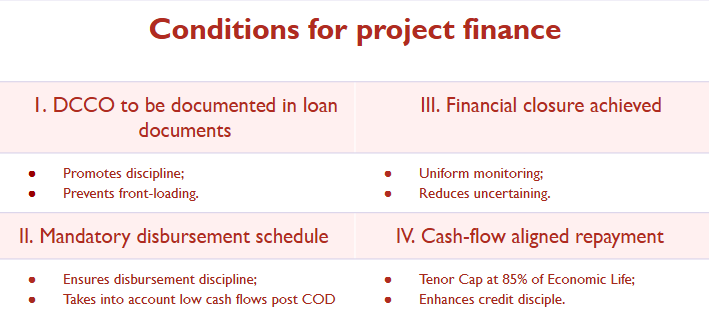
Mandatory requirements before sanctioning a project finance loan: (13)
Achievement of financial closure and documentation of original DCCO;
Project specific disbursement schedule vis a vis stage of completion is included in loan agreement
Post DCCO repayment schedule designed to factor initial cash flows
Prudential conditions related to disbursement and monitoring:
Lender to ensure the following:
Clearances are obtained by the lender:
All requisite approvals/clearances for implementing/constructing the project are obtained before financial closure.(examples: environmental clearance, legal clearance, regulatory clearances, etc.)
Approvals/clearances contingent upon achievement of certain milestones would be deemed to be applicable when such milestones are achieved.
Availability of sufficient (prescribed) minimum land/right of way with the lender before disbursal of funds
This would mean that lender must ensure that the builder executing the project has either:
Ownership of the land (through purchase, lease etc.) or
Legal rights to use/access the land i.e. Right of Way.
For PPP projects, disbursal of funds to occur only after declaration of the appointed date.
Except where non-fund based facilities are mandated by the concessioning authority as a pre-requisite for declaration of the appointed date itself;
Disbursal to be proportionate
To stages of completion of project, infusion of equity or other sources of finance and receipt of clearances
Lender’s Independent Engineer/Architect to certify the stages
Creation and maintenance of a project finance database (see para 37):
Every lender to capture and maintain, on an ongoing basis, project specific information relating to:
Debtor and project profile;
Change in DCCO;
Credit events other than deferment of DCCO;
Specifications of project
Any updation shall be made within 15 days from any change in information;
Necessary systems to be placed within 3 months from the effective date ie by 1st January, 2026
Resolution of Project Loans
Prudential norms for resolution
Lender to monitor performance of project on on-going basis;
Expected to initiate a resolution plan well in advance.
Collective resolution to be initiated by the lenders in case credit event happens with any one lender
In case of any credit event;
Lender to report the same:
to the Central Repository of Information on Large Credit and;
to all other lenders, in case of consortium lending.
Lender to take a review of debtor account within 30 days.
Inter creditor agreement and decision to implement a resolution plan may be done during this period.
Implement the resolution plan within 180 days from the end of the review period.
Resolution plans involving extension of DCCO
Paragraphs 26 to 28 provide a structured framework under which project loans may continue to be classified as ‘standard’ despite delays in project completion, provided specific conditions are met. The objective is to offer flexibility to lenders and borrowers in addressing genuine project delays or cost escalations, without triggering an immediate downgrade to NPA so long as the resolution is timely and prudently implemented.
Permitted DCCO deferment
The DCCO may be deferred, with a corresponding adjustment in the repayment schedule. However, such deferment is subject to the following maximum limits:
Up to 3 years for infrastructure projects
Up to 2 years for non-infrastructure projects (including commercial real estate)
Cost overrun associated with the DCCO deferment:
A cap of 10% of the original project cost, over and above Interest During Construction (IDC)
The overrun must be financed through a Standby Credit Facility sanctioned at the time of financial closure
Post-funding, key financial metrics such as the Debt-Equity ratio and credit rating must remain unchanged or show improvement in favour of the lender
Deferment in DCCO associated with change in scope and size
Rise in project cost (excluding cost overrun) is at least 25% or more of the original project outlay
Reassessment of project viability by the lender before approving the revised scope and DCCO
If the project has an existing credit rating, the new rating must not deteriorate by more than one notch; if unrated and aggregate lender exposure is ₹100 crore or more, the revised project must obtain an investment-grade rating
This benefit of maintaining ‘Standard’ classification due to a change in scope can be availed only once during the project’s life
Resolution plan (‘RP’) deemed successfully implemented only if:
Necessary documentation completed within 180 days from the end of the Review Period and;
Revised capital structure and financing terms are duly reflected in the books of both the lender and the borrower.
Immediate downgrading to NPA if the resolution plan is not implemented within the timeline and conditions above
Once NPA, account can be upgraded only after:
Satisfactory performance post actual DCCO, in case of non-compliance with conditions of resolution plan;
Successful implementation of resolution plan, in case of non-implementation of RP within the specified time.
See a detailed PPT on the Project Finance Directions here
A contractual model where the project earns fixed payments from the counterparty based on the asset’s availability and performance, irrespective of actual usage or demand ↩︎
A contract under which the buyer agrees to pay for a specified quantity of output (e.g., power, gas, water) whether or not it actually takes delivery, ensuring predictable cash flows for the project. ↩︎
https://vinodkothari.com/wp-content/uploads/2023/06/vinod-kothari-logo.png00Staffhttps://vinodkothari.com/wp-content/uploads/2023/06/vinod-kothari-logo.pngStaff2025-06-23 16:44:502025-10-28 18:11:30Balancing flexibility and discipline: Analysis of RBI’s Project Finance Directions, 2025
Alternative Investment Funds (AIFs) have come up as a regulators’ favourite in the recent years with both SEBI and RBI tightening regulatory controls around the same within their respective domains. The use of AIF as regulatory arbitrage in recent years calls for such strict regulatory boundaries. The growth of AIFs appears quite decent, with statistics showing a cumulative investment of Rs. 5.38 lac crores made by AIFs, against Rs. 5.63 lac crores of funds raised (as on 31st March, 2025). Compared to the market size as at the end of 31st March, 2023, the market has grown by more than 50% as at the end of 31st March, 2025. Category II AIFs occupy the highest share, with Category III AIFs following suit. As the market size increases, so does the regulatory supervision.
This article deals with the regulatory requirements for AIFs that find their first-time mandatory applicability during FY 25-26, and would form a part of the Compliance Test Report (CTR) to be issued for FY 25-26 (see later part of this article).
Certification requirements for key investment team of Manager of AIF
Vide a 2023 amendment, the active schemes of AIFs as on 13th May, 2024 and those launched on or after 10th May, 2024 are required to have at least one key personnel in the key investment team of its Manager, with relevant certification as specified by SEBI. The NISM certification requirement, prescribed on 13th May, 2024, as extended, is required to be complied latest by 31st July, 2025.
Holding investments in dematerialised form
AIFs have been mandated to hold investments in dematerialised form, subject to certain relaxations. The timelines, as extended videcircular dated 14th February, 2025, attract dematerialisation requirements as below:
Date of investment by AIF
Applicability of dematerialisation
Inapplicability of dematerialisation
Dematerialisation to be ensured by
On or after 1st July, 2025
Mandatory
Scheme of an AIF whose: Tenure ends on or before 31st October, 2025 orExtended tenure as on 14th February, 2025
Immediately
Prior to 1st July, 2025
Not applicable, except: If investee company is mandated under applicable law to facilitate dematerialisation (for e.g. – CA, 2013 requires mandatory dematerialisation of shares except in case of small company or WoS of public company etc)AIF exercises control over the investee company, either on its own or along with other SEBI regd. intermediaries mandated to hold investments in demat form
On or before 31st October, 2025
Due diligence of investors and investments of AIF
An April 2024 amendment to the AIF Regulations, followed by a circular dated 8th October, 2024 read with the Implementation Standards formulated by the Standard Setting Forum for AIFs (‘SFA’) requires an AIF to carry out various due diligence checks through its Manager and its Key Management Personnel (KMP) with respect to investors and investments of the AIF, to prevent facilitation of circumvention of the specified regulatory frameworks. The scope and requirements for the due diligence has been detailed in our article and further elaborated in the form of FAQs (read here).
In addition to the ongoing due diligence requirements, a one-time due diligence was required for existing investments as on the date of the Circular (8th October, 2024), the report of which was required to be submitted to the custodian on or before 7th April, 2025.
Cybersecurity and Cyber Resilience Framework (CSCRF)
The Cybersecurity and Cyber Resilience Framework (CSCRF), notified vide the circular dated 20th August, 2024 as revised vide the circular dated 30th April, 2025, categorises AIFs based on the AUM at manager level. Accordingly, the following categorisation follows:
Corpus of all AIFs, VCFs and their schemes managed by a manager
Categorisation under CSCRF
> Rs. 10000 crores
Mid-size REs
3000 crores < AUM < 10000 crores
Small-size REs
< Rs. 3000 crores
Self-certification REs
The classification w.r.t. Qualified REs (the topmost categorisation) does not apply in case of AIFs.
The timeline for compliance with the requirements as per the CSCRF is 30th June, 2025 (as extended by the circular dated 28th March, 2025) based on which cyber audit is to be conducted from FY 25-26 and the report shall be submitted to SEBI.
Consequence of non-compliance: negative reporting in Compliance Test Report
The manager of AIF is required to report the compliances with various applicable provisions of the AIF Regulations read with the circulars made thereunder, on an annual basis. CTR is submitted within 30 days from the end of the financial year, to the sponsor and trustee (in case AIF is set up as a trust). The trustee/ sponsor provides their comments on the CTR to the manager within 30 days from the receipt of CTR, based on which the manager shall make necessary changes and provide a response within the next 15 days.
A significant aspect of the CTR is that any violation observed by the trustee/ sponsor is required to be intimated to SEBI, as soon as possible.
RBI, through a series of circulars (dated 19th December 2023 and 27th March 2024 respectively), regulates the investments made by the RBI-regulated entities in AIFs, putting a prohibition on the regulated entities from making investments in any scheme of AIFs which has downstream investments either directly or indirectly in a debtor company of such an entity. Draft Directions have been issued recently, proposing to permit investments by RBI-regulated entities upto a certain percentage of the corpus of the AIF scheme. Read more about the same here. Once notified, the same would relax the investment norms for RBI regulated entities in AIFs.
Further, SEBI has, in its meeting held on 18th June 2025, approved certain amendments for AIFs, particularly for angel funds. This aims to strengthen the regulatory regime around investments by angel funds considering the abolishment of angel tax in India, while also relaxing certain investment norms by such angel funds. Further, SEBI has approved co-investment schemes that may be offered by Cat I and Cat II AIFs, facilitating co-investment to accredited investors of a particular scheme of an AIF, in unlisted securities of an investee company where the scheme of the AIF is making investment or has invested. The AIF Regulations presently permits co-investments through a co-investment portfolio manager.
Thus, the approach of regulators seems to be gradually softening, attempting to bring a balance between regulatory supervision and ease of business considerations.
https://vinodkothari.com/wp-content/uploads/2023/06/vinod-kothari-logo.png00Staffhttps://vinodkothari.com/wp-content/uploads/2023/06/vinod-kothari-logo.pngStaff2025-06-21 18:54:072025-06-21 18:54:08Regulatory landscape for AIFs: what’s new?
– Easing ESOPs for IPO-bound companies, relaxations to SEBI regd. intermediaries, providing clarity for uniformity of practices
– Team Corplaw | corplaw@vinodkothari.com
Various proposals have been approved by SEBI in its Board meeting dated June 18, 2025, pertaining to various relevant regulations. The approved changes may impact various market participants – listed entities as well as IPO-bound companies, SEBI registered intermediaries and regulated entities such as REITs, Invits, AIFs, FPIs, etc. We briefly discuss some of the important proposals as approved by SEBI.
Relief for promoters in IPO-bound companies: easing rules on ESOPs and offer for sale
Relaxation in eligibility norms with respect to Offer for Sale (OFS) in IPO (see Consultation Paper here)
Exemption from minimum holding period of 1 year extended to equity shares arising from conversion of Compulsory Convertible Securities (CCS), where such CCS were acquired pursuant to an approved scheme (earlier limited to equity shares) to assist in reverse flipping (i.e. shifting the country of incorporation from a foreign jurisdiction to India) [Reg 8 & 105 of ICDR Regulations].
Enabling Minimum Promoter Contribution (MPC) by Relevant Persons (apart from promoter) through equity shares arising from conversion of fully paid-up CCS
Relevant Persons comprise of AIFs, FVCIs, Scheduled Commercial Banks, PFIs, insurance cos etc.
Founders-turned-promoters can retain share based benefits, ESOPs granted 1 year prior to filing of DRHP (see Consultation Paper here)
Brings relaxation for treatment of options granted prior to becoming a promoter, which was otherwise required to be liquidated
Dematerialisation of shares: pre-IPO and post-listing requirements
Mandatory dematerialization of securities held by critical pre-IPO shareholders before filing of DRHP (see Consultation Paper here):
Following categories covered:
Promoter Group
KMPs
Directors
Employees
Selling Shareholders
QIBs
Senior Management
Financial sector entities
To reduce volume of physical shares
CA, 2013 also requires mandatory dematerialisation of holding of promoters, directors and KMP of companies prior to undertaking any share based corporate action [Rule 9A and 9B of Companies (Prospectus and Allotment of Securities) Rules]
Corporate actions by listed entities in dematerialised form only
For shares to be issued pursuant to consolidation/split of face value of securities and scheme of arrangements
CA, 2013 already requires companies to issue shares in dematerialised form only
Fund raising mandatory for social enterprises registered with SSE, relaxations in eligibility conditions for registration
Mandatory fund raising through SSE
Registration to lapse if social enterprise registered with SSE does not raise funds within 2 years from registration
Definition of “Not for Profit Organization” expanded [Reg 292A(e) of ICDR]
Trusts registered under Indian Registration Act, 1908 permitted (extant regulations refer to Indian Trusts Act, 1882 and a trust registered under the public trust statute of the relevant state)
Charitable society registered under relevant state Act (extant regulations covered only society registered under the Societies Registration Act, 1860)
Companies registered under Section 25 of the erstwhile Companies Act, 1956 (clarity provided since extant regulation refers to section 8 of 2013 Act)
List of eligible activities expanded to align with Schedule VII of the Act, 2013 (pertaining to CSR activities)
Criteria of 67% of total activities reflecting in eligible activities (through revenues, expenditure or total customer base) relaxed
To be applicable only to “for profit social enterprises”
Annual disclosures bifurcated into financial and non-financial disclosures
Different timelines to be prescribed for such disclosures
CP prescribes the extant 60 days’ period for non-financial disclosures, and upto 31st October after end of FY for financial disclosures
Self-reporting of Annual Impact Report instead of certification from Social Impact Assessor
For social enterprise that has not raised funds through the SSE
Change in nomenclature of “Social Impact Assessment Firm” to “Social Impact Assessment Organization”(SIAO) and eligibility conditions for the SIAO prescribed
SIAO to is permitted to conduct social impact assessment provided they have at least two social impact assessors in full time employment
Having an and such impact assessors have experience of at least 3 years of conducting social impact assessment.
Social impact assessor to sign the report if SIAO does not have 3 years’ track record
Revamping of regulatory framework for Angel Funds under AIF Regulations
Mandatory registration of Angel Investors as Accredited Investors(AI)
Attracts independent verification of investor status
Recent CP dated June 17, 2025 proposes certain flexibilities under the accreditation framework.
Grandfathering of earlier investments as non AI, and implementation through glide path
Accredited Investors included as Qualified Institutional Buyer in ICDR for investments in Angel Funds.
Relaxation in investment norms by angel funds in investee company
Floor and cap relaxed from Rs. 25 lacs to Rs. 10 lacs, and from Rs. 10 crores to Rs. 25 crores respectively
Concentration limits of 25% per investee company removed.
Follow on investments permitted in investee company, though may no longer be start-up
Scheme may now have more than 200 AIs
Minimum continuing interest of Sponsor/ Manager at investment level instead of Fund level
higher of 0.5% of investment amount or Rs. 50,000
Earlier the commitment was required to be maintained at a fund level only
SEBI regulated entities enabled to carry out activities not regulated by SEBI
Merchant Bankers and Debenture Trustees have been permitted to carry out activities not regulated by SEBI within the same legal entity subject to following conditions:
DT may undertake activity within the purview of any other financial sector regulator (FSR), subject to compliance with the regulatory framework specified by such regulator
For activities not within the purview of SEBI or other FSR, the same shall be fee-based and non-fund-based activity and pertain to FSR
Had been previously required to hive off such activities pursuant to SEBI Board Meeting decision in December, 2024
Custodians permitted to carry out other financial services under the regulatory oversight of other financial sector regulators within the same legal entity
subject to having adequate mechanisms to address issues of conflicts of interest
Non-bank associated custodians offering services which are not overseen by any financial sector regulator to :
Disclose clearly that such activities are outside the purview of, and without recourse to SEBI
Set up distinct strategic business units (SBUs) for undertaking activities not under the purview of SEBI with adequate mechanisms to address issues of conflicts of interest
Clarity of responsibilities and uniformity measures for DTs
Specifying rights of DT and corresponding obligations on issuer under LODR
To enable DT in enforcing its rights
Enabling provisions for providing format for model debenture trust deed (DTD) [Refer Annexure-1 of Consultation paper dated Nov 04, 2024 for the model DTD as proposed by SEBI]
Modification in manner of utilization of Recovery Expense Fund (REF) (see an article on REF here)
Elaboration of list of expenses for which REF can be utilised
To provide ease to DTs to take prompt action upon default by listed entity
Relaxations in regulatory norms for REITs and InvITs [see consultation paper dated May 02, 2025]
Definition of ‘public’ under REITs / InvITs to be amended to include related parties of the sponsor, investment manager/manager and project manager to qualify as public if such related parties are Qualified Institutional Buyers
Relevant for determination of minimum public holding
Related party of REIT/ InvIT viz. sponsor, sponsor group, investment manager, project manager are not regarded as ‘public’
Adjustment of negative net distributable cash flows generated by the Holdco against cash received from the SPVs
Net cash flow post adjustment to be distributed to unitholders
Alignment of timelines of submission of various reports including quarterly reports, valuation reports with the timelines for submission of financial results.
Reduction of minimum allotment lot for privately placed InVITs to INR 25 lacs from INR 1 crore to align with the trading lot in secondary market.
https://vinodkothari.com/wp-content/uploads/2023/06/vinod-kothari-logo.png00Staffhttps://vinodkothari.com/wp-content/uploads/2023/06/vinod-kothari-logo.pngStaff2025-06-21 12:05:272025-06-21 12:07:33SEBI approves a mix of reforms for regulated entities
A seemingly benign, innocuous and long standing definition of “promoter group” in SEBI (ICDR) Regulations, 2018 (‘ICDR Regulations’) is suddenly seeming to put to trial family relationships, by forcing spouse-side relations to share the details of entities owned by the spouse’s family – even when they have no stake or involvement in the listed company. Those entities will now have to be disclosed as a part of the “promoter group” entities of either family.
This definition has been there ever since in the ICDR Regulations, but the instant focus on the definition springs from SEBI FAQs dated April 23, 2025, on the disclosure of the entity forming part of the promoter group in terms of regulation 31(4) of LODR Regulations. This FAQ, being no. 19, assumes effect for the shareholding pattern due to be filed for the quarter ending June 2025 and onwards, and requires listed companies to disclose the names of all “promoter group” entities, irrespective of whether such persons or entities have any say or shares in the host company’s business.
Definition of Promoter Group
At the root of the issue lies in Regulation 2(1)(pp) of the ICDR Regulations, which defines “promoter group” to include “immediate relatives.” The term “immediate relatives” is further defined to include any spouse of that person, or any parent, brother, sister, or child of the person or of the spouse.
Spouse-side relations
The interpretational dilemma stems from the phrase “or of the spouse.” Does this qualify only the child of the spouse (the last relation mentioned), or extend to all relations of the spouse—i.e., the spouse’s parents, siblings, and children?
Spouse-side entities
The concern becomes more acute considering that any body corporate in which an immediate relative holds 20% or more equity must also be disclosed as part of the promoter group. If “immediate relative” includes all spouse-side relations, this leads to impractical over-disclosure – stretching the PG list way too far.
Is it sensible, or practical?
Consider the scenario where members of two distinct listed business families marry. Should both families – and their associated entities – be classified as part of each other’s promoter group, despite having no shareholding, control, or influence? This interpretation seems to stretch both logic and intent.
While reclassification under Regulation 31A of LODR may later be used, the very inclusion appears misplaced from the outset.
An interpretation of convenience: limit it to the child of the spouse
A more reasonable interpretation is to read “or of the spouse” as qualifying only the child of the spouse. This interpretation aligns with cases like a step-child, who is more likely to be financially dependent or influenced by the promoter / the spouse of the promoter.
Similar definition in other sebi regulations
Note that this phrase “or of the spouse” has been used in other sebi regulations as listed hereunder:
As per Regulation 2(1)(pp) of ICDR Regulations,
(pp) “promoter group” includes:
i) the promoter;
ii) an immediate relative of the promoter (i.e. any spouse of that person, or any parent, brother, sister or child of the person or of the spouse); and
As per Regulation 2(l) of the Takeover Regulations
(l) “immediate relative” means any spouse of a person, and includes parent, brother, sister or child of such person or of the spouse;
As per Regulation 2(f) of PIT Regulations
(f) “immediate relative” means a spouse of a person, and includes parent, sibling, and child of such person or of the spouse, any of whom is either dependent financially on such person, or consults such person in taking decisions relating to trading in securities;
Same phrase, different uses
While the same phrase “or of spouse” is used across various SEBI Regulations for defining “immediate relative”, the implications differ depending on the regulatory context.
Regulation reference
Immediate context
Consequent impact
ICDR
The definition of promoter group includes immediate relatives
Promoter Group: The list of promoter group does not end at listing out the immediate relatives. As per reg 2(1)(pp)(iv), all such entities where such immediate relative holds 20% stake of the equity share capital, also becomes part of the promoter group. In short, the longer the list of immediate relatives, the longer is the list of promoter group. Related Parties As per reg 2(zb) of LODR, all promoter and promoter group of a listed entity is a related party. Accordingly, this additional list of promoter group arising from spouse -side relations also becomes related party of the listed entity.
PIT Regulations
Immediate relative of the designated person (DP): The definition of immediate relative in PIT is coupled with specific conditions of such relative being financially dependent or consulting the DP for trading decisions
Such immediate relative is covered by the Code of Conduct to prevent insider trading in the securities of the listed entity and is required to comply with it.
Takeover Regulations
Immediate relatives are deemed to be ‘Persons acting in concert’ (PAC) with the promoter unless proven otherwise.
Transactions between the immediate relatives are exempted under regulation 10 of the Takeover Regulations.
While the purpose for each of the above may be different, however, the underlying regulatory rationale remains the same, i.e persons who are closely knit, by blood, marriage, or association (where there is commonality of objective and / or commonality of interest with the promoter group) – any action with respect to shareholding in the listed company among such person / by one of them, is to be treated as the action by the same PG.
Judicial precedents
In the informal guidance provided to Promoters of D B Corp Ltd, in relation to transfer of shares between ‘immediate relatives, SEBI provided that –
f) Further, as per the definition of ‘immediate relative’ stated above such term shall also mean any spouse of a person and shall include brother of the spouse. Therefore, the proposed transfers at para 4(b) also appears to be between entities who are ‘immediate relative.
This confirms SEBI’s intent to include spouse-side relatives – at least under certain contexts.
Conclusion
The expansive reading of “immediate relatives” to include all spouse-side relations is neither practical nor justified – especially when it results in the inclusion of entities with no business connection to the listed entity. An interpretation that restricts this to the child of the spouse would better align with regulatory objectives, avoid unnecessary disclosures and preserve the relevance of the PG list. However, as the laws currently is – the literal reading warrants the expansive reading.
Read our related resources on the subject matter below:
https://vinodkothari.com/wp-content/uploads/2023/06/vinod-kothari-logo.png00Staffhttps://vinodkothari.com/wp-content/uploads/2023/06/vinod-kothari-logo.pngStaff2025-06-16 10:14:452025-07-17 13:28:23No shares, no say, yet a promoter: How marital ties create fictional “promoter groups”
KYC compliance is mandatory for opening bank accounts, investing in mutual funds, opening demat accounts, purchasing insurance policies, and availing various other financial services. It ensures not only regulatory compliance but also safeguards the integrity of the financial system by preventing identity fraud, money laundering, and other illicit activities.
Further, India’s banking and financial sector is changing fast. Banks and other financial institutions need to make sure they know who their customers really are and that their money transactions are legal, this is where KYC processes play a pivotal role.
https://vinodkothari.com/wp-content/uploads/2023/06/vinod-kothari-logo.png00Team Finservhttps://vinodkothari.com/wp-content/uploads/2023/06/vinod-kothari-logo.pngTeam Finserv2025-06-13 19:17:272025-06-13 19:20:38Understanding Know Your Customer (KYC): Safeguarding Financial Integrity in India
The Know Your Customer (KYC) Direction, 2016 dated February 25, 2016 are dense, highly technical and operationally intricate. While these directions form the regulatory backbone for customer onboarding and due diligence for financial institutions, they are not always easy to navigate for the very people tasked with implementing them, the on ground compliance officers and operational staff.
Recognising this operational gap, on June 9, 2025, the RBI published a comprehensive set of FAQs on KYC guidelines, with the intent of simplifying the KYC framework and aimed at clarifying confusion surrounding KYC measures for banks and financial institutions. While the majority of these FAQs successfully provide the much-needed clarity to the financial sector, the response to Question 13, however, has the possibility of inadvertently creating a regulatory arbitrage, by treating the modes of collecting KYC documents in isolation, as full fledged face to face customer onboarding. This article examines the root of this discrepancy, its potential consequences, and why it warrants a re-examination by the regulator.
Face to Face vs. Non-face-to-face Modes of Onboarding
The RBI’s KYC Directions classify onboarding into two modes:
Face-to-Face
Non Face-to-Face
This classification is significant because the risk perception, control measures, and regulatory compliances differ for each mode, especially with remote onboarding posing higher risks of impersonation, identity fraud, and misuse. Para 40(f) of the directions provides that the customers onboarded in non face to face mode shall be classified as high risk customers and shall be subjected to enhanced due diligence until they have done the face to face identification.
As per the KYC Directions, a ‘Non face to face customer’ means customers who open accounts without visiting the branch/offices of the REs or meeting the officials of REs (refer para 3(b)(x)). In this regard, e-KYC authentication, undertaking offline verification of proof of possession of Aadhaar Number (submitted by way of aadhaar XML, mAadhar or electronic copy of the PVC card)); obtaining equivalent e-document of OVD can all be done by remote mode. These modes of submitting KYC information do not require the presence of the customer at the branch or an authorised official having to meet the customer in person. Hence, the aforesaid modes of collecting KYC documents are regarded as non face to face onboarding process.
However, a confusion has erupted since these modes have been listed under face-to-face methods of onboarding in the response to Question 13 in the FAQs. The relevant extract is reproduced herein below:
Visit to the branch/ office of the RE;
using e-KYC authentication (OTP as well as biometric based authentication); undertaking offline verification of proof of possession of Aadhaar Number; obtaining certified copy of the OVD or equivalent e-document thereof; undertaking ‘Digital KYC Process’, as per paragraph 16 of the MD on KYC.
Video based Customer Identification Process (V-CIP) complying with prescribed standards and procedures.
While it is understood that physical visit to the bank or digital KYC process requires the physical presence of the customer either at the branch or the authorised official of the RE meeting the customer physically. The KYC documents are collected and verified accordingly during the physical meeting or as a part of the digital KYC process. Similarly, the process of conducting V-CIP, has been specifically recognised as a face to face mode of onboarding, which also requires the KYC document to be submitted by the customer through any one of the modes mentioned above.
V-CIP as face to face mode of onboarding
In case these modes of collecting the KYC documents, in isolation, are considered as face to face modes of onboarding then the utility of performing V-CIP also comes into question. Let us examine why? V-CIP has been granted the same standing as face to face mode of onboarding and REs performing V-CIP are freed from additional compliance burden of performing EDD according to para 40 of the KYC Directions. The V-CIP process requires the REs to maintain costly infrastructure and also bear operating costs to run the process. Now, the V-CIP process has two parts – one, the KYC Directions mandate a rigorous process for capturing and storing the live video of the customer which is used for establishing the existence/ genuineness of the said person and two, obtaining requisite identification information from the Customer as per para 18 (b)(vi). The modes of obtaining customer identification information are –
OTP based Aadhaar e-KYC authentication
Offline Verification of Aadhaar for identification
KYC records downloaded from CKYCR, in accordance with paragraph 56, using the KYC identifier provided by the customer
Equivalent e-document of Officially Valid Documents (OVDs) including documents issued through DigiLocker
Hence, if merely performing Aadhar-based e-kyc or offline verification of aadhar or obtaining OVD e-document are considered as face-to-face modes of customer onboarding, REs will have no motivation of performing the full V-CIP. This cannot be the intention of the regulator.
Additionally, RBI in its notification dated June 12, 2025 on Updation/ Periodic Updation of KYC – Revised Instructions has touched upon the distinction between face-to-face, Non face-to-face, and V-CIP onboarding. It has considered only biometric-based e-kyc and digital KYC as face to face onboarding while considering V-CIP on the same footing as face to face onboarding.
As per para 40(f) of KYC Directions, customers onboarded through non face to face mode, are classified as high risk customers. Enhanced due diligence measures are required to be undertaken for such accounts until the customer undergoes face-to-face KYC verification.
Conclusion
The meaning of face-to-face mode of onboarding is implicit in the definition of Non-face-to-face Customer as per para 3(b)(x) of the KYC Directions. Face to face onboarding will mean that either the customer physically visits the branch of the RE to open their account or or an authorised official of the RE physically meets such customer for such purpose. In either case the existence of the customer is physically verified when it comes to face to face onboarding.
Given the aforesaid understanding of the regulations, in our view, the KYC Directions allow for only the following three modes of face to face onboarding –
Physical meeting of the Customer with the officials of the RE (e.g. branch visit), or
Conducting Digital KYC as per Annex I where an authorised official of the RE is required to meet the customer physically, or
Conducting V-CIP, in compliance with all the infrastructure and operational requirements, has been explicitly recognised to have the same standing as face-to-face onboarding per para 3(b)(xvi).
The different modes of face to face and non-face to face KYC has been visualised in the following infographic :
https://vinodkothari.com/wp-content/uploads/2023/06/vinod-kothari-logo.png00Team Finservhttps://vinodkothari.com/wp-content/uploads/2023/06/vinod-kothari-logo.pngTeam Finserv2025-06-12 17:34:512025-06-19 12:17:51RBI publishes FAQs on KYC - Question on Modes of Onboarding Raises more Questions
On June 06, 2025, the RBI notified the final Reserve Bank of India (Lending Against Gold and Silver Collateral) Directions, 2025 (‘Gold Lending Directions’), after incorporating substantial changes from the Draft Directions published on April 09, 2025 . In the final version, the RBI appears to have accepted some of the recommendations of the Ministry of Finance as also several of the recommendations from stakeholders and other commentators [VKC also sent some recommendations, partly accepted].
In this resource, we analyse the Gold Lending Directions, while also comparing the final version with the original draft.
II. Applicability
As stipulated under the Draft Directions, the Gold Lending Directions aim to create a harmonized and unified regulatory framework for Regulated Entities (REs) in gold-lending, and are applicable to:
Commercial Banks (including SFBs, Local Area Banks and Regional Rural Banks, but excluding Payments Banks).
Primary (Urban) Co-operative Banks (UCBs) & Rural Co-operative Banks (RCBs), i.e., State Co-operative Banks (StCBs) and Central Co-operative Banks (CCBs), and
All NBFCs, including HFCs
There has been no change from the Draft Directions with regard to applicability. In fact, remarkably, there was a discrimination in the Draft Directions seeming to put NBFCs to a disadvantage (the LTV cap was not applicable to banks in case of income generating loans, though applicable to NBFCs); the same has now been removed..
Applicability Date:
Above entities should apply the directions as expeditiously as possible, but no later than April 1, 2026. Further, the Directions refer to “adoption” by the RE – which implies that REs are expected to act soonest towards “adopting”. Loans extended before such adoption are covered by the erstwhile rules. This essentially implies that there is no disruption of business and the transitioning is smooth.
Does it have to be an all-at-a-time transitioning, or can lenders transition in tranches? There may be many changes required: besides LTV flexibility, there are rules on valuations, safe-keeping, auctioning, documentation, etc. Our view is that as regards changes in policy, SOPs, documentation, etc., the same may be initiated in tranches, but on key business aspects such as LTV, top-up lending, etc., the shift should be done only when the RE is fully ready to transition.
Given the surging gold prices and LTV and top-up flexibility, we also expect that many REs may be tempted to transition before the deadline.
III. Type of Loans
The Gold Lending Directions apply to “income generating loans” and “consumption loans” where eligible gold collateral or silver collateral is accepted as a collateral security. Some definitions are of relevance here, namely:
Collateral security: “Collateral Security” or “Collateral” means an existing asset of the borrower pledged to the lender for availing and securing a credit facility extended by the lender to the borrower”
Income generating loans: Loans extended for the purpose of productive economic activities. Here, of course, the lending – including the size of the loan, tenure, repayment pattern, etc are all defined by the cashflows of the income source for which the loan will be utilised.
Consumption loans: A loan that does not fit under the definition of an income generating loans.
Eligible gold-collateral: Collateral of jewellery, ornaments, or coins made of gold or silver.
Hence, all lending against gold collateral would be either categorised as an income generating loan, and if not, as a consumption loan, and consequently, be regulated under these Directions.
If there is an “eligible collateral”, then the question that arises is what is the “ineligible collateral”? Consistent with the Draft Directions, the Gold Lending Directions clarify that: Lenders shall not lend against,
Primary gold or silver; or
Financial assets, backed by such primary gold/silver (e.g. units of exchange traded funds, or mutual funds), or gold bonds.
Changes against the Draft Directions: The following changes have been made against the Draft Directions in this regard:
Aspect
Change from Draft Directions
“Collateral Security”
Draft Directions: Defined the collateral security in relation to primary security (i.e. assets created out of the credit facility). Going by this definition – In situations where there were no assets created out of the credit facility, there would be no “collateral security” Further, the Draft Directions specified ambit for regulation as “where eligible gold is the only collateral available”. This created ambiguity/exclusion in case of mixed collateral (e.g. lending partly against gold, and partly against other assets). Final Directions: Both the issues are now resolved.
“Consumption Loans”
Draft Directions: Consumption loans were defined as: (a) Loans given for certain specific purposes – such as medical needs, consumer durables, emergency requirements, which do not directly help in generating income; and/or, (b) any loan that is not an IG loan. Final Directions: The definition has been simplified to mean any loan which is not an income generating loan.
IV. Differentiation between ‘Income Generating’ loans, and ‘Consumption’ loans:
Formerly, under the Draft Directions, there was a significant differentiation between the applicable compliance requirements for Income Generating loans (IG Loan) and Consumption loans. A tabulated snapshot of the compliance under the Draft Directions, may be accessed here.
However, under the present Gold Lending Directions, the differentiation has been reduced. Whilst the Draft Directions prescribed more stringent requirements with respect to monitoring end use, concurrent lending, purpose based internal classification and mandatory cash flow assessment for credit sanction, under the final Directions the lenders have been asked to adopt necessary policies and SOPs for ensuring PSL classification.
The essence of the differentiation is that in case of an income generating loan, as it is for a productive economic activity, the credit evaluation shall not be restricted to just the value of the gold but also the credit profile of the borrower and its activities. .
On the other hand, in the case of a consumption loan, such an assurance is not readily available except for the collateral value. Hence, greater safeguards are required. In the new regulations, all provisions are applicable to both types of loans i.e. income generating and consumption unless specified otherwise. Wherever separate provisions are given for any specific type of loan, such provision will be applicable only to such type of loan.
Differences between the two are tabulated below:
Basis
Income generating loan
Consumption loan
Definition
Loans extended for the purpose of productive economic activities. Such as: Farm credit Loans for businesses for commercial purposes; Loans for creation or acquisition of productive assets etc.
Any permissible loan that does not fit in the definition of income-generating loan.
Maximum Tenor
Maximum tenor not prescribed in the regulations. Usually for such loans, the tenor shall be based on the assessment of the borrower’s economic activity. This approach also becomes relevant in case of PSL classification. Refer RBI’s FAQs on PSL (No. 9), where for gold loans it is stated that, “bank should have extended the loan based on scale of finance and assessment of credit requirement for undertaking the agriculture activity and not solely based on available collateral in the form of gold.”
In case of bullet repayment loans, maximum tenor has been prescribed as 12 months None in case of non-bullet repaying loans.
Maximum LTV
Maximum LTV not prescribed. The same will have to be prescribed by the lenders under the respective lending policies.
Maximum LTV is based on the total consumption loan amount per borrower. Less than equal to 2.5 Lakh – 85% > ₹2.5 lakh & ≤ ₹5 lakh – 80% > ₹5 lakh – 75%
Disclosure in notes
No obligation to disclose what subset of income generating loans are in the nature of bullet repayment
Lender to disclose bifurcation between Consumption loans and what subset of the same are bullet repayment loans
V. Restrictions for Lenders
Restrictions for lenders
No advances against primary gold, silver, or financial assets backed by primary gold/silver: Lenders shall not grant advances against such collateral.
Doubtful ownership of collateral: Lenders shall not extend loans where the ownership of collateral is doubtful. Hence, suitable documentation shall be obtained from borrowers to confirm ownership of the collateral. Given the fact that a lot of gold articles for Indian households may either be inherited, or acquired by way of wedding gift etc., suitable documentation in many cases may be a declaration. However, where the value appears to be disproportional to the apparent sources of income, lenders may take extra precaution. .
Multiple loans to the same borrower/group of borrowers: Multiple loans extended to the same borrower/group of borrowers should be evaluated for anti-money laundering and fraud-risk.
Re-pledged collateral: Lenders shall not (i) avail loans through repledging of the borrower’s collateral; and (ii) Extend loans against the re-pledged collateral . However, it has been clarified that there is no bar on lenders obtaining finance against security of underlying receivables.
Tenor of bullet repayment consumption loans: The tenor of bullet repayment consumption loans shall not exceed 12 months. There is no such restriction on the tenor of bullet repayment income generating loans.
Top-up lending: Top-up loans may be extended only in case the existing loan is standard, based on the explicit request of the borrower, and subject to the LTV headroom. In the case of all bullet loans (income generating or consumption), the top-up shall be allowed only after the payment of accrued interest (if any). This acts as an evergreening check. Apparently, in case of bullet repaying loan, there is very little chance of the borrower turning an NPA except after maturity. Therefore, value of the gold so permitting, a top-up lending seems quite possible Will the renewal of a loan be considered a restructuring of the loan? The need for restructuring arises when a borrower is facing financial difficulties that hinder timely repayment of the loan. In such cases, the lender modifies the terms of the advances to provide concessions or relaxations to the borrower. In contrast, a gold loan renewal may not involve any concessions or changes due to any financial stress; it may merely be an extension or fresh sanction of the loan without being linked to the borrower’s financial hardship.
VI. Prudential Requirements in the loan journey
Aspect
Compliance
Credit underwriting
Lending upto ₹2.5 lakh: Under the Gold Lending Directions, lending upto ₹2.5 lakh, lenders have been provided the discretion to conduct credit assessment as per their own credit risk management framework. In such cases for instance, lenders may rely predominantly on the strength of the collateral, rather than conducting a deeper probe into the borrower’s repayment capacity, the cash-flows from the economic activity of the borrower.
Lending above ₹2.5 lakh: For lending above ₹2.5 lakh, the lenders are mandatorily required to conduct a detailed credit assessment of the borrower.
Our comments: Under the Draft Directions, the requirement for conducting credit assessment was applicable in case of all loans. However it is possible that this would have restricted credit access to poorer borrowers. Hence, in our view, this change may also be for the purpose of enabling access to credit through small ticket loans. This is also in line with the suggestions provided by the MOF.
Exposure Limits
Sectoral Limits: Given that gold is a “sensitive” sector, and the value is subject to regular fluctuations, lenders have been advised to set sectoral limits for lending against gold collateral, and include the same in their policy.
Borrower Limits: The Policy shall also capture limits for lending against a single borrower.
Weight Limits: Loans against gold and ornaments shall be subject to the following limits: (i) the aggregate weight of ornaments pledged for all loans to a borrower shall not exceed 1 kilogram for gold ornaments, and 10 kilograms for silver ornaments. (ii) the aggregate weight of coin(s) pledged for all loans to a borrower shall not exceed 50 grams in case of gold coins, and 500 grams in case of silver coins.
LTV Limits: Specific LTV norms are prescribed for consumption loans. They are as follows: Under ₹2.5 Lakhs: 85% Between ₹2.5 Lakhs – 5 Lakhs: 80% Greater than 5 lakhs: 75%
Our comments: Here, it must be noted that for income generating loans, although no specific LTV norms have been prescribed, it does not mean that such loans will not be subject to LTV requirements. It is merely a flexibility accorded to the lender, in recognition of its credit underwriting standards and the income generating nature of the facility. Such flexibility should be leveraged in good-faith and prudentially; As regards the LTV above, the maximum LTV has been prescribed, and hence lenders may also set their internal limits that are stricter.
PSL Classification
In case the loans have been originated to classify under priority sector lending, then the lender’s policy should also include appropriate documentation to be obtained and maintained for such loans.
Loans originated by banks: In case of gold loans originated by banks, the RBI FAQs on PSL Lending clarify, that in order for such gold loans to be eligible for PSL classification, the banks should have extended the loan based on scale of finance and assessment of credit requirement for undertaking the activity. Further, as applicable to all loans under PSL, banks should put in place proper internal controls and systems to ensure that the loans extended under priority sector are for approved purposes and the end use is continuously monitored.
Loans originated by NBFCs: PSL norms are not applicable upon NBFCs. However, NBFC originated exposures to priority sector categories, when securitised or transferred, are eligible for PSL classification by the investing/transferee Bank (see Para 18 and 19 of PSL Directions, 2025). However, gold loans are at present excluded under the aforesaid provisions (see Para 18(ii) and Para 19(iii) of the PSL Directions, 2025).
Our comments: In our view, in case the originating NBFC, has ensured the safeguards captured for banks (i.e. credit underwriting and end-use monitoring norms), the gold loans originated should also be eligible for PSL benefit about TLE/securitisation. We hope to see enabling changes in the PSL Directions.
VII. Fair Lending Practices
Under the Gold Lending Directions (in line with the Draft Directions) lenders are required to ensure certain fair lending practices. These are:
Loan approval and sanctioning: The Borrower’s presence is to be ensured while assaying the collateral. There shall also be standardized documents (see Heading X)
Key Fact Statement: All the applicable charges shall be clearly included in the loan agreement, and a KFS shall flow to the borrower.
Communications with borrower: Communications shall be as per borrower’s regional language. For illiterate borrowers, the terms shall be explained in the presence of a witness (who is not the lender’s employee)
Misleading advertisements: In some cases, it has been observed that lenders advertise the interest rate to be a certain amount (say, 12%), however, the interest rate is a “jumping-interest-rate”, i.e. changes based on the borrower’s repayment behaviour. Repayments after a higher DPD may attract a higher interest rate. While this may be justifiable from the standpoint of compensating the lender for the increased riskiness of borrower, the facility should be advertised transparently, and the borrower should be made aware of the jumping interest rate nature of facility.
Use of recovery agents: The Gold Lending Directions clarify that the use of recovery agents for recovery/sourcing agents, are in compliance with the applicable guidelines on outsourcing and recovery practices. For NBFCs, the applicable regulations would be Annex XIII of the SBR Directions, the IT Outsourcing Directions, and the Digital Lending Guidelines.
Compensation: The Gold Lending Directions ensure that the borrower is able to receive compensation, and the cost of any damages to the collateral, whilst in possession of lender, is borne by lender. For each day of delay in release of collateral (beyond the stipulated timeline – i.e. 7 days of repayment/settlement), the borrower is to be compensated ₹5000. Further, it is noteworthy that the compensation above is without prejudice to the borrower’s rights under applicable law. This is a very significant consumer protection measure. Also consider that often the strata of borrowers may be such that they cannot afford lengthy court proceedings (consider that many of borrowers who take gold loans may be pledging their ancestral/inherited/bridal property in the absence of other property).
Fairness in auction procedure has been prescribed for lenders: Auction procedure is to be as per steps prescribed.
VIII. Policy Requirement
To a large extent, RBI has given flexibility to the lenders in respect of framing conditions for gold/silver lending. However, the Directions prescribe the below mentioned aspects to be mandatorily captured in the credit policy of the lender
appropriate single borrower limits
aggregate limits for the portfolio of loans against eligible collateral
maximum LTV ratio permissible for such loans
action to be taken in cases of breach of LTV ratio
valuation standards and norms
standards of gold and silver purity
appropriate documentation to be obtained and maintained for loans proposed to be categorised under PSL
Notably, ‘methods to ensure end-use’ which was one of the mandatory aspects to be covered in the credit policy under the draft directions were dropped from these present directions. However, in case lenders want to originate PSL loans, in our view, the same would still need to be captured.
Further, under the Draft Directions, LTV values for both Income generating and Consumption loans were provided. However, only the LTV values for the consumption loans could make it to the final directions. Therefore, the lenders should mention the LTV values for income generating loans in their Credit Policies.
IX. SOP Requirement
Since the credit policy will provide the skeleton of the process, the flesh i.e. the minute details will be the domain of the SOPs framed under the Policy. As per the present directions, the SOP shall cover the conduct-related aspects including but not limited to the following:
assaying procedure;
criteria/ qualifications for employing assayer/ valuer;
the auction procedure specifying, inter alia, the trigger event for the auction of eligible collateral;
timeline for serving an auction notice upon the borrower;
mode of auction;
notice period allowed to the borrower(s)/ legal heir(s) for settlement of loan before auction;
empanelment of auctioneers;
Procedure to be followed in case of loss, discrepancy in quantity or purity, or deterioration of eligible collateral during internal audit or otherwise, including at the time of return or auction, and fair compensation to be paid to the borrower(s)/legal heir(s) in such cases, along with timelines for effecting the same;
In addition to the above, in our view, the following key considerations should also find their way either in the Credit Policy or the SOPs framed thereunder:
Aspects
Compliance
Disbursements
Loans to generally be disbursed into customer accounts directly. An exception is made for flow of money between lenders for co-lending transactions.
Bank transfers: Funds directly in lender and borrower account; no routing through third party accounts (exceptions similar to DL Guidelines may be considered)
Cash transactions: Comply with provisions of IT Act, KYC Directions and PMLA
Disclosures
Disclosure in notes to account: Amount and percentage of loans extended against eligible collateral to total assets
Separately for IG and consumption purposes
Specific disclosures to be made for lending against silver collateral
Multiple loans
Multiple loans simultaneously to a single borrower/ group of related borrowers to be subject to stricter internal audit
Collateral management
Necessary infrastructure and security measures to be put in place for handling of gold collateral. Gold to be handled at own branches and by own employees Loans to not be extended by branches not having secured facility
X. Minimum Clauses to be added in the loan agreement
XI. Concluding notes – persisting ambiguities:
The flavour of the Gold Lending Directions is – a harmonised framework, consumer protection, and plugging the irregularities observed by the regulator in the past (see here our resource on the same).
However, it may be noted that the Gold Lending Directions have not repealed the provisions related to gold lending by NBFCs under the SBR Directions. It is important to note that the Draft Directions had proposed repealing para 37 (except 37.1.2 which deals with providing a loan for purchase of gold) and para 45.14 of the SBR Directions dealing with the provisions for gold lending. The miss out can lead to either of the following interpretations:
NBFCs will be required to adhere to the provisions of the SBR Directions in addition to the Gold Lending Directions – This does not seem likely since there are quite a few contradictions in the existing and new provisions.
Para 37 and 45.14 will be repealed/ amended to align with the Gold Lending Directions- this would require necessary action from the RBI.
Para 37 and 45.14 will not apply entirely and these Gold Lending Directions will prevail- however, this would require to be explicitly prescribed under the repeal provisions.
Our Resources in relation to the same:
Readers interested in a “bird’s-eye” view of the Draft Directions, for a better study of the regulation, may also view our resource here!
Our comprehensive book on NBFC Regulations, available here, contains a comprehensive section on the law as well as business of gold lending.
Our Shatrartha (Video), on the Draft Directions, here.
https://vinodkothari.com/wp-content/uploads/2023/06/vinod-kothari-logo.png00Staffhttps://vinodkothari.com/wp-content/uploads/2023/06/vinod-kothari-logo.pngStaff2025-06-07 19:14:592025-07-01 17:50:48A pledge of prudence – New Gold Lending Directions keep it balanced, non-discriminatory and flexible