Revising minimum public holding requirements for large issuers and companies under CIRP

Securities Contract (Regulations) Amendment Rules, 2021 notified

Payal Agarwal, Executive ( corplaw@vinodkothari.com )

Background

SEBI had released a consultation paper on 20th November, 2020 order to review the requirements of minimum public offer for large issuers. The Consultation Paper proposed to reduce the requirements of minimum public offer for large issuers while also reducing the time period to meet the minimum public shareholding requirement (“MPS”). Further, SEBI had released another consultation paper on 19th August, 2020 for review of minimum public shareholding requirements for companies undergoing CIRP under IBC, wherein the Consultation Paper suggested three different modes of recalibrating the requirement for MPS upon approval of resolution plan.

Consequently, the Ministry of Finance has notified the Securities Contract (Regulations) Amendments Rules, 2021 (“the Amended Rules”) on 18th June, 2021 to amend Rule 19 and 19A of the Securities Contract (Regulations) Rules, 1957 (“the Rules”) giving effect to the above-mentioned proposals.

Reduction in minimum public shareholding requirement for large issuers

Who are large issuers?

Large issuers are issuers with post issue market capitalisation (‘MCap’) equal to or above Rs. 4000 crores. Currently all issuers with an MCap of Rs. 4000 crores are required to dilute 10% of an IPO to public shareholding. Large issuers have now been bifurcated into large issuers (MCap of Rs. 4000 crores and above) and very large issuers (MCap of Rs.  1 lakh crores).

New minimum public offer requirements for large issuers as per the Amended Rules

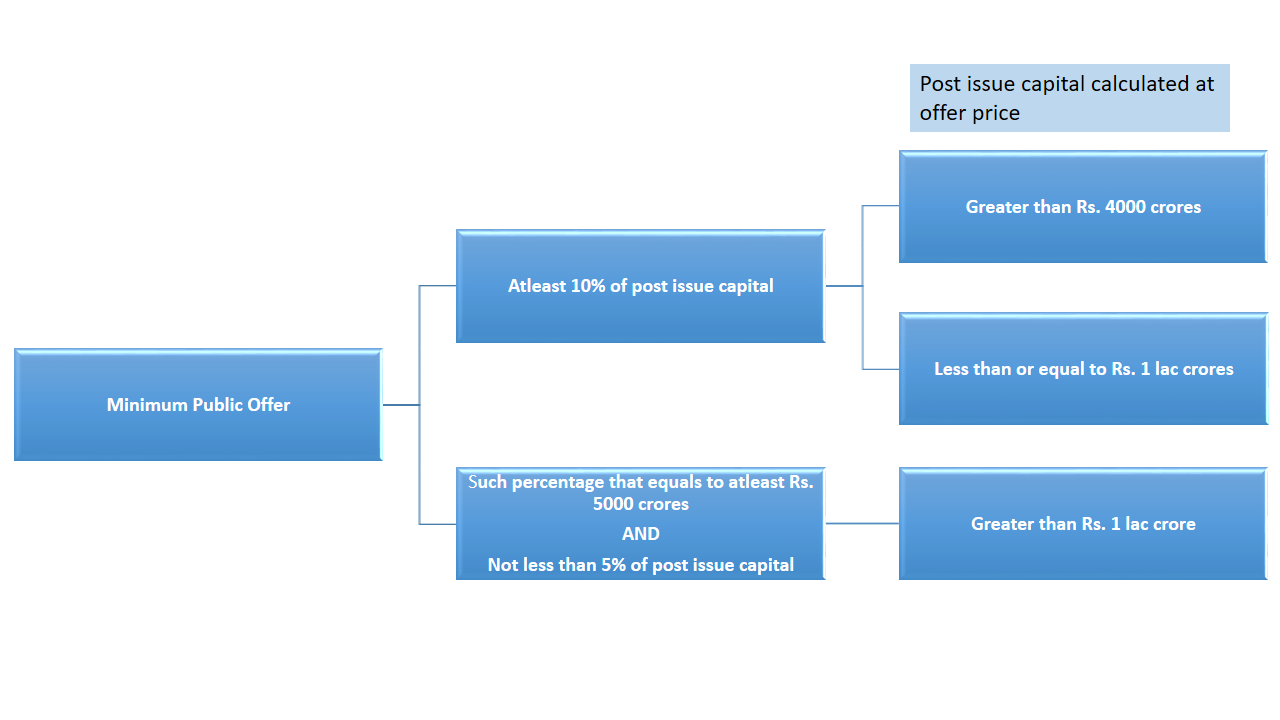
The post issue MCAP requirement for large and very large issuers has now been amended as below –

Accordingly, a flat rate of 10% has been set for large issuers while an incremental rate has been set for very large issuers with a post issue MCap of Rs. 1 lakh crores and above. For issuers below these thresholds, the existing requirements continue.

New MPS requirement

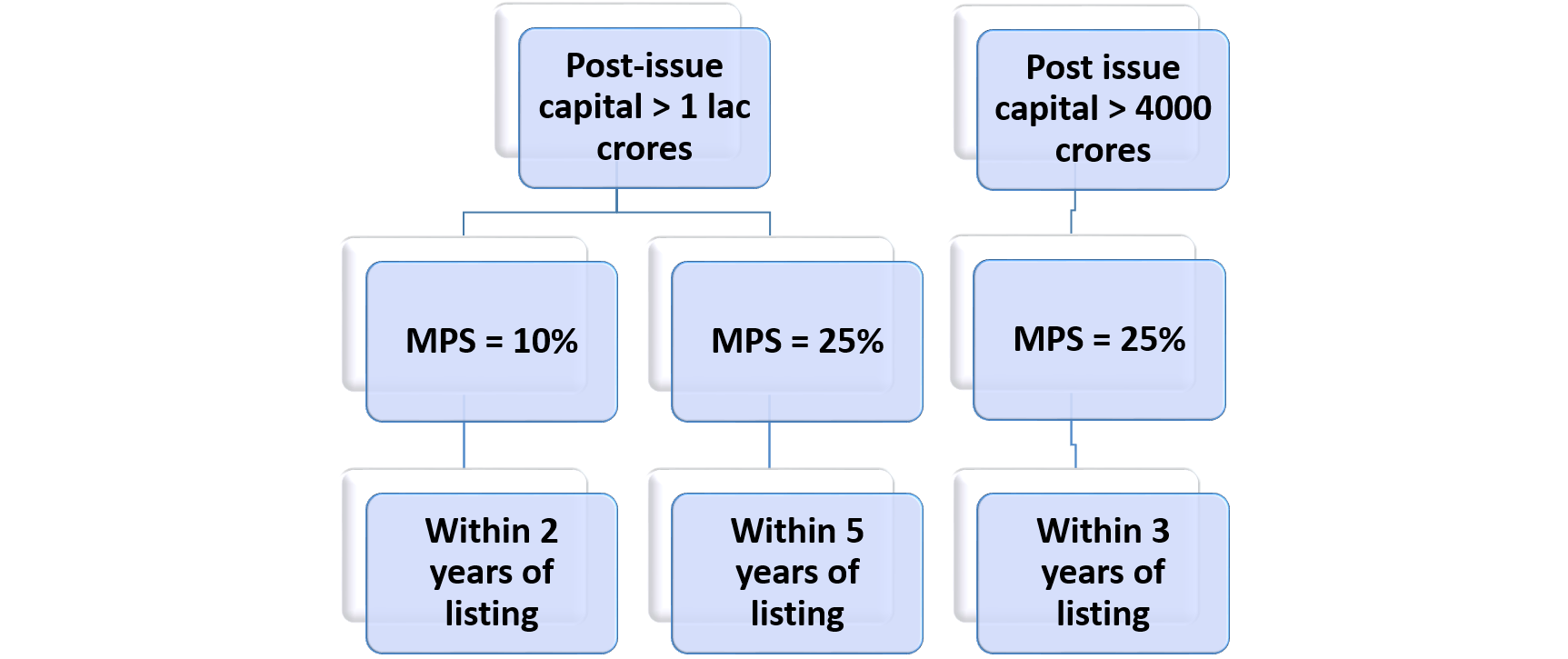
Currently, companies are required to meet the MPS within 3 years from the date of listing. However, in case of large issuers, the MPS is to be met as follows –

Rationale as proposed in the Consultation Paper

The reduction in the minimum public offer requirements for large issuers was proposed due to the following reasons –

  • The compliance of such minimum public shareholding requirements is cumbersome for the large issuers.
  • The large issuers already have investments from strategic investors who are classified as “public shareholders” post listing. Therefore, the requirement of minimum public offer results in unnecessary dilution of control of promoters thereby imposing constraints on issuers.

Minimum public shareholding requirement for companies under Resolution Plan

Further, amendments have been made in Rule 19A of the Rules, with respect to the minimum public shareholding requirements for a company under CIRP under Insolvency and Bankruptcy Code, 2016 (‘IBC’).The Amended Rules provide a strict-er timeline for post-CIRP companies to comply with the MPS requirements upon implementation of resolution plans

Change in the requirements as per the Amended Rules are as follows –

Particulars Requirement before amendment Requirement as per Amended Rules
Public shareholding falls below 25% Bring to 25% within 3 years of such fall No change
Public shareholding falls below 10% Bring to 10% within maximum 18 months of such fall Bring to 10% within maximum 12 months from such fall
Minimum public shareholding to be maintained No such requirement Shall not fall below 5%

Rationale as proposed in the Consultation Paper

The relaxations with respect to the strict enforcement of Rule 19 of the Rules have been given in order to ensure revival of a Corporate Debtor pursuant to a resolution plan. However, while the same seems to be in favour of Corporate Debtors, specifying no MPS requirement may result in cases where the public shareholding will become extremely low, leading to less float, thereby hampering the market integrity and price discovery in secondary market.

The Consultation Paper suggested three different alternatives out of which the second one has been preferred since the MPS of 5% being a lower threshold will incentivise the companies to stay listed post-CIRP whereas higher thresholds may cause total delisting

The said requirement shall have significant ramifications for resolution applicants who otherwise are more focused on operational aspects over regulatory requirements. While resolution plans relaxes several requirements like an open offer under SAST regulations, it is significant to note that requirements w.r.t. MPS were never completely waived off. The present step of giving more stringent timelines is introduced with the objective of protecting the investors’ interest and shielding them from the possible loss of value due to delayed MPS adherence. The loss of value can be on account of delisting of such corporate debtors under CIRP, whereas the shareholders may recover potential value from the shares of such corporate debtor if it continues to remain listed post implementation of resolution plan.

CEOs as deemed Managers: Ascertaining their true role and liability

Sharon Pinto, Manager, corplaw@vinodkothari.com 

Introduction

The Board of directors of a Company typically comprises of executive and non-executive directors. The Board is supported by the Key Managerial Personnel (‘KMP’) and senior management i.e. personnel of the company who are members of its core management team excluding Board of Directors comprising all members of management one level below the executive directors, including the functional heads. KMPs have been defined under Section 2 (51) of Companies Act, 2013 (‘Act’/ ‘CA, 2013’) to include Chief Executive Officer (‘CEO’) or Managing Director (‘MD’) or Manager, thus placing them on the same pedestal while differentiating the said posts on the basis of mere nomenclature. Due to the said differentiation in nomenclature, it is often seen that companies have a practice of regarding the person designated as CEO different from Manager of the company. Thus, the person holding a position at the head of the organisational hierarchy, is interpreted to not be the Manager on account of only being designated as CEO of the company. The result of this rationale / categorisation results in avoidance of the restrictions and procedures for appointment and remuneration as enlisted under the Act under Section 196 and 197 which specifically prescribe that the terms of appointment shall be placed before the shareholders, for a Manager in case of appointment of a CEO.

The position of a ‘Manager’ in the corporate organisational structure has been around for decades. It has been defined under Companies Act, 1956 which can also be seen in the Companies Act, 2013. In recent times, corporates have developed a pattern of designating the head of the corporate organisation, with substantial powers of the management, as CEO who is often a professional, rather than designating the said person as Managing Director or Manager and appointing them on the Board. A few examples of such corporates which have the CEO as the head of the organisation include Microsoft, Pepsico, Google Inc, etc.

We have in our previous article[1] deliberated on the various combinations of KMP positions that can legally be held by two different individuals. In this article we shall discuss the concept of CEO and analyse whether the same is different from the positions of a Manager and MD.

Concept of CEO

  • Companies Act

The term CEO was not mentioned under Companies Act, 1956. It was included and defined under the Act, 2013 and formed part of the definition of KMP. As per the Report of JJ Irani Committee[2], as KMPs play a significant role of formulating and executing company policies. Thus, in order to provide a legal recognition to KMPs and also to define their liabilities arising out of such a position held, the committee recommended the following to be identified as KMP:

  1. Chief Executive Officer (CEO)/Managing Director
  2. Company Secretary (CS)
  3. Chief Finance Officer (CFO)

The committee further recommended key managerial personnel including WTDs and MDs shall not be in whole time employment of more than one company.

The report of the Company Law Committee[3] dated February 2016, recommended that a whole time KMP may hold more than one position in the company in order to reduce cost of compliance and to facilitate optimum utilisation of their skills and competencies. The committee further recommended flexibility in appointing other officers of the company in whole-time employment as KMP, pursuant to which the definition of KMP was expanded to include ‘such other officer, not more than one level below the directors who is in whole-time employment, designated as key managerial personnel by the Board’ under its ambit.

Section 2 (18) of the Act defines a CEO as ‘an officer of a company, who has been designated as such by it.’ Thus the position of CEO is designation oriented and the role is not specifically defined under the Act. Therefore, a person performing the role of any other KMP as specified under the Act, may be designated as a CEO.

  • Listing Regulations

Regulation 2 (1) (e) of SEBI (Listing Obligations and Disclosure Requirements) Regulations, 2015 (‘Listing Regulations’), have defined CEO as the person so appointed in terms of the Act. The erstwhile Listing Agreement vide Clause 49 (IX) stated as follows:

“The CEO, i.e. the Managing Director or Manager appointed in terms of the Companies Act, 1956 and the CFO i.e. the whole-time Finance Director or any other person heading the finance function discharging that function shall certify to the Board that:”

In order to harmonize the provision with the newly inserted definition of KMP under Companies Act, 2013, the said clause was amended[4] as follows:

“The CEO or the Managing Director or manager or in their absence, a Whole Time Director appointed in terms of Companies Act, 2013 and the CFO shall certify to the Board that :”

The above-mentioned provision also specifies that CEO shall be the officer so designated by the Company, who may have the role of a Manager or a Managing Director on line with the specification under the Act.

Analysis of the role and function of CEO, Manager, MD

The Act under Section 2 (53), defines Manager as ‘an individual who, subject to the superintendence, control and direction of the Board of Directors, has the management of the whole, or substantially the whole, of the affairs of a company, and includes a director or any other person occupying the position of a manager, by whatever name called, whether under a contract of service or not’. Whereas an MD is defined under Section 2(54) as ‘a director who, by virtue of the articles of a company or an agreement with the company or a resolution passed in its general meeting, or by its Board of Directors, is entrusted with substantial powers of management of the affairs of the company and includes a director occupying the position of managing director, by whatever name called. In Regina v. Boal, (1992) BCLC 872 (CA[5]), it was held that assistant general manager of its bookshop, had responsibility for the day to day running of the shop but had been given no training in management, health and safety at work or fire precautions. Thus only those who were in a position of real authority, who had both the power and the responsibility to decide corporate policy would be construed to be ‘Manger’ for the purpose of the Act. It also needs to be noted that the person occupying the position of a ‘Manager’ should be under the superintendence of the Board.

Thus, the definition of Manager can be construed to be function based, irrespective of the designation of the individual. The same has been held in the SC judgment of Ramchandiram Mirchandani v. The India United Mills Ltd., AIR 1962[6] wherein the apex court held that the definition of the word “manager” is very wide, and whatever be the nomenclature employed by the parties, if large powers of management of substantially the whole business of the company are vested in a person then that person becomes the manger. In Basant Lal v. The Emperor[7] it was held that it was held that a person who is not in charge of the entire business of the company cannot be deemed to be a manager. In the case of Commissioner Of Income-Tax, Kerala Vs.Alagappa Textile (Cochin) Ltd. 1980[8], the Supreme Court held that Manager must be an individual, having the management of the whole or substantially the whole affairs of the company, subject to the superintendence, control and directions of the Board of Directors in the matter of managing the affairs of the Company. The key difference between a Manager and an MD is that an MD has substantial powers of management and is also on the Board of the company, while a Manager has the management of whole or substantially the whole of the business of the Company. There are judicial precedents that indicate that while both enjoy substantial powers of management, the source from which this power arises is different. In case of manager his power is natural and in case of an MD, it has to be entrusted by the Board in him.

On perusal of the above roles of the MD and Manager, basis the provisions, it is evident that an individual who has been entrusted with whole or substantial powers of management, shall be said to be performing the role of a Manager. Further, if the said individual is a director of the company he may be designated as the MD. However, companies may choose to designate the individual otherwise i.e. CEO of the company, if the said role and powers of management rest with the concerned officer. Thus, one can opine that the person who is at the top of the corporate hierarchy, with whole or substantially whole powers of the management and affairs of the company, in cases where not explicitly designated as ‘Manager’ shall be deemed to be a Manager of the company. CEO is a designation and the position of Manager is based on function. Merely, by not designating an individual as a Manager, compliance under the provisions of the Act cannot be avoided.

Compliances relating to appointment and remuneration

As per the analysis stated above, the procedure and restrictions relating to the appointment of a Manager shall be applicable to a CEO who holds such a position of a deemed Manager of a company. Thus, the company is required to comply with the provisions of Section 196 for appointment of such a person. The term of the deemed Manager shall not exceed 5 years at a time, wherein the re-appointment shall be done not less than 1 year before the end of the term. Further, the appointee shall have to satisfy the criteria and conditions specified in sub-section 3 of Section 196 in order to get appointed. As per the said provisions, the terms of the appointment and remuneration will be subject to approval of shareholders. Further, Part I of Schedule V has set forth certain conditions to be fulfilled in order to be appointed as a Manager. In case of appointment in variance of these conditions, the company in addition to approval by shareholders, is also required to obtain approval from the Central Government by stating the rationale of appointing such a person.

Similarly, the provisions relating to managerial remuneration specified in Section 197 read with Part II of Schedule V as applicable to a Manager shall be applicable to a deemed Manager. Thus the deemed Manager shall be entitled to remuneration as per the limits specified in this regard under Section 197 subject to approval of shareholders. Therefore, while determining the cap of total managerial remuneration i.e. 11% of the net profits of the company, the remuneration paid to CEO who plays the role of deemed Manager will also be required to be included. If there is an increase in the said cap, it will require approval from the shareholders of the company. Further, the said provisions also place a bar on the individual limits of remuneration paid to the Manager, which shall not exceed 5% of net profits of the company in case of not more than one MD/WTD/Manager and 10% of total remuneration payable to more than one MD/WTD/Manager. If the company wishes to pay in excess of the limits thus prescribed it may do so by obtaining approval of the shareholders in the form of a special resolution.

In case the company has inadequate or no profits, it is required to abide by the limits prescribed under Part II of Schedule V subject to approval of shareholders. Further, in case the company wishes to pay in excess of the said thresholds, the shareholders approval will be required to be obtained in the form of a special resolution.

The above-mentioned provisions of the Act do not cover the appointment and remuneration of KMPs other than MD, WTD and Manager. Since the CEO is considered to be different from Manager, their appointment and remuneration in many cases are not approved by the shareholders of the Company. However as per the analysis stated above, in case of a CEO having substantial powers of the management and being on the head of the organisational hierarchy, there is a need that their terms of appointment and remuneration to be paid is placed before the members of the company.

Circumstances which would result in consideration as deemed Manager under the Act

Particulars of cases Whether Manager under the Act Rationale
Branch Manager × A Branch Manager does not have whole or substantial powers of the management of the company in addition to not being under the superintendence of the Board.
Factory Manager × Similar as in the case of a Branch Manager, a Factory Manager has limited powers relating to a specific unit of the company.
CEOs appointed for specific business verticals of the company × As the powers and responsibility of the said CEO would be limited to the specific business division of the company and would not entail overseeing the overall affairs of management.
CEO where the company has a separate MD or Manager × In case the company has an MD, the powers of the MD shall include substantial control over the management and affairs of the company as per Section 2 (54) of the Act.
CEO where the company does not have an MD or Manager In case of no MD/Manager, the CEO shall be the deemed Manager of the company on account of having whole or substantially whole powers over the affairs of the company.
Person designated as CEO and MD A Manager as defined under Section 2 (53) includes a director occupying the position of a Manager, by whatever name called.

Conclusion

The intent of defining KMPs of the company separately under the Act was to ascertain the legal liability and to define their roles on account of them being the visionary and executive authority carrying out the policies and functions of the company. With power comes responsibility and it is lucid from the discussion above that the person having the requisite powers would be subject to the restrictions and procedures prescribed under the provisions in this regard, irrespective of the designation assigned to the post.


Kindly find below additional resources on the above-discussed topic:

  1. https://vinodkothari.com/?s=remuneration
  2. https://vinodkothari.com/wp-content/uploads/2018/10/Appointment-and-Remuneration-of-Managerial-Personnel.pdf
  3. https://vinodkothari.com/wp-content/uploads/2019/09/Manangerial-Remuneration_IMTB-_26.08.pdf
  4. https://vinodkothari.com/2018/09/managerial-remuneration-a-five-decades-old-control-cedes/
  5. https://vinodkothari.com/2018/10/applications-with-cg-for-managerial-remuneration/
  6. https://vinodkothari.com/wp-content/uploads/2018/09/Defaulter-companies-to-seek-lenders-nod-to-pay-managerial-remuneration-1-1.pdf

[1]https://vinodkothari.com/wp-content/uploads/2017/03/The_Combinations_of_KMP_positions_in_a_Company_Unravelling_a_mystery.pdf

[2] https://www.mca.gov.in/bin/dms/getdocument?mds=TRnXREiyG027hEwjF77x3w%253D%253D&type=open

[3] https://www.mca.gov.in/Ministry/pdf/Report_Companies_Law_Committee_01022016.pdf

[4] https://www.sebi.gov.in/sebi_data/attachdocs/1410777212906.pdf

[5] http://www.uniset.ca/other/cs4/1992QB591.html

[6] https://indiankanoon.org/doc/106177/

[7] https://indiankanoon.org/doc/879077/

[8] https://indiankanoon.org/doc/1799476/

Retrospective Operation of S. 29A & OTS under IBC – Analysing Prospects

– Megha Mittal

[resolution@vinodkothari.com]

The Hon’ble NCLAT vide its order Martin SK Golla v. Wig Associates, 2019[1] has set aside the order of the Adjudicating Authority which had accepted a one-time settlement-cum-resolution plan submitted by a connected person of Corporate Debtor, who later on, after the implementation of section 29A became ineligible to submit a plan. Hence, the question before the Hon’ble Tribunal was whether sec 29A of IBC will be applicable with retrospective effect in section 10 proceedings which were initiated prior to sec 29A came into force?

The Hon’ble NCLAT held that the reason that once CIRP is commenced, provisions as existing on the day of the petition would continue to apply even in the face of amendment brought about by way of 29A- cannot be maintained, and as such the one time settlement-cum-resolution plan, offered by the connected person of the Corporate Debtor cannot be considered good under law.

In this article, along with the issue of retrospective applicability of section 29A and its likely impact on the stakeholders, the Author also delves into the question whether a one-time settlement scheme could tantamount to a resolution plan under the Code.

Read more

Leveling the playing field for all Microfinance Lenders

RBI proposes uniform regulatory framework for the Microfinance Sectorfinserv@vinodkothari.com )

The microfinance sector, in India, has proved to be fundamental for promoting financial inclusion by extending credit to low-income groups that are traditionally not catered to by lending institutions. The essential features of microfinance loans are that they are of small amounts, with short tenures, extended without collateral and the frequency of loan repayments is greater than that for traditional commercial loans. These loans are generally taken for income-generating activities, although they are also provided for consumption, housing and other purposes. There exist various market players in the microfinance industry viz. scheduled commercial banks, small finance banks, co-operative banks, various NBFCs extending microfinance loans and NBFCs-MFIs.

The microfinance industry has reached 6 crores of live borrowers base the end of the calendar year of 2020. Book size of the microfinance industry as on 31st December is 228,818 crore[1]. The sector grew by 16% from December 2019 to December 2020 (based on outstanding loan portfolio size) and has witnessed phenomenal growth over the last two decades.
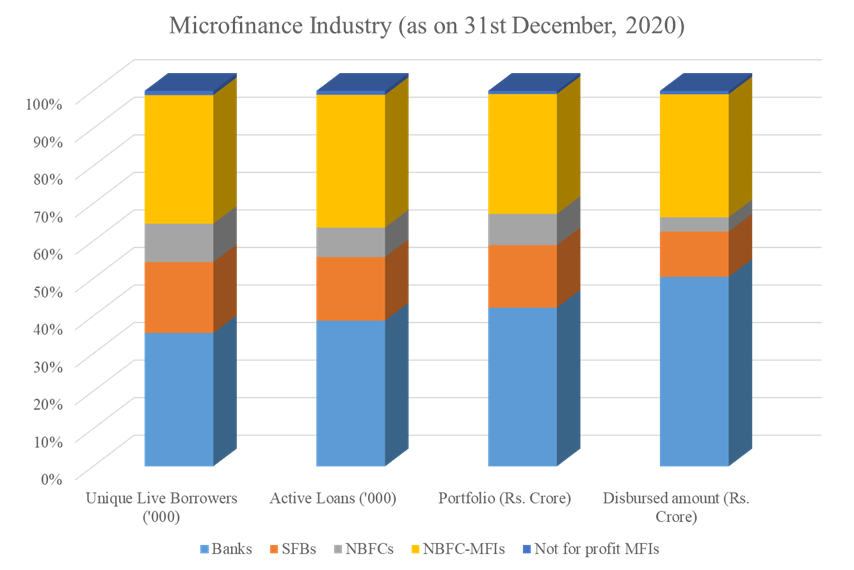
Source- SIDBI Microfinance Pulse Report, April 2021
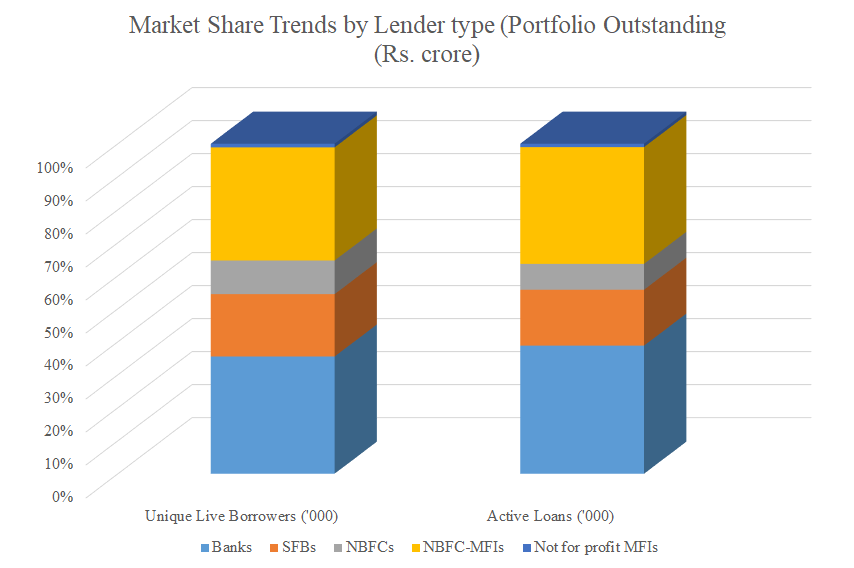
Source- SIDBI Microfinance Pulse Report, April 2021

While banks are leading by contributing 42% towards total portfolio outstanding and 39% towards active loans, NBFC-MFIs are the second highest contributors in the microfinance sector. When compared to the total portfolio size of all microfinance lenders, NBFC-MFIs only contribute to a little over 30% of the total size. However, the framework regulating microfinance has been made applicable solely to NBFC-MFIs (‘NBFC-MFI Regulations’ as provided under the respective Master Directions) while the other lenders that hold a lion’s share of the sector are not subjected to similar regulatory conditions/ restrictions. These include cap on multiple lending, ceiling on maximum lending amount, various customer protection measures etc. Absence of regulatory control has led to various problems such as multiple lending by borrowers resulting in overindebtedness, increased defaults, coercive recovery methods by lenders at the prejudice of borrowers etc.

As a solution to the same, RBI has issued a consultative paper on regulation of microfinance on June 14, 2021[2] (‘Consultation Paper’) with an intention to harmonise the regulatory frameworks for various regulated lenders (‘RE’s) in the microfinance space while also proposing a slew of changes to the existing norms for NBFC-MFIs and NBFCs.

RBI has invited comments, suggestions and feedback on the proposed regulation by July 31, 2021 from all stakeholders. The proposed norms intend to have uniform regulations applicable to microfinance loans provided by all entities regulated by the RBI and are aimed at protecting the microfinance borrowers from over-indebtedness as well as enabling competitive forces to bring down the interest rates by empowering the borrowers to make an informed decision. The key proposals of the Consultative Document have been discussed herein below in this article:
Regulations for all Microfinance Loans

MFIs encompass a host of financial institutions engaged in advancing loans to low-income groups. However, except NBFC-MFIs, none of the other entities are regulated by microfinance-specific regulations.

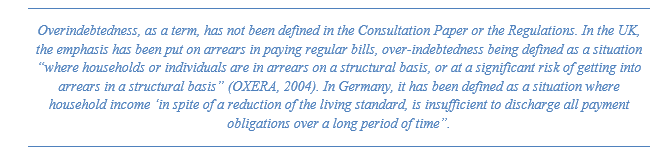
Resultantly, RBI has proposed to introduce a common regulatory framework for all microfinance lending institutions, irrespective of their form. The intent behind the same is to ensure that all lenders under the microfinance sector are subject to the same rules. This would not only protect borrower interest but also ensure that all lenders are operating on a level playing field thereby passing the benefit of competition to the ultimate borrower. Further, considering the total indebtedness of borrowers vis-a-vis their repayment capacity seems more fitting rather than indebtedness only from NBFC-MFIs.

Common definition of ‘Microfinance’ for all REs

RBI has proposed to revise the definition of ‘microfinance loans’ and in order to avoid over-indebtedness and multiple lending, the same is proposed to be applied uniformly to all entities regulated by the RBI (REs) and operating in the microfinance sector.


Annual Household Income Threshold

Common definition of microfinance borrowers

Under extant regulations for NBFC-MFIs, a microfinance borrower is identified by annual household income not exceeding ₹1,25,000 for rural and ₹2,00,000 for urban and semi-urban areas. In order to ensure a common definition, the said criteria for classification is proposed to be extended to all regulated entities (REs).

RBI has proposed to base the threshold on the income of the entire household rather than that of an individual, similar to the existing guidelines for NBFC-MFIs. The reason being that income in such households is usually assumed to be pooled.

For this purpose, ‘household’ shall mean a group of persons normally living together and taking food from a common kitchen. Even though the determination of the actual composition of a household shall be left to the judgment of the head of the household, more emphasis has been advised to be placed on ‘normally living together’ than on ‘ordinarily taking food from a common kitchen’. Note that a household differs from a family. Households include persons who ordinarily live together and therefore may include persons who are not related by blood, marriage or adoption but living together, while a family may comprise persons who are living apart from the household.

Methodology for assessment of household income

Assessment of household income in a predominant cash-based economy might pose certain difficulties. However, applying a uniform methodology may not be appropriate for such assessment, especially of low-income households, since the practice may differ based on the different types of borrowers and lenders. The same should be left at the discretion of the lender in the form of a policy. However, broad parameters/ factors may be provided. These can include deriving income from expenditure patterns, assessment of the borrower’s occupation and the ordinary remuneration flowing thereof, assessment of cash flows etc.

Criteria dropped from the existing definition –

  1. Absolute cap on the permissible amount of loan to be extended, is no longer relevant due to linking of loan to income in terms of debt-income ratio and therefore has been removed;
  2. Minimum tenure requirement is also to be be removed since longer tenures for larger loans will not be appropriate (since the absolute cap for amount of loans has been removed);
  • The existing NBFC-MFI regulations require at least 50% of the total amount of loans extended by NBFC-MFIs to be given for income generation. This means part (i.e. maximum of 50 per cent) of the aggregate amount of loans may be extended for other purposes such as housing repairs, education, medical and other emergencies. However, aggregate amount of loans given to a borrower for income generation should constitute at least 50 per cent of the total loans from the NBFC-MF. It has been realised that while microfinance loans should ideally be used for income-generating activities, placing too much emphasis on the same may lead to borrowers availing informal and more expensive modes of lending for their other financial needs. Therefore, the said requirement not being conducive, has been proposed to be removed;
  1. Restriction on lending by two NBFC-MFIs to be dropped due to overall restriction in terms of debt-income ratio (discussed below).

Maximum Permissible level of indebtedness in terms of debt-income ratio

One of the major risks in microlending has been the issue of overborrowing, with nearly 35% of the borrowers having access to two or more lenders.(source PWC report)

It is proposed to link the loan amount to household income in terms of debt-income ratio.  The payment of interest and repayment of principal for all outstanding loans of the household at any point of time is proposed to be capped at 50% of the household income i.e. total indebtedness of any borrower will not increase 50% of his/her total income. This has been proposed keeping in mind various factors such as –

  • Low savings therefore taking into account that half of their income should be available to meet their other expenses necessary for survival
  • Possibility of repayment towards other forms of informal lending from friends and family
  • Likely inflation of income to avail higher loans.

However, individual REs will be permitted to adopt a conservative threshold as per their own assessments and Board approved policy. Since, the level of indebtedness for a particular borrower is proposed to be regulated, the current stipulation that limits lending by not more than two NBFC-MFIs to the same borrower will no longer be required.

Grandfathering of existing facilities

The aforesaid threshold shall become effective from the date of introduction of the proposed regulations. However, existing loans to the households which are not complying with the limit of 50% of the household income, shall be allowed to mature. Although, in such cases, no new loans will be provided to such households till the limit is complied with.

Collateral-free loans

Microfinance borrowers belong to the low income group and generally do have the available assets to be provided as collateral for availing financial facilities. The assets possessed by them are usually those that are essential for their survival and losing them in case of a default will be detrimental to their existence. Therefore, it has been proposed that to extend the collateral free nature of microfinance loans, as applicable to NBFC-MFIs, to all REs.

Prepayment Penalty

In case of NBFC-MFIs, the borrowers are allowed prepayment without charging any penalty. It has now been proposed that microfinance borrowers of all REs shall be provided with the right of prepayment without attracting penalty.

Repayment Schedule

As per the extant regulations, microfinance borrowers of NBFC-MFIs are permitted to repay weekly, fortnightly or monthly instalments as per their choice. With a view to keep the repayment pattern at the discretion of the borrowers that will suit their repayment capacity and/or preference, all REs will be required to provide repayment periodicity to such borrowers as per a Board approved policy.

Minimum NOF for NBFC-MFIs

RBI had issued a Discussion Paper on ‘Revised Regulatory Framework for NBFCs – A Scale-Based Approach’ on January 22, 2021 proposing to revise the minimum net owned fund (NOF) limit for all NBFCs including NBFC-MFIs, from ₹2 crore to ₹20 crore.

At present, NBFC-MFIs are required to have a minimum NOF of ₹5 crore (₹2 crore for NBFC-MFIs registered in the North Eastern Region). RBI has sought the view of stakeholders whether the proposed minimum NOF of ₹20 crore for NBFCs under scale-based regulations is appropriate for NBFC-MFIs or not.

The evolution of regulatory framework for NBFCs may recall, the NOF requirement for NBFCs was Rs 25 lacs in 1990s. Then, it was increased to Rs 2 crores, Rs. 5 crores in case of NBFC-MFIs. The regulator is now proposing to increase the same to Rs 20 crores – a 10 fold increase. The underlying rationale is to have a stronger entry barrier, and to ensure that NBFCs have the initial capital for investing in technology, manpower and establishment. However, such a sharp hike in entry point requirement will keep smaller NBFCs out of the fray. Smaller NBFCs, especially NBFC-MFIs, have been doing a useful job in financial inclusion and having a stricter entrance will only prove to demotivate the sector.  You may read further on the scalar based approach framework by RBI in our article here.

Revised Definition of ‘microfinance’ for ‘not for profit’ Companies

Section 8 companies engaged in micro-finance and not accepting public deposits, are exempt from obtaining registration under section 45IA of the RBI Act, 1934 as well as from complying with sections 45-IB (Maintenance of percentage of assets) and 45-IC (Reserve Fund).

The exemption is applicable to all not-for-profit NBFC-MFIs that meet the above criteria irrespective of their size.  However, it has been proposed to bring Section 8 companies above a certain threshold in terms of balance sheet size (say, asset size of ₹100 crore and above) under the regulatory ambit of the RBI. This is because Section 8 companies are dependent on public funds including borrowings from banks and other financial institutions for their funding needs and any risk of failure in these companies will have a resultant impact on the financial sector.

Further, not-for profit MFIs operate in an almost similar manner to that of for-profit MFIs but the latter enjoys exemptions from various requirements. The mandatory requirement for registration will ensure that not-for-profit MFIs with considerably large asset size, are effectively regulated.

The revised criteria for exemption is proposed to be as under:

‘Exemption from Sections 45-IA, 45-IB and 45-IC of the RBI Act, 1934 shall be available to a micro finance company which is

  1. engaged in micro financing activities i.e. providing collateral-free loans to households with annual household income of ₹1,25,000 and ₹2,00,000 for rural and urban/semi urban areas respectively, provided the payment of interest and repayment of principal for all outstanding loans of the household at any point of time does not exceed 50 per cent of the household income;
  2. registered under Section 8 of the Companies Act, 2013;
  3. not accepting public deposits; and
  4. having asset size of less than ₹100’

Review of Specific Regulations for NBFC-MFIs

Qualifying Asset Criteria

In order to be classified as a ‘qualifying asset’, a loan is required to satisfy the following criteria:

  1. Loan which is disbursed to a borrower with household annual income not exceeding ₹1,25,000 and ₹2,00,000 for rural and urban/semi-urban households respectively;
  2. Loan amount does not exceed ₹75,000 in the first cycle and ₹1,25,000 in subsequent cycles;
  • Total indebtedness of the borrower does not exceed ₹1,25,000 (excluding loan for education and medical expenses);
  1. Minimum tenure of 24 months for loan amount exceeding ₹30,000;
  2. Collateral free loans without any prepayment penalty;
  3. Minimum 50 per cent of aggregate amount of loans for income generation activities;
  • Flexibility of repayment periodicity (weekly, fortnightly or monthly) at borrower’s choice.

The following changes have been proposed –

  1. The household income limits have been retained under the revised definition of microfinance loans and made applicable to all REs
  2. Absolute cap is no longer relevant due to linking of loan to income in terms of debt-income ratio
  • Minimum tenure requirement to be removed since longer tenures for larger loans will not be appropriate (since the absolute cap for amount of loans has been removed)
  1. Collateral free loans and absence of prepayment penalty have been retained in the revised definition.
  2. The existing NBFC-MFI regulations require at least 50% of the total amount of loans extended by NBFC-MFIs to be given for income generation. This means part (i.e. maximum of 50 per cent) of the aggregate amount of loans may be extended for other purposes such as housing repairs, education, medical and other emergencies. However, aggregate amount of loans given to a borrower for income generation should constitute at least 50 per cent of the total loans from the NBFC-MF. It has been realised that while microfinance loans should ideally be used for income-generating activities, placing too much emphasis on the same may lead to borrowers availing informal and more expensive modes of lending for their other financial needs. Therefore, the said requirement not being conducive, has been proposed to be removed.

Limit of lending by two NBFC-MFIs

Owing to an overall restriction based on debt-income ratio of 50% for all REs, the restriction of lending by only two NBFC-MFIs to a borrower will be withdrawn.

Pricing of Credit by NBFC-MFIs

Given the vulnerable nature of the borrowers of microfinance loans, the NBFC-MFI regulations imposed an interest cap to prevent exorbitant interest rates charged to such borrowers.

The interest rate cap prescribes multiple ceilings rather than a single one. Accordingly, NBFC-MFIs have been permitted to charge interest with a maximum margin cap of 10% and 12% over and above the cost of funds, depending on the size of loan portfolio (₹100 crore threshold) or 2.75 times of the average base rate of five largest commercial banks, whichever is lower.

The latter criterion provides a linkage with the prevailing interest rate in the economy and ensures that higher borrowing costs for NBFC-MFIs with riskier business models are not transmitted to the end borrowers. Further, NBFC-MFIs are not permitted to levy any other charge except for a processing fee (capped at 1% of the loan amount) and actual cost of insurance to ensure that interest rate ceilings are not bypassed by NBFC-MFIs through other hidden charges.

However, the regulatory ceiling on interest rate is applicable only to NBFC-MFIs. Nearly 70% of the microfinance sector, comprising banks and small finance banks, is deregulated in terms of pricing. It has also been observed that an unintended consequence of creating a regulatory prescribed benchmark for the rest of the entities operating in the microfinance segment. Lenders, such as banks, though having a lower cost of funds, still charge a higher interest rate. This has led to borrowers being deprived of benefits of economies of scale and competition in the microfinance market.

The provision of such interest rate ceilings was suitable in an environment where NBFC-MFIs were the primary lenders. However, currently, as discussed, NBFC-MFIs contribute to only 30%. Proposing a fixed benchmark for interest rate in the microfinance industry may not be appropriate considering the differences in the cost of funds, financial or otherwise, among different types of entities.

Based on the above rationale, it has been proposed to remove such interest rate ceiling limits and align the interest rate model for NBFC-MFIs with that of regular NBFCs.  NBFC-MFIs will now be permitted to adopt interest rates based on a Board approved policy while adhering to fair practice code to ensure disclosure and transparency. However, necessary regulation must also be put in place to avoid charging usurious interest rates. The intention is to enable the market mechanism to reduce the lending rates for the entire microfinance sector.

Fair Practice Norms

The above relaxation from interest rate ceiling, comes with its own set of fair practice norms to ensure transparency and protecting interests of borrowers.

  1. Disclosure of information on pricing

To allow borrowers to make an informed decision, REs will mandatorily be required to disclose pricing information by way of a standardised and simplified disclosure format (specified under table III of the Consultation Paper). Such information will enable borrowers to compare interest rates as well as other fees associated with a microfinance loan in a more readable and understandable manner. The pricing related fact sheet shall be provided to every prospective borrower before on-boarding.

  1. Board Policy for determining charges including interest rate

Boards of all REs will be required to frame suitable internal principles and procedures for determining interest rates and other charges to arrive at an all-inclusive usurious interest rate.

  1. Display of interest rates

All REs will be required to display the minimum, maximum and average interest rates charged by them on microfinance loans. The manner of display is still to be prescribed.

  1. Scrutiny by RBI

The above information will also be incorporated in returns submitted to RBI and shall be subjected to the supervisory scrutiny.

[1] Source- SIDBI Microfinance Pulse Report, April 2021

[2] https://www.rbi.org.in/scripts/BS_PressReleaseDisplay.aspx?prid=51725

Presentation on LODR Amendments

RBI Guidelines at odds with the Companies Act on appointment of Auditor

A comparative analysis between the Companies Act, SEBI Guidelines and SEBI Circular dated 18th Oct. 2019

– Ajay Kumar K V | Manager (corplaw@vinodkothari.com)

Introduction

The Reserve Bank of India has issued Guidelines[1] for Appointment of Statutory Central Auditors (SCAs)/Statutory Auditors (SAs) of Commercial Banks (excluding RRBs), UCBs and NBFCs (including HFCs) under Section 30(1A) of the Banking Regulation Act, 1949, Section 10(1) of the Banking Companies (Acquisition and Transfer of Undertakings) Act, 1970/1980 and Section 41(1) of SBI Act, 1955; and under provisions of Chapter IIIB of RBI Act, 1934 for NBFCs, on 27th April 2021.

The Guidelines provide for appointment of SCAs/SAs, the number of auditors, their eligibility criteria, tenure and rotation as well as norms for ensuring the independence of auditors.

However certain provisions of these Guidelines are either completely different or stringent as compared to the provisions of the Companies Act, 2013 (Act). Further, in case of listed entities the question would arise whether the SEBI circular CIR/CFD/CMD1/114/2019[2] dated 18th October 2019 shall be applicable, where the existing auditor is ineligible to continue as the auditor of the company and a new auditor is to be appointed.

In this write up, we have discussed the requirements under both RBI Guidelines as well as the Act.

Read more

Easing Delisting of Equity Shares

-Shreya Masalia and Anushka Vohra

corplaw@vinodkothari.com

In order to make the existing delisting Regulations robust, efficient, transparent and investorfriendly, the Securities Exchange Board of India (‘SEBI’) has issued the SEBI (Delisting of Equity Shares) Regulations, 2021[1] (‘Delisting Regulations, 2021’) on June 11, 2021, thereby superseding the erstwhile SEBI (Delisting of Equity Shares) Regulations, 2009[2] (‘Erstwhile Regulations’). The Erstwhile Regulations were notified on June 10, 2009. Thereafter, several amendments have been carried out in the delisting regulations according to the changing need and developments in the securities market. Thus, to further streamline and strengthen the process to be followed for delisting, the Delisting Regulations have been introduced.

In India, a large number of entities are listed on regional stock exchanges, serving no public interest at all. In fact, over the years, most of them have become non-compliant. However, given the cumbersome process of delisting, these companies have chosen to remain listed. The Delisting Regulation, 2021 has made the path of exit for these entities comparatively easier.

In this article, the authors have made an attempt to discuss the changes in the delisting procedure as introduced vide the Delisting Regulations, 2021.

Background

Listing of shares at stock exchanges provides for free transferability and ready marketability to the shares of a company. In contrast to that, when a public company chooses to go private, it has to delist from the stock exchanges – which means that the shares of that company will no longer be available for trading on the platform provided by the stock exchange.

The Companies choose to list themselves to grab the advantages of listing viz; lower cost of capital, greater shareholder base, liquidity in trading of shares, prestige etc. But the companies need to be contended that the benefits of listing outweigh the listing costs, the compliance requirements do not overburden the companies and do not expose them to disciplinary actions.

Initially, there existed 21 regional stock exchanges (‘RSE’) in India of which 20 such RSEs have shut down over the years due course due to their lack of financial viability, exchanges becoming defunct, usage of archaic technology and subsequent derecognition of the exchanges by SEBI. The lone-standing regional stock exchange is the Calcutta Stock Exchange (‘CSE’), which is also at its verge of getting shut. Various companies continue to be listed on CSE, however the economic viability of the same is still questionable. The Delisting Regulations provide for an easy exit opportunity to these companies by significantly reducing the time-period of the delisting process and streamlining the same.

Also with the relisting bar of 5 years in case of voluntary delisting having been reduced to 3 years will now allow the companies to relist in a comparatively lesser period of time and raise funds for their new venture.

Why do companies opt for delisting?

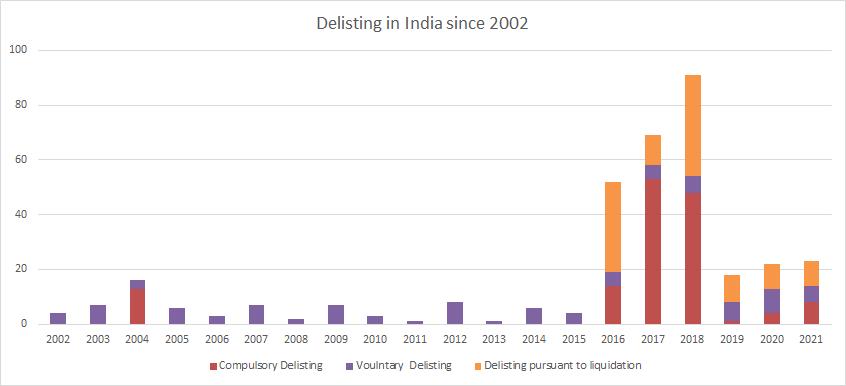
The statistics given below show that there has been a tremendous increase in the number of companies being delisted from the stock exchange. Delisting from the stock exchanges could either be undertaken voluntarily, or compulsory delisting by the Stock Exchanges or delisting pursuant to liquidation.

(Source: NSE)

Understanding compulsory and voluntary delisting

Compulsory delisting generally, is caused due to procedural and compliance lapses by the companies. Amongst other causes, the major causes for compulsory delisting include non-payment of listing fee, reduction in public shareholding and failure to meet the same, unfair trade practices at the behest of the management/promoters etc.

While compulsory delisting is at the precept of the Stock Exchanges, companies opt to voluntarily delist themselves.

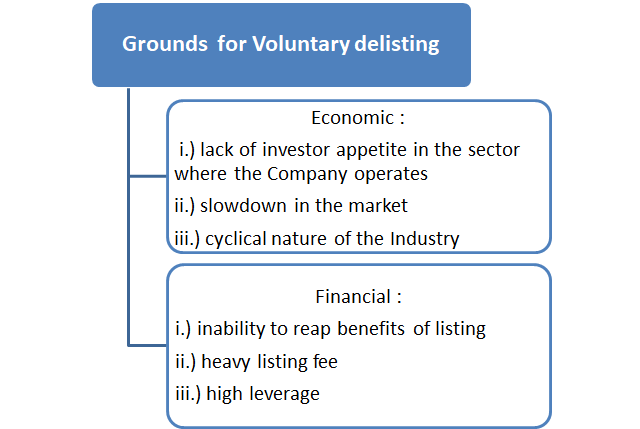
The most common rationale for companies to opt for voluntary delisting in the recent time has been;

  1. To obtain full ownership of the company by the promoter & promoter group which will in turn provide increased financial flexibility to support the Company’s business and financial needs;
  2. To explore new financing structures including financial support from the Promoter Group;
  3. To help in cost savings and allow the management to dedicate more time and focus on the core business;
  4. To provide easy exit to shareholders because of thin trading volume.

Modes of Exit via Delisting

The Delisting Regulations, as laid down by SEBI provides two modes of delisting of equity shares viz; (a) Compulsory and (b) Voluntary:

Further, in the case of voluntary delisting, companies have the following options:

  1. delisting from all the recognised stock exchanges ;
  2. delisting from any but not all the recognised stock exchanges, including delisting from Stock Exchange having nationwide trading terminal;
  3. delisting from any but not all the recognised stock exchanges, while remaining listed on the Recognised Stock Exchange having nationwide trading terminal.

In the case of 1 and 2 above, the companies have an obligation to provide an exit opportunity to the existing shareholders.

While the process in case of iii. above remains the same, changes have been brought about in the way a company has to manage the delisting offer pursuant to provision of exit opportunity. The gist of the changes introduced by the Delisting Regulations have been discussed below.

Overview of the Key Changes

  1. Disclosure by the Acquirer / Promoter[3]

 In the Erstwhile Regulations, the process flow was that the acquirer used to intimate their intention to delist the Company to the Board and the Board would then intimate the same to the Stock Exchanges before granting its approval.

Now the Delisting Regulations, 2021, cast an obligation on the acquirer to intimate to the Stock Exchanges, their intention to delist the Company first and within one working day of its intimation shall also inform the Company at its Registered Office, this is termed as the Initial Public Announcement.

Comments: An intention to delist a company is a price sensitive event and can have a major impact on the market. Hence, its immediate disclosure to the public is warranted. Therefore, to fill the lacunae on information being made available to the public, intimation by the acquirer has been made mandatory.

2.Time-bound mechanism

The delisting procedure involves intricacies requiring approvals at various stages.Unlike the t new regulations specify the timelines for the entire process, making it less cumbersome and time-bound, as shown in the table below:

Event / complianceExisting TimelineRevised Timeline
Board resolutionNone specifiedWithin 21 days from the date the acquirer expresses his intention
Special resolutionNone specifiedWithin 45 days from the date of approval of the board
Escrow AccountBefore making public announcementNot later than 7 working days from the date of obtaining the shareholder’s approval.
In-principle approvalNone specifiedWithin 15 working days from the date of obtaining shareholders approval or receipt of any statutory or regulatory approval; whichever is later.
Outcome of Reverse Book Building (‘RBB’)None specifiedTo be announced within 2 hours from the closure of the bidding period. The same is also required to be published in the same newspapers as the newspapers in which the detailed public announcement was made within 2 working days from closure of the tendering period.
Release of shares in case of failure of offerWithin 10 working days from the closure of the offer, where bids were not acceptedIn case of failure due to

90% of the shares are not tendered: on the date of disclosure of the outcome of the RBB process


Discovered price being rejected by acquirer: on the date of making public announcement for the failure of the delisting

Payment on successful delistingWithin 10 working days from closure of offerDiscovered price same as floor price: payment through secondary market settlement mechanism


Discovered price higher than floor price: within 5 working days from the date of making the payment to the public shareholders

Final application to the stock exchanges after successful delistingWithin a period of 1 year from the date of passing of special resolutionWithin 5 working days from the date of making the payment to the public shareholders


3.Due diligence by Peer Reviewed Company Secretary

 Before making the public announcement in case of voluntary delisting, the board had to appoint a Merchant Banker for carrying out the due diligence and then on obtaining the in-principle approval, the acquirer had to appoint a Merchant Banker to act as manager to the issue. The Regulations provided that the Merchant Banker appointed by the board could act as manager to the offer.

Comments: Realising that this could probably result in conflict of interest, the new regulations provide that the board shall appoint a Peer Reviewed Company Secretary, who shall be independent of the promoter/ acquirer/Merchant Banker/or their Associates before the board meeting for granting approval and the Company Secretary shall carry out the necessary due diligence. Further, the acquirer shall before making the initial public announcement, appoint a Merchant Banker to act as manager to the offer. This has also opened up a new avenue for the Company Secretaries in Practice.

4.Escrow Account

Under the Erstwhile Regulation, the acquirer was required to deposit the consideration amount in the Escrow account after getting in-principle approval from SE however before making the PA. The new regulations make it obligatory on the acquirer to open an escrow account even before applying for in-principle approval. The acquirer has to deposit an amount equivalent to 25% of the total consideration at the time of opening the escrow account and the remaining consideration amount of 75% shall be deposited in the escrow account prior to the detailed public announcement.

Comments: Because of stringent timelines, surety is provided that the acquirer has the financial stability and has earmarked funds for the proposed delisting. Moreover, since this is an interest-bearing account, there would be no loss of interest, even if the delisting offer fails at the end.

5.Enhanced responsibility on the Board of Directors

 The new regulations intend to be more robust as far as the responsibility of the board is concerned. The erstwhile regulations required that the board shall before granting its approval certify that the proposed delisting is in the interest of the shareholders. And this certification was mere infructuous because there was no disclosure of the same and no reasonable justification, for that matter.

Comments: Considering a situation, where the Expression of Interest is received from an amicable acquirer i.e. the case of friendly takeover, there is a possibility of collusion between the acquirer and the management and in that case the interest of shareholders’ might take a back seat. However, to avoid the same, Regulation 28 has been added into the new regulations which provides that upon receipt of the detailed public statement the Board of Directors shall constitute a committee of independent directors to provide written reasoned recommendations on the delisting offer and the same shall also be disclosed by the Company in the newspapers where the detailed public statement was published, at least 2 working days before the bidding period.

6.Investor friendly regulations

 SEBI, being the watchdog of the Securities Market, had been established to protect the interest of investors as one of its main objectives, amongst others.

The Delisting Regulations provide that the public shareholders who could not participate in the RBB process could further tender their shares upto 1 year from the date of delisting and the promoter shall accept the tendered shares at the price which was finalised through RBB.

In addition to that, the new regulations now require the promoter/acquirer/Merchant Banker to comply with the following on a quarterly basis for 1 year from the date of delisting:

  1. Submit quarterly reports to the Stock Exchanges specifying details of shareholders at the beginning and end of the quarter and shareholders who availed the offer during the quarter;
  2. To send follow up communications to remaining shareholders;
  3. Publishing advertisement to invite the remaining shareholders to avail the offer

Comments: While the shareholders were given a time of upto 1 year, it was observed that the promoters did not take active steps to bail out the remaining shareholders.

7.Indicative Price

The new regulations have unraveled the concept of Indicative Price. As a general practice, some companies with a view to wriggle out of the complexities of remaining listed on the bourses, used to mention the terms indicative price or attractive price in the letter of offer. This price being higher than the floor price, was used to lure the shareholders to tender their shares.

The new regulations have defined Indicative Price as being a price higher than the floor price.

Comments: Even though the word has found its place in the regulations, in our view, SEBI should place a capping on the indicative price so as to ensure that the Companies do not offer lucrative price to the shareholders.

Changes in addition to the above

 Special provisions for delisting of shares already existed for small companies in the erstwhile regulations. SEBI has further prescribed the following special provisions for delisting:

1.Special provisions for delisting of shares on Innovators Growth Platform

These provisions are similar to the provisions for delisting of shares from the main board however, these provisions require that shares tendered reach 75% of the total issued shares of that class and at least 50% shares of the public shareholders as on date of the board meeting in which such delisting is approved are tendered and accepted instead of the 90% requirement.

 2. Special provisions for a subsidiary company getting delisted through scheme of arrangement wherein the listed holding entity and subsidiary company are in the same line of business

Transactions covered under the given head will not attract provisions of these Regulations provided the various conditions mentioned in regulation 37(2) have been complied with.

SEBI, vide notifcation dated July 09, 2021 has exempted the listed subsidiary companies, getting delisted through scheme of arrangement, that are –
– in the ‘same line of business’ as of its holding company;
– the subsidiary shall be a listed subsidiary of a listed holding company for a period of 3 years.

Further, vide said notification, SEBI has also laid down the following criteria for ascertaining whether the listed holding entity and subsidiary are in the ‘same line of business’:

 3. Special provisions for delisting by operation of law

These provisions shall be applicable in case of winding up of a company and recognition of a stock exchange by SEBI. In the former, the process of winding up shall be as prescribed by the prevalent regulatory framework. However, the latter seems highly unlikely.

Some Miscellaneous Changes

  1. The erstwhile regulations identified only peer reviewed chartered accountants and merchant bankers as valuers, however the same has now been defined with reference to section 247 of the Companies Act, 2013 which widens the scope of the definition. Therefore, any individual with a post-diploma/postgraduate degree or a bachelor’s degree with 3 and 5 years experience respectively in the specified field or having membership of a professional institute established by an Act of Parliament enacted for the purpose of regulation of a profession with at least 3 years’ experience after such membership shall also be considered as eligible valuers.
  2. The detailed public announcement, amongst other details, is now also required to provide the indicative price if any given by the acquirer and a list of documents copies which shall be available for inspection by public shareholders at the registered office of the manager during the working days.
  3. The copy of the letter of offer shall be made available on the website of the company as well as that of the manager to the offer. The order copy of the stock exchange ordering compulsory delisting of the entity shall be uploaded on the website of the stock exchanges.
  4. As a pre-condition to voluntary delisting, the erstwhile regulations provided that the Companies cannot apply for delisting pursuant to buyback/preferential allotment offer being made. But there was lack of cohesiveness on when the buyback/preferential allotment offer being made by the Company would restrict delisting offer. Therefore, the new regulations specify that voluntary delisting shall not be permitted unless a period of 6 months has elapsed from the date of completion of last buyback/preferential allotment.
  5. For counting minimum 90% of the issued shares of a class, shares held by custodian of depository receipts, by Trust under SEBI (Share Based Employee Benefit) Regulations, by inactive shareholders such as vanishing and struck off companies have been excluded aiding the acquirer to achieve the minimum share tendering criteria with greater ease.

Effect of the instant changes

The new regulations have eased the earlier complex procedure of voluntary delisting. The enhanced disclosures and transparency will help to instil confidence among the shareholders. The business environment is dynamic and the time-bound procedure would help the companies to avail exit from the Stock Exchanges and explore their business opportunities by going private.

Concluding Remarks

In India, “Delisting” process has seen very less success as compared to the global market. The new regulations irrefutably addresses some core aspects and also emphasizes on incremental improvements by plugging some of the gaps in the Erstwhile Regulations, as the new Regulations inter alia provide for delisting of equity shares of a subsidiary company (having the same line of business), delisting pursuant to a scheme of arrangement and delisting due to operation of law such as due to winding up of a company or de-recognition of a stock exchange. However, in view of the authors, the cautious approach taken by the SEBI in the New Regulations may still narrow its applications. The impact of the changes brought in through New Delisting Regulations on the success rate of the delisting process is yet to be seen.

[1] https://egazette.nic.in/WriteReadData/2021/227507.pdf

[2] https://www.sebi.gov.in/legal/regulations/jun-2009/sebi-delisting-of-equity-shares-regulations-2009-last-amended-on-march-6-2017-_34625.html

[3] “acquirer” includes a person –

(i) who decides to make an offer for delisting of equity shares of the company along with the persons

acting in concert in accordance with regulation 5A of the Takeover Regulations as amended from

time to time ; or

(ii) who is the promoter or part of the promoter group along with the persons acting in concert.


Ourresources on the topic:- 

  1. https://vinodkothari.com/wp-content/uploads/2020/04/Note-on-Delisting-of-equity-shares-1.pdf 
  2. https://vinodkothari.com/2023/09/sebi-proposes-to-ease-delisting-process-consultation-paper-on-review-of-voluntary-delisting-norms/

Various forms of Secured Lending

-Anita Baid, anita@vinodkothari.com

In this era of ever-increasing demand and continuous urge for developments, limitation of financial resources come as the biggest constraint in overall satisfaction of an individual or entity’s needs. Financial or funding options provided by various financial institutions such as banks and NBFCs come as a solution to such financial constraints. Loans from such financial institutions can be availed depending upon one’s immediate requirement and repayment capacity.

From the consumer’s perspective, funding is granted and resource constraint is sort out. However, there is always a fear of default in repayment of loans faced by the lenders. Thus, the position of the lender becomes ambiguous and unsafe in granting such loans. Here, comes the concept of secured financing. Secured financing is one in which the lender has security rights over certain collateral that the borrower makes available to support the loan. The borrower agrees that should he not repay the loan as agreed, the lender has a right to seize the collateral to satisfy the debt.

There are various instruments offered under secured financing depending upon the collateral the borrower is willing to provide. Some of the commonly used instruments have been discussed herein this article[1].

Loan Against Property (LAP)

A loan against property is a loan given or disbursed against the mortgage of a property. LAP belongs to the secured loan category where the credit evaluation of the borrower is done keeping his property as a security. The property can be commercial or residential.[2]

Immovable property being one of the most non-volatile security is mortgaged with the financial institution for obtaining required funds. Borrowers willing to purchase a residential/commercial property can obtain loan by keeping such desired property as the underlying security. The underlying security can be the property for which loan is being taken and/or a separate property as well. The loan is given as a certain percentage of the property’s market value, usually around 40% to 60%.

Here the loan is granted based on the quality of the collateral and less importance is given to the credit quality of the borrowers. Also, usually, these loans do not come with any end use restriction, that is to say, the borrowers get a free hand with respect to utilization of funds.

Loan Against Securities (LAS)

A loan against securities (LAS) is a loan given against the collateral of shares or securities. LAS enables one to borrow funds against listed securities such as shares, mutual funds, insurance and bonds to meet current financial needs. Borrowers can opt for this loan when they need instant liquidity for their personal/business needs and are sure to pay it back in few months.

There are however, specific regulations issued by RBI with respect to loan against shares of listed entities,

As per the [3]Master Directions applicable on NBFC-NSI-ND issued by RBI, NBFCs with asset size of Rs.100 crore and above who are lending against the collateral of listed shares shall, maintain a Loan to Value (LTV) ratio of 50% for loans granted against the collateral of shares. Additionally, for LAS in case where lending is being done for investment in capital markets, only Group 1 securities (specified in SMD/ Policy/ Cir – 9/ 2003 dated March 11, 2003 as amended from time to time, issued by SEBI) shall be accepted as collateral for loans of value more than Rs5 lakh, subject to review by the Bank. The lender shall also be required to report on-line to stock exchanges on a quarterly basis, information on the shares pledged in their favour, by borrowers for availing loans in the prescribed format.

Difference between LAP and LAS

The underlying security for LAP and Las is different which is prevalent from the respective names itself. Apart from this major difference there are other areas of difference between the two as well. The basic differences between the two are highlighted hereunder:


Features Loan against securities Loan against property
Nature of facility A loan against securities (LAS) is a loan given against the collateral of shares or securities. A loan against property (LAP) is a loan given or disbursed against the mortgage of a property.
Exposure In case of LAS the exposure is based on the value of securities In case of LAP it is based on the value of property.
Volatility The value of securities, in case it is listed shall fluctuate very frequently and hence the value of security is very volatile. The value of property is less volatile as compared to LAS.
Type of security The shares or securities can either be listed or unlisted. The property can either be movable or immovable.
End use Usually the end use of the facility extended is for investment in the securities. There is no end use restriction in case of LAP.
Regulations from RBI As per the Master Directions applicable on NBFC-NSI-ND issued by RBI, all Applicable NBFC with asset size of Rs.100 crore and above who are lending against the collateral of listed shares shall, maintain a Loan to Value (LTV) ratio of 50% for loans granted against the collateral of shares. No specific regulatory guideline has been prescribed regarding LTV ratio for granting loan against property by an NBFC.


LTV Ratio Further, as per the statutory provision, if the value of listed securities falls down thereby increasing the LTV ratio, additional security must be provided to maintain such LTV ratio. The Applicable NBFC must ensure that any shortfall in the maintenance of 50% LTV occurring on account of movement in the share prices is to be made good within 7 working days. In case of LAP, such reinstating is not statutory. However, the lender may revise the sanctioned limit in case the loan agreement provides for such discretionary right to the lender.


Statutory Requirement Additionally, for LAS in case where lending is being done for investment in capital markets, only Group 1 securities (specified in SMD/ Policy/ Cir – 9/ 2003 dated March 11, 2003 as amended from time to time, issued by SEBI) shall be accepted as collateral for loans of value more than Rs5 lakh, subject to review by the Bank. The lender shall also be required to report on-line to stock exchanges on a quarterly basis, information on the shares pledged in their favour, by borrowers for availing loans in the prescribed format. No such regulatory requirement.


IPO Funding

IPO or Initial Public Offer is a rewarding experience for individuals and companies as it offers substantial return to investors on the shares subscribed by them. However, it may so happen that an investor might not possess the requisite funds to subscribe to IPOs. In such a situation, inflow of funds from another source may become necessary. Here comes the concept of IPO funding which bridges the deficit between the resources at hand and the funds needed in aggregate. The lender creates a right of lien on the shares to be allotted to the investor/borrower in the IPO. This shall form the underlying security against the loan which can be liquidated in case of non-payment of principle and/or interest.[4]

Similar to LAS, IPO Financing is loan against acquiring shares and making a short-term profit that is expected at the time of initial price discovery of the shares once the shares are listed. However, unlike LAS, it is specifically for funding subscriptions to IPOs. In case of an IPO Financing, the exposure is based on the borrower and the securities/ shares, if allotted, are taken as collateral for securing the obligations under the loan. The transaction forces the applicant to sell the shares once listed, hence, the idea cannot be to finance an investment in shares.

The financial institution demands for an upfront payment of the margin amount based on the assessment of subscription levels. For example, if an investor applies for 100 shares and gets allotted only 10 shares due to oversubscription, the refund on 90 shares is divided between the borrower and lender proportionately. The shares allotted are held as lien by the lender.

Recently, the RBI had released a Discussion Paper on the Revised Regulatory Framework for NBFCs on 22nd January, 2021[5], wherein it has been proposed to fix a ceiling of Rs. 1 crore per individual in case of IPO financing by any NBFC.

Equipment Finance

Equipment financing is yet another type of secured financing wherein loan is given for purchase of commercial or office equipment. The underlying asset is the equipment for which loan is advanced and/or any other equipment. The loan is secured by way of a hypothecation over the equipment financed. For efficient and smooth functioning of various units of a commercial enterprise, existence of upgraded machinery is of utmost importance. Such acquisitions may require additional funds from external sources. Hence, equipment finance helps in improving the overall production levels.

Secured Working Capital Finance

Fulfilment of working capital requirements is perhaps the most integral responsibility of a company. Adequate working capital is needed to meet the day-to-day activities of an enterprise and enable it to function smoothly. Financing options for meeting working capital limits is also available. Loan is given for maintaining such working capital by placing a floating charge on the assets of the company. No fixed asset is kept aside as the underlying security. In case of any default, an asset of sufficient value shall be a seized and liquidated to meet the default.

Here, it is important to understand the difference between LAS or LAP and a regular secured working capital loan. For instance, in case of LAS or LAP the exposure is based on the value of securities or the property, as the case may be, and not on the borrower. Whereas, in case of a secured loan the exposure is based on the borrower and the securities or property are taken as collateral for securing the obligations under the loan. Such a secured loan shall not be classified as LAS or LAP and hence maintaining the prescribed regulatory LTV ratio will also not be applicable in this case.

At a Glance


Features

LAP LAS IPO Funding Equipment Financing Working Capital Financing
Nature of facility Loan disbursed against the collateral of property Loan disbursed against the collateral of shares Loan extended for investing in IPO Loan advanced for purchase of equipment against the collateral of the same and/or any other equipment Loan advanced for meeting working capital requirements and accordingly a floating charge is created
Nature of security Property Shares Shares subscribed in IPO Equipment Floating charge on the assets.
Exposure Property Shares Investor Borrower Borrower
Volatility Very less Volatile Volatile Less volatile Less volatile
Regulatory Framework No specifications but additions can be made in the loan agreement as per discretion As per the Master Directions applicable on NBFC-NSI-ND issued by RBI, all Applicable NBFC with asset size of Rs.100 crore and above who are lending against the collateral of listed shares shall, maintain a Loan to Value (LTV) ratio of 50% for loans granted against the collateral of shares. No specifications but additions can be made in the loan agreement as per discretion No specifications but additions can be made in the loan agreement as per discretion No specifications but additions can be made in the loan agreement as per discretion

Conclusion

Secured financing comes as a relief to both borrowers and lenders. The borrower avails the required funds for meeting its financial or domestic purpose and the lender ensures security against the loan advanced by creating a mortgage or lien on the borrower’s property/shares.

Read our other relevant articles and books on the subject matter:

1. Securitisation, Asset Reconstruction & Enforcement of Security Interest-
https://vinodkothari.com/arcbook/
2. Fragmented framework for perfection of security interest-
https://vinodkothari.com/2021/03/fragmented-framework-for-perfection-of-security-interest/
3. Vehicle financing: Multiple Security Interest Registrations & its Impact by Vinod Kothari
https://www.youtube.com/watch?v=CeXqlsrEDYI

[1] The discussion on the regulatory aspects have been restricted to the regulations applicable to NBFCs only.

[2] Read our article titled- Sitting comfy in the lap of LAP: NBFCs push loans against properties-  https://vinodkothari.com/wp-content/uploads/2017/03/sitting_comfy_in_the_lap_of_LAP.pdf

[3] https://rbidocs.rbi.org.in/rdocs/notification/PDFs/MD44NSIND2E910DD1FBBB471D8CB2E6F4F424F8FF.PDF

[4] http://www.thehindubusinessline.com/opinion/the-risky-game-of-ipo-financing/article9631176.ece

[5] https://rbidocs.rbi.org.in/rdocs/Publications/PDFs/DP220121630D1F9A2A51415B98D92B8CF4A54185.PDF

BRSR Reporting: Actions and disclosures required for business sustainability

Abhishek Saraf, Manager and Payal Agarwal, Executive (corplaw@vinodkothari.com)

Background

The Business Responsibility and Sustainability Reporting (“BRSR”), originating from the MCA report on Business Responsibility Reporting, has found its way into the regulatory provisions by way of an amendment to the Regulation 34(2)(f) of the Listing Regulations[1], notified on 5th May, 2021. Further, SEBI vide circular dated 10th May, 2021 introduced the format of BRSR and the guidance note to enable the companies to interpret the scope of disclosures.

The BRSR will replace the existing BRR format w.e.f. FY 2022-23. For the FY 2021-22, the top 1000 listed entities may voluntarily submit the BRSR and from FY 2022-23 onwards, the same has to be submitted mandatorily. It is notable that the BRSR, though replacing BRR, is actually an extension of the existing BRR reporting While the BRSR has been made effective from FY 2022-23, it has to be understood that reporting is secondary, and needs to be backed by the company taking appropriate actions to ensure a positive report. Where the BRSR reporting of a company is negative, the same, though not a non-compliance of the regulatory provisions, will result in a negative impact on the minds of the stakeholders.

Read more

Basics of Factoring in India

Megha Mittal, Associate ( mittal@vinodkothari.com )
Factoring as an age-old concept has stood the test of time as it enabled businesses to resolve the cash flow issues, rendered liquidity, facilitated uninterrupted services and cushioned businesses against the lag in the billing cycles. Also the merit of the product lies in the simplicity of the concept which is well understood and accepted. 
The principles of factoring work broadly on the seller selling the receivables of a debtor to a specialised financial intermediary called a factor. The sale of the receivables happens at a discount and transfers the ownership of the receivables to the factor who shall on purchase of receivables, collect the dues from the debtor instead of the seller doing so, enabling the seller to receive upfront funds from the factor.  This allows companies to release the working capital required for holding receivables. 

Read more