Restructuring of debt securities not to be treated as default, clarifies SEBI

-Financial Services Division (finserv@vinodkothari.com)

Unprecedented crises call for unprecedented measures; the good thing is that all regulators are responding soon enough to the need for tweaking regulations, valuation rules, provisioning norms, accounting norms, and so on, to allow companies to adjust themselves to the new world that we are being ushered in.

SEBI has come up with a Circular no SEBI/HO/IMD/DF3/CIR/P/2020/70 dated 23rd April, 2020[1] (Circular), to the effect that mutual funds will not have to treat restructuring of a debt security as a case of “default”. With this, the funds have been able to avert having to make as much as 50% provision for what was deemed as a case of default.

It is notable that there have been court rulings whereby companies have evoked the “force majeure” clause to seek breather to repayment of debt securities[2].

Given the sensitiveness of the situation, this Circular has come as breather for a lot of financial sector entities, especially the ones actively engaged in securitisation, and ofcourse mutual funds. This write-up intends to first set a context to the Circular and then discuss the potential impact of the Circular.

Deemed Default in Case of Restructuring and Valuation Rules

A circular on valuation of money market and debt securities[3] issued by SEBI stated that “Any extension in the maturity of a money market or debt security shall result in the security being treated as “Default”, for the purpose of valuation”.

As per the valuation norm, mentioned above, mutual funds are required to take a haircut on the value of debt securities declared as default. In this regard, AMFI[4] has issued benchmarks for haircuts, based on which the valuation agencies are required to consider haircut as high as 50%, thereby reducing the value of the securities to half.

This circular turned out to be a major stumbling block for the mutual funds while extending the tenure of PTC transactions vis-à-vis the RBI’s moratorium on term loans in the wake of COVID 19 pandemic. The same has been discussed at length in the following section.

Restructuring of Pass Through Certificates

On March 27, 2020, the Reserve Bank of India (RBI) introduced COVID-19 Regulatory Package[5]  which provided for moratorium on payment of instalments for term loans falling due between 1st March, 2020 and 31st May, 2020[6]. The moratorium has to be extended to all the loans, irrespective of whether they have been sold off by the originators by way of securitisation or direct assignment.

The moratorium as per the RBI’s framework, forced the originators to alter the payout structures originally agreed with the investors under PTC/ DA transactions, so as to pass on effect of moratorium to the investors as well. However, the problem arose when the matter was placed before mutual funds. The mutual funds are major investors in PTCs, representing approximately 43% of securitisation issuances in India[7]. The mutual funds became wary of any extension or modification in the terms of the PTCs, due to apprehensions on valuation losses due to reasons discussed earlier in this write-up.

This created a deadlock between the originators and mutual funds (as investors). On one hand, there was a pressure on the originators to extend moratorium across all the borrowers, on the other hand, the mutual funds were apprehensive in accepting the revised terms due to a potential valuation loss.[8]

Considering the situation, the SEBI issued the Circular to address the issues with respect to valuation of debt securities.

Restructuring of Debentures

Restructuring by deferral of the maturity is something that may be done in case of debentures as well. Debentures may have been (a) private placed; or (b) publicly offered. The former is the more common route for mutual funds to invest.

Any change in the terms of issue amounts to modification of rights of debenture-holders. There is no provision under the Companies Act or SEBI regulations dealing with modification of rights of debenture-holders. Therefore, such modification can be done subject to and in accordance with the terms of issue.

Typically, in case of private placement, the consent of debenture-holders, either directly or through the debenture trustees, is required to be obtained. On the part of the Company, the power to modify the terms usually reside with the Board of Directors or are delegated by the Board to a Committee or a person or persons.

In case of publicly offered debentures, in addition to obtaining the above mentioned consent, compliance with provisions of SEBI LODR Regulations is also required to be ensured.

How can Debenture Issuers Make Use of the SEBI Circular?

  • The restructuring must be solely on account of the COVID crisis. It should be possible to demonstrate that the asset pool or ALM arrangement, but for the impact of the crisis, was adequate enough to take care of the scheduled maturity of the bond.
  • It should be possible to demonstrate that the underlying asset cover still remains healthy, and conditions such as asset cover etc. are benign complied with.
  • The necessary formalities of obtaining required consents must have been done.

If these conditions are fulfilled, a bond issuer may be able to get the consent of the investors without the investors having to provide deep haircuts on account of a deemed default.

Specific Provisions of the Circular

  • An extension of term of a security would not be considered as a default only when the valuation agency is of a view that such delay in payment or extension of maturity has  arisen  solely  due  to  COVID-19 pandemic  lockdown  and/or  in  light  of  the  moratorium  permitted  by  the RBI.
  • In case of difference in the valuation of securities provided by two valuation agencies, the conservative valuation i.e. the lower of the two values shall be accepted.
  • The relief from attraction of provision of default shall be limited to the period the moratorium is in operation.
  • AMCs shall continue to be responsible for true and fairness of valuation of securities.

Conclusion

Due to the obvious outcome of reduction in value of the assets, the mutual funds, as investors of debentures or PTCs, had been rejecting the proposals of issuers/originators/servicers as the case maybe with respect grant of moratorium to the borrowers. Mostly the Mutual Funds which are major investors in PTCs have been denying the grant of moratorium benefit to the borrowers owing to the reduction in value of AUM that would follow. With introduction of this Circular, the problem of taking deep haircuts on the value on account of deemed default stand resolved.

Mutual Funds are now expected to give a green signal on grant of moratorium by lenders. This would help to finally meet the objective of providing relief to the country at the time of the current crisis.


[1] https://www.sebi.gov.in/legal/circulars/apr-2020/review-of-provisions-of-the-circular-dated-september-24-2019-issued-under-sebi-mutual-funds-regulations-1996-due-to-the-covid-19-pandemic-and-moratorium-permitted-by-rbi_46549.html

[2] Our write-up dealing with Force Majeure clauses in agreements may be referred here: https://vinodkothari.com/2020/03/covid-19-and-the-shut-down-the-impact-of-force-majeure/

[3] https://www.sebi.gov.in/legal/circulars/sep-2019/valuation-of-money-market-and-debt-securities_44383.html

[4] https://docs.utimf.com/v1/AUTH_5b9dd00b-8132-4a21-a800-711111810cee/UTIContainer/Standard%20Hair%20Cut%20matrix__AMFI20190606-110846.pdf

[5] https://www.rbi.org.in/Scripts/NotificationUser.aspx?Id=11835&Mode=0

[6] Our detailed FAQs relating to the moratorium may be viewed here: https://vinodkothari.com/2020/03/moratorium-on-loans-due-to-covid-19-disruption/

[7] https://vinodkothari.com/2020/01/shadow-banking-in-india/

[8] Issue discussed at length in a virtual conference organised by Indian Securitisation Foundation: Agenda and minutes may be referred on the following links:

https://vinodkothari.com/2020/04/virtual-conference-on-impact-of-rbis-moratorium-on-ptc-transactions/

https://vinodkothari.com/2020/04/minutes-of-the-isf-virtual-conference/

Extended meaning of “encumbrance” on promoter holdings in listed entities

-SEBI’s Order in Yes Bank promoters indicates long arm of the provision 

Munmi Phukon | Partner | Vinod Kothari & Company

corplaw@vinodkothari.com

Introduction

While structuring of instruments like debentures, parties resort to various covenants in order to protect the interests of the investors and also to reflect the intent and purpose of the parties more specifically. One fairly commonplace practice with promoters of Indian listed companies to raise funds on the strength of their shareholding in their companies. It is often observed that, in structuring such transactions, companies find innovative ways of creating pseudo security interests on shares. Therefore, a careful analysis of the documentation entered into by the parties is required to conclude whether the covenants amount to creation of an encumbrance or not.

SEBI has recently dealt with such a case[1], in which SEBI throws some light on what could constitute an encumbrance for the purpose of SEBI (SAST) Regulations, 2011 (Regulations). SEBI considered the covenants mentioned in the debenture trust deed (DTD) executed by the promoter entities of the listed entity at the time of issuance of NCDs and held the promoters liable for non-disclosure of the encumbrance created on the shares held in the listed entity.

Legislative intent and purpose of the SAST Regulations

SAST Regulations are considered to be a social welfare legislation. The aim and intent of the Regulations is to protect the interest of the investors and ensuring market integrity. That is why, the Regulations recognise the importance of event based and periodic disclosures, specifically by the promoters of the entity, through Regulation 29 to 31 thereof. It has always been seen as a measure for ensuring better corporate governance which in turn enables the regulators and stock exchanges to monitor the transactions of the promoters.

Requirements related to encumbered shares under the Regulations

Transactions involving promoters’ shares are considered crucial in order to ensure transparency as regards the ownership/ control of the target company as well as price discovery of the shares in an informed manner. The genesis of the requirements of such disclosures arose in the beginning of 2009 when SEBI made it mandatory by amending the provisions of the erstwhile Regulations.

Later, similar requirements were provided in the revamped SAST Regulations vide Regulation 31 which requires the promoters to disclose about the shares of the target company encumbered by them on a yearly basis to the stock exchange(s) where the shares of the target company are listed and also to the target company. The promoters have also been mandated, by virtue of an amendment made in the said Regulation, to give declaration to the audit committee of the target company and the stock exchange(s) on a yearly basis about not having any encumbrance.

Further, SEBI vide its Circular dated 7th August, 2019[2] read with its Press Release-PR No.16/2019[3] requires the promoters to disclose to the stock exchange(s) and the target company, the detailed reasons for encumbrance if the combined encumbrance by the promoter along with PACs with him equals or exceeds, a) 50% of their shareholding in the target company; or b) 20% of the total share capital of the target company and also any positive changes therein thereafter within two working days from the creation of such encumbrance.

Furthermore, Regulation 29 requiring disclosure of acquisition/ disposal of shares of the target company by an acquirer on meeting certain threshold, interestingly, also provides that shares taken by way of encumbrance shall be treated as an acquisition, and shares given upon release of encumbrance shall be treated as a disposal and shall also require disclosure. In this context, it is pertinent to note if the pledgee/creditor gets voting rights also or has the right to cause the shareholder to vote as per the instructions of the creditor, the transaction would well amount to acquisition of control and hence, triggering the Regulation 3 as well.

The term ‘encumbrance’ under the Regulations

The term ‘encumbrance’ is defined under Regulation 28(3) of the SAST Regulations. Further, there has been an amendment to the existing definition w.e.f 29th July, 2019 vide SEBI (Substantial Acquisition of Shares and Takeovers) (Second Amendment) Regulations, 2019[4]. Evidently, the text of the existing definition signifies that it is an inclusive explanation and not an exhaustive one keeping the same open to different interpretations.


SEBI had tried to clarify the broad definition through its FAQs that, non- disposal undertaking (NDU) will be covered under the purview of ‘encumbrance’. The FAQs also clarified that NDUs may, inter alia, include the following:

“-     not encumbering shares to another party without the prior approval of the party with whom the shares have been encumbered;

  • non-disposal of shares beyond a certain threshold so as to retain control;
  • non-disposal of shares entailing risk of appropriation or invocation by the party with whom the shares have been encumbered or for its benefit.”

As mentioned above, the existing text of the definition has been expanded. As claimed by SEBI itself, the amendments have been made in the context of recent concerns w.r.t. promoter/ companies raising funds from Mutual Funds/ NBFCs through structured obligations, pledge of shares, non- disposal  undertakings,  corporate/  promoter guarantees and various other complex structures,  which reads as below:

“(3) For the purposes of this Chapter, the term “encumbrance” shall include,

  • any restriction on the free and marketable title to shares, by whatever name called, whether executed directly or indirectly;
  • pledge, lien, negative lien, non-disposal undertaking; or
  • any covenant,  transaction,  condition  or  arrangement  in  the  nature  of encumbrance,  by  whatever  name  called,  whether  executed  directly  or indirectly.”

Brief of the SEBI’s Order

The Order of SEBI seems to be an attempt of making an interpretation of certain clauses of the debenture trust deeds (DTDs) entered into by the promoter entities in the context of the then definition of ‘encumbrance’ provided u/r 28(3). SEBI found the following clauses in the DTDs and construed the same as creation of encumbrance on the shares of the listed company:

  • Maintenance of asset cover ratio at all times i.e. maintenance of equity shares held by the promoters in the listed entity, over and above the borrowing of the promoter.
  • In case of breach of the said condition, even though the debentures can be redeemed, however, only with an approval of the debenture holders for such early redemption;
  • The requirement of creation of security in favour of the DTs by way of exclusive pledge of the shares held by the promoter in the listed entity while availing any further borrowing and also with prior notice and giving of right of first refusal to the debenture holders;
  • Maintenance of borrowing cap at all times i.e. borrowing over the value of the shares held in the listed entity and the requirement of obtaining of a consent of the debenture holders in case of sell, disposal or encumbrance of the said shares.

SEBI contended that the covenants related to maintenance of asset cover/ borrowing cap at all times restrict the abilities of the borrowers/ promoters to dispose of the shares of the listed entity held by them. Therefore, the same should be considered as encumbrance for the purpose of Regulation 28(3). Further, the requirement of obtaining prior approval/ consent of the debenture holders before disposing of the shares tantamount to be a non- disposal undertaking as clarified vide the FAQs which include not encumbering shares to another party without prior approval of the party with whom the shares have been encumbered.

Meaning of ‘encumbrance’ in jurisprudence

In two passages in Salmon on Jurisprudence, 12th Edition, at Page 241 under the sub-heading “Rights in re propria and rights in re aliena” the learned author has stated thus:

“Rights may be divided into two kinds, distinguished by the civilians as Jura in re propria[5] and jura in re aliena[6]. The latter may also be conveniently termed encumbrances, if we use that term in its widest permissible sense. A right in re aliena or encumbrance is one which limits or derogates from some more general right belonging to some other person in respect of the same subject -matter. All other are jura in re propria.”

At Page 242 the learned author has observed as follows:

“it is essential to an encumbrance that it should in the technical language of our law, run with, the right encumbered by it. In other words, the document and the servant rights are necessarily concurrent. By time it is meant that an encumbrance must follow the encumbered right into the hands of new owners, so that a change of ownership will not free the right from the burden imposed upon it. If this is not so — if the right is transferable free from the burden — there is no true encumbrance.”

Thus, the true test of an encumbrance is the concurrence of the right with property – that the right attaches to property and travels along with it. Salmon has discussed encumbrances elaborately and mentions 4 types of encumbrances: leases, servitudes, security interests, and trusts. A lease confers a right to use the property. Servitude is a right to the limited use of the property such as the right of way or easements. Security interests (including mortgages) are encumbrances vested in a creditor. A trust is the obligation attached to property to hold it for the benefit of another.

Madras High Court also in the matter of M. Ratanchand Chordia And Ors. vs Kasim Khaleeli[7] held as below:

“The word “Encumbrances” in regard to a person or an estate denotes a burden which ordinarily consists of debts, obligations and responsibilities. In the sphere of law it connotes a liability attached to the property arising out of a claim or lien subsisting in favour of a person who is not the owner of the property. Thus a mortgage, a charge and vendor’s lien are all instances of encumbrances. The essence of an encumbrance is that it must bear upon the property directly and in-directly and not remotely or circuitously. It is a right in re aliena circumscribing and subtracting from the general proprietary right of another person. An encumbered right, that is a right subject to a limitation, is called servient while the encumbrance itself is designated as dominant.”

An analysis of the meaning of encumbrance

The following important features of encumbrances arise from the discussion above:

  • An encumbrance is a burden attached to property;
  • If it is a burden for the owner, it must be a benefit for the person holding the encumbrance. This also follows from the discussion by Salmond which has taken encumbrances to be jura in re propria, that is, rights over estate of someone else. That is, the burden created by the owner must be such which can operate as a benefit in the hands of the person holding the encumbrance;
  • The burden must necessarily be attached to the asset in question;
  • Since the essence of attachment or concurrence of the burden is that the burden will pass on a person acquiring the property, it necessarily follows that the burden must be on an ascertainable, identifiable property;
  • A mere restraint on sale or negative covenant is not an encumbrance. A leading English case law on whether a negative covenants “runs” with the property is Tulk v Moxhay(1848) 41 ER 1143. This classic ruling holds that a negative covenant is passable to the buyer of the property only where the parties intended the same to pass, and the burden “touches and concerns” the property. Here, a question of intent of parties will come in.

Different forms of quasi security interests on shares

Negative Lien or Negative Pledge

Negative Lien is used in banking parlance for a borrower to undertake not to create any charge on his property without the consent of the lender.

A negative pledge covenant does not give the negative pledgee a security interest or, in general, any other right in the debtor’s property.

It was held in Knott[8] that Negative Pledgee’s remedies are purely contractual and that the covenant confers no right in the property.

The generally accepted view as mentioned before is that the negative pledge does not create a proprietary or security interest and is therefore not registrable. [Tracy Hobbs, The Negative Pledge: A Brief Guide, 8(7) J.I.B.L.269 (1993)]

Springing Lien

A “springing lien” refers to lien granted in the future by a debtor (borrower or lessee) in favor of its creditors whereby the right conferred on the lender springs into a full-fledged lien or pledge either on the happening of certain events, or the discretion of the person holding the pledge.

Whether a so-called springing lien will amount to encumbrance or security interest will depend on intent of parties. If the debtor is free to deal with the subject matter before the trigger events that transform a springing lien into full-fledged lien have taken place, it cannot be said that the lien is an obligation attached to property. Therefore, it will not amount to encumbrance. However, if the lien comes attached with restrictions on sale, it will amount to encumbrance, because the combination of restriction on sale, and automatic attachment of a right on the asset that cannot be sold, in conjunction, will amount to a passable burden on property.

Conclusion

As discussed earlier, an encumbrance carries certain features along with it. A mere restraint on sale or negative covenant is not an encumbrance. Having said so, SEBI’s view in this context may not be in line with the jurisprudence of encumbrance.

However, it is seen that SEBI has been constantly endeavoring to expand the scope of the disclosure requirements, in the wake of various corporate governance failure recently witnessed by the country. SEBI, realizing the recent concerns w.r.t. promoters raising funds through structured obligations, pledge of shares, NDUs and various other complex structures and its impact on the corporate governance structures, had amended the meaning of encumbrance provided in Regulation 28(3). The said amendment has been made to include all such structures including any restriction on the free and marketable title to shares, by whatever name called, whether executed directly or indirectly or any covenant, transaction, condition or arrangement in the nature of encumbrance, by whatever name called, whether executed directly or indirectly.

Considering the amended definition of the term ‘encumbrance’, apparently, SEBI’s intent gets clearer that it wants to include all the possible arrangements/ structures which may carry a potential dilution in the promoter holding. The views held by SEBI are still open for a contest before the Securities Appellate Tribunal.

Read our related articles:

https://vinodkothari.com/wp-content/uploads/2020/04/Article_on_Meaning_of_encumbrance_under_takeover_code.pdf

For more updates, please visit our website.

[1] https://www.sebi.gov.in/enforcement/orders/mar-2020/adjudication-order-in-respect-of-two-entities-in-the-matter-of-yes-bank-ltd-_46477.html

[2] https://www.sebi.gov.in/legal/circulars/aug-2019/disclosure-of-reasons-for-encumbrance-by-promoter-of-listed-companies_43837.html

[3] https://www.sebi.gov.in/media/press-releases/jun-2019/sebi-board-meeting_43417.html

[4] https://www.sebi.gov.in/legal/regulations/jul-2019/securities-and-exchange-board-of-india-substantial-acquisition-of-shares-and-takeovers-second-amendment-regulations-2019_43812.html

[5] Right over one’s own property

[6] Right over someone else’s property

[7] https://indiankanoon.org/doc/548843/

[8] Knott v. Shepherdstown Manufacturing Co. 5 S.E. 266 (W. Va. 1888)

Deemed public offers and private placement- searching the lost boundary!

-Analysis of SAT ruling in the matter of Canning Industries Cochin Limited

Read our related write ups below –

Revised, stringent private placement framework becomes effective: a step-by-step guide to compliance

Revamping private placement mechanism

Comparison and Mapping of Rule 14 of PAS Rules dealing with Private Placement

Video lectures –

Further Issue of Shares | Overview of Basic Concepts

Lecture 2 | Private placement of securities | Power of 30 | Vinod Kothari & Company

Guidance on money laundering and terrorist financing risk assessment

-Financial Services Division (finserv@vinodkothari.com)

Background

The Reserve Bank of India (RBI) introduced an amendment[1] to Master Direction – Know Your Customer (KYC) Direction, 2016 (‘KYC Directions’)[2] requiring Regulated Entities (REs) to carry out money laundering (ML) and terrorist financing (TF) risk assessment exercises periodically. This requirement shall be applicable with immediate effect and the first assessment has to be carried out by June 30, 2020.

Carrying out ML and TF risk assessment is a very subjective matter and there is no thumb rule to be followed for the same. There is no uniformity on procedures of risk assessment, however, they may be guided by a set of broad principles. The following write-up intends to explore guidance principles enumerated by international bodies and suggest principles to be followed by financial institutions in India, specifically NBFCs, for carrying out risk assessment exercise.

Origin of the concept

The concept of ML and TF risk assessment arises from the recommendations of Financial Action Task Force (FATF). FATF has also provided detailed guidance on TF Risk Assessment[3]. Due to the inter-linkage between ML and TF, the guidelines also serve the purpose of guiding ML risk assessment. TF risk is defined as-

A TF risk can be seen as a function of three factors: threat, vulnerability and consequence. It involves the risk that funds or other assets intended for a terrorist or terrorist organisation are being raised, moved, stored or used in or through a jurisdiction, in the form of legitimate or illegitimate funds or other assets.”

Global practices for ML/TF risk assessment

Based on FATF recommendations, many jurisdictions have prepared and published risk assessment procedures. India is yet to come up with the same.

For example, the National risk assessment of money laundering and terrorist financing[4] is the guidance published by the UK government. It provides sector specific guidance for risk assessment. The sector specific guidance is further granulated keeping in view the specific threats to certain parts of the sector.

The guidance provided by the Republic of Serbia[5] is a generalised one providing broad guidance to all sectors for risk assessment.

In Germany, financial institutions are classified on the basis of potential risk of ML/TF identified by them (considering the factors such as location, scope of business, product structure, customers’ profile and distribution structure) and the intensity of supervision by regulator is based on such risk categorisation.

Risk assessment process by NBFC

The risk assessment of a financial sector entity such as an NBFC, need not be complex, but should be commensurate with the nature and size of its business. For smaller or less complex NBFCs where the customers fall into similar categories and/or where the range of products and services are very limited, a simple risk assessment might suffice. Conversely, where the loan products and services are more complex, where there are multiple subsidiaries or branches offering a wide variety of products, and/or their customer base is more diverse, a more sophisticated risk assessment process will be required.

Based on the guiding principles provided by the FATF and specific guidance issued by FATF for banking and financial sector[6], the process of risk assessment by NBFCs may be divided into following stages:

Stage 1: Collection of information

The risk assessment shall begin with collecting of information on a wide range of variables including information on the general criminal environment, TF and terrorism threats, TF vulnerabilities of specific sectors and products, and the jurisdiction’s general AML capacity

The information may be collected externally or internally. In India, Directorate of Enforcement is the body which deals with ML and TF matters and has collection of information and list of terrorists. Further, the information may also be obtained from Central Bureau of Investigation.

Stage 2: Threat identification

Based on the information collected, jurisdiction and sector specific threats should be identified. Threat identification should be based on the risks identified on the national level, however, shall not be limited to the same. It should also be commensurate to the size and nature of business of the entity.

For individual NBFCs, it should take into account the level of inherent risk including the nature and complexity of their loan products and services, their size, business model, corporate governance arrangements, financial and accounting information, delivery channels, customer profiles, geographic location and countries of operation. The NBFC should also look at the controls in place, including the quality of the risk management policy, the functioning of the internal oversight functions etc.

Stage 3: Assessment of ML/TF vulnerabilities

This stage involves determination of the how the identified threats will impact the entity. The information obtained should be analysed in order to assess the probability of risks occurring. Based on the assessment, ML/TF risks should be classified as low, medium and high impact risks.

While assessing the risks, following factors should be considered:

  • The nature, scale, diversity and complexity of their business;
  • Target markets;
  • The number of customers already identified as high risk;
  • The jurisdictions the entity is exposed to, either through its own activities or the activities of customers, especially jurisdictions with relatively higher levels of corruption or organised crime, and/or deficient AML/CFT controls and listed by RBI or FATF;
  • The distribution channels, including the extent to which the entity deals directly with the customer or relies third parties to conduct CDD;
  • The internal audit and regulatory findings;
  • The volume and size of its transaction.

The NBFCs should complement this information with information obtained from relevant internal and external sources, such as operational/business heads and lists issued by inter-governmental international organisations, national governments and regulators.

The risk assessment should be approved by senior management and form the basis for the development of policies and procedures to mitigate ML/TF risk, reflecting the risk appetite of the NBFC and stating the risk level deemed acceptable. It should be reviewed and updated on a regular basis. Policies, procedures, measures and controls to mitigate the ML/TF risks should be consistent with the risk assessment.

Stage 4: Analysis of ML/TF threats and vulnerabilities

Once potential TF threats and vulnerabilities are identified, the next step is to consider how these interact to form risks. This could include a consideration of how identified domestic or foreign TF threats may take advantage of identified vulnerabilities. The analysis should also include assessment of likely consequences.

Stage 5: Risk Mitigation

Post the analysis of threats and vulnerabilities, the NBFC must develop and implement policies and procedures to mitigate the ML/TF risks they have identified through their individual risk assessment. Customer due diligence (CDD) processes should be designed to understand who their customers are by requiring them to gather information on what they do and why they require financial services. The initial stages of the CDD process should be designed to help NBFCs to assess the ML/TF risk associated with a proposed business relationship, determine the level of CDD to be applied and deter persons from establishing a business relationship to conduct illicit activity.

Focus on CDD procedure

While entering into a relationship with the customer, carrying out Customer Due Diligence (CDD) is the initial step. It is during the CDD process that the identity of a customer is verified and risk based assessment of the customer is done. While assessing credit risks, financial entities should also assess ML/TF risks. The CDD procedures and policies should suitably include checkpoints with respect to ML and TF.

The risk classification of the customer, as discussed above, should also be done based on the CDD carried out. The CDD procedure, apart from verifying the identity of the customer, should also go a few steps further to understand the nature of business or activity of the customer. Measures should be taken to prevent the misuse of legal persons for money laundering or terrorist financing.

In case of medium or high risk customers, or unusual transactions, the entities should also carry out transaction due diligence to identify source and application of funds, beneficiary of the transaction, purpose etc.

NBFCs should document and state clearly the criteria and parameters used for customer segmentation and for the allocation of a risk level for each of the clusters of customers. Criteria applied to decide the frequency and intensity of the monitoring of different customer segments should also be transparent. Further, the NBFC must maintain records on transactions and information obtained through the CDD measures. The CDD information and the transaction records should be made available to competent authorities upon appropriate authority.

Some examples of enhanced and simplified due diligence measures are as follows:

Enhanced Due Diligence (EDD)

  • obtaining additional identifying information from a wider variety or more robust sources and using the information to inform the individual customer risk assessment
  • carrying out additional searches (e.g., verifiable adverse media searches) to inform the individual customer risk assessment
  • commissioning an intelligence report on the customer or beneficial owner to understand better the risk that the customer or beneficial owner may be involved in criminal activity
  • verifying the source of funds or wealth involved in the business relationship to be satisfied that they do not constitute the proceeds from crime
  • seeking additional information from the customer about the purpose and intended nature of the business relationship

Simplified Due Diligence (SDD)

  • obtaining less information (e.g., not requiring information on the address or the occupation of the potential client), and/or seeking less robust verification, of the customer’s identity and the purpose and intended nature of the business relationship
  • postponing the verification of the customer’s identity
Ongoing CDD and Monitoring

Ongoing monitoring means the scrutiny of transactions to determine whether the transactions are consistent with the NBFC’s knowledge of the customer and the nature and purpose of the loan product and the business relationship.

Monitoring also involves identifying changes to the customer profile (for example, their behaviour, use of products and the amount of money involved), and keeping it up to date, which may require the application of new, or additional, CDD measures. Monitoring transactions is an essential component in identifying transactions that are potentially suspicious. Monitoring should be carried out on a continuous basis or triggered by specific transactions. It could also be used to compare a customer’s activity with that of a peer group. Further, the extent and depth of monitoring must be adjusted in line with the NBFC’s risk assessment and individual customer risk profiles

Reporting

The NBFCs should have the ability to flag unusual movement of funds or transactions for further analysis. Further, it should have appropriate case management systems so that such funds or transactions are scrutinised in a timely manner and a determination made as to whether the funds or transaction are suspicious. Funds or transactions that are suspicious should be reported promptly to the FIU and in the manner specified by the authorities. There must be adequate processes to escalate suspicions and, ultimately, report to the FI.

Internal Controls

Adequate internal controls are a prerequisite for the effective implementation of policies and processes to mitigate ML/TF risk. Internal controls include appropriate governance arrangements where responsibility for AML/CFT is clearly allocated and there are controls to test the overall effectiveness of the NBFC’s policies and processes to identify, assess and monitor risk. It is important that responsibility for the consistency and effectiveness of AML/CFT controls be clearly allocated to an individual of sufficient seniority within the NBFC to signal the importance of ML/TF risk management and compliance, and that ML/TF issues are brought to senior management’s attention.

Recruitment and Training

NBFCs should check that personnel they employ have integrity and are adequately skilled and possess the knowledge and expertise necessary to carry out their function, in particular where staff are responsible for implementing AML/CFT controls. The senior management who is responsible for implementation of a risk-based approach should understand the degree of discretion an NBFC has in assessing and mitigating its ML/TF risks. In particular, it must be ensured that the employees and staff have been trained to assess the quality of a NBFC’s ML/TF risk assessments and to consider the adequacy, proportionality and effectiveness of the NBFC’s AML policies, procedures and internal controls in light of this risk assessment. Adequate training would allow them to form sound judgments about the adequacy and proportionality of the AML controls.

Stage 6: Follow-up and maintaining up-to-date risk assessment

Once assessed, the impact of the risk shall be recorded and measures to mitigate the same should be provided for. The information that forms basis of the risk assessment process should be timely updated and the entire risk assessment procedure should be carried out in case of major change in the information.

The compliance officer of the NBFC should have the necessary independence, authority, seniority, resources and expertise to carry out these functions effectively, including the ability to access all relevant internal information. Additionally, there should be an independent audit function carried out to test the AML/CFT programme with a view to establishing the effectiveness of the overall AML/CFT policies and processes and the quality of NBFC’s risk management across its operations, departments, branches and subsidiaries, both domestically and, where relevant, abroad.


[1] https://www.rbi.org.in/Scripts/NotificationUser.aspx?Id=11873&Mode=0

[2] https://www.rbi.org.in/Scripts/BS_ViewMasDirections.aspx?id=11566

[3] https://www.fatf-gafi.org/media/fatf/documents/reports/Terrorist-Financing-Risk-Assessment-Guidance.pdf

[4] https://assets.publishing.service.gov.uk/government/uploads/system/uploads/attachment_data/file/655198/National_risk_assessment_of_money_laundering_and_terrorist_financing_2017_pdf_web.pdf

[5] https://www.nbs.rs/internet/english/55/55_7/55_7_4/procena_rizika_spn_e.pdf

[6] http://www.fatf-gafi.org/media/fatf/documents/reports/Risk-Based-Approach-Banking-Sector.pdf


Our other write-ups on NBFCs may be viewed here: https://vinodkothari.com/nbfcs/

Write-rps relating to KYC and Anti-money laundering may also be referred:


The Rise of Stablecoins amidst Instability

-Megha Mittal

(mittal@vinodkothari.com

The past few years have witnessed an array of technological developments and innovations, especially in Fintech; and while the world focused on Bitcoins and other cryptos, a new entrant ‘Stablecoin’ slowly crept its way into the limelight. With the primary motive of shielding its users from the high volatility associated with cryptos, and promises of boosting cross-border payments and remittance, ‘Stablecoins’ emerged in 2018, and now have become the focal point of discussion of several international bodies including the Financial Standards Board (FSB), G20, Financial Action Task Force (FATF) and International Organization of Securities Commission (IOSCO).

Additionally, the widespread notion that the desperate need of cross-border payments and remittances during the ongoing COVID-crisis may prove to be a defining moment for stablecoins, has drawn all the more attention towards the need of establishing regulations and legal framework pertaining to Stablecoins.

In this article, we shall have an insight as to what Stablecoins, (Global Stable Coinss) are, its modality, its current status of acceptance by the international bodies, and how the ongoing COVID crisis, may act as a catalyst for its rise.

Read more

US Federal Reserve provides support to senior ABS securities

Timothy Lopes, Executive, Vinod Kothari Consultants

finserv@vinodkothari.com

Measures to maintain and strengthen credit flow to consumers is an important part of regulatory initiatives to contain the effects of the COVID crisis. Asset-backed securities and structured finance instrument are recognised as important instruments that connect capital market resources with the market for loans and financial assets. Underscoring the relevance of securitization to the flow of credit to consumers, the US Federal Reserve has set up a USD 100 billion loan facility, called Term Asset-backed Securities Loan Facility, 2020 [TALF] for lending against asset backed securities, issued on or after 23rd March, 2020.

Note that equivalent of TALF 2020 was set up post the Global Financial Crisis (GFC) as well, in 2008[1].

It is also notable that global financial supervisors have attempted to help financial intermediaries stay firm, partly by helping structured finance transactions. The example of the Australian regulators setting up a Structured Finance Support Fund (SFSF)[2] is one such regulatory measure. Another example is the Canada Mortgage Bond Purchase Program initiated by the Bank of Canada[3].

Read more

MCA extends timeline for companies following calendar year

– by Megha Saraf

megha@vinodkothari.com

Updated as on 24th April, 2020

While currently the world is suffering due to the pandemic COVID-19, our regulatory authorities have been continuously providing reliefs/ relaxations to all corporate houses from making various compliances required under the statutory laws. While some of the major relaxations such as conducting extraordinary general meeting of shareholders through VC, making contribution to PM-CARES Fund as a notified CSR expenditure or making compliances under Listing Regulations have already been notified, MCA has come up with yet another Circular[1] granting relaxation from holding AGMs to such companies that follows calendar year as their financial year.

Can there be a different financial year apart from April-March?

Section 2(41) of the Companies Act, 2013 (“Act, 2013”) lays down the definition of “financial year” as, “in relation to any company or body corporate, means the period ending on the 31st day of March every year, and where it has been incorporated on or after the 1st day of January of a year, the period ending on the 31st day of March of the following year, in respect whereof financial statement of the company or body corporate is made up:

Provided that where a company or body corporate, which is a holding company or a subsidiary or associate company of a company incorporated outside India and is required to follow a different financial year for consolidation of its accounts outside India, the Central Government may, on an application made by that company or body corporate in such form and manner as may be prescribed, allow any period as its financial year, whether or not that period is a year:”

XX

There are corporate groups where the structure of shareholding is such, that the holding company is situated outside India and is having Indian subsidiaries. The provisions of law provide that where the relationship between the group is such, that it requires the Indian company to follow a different financial year for the purpose of consolidation of its accounts with the accounts of the company situated outside India, such Indian company can have a different financial year. However, such company needs to apply to the Tribunal for the same.

What is the timeline for holding AGMs?

Section 96 of the Act, 2013 provides that a company is required to hold an AGM within 6 months from the date of closing of the financial year. However, a newly incorporated company can have its first AGM within 9 months of the closure of the financial year.

Are there such companies following a different financial year?

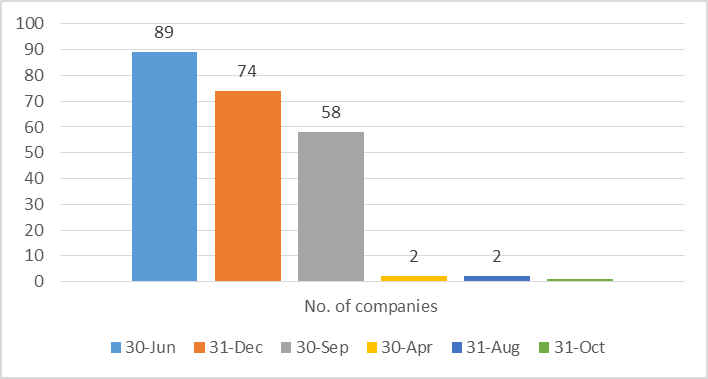
Source[2]: Business Standard: 226 firms to march to a new accounting year

Yes. As per the above graph, there are nearly 226 companies in India that follow a different financial year. Out of the 226 companies, 74 are such companies whose calendar year is the financial year i.e. January- December.

What is the relaxation?

Currently, only companies that follows calendar year as financial year have been granted a 3-months relaxation from holding their AGMs i.e. such companies are allowed to hold their AGMs till 30th September, 2020 instead of June, 2020. Further, the due dates of all other related compliances such as filing of annual returns or financial statements which are required to be done within 60 days/ 30 days as applicable shall be construed accordingly.

What if the company is a listed entity?

Regulation 44(5) of the SEBI (LODR) Regulations, 2015 provides that where the listed entity is within top 100 listed entities based on market capitalization, they have to hold their AGM within 5 months from the closure of the financial year i.e. by August 31, 2020. However, considering the present situation and the need for social distancing, conducting AGMs within such time was becoming a challenge for large corporates. Keeping this in mind, SEBI has granted relief to such entities by extending the requirement by 1 month i.e. till September 30, 2020. However, there was no clarity on what if such entity is a listed entity and follows calendar year as their financial year and is among the top 100 listed entities.

SEBI has now also clarified the same vide its Circular[3] dated 23rd April, 2020 and the present timeline may be summarized as follows:

Sl. No. Type of company Time line under the Companies Act, 2013 Time line under the  SEBI (LODR) Regulations, 2015 Extended timeline
1 Listed company following Apr- Mar as F.Y. Within 6 months from end of FY i.e. 30th September, 2020 Does not provide No extension
2 Listed company following Jan-Dec as F.Y. Within 6 months from end of FY i.e. till 30th June, 2020 Does not provide Extended by 3 months i.e. till 30th September, 2020
3 Listed company following Apr- Mar as F.Y. and amongst top 100 listed entities General provision- Within 6 months from end of FY i.e. 30th September, 2020 Within 5 months from end of FY i.e. till 31st August, 2020 Extended by 1 month i.e. till 30th September, 2020
4 Listed company following Jan- Dec as F.Y. and amongst top 100 listed entities General provision- Within 6 months from end of FY i.e. 30th September, 2020 Within 5 months from end of FY i.e. till 31st May, 2020 Extended till 30th September, 2020 under both laws


Therefore, all types of companies can conduct their AGMs till 30th September, 2020.

Our other articles on related subject may be found here.

[1] http://www.mca.gov.in/Ministry/pdf/Circular18_21042020.pdf

[2] https://www.business-standard.com/article/companies/226-firms-to-march-to-a-new-accounting-year-113100300666_1.html

[3] https://www.sebi.gov.in/legal/circulars/apr-2020/relaxation-in-relation-to-regulation-44-5-of-the-sebi-listing-obligations-and-disclosure-requirements-regulations-2015-lodr-on-holding-of-annual-general-meeting-agm-by-top-100-listed-entitie-_46552.html

SEBI regards maintenance of ‘cover ratio’ & ‘borrowing cap’ as ‘encumbrance’

Penalises promoter entities for non-disclosure under SAST

Ambika Mehrotra & Smriti Wadhera

corplaw@vinodkothari.com

Introduction

The term ‘encumbrance’ as referred to in various court rulings is not a novel term used in law. Although defined in various rulings, in its generic sense, encumbrance means to specify any burden, obstruction, or impediment on an asset, that lessens its value or makes it less marketable. The Securities and Exchange Board of India (Substantial Acquisition of Shares and Takeovers) Regulations, 2011 (SAST Regulations) prior to the amendment introduced vide SEBI (Substantial Acquisition of Shares and Takeovers) (Second Amendment) Regulations, 2019, w.e.f. 29-07-2019[1], defined encumbrance under Regulation 28(3) as

“a pledge, lien or any such transaction, by whatever name called

However, SEBI had further widened the scope of encumbrance vide the said regulation. Though, the earlier interpretation as was clear enough to say that the definition was an inclusive explanation and not an exhaustive one. In order to provide a simplistic explanation/clarification of terms/concepts related to SAST Regulations, SEBI has also come with its FAQs on SAST Regulations[2] to setting various interpretational issues in this regard. The above regulations provide that the shares taken by way of an encumbrance shall be treated as an acquisition and its release shall be treated as disposal under the said Regulations. Accordingly, the disclosures w.r.t acquisition or disposal of shares in any manner, as such, shall mutatis mutandis apply in the case of such transactions. Having said that SEBI has also clarified this requirement in its recent order dated March 31, 2020[3].

In this article, we intend to cover various points of law discussed by SEBI while clarifying the ambit of encumbrance.

Read more