Archive for year: 2020
Implicit deferral of concomitant actions with IEPF amidst COVID-19?
-Pammy Jaiswal (pammy@vinodkothari.com) & Smriti Wadehra (smriti@vinodkothari.com)
Considering the pandemic, the Ministry of Corporate Affairs (‘MCA’) has relaxed various time specific provisions of Companies Act, 2013 so as to the ease the process of running a Company during the lockdown. One of such relaxation was introduction of ‘Companies Fresh Start Scheme, 2020’ (hereinafter referred to as ‘CFSS’) vide General Circular dated 30th March, 2020 [1]which has permitted delayed filing of various e-forms without any additional fees upto 6 months from the expiry of 30th September, 2020.
In furtherance to the said circular, the MCA on 13th April, 2020[2] clarified that the sanction for delayed filing without additional fees shall also apply for filings made under Section 124 and 125 of the Companies Act, 2013 read with IEPF (Accounting, Audit, Transfer and Refund) Rules, 2016. Pursuant to such relaxation, the due date for filing the e-Forms with the Registrar has been relaxed, however, the fate of concomitant actions which take place even before the filing formalities?
Please note that the CFSS is a one-time settlement scheme which allows belated filings to be cleared by the Company without payment of additional fees. Accordingly, the relaxation provided for IEPF filings is also with respect to belated filings or delayed filings up till 30th September, 2020. It is to be noted that form filing is a post facto activity. There are several pre & post filing compliance requirements which is to be executed by companies. However, when it comes to giving relaxations, the Ministry has identified form filings as the only compliance burden on the Company and did not come out with explicit relaxations on the other aspects of compliance activities connected with such filing.
In this write up, we aim to enlist such incidental activities w.r.t IEPF filings and how to ensure their conduct during the pandemic.
| Sl. No. | Form No. | Details provided in the form | Due date of filing | Compliances to be ensured by the Company before filing
|
Our Analysis |
| 1. | IEPF-1 | Statement of amounts credited to IEPF | Within a period of 30 days of such amounts becoming due to be credited to the Fund.
|
· Credit of unclaimed dividend to the IEPF Authority through PNB or MCA;
· Maintenance of record consisting of name, last known address, amount, folio no. or client ID, certificate no., beneficiary details etc. of the persons in respect of whom unpaid or unclaimed amount has remained unpaid or unclaimed for a period of 7 years and has been transferred to the Fund. |
The timeline for reporting the amounts credited to IEPF has been relaxed till 30th September, 2020. Does this mean that the transfer of unclaimed dividend to IEPF has also been extended?
No. The credit of unclaimed dividend to Authority is an online transfer and can be done from anywhere. Therefore, the transfers shall not be delayed/affected due to lockdown. Still, claiming back of shares by investors from IEPF may be delayed or disputed.
However, transfer of unpaid dividend by companies to a separate bank account may not be possible during the crisis as the Banks are not fully functional. Subsequently, application for claiming back shares from unpaid dividend account may also be delayed
Accordingly, extension is only provided for filing of statement in e-Form IEPF-1 by the Company. However, activities related to such filing has been disregarded.
|
| 2. | IEPF-2 | Statement of unclaimed or unpaid amounts and details of Nodal Officer
|
Within a period of 60 days after the holding of AGM.
|
Information to be submitted to Authority:
a) Names and addresses of person entitled to receive sum b) Nature of amount c) Amount which the person is entitled d) Due date for transfer to IEPF
|
The filing requirement comes post AGM. While the MCA has come out with its General Circular dated 8th and 13th April, 2020 laying down modalities for holding EGM within a time frame till 30th June, 2020, however, no such directions have been brought for holding AGMs. However, for companies whose financial year ends on 31st December have been granted an extended timeline till 30th September, 2020 for holding their AGM. While for rest of the companies there is no such extension, it is implicit that if the AGM is held after their respective due dates, the filing is automatically extended.
|
| 3. | IEPF-3 | Form for filing Statement of shares and unclaimed or unpaid dividend not transferred to IEPF
|
Within 30 days of end of FY if company does not transfer the shares and amount to IEPF. | a) Company has to collate the information w.r.t. shares which have restraining orders
b) Company to inform depository by way of corporate action c) Issuance of new certificate in case of physical shares
|
As the filing of such information is extended till 30th September, 2020, the Company may defer incidental activities w.r.t. the said form till the extended date. |
| 4. | IEPF-4 | Statement of shares transferred to the IEPF | Within 30 days of the corporate action containing details of such transfer.
|
· inform at the latest available address to the shareholder concerned regarding transfer of shares 3 months before the due date of transfer of shares (which shall be 6 years and 9 months) and
· also simultaneously publish a notice in the leading newspaper in English and regional language having wide circulation informing that the names and folio no/DP id/Client ID of the concerned shareholders are available on the website of the company, and · also publish on their website the details of such shareholders and shares due for transfer
|
Since, the Rules are silent on the mode of informing the shareholders, therefore, the Company may opt for sending notices vide email. Subsequently publish the same on its website. The question that might create an issue during the current times is the manner of sending individual notices to those who have not registered their e-mail ids.
Further, the notice will also be required to be published in newspapers. Please note that the newspaper services are operational in many parts of the Country, however, large number of people are avoiding purchase of newspapers during the crisis due to fear transmission. Hence, in our view, so as to reach a larger audience, companies may prefer e-version for this purpose.
|
| 5. | E-verification IEPF-5 | Application to the Authority for claiming unpaid amounts and shares out of IEPF | Company shall, within 30 days from the date of receipt of claim, send an online verification report to the Authority.
|
Submission of online verification report along with all the documents submitted by the claimant along with scanned copy of all the original documents submitted by the claimant in physical form duly certified by its Nodal Officer along with the e-verification report and scanned copy of both sides of original physical share certificate or original bond
Further, if there is delay in submission of e-verification report beyond 30 days of filing of the claim the Company shall be liable to pay additional fee of Rs. 50 for every day max- Rs. 2500.
|
E-verification has been extended, hence no comments. |
| 6. | IEPF-7 | Statement of amounts credited to IEPF on account of shares transferred to the fund
|
Within 30 days of transferring the amount to IEPF or date of modification of Rule. | – | – |
Conclusion
While MCA has kept its focus on granting relaxations for filing requirements, it is to be noted that such extended timelines for a post facto activity should actually be taken as an implicit relaxation, during the current COVID -19 crisis, in fulfilling the concomitant actions in relation thereto.
[1] http://www.mca.gov.in/Ministry/pdf/Circular12_30032020.pdf
[2] http://www.mca.gov.in/Ministry/pdf/Circular16_13042020.pdf
Our other content may be viewed here- https://vinodkothari.com/corporate-laws/
Our write-ups relating to COVID-19 maybe viewed here- https://vinodkothari.com/covid-19-incorporated-responses/
Ease of Exit of Businesses in India
‘Doing business’ is not only about seamless starts or how less cumbersome the journey can be – it is also about the certainty of freedom to exit, as and when needed. As such, a sound framework for exit is quintessential for businesses – viable or non-viable. A company might opt to liquidate itself voluntarily, or go for a scheme of merger or amalgamation or even striking off. At the same time, it must be noted that exit may not be always voluntary – sometimes, it may be forced upon the business, for example, in case of insolvent companies, creditors may prefer to liquidate the entity rather than drag it as a going concern. Some of the important considerations in making a choice are – solvency of the company, position of assets and liabilities, extent of judicial involvement, extent of flexibility in the conduct of the process, professional involvement, time involved, and costs. With the judicial authorities being clogged with cases, we may need to reinvent the infrastructural framework and take steps to make the exit process easier. The article discusses the aspects as above.
- This Article has been published in the April, 2020 issue of Chartered Secretary, issued by the Institute of Companies Secretaries of India, available at- https://www.icsi.edu/media/webmodules/linksofweeks/ICSI-April_2020.pdf
Regulator’s move to repair the NBFC sector
-Mridula Tripathi
The evolving impact on people’s health has casted a threat on their livelihoods, the businesses in which they work, the wider economy, and therefore the financial system. The outbreak of this pandemic is nothing like the crisis faced by the economies in the year 2007-08 and imperils the stability of the financial system. The market conditions have forced traders to take aggressive steps exposing the system to great volatility thereby resulting in crashing asset values. Combating the pandemic and safeguarding the economy, the financial sectors across the globe have witnessed numerous reforms to hammer the aftermaths of the global crisis. Read more →
SEBI’s proposal to aid financially “stressed” companies
-Proposal for relaxation in pricing norms for preferential issue and making an open offer
Henil Shah | Executive
Introduction
In layman’s term, a company with falling share prices, inability to pay off its obligations is said to be a company with financial distress. It’s safe to say that for such a company, one of the foremost priority is to secure a source of funds in order to fund their operations to upturn its economic conditions thereby avoiding Insolvency/Bankruptcy. Keeping the same view in mind, the Securities and Exchange Board of India (‘SEBI’) deliberated the matter to its Primary Market Advisory Committee (‘PMAC’), which identified the following key issues to be addressed in order to assist the financially stressed companies to raise funds:
- Criteria for determining a company as stressed
- Determination of a reasonable price for preferential allotment
- Exemptions from open offer obligations under the SAST Regulations
Based on the recommendations given by PMAC, SEBI on April 22, 2020 released a Consultation paper “Pricing of preferential issues and exemption from open offer for acquisitions in companies having stressed assets”[1] seeking public comments till May 13, 2020.
Rationale behind the proposed changes
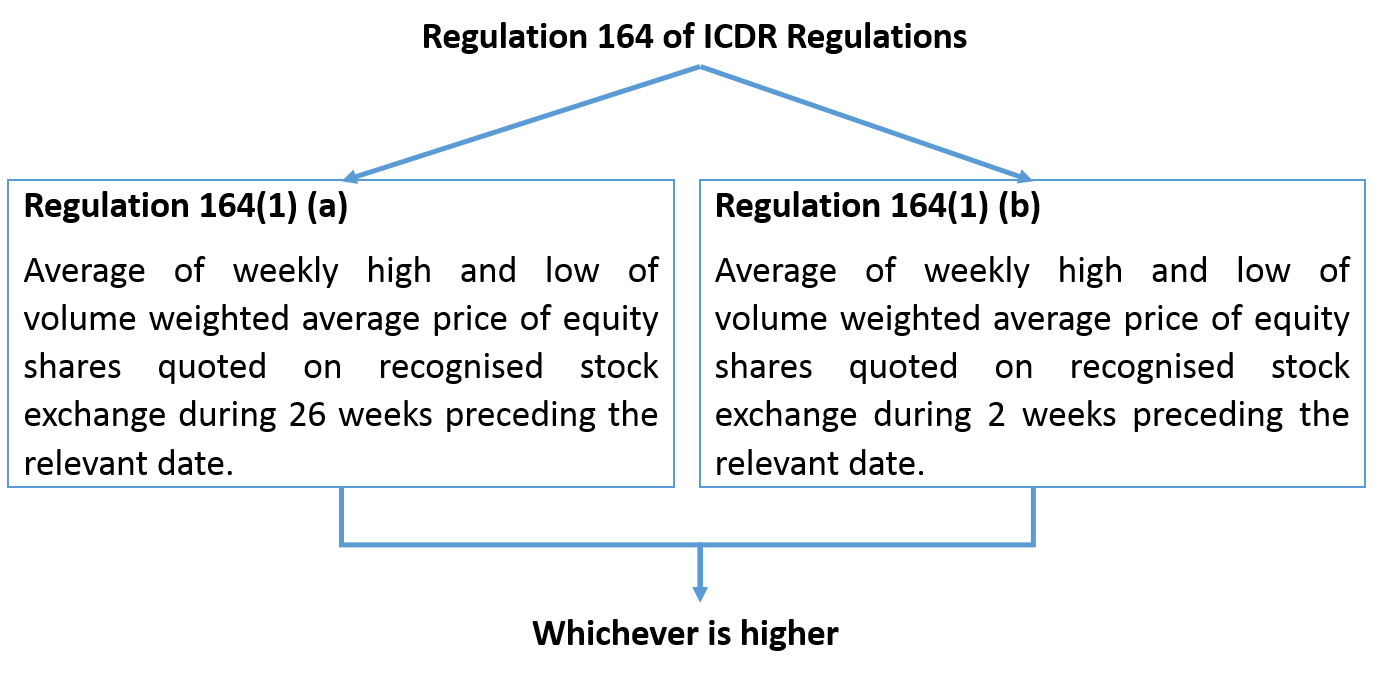
One of the key modes of raising funds by a company especially a financially distressed company is by way of preferential issue of equity shares or convertible instruments. Knowing the probable investors ready to invest in the company makes preferential issue one of the most commonly used ways for raising funds. For a listed company, under a preferential issue, the issue price has to be determined as per the pricing provisions of Chapter V of SEBI (Issue of Capital and Disclosure Requirements) Regulations, 2018 (“ICDR Regulations”). The ICDR Regulations provides the pricing mechanism for both frequently traded shares and infrequently traded shares. In case of frequently trades shares, the price shall be determined as per the provisions of Regulation 164(1) (a) & (b) of the ICDR Regulations which are as follows.
i. Onerous pricing mechanism
Considering the continuous falling prices of the shares over a period of 26 weeks due to the company being in stress, the determination of the price as per the pricing mechanism provided in Regulation 164(1)(a) becomes too onerous for the investor. Further, the price under Regulation 164(1)(a) is much higher than that as determined as per Regulation 164(1)(b). Hence, the pricing mechanism acts as a major deterrent for the investors from subscribing to the shares offered under the preferential issue.
ii. Exemptions only to 5 QIBs restricting investor pool
Though the ICDR Regulations allow issuance to QIBs at a price determined as per regulation 164(1) (b) however, the same is restricted to only 5 QIBs and is not applicable to the investors other than QIBs thereby restricting the investor pool.
iii. Open offer obligations for the acquirer
Another roadblock which the issuers tend to face is from the view point of the investors i.e. an incoming investor who has an impending burden on complying with an open offer obligation in case where the subscription to the preferential offer leads to the triggering of the open offer obligations under SEBI (Substantial Acquisition of Shares and Takeovers) Regulations, 2011(‘SAST Regulations’).
As per the extant provisions, the acquisition pursuant to a resolution plan approved under the Insolvency and Bankruptcy Code, 2016 is exempted from meeting the open offer obligations but no such exemption has been provided in case for acquisition in the financially distressed entity which are not under any resolution plan.
Therefore, where the listed entity is already under distress and suffering from a financial crisis, huge open offer obligations and the cost involved therein discourage the probable investors from taking any controlling interest in such entity.
Rescue mechanism by way of proposed changes
What will be regarded as “stressed”?
It is proposed that only such listed companies which meet any 2 (two) of the following 3 (three) conditions will be determined as a “stressed” company and shall be able to avail the benefits while making an offer under preferential issue once the proposed changes come alive.
- A listed company which has made disclosure of defaults on payment of interest/ principal amount of loans from banks/ financial institutions and listed and unlisted debt securities for 2 consequent quarters in terms of the SEBI Circular[2] issued in this regard;
Default for the purpose of the above circular shall mean non –payment of interest or principal in full on the pre-agreed due date. Provided in case of revolving facilities default shall be considered when outstanding balance remains continuously in excess of the sanctioned limit or drawing power, whichever is lower for more than 30 days.
- Existence of Inter-Creditor agreement in terms of Reserve Bank of India (Prudential Framework for Resolution of Stressed assets) Directions 2019[3];
Inter-credit agreement in terms of the RBI directions stands for agreement executed among all the lenders of a defaulting borrower, providing for ground rules for finalisation and implementation of resolution plan in respect to the borrower.
- Credit rating of the listed instruments of the company has been downgraded to “D”.
Proposal for relaxed pricing norms under the ICDR Regulations:
Unlike the current pricing requirements as provided in Regulations 164(1) (a) & (b) for a preferential issue, the price of the shares to be issued by a stressed company as aforesaid shall be a price which shall not be less than the average of the weekly high and low of the volume weighted average prices of the related equity shares quoted on a recognised stock exchange during the two weeks preceding the relevant date.
Exemptions proposed under the SAST Regulations
Where due to the subscription of shares offered under preferential issue by a financially stressed company triggers open offer obligations as per SAST Regulations, the same shall be exempted.
Additional conditions for availing the exemptions
The Consultation Paper also provides for an additional set of requirements to be complied in case were the benefits of the proposed exemptions are to be availed.
- Persons/entities that are not part of the promoter or promoter group will not be eligible to participate in the preferential issue.
- Obtaining of shareholders’ consent for the exemption to make an open offer by the proposed investors along with the proposal of preferential issue. The shareholders’ approval shall be an approval of majority of minority excluding the promoters and promoter group and any proposed allottee that already hold securities in the issuer.
- Disclosure of the proposed use of the proceeds of such preferential issue in the explanatory statement. This requirement is nothing new as the provisions of regulation 163 of ICDR Regulations and Rule 13 of the Companies (Share Capital and Debenture) Rules, 2014 do provide for mandatorily mentioning object for which the preferential issue is being made in the explanatory statement of the notice.
- Appointment of a monitoring agency. Though there is no requirement of appointing a monitoring agency as per the provisions of chapter V (Preferential Issue) requirement of ICDR Regulations, the concept of the monitoring agency is not new as several chapters of the regulations provide for appointment and functions to be performed by the monitoring agency in case where offer size exceeds a predefined limit.
- Mandatory lock in requirements of shares issued on preferential basis for 3 years which is same as provided in chapter V (Preferential issue) requirement of ICDR Regulations.
Conclusion
Considering the stressed status of the company, it is believed that aligning the pricing requirement with that of pricing requirement in case of preferential issue to QIBs, shall effectively increase the pool of investors. Similarly, the proposed exemption from making of an open offer shall lessen the additional burden on an incoming investor to comply with the stringent requirements thereby attracting investors to put in money in such companies.
Accordingly, SEBI’s intention behind the proposed changes may be said to be a welcome move as it will definitely help the financially stressed companies to revive.
Our write up on prudential framework for resolution for stressed assets can be accessed at:
https://vinodkothari.com/2019/06/fresa/
Our other write ups can be accessed at: https://vinodkothari.com/category/corporate-laws/
[1] https://www.sebi.gov.in/reports-and-statistics/reports/apr-2020/consultation-paper-preferential-issue-in-companies-having-stressed-assets_46542.html
[2] https://www.sebi.gov.in/legal/circulars/nov-2019/disclosures-by-listed-entities-of-defaults-on-payment-of-interest-repayment-of-principal-amount-on-loans-from-banks-financial-institutions-and-unlisted-debt-securities_45036.html
[3] https://www.rbi.org.in/Scripts/NotificationUser.aspx?Id=11580&Mode=0