
Sale assailed: NBFC crisis may put Indian securitisation transactions to trial

-By Vinod Kothari (vinod@vinodkothari.com)

Securitisation is all about bankruptcy remoteness, and the common saying about bankruptcy remoteness is that it works as long as the entities are not in bankruptcy! The fact that any major bankruptcy has put bankruptcy remoteness to challenge is known world-over. In fact, the Global Financial Crisis itself put several never-before questions to legality of securitisation, some of them going into the very basics of insolvency law[1]. There have been spate of rulings in the USA pertaining to transfer of mortgages, disclosures in offer documents, law suits against trustee, etc.

The Indian securitisation market has faced taxation challenges, regulatory changes, etc. However, it has so far been immune from any questions at the very basics of either securitisability of assets, or the structure of securitisation transactions, or issues such as commingling of cashflows, servicer transition, etc. However, sitting at the very doorstep of defaults by some major originators, and facing the spectrum of serious servicer downgrades, the Indian securitisation market clearly faces the risk of being shaken at its basics, in not too distant future.

Before we get into these challenges, it may be useful to note that the Indian securitisation market saw an over-100% growth in FY 2019 with volumes catapulting to INR 1000 billion. In terms of global market statistics, Indian market may now be regarded as 2nd largest in ex-Japan Asia, only after China.

Since the blowing up of the ILFS crisis in the month of September 2018, securitisation has been almost the only way of liquidity for NBFCs. Based on the Budget proposal, the Govt of India launched, in Partial Credit Guarantee Scheme, a scheme for partial sovereign guarantee for AA-rated NBFC pools. That scheme seems to be going very well as a liquidity breather for NBFCs. Excluding the volumes under the partial credit enhancement scheme, securitisation volumes in first half of the year have already crossed INR 1000 billion.

In the midst of these fast rising volumes, the challenges on the horizon seem multiple, and some of them really very very hard. This write up looks at some of these emerging developments.

Sale of assets to securitisation trusts questioned

In an interim order of the Bombay High court in Edelweiss AMC vs Dewan Housing Finance Corporation Limited[2], the Bombay High court has made certain observations that may hit at the very securitisability of receivables.  Based on an issue being raised by the plaintiff, the High Court has directed the company DHFL to provide under affidavit details of all those securitisation transactions where receivables subject to pari passu charge of the debentureholders have been assigned, whether with or without the sanction of the trustee for the debentureholders.

The practice of pari passu floating charge on receivables is quite commonly used for securing issuance of debentures. Usually, the charge of the trustees is on a blanket, unspecific common pool, based on which multiple issuances of debentures are covered. The charge is usually all pervasive, covering all the receivables of the company. In that sense, the charge is what is classically called a “floating charge”.

These are the very receivables that are sold or assigned when a securitisation transaction is done. The issue is, given the floating nature of the charge, a receivable originated automatically becomes subject to the floating charge, and a receivable realised or sold automatically goes out of the purview of the charge. The charge document typically requires a no-objection confirmation of the chargeholder for transactions which are not in ordinary course of business. But for an NBFC or an HFC, a securitisation transaction is a mode of take-out and very much a part of ordinary course of business, as realisation of receivables is.

If the chargeholder’s asset cover is still sufficient, is it open for the chargeholder to refuse to give the no-objection confirmation to another mode of financing? If that was the case, any chargeholder may just bring the business of an NBFC to a grinding halt by refusing to give a no-objection.

The whole concept of a floating charge and its priority in the event of bankruptcy has been subject matter of intensive discussion in several UK rulings[3]. There have been discussions on whether the floating charge concept, a judge-made product of UK courts, can be eliminated altogether from the insolvency law[4].

In India, the so-called security interest on receivables is not really intended to be a security device – it is merely a regulatory compliance with company law rules under which unsecured debentures are treated as “deposits”[5]. The real intent of the so-called debenture trust document is maintenance of an asset cover, which may be expressed as a covenant, even otherwise, in case of an unsecured debenture issuance. The fact is that over the years, the Indian bond issuance market has not been able to come out of the clutches of this practice of secured debenture issuance.

While bond issuance practices surely need re-examination, the burning issue for securitisation transactions is – if the DHFL interim ruling results into some final observations of the court about need for the bond trustee’s NOC for every securitisation transaction, all existing securitisation transactions may also face similar challenges.

Servicer-related downgrades

Rating agencies have recently downgraded two notches from AAA ratings several pass-through certificate transactions of a leading NBFC. The rationale given in the downgrade action, among other things, cites servicer risks, on the ground that the originator has not been able to obtain continuous funding support from banks. While absence of continuing funding support may affect new business by an NBFC, how does it affect servicing capabilities of existing transactions, is a curious question. However, it seems that in addition to the liquidity issue, which is all pervasive, the rating action in the present case may have been inspired by some internal scheme of arrangement proposed by the NBFC in question.

This particular downgrades may, therefore, not have a sectoral relevance. However, what is important is that the downgrades are muddying the transition history of securitisation ratings. From the classic notion that securitisation ratings are not susceptible to originator-ratings, the dependence of securitisation transactions to pure originator entity risks such as internal funding strengths or scheme of arrangement puts a risk which is usually not considered by securitisation investors. In fact, the flight to securitisation and direct assignments after ILFS crisis was based on the general notion that entity risks are escaped by securitisation transactions.

Servicer transitions

The biggest jolt may be a forced servicer transition. In something like RMBS transactions, outsourcing of collection function is still easy, and, in many cases, several activities are indeed outsourced. However, if it comes to more complicated assets requiring country-wide presence, borrower franchise and regular interaction, if servicer transition has to be forced, the transaction will be worse than originator bankruptcy.

Questions on true sale

The market has been leaning substantially on the “direct assignment” route. Most of the direct assignments are seen by the investors are look-alikes and feel-alikes of a loan to the originator, save and except for the true-sale opinion. Investors have been linking their rates of return to their MCLR. Investors have been viewing the excess spread as a virtual credit support, which is actually not allowed as per RBI regulations. Pari-passu sharing of principal and interest is rarely followed by the market transactions.

If the truth of the sale in most of the direct assignment transactions is questioned in cases such as those before the Bombay High court, it will not be surprising to see the court recharacterise the so-called direct assignments as nothing but disguised loans. If that was to happen in one case of a failed NBFC, not only will the investors lose the very bankruptcy-remoteness they were hoping for, the RBI will be chasing the originators for flouting the norms of direct assignment which may have hitherto been ignored by the supervisor. The irony is – supervisors become super stringent in stressful times, which is exactly where supervisor’s understanding is required more than reprimand.

Conclusion

NBFCs are passing through a very strenuous time. Delicate handling of the situation with deep understanding and sense of support is required from all stakeholders. Any abrupt strong action may exacerbate the problem beyond proportion and make it completely out of control. As for securitisation practitioners, it is high time to strengthen practices and realise that the truth of the sale is not in merely getting a true sale opinion.

Other Related Articles:


[1] For example, in a Lehman-related UK litigation called Perpetual Trustees vs BNY Corporate Trustee Services, the typical clause in a synthetic securitisation diverting the benefit of funding from the protection buyer (originator – who is now in bankruptcy) to the investors, was challenged under the anti-deprivation rule of insolvency law. Ultimately, UK Supreme Court ruled in favour of securitisation transactions.

[2] https://www.livelaw.in/pdf_upload/pdf_upload-365465.pdf. Similar observations have been made by the same court in Reliance Nippon Life AMC vs  DHFL.

[3] One of the leading UK rulings is Spectrum Plus Limited, https://www.bailii.org/uk/cases/UKHL/2005/41.html. This ruling reviews whole lot of UK rulings on floating charges and their priorities.

[4] See, for example, R M Goode, The Case for Abolition of the Floating Charge, in Fundamental Concepts of Commercial Law (50 years of Reflection, by Goode)

[5] Or partly, the device may involve creation of a mortgage on a queer inconsequential piece of land to qualify as “mortgage debentures” and therefore, avail of stamp duty relaxation.
UPDATE: No GST input if supplier doesn’t upload details of output: GST Council amends CGST rules to curb ineligible credit availing

-Rahul Maharshi

(rahul@vinodkothari.com) (finserv@vinodkothari.com)

The GST council in its 37th Meeting held on 20th September, 2019, had proposed to make amendments in the CGST Rules, 2017 (“Rules”) pertaining to matters relating to the extension of due date of filing of GSTR-3B GSTR-1 as well as voluntary requirement of filing of GST Annual return for registered person whose aggregate turnover is less than Rs. 2 crores.

One of the major amendment proposed was to restrict the claiming of input tax credit by the recipient, in case of mismatch in details uploaded by the supplier, to the extent of 20% over and above the value of uploaded details by the supplier.

The above proposed amendment has been brought into force through notification 49/2019- Central Tax   [1] whereby the input credit availed by a registered person, the details of which have not been uploaded by the suppliers vide GSTR-1, the same should not exceed 20% of the eligible credit that has been uploaded by the suppliers.

As per the insertion in the CGST rules, 2017, viz. sub-rule (4) of rule 36:

“(4) Input tax credit to be availed by a registered person in respect of invoices or debit notes, the details of which have not been uploaded by the suppliers under sub-section (1) of section 37, shall not exceed 20 per cent. of the eligible credit available in respect of invoices or debit notes the details of which have been uploaded by the suppliers under sub-section (1) of section 37.”

For example, as per the books of the recipient, there is an input tax credit of Rs. 5,000 for a particular month from a particular supplier against 5 tax invoices having the GST component of Rs. 1,000 each.  Post the amendment, the following scenarios shall arise:

Case-1: In case the supplier has uploaded all 5 invoices:

In case the supplier has duly uploaded the details of all the 5 invoices through filing the GSTR-1 for the particular month, the auto-populated GSTR-2A will have the details of all such invoices and accordingly the recipient will be eligible to claim the input tax credit of all 5 invoices

Case-2: In case the supplier has uploaded 3 invoices:

In case the supplier has uploaded less than 5 invoices, i.e. 3 invoices having GST component of Rs. 3,000, the recipient will be eligible to claim input tax credit at a maximum of Rs. 3,600 (viz. 3,000+20% of 3,000= 3,600).

Case-3: In case the supplier has not uploaded any invoice:

In case the supplier has not uploaded any invoice in the GSTR-1 of the respective month, the recipient will not be eligible to claim the input tax credit in that particular month. However, the recipient may claim the input as soon as the supplier uploads the details in the GSTR-1 and corresponding details reflect in the auto-populated GSTR-2A.

As a result of the said amendment, the recipient will be required to monitor the duly uploading of the invoices by the supplier in a more stringent manner, since omission of the same will result in reduction in claiming of input tax credit by the recipient.

Also, an important point of concern will be the change in accounting of the input tax credit in the books of the recipient. The excess claim over 20% of the eligible input tax credit will require allocation against the invoices of which the input tax credit would pertain to.

Continuing the above example viz. Case 2, where the supplier has uploaded 3 invoices, how will the recipient allocate the said portion of 20% viz. Rs. 600 if the recipient claims input tax credit at the excess of 20%. The recipient has to allocate the said amount against portion of particular invoices.

The above move may be seen as a way to monitor the claiming of inputs by the recipients as well as a check on the supplier for uploading the returns on a regular basis. However, there are pertinent issues which require further clarification from the department.


[1] http://www.cbic.gov.in/resources//htdocs-cbec/gst/notfctn-49-central-tax-english-2019.pdf;jsessionid=15BA096E92769114F368D806E28B8FF5

Lenders’ piggybacking: NBFCs lending on Fintech platforms’ guarantees

-Vinod Kothari

(vinod@vinodkothari.com)

Among the disruptive Fintech practices, app-based lending is certainly notable. The scenario of an app-based lending is somewhat like this – a prospective borrower goes to an app platform, fills up some information. At the background, the app collects and collates the information including credit scores of the individual, may be the individual’s contact bases in social networks, etc. Finally, the loan is sanctioned in a jiffy, mostly within minutes.

The borrower interacts with the platform, but does the borrower know that the loan is actually not coming from the platform but from some NBFC? Whether the borrower knows or cares for who the lender is, the fact is that mostly, the technology provider (platform) and the funding provider (lender) are not the same. It may be two entities within the same group, but more often than not, the lender is an NBFC which is simply originating the loan based on the credit comfort provided by the platform.

The relation between the platform and the lender may take one of the following forms: (a) platform simply is procuring or referring the credit; the platform has no credit exposure at all; (b) the platform is acting as a sourcing agent, and is also providing a credit support, say in form of a first-loss guarantee for a certain proportion of the pool of loans originated through the platform; (c ) the platform provides full credit support for all the loans originated through the platform, and in return, the lender allows the platform to retain all the actual returns realised through the pool of loans, over an and above a certain “portfolio IRR”.

Option (a) is pure sourcing arrangement; however, it is quite unlikely that the lender will be willing to trust the platform’s credit scoring, unless there is significant skin-in-the-game on the part of the platform.

If it is a case of option (c ) [which, incidentally, seems quite common, the loan is actually put on the books of the lender, but the credit exposure is on the platform. The lender’s exposure is, in fact, on the platform, and not the borrower. The situation seems to be quite close to a “total rate of return swap”, a form of a credit derivative, whereby parties synthetically replace the exposure and the actual rate of return in a portfolio of loans by a pre-agreed “total rate of return”.

Our objective in this article is to examine whether there are any regulatory concerns on the practice as in case of option (c ) . Option c is an exaggeration; there may be a case such as option (b). But since option (b) is also a first loss guarantee with a substantial thickness, it is almost akin to the platform absorbing virtually all the risks of the credit pool originated through the platform.

Before we get into the regulatory concerns, it is important to understand what are the motivations of each of the parties in this bargain.

Platform’s motivations

The motivation on the part of the platform is clear – the platform makes the spreads between the agreed portfolio IRR with the lender, and the actual rate of return on the loan pool, after absorbing all the risk of defaults. Assume, the small-ticket personal loan is being given at an interest rate of 30%, and the agreed portfolio IRR with the lender is 14%, the platform is entitled to the spread of 16%. If some of the loans go bad, as they indeed do, the platform is still left with enough of juice to be a compensation for the risks taken by it.

The readiness on the part of the platform is also explained by the fact that the credibility of the platform’s scoring is best evidenced by the platform agreeing to take the risk – it is like walking the talk.

Lender’s motivations

The lender’s motivations are also easy to understand – the lender is able to disburse fast, and at a decent rate of return for itself, while taking the risk in the platform.  In fact, several NBFCs and banks have been motivated by the attractiveness of this structure.

Are there any regulatory concerns?

The potential regulatory concerns may be as follows:

  • De-facto, synthetic lending by an entity that is not a regulated NBFC
  • Undercapitalised entity taking credit risk
  • Skin-in-the-game issue
  • A CDS, but not regulated as a CDS
  • Financial reporting issues
  • Any issues of conflict of interest or misalignment of incentives
  • Good borrowers pay for bad borrowers
  • KYC or outsourcing related issues.

Each of these issues are examined below.

Synthetic lending by an unregulated entity

It is common knowledge that NBFCs in India require registration. The platform in the instant case is not giving a loan. The platform is facilitating a loan – right from origination to credit risk absorption. Correspondingly, the platform is earning a spread, but the activity is technically not a “financial activity”, and the spread not a “financial income”; hence, the platform does not require regulatory registration.

Per contra, it could be argued that the platform is essentially doing a synthetic lending. The position of the platform is economically similar to an entity that is lending money at 30% rate of interest, and refinancing itself at 14%. There will be a regulatory arbitrage being exploited, if such synthetic lending is not treated at par with formal lending.

But then, there are whole lot of equity-linked or property-linked swaps, where the returns of an investment in equities, properties or commodities, are swapped through a total rate of return swaps, and in regulatory parlance, the floating income recipient is not regarded as investor in equities, properties or commodities. Derivatives do transform one asset into another by using synthetic technology – in fact, insurance-linked securities allow capital market investors to participate in insurance risk, but it cannot be argued that such investors become insurance companies.

Undercapitalised entities taking credit risk

It may be argued that the platform is not a regulated entity; yet, that is where the actual credit risk is residing.  Unlike NBFCs, the platform does not require any minimum capitalisation norms or risk-weighted capital asset requirements. Therefore, there is a strong potential for risk accumulation at the platform’s level, with no relevant capital requirements. This may lead to a systemic stability issue, if the platforms become large.

There is a merit in the issue. If fintech-based lending becomes big, the exposure taken by fintech entities on the loans originated through them, on which they have exposure, may be treated at par with loans actually held on the balance sheet of the fintech. As in case of financial entities, there are norms for converting off-balance sheet assets into their on-balance sheet equivalents, the same system may be adopted in this case.

Skin-in-the game issue

Post the Global Financial Crisis, one of the regulatory concerns was skin-in-the-game. In light of this, the RBI has imposed minimum holding period, and minimum risk retention requirements in case of direct assignments as well as securitisation.

The transaction of guarantee discussed above may seem like the exposure being shifted by the platform to the NBFC. However, the transaction is not at all comparable with an assignment of a loan. Here, the lending itself is originated on the books of the NBFC/lender. The lender has the ultimate discretion to agree to lend or not. The credit decision is that of the lender; hence, the loan is originated by the lender, and not acquired. The lender is mitigating the risk by backing it up with the guarantee of the platform – but this is not a case of an assignment.

There is a skin-in-the-game on either side. For the platform, the guarantee is the skin-in-the-game; for the NBFC, the exposure in the platform becomes its stake.

A CDS, but not regulated as a CDS

The transaction has an elusive similarity to a credit default swap (CDS) contract. It may be argued that the guarantee construct is actually a way to execute a derivative contract, without following CDS guidelines provided by the RBI.

In response, it may be noted that a derivative is a synthetic trading in an exposure, and is not linked with an actual exposure. For example, a protection buyer in a CDS may not be having the exposure for which he is buying protection, in the same way as a person acquiring a put option on 100 gms of gold at a certain strike price may not be having 100 gms of gold at all. Both the persons above are trying to create a synthetic position on the underlying.

Unlike derivatives, in the example of the guarantee above, the platform is giving guarantee against an actual exposure. The losses of the guarantor are limited to actual losses suffered by the lender. Hence, the contract is one of indemnity (see discussion below), and cannot be construed or compared to a derivative contract. There is no intent of synthetic trading in credit exposure in the present case.

Financial reporting issues:

It may be argued that the platform is taking same exposure as that of an actual lender; whereas the exposure is not appearing on the balance sheet of the platform. On the other hand, the actual exposure of the lender is on the platform, whereas what is appearing on the balance sheet of the lender is the loan book.

The issue is one of financial reporting. IFRSs clearly address the issue, as a financial guarantee is an on-balance sheet item, at its fair value. If the platform is not covered by IFRSs/IndASes, then the platform will be reflecting the guarantee as a contingent liability on its balance sheet.

Conflicts of interest or misalignment of incentives:

During the prelude to the Global Financial Crisis, a commonly-noted regulatory concern was misalignment of incentives – for instance, a subprime mortgage lender might find it rewarding to lend to a weak credit and capture more excess spread, while keeping its exposure limited.

While that risk may, to some extent, remain in the present guarantee structure as well, but there are at least 2 important mitigants. First, the ultimate credit decision is that of the NBFC. Secondly, if the platform is taking full credit recourse, then there cannot be a misalignment of incentives.

Good borrowers pay for bad borrowers

It may be argued that eventually, the platform is compensating itself for the risk of expected losses by adding to the cost of the lending. Therefore, the good borrowers pay for the bad borrowers.

This is invariably the case in any form of unsecured lending. The mark-up earned by the lender is a compensation for risk of expected losses. The losses arise for the loans that don’t pay, and are compensated by those that do.

KYC or outsourcing related issues

Regulators may also be concerned with KYC or outsourcing related issues. As per RBI norms “NBFCs which choose to outsource financial services shall, however, not outsource core management functions including Internal Audit, Strategic and Compliance functions and decision-making functions such as determining compliance with KYC norms for opening deposit accounts, according sanction for loans (including retail loans) and management of investment portfolio.”

Usually the power to take credit decisions vests with the lender. However, in case the arrangement between the lender and the platform is such that the platform performs the decision-making function, the same shall amount to outsourcing of core management function of the NBFC, which is expressly disallowed by the RBI. The relevant extract from the KYC Master Directions is as follows:

“REs shall ensure that decision-making functions of determining compliance with KYC norms are not outsourced.”

Is it actually a guarantee?

Before closing, it may be relevant to raise a legal issue – is the so-called guarantee by the platform actually a guarantee?

In the absence of tripartite agreement between the parties, the arrangement cannot be said to be a contract of guarantee. Here the involvement is of only two parties in the arrangement i.e. the guarantor and the lender.

It was held in the case of K.V. Periyamianna Marakkayar and others vs Banians And Co.[1] that “Section 126 of the Indian Contract Act which defines a contract of guarantee though it does not say expressly that the debtor should be a party to the contract clearly implies, that there should be three parties to it namely the surety, the principal-debtor and the creditor ; otherwise it will only be a contract of indemnity. Section 145 which enacts that in every contract of guarantee there is an implied promise by the principal debtor to indemnify the surety clearly shows that the debtor and the surety are both parties to such a contract ; for it will be strange to imply in a contract a promise between persons who are not parties to it.”

Accordingly, the said arrangement maybe termed as a contract of indemnity wherein the platform agrees to indemnify the lender for the losses incurred on account of default by the borrower.

Conclusion

Fintech-based lending is here to stay, and grow. Therefore, risk participation by Fintech does not defeat the system – rather, it promotes lending and adds to the credibility of the Fintech’s risk assessment. Over period of time, the RBI may evolve appropriate guidelines for treating the credit exposure taken by the platforms as a part of their credit-equivalent assets.


[1] https://indiankanoon.org/doc/1353940/

Director’s liability has a nexus with his role and not the position

– Pammy Jaiswal, Partner | corplaw@vinodkothari.com Updated as on 22nd July, 2022 Background While there has been a lot of rulings on the liability of directors, the question that mostly cropped up for examination was with respect to their involvement in the day-to-day operations. The liability of non-executive directors has mostly been scanned to evaluate […]

From manufacturing to providing services: How does it transform?

-Kanakprabha Jethani | Executive

(kanak@vinodkothari.com)

Background

Servitization is that foreign business term that does not find place in any dictionary but is in steps to becoming essence of many businesses. It is a transformation, from manufacturing to providing solutions, from being product-centred to being complete-solution centred. Essentially, it is a business model in which, manufacturer of a product also engages in provision of services relating to that product.

The concept of servitization arises from the traditional ideology of business of maintaining life-long relationship with customers. Cranfield University defines servitization as “the innovation of organisation’s capabilities and processes to better create mutual value through a shift from selling product to selling Product-Service Systems.”

For instance, a laptop manufacturing company, say A Co. manufactures and sells “laptops”, it is a manufacturing concern. However, when A Co. sells a “package” which includes a laptop along with provision for after-sale services, software to support operations on the laptop, anti-virus software, cloud-space for data storage etc. it is said to be servitization.

How does this model operate? How do the parties earn? Are there any existing models operating? What is their structure of operation?  Why does a manufacturer need to adopt this model? How will this be implemented? The following write-up answers all these questions and seeks to provide an all-round insight to the concept of servitization.

Structure of a servitization model

The concept of servitization has evolved answering the calls of the market that arose from phased transitions in customers approach to the products.

  • Initially, a product-oriented market was prevalent in which the manufacturer and seller had just a buy and sell relationship. They became strangers right after the sale.
  • This approach then shifted to product-oriented services, under which the manufacturer started providing additional services with respect to the product sold by it such as delivery, product installation, spare parts, updates and upgrades, warranty, maintenance etc.
  • With Rolls Royce making leaps into innovation, the concept of use-oriented services came into place. Under this companies offer product leasing, sharing, renting, and pooling services where the customer pays fee for using the product.

This concept is however different from leasing as leasing provides exclusive rights to use to the lessee. In this model, the product can be shared between two or more customers or the owner and the customer.

  • Later, the approach shifted to result-oriented services where the consideration for service provider is directly linked to the output generated by the customer.

Servitization model is a customer-oriented services model which combines features of all of the aforementioned approaches. This model serves the customers’ demand for real-time responses, effective self-service options, predictive maintenance etc.

An ideal servitization model involves an entire process from manufacturing of a product, its delivery, installation and training for its use to ongoing maintenance and consultancy relating to the product. It provides for an all-round cover of the product along with support services to the customer.

Money matters: How does the service-provider/manufacturer earn?

A typical servitization model of a manufacturer includes the following:

  • Sustainable production process
  • Supplier and customer interdependencies
  • Lifetime product maintenance
  • Repairs
  • Recycling of end product
  • Help desk
  • Customer specific support agreements

An ideal servitization relationship includes incentives for the supplier to reduce costs. It shares risks, financial risk especially, and it is based on achieving the highest performance possible. The optimal contract consists of a fixed payment or fixed price, cost-sharing and performance-based compensation.

Through servitization, the seller is bound to provide services to the buyer till the product exists. This bond is achieved by tying the supplier’s compensation to the output value of the equipment generated by the customer. This creates a lasting relationship between the seller and buyer. This is the transformation from earning profits to creating mutual value.

Economics of servitization

For a business, the essence of servitization lies in establishing long-term relationship with customers. This lengthened relationship results in maintenance of steady revenues which then results in greater profitability and customer retention. Further, streamlining the supply and services reduces the risk of quality deterioration. To sustain in the market, it is very necessary to provide value addition. The market wants innovation and new offerings every day and has offerors all around. For a business to stay, will have to provide more than just a product. Providing aftersales services and advanced services such as consultancy services and solutions enables a business to meet customers’ demand for complete solution packages and thus ensures sustainability.

Further, through servitization, manufacturers are exposed to a whole new set of issues faced during operation of their products. This provides them insights for future R&D and helps them bring innovation in their products and ensure continuous product improvement.

For a customer, the prime benefit that servitization brings out is that the customer has to pay only for the value derived from the product. The customer is saved from risk of unproductive expenditure. Further, the quality of product is maintained as the manufacturing entity only does further servicing of the product. Since, the customer has to pay for what is operational, it also ensures that the ‘operational time’ is productive as well. This urges the customer to undertake profitable operations only.

Risks in servitization

  • Financial risks: The transition from a manufacturing model to servitization model requires a complete shift in the operational basis of the entity. Also, the revenue generation model is completely changed by shifting the point of revenue generation from sale to outcome, which would result in elongation of operating cycle. Due to this, requirement of working capital is increased.
  • Operational risks: Manufacturers face operational issues like how to assess the use of asset, level of maintenance required, frequency of updations etc. Further, the transition requires a complete turnaround in the operating team and procedures which involves a very long downtime.
  • Partner risks: The concept of servitization is based on a generation of revenue when some other person is in operation. The return to manufacturer is directly linked with the operation or outcome of the customer. Thus, it poses a risk over the earning of the manufacturer.

Why does a business need to servitize?

For a business, where all competitors are trying to knock you down, survival is a lonely process. In order to stay, the business needs to keep the market interested. Following are certain factors which lead a business towards the direction of transformation:

  • Economic rationale: In a competitive market, it is not possible for firms to compete on basis of cost as they already operate on very low margins. In such a case, innovation is the key to stand out from the competitors. Further, stability of revenues is yet another driving force in this direction.
  • Strategic rationale: Through servitization, a business is able to retain its customers for a very long time. Lock-in customers and lock-out competitors is a clear implication of this. Moreover, customers are very much educated and aware in the present day market. They demand such models and a business that fulfils their demands, stays.
  • Environmental rationale: The world is moving towards sustainability. Responding to the current environmental changes, if a single entity is engaged during the entire lifecycle of the product, it would result in preservation of resources to a great extent. A business with such values and respect towards the environment always achieves a higher place in the eyes of the customer.

Global examples

The philosophy of “co-existence” has laid its nets in the business also. The concept of mutual-benefit has become the new definition of profitability and the world is responding to this change in the following manner:

  • Rolls Royce: This was the pioneering engine solution which changed the deal with customers from a transactional purchase of equipment towards a ten-year contractual relationship guaranteeing operational time of the engine. This model gave rise to the concept of ‘Performance-Based Logistics’ (PBL) which was initially introduced by Rolls Royce for jet engines. Later a similar model was proposed for the marine industry as well.
    Under this model, a fixed amount for flying per hour is charged. The customer are provided with accurate projections for maintenance cost and assurance for avoidance of breakdown costs.
  • Xerox’s print management: This model offers a bundle of services and copier to the customer. It provides a comprehensive set of capabilities which prevent malicious attacks, proliferation of malware and misuse of unauthorised access to printers etc. as well as services to help better manage documentation. The customer is charged based on the number of sheets of paper they have copied or printed.
  • MAN’s Financial Services: Offers comprehensive services around drivers’ behaviour and fuel efficiency in order to help customers operate more efficiently, with charging based on the distance trucks are driven.
    This was launched with the basic motive of reducing the cost of lease during off-seasons. It enabled the lessee to pay certain sum on each kilometre travelled by the leased truckthereby reducing the downtime costs.
  • Lumenstream: This Britain based start-up provides customers with fully maintained LED lighting with no upfront cost. In line with the proven fact that LED lights save upto 60% energy costs, the customer is charged based on share of energy savings achieved over a period of five years.
  • Small Robot Company: This company is transforming the process of farming through their Farming as a Service (FaaS) model. Under this model a series of robots (Tom, Dick and Harry) with ‘clever’ operating systems are linked to provide a full-fledged farming support. One of the robots monitors the crops, soil and weeds. The other two take care of all the feeding, seeding, and weeding. They record location of every crop and take care of each individual plant until it is entirely grown up.
    The farmer does not need to make any upfront payment for leasing the robot. Instead the farmer is charged on the basis of per-hectare subscription fee of robots working.
  • Philips: Philips provides LED lighting as a service to Amsterdam Schiphol airport through ‘Internet of Things’ (IoT) connectivity. Under the arrangement, Philips takes responsibility of the performance of the LED lamps. On the other hand, the airport is able to save 50% energy cost by using LED lights. A share of saved cost is paid as consideration to Philips.

How has the world responded to servitization?

Penetration of servitization model: Country-wise

Servitization has been a buzz in the recent times. Some countries have already made it the core model of their businesses while some are still struggling to get familiar with the concept itself. To understand how servitization has impacted and will continue to impact the world, it is first important to understand, how deep servitization has spread its roots in business models of various countries.

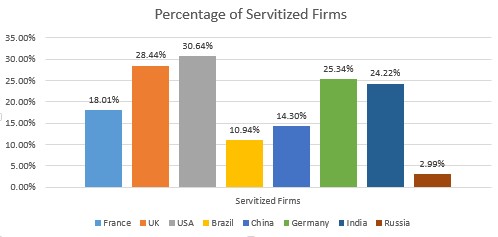
Following chart depicts that, out of certain number of entities, selected on random basis, what percentage of entities were practising servitization as on November 2013.

Source: University of Cambridge[1]

From the above figure it can be seen that USA has already embossed the concept of servitization in its ideology of business. A major chunk of the firms in USA covered by the research operate on servitization model. Seemingly, servitization model is in the steps of becoming the core model for majorly all businesses in USA. UK is following the footsteps of USA and has implemented servitization to some extent. Countries like Germany, India and France seem to be advancing in this field of innovation and some entities in these countries have initiated adopting servitization models. Russia seems to be resistant towards adoption of this innovation in its business models.

All that matters is growth

Benefits, growth, profits are the words that really matter in a business. Whether an innovation should be introduced or not? The answer lies in the benefits it gives. Businesses see benefits in growth and profitability. Increased sales, turnover, consumer base is what they look forward to.

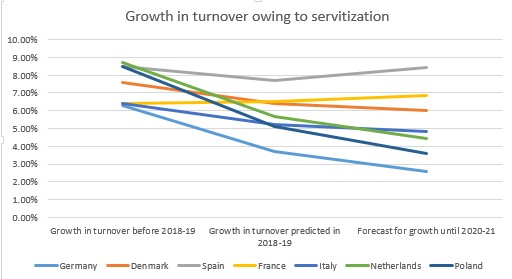
Following figure shows how servitization has effected the turnover growth in various countries and what the forecasts are for the near future.

Source: European Commission report on servitization

From its inception till 2018-19, the initial stages of implementation of servitization have shown the very high levels of growth in turnover for countries like Germany, Italy and Netherlands where servitization has been implemented upto reasonable levels. A study in France by European Commission shows that with 70% of SMEs in France being servitized, rate of employment also grew by 30% and an average annual increase of around 10% in turnover in the country was also witnessed. By 2020-21, when servitisation would already have been implemented in major countries, the pace of growth would tend to slow down. However, there are still no signs of negative growth forecasts in any of the countries. Servitization is expected to increase turnovers of various countries by averagely 3-4% in the coming years.

Striking the balance

Seemingly, the structure of servitization-based models is altogether a risky exertion. The manufacturer is exposed to huge risks as the consideration is based on the output of the customer. This might, on one hand, result in blocking of funds in the initial stages. While on the other hand, the customer base of the manufacturer is strengthened. Earning of the manufacturer depends on operations of the customer which are substantially out of the control of the manufacturer. This creates a gap in the chain of flow of income for the manufacturer.

The servitization model requires integration of operations of manufacturer and the customer. It calls for a close connection between the both. The manufacturer shall not only communicate with the person procuring the product, but also with the person actually engaged in operation of the product. The necessity of rethinking internal and external processes is highly felt while transforming from a product-based to a customer-based structure. Introduction of new technology and human resources specializing the service industry has to be the primary step in the transformation process. Extensive use of data and analytics is an inseparable part of servitization industry.

In essence, manufacturer will have to implement servitization as one major programme, which would address everything, from production processes to client communication and revenue generation. A risk-return balance will have to be achieved so that continuous inflow of income for the manufacturer is ensured.

Way forward

While some countries have implemented it to a large extent, some are advancing, some struggling and some oblivious to it, servitization seems to have entered all territories. Various sectors also have reacted differently to servitization, but reasonable growth has been recognised in all of them by now. Flaws would pop-up with time and would be handled accordingly. The concept of servitization is based on the principle of value for all. It has the potential to serve productivity and profitability at all levels of a value chain. Like every other innovation, operational aspects obviously have certain glitches which one can understand only after continuous operation. An effective implementation of servitization models would require consistent updations and modifications to achieve a feasible structure suitable to specific needs of both, the manufacturer and the customer. It’s a slow pathway to growth: Innovation and consistency are the keys.

[1]https://cambridgeservicealliance.eng.cam.ac.uk/resources/Downloads/Monthly%20Papers/2013November_ServitizationinGermany.pdf

Draft guidelines for on tap licensing of SFBs: decoded

-Kanakprabha Jethani | Executive

(kanak@vinodkothari.com)

The Reserve Bank of India (RBI) has issued draft guidelines for ‘on tap’ licensing of Small Finance Banks (SFBs). The guidelines are largely similar to the existing guidelines for licensing of SFBs. However, the major difference is that the licensing will be allowed ‘on tap’. Further, there are certain changes in the eligibility requirements as well. The following write-up intends to answer all the questions relating to licensing of SFBs under the new ‘on tap’ mechanism.

What is ‘on-tap’ licensing?

Under the existing framework, the RBI issues licences for SFBs in batches i.e. all the applications are reviewed in a decided time frame and approvals for a number of SFBs are issued at once. The RBI doesn’t give out approvals as and when applications are received. Rather, when sufficient number of applications are received, they are reviewed at once and the applications that satisfy RBI’s criteria are issued with licenses.

Under the ‘on-tap’ mechanism, RBI will initiate the review of applications as and when they are received. Individual applications will be reviewed and licenses will be issued accordingly.

Who is eligible to apply?

Eligible Promoters:
Resident individuals Atleast 10 years’ experience in banking and finance sector at senior level
Professionals who are Indian citizens Atleast 10 years’ experience in banking and finance sector at senior level
Companies/societies owned and controlled by residents Having successful track record of running their business for atleast 5 years
Conversion:
Existing NBFCs, Micro Finance Institutions (MFIs), Local Area Banks (LABs) -in private sector + controlled by residents + successful track record of running the business for atleast 5 years
Primary Urban Co-operative Banks (UCBs) As per the scheme for voluntary transition.
Fit and Proper Criteria:
Promoters/ promoter group Past record of sound credentials and integrity, financial soundness and successful track record of professional experience or of running their business for atleast 5 years

Who cannot apply?

Joint ventures by different promoter groups for purpose of setting up SFB. Public sector entities, large industrial houses or business groups, bodies set up under state legislature, state financial corporations, etc. Group with assets of Rs. 5000 crores or more+ non financial business accounting for 40% or more

What will be the structure of SFB?

An SFB maybe floated either as a standalone entity or under a holding company, which shall act as the promoting entity of the bank. Such holding company shall be a Non-Operative Financial Holding Company (NOHFC) or be registered with the RBI as NBFC-CIC.

What activities can an SFB carry out?

Primarily, an SFB is allowed to carry out basic banking activities.

Apart from the primary functions, SFBs can also undertake non-risk sharing simple financial activities, not requiring commitment of their own funds, after obtaining approval of the RBI. Also, they are allowed to become Category II Authorised Dealer in foreign exchange business.

An activity that involves commitment of funds of the SFB, such as issue of credit cards, shall not be allowed.

What will be the capital structure in SFB?

Minimum paid-up equity capital:
All applicants Rs. 200 crores
For UCBs converting into SFB Initially Rs. 100 crores, which shall be required to be increased to Rs. 200 crores within 5 years
Capital Adequacy Ratio:
Tier I capital 7.5% of total risk-weighted assets
Tier II capital Maximum 100% of tier I capital
Capital 15% of total risk- weighted assets
Promoters Contribution:
Promoters’ holding Minimum 40% of paid-up voting equity capital

·         Bring down to 30% in 10 years

·         Bring down to 15% in 15 years

In case of conversion of NBFC/MFI to SFB, if promoters’ shareholding is maintained below 40% but above 26% due to regulatory requirements or otherwise, the same shall be acceptable. Provided that promoters’ shareholding doesn’t fall below 20%.
Lock-in on promoters’ minimum holding 5 years
If promoters’ shareholding > 40% Bring down to 40%

·         within 5 years from commencement of business (in case of other SFB)

·         within 5 years from the date paid-up capital of Rs. 200 crores is reached (in case of conversion from UCB)

No person other than promoters shall be allowed to hold more than 10% of the paid-up equity capital.
Foreign Shareholding:
Under automatic route Upto 49%
Government route Beyond 49% upto 74%
Atleast 26% of the paid-up equity capital should be held by resident shareholders.

Will the SFB be listed?

An application for listing of the SFB can be made voluntarily after obtaining approval of the RBI. However, on reaching a paid-up equity capital of Rs. 500 crores, listing shall be made mandatory.

What will be the compliance requirements for SFBs?

  • Have in place a robust risk management system.
  • Prudential norms as applicable to commercial banks shall be applicable.
  • 75% of Adjusted Net Bank Credit (ANBC) shall be extended to priority sectors.
  • The maximum loan size to a single person or group shall not be more than 10% of SFB’s capital funds.
  • The maximum investment exposure to a single person or group shall not be more than 15% of SFB’s capital funds.
  • Atleast 50% of loan portfolio should consist of small size loans (upto Rs. 25 lakhs per borrower).
  • There should be no exposure of the SFB to its promoters, shareholder holding 10% or more of the paid-up capital, and relatives of promoters.
  • Payments bank may make application to set up an SFB, provided that both the banks shall be under NOHFC structure.
  • SFB cannot be a Business Correspondent of other banks.

Are there any specific compliance requirements for NBFCs/MFIs/LABs converting into SFB?

Following are the specific requirements to be complied with in case of conversion from NBFC/MFI/LAB:

  • Have minimum paid-up capital of Rs. 200 crores. In case of deficiency, infuse the differential capital within 18 months.
  • Convert the branches of NBFC/MFI to branches of the SFB within 3 years from commencement of operations.
  • In case any floating charges stand in the balance sheet of the NBFC/MFI, the same shall be allowed to be carried until the related borrowings are matured.

How to make an application to set up an SFB?

An application shall be made to the RBI in Form III along with a business plan and detailed information of the existing as well as proposed structure, a project report regarding viability of the business of SFB and any other relevant information. The application shall be submitted to the RBI in physical form in an envelope superscripted “Application for Small Finance Bank” addressed to the Chief General Manager of the RBI.

In case, the application satisfies the RBI criteria, the fact of approval shall be placed on the RBI website. In case, the application is rejected, the applicant will be barred from making fresh application for a period of three years from such rejection.
