
Archive for year: 2019
Provisions relating to DVR & DRR- stands amended
Amendments introduced in Companies (Share Capital and Debentures) Amendment Rules, 2019
by Smriti Wadehra (smriti@vinodkothari.c0m)
The recent Notification of Ministry dated 16th August, 2019 has amended the provisions of Companies (Share Capital and Debentures) Rules, 2014 with respect to quantum of holding of equity shares with differential voting rights by a Company and provisions pertaining to creation of debenture redemption reserve. The amended provisions are applicable from the date of notification in the e-gazette i.e. 16th August, 2019.
Differential Voting Rights
SEBI in its Board Meeting dated 27th June, 2019 proposed insertion of the provisions of DVRs in SEBI ICDR Regulations. The proposal was w.r.t inter alia to cap the total voting rights of superior rights shareholders (including ordinary shares) at 74% of the total voting power. The respective amendments are still awaited. Meanwhile, the Ministry vide the aforesaid Notification amended the provisions under CA, 13 related to DVRs. The Notification has escalated the limit of DVR shares in the Company from 26% of total post-issue paid up equity capital of the Company to 74% of the total voting power.
The erstwhile provisions of the Companies (Share Capital and Debentures) Rules, 2014 permitted issuance of equity shares with differential rights subject to compliance of conditions mentioned in Rule 4(1) of the said Rules. One of criterion for issuance of equity shares with differential rights by a Company was that shares with differential rights should not exceed 26% of total post-issue paid up equity capital of the Company at any point of time. However, the amendment has increased this limit to 74% of the total voting power at any point of time. Notably, this is another significant highlight of the amendment that the erstwhile cap of 26% was based on the post-issue paid up equity capital which has now been changed to 74% of the voting power.
Further, in this regard, condition on companies issuing shares with differential rights having consistent track record of distributable profits for the last three years have been done away with.
Debenture Redemption Reserve
The erstwhile provisions of Section 71(4) read with Rule 18(1)(c) of the Companies (Share Capital and Debentures) Rules, 2014 required every company issuing redeemable debentures to create a debenture redemption reserve (“DRR”) of at least 25% of outstanding value of debentures for the purpose of redemption of such debentures. Apart from creation of DRR, such companies were required to either deposit, before April 30th each year, in a scheduled bank account, a sum of at least 15% of the amount of its debentures maturing during the year ending on 31st March of next year or invest in one or more securities enlisted in Rule 18(1)(c) of Debenture Rules.
Under the erstwhile framework, the following classes of companies were required to comply with the provisions relating to DRR:
- NBFCs registered with RBI under section 45-IA of RBI Act, 1934 issuing debentures through public issue;
- Other listed companies coming up with public issue or private placement;
- Unlisted companies issuing debentures on private placement basis.
With a view to liberalise the legal framework surrounding issuance of debentures by NBFCs, the FinMin proposed Union Budget of 2019-20 proposed to scrap off the requirement of creation of DRR for publicly issued debentures also so as to motivate NBFCs. Subsequently, the MCA came out with notification to amend the Companies (Share Capital and Debentures) Rules, 2014.
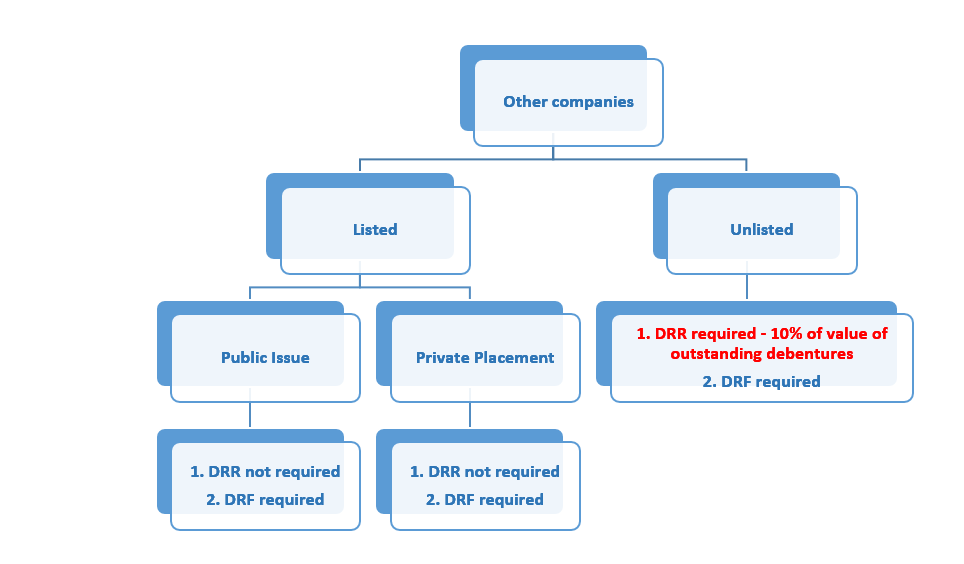
The amended provisions has exempted NBFCs registered with RBI and HFCs registered with National Housing Bank from creation of DRR in case of public issue of debentures. Further, the requirement of listed companies to create DRR has been done away with. The amended Rules have also lowered down the quantum of funds to be transferred to DRR by unlisted companies. However, as a flipside to the exemptions granted, the MCA has knowingly or unknowingly, unsettled an otherwise settled matter on creation of debenture redemption fund as per Rule 18(7).
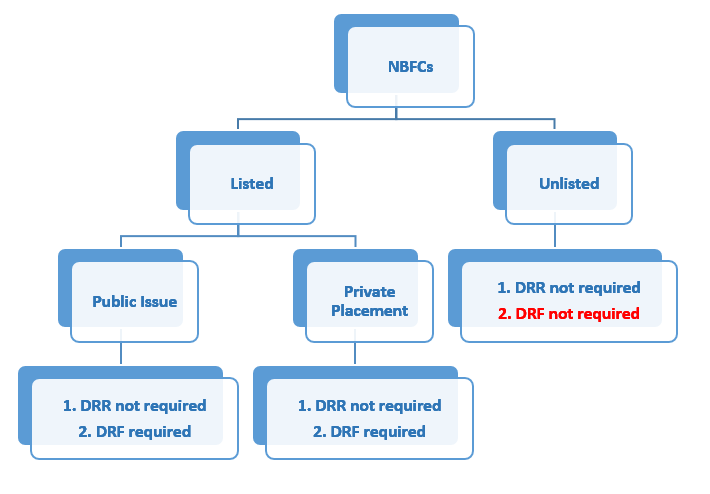
Under the erstwhile provisions required creation of debenture redemption fund only by those companies on which DRR was applicable. However, under the current set of rules, the requirement to create DRF will apply to all listed companies, other than AIFIs or other FIs as per the clause of section 2(72). This new rule applies even to NBFCs.
It is pertinent to note that until now, NBFCs were required to create debenture redemption reserve only for publicly issued debt securities. However, under the new rule, all listed NBFCs will have to create a DRF even in case of private placement of debentures. This change in the rules seems to be contradicting the intention of proposal in the Union Budget.
The intention of the proposal was to promote NBFCs to explore Bond markets more often for fund raising, however, the language of the new rule has jeopardised the existing cases of debenture issuances, let alone be new debenture issuances. Considering the ongoing liquidity crisis, the entire financial system is going through, the implications of this requirement could be severe.
Creation of DRR is somewhat a liberal requirement then creation of DRF, this is because, where the former is merely an accounting entry, the latter is investing of money out of the Company and the fact the new rule casts an exemption from the first and not from the second makes the situation a bit awkward. Therefore, where there is no requirement even for annually conserving a part of their profits, the requirement of creating a fund out of the same becomes completely illogical.
Hence, in our view, the amendments have actually slashed the expectation to relax issuance of debentures by NBFCs and on the other hand has also taken away the available exemption to the NBFCs for not creating DRF in case of issuance of debt securities through private placement. The actual intent of the amendment would have been to reduce the requirement of DRR from somewhat say 25% to 10%, however, in a completely unexpected move, the requirement for parking liquid funds, in form of a debenture redemption fund (DRF) has been extended to all bond issuers except unlisted NBFCs (which are hardly any in India), irrespective of whether they are covered by the requirement of DRR or not.
In this regard, the notification also fails to clarify the basic question that is whether the requirement will be applicable to debentures/bonds already issued, before the date of the notification or only after the date of notification. Though, the language suggest that the same shall be applicable on debentures due for redemption after the date of notification, i.e. for debentures maturing during the year ending on 31st March, 2020. However, in our view, one should try to create a DRF for the debentures maturing within 31st March, 2020 itself. Lastly needless to say, the MCA notification needs to be considered immediately.
A brief analysis of the amendments are discussed below:
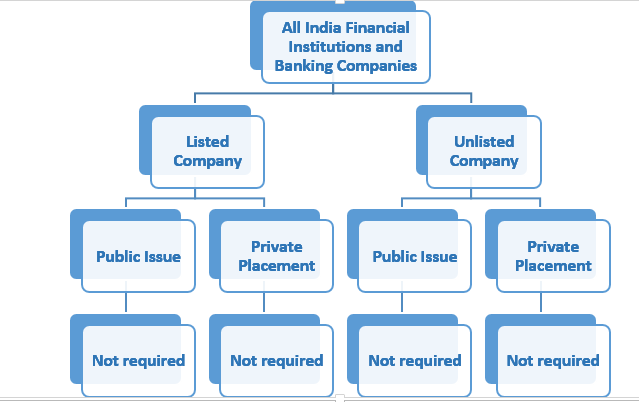
Applicability of DRR and Debenture Redemption Fund
a) All India Financial Institutions and Banking Companies
b) NBFCs registered with RBI under section 45-IA of RBI Act, 1934 and Housing Finance Companies registered with National Housing Bank
- Other companies
Synopsis of amendments in DRR provisions
| Sl. No. | Particulars | Type of Issuance | DRR as per erstwhile provisions | DRR as per amended provisions | DRF as per erstwhile provisions | DRF as per amended provisions |
| 1. | All India Financial Institutions | Public issue/private placement
|
× | × | × | × |
| 2. | Banking Companies | Public issue/private placement
|
× | × | × | × |
| 3.
|
Listed NBFCs registered with RBI under section 45-IA of the RBI Act, 1934 and HFC registered with National Housing Bank
|
Public issue | √
25% of value of outstanding debentures |
× | √ | √ |
| Private Placement
|
× | × | × | √ | ||
| 4. | Unlisted NBFCs registered with RBI under section 45-IA of the RBI Act, 1934 and HFC registered with National Housing Bank
|
Private Placement
|
× |
× |
× |
× |
| 5.
|
Other listed companies
|
Public Issue
|
√
25% of value of outstanding debentures
|
× | √ | √ |
| Private Placement
|
√
25% of value of outstanding debentures
|
× | √ | √ | ||
| 6. | Other unlisted companies | Private Placement | √
25% of value of outstanding debentures
|
√
10% of the value of outstanding debentures |
√ | √ |
Provisions updated as on 5th June, 2020 maybe viewed here
Government credit enhancement for NBFC pools: A Guide to Rating agencies
Vinod Kothari Consultants P Ltd (finserv@vinodkothari.com)
The partial credit enhancement (PCE) Scheme of the Government[1], for purchase by public sector banks (PSBs) of NBFC/HFC pools, has been discussed in our earlier write-ups, which can be viewed here and here.
This document briefly puts the potential approach of the rating agencies for rating of the pools for the purpose of qualifying for the Scheme.
Brief nature of the transaction:
- The transaction may be summarised as transfer of a pool to a PSB, wherein the NBFC retains a subordinated piece, such that the senior piece held by the PSB gets a AA rating. Thus, within the common pool of assets, there is a senior/junior structure, with the NBFC retaining the junior tranche.
- The transaction is a structured finance transaction, by way of credit-enhanced, bilateral assignment. It is quite similar to a securitisation transaction, minus the presence of SPVs or issuance of any “securities”.
- The NBFC will continue to be servicer, and will continue to charge servicing fees as agreed.
- The objective to reach a AA rating of the pool/portion of the pool that is sold to the PSB.
- Hence, the principles for sizing of credit enhancement, counterparty (servicer) risk, etc. should be the same as in case of securitisation.
- The coupon rate for the senior tranche may be mutually negotiated. Given the fact that after 2 years, the GoI guarantee will be removed, the parties may agree for a stepped-up rate if the pool continues after 2 years. Obviously, the extent of subordinated share held by the NBFC will have to be increased substantially, to provide increased comfort to the PSB. Excess spread, that is, the excess of actual interest earned over the servicing fees and the coupon may be released to the seller.
- The payout of the principal/interest to the two tranches (senior and junior), and utilisation of the excess spread, etc. may be worked out so as to meet the rating objective, provide for stepped-up level of enhancement, and yet maintain the economic viability of the transaction.
- Bankruptcy remoteness is easier in the present case, as pool is sold from the NBFC to the PSB, by way of a non-recourse transfer. Of course, there should be no retention of buyback option, etc., or other factors that vitiate a true sale.
- Technically, there is no need for a trustee. However, whether the parties need to keep a third party for ensuring surveillance over the transaction, in form of a monitoring agency, may be decided between the parties.
Brief characteristics of the Pool
- For any meaningful statistical analysis, the pool should be a homogenous pool.
- Surely, the pool is a static pool.
- The pool has attained seasoning, as the loans must have been originated by 31st March, 2019.
- In our view, pools having short maturities (say personal loans, short-term loans, etc.) will not be suitable for the transaction, since the guarantee and the guarantee fee are on annually declining basis.
Data requirement
The data required for the analysis will be same as data required for securitisation of a static pool.
Documentation
- Between the NBFC and the PSB, there will be standard assignment documentation.
- Between the Bank and the GoI:
- Declaration that requirements of Chapter 11 of the GFR have been satisfied.
- Guarantee documentation as per format given by GOI
[1] http://pib.gov.in/newsite/PrintRelease.aspx?relid=192618
Other Related Articles :
- Government Credit enhancement scheme for NBFC Pools: A win-win for all
- GOI’s attempt to ease out liquidity stress of NBFCs and HFCs: Ministry of Finance launches Scheme for Partial Credit Guarantee to PSBs for acquisition of financial assets
- Dissecting the gois partial credit guarantee scheme
- https://vinodkothari.com/2019/09/partial-credit-guarantee-scheme/
Government Credit enhancement scheme for NBFC Pools: A win-win for all
Vinod Kothari (vinod@vinodkothari.com)
The so-called partial credit enhancement (PCE) for purchase of NBFC/HFC pools by public sector banks (PSBs) may, if meaningfully implemented, be a win-win for all. The three primary players in the PCE scheme are NBFCs/HFCs (let us collectively called them Originators), the purchasing PSBs, and the Government of India (GoI). The Scheme has the potential to infuse liquidity into NBFCs while at the same time giving them advantage in terms of financing costs, allow PSBs to earn spreads while enjoying the benefit of sovereign guarantee, and allow the GoI to earn a spread of 25 bps virtually carrying no risks at all. This brief write-ups seeks to make this point.
The details of the Scheme with our elaborate questions and answers have been provided elsewhere.
Modus operandi
Broadly, the way we envisage the Scheme working is as follows:
- An Originator assimilates a pool of loans, and does tranching/credit enhancements to bring a senior tranche to a level of AA rating. Usually, tranching is associated with securitisation, but there is no reason why tranching cannot be done in case of bilateral transactions such as the one envisaged here. The most common form of tranching is subordination. Other structured finance devices such as turbo amortisation, sequential payment structure, provisions for redirecting the excess spread to pay off the principal on senior tranche, etc., may be deployed as required.
- Thus, say, on a pool of Rs 100 crores, the NBFC does so much subordination by way of a junior tranche as to bring the senior tranche to a AA level. The size of subordination may be worked, crudely, by X (usually 3 to 4) multiples of expected losses, or by a proper probability distribution model so as to bring the confidence level of the size of subordination being enough to absorb losses to acceptable AA probability of default. For instance, let us think of this level amounting to 8% (this percentage, needless to say, will depend on the expected losses of respective pools).
- Thus, the NBFC sells the pool of Rs 100 crores to PSB, retaining a subordinated 8% share in the same. Bankruptcy remoteness is achieved by true sale of the entire Rs 100 crore pool, with a subordinated share of 8% therein. In bilateral transactions, there is no need to use a trustee; to the extent of the Originator’s subordinated share, the PSB is deemed to be holding the assets in trust for the Originator. Simultaneously, the Originator also retains excess spread over the agreed Coupon Rate with the bank (as discussed below).
- Assuming that the fair value (computation of fair value will largely a no-brainer, as the PSB retains principal, and interest only to the extent of its agreed coupon, with the excess spread flowing back to the Originator) comes to the same as the participation of the PSB – 92% or Rs 92 crores, the PSB pays the same to the Originator.
- PSB now goes to the GoI and gets the purchase guaranteed by the latter. So, the GoI has guaranteed a purchase of Rs 92 crores, taking a first loss risk of 10% therein, that is, upto Rs 9.20 crores. Notably, for the pool as a whole, the GoI’s share of Rs 9.20 crores becomes a second loss position. However, considering that the GoI is guaranteeing the PSB, the support may technically be called first loss support, with the Originator-level support of Rs 10 crores being separate and independent.
- However, it is clear that the sharing of risks between the 3 – the Originator, the GoI and the Bank will be as follows:
- Losses upto first Rs 8 crores will be taken out of the NBFC’s first loss piece, thereby, implying no risk transfer at all.
- Losses in excess of Rs 8 crores, but upto a total of Rs 17.20 crores (the GoI guarantee is limited to Rs 9.20 crores), will be taken by GoI.
- It is only when the loss exceeds Rs 17.20 crores that there is a question of the PSB being hit by losses.
- Thus, during the period of the guarantee, the PSB is protected to the extent of 17.2%. Note that first loss piece at the Originator level has been sized up to attain a AA rating. That will mean, higher the risk of the pool, the first loss piece at Originator level will go up to protect the bank.
- The PSB, therefore, has dual protection – to the extent of AA rating, from the Originator (or a third party with/without the Originator, as we discuss below), and for the next 10%, from the sovereign.
- Now comes the critical question – what will be the coupon rates that the PSB may expect on the pool.
- The pool effectively has a sovereign protection. While the protection may seem partial, but it is a tranched protection, and for a AA-rated pool, a 10% thickness of first loss protection is actually far higher than required for the highest degree of safety. What makes the protection even stronger is that the size of the guarantee is fixed at the start of the transaction or start of the financial year, even though the pool continues to amortise, thereby increasing the effective thickness.
- Assume risk free rate is R, and the spreads for AAA rated ABS are R +100 bps. Assume that the spreads for AA-rated ABS is R+150 bps.
- Given the sovereign protection, the PSB should be able to price the transaction certainly at less than R +100 bps, because sovereign guarantee is certainly safer than AAA. In fact, it should effectively move close to R, but given the other pool risks (prepayment risks, irregular cashflows), one may expect pricing above R.
- For the NBFC, the actual cost is the coupon expected by the PSB, plus 25bps paid for the guarantee.
- So as long as the coupon rate of the pool for the NBFC is lower than R+75 bps, it is an advantage over a AAA ABS placement. It is to be noted that the NBFC is actually exposing regulatory and economic capital only for the upto-AA risk that it holds.
Win-win for all
If the structure works as above, it is a win-win for all:
- For the GoI, it is a neat income of 25 bps while virtually taking no real risks. There are 2 strong reasons for this – first, there is a first loss protection by the Originator, to qualify the pool for a AA rating. Secondly, the guarantee is limited only for 2 years. For any pool, first of all, the probability of losses breaching a AA-barrier itself will be close to 1% (meaning, 99% of the cases, the credit support at AA level will be sufficient). This becomes even more emphatic, if we consider the fact that the guarantee will be removed after 2 years. The losses may pile up above the Originator’s protection, but very unlikely that this will happen over 2 years.
- For the PSB, while getting the benefit of a sovereign guarantee, and therefore, effectively, investing in something which is better than AAA, the PSB may target a spread close to AAA.
- For the NBFC, it is getting a net advantage in terms of funding cost. Even if the pricing moves close to AAA ABS spreads, the NBFC stands to gain as the regulatory capital eaten up is only what is required for a AA-support.
The overall benefits for the system are immense. There is release of liquidity from the banking system to the economy. Depending on the type of pools Originators will be selling, there may be asset creation in form of home loans, or working capital loans (LAP loans may effectively be that), or loans for transport vehicles. If the GoI objective of buying pools upto Rs 100000 crores gets materialised, as much funding moves from banks to NBFCs, which is obviously already deployed in form of assets. The GoI makes an income of Rs 250 crores for effectively no risk.
In fact, if the GoI gains experience with the Scheme, there may be very good reason for lowering the rating threshold to A level, particularly in case of home loans.
Capital treatment, rating methodologies and other preparations
To make the Scheme really achieve its objectives, there are several preparations that may have to come soon enough:
- Rating agencies have to develop methodologies for rating this bilateral pool transfer. Effectively, this is nothing but a structured pool transfer, akin to securitisation. Hence, rating methodologies used for securitisation may either be applied as they are, or tweaked to apply to the transfers under the Scheme.
- Very importantly, the RBI may have to clarify that the AA risk retention by Originators under the Scheme will lead to regulatory capital requirement only upto the risk retained by the NBFC. This should be quite easy for the RBI to do – because there are guidelines for securitisation already, and the Scheme has all features of securitisation, minus the fact that there is no SPV or issuance of “securities” as such.
Conclusion
Whoever takes the first transaction to market will have to obviously do a lot of educating – PSBs, rating agencies, law firms, SIDBI, and of course, DFS. However, the exercise is worth it, and it may not take 6 months as envisaged for the GoI to reach the target of Rs 1 lakh crores.
Other related articles:
Commencement of certain sections under Companies (Amendment) Act, 2019
-Phase II
by Smriti Wadehra (smriti@vinodkothari.com)
The Companies (Amendment) Bill, 2019 was introduced on 25th July, 2019 which received President’s assent on 31st July, 2019 and became the Companies (Amendment) Act, 2019. The Companies (Amendment) Act, 2019 is a combination of Companies (Amendment) Ordinance, 2019 introduced on 21st February, 2019 and 9 out of 20 proposed changes which were proposed by the Ministry on 5th November, 2018. There were two additional amendments which were not covered by the Ordinance and proposed changes.
The Companies (Amendment) Act, 2019 notified 43 sections out of which 31 sections were effective from 2nd November, 2018. Other sections were to be notified by the Ministry by way of separate commencement notification. Accordingly, the Ministry on 14th of August, 2019 further notified 10 section to be effective from the date of notification. A brief synopsis of the amendments are provided below:
| Section No. of Companies (Amendment) Act, 2019 | Section No. of Companies Act, 2013 | Particulars | Amendment | Impact / Rermarks | Actionable for companies |
| 6 | 26 | Matters to be stated in prospectus | 1. Substitution of word “registration” with “filing” in sub-section (4), (5) and (6)
2. Omission of Registrar’s power to not register a prospectus for non-fulfilment of requirements of section 26
|
Seems to be a change in the terminology. | – |
| 7 | 29 | Public offer of securities to be in dematerialised form | 1. Omission of word “public” in sub-section(1)(b)
2. Insertion of new clause to provide such class or classes of unlisted companies as may be prescribed, the securities shall be held or transferred only in dematerialised form in the manner laid down in the Depositories Act, 1996 and the regulations made thereunder |
Pursuant to the amendment, all companies falling under such class of companies as may be prescribed has to mandatorily issue securities only in demat form.
In the absence of the Rules, this change seems to include private companies, small companies and OPC as well. However, the new clause comes with a proviso that states that the Ministry will come out with revised Rules prescribing thresholds for companies (which may include private companies) which requires issuance compulsorily in dematerialized form.
Further, there remain certain other grey areas which shall be clear only once the revised Rules in this regard are out. These include: · whether this requirement will be made applicable only for new issues of capital by companies; or · Will require all existing shares also to be dematerialised.
|
However, whether the same will be applicable to companies having prescribed thresholds which may include private companies, small companies, section 8 companies, OPCs etc.
The actionables can be determined only once the Rules are in place.
|
| 8 | 35 | Civil liability for mis-statements in prospectus
|
To give effect to the amendment introduced in section 26, the term registration has been substituted with filing in this section also.
|
Mere linking of amendment in different sections. | – |
| 14- clause (i), (iii) and (iv) | 90(4A), (9A) and (11) | Register of significant beneficial owners in a company | 1. Every company has to take necessary steps to identify an individual who is a significant beneficial owner in relation to the company and require him to comply with the provisions of this section
2. Government to come out with Rules in this regard
|
The existing provisions casted an obligation on the SBO to come and declare to the reporting company, however, the amendment indicates that nin addition to sending BEN-4 notices to the shareholders, the reporting company may also be required to go out on an investigation spree even in cases where it does not have a reason to believe about the presence of an SBO.
Further, the amendment also indicates that the SBO Rules shall be revised in this regard which is expected to provide the clarity on the actionables. |
SBO determination is a collaborative exercise which the Company and SBO has to ensure.
Accordingly, as a result of this change, companies may need to send letters, notices and any other type of correspondence in addition to those cases where it was obligated to send notices to entities holding more than 10% shareholding in the Company.
In any event, the medium and extent of this new exercise will be clear once the MCA comes out with revised rules in this regard. Also, considering the commencement of the said amendment has been made effective from 14th August, 2019, surely the same is to be used by the companies for identification of subsequent SBO, if any, which are identified, as the first round of identification has already been done.
However, what necessary steps are to be taken by the Company for identification of SBO requires clarity.
|
| 20 | 132 | Constitution of National Financial Reporting Authority | 1. NFRA to perform its functions through such divisions as may be prescribed;
2. Each division of the National Financial Reporting Authority shall be presided over by the Chairperson or a full-time Member authorised by the Chairperson;
3. There shall be an executive body of the National Financial Reporting Authority consisting of the Chairperson and full-time Members of such Authority for efficient discharge of its functions as specified in the section;
4. NFRA may debar a member or firm: I. being appointed as an auditor or internal auditor or undertaking any audit in respect of financial statements or internal audit of the functions and activities of any company or body corporate; or II. performing any valuation as provided under section 247, for a minimum period of 6 months or such higher period not exceeding 10 years as may be determined by the Authority
|
Amendment notifies constitution of NFRA | – |
| 31 | 212 | Investigation into affairs of Company by SFIO | Pursuant to investigation report of SFIO, if fraud is reported, the Government may make an application to NCLT for disgorgement of profits/assets. Further, there will be unlimited personal liability on officers/person/entity benefitted
|
The amendment proposes disgorgement of properties of officers in default in case of corporate frauds. | – |
| 33 | 241 | Application to Tribunal for relief in cases of oppression, etc.
|
1. Application for oppression has to be made before the Principal Bench of Tribunal by certain class of companies to be prescribed by Ministry;
2. New sub-section (3) has been inserted which provides that where Central Govt is of the opinion that there exists: a) Fraud, misfeasance, negligence or default in management or breach of trust; or b) Business is not being conducted as per business principles c) Company is being managed by person who is likely to cause serious injury or damage to the business d) Business is being carried out with the intent to defraud creditors, members or any other person or prejudicial to public interest The Government may initiate a case against such person and refer the same to the Tribunal and inquire into the case to record a decision as to whether or not such person is a fit and proper person to hold the office of director or any other office connected with the conduct and management of any company.
|
The law was silent of the fact that what does “matters prejudicial to public interest” with regard to section 242(2) means. The amendment list down matters where Central Government may make application against the Company to Tribunal for conducting business prejudicial to the interest of the Company.
The erstwhile provisions of section 398(1)(b) of the 1956 Act it was enough to establish that there was a likelihood of affairs being conducted in a prejudicial manner to the interest of Company. However, the amended provisions of Act clearly lays down situatiobs where interest of the Company can be prejudicial affected. |
– |
| 34 | 242 | Powers of Tribunal
|
Pursuant to the application made to Tribunal in sub-section 241(3), the Tribunal shall record its decision stating therein specifically as to whether or not the respondent is a fit and proper person to hold the office of director or any other office connected with the conduct and management of any company
|
Tribunal on application being made by Central Government determine whether oppression/mismanagement is being conducted in the Company and record reasons whether an officer is fit and proper for managing the Company. | – |
| 35 | 243 | Consequence of termination or modification of certain agreements
|
The person who is not a fit and proper person pursuant to sub-section (4A) of section 242 shall not hold the office of a director or any other office connected with the conduct and management of the affairs of any company for a period of 5 years from the date of the said decision. Further shall not be entitled to any compensation for loss of office.
However, CG may, with the leave of the Tribunal, permit such person to hold any such office before the expiry of the said period of five years. |
Explicit prohibition on officers in default from holding similar office for a period of 5 years. | – |
| 37 | 272 | Petition for winding up
|
The amendment omits reference of clause (e) of section 271(1) from sub-section (3) of section 272.
|
The Registrar shall be entitled to present a petition for winding up under section 271, except on the grounds specified in clause (a) which provides that the Company must have resolved by way of a SR that the Company would be wound up by the Tribunal.
Reference of clause providing that Tribunal may file a petition under 272 if it is of the opinion that it is just and equitable that company should be wound up has been done away with.
|
– |
| 38 | 398 | Provisions relating to filing of applications, documents, inspection etc in electronic form.
|
The term “prospectus” has been omitted from clause (f) of sub-section (1) which provides for registration of prospectus by Registrar. | Seems to be a change in the terminology. | – |
Our other articles of interest can be read here –
GOI’s attempt to ease out liquidity stress of NBFCs and HFCs: Ministry of Finance launches Scheme for Partial Credit Guarantee to PSBs for acquisition of financial assets
Abhirup Ghosh (abhirup@vinodkothari.com)
The Finance Minister, during the Union Budget 2019-20, promised to introduce a partial credit guarantee scheme so as to extend relief to the NBFC during the on-going liquidity crisis. The proposal laid down in the budget was a very broad statement and were subject to several speculations. At last on 13th August, 2019[1], the Ministry of Finance came out with a press release to announce the notification in this regard dated 10th August, 2019, laying down specifics of the scheme.
The scheme will be known by “Partial Credit Guarantee offered by Government of India (GoI) to Public Sector Banks (PSBs) for purchasing high-rated pooled assets from financially sound Non-Banking Financial Companies (NBFCs)/Housing Finance Companies (HFCs)”, however, for the purpose of this write-up we will use the word “Scheme” for reference.
The Scheme is intended to address temporary asset liability mismatch of solvent HFCs/ NBFCs, owing to the ongoing liquidity crisis in the non-banking financial sector, without having to resort to distress sale of their assets.
In this regard, we intend to discuss the various requirements under the Scheme and analyse its probable impact on the financial sector.
Applicability:
The Scheme has been notified with effect from 10th August, 2019 and will remain open for 6 months from or until the period by which the maximum commitment by the Government in the Scheme is fulfilled, whichever is earlier.
Under the Scheme, the Government has promised to extend first loss guarantee for purchase of assets by PSBs aggregating to ₹ 1 lakh crore. The Government will provide first loss guarantee of 10% of the assets purchased by the purchasing bank.
The Scheme is applicable for assignment of assets in the course of direct assignment to PSBs only. It is not applicable on securitisation transactions.
Also, as we know that in case of direct assignment transactions, the originators are required to retain a certain portion of the asset for the purpose of minimum retention requirement; this Scheme however, applies only to the purchasing bank’s share of assets and not on the originators retained portion. Therefore, if due to default, the originator incurs any losses, the same will not be compensated by virtue of this scheme.
Eligible sellers:
The Scheme lays down criteria to check the eligibility of sellers to avail benefits under this Scheme, and the same are follows:
- NBFCs registered with the RBI, except Micro Financial Institutions or Core Investment Companies.
- HFCs registered with the NHB.
- The NBFC/ HFC must have been able to maintain the minimum regulatory capital as on 31st March, 2019, that is –
- For NBFCs – 15%
- For HFCs – 12%
- The net NPA of the NBFC/HFC must not have exceeded 6% as on 31st March, 2019
- The NBFC/ HFC must have reported net profit in at least one out of the last two preceding financial years, that is, FY 2017-18 and FY 2018-19.
- The NBFC/ HFC must not have been reported as a Special Mention Account (SMA) by any bank during year prior to 1st August, 2018.
Some observations on the eligibility criteria are:
- Asset size of NBFCs for availing benefits under the Scheme: The Scheme does not provide for any asset size requirement for an NBFC to be qualified for this Scheme, however, one of the requirement is that the financial institution must have maintained the minimum regulatory capital requirement as on 31st March, 2019. Here it is important to note that requirement to maintain regulatory capital, that is capital risk adequacy ratio (CRAR), applies only to systemically important NBFCs.
Only those NBFCs whose asset size exceeds Rs. 500 crores singly or jointly with assets of other NBFCs in the group are treated as systemically important NBFCs. Therefore, it is safe to assume that the benefits under this Scheme can be availed only by those NBFCs which – a) are required to maintained CRAR, and b) have maintained the required amount of capital as on 31st March, 2019, subject to the fulfilment of other conditions.
- Financial health of originator after 1st August, 2018 – The eligibility criteria for sellers state that the financial institution must not have been reported as SMA by any bank any time during 1 year prior to 1st August, 2018, the apparent question that arises here is what happens if the originator moves into SMA status after the said date. If we go by the letters of the Scheme, if a financial institution satisfies the condition before 1st August, 2018 but becomes SMA thereafter, it will still be eligible as per the Scheme. This makes the situation a little awkward as the whole intention of the Scheme was to facilitate financially sound financial institutions. This seems to be an error on the part of the Government, and it surely must not have meant to situations such as the one discussed above. We can hopefully expect an amendment in this regard from the Government.
Eligible assets
Pool of assets satisfying the following conditions can be assigned under the Scheme:
- The asset must have been originated on or before 31st March, 2019.
- The asset must be classified as standard in the books of the NBFC/ HFC as on the date of the sale.
- The pool of assets should have a minimum rating of “AA” or equivalent at fair value without the credit guarantee from the Government.
- Each account under the pooled assets should have been fully disbursed and security charge should have been created in favour of the originating NBFCs/ HFCs.
- NBFCs/HFCs can sell up to a maximum of 20% of their standard assets as on 31.3.2019 subject to a cap of Rs. 5,000 crore at fair value. Any additional amount above the cap of Rs. 5,000 crore will be considered on pro ratabasis, subject to availability of headroom.
- The individual asset size in the pool must not exceed Rs. 5 crore.
- The following types of loans are not eligible for assignment for the purposes of this Scheme:
- Revolving credit facilities;
- Assets purchased from other entities; and
- Assets with bullet repayment of both principal and interest
Our observations on the eligibility criteria are as follows:
- Rating of the pool: The Scheme states that the pools assigned should be highly rated, that is, should have ratings of AA or equivalent prior to the guarantee. Technically, pool of assets are not rated, it is the security which is rated based on the risks and rewards of the underlying pools. Therefore, it is to be seen how things will unfold. Also, desired rating in the present case is quite high; if an originator is able to secure such a high rating, it might not require the assistance under this Scheme in the first place. And, the fact that the originators will have to pay guarantee commission of 25 bps. Therefore, only where the originators are able to secure a significantly lower cost from the banks for a higher rating, that would also cover the commission paid, will this Scheme be viable; let alone be the challenges of achieving an AA rating of the pool.
- Cut-off date of loan origination to be 31st March, 2019: As per the RBI Guidelines on Securitisation and Direct Assignment, the originators have to comply with minimum holding requirements. The said requirement suggests that an asset can be sold off only if it has remained in the books of the originator for at least 6 months. This Scheme has come into force with effect from 10th August, 2019 and will remain open for 6 months from the commencement.
Considering that already 5 months since the cut-off date has already passed, even if we were to assume that the loan is originated on the cut-off date itself, it would mean that closer to the end of the tenure of the Scheme, the loan will be 11 months seasoning. Such high seasoning requirements might not be motivational enough for the originators to avail this Scheme.
- Maximum cap on sell down of receivables: The Scheme has put a maximum cap on the amount of assets that can be assigned and that is an amount equal to 20% of the outstanding standard assets as on 31st March, 2019, however, the same is capped to Rs. 5000 crores.
It is pertinent to note that the Scheme also allows additional sell down of loans by the originators, beyond the maximum cap, however, the same shall depend on the available headroom and based on decisions of the Government.
Invocation of guarantee and guarantee commission
Guarantee commission
As already stated earlier, in order to avail benefits under this Scheme, the originator will have to incur a fee of 25 basis points on the amount guaranteed by the Government. However, the payment of the same shall have to be routed through the purchasing bank.
Invocation of guarantee
The guarantee can be invoked any time during the first 24 months from the date of assignment, if the interest/ principal has remained overdue for a period of more than 90 days.
Consequent upon a default, the purchasing bank can invoke the guarantee and recover its entire exposure from the Government. It can continue to recover its losses from the Government, until the upper cap of 10% of the total portfolio is reached. However, the purchasing bank will not be able to recover the losses if – (a) the pooled assets are bought back by the concerned NBFCs/HFCs or (b) sold by the purchasing bank to other entities.
The claims of the purchasing bank will be settled with 5 working days from the date of claim by the Government.
However, if the purchasing bank, by any means, recovers the amount subsequent to the invocation of the guarantee, it will have to refund the amount recovered or the amount received against the guarantee to the Government within 5 working days from the date of recovery. Where the amount recovered is more than amount of received as guarantee, the excess collection will be retained by the purchasing bank.
Other features of the Scheme
- Reporting requirement – The Scheme provides for a real-time reporting mechanism for the purchasing banks to understand the remaining headroom for purchase of such pooled assets. The Department of Financial Services (DFS), Ministry of Finance would obtain the requisite information in a prescribed format from the PSBs and send a copy to the budget division of DEA, however, the manner and format of reporting has not been notified yet.
- Option to buy-back the loans – The Scheme allows the originator to retain an option to buy back its assets after a specified period of 12 months as a repurchase transaction, on a right of first refusal basis. This however, is contradictory to the RBI Guidelines on Direct Assignment, as the same does not allow any option to repurchase the pool in a DA transaction.
- To-do for the NBFCs/ HFCs – In order to avail the benefits under the Scheme, the following actionables have to be undertaken:
- The Asset Liability structure should restructured within three months to have positive ALM in each bucket for the first three months and on cumulative basis for the remaining period;
- At no time during the period for exercise of the option to buy back the assets, should the CRAR go below the regulatory minimum. The promoters shall have to ensure this by infusing equity, where required.
[1] http://pib.gov.in/newsite/PrintRelease.aspx?relid=192618
Other Related Articles:
Government Guarantee for NBFC Pool Purchases by Banks: Analysis, questions, and gaps
[Updated as on 12th December, 2019]
By Financial Services Division, finserv@vinodkothari.com
The Finance Minister, during the Union Budget 2019-20, proposed to introduce a partial credit guarantee scheme so as to extend relief to NBFCs during the on-going liquidity crisis. The proposal laid down in the budget was a very broad statement. On 13th August, 2019[1], the Ministry of Finance came out with a Press Release to announce the notification in this regard, dated 10th August, 2019, laying down specifics of the scheme.
The Scheme, however, did not sail through, as literally no transactions was conducted under the Scheme until November, 2019. Various stakeholders[1] represented to the MOF to remove the bottlenecks in the structure. Subsequently, on 11th December, 2019, the Union Cabinet approved amendments[2] to the Scheme (Amendments).
The scheme, known as “Partial Credit Guarantee offered by Government of India (GoI) to Public Sector Banks (PSBs) for purchasing high-rated pooled assets from financially sound Non-Banking Financial Companies (NBFCs)/Housing Finance Companies (HFCs)”, is referred to, for the purpose of this write, as “the Scheme”.
The Scheme is intended to address the temporary liquidity crunch faced by solvent HFCs/ NBFCs, so that such entities may refinance their assets without having to resort to either distress sale or defaults on account of asset-liability mismatches.
In this write-up we have tried to answer some obvious questions that could arise along with potential answers.
Scope of applicability
1.When does this scheme come into force?
The Scheme was originally introduced on 10th August, 2019 and has been put to effect immediately. The modifications in the Scheme were made applicable with effect from 11th December, 2019.
2. How long will this Scheme continue to be in force?
Originally, the Scheme was supposed to remain open for 6 months from the date of issuance of this Scheme or when the maximum commitment of the Government, under this Scheme, is achieved, whichever is earlier. However, basis the Amendments discussed above, the Scheme will remain open till 20th June, 2020 or till such date when the maximum commitment under the Scheme is achieved, whichever is earlier. The Amendments however, bestows upon the Finance Minister to extend the tenure by upto 3 months.
This signifies that the parties must complete the assignment and execution of necessary documents for the guarantee (see below) within the stipulated time period.
3. Who is the beneficiary of the guarantee under the Scheme – the bank or the NBFC?
The bank is the beneficiary. The NBFC is not a party to the transaction of guarantee.
4. Does a bank buying pools from NBFCs/HFCs (Financial Entities) automatically get covered under the Scheme?
No. Since a bank/ Financial Entities may not want to avail of the benefit of the Scheme, the Parties will have to opt for the benefit of the guarantee. The bank will have to enter into specific documentation, following the procedure discussed below.
5. What does the Bank have to do to get covered by the benefit of guarantee under the Scheme?
The procedural aspects of the guarantee under the Scheme are discussed below.
6. Is the guarantee specifically to be sought for each of the pools acquired by the Bank or is it going to be an umbrella coverage for all the eligible pools acquired by the Bank?
The operational mechanism requires that there will be separate documentation every time the bank wants to acquire a pool from a financial entity in accordance with the Scheme. There is no process of master documentation, with simply a confirmation being attached for multiple transactions.
7. How does this Scheme rank/compare with other schemes whereby banks may participate into originations done by NBFCs/HFCs?
The RBI has lately taken various initiatives to promote participation by banks in the originations done by NBFCs/ HFCs. The following are the available ways of participation:
- Direct assignments
- Co-lending
- Loans for on-lending
- Securitisation
Direct assignments and securitisation have been there in the market since 2012, however, recently, once the liquidity crisis came into surface, the RBI relaxed the minimum holding period norms in order to promote the products.
Co-lending is also an alternative product for the co-origination by banks and NBFCs. In 2018, the RBI also released the guidelines on co-origination of priority sector loans by banks and NBFCs. The guidelines provide for the modalities of such originations and also provide on risk sharing, pricing etc. The difficulty in case of co-origination is that the turnaround time and the flexibility that the NBFCs claimed, which was one of their primary reasons for a competitive edge, get compromised.
The third product, that is, loans for on-lending for a specific purpose, has been in existence for long. However, recent efforts of RBI to allow loans for on-lending for PSL assets have increased the scope of this product.
This Scheme, though, is meant to boost specific direct assignment transactions, but is unique in its own way. This Scheme deviates from various principles from the DA guidelines and is, accordingly, intended to be an independent scheme by itself.
The basic use of the Scheme is to be able to conduct assignment of pools, without having to get into the complexity of involving special purpose vehicles, setting enhancement levels only so as to reach the desired ratings as per the Scheme. The effective cost of the Financial Entities doing assignments under the Scheme will be (a) the return expected by the Bank for a GoI-guaranteed pool; plus (b) 25 bps. If this effectively works cheaper than opting for a similar rated pool on standalone basis, the Scheme may be economically effective.
A major immediate benefit of the Scheme may be to nudge PSBs to start buying NBFC pools. While the guarantee is effective only for 2 years that does not mean, after 2 years, the PSBs will either sell or sell-back the pools. Therefore, in ultimate analysis, PSBs will get comfortable with buying NBFC pools on direct assignment basis.
The Scheme may go to encourage loan pool transfers outside the existing DA discipline.
8. Is the Scheme an alternative to direct assignment covered by Part B of the 2012 Guidelines, or is it by itself an independent option?
While intuitively one would have thought that the Scheme is a just a method of risk mitigation/facilitation of the DA transactions which commonly happen between banks and Financial Entities, there are several reasons based on which it appears that this Scheme should be construed as an independent option to banks/ Financial Entities:
- This Scheme is limited to acquisition of pools by PSBs only whereas direct assignment is not limited to either PSBs or banks.
- This Scheme envisages that the pool sold to the banks has attained a BBB+ rating at the least. As discussed below, that is not possible without a pool-level credit enhancement. In case of direct assignments, credit enhancement is not permissible.
- Investments in direct assignment are to be done by the acquirer based on the acquirer’s own credit evaluation. In case of the Scheme, the acquisition is obviously based on the guarantee given by the GoI.
- There is no question of an agreement or option to acquire the pool back after its transfer by the originator. The Scheme talks about the right of first refusal by the NBFC if the purchasing bank decides to further sell down the assets at any point of time.
Therefore, it should be construed that the Scheme is completed carved out from the DA Guidelines, and is an alternative to DA or securitisation. The issue was clarified by the Reserve Bank of India vide its FAQs on the issue[3].
9. Is this Scheme applicable to Securitisation transactions as well?
Assignment of pool of assets can be happen in case of both direct assignment as well as securitisation transaction. However, the intention of the present scheme is to provide credit enhancements to direct assignment transactions only. The Scheme does not intend to apply to securitisation transactions; however, the credit enhancement methodology to be deployed to make the Scheme work may involve several structured finance principles akin to securitisation.
Risk transfer
10. The essence of a guarantee is risk transfer. So how exactly is the process of risk transfer happening in the present case?
The risk is originated at the time of loan origination by the Financial Entities. The risk is integrated into a pool. Since the transaction is presumably a direct assignment (see discussion below), the risk transfer from the NBFC to the bank may happen either based on a pari passu risk sharing, or based on a tranched risk transfer.
The question of a pari passu risk transfer will arise only if the pool itself, without any credit enhancement, can be rated BBB+. Again, there could be a requirement of a certain level of credit enhancements as well, say through over-collateralisation or subordination.
Based on whether the share of the bank is pari passu or senior, there may be a risk transfer to the bank. Once there is a risk transfer on account of a default to the bank, the bank now transfers the risk on a first-loss basis to the GoI within the pool-based limit of 10%.
11. What is the maximum amount of exposure, the Government of India is willing to take through this Scheme?
Under this Scheme, the Government has agreed to provide 10% first loss guarantee to assets, amounting to total of ₹ 1 lakh crore. Here it is important to note that the limit of ₹ 1 lakh crore refers to the total amount of assets against which guarantee will be extended and not the total amount of guarantee. The maximum exposure that the Government will take under the Scheme is ₹ 10,000 crores (10% of ₹ 1 lakh crore). Both the amounts, Rs 1 lakh crore, as also Rs 10,000 crores, are the aggregate for the banking system as a whole.
12. What does 10% first loss guarantee signify?
Let us first understand the meaning for first loss guarantee. As the name suggests, the guarantor promises to replenish the first losses of the financier upto a certain level. Therefore, a 10% first loss guarantee would signify that any loss upto 10% of the total exposure of the acquirer in a particular pool will be compensated by the guarantor.
Say for example, if the size of pool originated by NBFC N is Rs. 1000 crores, consisting of 1000 borrowers of Rs. 1 crore each. Assume further that each of the loans in the pool are such that if a default occurs, the crystallised loss is 100% (that is, there is nil recovery estimated at the time of recognising the loan as a bad loan). We are also assuming that the loans in the pool are at least BBB+ rated; therefore, the pool gets a BBB+ rating.
Let us say this pool is sold by N to bank B. N retains a 10% pari passu share of the pool – thereby, the amount of the assets transferred to the B is Rs 900 crores. Assume that the fair value is also Rs 900 crores – that means, B buys the pool at par by paying Rs 900 crores. Assume B gets the acquisition guaranteed under the Scheme.
After its acquisition by B, assume a loan goes bad (see discussion below), and therefore, N allocates a loss of Rs 90 lacs (assuming there is pari passu sharing of losses) to B. B will claim this money by way of a guarantee compensation from GoI. B will keep getting such indemnification from GoI until the total amount paid by GoI reaches Rs. 90 crores (10% of the guaranteed amount). This, based on our hypothetical assumption of each loan having the same size, will mean loss of 100 loans out of the 1000 loans in the pool.
On the other hand, if it was to be understood that the pool will have to be first credit enhanced at the level of N, to attain a credit rating of BBB+, then N itself may have to provide a first-loss support at the transaction level. This may be, say, by providing a subordination, such that the share of N in the transaction is subordinated, and not pari passu. In that case, the question of any risk transfer to B, and therefore, an indemnification by GoI, will arise only if the amount of losses on account of default exceed the level of first loss support provided by N.
13. When is a loan taken to have defaulted for the purpose of the Scheme?
Para D of the Scheme suggests that the loan will be taken as defaulted when the interest and/or principal is overdue by more than 90 days. It further goes to refer to crystallisation of liability on the underlying borrower. The meaning of “crystallisation of liability” is not at all clear, and is, regrettably, inappropriate. The word “crystallisation” is commonly used in context of floating charges, where the charge gets crystallised on account of default. It is also sometimes used in context of guarantees where the liability is said to crystallise on the guarantor following the debtor’s default. The word “underlying borrower” should obviously mean the borrower included in the pool of loans, who always had a crystallised liability. In context, however, this may mean declaration of an event of default, recall of the loan, and thereby, requiring the borrower to repay the entire defaulted loan.
14. On occurrence of “default” as above, will be the Bank be able to claim the entire outstanding from the underlying borrower, or the amount of defaulted interest/principal?
The general principle in such cases is that the liability of the guarantor should crystallise on declaration of an event of default on the underlying loan. Hence, the whole of the outstandings from the borrower should be claimed form the guarantor, so as to indemnify the bank fully. As regards subsequent recoveries from the borrower, see later.
15. Does the recognition of loss by the bank on a defaulted loan have anything to do with the excess spreads/interest on the other performing loans? That is to say, is the loss with respect to a defaulted loan to be computed on pool basis, or loan-by-loan basis?
A reading of para D would suggest that the claiming of compensation is on default of a loan. Hence, the compensation to be claimed by the bank is not to be computed on pool basis.
16. Can the guarantee be applicable to a revolving purchase of loans by the bank from the NBFC, that is, purchase of loans on a continuing basis?
No. The intent seems clearly to apply the Scheme only to a static pool.
17. If a bank buys several pools from the same NBFC, is the extent of first loss cover, that is, 10%, fungible across all pools?
No. The very meaning of a first loss cover is that the protection is limited to a single, static pool.
18. From the viewpoint of maximising the benefit of the guarantee, should a bank try and achieve maximum diversification in a pool, or keep the pool concentric?
The time-tested rule of tranching of risks in static pools is that in case of concentric, that is, correlated pools, the limit of first loss will be reached very soon. Hence, the benefit of the guarantee is maximised when the pool is diversified. This will mean both granularity of the pool, as also diversification by all the underlying risk variables – geography, industry or occupation type, type of property, etc.
19. Can or should the Scheme be deployed for buying a single loan, or a few corporate loans?
First, the reference to pools obviously means diversified pools. As regards pools consisting of a few corporate loans, as mentioned above, the first loss cover will get exhausted very soon. The principle of tranching is that as correlation/concentricity in a pool increases, the risk shifts from lower tranches to senior tranches. Hence, one must not target using the Scheme for concentric or correlated pools.
20. On what amount should the first loss guarantee be calculated – on the total pool size or the total amount of assets assigned?
While, as we discussed earlier, there is no applicability of the DA Guidelines in the present case, there needs to be a minimum skin in the game for the selling Financial Entity. Whether that skin in the game is by way of a pari passu vertical tranche, or a subordinated horizontal tranche, is a question of the rating required for attaining the benefit of the guarantee. Therefore, if we are considering a pool of say ₹ 1000 crores, the originator should retain at least ₹ 100 crores (applying a 10% rule – which, of course, will depend on the rating considerations) of the total assets in the pool and only to the extent the ₹ 900 crores can be assigned to the purchasing bank.
The question here is whether the first loss guarantee will be calculated on the entire ₹ 1000 crores or ₹ 900 crores. The intention is guarantee the purchasing banks’ share of cash flows and not that retained by the originator. Therefore, the first loss guarantee will be calculated on ₹ 900 crores in the present case.
Scope of the GoI Guarantee
21. Does the guarantee cover both principal and interest on the underlying loan?
The guarantee is supposed to indemnify the losses of the beneficiary, in this case, the bank. Hence, the guarantee should presumably cover both interest and principal.
22. Does the guarantee cove additional interest, penalties, etc.?
Going by Rule 277 (vi) of the GFR, the benefit of the guarantee will be limited to normal interest only. All other charges – additional interest, penal interest, etc., will not be covered by the guarantee.
23. How do the General Financial Rules of the Government of India affect/limit the scope of the guarantee?
Para 281 of the GFR provides for annual review of the guarantees extended by the Government. The concerned department, DFS in the present case, will conduct review of the guarantees extended and forward the report to the Budget Division. However, if the Government can take any actions based on the outcome of the review is unclear.
Bankruptcy remoteness
24. Does the transaction of assignment of pool from the Financial Entity to the bank have to adhere to any true sale/bankruptcy remoteness conditions?
The transaction must be a proper assignment, and should achieve bankruptcy remoteness in relation to the Financial Entity. Therefore, all regular true sale conditions should be satisfied.
25. Can a Financial Entity sell the pool to the bank with the understanding that after 2 years, that is, at the end of the guarantee period, the pool will be sold back to the NBFCs?
Any sale with either an obligation to buyback, or an option to buy back, generally conflicts with the true sale requirement. Therefore, the sale should be a sale without recourse. However, retention of a right of first refusal, or right of pre-emption, is not equivalent to option to buy back. For instance, if, after 2 years, the bank is desirous of selling the pool at its fair value, the NBFC may have the first right of buying the same. This is regarded as consistent with true sale conditions.
26. If off-balance sheet treatment from IFRS/Ind-AS viewpoint at all relevant for the purpose of this transaction?
No. Off balance sheet treatment is not relevant for bankruptcy remoteness.
Buyers and sellers
27. Who are eligible buyers under this Scheme?
As is evident from the title of the Scheme, only Public Sector Banks are eligible buyers of assets under this Scheme. Therefore, even if a Private Sector Bank acquires eligible assets from eligible sellers, guarantee under this Scheme will still not be available.
This may be keeping in view two points – first, the intent of the Scheme, that is, to nudge PSBs to buy pools from Financial Entities. It is a well-known fact that private sector banks are, as it is, actively engaged in buying pools. Secondly, in terms of GFR of the GoI, the benefit of Government guarantee cannot go to the private sector. [Rule 277 (vii)] Hence, the Scheme is restricted to PSBs only.
28. Who are eligible sellers under this Scheme?
The intention of the Scheme is to provide relief from the stress caused due to the ongoing liquidity crisis, to sound HFCs/ NBFCs who are otherwise financially stable. The Scheme has very clearly laid screening parameters to decide the eligibility of the seller The qualifying criteria laid down therein are:
- NBFCs registered with the RBI, except Micro Financial Institutions or Core Investment Companies.
- HFCs registered with the NHB.
- The NBFC/ HFC must have been able to maintain the minimum regulatory capital as on 31st March, 2019, that is –
- For NBFCs – 15%
- For HFCs – 12%
- The net NPA of the NBFC/HFC must not have exceeded 6% as on 31st March, 2019
- The NBFC/ HFC must have reported net profit in at least one out of the last two preceding financial years, that is, FY 2017-18 and FY 2018-19.
- The Original Scheme stated that the NBFC/ HFC must not have been reported as a Special Mention Account (SMA) by any bank during year prior to 1st August, 2018. However, the Amendment even allows NBFC/HFC which may have slipped during one year prior to 1st August, 2018 shall also be allowed to sell their portfolios under the Scheme.
29. Can NBFCs of any asset size avail this benefit?
Apparently, the Scheme does not provide for any asset size requirement for an NBFC to be qualified for this Scheme, however, one of the requirement is that the financial institution must have maintained the minimum regulatory capital requirement as on 31st March, 2019. Here it is important to note that requirement to maintain regulatory capital, that is capital risk adequacy ratio (CRAR), applies only to systemically important NBFCs.
Only those NBFCs whose asset size exceeds ₹ 500 crores singly or jointly with assets of other NBFCs in the group are treated as systemically important NBFCs. Therefore, it is safe to assume that the benefits under this Scheme can be availed only by those NBFCs which – a) are required to maintained CRAR, and b) have maintained the required amount of capital as on 31st March, 2019, subject to the fulfilment of other conditions.
30. The eligibility criteria for sellers state that the financial institution must not have been reported as SMA-1 or SMA-2 by any bank any time during 1 year prior to 1st August, 2018 – what does this signify?
As per the prudential norms for banks, an account has to be declared as SMA, if it shows signs of distress without slipping into the category of an NPA. The requirement states that the originator must not have been reported as an SMA-1 or SMA-2 any time during 1 year prior to 1st August, 2018, and nothing has been mentioned regarding the period thereafter.
Therefore, if a financial institution satisfies the condition before 1st August, 2018 but becomes SMA-1 or SMA-2 thereafter, it will still be eligible as per the Scheme. The whole intention of the Scheme is eliminate the liquidity squeeze due to the ILFS crisis. Therefore, if a financial institution turns SMA after the said date, it will be presumed the financial institution has fallen into a distressed situation as a fallout of the ILFS crisis.
Eligible assets
31. What are the eligible assets for the Scheme?
The Scheme has explicitly laid down qualifying criteria for eligible assets and they are:
- The asset must have been originated on or before 31st March, 2019.
- The asset must be classified as standard in the books of the NBFC/ HFC as on the date of the sale.
- The original Scheme stated that the pool of assets should have a minimum rating of “AA” or equivalent at fair value without the credit guarantee from the Government. However, through the Amendment, the rating requirement has been brought down to BBB+.
- Each account under the pooled assets should have been fully disbursed and security charge should have been created in favour of the originating NBFCs/ HFCs.
- The individual asset size in the pool must not exceed ₹ 5 crore.
- The following types of loans are not eligible for assignment for the purposes of this Scheme:
- Revolving credit facilities;
- Assets purchased from other entities; and
- Assets with bullet repayment of both principal and interest
Pools consisting of assets satisfying the above criteria qualify for the benefit of the guarantee. Hence, the pool may consist of retail loans, wholesale loans, corporate loans, loans against property, or any other loans, as long as the qualifying conditions above are satisfied.
32. Should the Scheme be deployed for assets for longer maturity or shorter maturity?
Utilising the Scheme for pools of lower weighted average maturity will result into very high costs – as the cost of the guarantee is computed on the original purchase price.
Using the Scheme for pools of longer maturity – for example, LAP loans or corporate loans, may be lucrative because the amortisation of the pool is slower. However, it is notable that the benefit of the guarantee is available only for 2 years. After 2 years, the bank will not have the protection of the Government’s guarantee.
33. If there are corporate loans in the pool, where there is payment of interest on regular basis, but the principal is paid by way of a bullet repayment, will such loans qualify for the benefit of the Scheme?
The reference to bullet repaying loans in the Scheme seems similar to those in DA guidelines. In our view, if there is evidence/track record of servicing, in form of interest, such that the principal comes by way of a bullet repayment (commonly called IO loans), the loan should still qualify for the Scheme. However, negatively amortising loans should not qualify.
34. Is there any implication of keeping the cut-off date for originations of loans to be 31st March, 2019?
As per the RBI Guidelines on Securitisation and Direct Assignment, the originators have to comply with minimum holding requirements. The said requirement suggests that an asset can be sold off only if it has remained in the books of the originator for at least 6 months. This Scheme has come into force with effect from 10th August, 2019 and will remain open till 30th June, 2020.
Already substantial amount of time has passed since the cut-off date, and even if we were to assume that the loan is originated on the cut-off date itself, it would mean that closer to the end of the tenure of the Scheme, the loan will be at least months seasoning as on the date of passing the Amendments. Such high seasoning requirements might not be motivational enough for the originators to avail this Scheme.
35. Is there is any maximum limit on the amount of loans that can be assigned under this Scheme?
Yes, the Scheme has put a maximum cap on the amount of assets that can be assigned and that is an amount equal to 20% of the outstanding standard assets as on 31st March, 2019, however, the same is capped to ₹ 5000 crores.
36. Is there a scope for assigning assets beyond the maximum limits prescribed in the Scheme?
Yes, the Scheme states that any additional amount above the cap of ₹ 5,000 crore will be considered on pro rata basis, subject to availability of headroom. However, from the language, it seems that there is a scope for sell down beyond the prescribed limit, only if the eligible maximum permissible limit gets capped to ₹ 5,000 crores and not if the maximum permissible limit is less than ₹ 5000 crores.
The following numerical examples will help us to understand this better:
| Total outstanding standard assets as on 31st March, 2019 | ₹ 20,000 crores | ₹ 25,000 crores | ₹ 30,000 crores |
| Maximum permissible limit @ 20% | ₹ 4,000 crores | ₹ 5,000 crores | ₹ 6,000 crores |
| Maximum cap for assignment under this Scheme | ₹ 5,000 crores | ₹ 5,000 crores | ₹ 5,000 crores |
| Amount that can be assigned under this Scheme | ₹ 4,000 crores | ₹ 5,000 crores | ₹ 5,000 crores |
| Scope for further sell down? | No | No | Yes, upto a maximum of ₹ 1,000 crores |
37. When will it be decided whether the Financial Entity can sell down receivables beyond the maximum cap?
Nothing has been mentioned regarding when and how will it be decided whether a financial institution can sell down receivables beyond the maximum cap, under this Scheme. However, logically, the decision should be taken by the Government of India of whether to allow further sell down and closer towards the end of the Scheme. However, we will have to wait and see how this unfolds practically.
38. What are the permissible terms of transfer under this Scheme?
The Scheme allows the assignment agreement to contain the following:
- Servicing rights – It allows the originator to retain the servicing function, including administrative function, in the transaction.
- Buy back right – It allows the originator to retain an option to buy back its assets after a specified period of 12 months as a repurchase transaction, on a right of first refusal basis. Actually, this is not a right to buy back, it is a right of first refusal which the NBFC/ HFC may exercise if the purchasing bank further sells down the assets. See elsewhere for detailed discussion
Rating of the Pool
39. The Scheme requires that the pool must have a rating of BBB+ before its transfer to the bank. Does that mean there be a formal rating agency opinion on the rating of the pool?
Yes. It will be logical to assume that SIDBI or DFS will expect a formal rating agency opinion before agreeing to extend the guarantee.
40. The Scheme requires the pool of assets to be rated at least BBB+, what does this signify?
As per the conditions for eligible assets, the pool of assets to be assigned under this Scheme must have a minimum rating of “BBB+” or equivalent at fair value prior to the guarantee from the Government.
There may be a question of expected loss assessment of a pool. Initially, the rating requirement was pegged at “AA” or higher and there was an apprehension that the originators might have to provide a substantial amount of credit enhancement in order to the make the assets eligible for assignment under the Scheme. Subsequently, vide the Amendments, the rating has been brought down to BBB+. The originators may also be required to provide some level of credit enhancements in order to achieve the BBB+ rating.
Unlike under the original Scheme, where the rating requirement was as high as AA, the intent is to provide guarantee only at AA level, then the thickness of the guarantee, that is, 10%, and the cost of the guarantee, viz., 25 bps, both became questionable. The thickness of support required for moving a AA rated pool to a AAA level mostly is not as high as 10%. Also, the cost of 25 bps for guaranteeing a AA-rated pool implied that the credit spreads between AA and a AAA-rated pool were at least good enough to absorb a cost of 25 bps. All these did not seemed and hence, there was not even a single transaction so far.
But now that the rating requirement has been brought down to BBB+, it makes a lot of sense. The credit enhancement level required to achieve BBB+ will be at least 4%-5% lower than what would have been required for AA pool. Further, the spread between a BBB+ and AAA rated pool would be sufficient to cover up the guarantee commission of 25 bps to be incurred by the seller in the transaction.
Here it is important to note that though the rating required is as low as BBB+, but there is nothing which stops the originator in providing a better quality pool. In fact, by providing a better quality pool, the originator will be able to fetch a much lower cost. Further, since, the guarantee on the pool will be available for only first two years of the transaction, the buyers will be more interested in acquiring higher quality pools, as there could be possibilities of default after the first two years, which is usually the case – the defaults increase towards the end of the tenure.
Risk weight and capital requirements
41. Can the bank, having got the Pool guaranteed by the GoI, treat the Pool has zero% risk weighted, or risk-weighted at par with sovereign risk weights?
No. for two reasons –one the guarantee is only partial and not full. Number two, the guarantee is only for losses upto first 2 years. So it is not that the credit exposure of the bank is fully guaranteed
42. What will be the risk weight once the guarantee is removed, after expiry of 2 years?
The risk weight should be based on the rating of the tranche/pool, say, BBB+ or better.
Guarantee commission
43. Is there a guarantee commission? If yes, who will bear the liability to pay the commission?
As already discussed in one of the questions above, the Scheme requires the originators to pay guarantee commission of 25 basis points on the amount of guarantee extended by the Government. Though the originator will pay the fee, but the same will be routed through purchasing bank.
44. The pool is amortising pool. Is the cost of 25 bps to be paid on the original purchase price?
From the operational details, it is clear that the cost of 25 bps is, in the first instance, payable on the original fair value, that is, the purchase price.
Invocation of guarantee and refund
45. When can the guarantee be invoked?
The guarantee can be invoked any time during the first 24 months from the date of assignment, if the interest/ principal has remained overdue for a period of more than 90 days.
46. Can the purchasing bank invoke the guarantee as and when the default occurs in each account?
Yes. The purchasing bank can invoke the guarantee as and when any instalment of interest/ principal/ both remains overdue for a period of more than 90 days.
47. To what extent can the purchasing bank recover its losses through invocation of guarantee?
When a loan goes bad, the purchasing bank can invoke the guarantee and recover its entire exposure from the Government. It can continue to recover its losses from the Government, until the upper cap of 10% of the total portfolio is reached. However, the purchasing bank will not be able to recover the losses if – (a) the pooled assets are bought back by the concerned NBFCs/HFCs or (b) sold by the purchasing bank to other entities.
48. Within how many days will the purchasing bank be able to recover its losses from the Government?
As stated in the Scheme, the claims will be settled within 5 working days.
49. What will happen if the purchasing bank recovers the amount lost, subsequent to the invocation of guarantee?
If the purchasing bank, by any means, recovers the amount subsequent to the invocation of the guarantee, it will have to refund the amount recovered or the amount received against the guarantee to the Government within 5 working days from the date of recovery. However, if the amount recovered is more than amount of received as guarantee, the excess collection will be retained by the purchasing bank.
Modus operandi
50. What will be the process for a bank to obtain the benefit of the guarantee?
While the Department of Financial Services (DFS) is made the administrative ministry for the purpose of the guarantee under the Scheme, the Scheme involves the role of SIDBI as the interface between the banks and the GoI. Therefore, any bank intending to avail of the guarantee has to approach SIDBI.
51. Can you elaborate on the various procedural steps to be taken to take the benefit of the guarantee?
The modus operandi of the Scheme is likely to be as follows:
- An NBFC approaches a bank with a static pool, which, based on credit enhancements, or otherwise, has already been uplifted to a rating of BBB+ or above level.
- The NBFC negotiates and finalises its commercials with the bank.
- The bank then approaches SIDBI with a proposal to obtain the guarantee of the GOI. At this stage, the bank provides (a) details of the transaction; and (b) a certificate that the requirements of Chapter 11 of General Financial Rules, and in particular, those of para 280, have been complied with.
- SIDBI does its own evaluation of the proposal, from the viewpoint of adherence to Chapter 11 of GFR and para 280 in particular, and whether the proposal is in compliance with the provisions of the Scheme. SIDBI shall accordingly forward the proposal to DFS along with a specific recommendation to either provide the guarantee, or otherwise.
- DFS shall then make its decision. Once the decision of DFS is made, it shall be communicated to SIDBI and PSB.
- At this stage, PSB may consummate its transaction with the NBFC, after collecting the guarantee fees of 25 bps.
- PSB shall then execute its guarantee documentation with DFS and pay the money by way of guarantee commission.
52. Para 280(i)(a) of the GFR states that there should be back-to-back agreements between the Government and Borrower to effect to the transaction – will this rule be applicable in case of this Scheme?
Para 280 has been drawn up based on the understanding that guarantee extended is for a loan where the borrower is known by the Government. In the present case, the guarantee is extended in order to partially support a sale of assets and not for a specific loan, therefore, this will not apply.
Miscellaneous
53. Is there any reporting requirement?
The Scheme does provide for a real-time reporting mechanism for the purchasing banks to understand the remaining headroom for purchase of such pooled assets. The Department of Financial Services (DFS), Ministry of Finance would obtain the requisite information in a prescribed format from the PSBs and send a copy to the budget division of DEA, however, the manner and format of reporting has not been notified yet.
54. What are to-do activities for the sellers to avail benefits under this Scheme?
Besides conforming to the eligibility criteria laid down in the Scheme, the sellers will also have to carry out the following in order to avail the benefits:
- The Asset Liability structure should restructured within three months to have positive ALM in each bucket for the first three months and on cumulative basis for the remaining period;
- At no time during the period for exercise of the option to buy back the assets, should the CRAR go below the regulatory minimum. The promoters shall have to ensure this by infusing equity, where required.
[1] http://pib.gov.in/newsite/PrintRelease.aspx?relid=192618
Other related articles-
- Government Credit enhancement scheme for NBFC Pools: A win-win for all
- GOI’s attempt to ease out liquidity stress of NBFCs and HFCs: Ministry of Finance launches Scheme for Partial Credit Guarantee to PSBs for acquisition of financial assets
- Government credit enhancement for NBFC pools: A Guide to Rating agencies
- https://vinodkothari.com/2019/09/partial-credit-guarantee-scheme/
[1] Including Indian Securitisation Foundation
