Posts

Demystifying Structured Debt Securities: Beyond Plain Vanilla Bonds

Palak Jaiswani, Manager | corplaw@vinodkothari.com

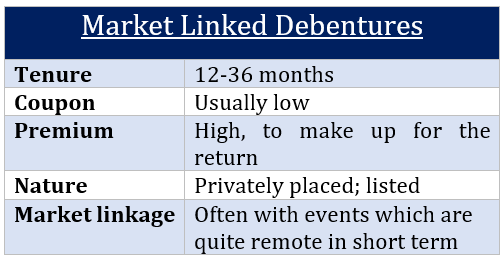
Debentures, one of the most common means for raising debt funding, where investors lend money to the issuer in return for periodic interest and repayment of principal at maturity. While the basic feature of any debenture is a fixed coupon rate and a defined tenure (commonly referred to as plain vanilla instruments), sometimes these instruments may be topped up with enhanced features such as additional credit support, market-linked returns, convertibility option, etc., thus referred to as structured debt securities.

Structured debt securities: motivation for issuers

Apart from the economic favouring such structural modifications, a primary motivation for the issuer in issuing such structured instruments might be the regulatory advantages that these securities offer. For instance,

  • Chapter VIII of SEBI NCS Master Circular provides an extra limit of 5 ISINs for structured debt securities & market-linked securities, thus more room for the issuers to issue debt securities, compared to the restriction of a maximum of 9 ISINs for plain vanilla debt.
  • In addition, as per NSE Guidelines on Electronic Book Provider (EBP) mechanism, market-linked debentures are not required to be routed through EBP, allowing issuers to place such instruments almost like an over-the-counter trade. This allows issuers to structure the debt securities on a tailored basis and offer them directly to specific investors.

Read more

Recent amendments relating to Corporate Bonds

– Vinita Nair, Aanchal Kaur Nagpal & Payal Agarwal | corplaw@vinodkothari.com

Loader Loading…
EAD Logo Taking too long?

Reload Reload document
| Open Open in new tab

Download as PDF [2.03 MB]

Read our related resources here :

  1. Debenture trustees’ nominees on Corporate Boards: FAQs
  2. SEBI Consultation Paper on NCS regulations: Changes in Offer Doc. | Mandatory Listing | Disclosure of Issue expense
  3. SEBIs Consultation Paper on review of CG norms for a High Value Debt Listed Entities
  4. SEBI to provide debenture holders the right to object material related party transactions

Recent amendments relating to Corporate Bonds

– Vinita Nair, Senior Parnter | corplaw@vinodkothari.com

Loader Loading…
EAD Logo Taking too long?

Reload Reload document
| Open Open in new tab

Download as PDF [1.64 MB]

Market-linked debentures: Is it the end of the market for them?

– Aanchal Kaur Nagpal, Manager | finserv@vinodkothari.com

Tax proposal to tax gains on MLDs as short-term capital gains

The Budget proposes that the capital gains on market linked debentures (MLDs) will be taxed as short term capital gain.

Presently, MLDs are mostly listed, and as listed securities they have 2 advantages:

  • First , there are exempt from withholding tax. This is one of the carve-outs in sec. 193
  • Secondly, the holding period for capital gain purposes is 12 months,  as opposed to 36 months in case of normal capital assets. This comes from sec. 2 (42A) of the Act. Therefore, if a listed security is held for at least 12 months, and transferred or redeemed thereafter, the gain will be taxed as long term capital gain, with a rate as low as 10%.

Market linked debentures is a concept that prevails world-over, with different names such as equity-linked bonds, index-linked bonds, etc. However, in India, the issuance of MLDs was being exploited as a regulatory and tax arbitrage device.

Read more

SEBI further caps limit for ISINs to reduce fragmentation and boost liquidity

– Lovish Jain, Executive | lovish@vinodkothari.com

Loader Loading…
EAD Logo Taking too long?

Reload Reload document
| Open Open in new tab

Download as PDF [78.62 KB]

Market Linked Debentures – Adding Flavour to Plain Vanilla Bonds

Loader Loading…
EAD Logo Taking too long?

Reload Reload document
| Open Open in new tab

Download as PDF [716.95 KB]