Diversity in the Boardroom, specifically gender diversity is in the limelight owing to the general awareness for breaking gender stereotypes and adopting a gender neutral board structure. While the Companies Act, 2013 and SEBI LODR Regulations have already taken their first steps towards implementing the same, considering the progress in global perspective, India still has a long way to go in increasing women participation in corporate boards . This article discusses the concept of Board diversity, specifically gender diversity, and the ways in which Indian corporate laws could take their next step in achieving a gender-diversified Board.
https://vinodkothari.com/wp-content/uploads/2023/06/vinod-kothari-logo.png00mahakagarwalhttps://vinodkothari.com/wp-content/uploads/2023/06/vinod-kothari-logo.pngmahakagarwal2023-08-21 11:25:542023-08-21 14:22:59Gender Diversity in the Boardroom
On August 18, 2023, the RBI came up with a circular on Reset of Floating Interest Rate on Equated Monthly Instalments (EMI) based Personal Loans (‘Circular)[1] casting certain obligations and disclosure requirements on Regulated Entities (REs) at the time of reset of floating interest rate on EMI based Personal loans. Accordingly, this Circular shall be adhered to by all applicable entities at the time of reset of floating interest rate on such loans.
We have developed a set of FAQs on the Circular, where we intend to answer some of the critical questions relating to the actionables by the REs at the time of reset of floating rate.
State Co-operative Banks and District Central Co-operative Banks
Non-Banking Financial Companies
Housing finance Companies
Which type of loans are covered by the Circular?
The Circular covers all EMI-based floating interest rate personal loans. Accordingly, business loans are not covered by the circular.
Further, if the loan carries a fixed rate of interest, it does not come under the Circular.
If the loan is not based on EMIs, that is, it is a bullet repayment loan, it does not seem to be covered by the Circular.
Further, the FAQ 1 of the RBI FAQs dated 10.01.2024 have clarified that the Circular is applicable only on EMI-based floating-rate personal loans.
Summarising the above, the table below states the applicability of the Circular on certain types of loans –
Covered by the Circular
Not covered by the Circular
Home loans at floating rate of interest
Home loan at fixed rate of interest
LAP to individuals other than for business purposes
LAP given to an individual/sole proprietor
Auto loans having rate variation clause
Auto loans not having rate variation clause
Student loans having rate variation clause, whether with or without moratorium
Fixed rate student loans
Loans against shares
Financial leases
A loan is based on EMIs, but is currently under a moratorium. Will it be covered by the Circular?
Yes, in our view. The EMIs are subjected to either variation, or the term may be modified based on interest rate changes. Hence, the Circular applies.
A loan is based on EMIs, but has a partial balloon repayment. Will it be covered by the Circular?
In our view, yes.
My company follows a different approach to interest rate variation. Neither do we increase the EMI, nor do we extend or contract the maturity based on interest rate changes. Instead, we add the impact of interest rate changes to a terminal amount, which either goes up or comes down based on interest rate changes. In a way, the last “unequal installment” reflects all interest rate changes during the period. Are we covered by the Circular?
In our view, yes. The burden or benefit of interest rate changes is being passed on. The applicability of the Circular is not dependent on the way the burden or interest is being passed on, instead it shall cover all floating interest rate personal loans. Hence, the Circular does apply in the present case.
What type of loans are covered under “personal loans”?
As clarified by FAQ 1 of the RBI FAQs dated 10.01.2024, for understanding the meaning of Personal loans reference shall be made to the RBI circular on XBRL Returns – Harmonization of Banking Statistics[2] which defines personal loans as-
“loans given to individuals and consist of (a) consumer credit, (b) education loan, (c) loans given for creation/ enhancement of immovable assets (e.g., housing, etc.), and (d) loans given for investment in financial assets (shares, debentures, etc.).”
Further, “Consumer Credit” has been again defined as-
“loans given to individuals, which consists of (a) loans for consumer durables, (b) credit card receivables, (c) auto loans (other than loans for commercial use), (d) personal loans secured by gold, gold jewellery, immovable property, fixed deposits (including FCNR(B)), shares and bonds, etc., (other than for business / commercial purposes), (e) personal loans to professionals (excluding loans for business purposes), and (f) loans given for other consumptions purposes (e.g., social ceremonies, etc.). However, it excludes (a) education loans, (b) loans given for creation/ enhancement of immovable assets (e.g., housing, etc.), (c) loans given for investment in financial assets (shares, debentures, etc.), and (d) consumption loans given to farmers under KCC. For risk weighting purposes under the Capital Adequacy Framework, the extant regulatory guidelines will be applicable.”
Does the Circular cover Loans Against Property?
There is no end use restriction in case of Loan Against Property or LAP. In case the same is extended to an individual it may or may not be for personal use. In such a case, if it is given to individuals for purposes other than business then it will be covered by the Circular.
However, in case it has been extended to non-individuals, such as SMEs or small businesses, it can be presumed that the primary use of the loan proceeds shall be for business purposes and therefore it will not be covered by the Circular.
Are we saying any lending to companies is outside the scope of the Circular?
Yes, in our view, the intent is to cover only personal loans to individuals- more specifically, EMI based floating rate personal loans. Since, it would be counter intuitive to say that the loan given to companies would be for personal use, the same may not be covered under the Circular.
Are auto loans covered by the circular too ?
Yes, the definition of the term consumer credit includes auto loans as well and therefore the same will be covered by the circular. Accordingly, all auto loans having a rate variation clause are covered by the circular.
Are loans given to SMEs covered?
As discussed previously, business loans are not covered by the Circular. Accordingly, SME loans do not fall within the ambit of this Circular.
Does the circular extend to micro-finance loans as well?
Yes. Microfinance loans as defined in the RBI Master Direction for Microfinance Loans, 2022 states that all collateral-free loans, irrespective of end use and mode of application/ processing/ disbursal (either through physical or digital channels), provided to low-income households, i.e., households having annual income up to ₹3,00,000, shall be considered as microfinance loans.
Accordingly, the microfinance loans fall within the ambit of the Circular in case they are extended at a floating rate.
Are digital loans covered by the Circular?
Yes, EMI based floating rate digital loans are also covered by the Circular.
Whether the Circular covers both floating rate loans linked with external benchmark as well as internal benchmark rate?
Yes, as per RBI FAQ No. 6, all EPI-based floating rate personal loans, whether linked to an internal or external benchmark rate, are covered under the purview of this Circular.
Options with the borrower
In case of reset in the floating interest rate, what are the options that have to be given to the borrower?
The Circular provides for a number of options which should be given to the borrower in the event of reset of the floating rate of interest. These are –
Enhancement/ reduction in EMI
Elongation/ contraction of tenor
Combination of both options
Prepayment in part
Prepayment in full
Switching from floating rate to fixed rate, which is optional for the lender to provide[3]
This has been further affirmed by FAQ No. 3 of RBI FAQ dated 10.01.2024.
In case the borrower does not exercise any option then can the REs provide a default option?
Yes, REs may put in place a default option which will be automatically exercised in case the borrower does not communicate his choice to the lender within a reasonable time given to him. In most cases, this default option is an elongation of the loan tenor. Ideally, this default option should also be communicated to the borrowers.
Let’s assume, the fixed interest rate at the time of sanctioning the loan was 14%. Now at the time of change in the floating rate of interest, the borrower exercises the option to convert his floating rate loan to a fixed interest rate loan. In such a case, are the REs required to charge the fixed rate of 14% or can they charge a higher rate ?
REs are not obligated to charge the same fixed rate of interest which was prevailing at the time of sanctioning of the loan.
How many times can a switch from floating to fixed rate and vice versa take place during the tenor of the loan ?
While the Circular itself does not specify the number of times such a switch is allowed during the tenor of the loan it states that the board approved policy framed may specify the same, provided that the RE intends to offer such an option. Accordingly, the number of times such a switch may happen during the tenor of the loan will be governed by the respective policies of the REs.
What is negative amortization?
Negative amortization refers to a situation where the scheduled payments on a loan are insufficient to cover the interest costs. As a result, the unpaid interest gets added to the loan’s principal balance. This leads to the loan balance increasing over time, rather than decreasing as it would with regular amortization.
What is the external benchmark lending rate?
As per the RBI circular on External Benchmark Based Lending[4] the base rate of the floating interest rate loans should is benchmarked to any one of the following:
Reserve Bank of India policy repo rate
Government of India 3-Months Treasury Bill yield published by the Financial Benchmarks India Private Ltd (FBIL)
Government of India 6-Months Treasury Bill yield published by the FBIL
Any other benchmark market interest rate published by the FBIL.
The Circular covers all loans linked to an external benchmark rate and in case of any reset in the floating interest rate with respect to such loans, the Circular becomes applicable.
Prepayment Option
Are we saying prepayment option has to be given to a borrower at every stage of a loan?
Usually the prepayment option is provided to the borrower, with or without certain caveats such as exercising the option post the initial lock-in period or levy of prepayment penalty, to the extent permissible, etc. The Circular provides to specifically provide this option at the time of reset of the floating interest rate. This option would be in addition to the prepayment option provided to the borrower as per the loan terms.
Are we saying a partial prepayment option has to be given to the borrower at every stage of a loan? Can the lender fix a minimum partial prepayment size? How large can such partial prepayment size be?
As discussed above, the partial prepayment option at any time of the loan shall be as per the agreed loan terms, that is with minimum size etc. However, the option at the time of reset should not be restricted and the borrower shall be allowed to partially prepay at its discretion.
What is the position about prepayment penalties?
The Circular states that in case the borrower exercises the option to prepay the loan either in full or in part, the prepayment penalty or foreclosure charges shall be in accordance with the extant guidelines.
However, levying prepayment penalty in case of floating interest rate loans to individuals for purposes other than business is not allowed both under the RBI Master Direction for NBFCs as well as RBI Master Directions for HFCs.
Can there be a penalty for partial prepayment?
While the situation for charging prepayment penalties remains the same in case of partial prepayment too, as discussed above, charging of such penalties in case of floating interest rate loans to individual borrowers for purposes other than business is not permitted.
Can the lender establish conditions for foreclosure, such as mandating that foreclosures can only occur in a single instance?
RBI in the circular has recognised partial foreclosure and specified the same as an option to be provided at the time of reset of the floating rate. Therefore, the lender at the time of reset in the floating rate of interest, has to give the borrower an option to either foreclose the loan in part or in full.
However, in other cases, the lender may impose conditions such as the one mentioned in the question. .
Can the lender impose a restriction on the number of partial prepayments during a year?
Considering the operational hassle and to discourage borrowers from frequently exercising the prepayment option, there can be restrictions imposed on the number of partial prepayments during a year. The same must be specified clearly in the loan documentation.
Can the excess amount paid by the borrower at the time of foreclosure be forfeited by the lender?
Foreclosure should not be declined due to payment of excess amount.
However, receipt of excess amounts could lead to operational hassles for the lenders, therefore, to discourage the customers for paying excess amounts and claiming refunds, the lender may incorporate a condition in the loan agreement stating that in case the company receives an excess amount at the time of foreclosure of loan, it shall refund the excess amount after deducting the administrative charges.
Can the lender allow foreclosure of the loan only between a specific period of the month, say between 10th to 20th of a month?
Yes, the same can be done for operational purposes. The lender should clearly specify the same in the loan documentation.
The HFC directions provide that no foreclosure charges can be charged to the borrowers who are closing the loan through their own sources. In this regard can the lender ask for documents to determine the borrowers’ capacity to pay at the time of pre-closure?
First and foremost, the onus to prove that the prepayment is being done out of owned funds will be on the borrower. However, in order to satisfy itself, the lender may ask for documents evidencing the borrower’s capacity to pay out of its own funds. In this regard, the lender may ask for documents like 2-3 months’ bank statements or other documents which can prove the borrower’s capacity to pay.
Can the lender impose a condition restricting part-payment and foreclosure for an initial period of 12 months?
In case of a reset in the floating rate of interest such a condition cannot be imposed and the lender has to allow foreclosure of the loan even during the initial period of 12 months.
In other cases, however, the lender may specify an initial period during which prepayment of loans shall not be allowed.
In case of partial prepayment, does the borrower have the option of (a) reducing EMIs every month, keeping the tenure the same, or (b) contracting the tenure?
In our view, EMIs are fixed based on the affordability and the debt-to-income ratio of the borrower. If the loan size gets curtailed due to partial prepayment, reducing the EMIs seems an unreasonable requ. We are of the view that if the lender does not agree to reducing the EMIs, and gives effect of the reduced principal on the remaining term, the same is reasonable.
Fixed rate option
Are we saying a fixed rate option has to be given to the borrower at every stage of the loan, or is it only at the time of a variation of interest rates?
Response:
Fixed rate options do not have to be mandatorily offered to the borrower as per the RBI (Interest Rate on Advances) (Amendment Directions), 2025[5]. However, if the lender still wishes to offer a fixed rate loan product at the time of variation, they must parallelly offer a floating and an equivalent fixed rate option.
Are we expecting a lender to disclose to the borrower what the fixed rate will be, in case of a variation of interest rates?
This is counter-intuitive. The fixed rate at the time of interest variation will be the fixed rate that corresponds to the revised variable rate at the time of variation.
How does one arrive at a fixed rate corresponding to a floating rate loan?
The pricing of a fixed rate loan factors the interest rate variation risk, as the only differentiator between a floating rate loan and fixed rate loan is the interest rate risk. In the case of a floating rate loan, the risk is transmitted to the borrower; in case of a fixed rate loan, the risk is taken by the lender. Hence, the lender has to price the interest rate variation risk.
The approach may be the same as the cost of an interest rate swap (IRS), that is, the fixed rate cashflows for a floating rate loan. There is a significant difference between an IRS and the pricing of a fixed rate loan. In the IRS, the notional value remains the same all through; in case of a home loan, the POS continues to amortize. However, that difference may not matter, as the rates are applied in either case on the notional value/ POS value. The other difference is the ability to prepay the loan which does not exist in case of an IRS. These nuances apart, the pricing may follow the same underlying logic.
In practice most home lenders price a fixed rate loan at the higher end of the yield curve for the remaining term of the loan. The slope of the yield curve captures the potential future changes in interest rates.
A borrower switching from a floating rate to a fixed rate loan protects himself from further changes; at the same time, deprives himself of the benefit of any rate reduction thereafter.
26A. Can a lender provide an option to a borrower to switch from floating to fixed and vice versa, and if yes, then how fixed rate can be switched into floating rate.
The position of a fixed rate loan getting converted into a floating rate loan is the same as that of prepayment of a fixed rate loan. When a fixed rate loan is prepaid, the lender loses the fixed rate of interest, and assuming that the money will now get invested at the-then prevailing rate, the lender will earn at the prevailing rate. When a fixed rate loan is swapped against a floating rate, even though there is no prepayment, the position is similar. As in the case of prepayment, the borrower will do the switchover only where he expects the interest rates to come down.
Fixed rate loans carry a mark-to-market gain when interest rates have moved down (the gain is not brought into books at loans are mostly carried at amortised cost, except where they fail the “business model of holding the loans” test. As floating rates are repriced based on market rates, they cannot carry any mark-to-market gains, except for the difference between the underlying base rate, or the credit risk premium.
The relationship between fixed rate and floating rate at any time is driven by the slope of the yield curve. If the yield curve is showing a downward slope, it is quite logical that the fixed rate option is cheaper than the floating rate. That itself will be a disincentive for the borrower to move from fixed rate to floating rate. In addition, the lender may charge a penalty (switchover charge) for choosing to move to floating rate, and this switchover charge may be priced based on the mark-to-market gain lost by the lender.
26B. If fixed rate is allowed to switch into floating then can the lender charge switching fees? How will the same be computed?
Para 2(iv) of the circular states that “all applicable charges for switching of loans from floating to fixed rate and any other service charges/ administrative costs incidental to the exercise of the above options shall be transparently disclosed in the sanction letter and also at the time of revision of such charges/ costs by the REs from time to time.“
In our view, what can transparently be disclosed is the computation of the switchover charges, as the actual charge is based on the mark-to-market gain inherent in the fixed rate loan at the relevant time.
According to RBI FAQ No. 7, the RBI has clarified that the switching charges, as approved by the Board of RE, should be displayed on the website. Therefore, the applicable switching charges may be updated periodically on the website to ensure transparency for customers.
Board-approved Policy
The REs are advised to put in place a board approved policy for the reset of floating interest rate on EMI based personal loans. What will be the contents of this policy ?
The policy should at minimum cover the following –
Options to extend to customers;
Maximum allowable frequency for borrowers to switch between floating and fixed rate loans;
Applicable charges related to the provided borrower options.
Disclosure and Communication
Are the REs required to send a statement to the borrowers every quarter ?
The Circular states that REs shall share / make accessible to the borrowers, through appropriate channels, a statement at the end of each quarter.
Accordingly, if the borrowers have access to this quarterly statement, the same is in sufficient compliance with the provisions of the Circular and there is no requirement of sending such statements to the borrower every quarter.
What are the contents of this quarterly statement ?
The quarterly statement should at the minimum state –
Principal and interest recovered till date
EMI amount
Number of EMIs remaining
Annualized rate of interest / Annual Percentage Rate (APR) for the entire tenor of the loan.
Are there any other disclosures required to be made to the borrowers apart from the quarterly statement?
Yes, at the time of sanction of loan APR and possible impact of change in benchmark rate of interest shall be disclosed in the KFS. Further, whenever there is any change in benchmark rate the same shall be communicated to the borrowers.
This has been clarified vide FAQ No. 2 of RBI FAQs dated 10.01.2024.
In case of loans other than floating interest rate loans, is there a requirement to send/make accessible such a statement every quarter to the borrowers ?
The Circular extends to only EMI based floating interest rate personal loans. Therefore, this requirement of sending/making accessible a quarterly statement to the borrower does not extend to other types of loans. The same would be sent as per the internal policy of the lender.
The Circular is applicable from 31st December 2023. Are the REs required to intimate the borrowers of the various options available to them in the event of change in the floating rate of interest before such date ?
The Circular covers both existing and new loans. Accordingly, all applicable entities are required to intimate the borrowers on or before 31st December 2023, the options available to them in the event of reset of floating interest rate.
This has been further affirmed by FAQ No. 9 of RBI FAQs dated 10.01.2024.
https://vinodkothari.com/wp-content/uploads/2023/06/vinod-kothari-logo.png00Team Finservhttps://vinodkothari.com/wp-content/uploads/2023/06/vinod-kothari-logo.pngTeam Finserv2023-08-19 17:18:342025-10-01 13:54:10FAQs on Reset of Floating Interest Rate on Equated Monthly Instalments (EMI) based Personal Loans
As indicated in the last Monetary Policy review, the RBI introduced new regulations for rate-based variations in floating rate loans, requiring lenders to mandatorily provide as many as 6 options to borrowers. The new regulations, vide the August 18, 2023[1] circular, will require all long-term consumer credit lenders, mainly home lenders, to incorporate changes in their policies and agreements by the end of the calendar year. We are of the view that this will also necessitate lenders to provide a meaningful fixed rate borrowing option, both at the start of the loan as also at the time of interest rate variations.
With an intent to promote the Corporate Bond market, SEBI had introduced the framework for borrowing by Large Corporates (‘LCs’) framework with effect from April 1, 2019 by way of circular issued on November 26, 2018. Under the said framework, certain listed entities[1] who satisfied the prescribed criteria with respect to their long term borrowings, were mandated to raise 25% of their incremental borrowings by way of issuance of debt securities. Incremental borrowings were defined to include borrowings of original maturity of more than 1 year excluding external commercial borrowings and inter-corporate borrowings between a parent and subsidiary(ies). This portion of incremental borrowings was required to be raised by way of debt securities on an annual basis For FY2020 and FY2021 and over a block of 2 years which was then extended to 3 years from FY 2022 onwards. Failure to meet the same would attract a penalty of 0.2% of the shortfall amount.
Around 1/3rd of the eligible LCs were unable to raise the required amount through debt securities in FY 21-22 on account of:
raising of debt becoming costlier due to tightening liquidity and hike in the benchmark rate;
non-availability of interest subsidy benefits from Central and State Governments in case of certain issuers and the resultant impact on viability of the projects undertaken;
cost of debt resulting in higher tariff rates to the ultimate consumers in case of power sector entities, etc.
On the other hand, the investors like insurers, pension, and provident funds are required to invest a particular percentage of their incremental receipts in corporate bonds and therefore, continuous issuance of debt securities was necessary.
Recently, SEBI amended the SEBI (Issue and Listing of Non-Convertible Debt Securities) Regulations, 2021 (‘NCS Regulations’) introducing Chapter V B effective from July 06, 2023 that provides the requirement for LCs under Reg. 50B to comply with requirements stipulated by SEBI.
While it has been more than 4 years since the introduction of the concept of LCs, issuers are still struggling to comply with the mandatory requirements. Therefore, SEBI decided to review the LCs framework and issued a Consultation Paper dated August 10, 2023, for public comments. Thereafter, basis the comments received from the public and suggestions of the Corporate Bond and Securitisation Advisory Committee (‘CoBoSAC’), SEBI approved the revised framework, as detailed herein in its Board meeting held on September 21, 2023 (‘SEBI BM’).
Revised framework as per the Present Circular
The revised framework has been notified by SEBI vide Circular dated October 19, 2023 (‘Present Circular’) and is applicable w.e.f. April 1, 2024 for LCs (criteria for identification discussed in the latter part) following April-March as their financial year and from January 1, 2024 for entities following January-December as their financial year. Thus, the revised framework is applicable for entities which would be identified as LCs as on March 31, 2024 or December 31, 2023, as the case may be.
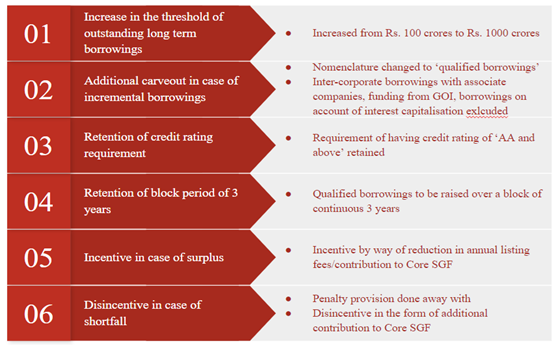
Key features of the revised framework are as follows:
This article discusses the amendments made in the LCs framework by way of the Present Circular including the rationale provided in the CP, relevant points discussed in the SEBI Board meeting in this regard and transition related requirement for ongoing block of 3 years for existing LCs.
Increase in the threshold of outstanding long-term borrowings
Existing Provisions
Proposed Changes in CP
SEBI’s rationale for proposed change
Outstanding long-term borrowings[3] of Rs. 100 crore or above
Outstanding long-term borrowing of Rs. 500 crore or above.
To align the criteria for LCs with the ‘High Value Debt Listed Entity’ or ‘HVDLEs’ as provided under the Listing Regulations.
Brief of public comments received and SEBI’s response:
While a major portion of public comments were in favour of the increase in the limit to Rs. 500 crore, a common remark raised by the public suggested applying the LC framework based on outstanding listed debt instead of outstanding long-term borrowings. SEBI disagreed as it will increase the burden for entities that have already tapped the debt market and will not help in reducing the burden on the banking system. There were few comments seeking exemption from the applicability in case of loss making companies and NBFCs, which was also dismissed by SEBI indicating that it has no nexus with profit or loss made by an entity and that NBFCs being the largest borrowers cannot be excluded.
SEBI BM decision
Increase the limit from existing Rs. 100 crores to Rs. 1000 crores, basis which, around 170 entities would qualify as LCs (as opposed to 482 entities in case of limit of Rs. 500 crore proposed).
Provisions under the Present Circular
The threshold limit of outstanding long term borrowings has been increased to Rs. 1000 crores.
Our Remarks
Classification as an HVDLE is on account of outstanding listed debt securities. On the contrary, an entity may not have any of its debt securities listed but may still be classified as an LC if it has its equity listed and borrowing from banks/ financial institutions exceeding the prescribed threshold. Increase of limit to Rs. 1000 crore is a welcome change.
Scope of outstanding long-term borrowings and incremental borrowings
Existing Provisions
Proposed Changes in CP
SEBI’s rationale for proposed change
Includes: any outstanding borrowing with an original maturity of more than 1 year Excludes: (i) External Commercial Borrowings (ii) Inter-corporate borrowings between a holding and subsidiary
Term ‘incremental borrowings’ to be replaced with ‘qualified borrowings’. Includes: any outstanding borrowing with an original maturity of more than 1 year Excludes: (i) External Commercial Borrowings (ii) Inter-Corporate Borrowings between its holding and/or subsidiary and /or associate companies;(iii) Grants, deposits, or any other funds received as per the guidelines or directions of the Government of India (‘GOI’);(iv) Borrowings arising on account of interest capitalization
To cover associate companies, on which the holding company has significant influenceThe end use of grants received from the Government is restricted to the purposes specified by Government and cannot be deviated fromInterest capitalized on the loan amount cannot be considered as borrowings.
Brief of public comments received and SEBI’s response:
All the public comments were in favor of the proposal. Few comments were received to additionally exclude borrowings for the purpose of refinancing which was not accepted by SEBI as it would defeat the intent of the framework. The suggestion to exclude borrowings made for mergers, acquisitions and takeovers was accepted by SEBI given those are not routine occurrences in the life-cycle of an entity.
SEBI BM decision
Incremental borrowings to be termed as qualified borrowings. Borrowings for mergers, acquisitions and takeovers to be further excluded from the scope of qualified borrowings.
Provisions under the Present Circular
The nomenclature ‘incremental borrowings’ has been revised to ‘qualified borrowings’ and the exclusions proposed in the CP i.e. inter-corporate borrowings involving associate companies, any funding received from the GOI, borrowings on account of interest capitalisation have been given effect to. Additionally, as per the public comments received, borrowings for the purpose of scheme of arrangement as stated above have also been excluded.
Retention of credit rating requirement as a criterion for LC identification
Existing Provisions
Proposed Changes in CP
SEBI’s rationale for proposed change
Have a credit rating of “AA and above”
Remove the requirement.
Entities with long-term outstanding borrowings of Rs. 500 Cr or above would generally fall under the bracket of credit rating of ‘AA and above’
Brief of public comments received and SEBI’s response:
Most of the public comments were against the proposal as entities with low rated debt may not find investors at all, which was accepted by SEBI.
SEBI BM decision
The criteria of a minimum credit rating to be retained as per existing norm.
Provisions under the Present Circular
SEBI has retained the existing requirement prescribing a minimum credit rating of “AA”/“AA+”/AAA under the revised framework.
Our Remarks
The proposal in the CP to drop the requirement altogether was inappropriate. An outstanding borrowing of Rs. 500 crore may not be necessarily indicative of the credit quality of the borrower. While regulations may force or incentivize the issuers to come up with debt issuance pursuant to this framework, however, it cannot force the investors to invest. An investor in debt security will rely on the credit quality which is fairly indicated through the credit rating of the debt security. The requirement of having a credit rating is one of the prerequisites for listing a debt security under NCS Regulations (Reg. 10). Even for determining the list of eligible issuers of debt securities for the purpose of contribution to Core Settlement Guarantee Fund (‘Core SGF’), the issuer should have long term debt rating of the eligible securities of AAA, AA+, AA and AA- (excluding AA- with negative outlook). Decision to retain the erstwhile requirement is a welcome move.
Retention of block period of three years
Existing Provisions
Proposed Changes in CP
SEBI’s rationale for proposed change
FY 2020 & FY 2021 – On an annual basis FY 2022 onwards – On a block of 3 years
On an annual basis
To simplify the process of raising debt securities and to eliminate the complex process of tracking all the issuances during the block years.
Brief of public comments received and SEBI’s response:
Most of the public comments were against the proposal, which was accepted by SEBI.
SEBI BM decision
SEBI to retain the requirement of the continuous block of 3 years in the framework.
Provisions under the Present Circular
It has been prescribed that atleast 25% of the qualified borrowings will be required to be raised by way of issuance of debt securities over a continuous block of 3 years.
Since, the framework is applicable w.e.f. FY 2025, entities identified as LCs as on the last day of ‘T-1’ [i.e. March 31, 2024 / December 31, 2023, as the case may be], will be required to raise the requisite quantum of qualified borrowings of FY ‘T’ [FY 2025] through issuance of debt over a block of 3 years i.e. over ‘T’ [FY 2025], ‘T+1’ [FY 2026] and ‘T+2’ [FY 2027].
Our Remarks
The proposal in the CP to make it an annual requirement was inappropriate. For the purpose of this framework, the interest of such issuers who do not issue debt securities frequently is also to be kept in mind. While frequent issuers of debt securities may not find it difficult to borrow funds by issuance of further debt securities, it may not be feasible for non-frequent issuers to raise the entire quantum of prescribed incremental borrowings within a period of 1 year. Issuers are to be given certain flexibility and the timelines need not be made more stringent. Decision to retain the erstwhile requirement is a welcome move.
Incentive for exceeding the mandatory limit
Existing Provisions
Proposed Changes
SEBI’s rationale for proposed change
–
In case of a surplus, a certain quantum of the annual listing fees to be reduced; Reduction in the contribution to be made to the core SGF.
To promote ease of doing business and to encourage LCs to raise funds by incentivizing them.
Brief of public comments received and SEBI’s response:
All public comments were in favour of the proposal. One of the recommendations was to provide incentive in the form of reduction in the contribution to be made to the Recovery Expense Fund[4], which was not approved by SEBI given it is a refundable deposit and meant to meet recovery expenses in case of any default.
SEBI BM decision
SEBI decided to introduce the incentive structure. With respect to the proposal for reduced contribution to Core SGF, SEBI approved to permit carry forward of incentive till utilisation or set off within 6 years of obtaining the incentive.
Provisions under the Present Circular
The incentive scheme proposed has been notified. A benefit of reduction in the annual listing fees pertaining to listed debt securities or non-convertible redeemable preference shares ranging between 2% to 10% computed in the following manner would be available in case of surplus borrowings raised through issuance of debt:
Sr. No.
% of surplus borrowing as on last day of FY “T+2” for the block starting FY “T”
% of reduction in annual listing fees payable to the Stock Exchanges by the LCs for FY “T+2”
1
0-15%
2% of annual listing fees
2
15.01% – 30%
4% of annual listing fees
3
30.01% – 50%
6% of annual listing fees
4
50.01% – 75%
8% of annual listing fees
5
Above 75%
10% of annual listing fees
Further, a credit in the form of reduction in the contribution to be made to the Core SGF of LPCC would also be available in the following manner:
Sr. No.
% of surplus borrowing for the block starting FY “T” as on last day of FY “T+2”
Quantum of Credit
1
0-15%
0.01%
2
15.01% – 30%
0.02%
3
30.01% – 50%
0.03%
4
50.01% – 75%
0.04%
5
Above 75%
0.05%
The Present Circular further mentions that in case of entities classified as ‘eligible issuers’ by the LPCC, the incentive would be permissible to be carried forward for a period of 6 years of obtaining the same as approved in the SEBI BM. Further, in case of an entity which is not an eligible issuer, the incentive may be carried forward until it is classified as an eligible issuer. Thereafter, the incentive would be available for the purpose of utilisation for a period of 6 years from year of such classification.
Manner of computation
Let us consider the following example to understand the computation of credit:
Company ‘X’ is identified as an eligible issuer requiring to contribute Rs. 2 crores to the Core SGF. It has complied with the requirements of raising the requisite qualified borrowings in the following manner:
Sr. No.
Particulars
Amount (in Rs. Cr)
1
Borrowings that should have been made from the debt market by the LC for FY “T” (A)
200
2
Actual borrowings in “Block of three years” (B)
250
3
Surplus borrowings (B-A) (C)
50
4
% of surplus borrowing (C/A*100)
25%
5
Quantum of credit (% of quantum of credit as per the table above*C)
0.01 (i.e. 50*0.02%)
6
Actual contribution required to be made to the SGF [Actual contribution required to be made – Quantum of credit]
1.99 (i.e. 2-0.01)
Our Remarks
Contribution to Core SGF:
The benefit of reduced listing fee can be availed by the listed entity for listed debt securities or non-convertible redeemable preference shares. However, the relaxation in the form of reduced contribution to Core SGF will be an incentive only to an ‘eligible issuer’ as per the list rolled out annually by AMC Repo Clearing Limited (‘ARCL’), recognised as Limited Purpose Clearing Corporation (‘LPCC’) by SEBI, on the basis of prescribed parameters. In case of an LC which has not been identified as an ‘eligible issuer’, the credit in contribution to the Core SGF would not serve as an incentive and may get lapsed. It may even be the case for an issuer identified as ‘eligible issuer’ in year 1 however, not identified in the subsequent year. ARCL vide Circular dated September 29, 2023 rolled out a list of 125 eligible issuers who will be required to contribute to Core SGF for the eligible issuance as per the eligible list issued on or after 01st October 2023 till 30th September, 2024. In the light of this, SEBI’s decision to allow carrying it forward till 6 years is a welcome change.
Mandatory Listing:
In case an LC which is a debt listed entity and raises further debt pursuant to the LC framework post January 1, 2024, it will be mandatorily required to list every such issuance pursuant to Reg. 62A of the SEBI Listing Regulations, inserted vide the SEBI (Listing Obligations and Disclosure Requirements) (Fourth Amendment) Regulations, 2023. On the other hand, in case an LC is not a debt listed entity, however, lists any particular issuance of debt securities issued pursuant to the LCB framework any time post January 1, 2024, as per the afore-mentioned provision, it will be mandatorily required to list all issuances done post January 1, 2024 within a period of 3 months from the date of listing.
As a result of such mandatory listing, the LCs may cross the threshold of having outstanding listed debt securities amounting to Rs. 500 crores, thereby classifying the entities as a ‘High Value Debt Listed Entity’ or an ‘HVDLE’. Consequently, the entity will be required to comply with the corporate governance provisions stipulated under Reg. 16 to Reg. 27 of the SEBI Listing Regulations. We have further analysed the same in our article which can be accessed here.
Disincentive for not meeting the mandatory limit
Existing Provisions
Nature of amendment proposed
Proposed Changes
SEBI’s rationale for the proposed change
Monetary penalty/ fine of 0.2% of the shortfall in the borrowed amount is levied in case of shortfall
Doing away with the penalty and introducing an incentive/ disincentive structure
In case of a shortfall, an amount equivalent to 0.5 basis points of such shortfall shall be made by the LC to the core Settlement Guarantee Fund (‘SGF’) as set up by the Limited Purpose Clearing Corporation (LPCC).
To promote ease of doing business and to encourage LCs to raise funds by incentivizing them.
Brief of public comments received and SEBI’s response:
While majority of the comments were in favour of the proposal, it was recommended that:
(a) the disincentive should be applicable if there is a non-compliance for a continuous block of 2/3 years;
(b) further reduction in the quantum; and
(c) applicability only to entities required to contribute to Core SGF.
SEBI BM decision
SEBI confirmed (a) and disagreed for (b). In case of (c). SEBI clarified that Core SGF requirement will be made applicable to all issuers to ensure uniformity.
Provisions under the Present Circular
SEBI has done away with the penalty provision and notified the disincentive structure. The said structure will apply in case of shortfall in raising the requisite quantum at the end of the block of 3 years, i.e. as on the last day of ‘T+2’. The disincentive scheme is in the form of additional contribution to be made to the Core SGF in the following manner:
Sr. No.
% of surplus borrowing for the block starting FY “T” as on last day of FY “T+2”
Quantum of additional contribution
1
0-15%
0.015%
2
15.01% – 30%
0.025%
3
30.01% – 50%
0.035%
4
50.01% – 75%
0.045%
5
Above 75%
0.055%
Manner of computation
Let us consider the following example to understand the computation of disincentive:
Company ‘X’ is identified as an eligible issuer requiring to contribute Rs. 2 crores to the Core SGF. It has complied with the requirements of raising the requisite qualified borrowings in the following manner:
Sr. No.
Particulars
Amount (in Rs. Cr)
1
Borrowings that should have been made from the debt market by the LC for FY “T” (A)
200
2
Actual borrowings in “Block of three years” (B)
150
3
Shortfall in borrowings (X-Y) (C)
50
4
% of shortfall in borrowing (C/A*100)
25%
5
Quantum of additional borrowing (% of quantum of additional borrowing as per the table above*C)
0.0125 (i.e. 50*0.025%)
6
Actual contribution required to be made to the SGF [Actual contribution required to be made + Quantum of additional borrowing]
2.0125 (i.e. 2+0.0125)
Dispensation for LCs identified basis erstwhile criteria
The entities which have been identified as LCs under the erstwhile LC framework are required to comply with the requirement over a block of 3 years in the following manner:
FY in which the entity was identified as LC i.e. ‘T-1’
Block of 3 years over which the LC was required to raise the requisite quantum of long term borrowings i.e.‘T’, ‘T+1’, ‘T+2’
Remaining period of the block as on March 31, 2023 prior to Present Circular
Remaining period as per the Present Circular
FY 2021
FY 2022, FY 2023, FY 2024
1 year i.e. FY 2024
1 year i.e. FY 2024
FY 2022
FY 2023, FY 2024, FY 2025
2 years i.e. FY 2024 & FY 2025
1 year i.e. FY 2024
FY 2023
FY 2024, FY 2025, FY 2026
3 years from FY 2024 to FY 2026
1 year i.e. FY 2024
The erstwhile LCs are required to endeavour to comply with the requirement of raising 25% of their incremental borrowings done during FY 2022, FY 2023 and FY 2024 respectively by way of issuance of debt securities till March 31, 2024, failing which, such LCs are required to provide a one-time explanation in their Annual Report for FY 2024.
The Present Circular additionally amends the Chapter XII of NCS Master Circular to the following effect:
Deletion of penalty related provision in Clause 2.2(d) of Chapter XII; and
Deletion of format of annual disclosure to be submitted within 45 days from end of the financial year by an identified LC providing details of incremental borrowing and mandatory borrowing, as provided in Clause 3.1 (b) of Chapter XII.
Conclusion
The changes in the framework vide the Present Circular attempt to tackle the hindrances which are being faced by entities classified as LCs, including removal of the penal provisions on shortfall, etc. Thus, these changes seem positive and would help LCs in complying with the LCs framework. However, while the framework aims to deepen the bond market by mandating debt issuance, one cannot disregard the other recent amendments in the legal framework governing debt securities, which seem to be a deterrent for companies from approaching the capital markets, for instance, provisions relating to mandatory listing of debt securities, requirement to obtain approval of all holders in case of voluntary delisting, etc. While the framework would be relevant for entities who have already tested the equity markets and wish to enter the debt market, the recent amendments relating to mandatory listing, no selective delisting etc. would impact issuers who intend to list their debt securities.
[1] Criteria under the erstwhile framework was as follows and was applicable to all listed entities except Scheduled Commercial Banks:
having listed specified securities or debt or non-convertible redeemable preference shares on a recognised stock exchange; and
having outstanding long term borrowing of Rs. 100 crore or above; and
having a credit rating of ‘AA and above’.
[2] About Core SGF: In terms of SEBI Circular SEBI/HO/DDHS/DDHS-RACPOD1/CIR/P/2023/56 dated April 13, 2023, eligible issuers are required to contribute 0.5 basis points (0.005%) of the issuance value of debt securities per annum based on the maturity of debt securities. The issuers need to make full contribution upfront prior to the listing of debt securities.The Core SGF contribution is applicable for all public issue or private placement of debt securities under the SEBI (Issue and Listing of Non-convertible Securities) Regulations, 2021 of eligible issuer except for a) Tier I & Tier II bonds issued by Banks, NBFCs & other institutions; b) Perpetual Debt; c) Floating rate bonds; d) Market linked bonds; e) Convertible bonds (Optional or Compulsorily); f) Securities other than long term debt rating of the eligible securities shall be AAA, AA+, AA and AA- (excluding AA- with negative outlook).
[3] Outstanding long term borrowings indicate borrowings which have original maturity of more than 1 year with certain exclusions as detailed further herein.
[4] Recovery Expense Fund is a refundable fund to be deposited with the stock exchanges at the time of listing. The purpose of the fund is recovery in case of default.
https://vinodkothari.com/wp-content/uploads/2023/06/vinod-kothari-logo.png00Team Corplawhttps://vinodkothari.com/wp-content/uploads/2023/06/vinod-kothari-logo.pngTeam Corplaw2023-08-11 19:40:392023-10-26 16:20:19SEBI rationalizes the framework for Large Corporates
https://vinodkothari.com/wp-content/uploads/2023/06/vinod-kothari-logo.png00Subhojit Shomehttps://vinodkothari.com/wp-content/uploads/2023/06/vinod-kothari-logo.pngSubhojit Shome2023-08-08 13:50:522023-11-29 11:24:17Digital Personal Data Protection Bill 2023: Analysing the Impact on Digital Lenders
The spate of new disclosure requirements introduced by Reg 30 of the Listing Regulations includes one of the most controversial pieces – disclosure of shareholders’ agreements which may impact or are designed to impact the management or control of a listed entity. This requirement is applicable not only to the pacts entered into after the effective date of the amendment, but also to existing agreements, which, by reg. 30A, need to be bared by the contracting parties to the company, and the company in turn, will need to upload this information to the public. There are views circula that the entire body of such agreement has to be made public.
We cannot miss the fact that a sizeable portion of the capital of listed companies in India is held by families. An OECD document says nearly half of the listed companies’ capital in India is held by promoter families.
Naturally, anything that pierces, peeps in or lifts the veil of family arrangements is as challenging as any attempt to get into anyone’s privacy. Note that privacy concerns are not in any way less important for promoter families, than for yours or mine.
Therefore, evidently, this issue has raked up a lot of controversy. Compliance Officers are even facing the query as to whether a will is also required to be disclosed.
https://vinodkothari.com/wp-content/uploads/2023/06/vinod-kothari-logo.png00Vinod Kotharihttps://vinodkothari.com/wp-content/uploads/2023/06/vinod-kothari-logo.pngVinod Kothari2023-07-31 20:01:572023-07-31 20:04:58Disclosure of shareholders’ pacts: Jo wada kiya wo bataana padega



 Reload document
  Open in new tab