ARCs and Insolvency Resolution Plans – The Enigma of Equity vs Debt

– By Sikha Bansal (resolution@vinodkothari.com)

This article has also been published in IndiaCorpLaw Blog, the same can be viewed here

A regulatory framework for asset reconstruction companies (ARCs) was introduced in India through the Securitisation and Reconstruction of Financial Assets and Enforcement of Security Interest Act, 2002 (SARFAESI Act). This intended to put in place a system for clearing up non-performing assets (NPAs) from the books of banks and financial institutions. Over a decade later, the Insolvency and Bankruptcy Code, 2016 (IBC) was introduced with the objective of reorganisation and resolution of insolvent entities.

Although the common goal of both these legislation seems to be the cleaning or reconstruction of bad loan portfolios, it is important to understand the difference between the basic premises of these two laws: while the SARFAESI Act deals with ‘recovery’ and is more of a ‘class’ remedy, the IBC is about ‘resolution’ and intended to constitute a collective process. Given a common set of stakeholders involved under both these laws, there remains an obvious possibility of overlaps or inconsistencies. Read more

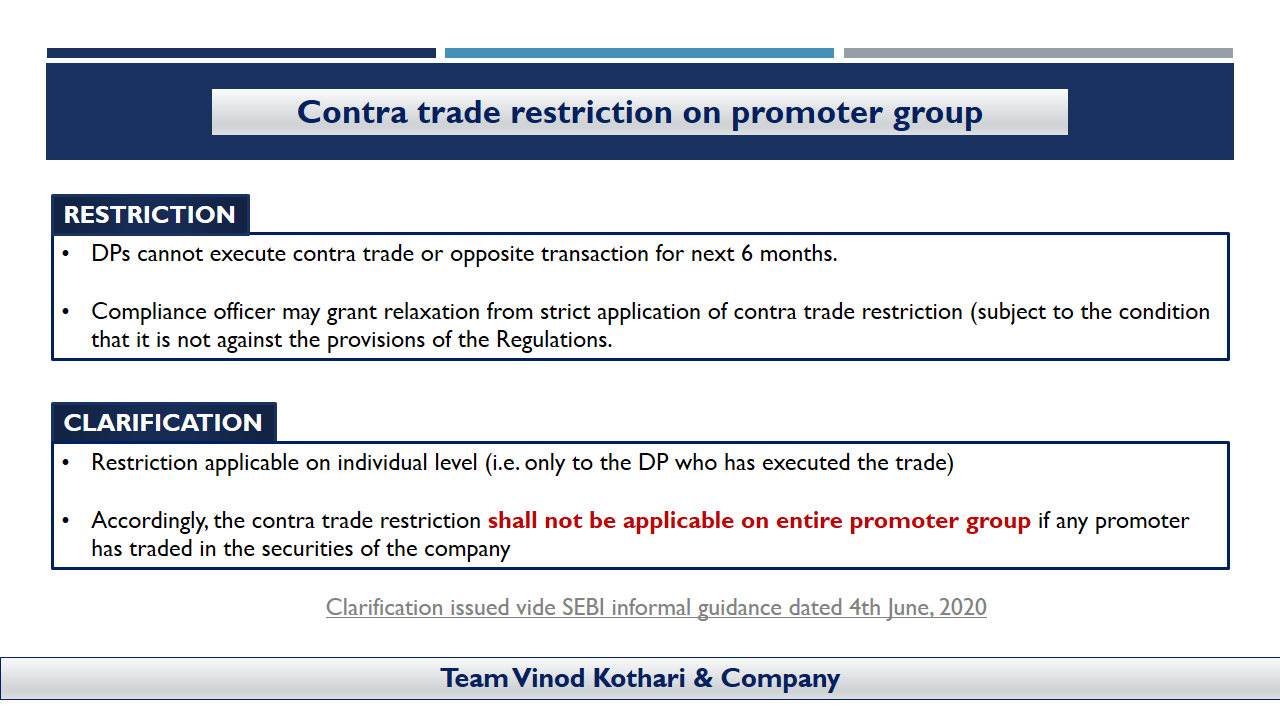
Contra trade restrictions on promoter group

corplaw@vinodkothari.com

Link to Informal Guidance by SEBI – https://www.sebi.gov.in/sebi_data/commondocs/sep-2020/SEBI%20let%20Raghav%20IG_p.pdf

RBI refines the role of the Compliance-Man of a Bank

Notifies new provisions relating to Compliance Functions in Banks and lays down Role of CCO.

By:

Shaivi Bhamaria | Associate

Aanchal Kaur Nagpal | Executive

Introduction

The recent debacles in banking/shadow banking sector have led to regulatory concerns, which are reflected in recent moves of the RBI. While development of a robust “compliance culture” has always been a point of emphasis, RBI in its Discussion Paper on “Governance in Commercial Banks in India’[1] [‘Governance Paper’] dated 11th June 2020 has dealt extensively with the essentials of compliance function in banks.  The Governance Paper, while referring to extant norms pertaining to the compliance function in banks, viz. RBI circulars on compliance function issued in 2007[2] [‘2007 circular’] and 2015[3] [‘2015 circular’], placed certain improvement points.

In furtherance of the above, RBI has come up with a circular on ‘Compliance functions in banks and Role of Chief Compliance Officer’ [‘2020 Circular’] dated 11th September, 2020[4], these new guidelines are supplementary to the 2007 and 2015 circulars and have to be read in conformity with the same. However, in case of or any common areas of guidance, the new circular must be followed.  Along with defining the role of the Chief Compliance Officer [‘CCO’], they also introduce additional provisions to be included in the compliance policy of the Bank in an effort to broaden and streamline the processes used in the compliance function.

Generally, in compliance function is seen as being limited to laying down statutory norms, however, the importance of an effective compliance function is not unknown. The same becomes all-the-more paramount in case of banks considering the critical role they play in public interest and in the economy at large. For a robust compliance system in Banks, an independent and efficient compliance function becomes almost indispensable. The effectiveness of such a compliance function is directly attributable to the CCO of the Bank.

Need for the circular

The compliance function in banks is monitored by guidelines specified by the 2007 and 2015 circular. These guidelines are consistent with the report issued by the Basel Committee on Banking Supervision (BCBS Report)[5] in April, 2005.

While these guidelines specify a number of functions to be performed by the CCO, no specific instructions for his appointment have been specified. This led to banks following varied practices according to their own tailor-made standards thus defeating the entire purpose of a CCO. Owing to this, RBI has vide the 2020 circular issued guidelines on the role of a CCO, in order to bring uniformity and to do justice to the appointment of a CCO in a bank.

Background of CCOs

The designation of a CCO was first introduced by RBI in August, 1992 in accordance with the recommendations of the Ghosh Committee on Frauds and Malpractices in Banks. After almost 15 years, RBI introduced elaborate guidelines on compliance function and compliance officer in the form of the 2007 circular which was in line with the BCBS report.

According to the BCBS report:

‘Each bank should have an executive or senior staff member with overall responsibility for co-ordinating the identification and management of the bank’s compliance risk and for supervising the activities of other compliance function staff. This paper uses the title “head of compliance” to describe this position’.

Who is a CCO and how is he different from other compliance officials?

The requirement of an individual overseeing regulatory compliance is not unique to the banking sector. There are various other laws that the provide for the appointment of a compliance officer. However, there is a significant difference in the role which a CCO is expected to play. The domain of CCO is not limited to any particular law or its ancillaries, rather, it is all pervasive. He is not only responsible for heading the compliance function, but also overseeing the entire compliance risk[6] in banks.

Role of a CCO in a Bank:

The predominant role of a CCO is to head the compliance function in a Bank. The 2007 circular lays down the following mandate of a CCO:

  1. overall responsibility for coordinating the identification and management of the bank’s compliance risk and supervising the activities of other compliance function staff.
  2. assisting the top management in managing effectively the compliance risks faced by the bank.
  3. nodal point of contact between the bank and the RBI
  4. approving compliance manuals for various functions in a bank
  5. report findings of investigation of various departments of the bank such as at frequent intervals,
  6. participate in the quarterly informal discussions held with RBI.
  7. putting up a monthly report on the position of compliance risk to the senior management/CEO.
  8. the audit function should keep the Head of compliance informed of audit findings related to compliance.

The 2020 circular adds additional the following responsibilities on the CCO:

  1. Design and maintenance of compliance framework,
  2. Training on regulatory and conduct risks,
  3. Effective communication of compliance expectations

Selection and Appointment of CCO:

The 2007 circular is ambiguous on the qualifications, roles and responsibilities of the CCO. In certain places the CCO was referred to as the Chief Compliance officer and some places where the words compliance officer is used. This led to difficulty in the interpretation of aspects revolving around a CCO. However, the new circular gives a clear picture of the expectation of RBI from banks in respect of a CCO. The same has been listed below:

Basis 2020 circular 2007 circular
Tenure Minimum fixed tenure of not less than 3 years The Compliance Officer should be appointed for a fixed tenure
Eligibility Criteria for appointment as CCO The CCO should be the senior executive of the bank, preferably in the rank of a General Manager or an equivalent position (not below two levels from the CEO). The compliance department should have an executive or senior staff member of the cadre not less than in the rank of DGM or equivalent designated as Group Compliance Officer or Head of Compliance.
Age 55 years No provision
Experience Overall experience of at least 15 years in the banking or financial services, out of which minimum 5 years shall be in the Audit / Finance / Compliance / Legal / Risk Management functions. No provision


Skills Good understanding of industry and risk management, knowledge of regulations, legal framework and sensitivity to supervisors’ expectations No provision
Stature The CCO shall have the ability to independently exercise judgement. He should have the freedom and sufficient authority to interact with regulators/supervisors directly and ensure compliance No provision
Additional condition No vigilance case or adverse observation from RBI, shall be pending against the candidate identified for appointment as the CCO. No provision
Selection* 1.      A well-defined selection process to be established

2.      The Board must be required to constitute a selection committee consisting of senior executives

3.      The CCO shall be appointed based on the recommendations of the selection committee.

4.      The selection committee must recommend the names of candidates suitable for the post as per the rank in order of merit.

5.      Board to take final decision in the appointment of the CCO.

No provision
Review of performance appraisal The performance appraisal of the CCO should be reviewed by the Board/ACB No provision
Reporting lines The CCO will have direct reporting lines to the following:

1.      MD & CEO and/or

2.      Board or Audit Committee

No provision
Additional reporting In case the CCO reports to the MD & CEO, the Audit Committee of the Board is required to meet the CCO quarterly on one-to-one basis, without the presence of the senior management including MD & CEO. No provision
Reporting to RBI 1.      Prior intimation is to be given to the RBI in case of appointment, premature transfer/removal of the CCO.

2.      A detailed profile of the candidate along with the fit and proper certification by the MD & CEO of the bank to be submitted along with the intimation, confirming that the person meets the supervisory requirements, and detailed rationale for changes.

No provision
Prohibitions on the CCO 1.      Prohibition on having reporting relationship with business verticals

2.      Prohibition on giving business targets to CCO

3.      Prohibition to become a member of any committee which brings the role of a CCO in conflict with responsibility as member of the committee. Further, the CCO cannot be a member of any committee dealing with purchases / sanctions. In case the CCO is member of such committees, he may play only an advisory role.

No provision

*The Governance paper had proposed that the Risk Management Committee of the Board will be responsible for selection, oversight of performance including performance appraisals and dismissal of a CCO. Further, any premature removal of the CCO will require with prior board approval. [Para 9(6)] However, the 2020 circular goes one step further by requiring a selection committee for selection of a CCO.

Dual Hatting

Prohibition of dual hatting is already applicable on the Chief Risk Officer (‘CRO’) of a bank. The same has also been implemented in case the of a CCO.

Hence, the CCO cannot be given any responsibility which gives rise to any conflict of interest, especially the role relating to business. However, roles where there is no direct conflict of interest for instance, anti-money laundering officer, etc. can be performed by the CCO. In such cases, the principle of proportionality in terms of bank’s size, complexity, risk management strategy and structures should justify such dual role. [para 2.11 of the 2020 circular] 

Role of the Board in the Compliance function

Role of the Board

The bank’s Board of Directors are overall responsible for overseeing the effective management of the bank’s compliance function and compliance risk.

Role of MD & CEO

The MD & CEO is required to ensure the presence of independent compliance function and adherence to the compliance policy of the bank.

Authority:

The CCO and compliance function shall have the authority to communicate with any staff member and have access to all records or files that are necessary to enable him/her to carry out entrusted responsibilities in respect of compliance issues.

Compliance policy and its contents

The 2007 circular required banks to formulate a Compliance Policy, outlining the role and set up of the Compliance Department.

The 2020 circular has laid down additional points that must be covered by the Compliance Policy. In some aspects, the 2020 circular provides further measures to be taken by banks whereas in some aspects, fresh points have been introduced to be covered in the compliance policy, these have been highlighted below:

1. Compliance philosophy: The policy must highlight the compliance philosophy and expectations on compliance culture covering:

  • tone from the top,
  • accountability,
  • incentive structure
  • Effective communication and Challenges thereof

2. Structure of the compliance function: The structure and role of the compliance function and the role of CCO must be laid down in the policy

3. Management of compliance risk: The policy should lay down the processes for identifying, assessing, monitoring, managing and reporting on compliance risk throughout the bank.

The same should adequately reflect the size, complexity and compliance risk profile of the bank, expectations on ensuring compliance to all applicable statutory provisions, rules and regulations, various codes of conducts and the bank’s own internal rules, policies and procedures and must create a disincentive structure for compliance breaches.

4. Focus Areas: The policy should lay special thrust on:

  • building up compliance culture;
  • vetting of the quality of supervisory / regulatory compliance reports to RBI by the top executives, non-executive Chairman / Chairman and ACB of the bank, as the case may be.

5. Review of the policy: The policy should be reviewed at least once a year

Quality assurance of compliance function

Vide the 2020 circular, RBI has introduced the concept of quality assurance of the compliance function Banks are required to develop and maintain a quality assurance and improvement program covering all aspects of the compliance function.

The quality assurance and improvement program should be subject to independent external review at least once in 3 years. Banks must include in their Compliance Policy provisions relating to quality assurance.

Thus, this would ensure that the compliance function of a bank is not just a bunch of mundane and outdated systems but is improved and updated according to the dynamic nature of the regulatory environment of a bank.

Responsibilities of the compliance function

In addition to the role of the compliance function under the compliance process and procedure as laid down in the 2007 the 2020 circular has laid down the below mentioned duties and responsibilities of the compliance function:

  1. To apprise the Board and senior management on regulations, rules and standards and any further developments.
  2. To provide clarification on any compliance related issues.
  3. To conduct assessment of the compliance risk (at least once a year) and to develop a risk-oriented activity plan for compliance assessment. The activity plan should be submitted to the ACB for approval and be made available to the internal audit.
  4. To report promptly to the Board/ Audit Committee/ MD & CEO about any major changes / observations relating to the compliance risk.
  5. To periodically report on compliance failures/breaches to the Board/ACB and circulating to the concerned functional heads.
  6. To monitor and periodically test compliance by performing sufficient and representative compliance testing. The results of the compliance testing should be placed before the Board/Audit Committee/MD & CEO.
  7. To examine sustenance of compliance as an integral part of compliance testing and annual compliance assessment exercise.
  8. To ensure compliance of Supervisory observations made by RBI and/or any other directions in both letter and spirit in a time bound and sustainable manner.

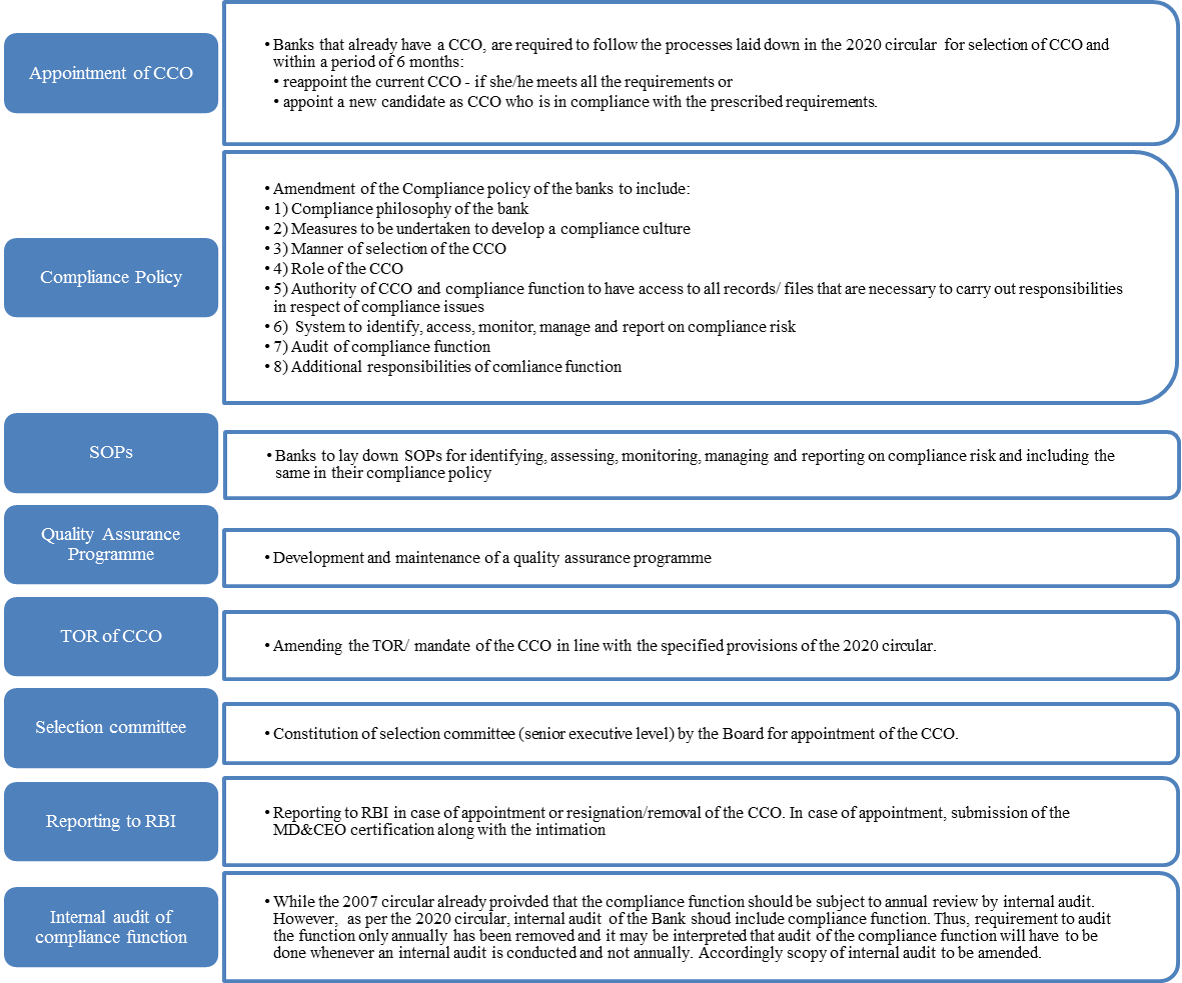
 Actionables by Banks:
Links to related write ups –

[1] https://www.rbi.org.in/Scripts/BS_PressReleaseDisplay.aspx?prid=49937

[2] https://www.rbi.org.in/Scripts/NotificationUser.aspx?Id=3433&Mode=0

[3] https://www.rbi.org.in/Scripts/NotificationUser.aspx?Id=9598&Mode=0

[4] https://www.rbi.org.in/Scripts/NotificationUser.aspx?Id=11962&Mode=0

[5] https://www.bis.org/publ/bcbs113.pdf

[6]  According to BCBS report, compliance risk is the risk of legal or regulatory sanctions, material financial loss, or loss to reputation a bank may suffer as a result of its failure to comply with laws, regulations, rules, related self-regulatory organization standards, and codes of conduct applicable to its banking activities”

Liability Acknowledgment & Limitation Period for IBC Applications

This article has also been published in the LawStreetIndia blog – http://www.lawstreetindia.com/experts/column?sid=466 Liability Acknowledgment & Limitation Period for IBC Applications – Deciphering the Enigma -Sikha Bansal (resolution@vinodkothari.com) The applicability of the Limitation Act, 1963 (Limitation Act) to the applications under the Insolvency and Bankruptcy Code, 2016 (Code) has been settled long back, after a series of […]

Moratorium Scheme: Conundrum of Interest on Interest

Siddhart Goel

finserv@vinodkothari.com

Introduction

On September 03, 2020 the Hon’ble Supreme Court (the “court”) while dealing with several petitions on account of Covid related stress from various stakeholders, passed an interim order that that the accounts which have not declared NPA till August 31, 2020 shall not be declared NPA till further orders of the court.[1] Further in its September 10, 2020 order the court asked the government and RBI to file affidavit within two weeks to the court, on issues raised and relief granted thereto.[2]

The primary contention raised before the court for consideration was that the moratorium postpones the burden and does not eases the plight. It would be a double whammy on borrowers since Banks are charging compounded interest, and banks have benefitted during moratorium by charging compounded interest from customers.  The court in its order dated September 10, 2020 observed that individuals are more adversely affected during this period of pandemic. Therefore, the court from the government and RBI, with regard to charging of compound interest and credit rating/downgrading during moratorium period, has sought specific instructions.

Though the matter is sub judice, this write-up aims to provide a legal analyses to the contentions raised in front of the court on the above counts, since any action or direction on the above issues will have an impact on the wider financial system including all, i.e. borrowers, government, banks and other financial institutions as a whole.

Before directly getting into the analyses, it is important to consider material reliefs and incentives announced by RBI and Government of India in respect to COVID19 related regulatory package. A brief history of timelines on series of regulatory reforms to cope with the disruptions caused due to COVID19 is provided below:


Waiver of Interest on Interest during moratorium and Systemic Implications

The moratorium scheme deferred the repayment schedule for loans, and the residual tenor, was to be shifted across the board. This essentially meant that all the liabilities of customers towards their repayments (principal plus interests) were to be rescheduled and shifted across the board by the Banks and NBFCs. However, the scheme clearly stipulated that the interest should continue to accrue on the outstanding portion of the term loans during the moratorium period. Moratorium granted to the customers of banks and NBFCs was to reprieve borrowers from any immediate liability to pay. However, charging of interest on outstanding accrued amount is the center of concern in the matter.

The money has time value, which is often expressed as interest in banking parlance. This is one of the most fundamental principles in finance.  Rupee 1 today is more valuable from a year today. If interest is not paid, when it accrues, this in effect means, right to receive interest, which is a predictable stream of cash flow, is not available for reinvestment. Therefore, interest earned but not paid, should earn interest until paid. In debt markets, an obligation towards debt is valued in reference to yield to maturity or present value, all these rest on the compounding interest. These are generally in form of obligations on Banks and NBFCs on the liability side of their balance sheet. Bank deposits and interest thereon also attracts interest, which is adjusted towards total deposit amount of the customer. Therefore, interest on interest is a rule in finance and not a selective event.

Banking is no different to any other commercial business, besides it involves liquidity and maturity transformation and hence is highly leveraged. The short-term demand deposits from customers are converted into long-term loans to borrowers (‘maturity transformation’). Similarly, the customer deposits (liabilities of banks) are payable on demand, while on asset side receivables (repayment of principal and interest) are fixed on due dates (‘liquidity transformation’). It would be wrong to presume that NBFCs are any different from commercial banks. NBFCs largely rely on borrowings from Banks and other financial institutions by way of issuing debt instruments (CP, bonds, etc.), which is reflected on the asset side of the investing commercial banks and other financial institutions. Though obligation of payment on these debt instruments is not payable on demand, but they carry a substantial roll over and default risk.  Hence, these institutions are highly leveraged and inherently fragile by nature of their business. Needless to state that receivables on asset side of banks and NBFC also carry certain risk of default and therefore are inherently risky in nature.

Financial institutions and other investors in market, (like Money Market Funds, Pension funds and etc.) invest in debt of Banks and NBFCs on the basis of strength of assets held by them. These assets are in form of receivables from pool of loans or by way advances to underlying borrowers. Thus, participants in financial markets are highly interlinked and are adversely affected by asset deterioration as a rule. Banks and financial institutions bear credit risk (default risk) of the underlying borrowers on their balance sheet. This credit risk has already increased substantially and would be unfolding further due the impact of pandemic on wider economy.

The waiver of interest charged on interest accrued but not paid during the moratorium, would not only be a loss for the banks and NBFCs, but would also substantially dilute the value of assets held by them. This could lead to an asset liability mismatch on balance sheets of banks. Such waiver of interest on accrued amount could exacerbate the risk of banks and NBFCs defaulting on other financial institutions (‘systemic risk’). The foregoing of charging of interest on interest accrued during moratorium would mean banks and financial institutions partially baling out borrowers either from their own limited funds or from the borrowed funds of other financial institutions. Such a move could entail systemic risk and wider financial catastrophe. As risk of default from comparatively large diversified group of borrowers will be shifted and get concentrated in the balance sheets of banks and financial institutions.

Credit Rating Downgrades and Stressed Assets Resolution

The RBI moratorium notification dated March 27, 2020, freezes the delinquency status of the loan accounts, which have availed moratorium benefit under the scheme. This essentially meant that asset classification standstill will be imposed for accounts where the benefit of moratorium have been extended.[3] As it stands, the RBI, March 27, 2020 circular clearly stipulated that moratorium/deferment/recalculation of loans is provided to borrowers to tide over economic fallout due to COVID and same shall not be treated as concession or change in terms and conditions due to financial difficulty of the borrower.  In essence the rescheduling of payments and interest is not a default and should not be reported to Credit Information Companies (CICs).  A counter obligation on CIC was also imposed to ensure credit history of the borrowers is not impacted negatively, which are availing benefits under the scheme. The relevant excerpt from the notification stipulates as follows:

 “7. The rescheduling of payments, including interest, will not qualify as a default for the purposes of supervisory reporting and reporting to Credit Information Companies (CICs) by the lending institutions. CICs shall ensure that the actions taken by lending institutions pursuant to the above announcements do not adversely impact the credit history of the beneficiaries.”

 Further through notifications dated August 06, 2020 RBI introduced a special window scheme for Resolution of stress on account of COVID 19 (“Special Window”). Banks and financial institutions could restructure the eligible accounts under the Special Window without any asset classification downgrade of borrowers. The Special Window scheme included personal loans to individuals and other corporate exposures. It is relevant to realize that the resolution of stressed assets is highly subjective to borrower’s leverage, sector specific risks, and other financial parameters. Banks and Financial institutions are better placed to implement the resolution or restructuring of the assets (loan accounts) at bank level.

The moratorium scheme and the Special Window resolution framework dated August 06, 2020 (the “Schemes”) were highlights of discussions during the court proceedings extensively. The primary contentions were in respect to limited applicability of these schemes. The schemes and their benefits were available to borrowers whose accounts were standard and not more than 30 DPD as on March 01, 2020 with their respective banks and financial institutions.  Though the legal validity of the schemes were questioned directly in front of the court, but selective nature of schemes conferring benefit on to standard accounts (which are not more than 30 DPDs) only. The exclusion of other borrower accounts was criticised extensively.  But this could form as a part of separate issue, the primary concern here being asset down gradation and credit rating scores.

The Special Window restructuring scheme notification under its disclosures and credit reporting section made an onus on lending institutions to make disclosures on such re-structured assets in their annual financial statements along with other disclosures. However where accounts have been restructured under special facility, and involve ‘renegotiations’, it shall qualify as restructuring and the same shall be governed under credit information polices as applicable. The relevant clause is produced as is herein below:

 “54. The credit reporting by the lending institutions in respect of borrowers where the resolution plan is implemented under this facility shall reflect the “restructured” status of the account if the resolution plan involves renegotiations that would be classified as restructuring under the Prudential Framework. The credit history of the borrowers shall consequently be governed by the respective policies of the credit information companies as applicable to accounts that are restructured.” 

It is argued that the area of application and scope of both the schemes are entirely exclusive and independent remedies available to respective eligible borrowers. Under moratorium scheme the borrower gets benefit of liquidity since all the payments due during the period are deferred. While in the latter, i.e. restructuring scheme the borrower under stress can get their accounts restructured by way of implementing resolution plan without facing any asset classification downgrade upfront. In the latter case, only such restructurings involving ‘renegotiations’ will affect the credit history of the borrowers.

Conclusion

The intention of the RBI and the government was to provide relief to the borrowers, who were gasping for relief after the disruptions caused due to COVID 19. There is no doubt that the COVID-19 outbreak and subsequent lockdown has impacted all level of borrowers, ranging from small to large borrowers, including, individuals to corporates. It would be wrong to presume that those accounts, which were NPA or otherwise ineligible under the schemes, are not affected by the pandemic. Therefore it is always open for the government and RBI to introduce or implement any other scheme or some sort of reprieving mechanism for the ineligible borrowers. However, it is important to consider that even banks and financial institutions are no exception like any other businesses that have been affected by the pandemic; moreover they have been exposed to severe liquidity crunch and on the flip side are witnessing asset quality problems on their balance sheets. Any attempts to tamper or distort with the fundamental principle of finance (‘interest on interest’) or shifting the burden of it on banks and other financial institutions could have a much wider systemic ramifications than the current economic stress.

[1] https://main.sci.gov.in/supremecourt/2020/11127/11127_2020_34_16_23763_Order_03-Sep-2020.pdf

[2] https://main.sci.gov.in/supremecourt/2020/11127/11127_2020_36_1_23895_Order_10-Sep-2020.pdf

[3] Our detailed write up asset classification standstill is available at < https://vinodkothari.com/2020/04/the-great-lockdown-standstill-on-asset-classification/>

The new PSL Master Direction and its Impact on NBFCs

-Siddharth Goel (finserv@vinodkothari.com)

Introduction

The Reserve Bank of India (RBI) issued Master Directions-Priority Sector Lending (PSL) Targets and Classification on September 4, 2020 (‘Master Directions’).[1] The Master Directions consolidates various circulars and guidelines issued by RBI with respect to PSL.

The changes made in the Master Directions primarily deal with targets and sub-targets for classification of loans as priority sector loans. Further there are some addition of new sectors in Eligible categories, along with increase in lending limit of some of the existing eligible categories for priority sector lending.

Our detailed write-up on the topic can be viewed here.

Changes in priority sector norms do not have a direct impact on the NBFCs, but they have an indirect impact. Banks are allowed to acquire loans under Direct Assignment arrangements or invest in pass through certificates backed by loans which qualify the definition of PSL, in order to meet the prescribed targets. Mostly, the banks acquire these receivables from NBFCs who does the origination of the loans. Additionally, banks also engage in co-lending arrangements with NBFCs to originate PSLs. Therefore, it is worthwhile to examine the impact of these changes on NBFCs.

Co-origination of loans by Banks for lending to Priority Sector

RBI through its vide notification RBI/2018-19/49 dated September 21, 2018 issued guidelines on Co-origination of loans by Commercial Banks and NBFC-ND-SI (“Co-origination Guidelines”).[2] These guidelines excluded Regional Rural Banks (RRBs) and Small Finance Banks (SFBs). Essentially, the banks could claim priority sector status in respect of its share of credit while engaging in the co-origination arrangement with NBFC under the Co-origination Guidelines. Provided, the priority sector assets on the bank’s books should at all times be without recourse to the NBFC.

It is pertinent to note that the PSL Master Directions under its para 25 covers Co-origination of loans by Banks and NBFC-ND-SI. The Master Direction specifically excludes, RRBs SFBs and Urban Co-Operative Banks (UCBs) and Local Area Banks (LABs) under the above para. Moreover, the Master Directions under the said para, specifically stipulates that detailed guidelines in this regard are to be governed as provided under Co-origination Guidelines dated September 21, 2018. Hence there are no changes intended to be introduced vis-a-vis Master Direction, to the co-origination of loans by banks and NBFCs.

PSL- Lending by Banks to NBFCs for On-Lending

In the earlier regime, after the review of Priority sector lending by banks to NBFC for On-Lending notification dated August 13, 2019[3], RBI through its notification dated March 23, 2020,[4] extend the priority sector classification for bank loans to NBFCs for on-lending for the FY 2020-21. Further, existing loans disbursed under the on-lending model continued to be classified under Priority Sector till the date of repayment/maturity. The extension notification also stipulated an overall capping limit for calculating bank’s total priority sector lending as produced herein below;

“3. Bank credit to registered NBFCs (other than MFIs) and HFCs for on-lending will be allowed up to an overall limit of five percent of individual bank’s total priority sector lending. Further, banks shall compute the eligible portfolio under on-lending mechanism by averaging across four quarters, to determine adherence to the prescribed cap.”

Para 22 of the Master Directions governs Bank loans to registered NBFCs (other than MFIs). It is highlighted that there is no change in sub-category for On-lending by NBFC, and limits also remain unchanged. The above para in the Master Direction, clearly stipulates that on-lending will be eligible for classification as priority sector under respective categories which is subject to the following conditions:

(i) Agriculture: On-lending by NBFCs for ‘Term lending’ component under Agriculture will be allowed up to ₹ 10 lakh per borrower.

(ii) Micro & Small enterprises: On-lending by NBFC will be allowed up to ₹ 20 lakh per borrower.

The above dispensation is valid up to March 31, 2021 and will be reviewed thereafter. However, loans disbursed under the on-lending model will continue to be classified under Priority Sector till the date of repayment/maturity. Caping of overall limit of Bank Credit to 5 percent has been prescribed under para 24 of the Master Directions.

Investments by Banks in Securitised Assets & Direct Assignment

Investments by banks in securitised assets or assignment/outright purchase of a pool of assets, representing loans by banks and financial institutions to various categories of priority sector, except ‘others’ category, are eligible for classification under respective categories of priority sector depending on the underlying assets. However, earlier the requirement was that the interest rate charged to the ultimate borrower in securitised assets and in case of transfer of assets through direct assignment, shall be capped at Base Rate of the investing bank plus 8 percent per annum.

Therefore, investments by banks, in securitised assets and purchase of assets originated by NBFCs in eligible sectors had to comply with above capping in order to qualify as eligible for PSL. To encourage MSME lending in smaller areas where cost of intermediation is high for the smaller NBFCs, the UK Sinha committee in its report has proposed the cap at Base Rate of the investing bank plus 12% per annum initially and periodical review thereafter. The intent of the recommendation stood on the grounds that price caps are not applicable to banks when they originate directly through branches.

Accordingly, such capping limit has been relaxed and as per the as per the revised requirement the all-inclusive interest charged to the ultimate borrower by the originating entity should not exceed the External Benchmark Lending Rate (EBLR)/ MCLR of the investing bank plus appropriate spread which will be communicated separately. It is expected that the RBI shall be separately communicating the limits to the banks.

The aforesaid relaxation in the interest rate capping would widen the eligibility of loans originated by the NBFCs for securitisation and direct assignment to banks, for meeting the PSL requirement.

Adjustments for weights in PSL Achievement

To address the regional disparities in flow of credit at the district level, currently districts have been ranked on the basis of per capita credit flow. Higher weight (125%) is assigned to the incremental priority sector credit in districts with low per capita credit flow. Similarly, lower weight (90%) has been assigned to incremental PSL in districts with comparatively higher credit flow. The higher PSL credit (125 %) districts are specified in ANNEX-I A and districts with comparatively low PSL credit (90%) are specified in ANNEX-IB of the Master direction. Districts not mentioned in either of the Annex will be having weightage of 100%. PSL incremental credit shall be applicable from F.Y. 2021-2022 onwards.

Thus, for the purpose of above incentives, banks will get incremental PSL credit, if they invest as following:

  • Investment in securitsed assets/direct assignment/outright purchase, of loans originated by NBFCs from high priority districts. The entire investment in PTCs made by the banks, the proportion which is represented by those as priority districts will be weighted at 125% and low priority districts at 90% and others at 100%.
  • On-lending by Banks to NBFCs, wherein NBFCs are further lending in districts with high priority.
  • Incremental credit incentive will be available to Banks, on proportion of their share of loans, to district with high priority under Co-Origination model.

Impact of new Master Directions on NBFCs

The new Master Direction does not seem to impact legal relationship between banks and NBFCs in respect to co-origination of loans and co-lending materially, since all the regulations are similar to the earlier PSL regime. However, the incentives introduced by way of incremental PSL credit to Banks will channel the credit to districts with low credit penetration. Therefore, banks will be benefitted by dealing with NBFCs having portfolio of loans (eligible for PSL) and presence in districts with lower credit penetration.

Further, change in capping, of investments by Banks in securitised assets and direct assignment/ outright purchase of loans, originated by NBFCs is intended to cover loans originated with higher spreads. Further lending to new sub sectors introduced through Master Direction, would also qualify towards PSL target investments by Banks.

The indicative list of new sub-sectors and sub-sectors with enhanced credit limit is reproduced herein below for ready reference.

Agriculture Lending Including Farm Credit (Allied Activities), lending for Agriculture Infrastructure and Ancillary Activities. ·        Inclusion of loans to farmers for installation of stand-alone Solar Agriculture Pumps and for solarisation of grid connected Agriculture Pumps.

·        Inclusion of loans to farmers for installation of solar power plants on barren/fallow land or in stilt fashion on agriculture land owned by farmer

·        Inclusion of loans up to ₹50 crore to Start-ups, as per definition of Ministry of Commerce and Industry, Govt. of India that are engaged in agriculture and allied services.

·        Inclusion of loans up to ₹2 lakh to individuals solely engaged in Allied activities without any accompanying land holding criteria. This change is in line with recommendation by M.K. Jain Committee7.

·        Inclusion of loans for construction of oil extraction/ processing units for production of bio-fuels, their storage and distribution infrastructure along with loans to entrepreneurs for setting up Compressed Bio Gas (CBG) plants.

·        Laying of Indicative list conveying permissible activities under Food Processing Sector as recommended by Ministry of Food Processing Industries.

·        A credit limit of ₹5 crore per borrowing entity has been specified for Farmers Producers Organisations (FPOs)/Farmers Producers Companies (FPCs) undertaking farming with assured marketing of their produce at a pre-determined price. This inclusion is as per the M.K Jain Committee Recommendations8.


Other Finance to MSMEs In line with the series of benefits being extended to MSMEs, loans up to ₹50 crore to Start-ups, as per definition of Ministry of Commerce and Industry, Govt. of India that confirm to the definition of MSME has been included under the PSL catergory. (On the basis of recommendations by UK Sinha Committee, to financially incentivise the startups in India)


Housing Loans


·        Increase in Loans up to ₹ 10 lakh (earlier ₹ 5 lakh) in metropolitan centres and up to ₹6 lakh (earlier 2 ₹ Lakh) in other centres for repairs to damaged dwelling units.

·        Bank loans to governmental agency for construction of dwelling units or for slum clearance and rehabilitation of slum dwellers subject to dwelling units with carpet area of not more than 60 square meters. Under the earlier regime, it was based on cost of dwelling unit which was ₹ 10 lakh per unit.

·        Inclusion of bank loans for affordable housing projects using at least 50% of FAR/FSI (Floor Area Ratio/ Floor Space Index) for dwelling units with carpet area of not more than 60 sq.m.


Social Infrastructure


Inclusion of loans up to a limit of ₹ 10 crore per borrower for building health care facilities including under ‘Ayushman Bharat’ in Tier II to Tier VI centres. This is in addition to the existing limit of ₹5 crore per borrower for setting up schools, drinking water facilities and sanitation facilities including construction/ refurbishment of household toilets and water improvements at household level, etc.


Renewable Energy Increase in loan limit to ₹ 30 Crore for purposes like solar based power generators, biomass-based power generators, wind mills, micro-hydel plants and for non-conventional energy based public utilities etc. This is to boost renewable energy sector, the earlier limit was up to ₹ 15 Crore.


[1]https://rbidocs.rbi.org.in/rdocs/notification/PDFs/MDPSL803EE903174E4C85AFA14C335A5B0909.PDF

[2] https://rbidocs.rbi.org.in/rdocs/notification/PDFs/NT49BAA4688D36A64EAF8DB0BFD99C6FC54C.PDF

[3] https://www.rbi.org.in/Scripts/NotificationUser.aspx?Id=11659&Mode=0

[4] https://www.rbi.org.in/scripts/FS_Notification.aspx?Id=11828&fn=2754&Mode=0


Our related write-ups


Comments on Discussion Paper on Corporate Liquidation Process

-Resolution Division 

(resolution@vinodkothari.com)

The Insolvency and Bankruptcy Board of India (‘IBBI’/ ‘Board’) issued Discussion Paper on Corporate Liquidation Process, dated 26th August, 2020 (‘DP’)[1] which envisages the introduction of (a) Assignment of Not Readily Realisable Assets (‘NRRA’) and (b) Assignment of Claims/ Interests.

Herein below we put forth our general and specific comments/ suggestions on the DP-

Read more

SEBI automates continual disclosures under PIT and SAST regulations

Physical disclosures to continue in certain cases

Updated as on September 23, 2020, June 16, 2021, August 25, 2021 and March 07, 2022

– Team Vinod Kothari and Company

(corplaw@vinodkothari.com)

Introduction & Background

SEBI, in its Board meeting dated June 25, 2020, discussed and approved necessary amendments[1] in SEBI (Prohibition of Insider Trading) Regulations, 2015 (‘PIT Regulations’) that were notified vide gazette notification[2] dated July 17, 2020. One of the amendments made pertained to insertion of enabling power to prescribe format for continual disclosures under PIT Regulations in order to mandate System Driven Disclosures (‘SDD’).

Earlier, in December 2015[3], SEBI had notified SDD in the first phase pertaining to acquisition/ disposal of equity shares by promoters/ promoter group based on specified thresholds under the SEBI (Substantial Acquisition of Shares and Takeovers) Regulations, 2011 (‘SAST Regulations’) and PIT Regulations and pledge of equity shares by promoters/promoter group under the SAST Regulations. Thereafter, in May 2018[4] next phase of SDD was implemented for disclosure under Reg. 29(1) and 29(2) of SAST Regulations by non-promoters and continual disclosures under Reg. 7(2) of PIT Regulations for directors and employees. Refer Figure 1: Flow of events in relation to SDD.

Thereafter, SEBI vide circular[5] dated September 09, 2020, superseded the aforesaid circulars dated December 01, 2015, December 21, 2016 and May 28, 2018 with respect to implementation of SDDs under PIT Regulations and mandated SDD for trading in equity shares and equity derivative instruments i.e. Futures and Options of the listed company (wherever applicable) by the entities. Read more

Suo-moto granting of extension by ROCs to hold AGM for FY 2019-20

Youtube Video – https://www.youtube.com/watch?v=5DNOJDB9o0k