Factors’ Registration Regulations: Going back to Square-one?

– Megha Mittal

mittal@vinodkothari.com

On 14th January, 2022, the Reserve Bank of India (‘RBI’) notified the Registration of Factors (Reserve Bank) Regulations, 2022[1] (‘Registration Regulations’) laying down the manner of granting Certificate of Registration (‘CoR’) to companies which propose to do factoring business. Applicable with immediate effect, this may essentially seem like an undoing of the Factoring Regulation (Amendment) Act, 2021. One of the several objectives of the said Amendment was to allay a doubt, arising from the existing language of the Factoring Act, that entities either had to be principally into factoring business, or not do factoring at all. The RBI’s Regulations almost lead to the very result – either an entity has a Certificate of Registration (COR) as a factor, or it does not do factoring at all.

Read more

FAQs on RPT regulatory framework as amended by the 6th LODR Amendment

– Team Vinod Kothari & Company | corplaw@vinodkothari.com (as on January 19, 2023)

Loader Loading…
EAD Logo Taking too long?

Reload Reload document
| Open Open in new tab

Download as PDF [637.19 KB]

The nitty-gritty of shareholders’ approval for material RPTs

– A guide for practical implementation under the revised LODR framework

– Team Vinod Kothari and Company; corplaw@vinodkothari.com

Regulation 23(4) of the Listing Regulations require all material related party transactions (‘Material RPTs’) to be approved by the shareholders of the listed entity. With the commencement of the LODR (Sixth Amendment) Regulations, 2021 (‘6th Amendment Regulations’), the term ‘prior’ has been inserted before the term ‘approval’ thereby requiring prior approval of shareholders for Material RPTs.

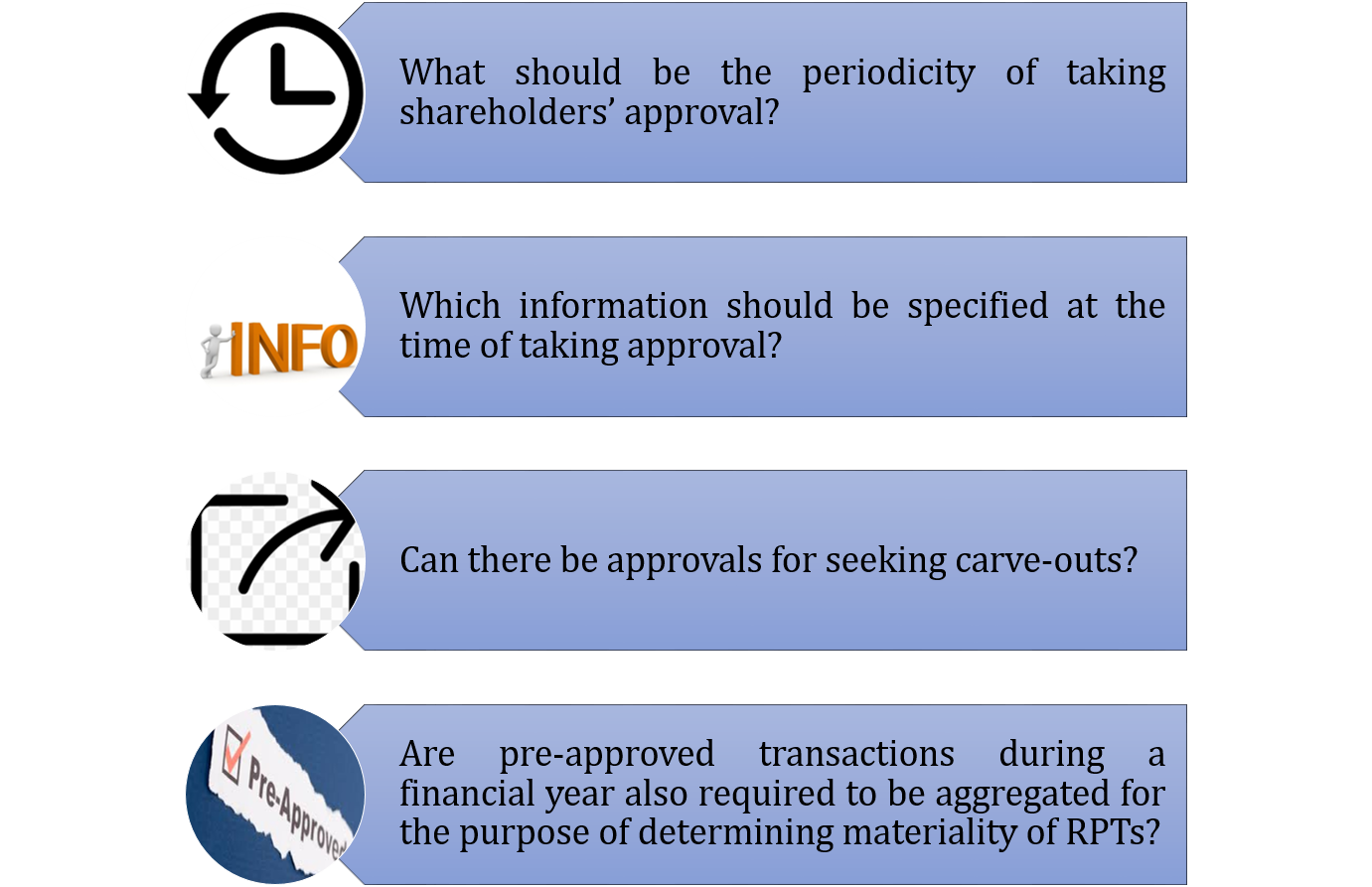
With the provisions coming into effect from 1st April, 2022, several questions need our special attention given the concept of prior approval. Some of them includes –

Detailed discussion on materiality thresholds of RPTs for obtaining shareholders’ approval has been dealt with in our article and can be read here. Further, you may refer to the detailed FAQs on amended LODR framework as amended by the 6th Amendment Regulations. In this article, we try to focus on the nitty-gritties around obtaining shareholders’ approval for material RPTs.

Periodicity of shareholders’ approval

While the shareholders’ approval is required to be taken prior to entering into a material RPT, the primary question lies as to the periodicity and validity of shareholders’ approval. Looking at the material thresholds given under the explanation to Regulation 23(1), it is beyond doubt that the approvals are required on an annual basis, since the transactions are aggregated on an annual basis for all the transactions entered during the financial year. Further, the basis for determining materiality is the annual consolidated turnover of the listed entity as per the last audited financial statements.

A related question arises on the approval by shareholders in case of material RPTs in the nature of multi-year contracts. In such cases, while the contract may involve series of transactions which continues in subsequent years in addition to the year in which it has been entered, the same contract is to be placed before the shareholders if the contractual value for the said FY exceeds the threshold with all the necessary details. Whether such executory contracts, being already approved by the shareholders in the year of execution, are required to be subsequently approved by the shareholders on the basis of materiality as per the consolidated turnover of preceding financial year? In our view, the answer should be in negative. Considering that a contract has already been approved by the shareholders, the same need not be placed before the shareholders in the subsequent years of its tenure, even if the same is material in any of those financial years. If a converse view is taken, it will lead to repetition of the information before the shareholders and does not serve any fruitful purpose. Therefore, it may be concluded that the shareholder’s approval for multi-year contracts are valid throughout even if the approval is taken in the first year when it being executed becomes material.

Here, it has to be noted that shareholders’ approval for a contract/ transaction will be required only if the same exceeds the materiality threshold on a yearly basis. In case a contract is not material for the year in which the contract is executed, but becomes material in subsequent years of execution on basis of consolidated turnover of relevant preceding financial year, approval for the same should be obtained in such financial year in which it becomes material.

Extent and adequacy of information to be placed before the shareholders

The next question that requires consideration is the extent of information that is required to be placed before the shareholders in order to enable them to take a reasoned decision for approving/disapproving the proposed RPT. SEBI Circular issued on 22nd November, 2021 (‘SEBI Circular’) provides guidance on the disclosures required to be made and we have briefly discussed on the same in our article which can be read here.

However, it has to be noted that all the information pertaining to the proposed RPT are not available with the company at the time of seeking shareholder’s approval. This is so because calling a shareholders’ meeting is a time-taking process and there might be time gaps between approval of an RPT and actual execution of the same, and some information may not be specified well in advance. Therefore, a more reasonable approach towards obtaining shareholders’ approval may be to specify such  quantum of information, as far as may be possible for the company to provide at the time of obtaining approval which is expected to be adequate to aid the shareholders in taking their decision.

The information pertaining to an RPT shall broadly include the following –

  1. Name of the parties to the transaction/ contract
  2. Nature of transaction/ contract
  3. Amount involved
  4. Terms of the transaction/ contract
  5. Duration/ span of the transaction/ contract

Below we consider some examples to check the obstacles that may arise on providing such disclosures at the time of practical implementation by a company, and the probable way-out for the same without breach of the provisions and intent of law.

1.     Amount involved in the transaction/ contract

Let us assume the case of issuance or subscription of bonds by a listed company. It may happen that a listed company, from time to time, issues short-term bonds to its group companies or promoters or directors etc. for meeting temporary funding requirements. The amount of funds raised by the company may not be presumed in advance and therefore, disclosure of the same will not be possible.

Consider the case of an even more floating arrangement, such as that of investment in securities through a stock broker, who is a related party or the maintenance of a savings or current account with a related party. The value of the transaction in each of these cases cannot be presumed, and therefore, the specific disclosure of the said information in such a scenario may become difficult.

Possible way to address the issue

A probable solution in such a scenario may be to disclose the estimated maximum amount of transactions to be entered into with the related parties, and the basis for reaching such estimates.

2.     Terms of the contract/ transaction

We again take the example of the loans proposed to be given by the holding company to its subsidiary. The time of granting such loans is not fixed at the time of taking shareholders’ approval. Considering that all transactions are required to be done on an arm’s length basis, the terms of the contract cannot be reasonably determined well in advance since the same will depend on the market conditions at the time of actual transaction taking place.

For example, at the time of granting loans, the relevant terms relating to the tenure of loans, rate of interest, prepayment penalty etc. has to be determined on the basis of the prevailing market rates at that point of time. Therefore, disclosure of the same cannot be possibly made before the shareholders at the time of obtaining approval for the same.

Possible way to address the issue

The shareholders resolution may specify that the terms and conditions of the proposed contract will be determined on an arm’s length basis, at the time of actual execution of the transaction. The responsibility of the shareholders is limited to the approval of an RPT on the basis of information placed. The judgement call as to verification of the arm’s length terms has to be made by the Audit Committee and the shareholders place reliance on the same. The shareholders’ approval for entering into a material RPT does not absolve the Audit Committee from examining the reasonableness and viability of the transaction, as to satisfaction of arm’s length basis.

3.     Duration/ span of the contract

Another information to be disclosed is with respect to the duration/ span for which a contract continues. Any RPT should not be approved for an infinite period, but a maximum duration/ span of the contract should be indicated in the statement seeking shareholders’ approval.

Carve-outs to shareholders’ approval

Having discussed the practicalities involved in obtaining shareholder’s approval, another matter that requires our attention is the possibility of a generic shareholders’ approval providing carve-outs from obtaining shareholders’ approval for each material RPT. By a generic approval, we mean approval sought from shareholders for proposed RPTs without specifying most or all of the information referred above. For example, a bank obtains approval from shareholders for providing banking services to one or more of its related parties on such terms and conditions as suitable on an arm’s length basis, in the ordinary course of business, for any amount as approved by the Audit Committee, irrespective of the same being in excess of the materiality thresholds under Regulation 23 of the Listing Regulations.

Note that the above resolution does not contain any of the details, such as, the name of the parties, amount involved, detailed terms, or the tenure of the contract. Even the nature of the contract is very generic and the specific services included under the broad term ‘banking services’ is not mentioned. More than an approval, the resolution seems to be an enabling resolution giving powers to the Audit Committee to approve any transaction with any related parties, subject to the same being in ordinary course of business of the bank, being banking services and on an arm’s length basis. It is imperative to note here that such sort of approvals are not Material RPTs in itself but an approval for carving out exclusions from the RPT approval process.

While one may doubt the admissibility of such resolutions, it has to be kept in mind that in the given case, a specific shareholders’ resolution specifying all the requisite information would not have been tenable. Similar justifications exist for an NBFC in the business of lending providing personal loans to its related parties at terms approved by the Audit Committee on an arm’s length basis. In our view, such carve-outs are admissible only when the RPT is in ordinary course of business at an arm’s length basis, otherwise entered into with the general public as well.

Pre-approved transactions beyond the scope of aggregation

Having obtained shareholders’ approval for material RPTs to be entered into with a related party, whether transaction of any value in excess of what has been approved, entered into with the same related party during the same financial year for which a material RPT has already been approved, will require approval of shareholders? Let us understand the same by way of an example.

Suppose X Ltd, a listed company, purchases coal from its associate company, B Ltd. On the basis of the production capacity of the company, X Ltd obtains an approval from the shareholders for purchase of coal upto a value of Rs. 1500 crores in the FY 2022-23 from B Ltd, its associate company, at prevailing market prices. Now, during the year 2022-23, B Ltd offers debentures of a value of Rs 50 lacs to X Ltd. In the instant case, the value of transaction involving subscription of debentures by X Ltd does not exceed materiality threshold, however, aggregating the same with the material RPT of Rs 1500 crores, the same becomes material.

Therefore, whether it can be said that entering into a material RPT with a related party, disqualifies a listed company from entering into a transaction of any value without obtaining prior approval of shareholders for the same, or whether one may take a view that pre-approved transactions are not required to be aggregated again for the purpose of determining materiality, and therefore RPTs of an immaterial value may be entered into with the approval of the Audit Committee, instead of placing the same before shareholders for their approval?

If one goes by the first alternative, it would mean that for parties with which a company has entered into a material RPT, no transaction can be undertaken without the approval of shareholders. On the contrary, considering that the material RPTs have already been pre-approved by the shareholders, one may safely take a view that approval of the shareholders need not be taken for the transaction entered into with the same related party in excess of the value or other than the nature of transactions for which approval has been taken by the shareholders. Transactions upto the materiality limits, excluding the pre-approved transactions may be taken care of by the Audit Committee instead of placing the same before shareholders, since the same falls within the authority of the committee.

Ratification of material RPTs without shareholders’ approval

A company cannot be expected to anticipate all the transactions/ contracts to be entered into with its related parties in advance. Therefore, there may be a possibility of any transaction having entered into with a related party by a listed company, resulting in exceeding the materiality thresholds, thereby, causing a violation of Regulation 23(4) of the Listing Regulations. In such circumstances, does the RPTs become void or can the same be ratified by the shareholders so as to keep the validity of the contracts intact?

The issue itself is not simple – there are several angles to the ratification principles. If the interests of shareholders is in question, the shareholders may ratify the breach of duty of the directors. However, if there is a question of creditors’ interest too, for example, funds borrowed from creditors have been hived off into an RPT, there is no question of ratification by shareholders. In a New Zealand ruling in Nicholson v Permakraft (NZ) Ltd [1985] 1 NZLR 242, it was held that the concurrence by the shareholders prevents any complaint by them, but compounds rather than excuses the breach as against creditors. Similarly, if there is question involving public policy, there can be no ratification.

In case of Material RPTs, the power to approve lies with the shareholders, who are not related parties to the company. While we discuss the power of ratification by shareholders, it has to be noted that the act, in itself, is not beyond the authority of the company. It is merely because of the apprehension of conflict of interest that the transaction required shareholders’ approval. Therefore, the shareholders had the authority, but the directors did not have the authority. If the shareholders, who had the original authority to approve the transaction, after due consideration of the relevant facts, decide to approve it, the approval dates back to the date on which the original act was done. This is backed by the age-old maxim: Omnis ratihabitio retrorahitur et mandato priori aequiparatur.  Section 196 of the Contract Act also incorporates the principle of ratification of the acts of an agent by the principal; in the context, the directors may be regarded as the agents of the company.

Therefore, if there is a ratification by shareholders, the legality of the contract is not disrupted; the contract may continue. Ratification of such RPTs cannot undo the violation of Reg 23(4) but avoid a continuing non-violation on the part of the company.

Our resource center on RPTs can be accessed here – https://vinodkothari.com/article-corner-on-related-party-transactions/

Provision w.r.t. higher additional fees notified by MCA | Effective July 1, 2022

corplaw@vinodkothari.com

Our resources on corplaw: https://vinodkothari.com/category/corporate-laws/

Auditors’ disqualification on account of business relationships: purport and scope

–  Neha Malu, Executive (corplaw@vinodkothari.com)

Background

Considering the key significance of auditors’ independence in ensuring the integrity of the statutory audit function, the Companies Act, 2013 (‘Act’) has prescribed several eligibility conditions, qualifications as well as disqualifications for their appointment. While there are several disqualifications under section 141, which includes indebtedness, provision of guarantee, conviction, etc. The existence of a “business relationship” between the auditor and auditee has also been stated as one of the prima facie disqualifying factors for a person to be appointed as an auditor in a company. It is significant to note that this disqualification was not there under the corresponding provisions of the Companies Act, 1956.

The relevant clause dealing with ‘business relationship’ is clause (e) of sub-section (3) of Section 141 of the Act. The clause (as reproduced below) has a wide coverage and includes all direct as well as indirect business relationships as under –

‘A person or a firm who, whether directly or indirectly, has business relationship with the company, or its subsidiary, or its holding or associate company or subsidiary of such holding company or associate company of such nature as may be prescribed shall not be eligible for appointment as an auditor of a company.’

Further, the meaning of the phrase ‘business relationship’ has been detailed out under sub-rule (4) of Rule 10 of the Companies (Audit and Auditors) Rules, 2014 (‘Rules’) which also carries certain carve-outs. In this article, we have tried to unbox the said carve-outs given for the existence of those business relationships which do and which do not lead to disqualifying the auditors from appointment.

Read more

Comments on proposed changes to the Corporate Insolvency Resolution and Liquidation Framework under Insolvency and Bankruptcy Code, 2016

– Team Resolution (resolve@vinodkothari.com)

On 23rd December, 2021, the Ministry of Corporate Affairs has issued proposed changes to the Corporate Insolvency Resolution and Liquidation Framework under Insolvency and Bankruptcy Code, 2016[1] and has solicited comments on the same.

While we discuss the proposed amendments in details below, a bird’s eye view of the proposed amendments gives an indication towards a more creditor-friendly approach, wherein the creditors have been bestowed with extended powers such as right to initiate insolvency proceedings, as well as have become less burdened with the the proposed amendment of only producing IU records at the time of application. At the same time, the roles and responsibilities of the RPs/liquidators seem to have been further widened by making RPs and liquidators also responsible for investigation of avoidance proceedings.

Other ancillary amendments like commencement of look-back back period, timeliness in approval of resolutions plans follow the trend of making the resolution process free of loopholes as and when they are identified.

Below we discuss the proposed amendments in detail –

Read more

Treatment of Lease Transactions under Insolvency and Bankruptcy proceedings

– Devika Agrawal and Anshit Aggrawal, Executive  (resolution@vinodkothari.com)

The determination of the nature of debt has been one of the primary tasks before a Resolution Professional/ Liquidator, and also for the stakeholders. The classification of debt is an important consideration since there exist only two types of debt under the Insolvency and Bankruptcy Code, 2016 (hereinafter referred to as “Code”), i.e., Operational Debt and Financial Debt, each with a significant set of rights and powers.

At the outset, one may think that the identification is a fairly simple job – loans and alike are financial debts, whereas those relating to supply of goods and services are operational in nature. Then, where does the confusion lie? The question of determination gains much importance for not-so-simple arrangements like lease transactions, which sit on the fence of being a financial transaction, and accordingly, the determination of financial versus operational nature will lead to consequent difference in rights and obligations.

In this article, the authors analyse the interface between the Code and lease transactions, and discuss the treatment of the leased assets or lease agreements/ transactions  under the Code.

Read more

Can companies donate out all their assets?

– Is sarvasva samarpan by companies valid?

Companies are creatures of their shareholders. If the company is a private company, the business and wealth of the company is the property of its shareholders. Technically, shareholders own the shares of the company, and certainly, a shareholder may donate his shares out. There are several iconic examples of such demonstrations of charitable intent, such as Mark Zuckerberg giving away 99% of his holdings in Facebook and Bill Gates donating 95% of his wealth to their charitable foundation and ultimately utilizing the same for charitable purposes.

However, can the shareholders resolve that the business and assets of the company that they own be donated out? Conceptually, there should be no difference between emptying out the assets of the company to the same charitable cause to which shareholders would have considered donating the shares. There are various judicial precedents[1] to refer to when it comes to checking the admissibility of a shareholder to transfer his shares by way of gift. However, in case of donation of shares, the company would remain up and running, and the charity will become simply the owner of the shares. However, if the business or assets of the company are donated out, that amounts to a mode of winding up, because the charity will not obviously run the business. So, can such donation be used as a mode of emptying the company out, so as to spend all its substratum, and once the company that empties out itself, it may just become a dud company, good for a strike off action u/s 248 (2) of the Companies Act, 2013 (‘Act’).

Surely enough, it will be unusual for the Memorandum of Association (‘MoA’) of the company to have the power to donate all its assets out. Normally, MoA will have charity as one of the incidental powers, but incidental powers can only be used in furtherance of the business or in conjunction thereof. There is no question of using incidental powers to donate the business out itself. So, can a corporate entity take such a drastic action, as to donate out all assets? And if yes, what will be the modality of doing the same? Also, what happens to the donee?

We have started with the donee being a charity. By way of argument, if one could donate all assets out to a charity, one can do it even to another entity. However, there may be taxation implications in that case, also discussed in this article.

Permissibility for a corporate person to make gifts

A doubt may arise as to whether a company, being a corporate person, can make a gift. Before answering that question, let us first understand the legality of making gifts. As per Section 25 of the Indian Contract Act, 1972, a contract without consideration is void. The same is also contemplated through the latin maxim ex nudo pacto nor oritur action meaning ‘a contract without consideration is void’. Here the adequacy of the consideration is not necessary and only the presence of the same suffice the requirement for constituting a valid contract.

However, Section 25 provides certain exceptions under which a contract is valid even if the same is not backed by consideration, which are –

  1. A written and registered document made on account of natural love and affection between the parties, i.e., a gift
  2. Compensation for voluntary services given by the recipient in the past
  3. Time barred debt

Explanation 1. —Nothing in this section shall affect the validity, as between the donor and donee, of any gift actually made.

Now given the fact that one can make gifts to the other, however, in the context of of a corporate person, the component of natural love and affection cannot be said to be present. The same was a question raised for determination before the ITAT – Mumbai bench in the matter of KDA Enterprises Pvt. Ltd., Mumbai vs Department Of Income Tax, ITA No.2662/M/2013, where both the donor as well as the donee were companies. In the matter of KDA Enterprises (supra), the AO was of the view that gifts can be given only by natural persons and therefore, a gift by a company is not tenable[2], against which, an appeal was preferred by the Company. However, the ITAT shifted the attention of the contended AO to the explanation u/s 25 of the Contract Act which states that the section does not have any effect on the validity of the gifts between donor and donee.

The AO, in the instant case, had further submitted that no gift deed has been executed, which is again, not a prerequisite for a valid gift. Here, one may refer to the definition of gift given under Section 122 of the Transfer of Property Act, 1822, which defines gift as –

“Gift is the transfer of certain existing moveable or immoveable property made voluntarily and without consideration, by one person, called the donor, to another, called the donee, and accepted by or on behalf of the donee.”

From the above definition, the three essential components of gift can be noted –

  1. Transfer or delivery of property
  2. Voluntary, i.e., with a donative intent
  3. Acceptance by donee

The aforementioned components of a gift may be present in case of a company as a donee and therefore, the contention of the AO that the transfer is not a gift on the basis of either of the grounds does not survive merit consideration.

In view of the above, the ITAT in the matter of KDA Enterprises (supra), has allowed the admissibility of gift by a company to a company and held that –

“… the companies are competent to receive and make gifts. All the three requirements of a valid gift, viz. identity of the donor, capacity/source and the genuineness stands proved in the case of the assessee. All the donor companies and the assessee are authorized by their Memorandum and Articles of Association for giving and receiving gifts. Proper resolutions in the Board Meeting have been passed by all the four companies for making the gift to the assessee and assessee has also accepted the said gifts by way of adopting a resolution in the meeting of Board of Directors.” [Emphasis supplied]

In another similar case of D.P. World Pvt. Ltd. vs. DCIT, ITA No. 3627, which related to the gift of shares made by a company to another, the view was upheld that a company can make a gift. The relevant extract is reproduced below –

“It would not be out of place to mention that a combined reading of Sec. 82 of the Companies Act, Section 5 and Section 122 of the TPA suggest that a company can validly transfer the shares by way of gift, provided where Articles of Association of the donor company permits the same. In case of donor is a foreign company, the relevant corporate/commercial law of the jurisdiction where the donor is based needs to be considered. In the light of the above discussion, we have no hesitation to hold that a company can gift shares and such transaction may appear as ‘strange’ transaction but cannot be treated as “non – genuine” transaction.” [Emphasis supplied]

Power of shareholders regarding disposal of all assets of a company

While the Act does permit the disposal of assets of a significant value in the company after obtaining shareholders’ approval, however, the shareholders’ authority cannot extend beyond the MoA of the company. Where the disposal of assets has the effect of impacting the going concern status of the company, the same cannot be done without express authorization for the same in the MoA of the company. This is evident from the rulings cited above as well, since in each of the said rulings, the company(ies) had express authority for making/ receiving gifts/donations through its/their MoA.

Points for consideration in case of disposal of entire assets of a company as a gift/donation

The above discussions clearly entail that a company is competent enough to make and/or receive gifts and/or donations. Having said that, consider the case of a company which wants to dispose off all its assets by way of donations/ gifts. The following points are significant to be considered while making the gift / donation:
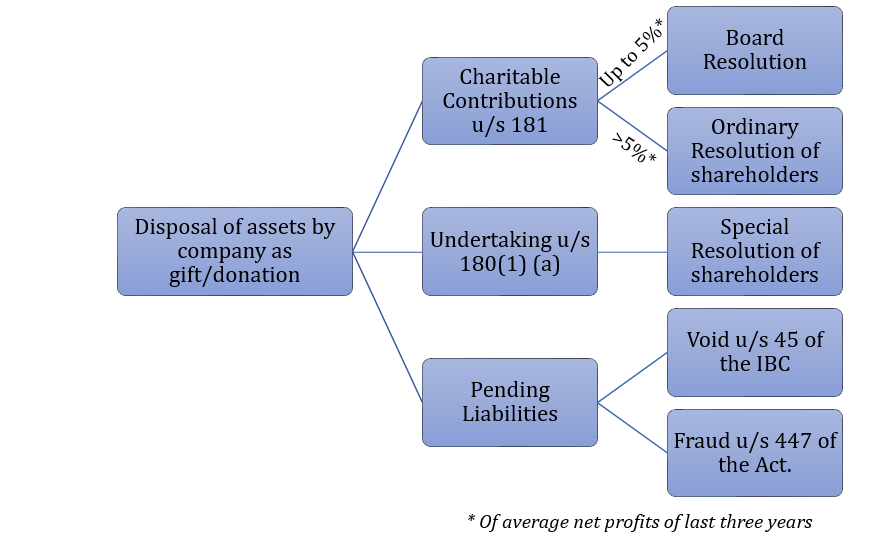
  • Board’s / shareholder’s power to make charitable contributions u/s 181 of the Companies Act (‘Act’)

The Act recognizes the power of directors to make contributions to bona fide charitable and other funds u/s 181 of the Act, subject to the shareholders’ approval if the same exceeds 5% of the preceding three years’ average net profits.

  • Disposal of undertaking u/s 180(1) (a) of the Act

Section 180(1)(a) of the Act restricts the powers of the board with respect to disposal of substantial undertaking(s) of a company. It requires shareholders’ consent by way of a special resolution in order to dispose of the whole or substantially the whole of undertakings of the company.

For the purposes of the said sub-section, undertaking would mean an undertaking in which the company’s investments exceed 20% of its net worth or which generates income equal to 20% or more of the total income of the company. ‘Substantial’ part of undertaking would mean 20% or more of the undertaking of the company.

Further, undertaking has not been defined under the Act and its meaning can be taken from the provisions of the Income Tax Act, 1961 (‘IT Act’). The explanation to Section 2(19AA) of the IT Act, defines undertaking as –

“undertaking shall include any part of an undertaking, or a unit or division of an undertaking or a business activity taken as a whole, but does not include individual assets or liabilities or any combination thereof not constituting a business activity.”

 In a case where a company wishes to donate all its assets, it definitely calls for taking approval of the shareholders and in fact considering the disposal of the entire assets, the unanimous approval from the shareholders should rule out any defiance from a third party.

  • Disposal of assets without cleaning of liabilities may attract section 45 of the IBC and 447 of the Act

While there may be no bar on the disposal of all the assets of a company, thereby leading it to dissolution, the same can be done only after all the external liabilities have been paid. Where a company has disposed off all its assets for free, without settlement of the external liabilities, the same may amount as an undervalued transaction under Section 45  of the Insolvency and Bankruptcy Code, 2016 (‘IBC’), and may be rendered void and therefore, directed to be reversed.

Done with the intent to defraud the creditors, the same also attracts the provision of Section 447 of the Act and imposes mandatory imprisonment on the person guilty of such offence.

Impact of disposal of all assets of a company

The disposal of all the assets of the company leads to the loss of substratum of the company. In the matter of Mohan Lal & Anr vs Grain Chamber Ltd, 1968 SCR (2) 252, “Substratum of the Company is said to have disappeared when the object for which it was incorporated has substantially failed, or when it is impossible to carry on the business of the Company except at a loss, or the existing and possible assets are insufficient to meet the existing liabilities.” This, in turn, becomes a ‘just and equitable ground’ u/s 271 for winding up of the company.

In another matter of Rajan Naginds Doshi And Anr. vs British Burma Petroleum Co. Ltd, 1972 42 CompCas 197 Bom, the Bombay High Court held that –

“…. the company has ceased to carry on business, its substratum is gone, it has carried on ultra vires business and that the said business has been carried on by meddlers and that it will be just and equitable that the company should be wound up.”

However, as per Section 274(2) of the Act, a petition for winding up on the basis of just and equitable grounds can be dismissed by the Tribunal if it is of the opinion that a remedy other than winding up is available to the petitioners and seeking winding up of the company is unreasonable.

Tax implications on gifts/donations

Gifts and donations are not prohibited to be made by the companies, rather regulated and made taxable over and above the specified limits. The provisions of IT Act by way of certain clauses of Section 56, provides for taxability in case of transfer of shares without consideration, over and above a specified amount. Similarly, Section 80G of the IT Act also permits various donations and voluntary contributions.

  • No capital gains

Any transfer of a capital asset under a gift or to an irrevocable trust is an exempted transfer under section 47(iv) of the IT Act, and therefore, not taxable as capital gains. However, reference may be made of the ruling of Madras High Court in the matter of Principal Commissioner Of Income Tax vs M/S.Redington (India) Limited, T.C.A.Nos.590 & 591 of 2019, in which, on the facts of the case it was found that the transfer of shares, camouflaged in the nature of a gift made to its subsidiary, is actually an attempt of corporate restructuring and does not include the necessary elements of a gift (para 6).

The receipt/giving of such gifts/donations cannot be said to be related to the business of an assessee and therefore, cannot be made taxable as profits and gains of business or profession (refer cases above).

  • Chargeability as income from other sources

Section 56 of the IT Act admits taxability of certain gifts (both movable and immovable) without consideration beyond a specified limit. As per clause (x) of Section 56, gifts (cash/movable property/immovable property) is not taxable upto a certain threshold, being Rs. 50 lacs. Over and above the specified limit, gifts are taxable as ‘income from other sources’ except when the same qualifies as an exception under the proviso to the said clause. Here also, benefits can be availed by a trust or an organisation registered under Section 12A, 12AA or 12AB or u/s 10(23C) for charitable or religious purposes.

Concluding Remarks

Disposal of all assets of a company does not seem to be prohibited and can be sought as a good means of providing closure to the business, subject to the same being authorised through the charter documents and sanctioned through shareholders’ consent. However, the same should not be designed as a ‘tax avoidance’ exercise, since if the malicious intent becomes evident, it may attract payment of taxes along with fine and penalty and may even lead to prosecution based on the severity of the case.

[1] Manjula Finance Ltd., New Delhi vs Ito, Ward-16(2), New Delhi

Direct Media Distribution … vs Pr.Cit – Range -6, Mumbai


[2] The sin qua non of a gift is that the transaction is without any consideration and out of natural love and affection, as held in various judicial pronouncements. Since company is an artificial judicial person, so there cannot be any natural love & affection by a company or between the companies. Hence, a transaction of gift cannot be said to be valid or legally tenable between companies or where one of the parties is a company.”


Circulation of credit information: RBI notification paves the way for “Specified Users”

– Team Finserv | finserv@vinodkothari.com

Background

One of the important elements of the lending process is credit evaluation of customers, which involves referring to the credit information of such customers. Credit information is the information relating to credit performance or credit worthiness of the customer. Procurement, storage and distribution of such credit information is regulated by the Credit Information Companies (Regulation) Act, 2005 (‘Act’)[1] and the regulations made thereunder. Read more

NHB Master Circular on HFC Returns

– Team Finserv | finserv@vinodkothari.com

Relevant Links:

  1. NHB Master Circular dated December 31, 2021
  2. Formats of the returns and statements specified in the Master Circular
  3. ORMIS Portal
  4. HFC Manual for filing on ORMIS Portal
  5. Master Direction – Non-Banking Financial Company – Housing Finance Company (Reserve Bank) Directions, 2021