


 Reload document
  Open in new tab
 The nitty-gritty of shareholders’ approval for material RPTs
– A guide for practical implementation under the revised LODR framework
– Team Vinod Kothari and Company; corplaw@vinodkothari.com
Regulation 23(4) of the Listing Regulations require all material related party transactions (‘Material RPTs’) to be approved by the shareholders of the listed entity. With the commencement of the LODR (Sixth Amendment) Regulations, 2021 (‘6th Amendment Regulations’), the term ‘prior’ has been inserted before the term ‘approval’ thereby requiring prior approval of shareholders for Material RPTs.
With the provisions coming into effect from 1st April, 2022, several questions need our special attention given the concept of prior approval. Some of them includes –
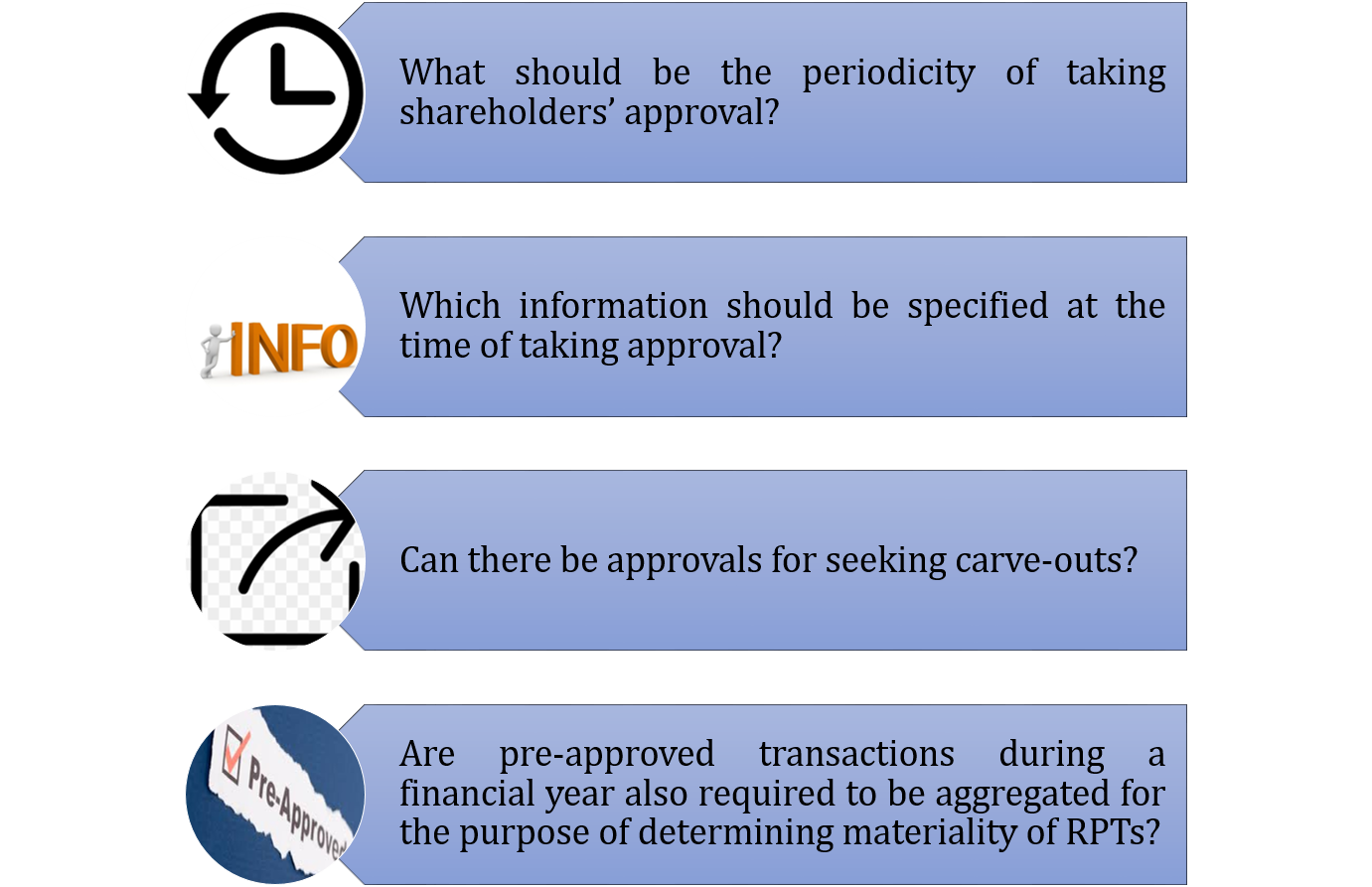
Detailed discussion on materiality thresholds of RPTs for obtaining shareholders’ approval has been dealt with in our article and can be read here. Further, you may refer to the detailed FAQs on amended LODR framework as amended by the 6th Amendment Regulations. In this article, we try to focus on the nitty-gritties around obtaining shareholders’ approval for material RPTs.
Periodicity of shareholders’ approval
While the shareholders’ approval is required to be taken prior to entering into a material RPT, the primary question lies as to the periodicity and validity of shareholders’ approval. Looking at the material thresholds given under the explanation to Regulation 23(1), it is beyond doubt that the approvals are required on an annual basis, since the transactions are aggregated on an annual basis for all the transactions entered during the financial year. Further, the basis for determining materiality is the annual consolidated turnover of the listed entity as per the last audited financial statements.
A related question arises on the approval by shareholders in case of material RPTs in the nature of multi-year contracts. In such cases, while the contract may involve series of transactions which continues in subsequent years in addition to the year in which it has been entered, the same contract is to be placed before the shareholders if the contractual value for the said FY exceeds the threshold with all the necessary details. Whether such executory contracts, being already approved by the shareholders in the year of execution, are required to be subsequently approved by the shareholders on the basis of materiality as per the consolidated turnover of preceding financial year? In our view, the answer should be in negative. Considering that a contract has already been approved by the shareholders, the same need not be placed before the shareholders in the subsequent years of its tenure, even if the same is material in any of those financial years. If a converse view is taken, it will lead to repetition of the information before the shareholders and does not serve any fruitful purpose. Therefore, it may be concluded that the shareholder’s approval for multi-year contracts are valid throughout even if the approval is taken in the first year when it being executed becomes material.
Here, it has to be noted that shareholders’ approval for a contract/ transaction will be required only if the same exceeds the materiality threshold on a yearly basis. In case a contract is not material for the year in which the contract is executed, but becomes material in subsequent years of execution on basis of consolidated turnover of relevant preceding financial year, approval for the same should be obtained in such financial year in which it becomes material.
Extent and adequacy of information to be placed before the shareholders
The next question that requires consideration is the extent of information that is required to be placed before the shareholders in order to enable them to take a reasoned decision for approving/disapproving the proposed RPT. SEBI Circular issued on 22nd November, 2021 (‘SEBI Circular’) provides guidance on the disclosures required to be made and we have briefly discussed on the same in our article which can be read here.
However, it has to be noted that all the information pertaining to the proposed RPT are not available with the company at the time of seeking shareholder’s approval. This is so because calling a shareholders’ meeting is a time-taking process and there might be time gaps between approval of an RPT and actual execution of the same, and some information may not be specified well in advance. Therefore, a more reasonable approach towards obtaining shareholders’ approval may be to specify such quantum of information, as far as may be possible for the company to provide at the time of obtaining approval which is expected to be adequate to aid the shareholders in taking their decision.
The information pertaining to an RPT shall broadly include the following –
- Name of the parties to the transaction/ contract
- Nature of transaction/ contract
- Amount involved
- Terms of the transaction/ contract
- Duration/ span of the transaction/ contract
Below we consider some examples to check the obstacles that may arise on providing such disclosures at the time of practical implementation by a company, and the probable way-out for the same without breach of the provisions and intent of law.
1. Amount involved in the transaction/ contract
Let us assume the case of issuance or subscription of bonds by a listed company. It may happen that a listed company, from time to time, issues short-term bonds to its group companies or promoters or directors etc. for meeting temporary funding requirements. The amount of funds raised by the company may not be presumed in advance and therefore, disclosure of the same will not be possible.
Consider the case of an even more floating arrangement, such as that of investment in securities through a stock broker, who is a related party or the maintenance of a savings or current account with a related party. The value of the transaction in each of these cases cannot be presumed, and therefore, the specific disclosure of the said information in such a scenario may become difficult.
Possible way to address the issue
A probable solution in such a scenario may be to disclose the estimated maximum amount of transactions to be entered into with the related parties, and the basis for reaching such estimates.
2. Terms of the contract/ transaction
We again take the example of the loans proposed to be given by the holding company to its subsidiary. The time of granting such loans is not fixed at the time of taking shareholders’ approval. Considering that all transactions are required to be done on an arm’s length basis, the terms of the contract cannot be reasonably determined well in advance since the same will depend on the market conditions at the time of actual transaction taking place.
For example, at the time of granting loans, the relevant terms relating to the tenure of loans, rate of interest, prepayment penalty etc. has to be determined on the basis of the prevailing market rates at that point of time. Therefore, disclosure of the same cannot be possibly made before the shareholders at the time of obtaining approval for the same.
Possible way to address the issue
The shareholders resolution may specify that the terms and conditions of the proposed contract will be determined on an arm’s length basis, at the time of actual execution of the transaction. The responsibility of the shareholders is limited to the approval of an RPT on the basis of information placed. The judgement call as to verification of the arm’s length terms has to be made by the Audit Committee and the shareholders place reliance on the same. The shareholders’ approval for entering into a material RPT does not absolve the Audit Committee from examining the reasonableness and viability of the transaction, as to satisfaction of arm’s length basis.
3. Duration/ span of the contract
Another information to be disclosed is with respect to the duration/ span for which a contract continues. Any RPT should not be approved for an infinite period, but a maximum duration/ span of the contract should be indicated in the statement seeking shareholders’ approval.
Carve-outs to shareholders’ approval
Having discussed the practicalities involved in obtaining shareholder’s approval, another matter that requires our attention is the possibility of a generic shareholders’ approval providing carve-outs from obtaining shareholders’ approval for each material RPT. By a generic approval, we mean approval sought from shareholders for proposed RPTs without specifying most or all of the information referred above. For example, a bank obtains approval from shareholders for providing banking services to one or more of its related parties on such terms and conditions as suitable on an arm’s length basis, in the ordinary course of business, for any amount as approved by the Audit Committee, irrespective of the same being in excess of the materiality thresholds under Regulation 23 of the Listing Regulations.
Note that the above resolution does not contain any of the details, such as, the name of the parties, amount involved, detailed terms, or the tenure of the contract. Even the nature of the contract is very generic and the specific services included under the broad term ‘banking services’ is not mentioned. More than an approval, the resolution seems to be an enabling resolution giving powers to the Audit Committee to approve any transaction with any related parties, subject to the same being in ordinary course of business of the bank, being banking services and on an arm’s length basis. It is imperative to note here that such sort of approvals are not Material RPTs in itself but an approval for carving out exclusions from the RPT approval process.
While one may doubt the admissibility of such resolutions, it has to be kept in mind that in the given case, a specific shareholders’ resolution specifying all the requisite information would not have been tenable. Similar justifications exist for an NBFC in the business of lending providing personal loans to its related parties at terms approved by the Audit Committee on an arm’s length basis. In our view, such carve-outs are admissible only when the RPT is in ordinary course of business at an arm’s length basis, otherwise entered into with the general public as well.
Pre-approved transactions beyond the scope of aggregation
Having obtained shareholders’ approval for material RPTs to be entered into with a related party, whether transaction of any value in excess of what has been approved, entered into with the same related party during the same financial year for which a material RPT has already been approved, will require approval of shareholders? Let us understand the same by way of an example.
Suppose X Ltd, a listed company, purchases coal from its associate company, B Ltd. On the basis of the production capacity of the company, X Ltd obtains an approval from the shareholders for purchase of coal upto a value of Rs. 1500 crores in the FY 2022-23 from B Ltd, its associate company, at prevailing market prices. Now, during the year 2022-23, B Ltd offers debentures of a value of Rs 50 lacs to X Ltd. In the instant case, the value of transaction involving subscription of debentures by X Ltd does not exceed materiality threshold, however, aggregating the same with the material RPT of Rs 1500 crores, the same becomes material.
Therefore, whether it can be said that entering into a material RPT with a related party, disqualifies a listed company from entering into a transaction of any value without obtaining prior approval of shareholders for the same, or whether one may take a view that pre-approved transactions are not required to be aggregated again for the purpose of determining materiality, and therefore RPTs of an immaterial value may be entered into with the approval of the Audit Committee, instead of placing the same before shareholders for their approval?
If one goes by the first alternative, it would mean that for parties with which a company has entered into a material RPT, no transaction can be undertaken without the approval of shareholders. On the contrary, considering that the material RPTs have already been pre-approved by the shareholders, one may safely take a view that approval of the shareholders need not be taken for the transaction entered into with the same related party in excess of the value or other than the nature of transactions for which approval has been taken by the shareholders. Transactions upto the materiality limits, excluding the pre-approved transactions may be taken care of by the Audit Committee instead of placing the same before shareholders, since the same falls within the authority of the committee.
Ratification of material RPTs without shareholders’ approval
A company cannot be expected to anticipate all the transactions/ contracts to be entered into with its related parties in advance. Therefore, there may be a possibility of any transaction having entered into with a related party by a listed company, resulting in exceeding the materiality thresholds, thereby, causing a violation of Regulation 23(4) of the Listing Regulations. In such circumstances, does the RPTs become void or can the same be ratified by the shareholders so as to keep the validity of the contracts intact?
The issue itself is not simple – there are several angles to the ratification principles. If the interests of shareholders is in question, the shareholders may ratify the breach of duty of the directors. However, if there is a question of creditors’ interest too, for example, funds borrowed from creditors have been hived off into an RPT, there is no question of ratification by shareholders. In a New Zealand ruling in Nicholson v Permakraft (NZ) Ltd [1985] 1 NZLR 242, it was held that the concurrence by the shareholders prevents any complaint by them, but compounds rather than excuses the breach as against creditors. Similarly, if there is question involving public policy, there can be no ratification.
In case of Material RPTs, the power to approve lies with the shareholders, who are not related parties to the company. While we discuss the power of ratification by shareholders, it has to be noted that the act, in itself, is not beyond the authority of the company. It is merely because of the apprehension of conflict of interest that the transaction required shareholders’ approval. Therefore, the shareholders had the authority, but the directors did not have the authority. If the shareholders, who had the original authority to approve the transaction, after due consideration of the relevant facts, decide to approve it, the approval dates back to the date on which the original act was done. This is backed by the age-old maxim: Omnis ratihabitio retrorahitur et mandato priori aequiparatur. Section 196 of the Contract Act also incorporates the principle of ratification of the acts of an agent by the principal; in the context, the directors may be regarded as the agents of the company.
Therefore, if there is a ratification by shareholders, the legality of the contract is not disrupted; the contract may continue. Ratification of such RPTs cannot undo the violation of Reg 23(4) but avoid a continuing non-violation on the part of the company.
Our resource center on RPTs can be accessed here – https://vinodkothari.com/article-corner-on-related-party-transactions/
SEBI notifies stricter norms for appointment of rejected candidates
– CS Aisha Begum Ansari, Manager | aisha@vinodkothari.com | Last updated as on January 24, 2022
SEBI vide notification dated January 24, 2022 has notified SEBI (Listing Obligations and Disclosure Requirements) (Amendment) Regulations, 2022 (‘Amendment Regulations’) applicable with immediate effect. With this amendment, SEBI has introduced provisions relating to appointment/ re-appointment of a person, including Managing Director (‘MD’) or Whole-Time Director (‘WTD’) or a manager who were earlier rejected by the shareholders at a general meeting.
Last year in January 27, 2021, SEBI issued a Consultation Paper for introducing provisions for appointment or re-appointment of persons who fail to get elected as MD or WTD at the general meeting of a listed entity (‘Consultation Paper’) to curb the practice followed by certain listed entities of passing separate resolutions for regularization of additional directors and for appointment of MD/ WTD. In cases where the latter resolution is not approved by the shareholders, the listed entities used to again appoint the same person as MD/WTD who could hold office until the same was again taken to the shareholders for approval at the next general meeting. The proposed amendments were also approved by SEBI in its Board meeting, however, with certain modifications.
This article discusses the procedure prescribed in the Consultation Paper and ascertains the compliance requirement to be ensured by the listed entity before appointing any director.
Consultation Paper limited the restriction to MD & WTD
In view of instances where the listed entities appointed the persons rejected by shareholders for appointment as MD/WTD by having two separate resolutions for regularization of additional director and for appointment of MD/ WTD, SEBI prescribed following stricter requirements for appointment of such rejected candidates, to ensure that no such appointments are made by the listed entity against the will of the shareholders and against the spirit of corporate governance:
- Justification by NRC as to why such appointment, despite rejection by shareholders, is recommended;
- Recording of reasons by the Board of Directors while approving the appointment, despite rejection by shareholders;
- Disclosure to the Stock exchange within 24 hours of approval by Board along with recommendations of NRC;
- Obtaining shareholder’s approval in the next general meeting or within 3 months from the date of such appointment, whichever is earlier (Requirement already implemented pursuant to insertion of Reg. 17 (1C) for appointment of directors made on or after January 1, 2022).
- Disclosure in the explanatory statement of the detailed explanation and recommendation from the NRC and the Board as to why such appointment is placed before the shareholders despite the earlier rejection by the shareholders.
- Mandatory cooling off period of next 2 years from being appointed or continuing as a director if the candidature of the person is rejected again by the shareholders.
Amendment in the Listing Regulations
Scope expanded to all directors and managers
While the Consultation Paper prescribed the requirement only for appointment of MD/ WTD, the Amendment Regulations cover all the directors and managers within its scope. Further, in view of enforcement of Reg. 17 (1C) of the Listing Regulations w.e.f. January 1, 2022, SEBI prescribed seeking prior approval of shareholders, being a stricter timeline than that proposed in the Consultation Paper.
Thus, the sequence will be as follows:

Rejection by the shareholders of which entity?
The language of the Consultation Paper and the Amendment Regulations clearly indicates that while considering the re-appointment of a person as a director, including MD/ WTD/ manager, the listed entity will have to see the rejection of such person by its own shareholders and not the shareholders of other listed entities.
History of rejection of person as a director, including MD/ WTD/ manager
The Consultation Paper as well as the Amendment Regulations emphasize on the procedure for re-appointment of a person who has been rejected by the shareholders. However, it does not provide any specific period upto which a company has to travel back to examine the rejection of such person. For instance, if a person’s candidature for appointment as a director was rejected by the shareholders ten years back, should the same be considered if the company intends to appoint him on the board of the company today? Further, should a company carry out due diligence to dig out the history of the appointee or seek declaration from to this effect from the appointee? Since, the Consultation Paper and the Amendment Regulations are silent on the above questions, the listed entity will be required to travel back to examine if the appointment of person was ever rejected by the shareholders in the lifetime of the listed entity.
Category for which a person was earlier rejected not relevant
The intent of the Consultation Paper was to counter the practice of the companies to re-appoint a person as MD/ WTD who was rejected by the shareholders for the same position, by providing stricter procedural requirements. In view of the restriction provided under the Amendment Regulations, it implies that the restriction is not only on appointment of person in the same category for which he was rejected but for appointment in any category of directorships or as manager. For e.g. if the candidature of a person was rejected for appointment as an MD, the requirement of prior approval will apply for appointment as NED as well.
Conclusion
The Board of Directors are primarily responsible for ensuring Corporate Governance and SEBI is determined to revisit and refine the process of appointment of directors by prescribing stricter norms in terms of process adopted for selection of candidates, disclosure requirements, timeline for seeking shareholder’s approval etc. Due to the Amendment Regulations, the listed entity will have one more actionable i.e. to carry out due diligence to ascertain if the candidature of the proposed appointee was ever rejected by the shareholders of the listed entity.
Our write-ups:
- Snapshot of SEBI approvals – Public issues | Preferential allotments | Appointment of shareholder-rejected directors – click here
- A Regulatory Affair: Fair Value Discovery in Preferential Share Issues – click here
- Other write-ups on Corporate Law matters – click here
SEBI approves amendments – Public issues | Preferential allotments | Appointment of shareholder-rejected directors
Amendments approved in various SEBI Regulations
– Team Corplaw | corplaw@vinodkothari.com
SEBI Press Release dated December 28, 2021 – click here
Our write-ups:
- SEBI approves stricter norms for appointment of rejected candidates – click here
- A Regulatory Affair: Fair Value Discovery in Preferential Share Issues – click here
- Other write-up on Corporate Law matters – click here
LODR changes on Independent Directors – Things to do before 1st Jan., 2022
– CS Aisha Begum Ansari | CS Pieyusha Sharma | corplaw@vinodkothari.com
SEBI (LODR) (3rd Amendment) Regulations, 2021 | Corrigendum dated August 6, 2021
NSE Circular dated December 22, 2021 | BSE Circular dated December 22, 2021
Detailed write-ups:
1.Recent amendments relating to independent directors
2.SEBI notifies substantial amendments in Listing Regulations
SEBI’s informal guidance offers temporary escape from impossibility
– HVDLE guided to explain and not comply!
Anushka Vohra | Manager (corplaw@vinodkothari.com)
Introduction
Recently, SEBI rolled out stricter corporate governance (CG) norms for entities having its non-convertible debt security listed and having an outstanding value of Rs. 500 crore and above as on March 31, 2021 [referred as High Value Debt Listed Entities (HVLDEs)[1]]. One of CG norms applicable is to comply with the requirements that apply with respect to Related Party Transactions (RPTs). The approval requirement, stipulated for material RPTs mandates approval of shareholders and prohibits related parties to vote to approve the transaction. The intent of the law is to ensure approval by shareholders who are not related parties. As HVDLEs include private companies and closely held public companies that must have listed its debentures, this requirement resulted in an impossibility and deadlock. On being approached by one such entity, SEBI suggested a temporary carve out by advising ‘to explain’ and ‘not comply’.
On December 16, 2021, SEBI issued an informal guidance[2] under SEBI (Listing Obligations and Disclosure Requirements) Regulations, 2015 (Listing Regulations) relating to the applicability of CG requirements on HVLDEs.
Pursuant to the fifth amendment of the Listing Regulations, notified on September 07, 2021[3], the applicability of CG norms were extended to entities with non-convertible debt securities listed and the outstanding amount being Rs. 500 cr or more. While the provisions became applicable from September 07, 2021 the same was implemented on a ‘comply or explain’ basis until March 31, 2023. Accordingly, an HVDLE is expected to endeavour to comply with the provisions and achieve full compliance by March 31, 2023. In case the HVDLE is not able to achieve full compliance with the provisions, till such time, it shall explain the reasons for such non-compliance/ partial compliance and the steps initiated to achieve full compliance in the quarterly compliance report filed under clause (a), sub-regulation (2) of regulation 27 of these regulations.
RPTs by HVDLEs
An HVDLE, that were not equity listed, were only required to comply with Companies Act, 2013 (CA, 2013) requirements for the purpose of transacting with related parties. While CA, 2013 also provides for similar restrictions, it provides a carve out in case of closely held companies. The restriction of related parties not to vote in favor of a resolution, does not apply where ninety per cent. or more members, in number, are relatives of promoters or are related parties. However, there is no such carve out provided in Regulation 23 (4) of the Listing Regulations.
The present case
India Infradebt Limited (IIL), a joint venture company and an HVDLE, realised about this deadlock situation as all the shareholders, being venturers, were related parties in terms of Section 2 (76) of CA, 2013. Therefore, it approached SEBI seeking informal guidance for the procedure to be followed for obtaining shareholders’ approval in case of material RPTs.
SEBI provided a stop-gap solution and stated that in view of the ‘inherent difficulty’ by IIL in getting shareholders’ approval for material RPTs, it may choose to explain the reason for not complying.
Conclusion
A pertinent question that arises from the informal guidance and which has not been dealt with, is whether the HVLDEs that are closely held companies, be expected to be on the same pedestal as that of equity listed entities. Even if they are supposed to be, it cannot continue to explain for not complying as from April 1, 2023 these provisions will become mandatory and violation of the same will attract penalties from the stock exchanges.
Further, the RPT provision has been drastically amended and becomes effective from April 1, 2022[4]. The scope of related party and RPT has been widened and the threshold for material RPT has also been amended to impose a numerical threshold of Rs. 1000 crore along with the existing threshold of 10% of annual consolidated turnover. Additionally, the requirement to seek shareholder’s approval will be ‘prior’ to breaching the materiality thresholds.
Therefore, several HVDLEs may be required to seek shareholder’s approval for prospective transactions. SEBI should consider incorporating a carve out similar to that provided under CA, 2013 for closely held HVDLEs in Regulation 23 (4) of the Listing Regulations in order to resolve the issue permanently.
[1] Refer our write up at https://www.moneylife.in/article/bond-issuers-facing-disproportional-compliances-on-corporate-governance-as-sebi-move-nullifies-mca-exemption/65132.html
[2] https://www.sebi.gov.in/sebi_data/commondocs/dec-2021/SEBI%20Informal%20guidance%20letter%20to%20India%20Infradebt%20Limited%20-%20December%2016,%202021.pdf
[3] https://www.sebi.gov.in/legal/regulations/sep-2021/securities-and-exchange-board-of-india-listing-obligations-and-disclosure-requirements-fifth-amendment-regulations-2021_52488.html
[4] Refer our write up here:https://vinodkothari.com/article-corner-on-related-party-transactions/
Round-up of regulatory updates during 2021
We have attempted to collate all major regulatory amendments notified throughout the year, with our resources on the same. Below we present a regulatory round-up for the year 2021, be it for MCA, SEBI, RBI or the like, along with the links to our major articles/ FAQs on the same.
Our youtube video giving a quick view on the same can be accessed at – https://www.youtube.com/watch?v=WJbJx2jgK9A
This version: 4th December, 2021
New Materiality Threshold for RPTs: Nagging questions on shareholder approval
Vinita Nair and Sikha Bansal
Related Party Transactions (RPTs) are perceived as potential tools for unjust enrichment of those in fiduciary capacity. Hence, the stock market regulator has recently revamped RPT norms (most of which are to take effect from 1st April, 2022 though) intending to have a greater scrutiny on RPTs. Among all the measures, one is revision in threshold for ‘materiality’, and second is, ‘prior’ approval of shareholders for all such material RPTs. Materiality is now fixed as a value above – (i) INR 1000 crores, or (ii) 10% of annual consolidated turnover of the listed entity, whichever is lower. For all such contracts which cross the threshold, the listed entity would need to have prior shareholder consent. Additionally, the scope of RPTs now also covers cross-RPTs, that is, transactions of listed entity with related parties of subsidiary, transactions of subsidiary with related parties of listed entity, and transactions of subsidiaries with its own related parties.
Given the above, all companies which have annual consolidated turnover exceeding INR 10000 crores, alongside contracts exceeding INR 1000 crores, are now faced with a quizzical issue: Do the amendments impact only future contracts or even past contracts? The question becomes perplexing as to continuing contracts because of the wide ramifications which can possibly occur if the contract fails to get favour from shareholders (which of course, would be unrelated shareholders). Further, there would be questions, relating to scope of transactions to be included to determine the threshold limit (especially because of expanded scope of RPTs), and the computation and aggregation of values thereof.
We intend to address these nagging questions in our write up below.
Tripling effect: ‘cross-RPTs’, ‘lower materiality threshold’ and ‘prior approval’
SEBI has made amendments to the SEBI (Listing Obligations and Disclosure Requirements) Regulations, 2015 (‘LODR’), vide the SEBI (Listing Obligations and Disclosure Requirements) (Sixth Amendment) Regulations, 2021 (‘amendment’).
The changes, which we are discussing here, are three-fold, as below:
First, SEBI felt that it is prudent to obtain “prior” approval of shareholders for material RPTs; this is on account of the practical difficulties which the listed entity may face in case the transaction is rejected by the shareholders at a later stage. Further, this would ensure consistency with the requirement of obtaining prior approval of the audit committee for all RPTs as specified in the regulations.
Second, and rather more importantly, as the threshold for determining materiality has changed (many companies would have transactions falling in the the bracket of INR 1000 crores), one is left to think if ongoing RPTs need to be reclassified as material and non-material; and if such classification is required, whether the RPT now classified as material RPT would need ‘prior’ shareholder approval.
The question of retrospective application to ongoing contracts arises because of reg. 23(8), which states, “All existing material related party contracts or arrangements entered into prior to the date of notification of these regulations and which may continue beyond such date shall be placed for approval of the shareholders in the first General Meeting subsequent to notification of these regulations.” Of course, reg. 23(8) has been in place right from the time LODR was notified; however, the expression ‘these regulations’ would refer to LODR as amended from time to time. The regulation, so far, has not been omitted.
Pursuant to the same, if it is concluded that a reclassification is required and consequently, all RPTs categorised as material RPTs have to pass shareholders’ nod before proceeding further, the same may have wide ramifications. The company would have entered into an ‘agreement’; the agreement would require both parties to execute their part of obligations under the agreement. The agreement would also include, as a part of default covenants, damages, etc. for breach of agreement. Hence, failure to have shareholders’ approval may have commercial implications on the company, along with ancillary consequences.
Here, note that there are certain other provisions in LODR which seem connected and may be relevant – one is proviso to reg. 1(2) which says that provisions of reg. 23(4) shall come into force on the date of notification of these regulations, and the other is reg. 23(6) which says that the provisions of this regulation shall be applicable to all prospective transactions. All these provisions, at the first stance, seem to be conflicting and overlapping (however, see below).
Thirdly, as regards expanded scope of RPTs to cover cross-RPTs, it might be possible that threshold limits get crossed because of cross-RPTs not considered earlier. While it is likely that the listed entity may have an existing approval in place for the transactions undertaken with its own related parties, but there is a rare probability of an approval being in place for cross-RPTs (considering the cases where there are no overlaps between the related parties of the listed entity and those of the subsidiary). Further, there would be ‘aggregation’ issues for such cross-RPTs, as we discuss further.
Understanding ‘transaction’ vs. ‘contract’ and implications under RPT framework
One would note that regs. 23(1), 23(4), and 23(6), all use the expression ‘transaction/s’; however, reg. 23(8) uses the word “contracts or arrangements’. What could be the relevance of such different usages? Essentially, ‘transaction’ and ‘contract’ are not one and the same. There may be a single transaction or a series of transactions pursuant to a contract or arrangement. As per the definition of RPT in LODR, a “transaction” with a related party shall be construed to include a single transaction or a group of transactions in a contract. Therefore, the term ‘contract’ is wider or an umbrella term within which there can be a single transaction or even a series of transactions resulting in transfer of resources, service or obligation by a listed entity. For instance, A sells goods to B at a certain price – this is a transaction; and this can as well be a contract. In another example, A agrees to supply goods to B over a period of 3 years at a predetermined price. This is a contract, which can have multiple transactions (multiple supplies of goods to B).
Hence, reading the provisions of LODR, one can have the following conclusions –
- It needs to be seen if the contract, and the RPT pursuant to such contract, is a secluded transaction, that is to say, the contract results in a single transaction. There is obviously no difficulty in this case. However, where the contract imbibes a series of transactions, the question will be, what are the transactions taking place during FY 22-23 (or subsequent years) pursuant to the said contract.
- The transaction may be prospective, or may have already taken place. In view of the prospective applicability by way of reg. 23(6), the provisions will be applicable to prospective transactions only. However, it may be tricky to identify the core transaction, and the consequential flow of resources or reciprocal performance due to such a transaction. For example, if goods have been sold during FY 2021-22, for which payment is made in FY 22-23, the transaction was one of sale of goods, and the payment is merely a reciprocal performance. Similarly, if a loan has been given in earlier years, and the same is partly repaid or interest is serviced during FY 22-23, it cannot be argued that the repayment of the loan or the servicing of interest are “transactions” happening in FY 22-23. In this context, it may be noted that, while the meaning of RPT is borrowed from IndAS 24 and may include items like dividend, interest, etc., however, approval requirement under LODR is to be assessed basis the principles above as it is a core part of transaction, unlike ‘disclosures’ which is a consequential part of the transaction.
Therefore, if there is a contract, transactions under which run beyond the effective date, such contracts need to be taken before shareholders with respect to transactions yet to be initiated. In that case, acts already performed under transactions previously concluded under the same contract should not be hampered. However, transactions which are pending execution shall only begin once shareholder approval is received.
Thus, in the context of effective date for the present amendment to take over, there can be various scenarios, and the treatment would accordingly depend as noted below –
| Scenarios | Possible implication under present amendment (assuming the transactions/contracts attain materiality limits) | |
| Case 1 | The entity enters into single transactions, where one transaction is equivalent to a contract | This is a simplistic case. No implication under present amendment if transaction is done and completed. However, the company would need shareholder approval to undertake fresh transactions. |
| Case 2 | The entity has entered into a contract for multiple transactions, and has completed all such transactions
|
This is a simple scenario too – past transactions in a past contract. The contract stands ‘executed’. No transaction remains to be fulfilled. Hence, no impact under present amendment. |
| Case 3 | The entity has entered into a contract for multiple transactions, and has completed only some transactions, while some transactions are yet to be executed | This is a case of executory contract. As a part of the transactions contemplated under the contract remains to be fulfilled, the contract might need to be placed before shareholders.
If the contract fails before shareholders, the ‘to-be executed’ transactions may need to be aborted (with possible commercial implications, as discussed above). For example, say A has agreed to deliver 5 lots of products to B over a period of 1 year. While 3 lots have been delivered and paid; 2 lots are pending (neither delivery nor payment has taken place). In such a case, the shareholder approval would be required for the pending 2 lots. |
| Case 4 | The entity has entered into a contract for multiple transactions, and all transactions thereunder are just partly fulfilled.
|
The contract too, is continuing. But this is a case where each transaction may have been partly fulfilled. For example, A might have delivered goods, but is yet to receive payments from B in tranches, or vice-versa. In such a case the transaction has been initiated, and should not come under shareholders’ radar. |
| Case 5 | The entity has entered into a contract for multiple transactions (say 10 sale transactions), out of which –
– 3 are complete as to delivery and payment – 2 have been delivered on credit sale basis, payment is awaited – in 5 sale transactions, goods are yet to be delivered |
Going by the interpretation and logic applied –
– 3 transactions are fulfilled, shall not need any approval – 2 transactions have been initiated already, and thus the transactions are not ‘prospective’ – remaining 5 transactions are prospective in nature, and thus would need shareholder approval. |
Understandably, the examples above are basic ones; in reality, contracts may be quite complicated and each contract has to be read with all its dimensions to understand the implications with respect to the present amendments.
Hence, reg. 23(8) cannot be read dehors reg. 23(6). On a harmonised reading, it can be deduced that, where there are no prospective transactions, there is no question of applying reg. 23(8) and consequently, reg. 23(4) is not attracted. However, shareholder approval for ‘existing contracts/arrangements’ which are continuing shall be required for prospective ‘transactions’ under those contracts.
An interpretation that the amendment applies only to prospective contracts but not to existing contracts will provide leeway to errant entities/controlling shareholders to have their way well before the amendment takes effect. Also, to say that prospective transactions under past contracts and those under future contracts should be treated differently, will lead to anomalies and discrimination, and would thus be incorrect. Therefore, the scope of RPTs to be considered for shareholder’s approval should be for all prospective transactions (including under continuing contracts) after the effective date.
There is another dimension to the issue, that is, aggregation, as discussed below.
Aggregation of transactions for determining material RPTs
As is clear from the language of the proviso to reg. 23(1), a ‘transaction’ has to be adjudged as ‘material’ or ‘immaterial’ in relation to ‘a related party’. Now, the revised definition of RPT includes cross-RPTs, that is, transactions by the listed entity and the subsidiary with – (i) their own related parties, and also, (ii) each other’s related parties[1]. Hence, all transactions which either the listed entity or the subsidiary(ies) enter with ‘a related party’ (that is, a particular related party) shall be aggregated to see if the value of the transactions is breaching the threshold limit. The intent is to regulate ‘the consolidated entity as a whole’, where a ‘network of entities’ may be used as conduit to benefit related parties[2]. Hence, irrespective of whether the transaction is undertaken by the listed entity or the subsidiary, if the counterparty is the same related party, aggregation has to happen. Otherwise, the easiest way to avoid materiality threshold will be to route the RPTs through various subsidiaries to ensure that the threshold is not breached. Note that, the aggregation shall exclude transactions entered into by a listed subsidiary with a related party, where the listed entity is not a party – as in that case, such transaction will have to be separately assessed under reg. 23 for the listed subsidiary. As proviso to reg. 23(4) also says, such transactions by listed subsidiary shall not require approval of shareholders of listed entity.
Also note that the coverage does not include associate companies. However, an interesting question is – whether any transaction entered into by the holding company of a listed entity with a related party (of its own or of the listed entity) needs to be considered? Assuming that the holding is an unlisted entity, there is no provision for aggregation of transactions at the holding level. On the other hand, if both holding and subsidiary are listed entities, question of aggregation does not arise (as explained above).
Another crucial question pertains to the manner of computing amounts for determining materiality. The answer depends on the type of transaction. For example, in case of a subsisting loan, payments of interest or even repayment of loan being reciprocal to the entire transaction of loan, should not be counted for the purpose of material thresholds. However, in case of incremental loans or renewal of loan or extending fresh loans, the entire amount will be required to be considered.
Manner of shareholder approval
Regulations require clubbing of all transactions to be undertaken with a particular related party for determining material RPT. However, the transactions may be of varied kinds – sale, purchase, loan, etc. Should shareholder approval be obtained separately for each kind of transaction? The regulations do not require separate resolutions. However, there is a possibility, that shareholders may be in favour of one transaction but not for others. Hence, the risk is that in case the shareholders intend to turn down one transaction, they will have to vote against the resolution covering several transactions.
Time available for seeking prior approval for material RPTs
Since, the amended provisions mandate prior approval of material RPTs, it is important to ascertain the time within which the listed entity shall approach shareholders, especially for ongoing transactions.
The requirement to seek approval of shareholders for material RPTs was first inserted under Clause 49 (VII) of the equity listing agreement w.e.f. October 1, 2014. When LODR superseded the listing agreement, reg. 23 (8) of the LODR provided a timeline for seeking shareholder’s approval and mandated (permitted) placing the same in the first general meeting subsequent to notification of LODR. Hence, companies were saved from the hassle of convening an extraordinary general meeting solely for the purpose of reg. 23(4).
As regards the present amendment, there are three possibilities:
- Obtain shareholder’s approval at the first general meeting held after the effective date;
- Obtain shareholder’s approval prior to the effective date; or
- Obtain shareholder’s approval before the threshold of Rs. 1000 crore or 10% of consolidated turnover is actually crossed.
In the first case, one may argue that provisions of reg. 23(8) were only relevant at the time of commencement of the regulations and will not be relevant in case of commencement of further amendments under the said regulation. However, the intent of the provision, in our view, remains in effect that a reasonable time should be made available post enforcement of a provision to be able to approach the shareholders.
In the second case, it may be argued that material RPTs are required to be determined on the basis of the annual consolidated turnover for the immediately preceding financial year. The immediately preceding financial year prior to the effective date is March 31, 2022 and the annual consolidated turnover as on March 31, 2022 will be available only when the financial statements are audited and approved by the Board. However, if 10% of the existing consolidated turnover as on March 31, 2021 was already above Rs. 1000 crores and it is reasonably expected that the situation will continue; in that case, it will be futile to wait for the audited numbers for consolidated turnover of March 31, 2022.
The third case seems most suitable as the provisions mandate prior approval for material RPTs, therefore, listed entities are free to undertake RPTs until the said threshold is breached. However, given the broad definition of RPT, it is not just sufficient to track the RPTs undertaken by the listed entity itself but also the transactions undertaken by the subsidiaries with that particular related party. This tracking may be difficult at a group level and therefore, it is prudent to avoid seeking approval at the last hour.
Information to be placed before shareholders/audit committee
As per SEBI Circular dated November 22, 2021, an array of information is required to be placed before shareholders, including a summary of information provided by the management of the listed entity to the audit committee. All the ongoing contracts which are taken to the shareholders pursuant to the amendments, shall be accompanied by all such information as mandated in the aforesaid SEBI Circular.
Also, if the transactions were not placed before the audit committee earlier, then the same will be first required to be placed before the audit committee, along with the information prescribed in SEBI Circular and approved only by the independent directors in the audit committee, in terms of requirement under the proviso to reg. 23 (2) effective from January 1, 2022.
For discussion on the information requirements, refer our earlier article on the same.
Closing Remarks
The amendments are to be take effect from April, 2022; as such it is possible that the regulator comes up with further clarifications or literature on the amendments. The discussions above have been made keeping in view the framework as it appears today. Needless to say, RPT framework has been constantly evolving. While the intent of law is to reach out to undesirable transactions, there is a simultaneous compliance burden on the companies, which also percolates at the group level.
[1] Regulation 2(1)(zc)(i) includes a transaction involving a transfer of resources, services or obligations between a listed entity or any of its subsidiaries on one hand and a related party of the listed entity or any of its subsidiaries on the other hand.
[2] See discussions in pgs. 19-20 of Working Group Report on Related Party Transactions
Enhanced disclosures for RPT approvals under LODR
SEBI accepts WG proposal for detailed review
Ajay Kumar K V | Manager (corplaw@vinodkothari.com)
Introduction
Related Party Transactions (‘RPTs’) involve conflict of interest and may consist of a potential means to transfer funds under the smoke screen of an unrelated party, however, for the benefit of certain related persons. Taking this fact into cognizance, SEBI constituted a Working Group in November 2019 to review the policy structure and gaps pertaining to RPTs in the SEBI (Listing Obligations and Disclosure Requirements) Regulations (‘Listing Regulations’), 2015 vis-à-vis the Indian Accounting Standards and the Companies Act, 2013 (‘Act’). The Working Group made recommendations on expanding the scope of RPs and RPTs, as well as enhancing disclosures before the audit committee (‘AC’), shareholders, and to the exchanges (‘SEs’).
Consequently, SEBI in its meeting held on 28th September 2021[1] considered and approved the amendments to Listing Regulations in line with the recommendations of WG. The decisions have been implemented vide two separate notifications.
SEBI, vide its notification dated November 9, 2021[2], amended Regulation 23 of the Listing Regulations thereby making significant changes in the definition of Related Parties (‘RPs’), RPTs including the approval mechanism for material RPTs, etc. A detailed analysis of the said amendment can be read here.
However, the provisions with respect to the information to be placed before AC and shareholders for seeking their approval, as well as half-yearly disclosures to stock exchanges were not made part of the aforesaid amendment. These amendments have been introduced vide SEBI circular SEBI/HO/CFD/CMD1/CIR/P/2021/662 dated 22nd November 2021[3] (‘SEBI Circular’).
The Circular broadly provides for the following –
- Information to be placed before AC;
- Information to be provided to shareholders for consideration of RPTs; and
- Format of disclosure of RPTs on a half-yearly basis
The Circular takes effect from 1st April 2022 (while the disclosure is to be triggered in the first half-year of 2022-2023, i.e., for the half-year ended 30th September 2022.)
Various practical implications and considerations arising out of the prescriptions of the Circular are discussed in this write-up.
Applicability
The Circular applies to listed entities which have listed their ‘specified securities’. Pursuant to the SEBI Listing Regulations 5th Amendment, a High Value Debt Listed Entity (‘HVDLEs’) is required to submit the disclosure on RTPs under Reg. 29(3) along with its standalone financial results for each half year.
HVDLEs are those listed entities which have listed its non-convertible debt securities and have an outstanding value of listed non-convertible debt securities of Rs. 500 crore and above as on 31st March 2021.
Thus, from the half-year ended 30th September 2022, HVDLEs are required to submit the disclosure of RPTs in the format prescribed in the SEBI Circular. Our detailed analysis of the amendments w.r.t HVDLEs can be read here.
Information to be provided to Audit Committee
The Act requires ‘relevant information’ to be placed before AC in case of omnibus approvals [refer, rule 6A of Companies (Meetings of Board and its Powers) Rules, 2014 (‘MPB rules’)]; however, relevant information has not been prescribed as such. While one may refer to section 188 read with rule 15 of the MPB rules which prescribes specific information to be placed before the board and shareholders for approval of RPTs. It would be counter-intuitive to say that the information which goes to the board for RPT approval would not go to AC. By obvious interpretation, all such information which rule 15 lists out, ought to be placed before AC as well.
SEBI Circular now specifically provides for minimum information to be placed before AC for consideration/approval of RPTs, including the items as listed below. The quantum of information to be placed before AC under the revised framework is more exhaustive than what is provided in rule 15. Also, while it is the obligation of the listed entity to place these information before AC, as a corollary, it appears equally incumbent on AC to demand such information from the entity.
It may also be important to note (as we discuss below), the notice sent to shareholders for seeking RPT approval shall consist of a “summary of information provided to the audit committee” as well. Hence, all such things which are placed before AC, shall also come before the shareholders, albeit in a summarised form.
Information to be provided to shareholders
The SEBI Circular has specifically listed out the details required to be placed before the Audit Committee and the Shareholders which has far-reaching impact on listed entities. It states that a summary of the information provided by the management of the listed entity to the Audit Committee while the RPT was placed before it for approval, shall also be given to the Shareholders while seeking their approval. The probable outcome of the same can be:
- Where the Audit Committee seeks very limited information for approval of RPTs
- Where the Audit Committee over-step into an enquiry state where information that may not be relevant to the transaction be placed before it, giving birth to thoughts of concerns in the mind of Shareholders
Another important change is that while placing information to the Shareholders, a statement that the valuation or other external report, if any, relied upon by the listed entity in relation to the proposed transaction will be made available through the registered email address of the Shareholders instead of making the same available for physical inspection at the registered office of the company which has been the existing practice.
The definition of RP as amended vide SEBI LODR Sixth Amendment Regulations, excluded acceptance of fixed deposits by Banks/NBFCs at the terms uniformly applicable/offered to all shareholders/public from the same, however, such transactions still require disclosure in the format specified by SEBI. This seems to be counter-productive as the intent of the law is to ensure that no transaction intended to benefit the RPs get away from the scrutiny of the Audit Committee and the Shareholders. To the paradox, even such transactions that have been executed 100% at par with public shareholders/customers of the company are also required to be disclosed by every listed company.
Snapshot of details requires to be placed before the AC & Shareholders

Some of the items are briefly discussed below:
- Type, material terms and particulars of the proposed transaction – By type, one means the kind of transaction – whether it is a purchase or a sale or a loan, etc. “Material terms” is a common expression meaning all such terms which might affect decision-making. Similar expression appears in rule 15(1)(c) as well.
- Source of funds for loans/ICDs, etc. in connection with the proposed transaction (clause 4(f)(i)).
- Financial indebtedness incurred (clause 4(f)(ii)) – This would indicate the financial burden which the listed entity/subsidiary might be bearing to enter into RPTs. Most entities will have Bank/Financial Institution borrowings (or even other borrowings) as their liabilities; however, it would be important to establish a ‘direct nexus’ between such borrowings and the proposed transaction. As to what constitutes ‘direct nexus’, is a function of various factors depending upon facts of each case. This aspect is also related to disclosure related to ‘source of funds’.
- Justification for RPT to be in interest of the listed entity (clause 4(g)) – This requirement is in consonance with the earlier requirement put forth by SEBI relating to the affirmation to be given by CEO/CFO of the listed entity on a half-yearly basis in Annex IV[4] of the Corporate Governance Report to the SEs.
- Ratio of proposed transaction to turnover (clause 4(e) read with clause 4(i))-The percentage of the listed entity’s annual consolidated turnover, for the immediately preceding financial year, is represented by the value of the proposed transaction, which is mandatorily (in case a subsidiary is a party, standalone turnover shall be considered) to be placed for approval. Further, the listed entity may, on a voluntary basis, provide the percentage of the counter-party’s annual consolidated turnover that is represented by the value of the proposed RPT.
- Any other relevant information – This is the residual clause. While it enables the entity to put such other information as may be relevant’ notably, it is also open to AC to seek any other information, which in AC’s view is relevant.
Information to be placed for approval of RPTs under the Act
Information to be placed before Board as per Section 188 read with Rule 15 of the Companies (Meetings of Board and its Powers) Rules, 2014
|
Information to be placed before shareholders as per Section 188 read sub-rule 3 of Rule 15 of the Companies (Meetings of Board and its Powers) Rules, 2014
|
Though rule 15, as stated above, does not explicitly state the details to be placed before Audit Committee except in case of Omnibus approval of RPTs under rule 6A of MBP Rules , it can be construed that the details to be placed before the Board of directors of the Company for approval of RPTs should be placed before the Audit Committee while seeking prior approval for RPTs by the listed entity.
On a careful analysis of the above, it can be seen that the capital market regulator has made the regulatory framework of RPTs more water-tight as compared to the existing norms under the Act. The listed entities shall now place exhaustive details before the Audit Committee and the Shareholders as compared to the norms for unlisted companies in the country.
New format of disclosure of RPTs under Reg. 23(9) of Listing Regulations
The SEBI Working Group had in its report, provided a format for disclosure of RPTs on a half-yearly basis as specified under Reg. 23(9). So far, the listed entities have been preparing the disclosure as per the IND-AS 24 since the regulator had not specified a format for the disclosure of RPTs.
The SEBI has now prescribed a format for disclosure of RPTs as recommended by the Working Group. The notes to the disclosure format put forward significant questions on how listed companies will ensure compliance w.r.t RPTs.
The note 1 states, opening and closing balances, including commitments, to be disclosed for existing related party transactions even if there is no new related party transaction during the reporting period. This would mean that those transactions which are continuing in nature, even though there were no transactions during the reporting period shall be disclosed, including any commitments. The term ‘commitments’ would mean those arrangements where both the parties agree to perform their obligations under the contract.
In note 3, exemption has been granted to listed banks for disclosures with respect to related party transactions involving loans, inter-corporate deposits, advances or investments. However, the same has not been extended to listed NBFCs. This could lead to additional compliance burden for NBFCs even though they are engaged in the financial activities.
The note 9 states “Transactions such as acceptance of fixed deposits by banks/NBFCs, undertaken with related parties, at the terms uniformly applicable /offered to all shareholders/ public shall also be reported.”
SEBI had excluded acceptance of fixed deposits by Banks/NBFCs at terms uniformly applicable/offered to all shareholders/public from the definition of RPTs but had explicitly stated that such transactions shall be disclosed.
Having said that, one should interpret the said note in such a way that the requirement of disclosure is only for acceptance of deposits by Banks/NBFCs which have been excluded from the definition of RPTs and not any other transaction which have been availed by any related party at par with the general public.
Conclusion
The recent amendments to the Listing Regulations evidences the growing concern over the regulatory framework for RPTs. The definition of RPT has been widened to include a bunch of transactions that have never been in the radar when it comes to RPTs.
SEBI Circular also put forward new challenges for listed entities for ensuring absolute compliance of the revised regulatory framework for RPTs and few of the new requirements may bring concerns for NBFCs to ensure compliance. Furthermore, the disclosure requirements for RPTs under the Listing Regulations have been made more stringent and elaborative to enable enhanced public disclosure of RPTs.
[1] https://www.sebi.gov.in/media/press-releases/sep-2021/sebi-board-meeting_52976.html
[2] https://www.sebi.gov.in/legal/regulations/nov-2021/securities-and-exchange-board-of-india-listing-obligations-and-disclosure-requirements-sixth-amendment-regulations-2021_53851.html
[3] https://www.sebi.gov.in/legal/regulations/nov-2021/securities-and-exchange-board-of-india-listing-obligations-and-disclosure-requirements-sixth-amendment-regulations-2021_53851.html
[4] https://www.sebi.gov.in/legal/circulars/may-2021/format-of-compliance-report-on-corporate-governance-by-listed-entities_50338.html
Read our other articles on the subject: https://vinodkothari.com/article-corner-on-related-party-transactions/
Other Corporate Law articles: https://vinodkothari.com/corporate-laws/
Presentation on Amended SEBI Framework on Related Party Transactions
Detailed analysis of the amendments in RPT framework pursuant to SEBI LODR (6th Amendment) Regulations, 2021: https://vinodkothari.com/2021/11/sebi-widens-the-sweep-of-related-party-provisions-drastically/
Article explaining the amendments in RPT framework with action points: https://vinodkothari.com/2021/11/sebi-notifies-stricter-norms-for-rpts/
Snapshot of SEBI LODR 6th Amendment Regulations 2021: https://vinodkothari.com/2021/11/snapshot-of-sebi-lodr-6th-amendment-regulations-2021/
Read our other articles on the subject: https://vinodkothari.com/article-corner-on-related-party-transactions/
Other Corporate Law articles: https://vinodkothari.com/corporate-laws/
