‘Material Subsidiary’ under LODR Regulations: Understanding the metrics of materiality

Barsha Dikshit | corplaw@vinodkothari.com

Himanshu Dubey | corplaw@vinodkothari.com

The term ‘subsidiary’ or ‘subsidiary company’ as defined under the Companies Act, 2013[1] (‘Act’) refer to a company in which a holding company controls the composition of the Board of directors or may exercise at least 51% of the total voting power either on  its own or together with one or more of its subsidiaries. A company may have a number of subsidiaries; however, all of them may or may not have a material impact on the holding company or on the group at a consolidated level. Therefore, regulations sometimes require identification of such subsidiaries which may have a material impact on the overall performance of the holding company/group.

Though SEBI (Listing Obligations and Disclosure Requirement) Regulations, 2015 (‘SEBI LODR’), define the term ‘Material Subsidiary’ as a subsidiary, whose income or net worth exceeds ten percent (10%) of the consolidated income or net worth, respectively, of the listed entity and its subsidiaries in the immediately preceding accounting year, however, there remains confusion w.r.t. the criteria provided for determining the materiality of a subsidiary. For instance, whether a subsidiary having negative net worth exceeding 10% of the consolidated net worth of the listed company will be qualified as a material subsidiary? Or say if the net worth at the group level is negative, however the net worth of the subsidiary is positive, will that subsidiary be treated as a material subsidiary, etc.

Through this article the author has made an attempt to decode some of these puzzling issues relating to determination of materiality of a subsidiary.

The Concept of ‘Material Subsidiary’

In present day corporate world, operating through a network of subsidiaries and associates is quite common. Sometimes, it is a matter of corporate structuring discretion, and sometimes, it is purely a product of regulation – for example, overseas direct investment can be made only through subsidiaries or joint venture entities. While the listed subsidiaries are always under the observation of SEBI, an appropriate level of review and oversight is required by the board of the listed entity over its unlisted subsidiaries for protection of interests of public shareholders. The board of directors of a holding company cannot take a tunnel view and limit their perspective only to the company on whose board they are sitting. After all, subsidiaries operate with the resources of the parent, and therefore, what happens at subsidiaries and associates is of immediate relevance to the holding company.  Accordingly, the obligation of the board of a listed entity with respect to its subsidiaries has been increased vide SEBI LODR Amendment Regulations, 2018 dated 9th May, 2018[2], thereby reducing the threshold for determining materiality of a subsidiary to 10% (as opposed to the previous limit of 20%) of the consolidated income or net worth respectively, of the listed entity and its subsidiaries, in the immediately preceding accounting year.

Since the material subsidiaries have a considerable role in the overall performance of the holding company or the group as a whole, it is important to arrive at the correct interpretation of the term in line with the intent and purpose of the definition as well as the compliance requirements following it.

In terms of the definition provided under Regulation 16(1)(c) of SEBI LODR the triggers for determining materiality of a subsidiary are- Net Worth [3]and Turnover. That is to say, the pre-requisites for determining materiality of a subsidiary are:

  1. It has to be a subsidiary, in terms of the definition provided under Act, 2013; and
  2. Its income/net worth in the immediately preceding financial year exceeds 10% of the consolidated net worth of the listed company.

It is pertinent to note that the definition of material subsidiary currently provides for 10% or more impact on the consolidated turnover or net worth of the listed company/group, however, it does not specify whether the said impact has to be in positive or negative. It just says that the impact has to be 10% of the overall income/net worth. Since the turnover of a company cannot be negative, the focus has to be made on the later.

A parent company is required to prepare consolidated financial statement taking into account the performance of its subsidiaries. While a subsidiary, with a good performance and positive net worth/income can add on the overall growth of the group, the same can affect the overall performance of the group with its negative net worth, and if the said impact exceeds 10% of the income/net worth of the consolidated performance of the group, the said subsidiary will become material and shall require special attention of the parent company. Therefore, for the purpose of determining the ‘materiality’, one has to drop the minus sign of the net worth of the subsidiary or group and has to see the absolute term and the overall impact it has on the group. In other words, if a subsidiary is big enough to shake the performance of its holding company, it shall be qualified as a ‘material subsidiary’.

Let us take some illustrations to understand the definition provided under Reg. 16 (1) (c) of SEBI LODR:

Illustration 1:

XYZ Limited is a subsidiary of ABC Limited. In the FY 2019-20, the net worth of XYZ Limited was Rs. 50 Crs. and the consolidated net worth of ABC Limited company was Rs. 400 Crs., Whether XYZ Limited be considered as a material subsidiary of ABC Limited?

Yes. The contribution of XYZ Limited towards the consolidated net worth of ABC Limited is more than 10%, therefore XYZ Limited shall be consolidated as a ‘material subsidiary’ of ABC Limited.

Illustration 2:

Net worth of XYZ Limited in FY 2019-20 was Rs. (50) Crs., however, the consolidated net worth of ABC Limited was Rs. 400 Crs, will XYZ Ltd. be considered as a material subsidiary of ABC Ltd?

Yes. Irrespective of having a negative net worth, since XYZ Limited contributes more than 10% of the consolidated net worth of ABC Limited, XYZ Limited shall be considered as a ‘material subsidiary’ of ABC limited.

Illustration 3:

Net worth of XYZ Limited in FY 2019-20 was Rs. (50) crores, and the consolidated net worth of ABC Limited was Rs. (400) Crs., will XYZ Limited be considered as a material subsidiary of ABC Limited?

Yes. Even if the net worth at the subsidiary level and the consolidated level are negative, however, one has to see as to how much contribution the subsidiary has in the consolidated net worth of the holding company. Therefore, irrespective of having negative net worth, XYZ Limited shall be considered as a ‘material subsidiary’ of ABC limited.

Illustration 4:

Net worth of XYZ Limited in FY 2019-20 was Rs. 50 crores and the consolidated net worth of ABC Limited was Rs. (400) Crs., will that subsidiary be considered as a material subsidiary of ABC Limited?

Yes. In the given case, because of the positive net worth of the subsidiary the net worth of the holding company has contributed to reduce the negative net worth of the holding company by more than 10%. Therefore, the subsidiary, viz. XYZ Limited shall be considered as a material subsidiary of ABC Limited.

Illustration 5:

Net worth of XYZ Limited in FY 2019-20 was Rs. 30 Crs. and the consolidated net worth of ABC Limited was  Rs. (400) Crs., will that subsidiary be considered as a material subsidiary of ABC Limited?

No. Even though the positive net worth of the subsidiary is contributing to reduce the negative consolidated net worth of the holding company, however, that contribution is less than 10%, therefore in this case, XYZ Limited shall not be considered as a ‘material subsidiary’ of ABC Limited.

Thus, for determining ‘materiality’ of a subsidiary, the emphasis should not be on whether net worth is positive or negative, rather the impact of its net worth or income on the overall consolidated performance of the listed entity is to be seen.

Special Situation in case of Regulation 24 (1)

 In the SEBI LODR, the term ‘Material Subsidiary’ has been defined twice, i.e under regulation 16 (1)(c) and under regulation 24 (1). While the threshold for determining ‘materiality’ provided under regulation 16 (1) (c) is 10%, the one provided under reg. 24 (1) is 20%. The reason behind the said increase in the threshold is the higher level of impact the said subsidiary can make on the performance of the listed company/group. That is to say, when a subsidiary is ‘material’ it requires attention of the parent company, however when it becomes significantly material, such that it can give shock to the parent company with its performance, it requires higher attention. Therefore regulation 24 (1) requires those significantly material subsidiaries to have on independent director of the parent company in its board.

The need for an independent director can be established by the fact that they are expected to be ‘independent’ from the management and act as the fiduciary of shareholders. This implies that they are obligated to be fully aware of the conduct which is going on in the organizations and also to take a stand as and when necessary, on relevant issues.

The requirement of appointing independent director is applicable only in case of significantly material subsidiary (unlisted), whether incorporated in India or not, and not in case of material subsidiary. 

Obligation of the Listed Entity with respect to its Material Subsidiary(ies)

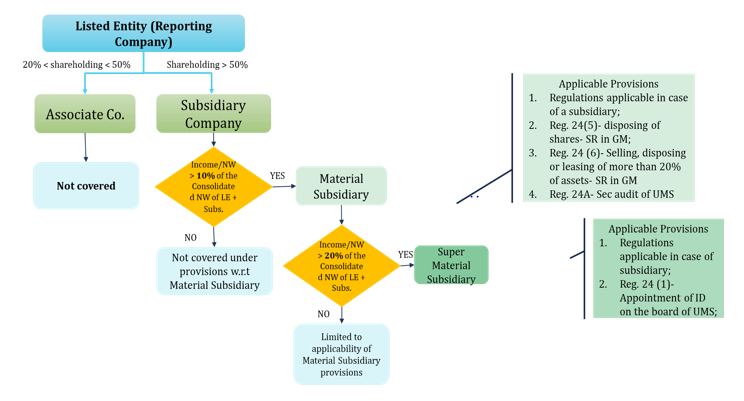
Other than the obligations provided under Reg. 24 of SEBI LODR for the listed companies w.r.t. their subsidiaries, the following additional obligations are applicable in case of material subsidiaries:

  • Formulating Policy– The listed entity is required to formulate a policy for determining materiality of its subsidiaries, and shall disseminate the same on its website.
  • Appointment of Independent Director– Pursuant to Regulation 24(1) of the LODR, at least one (1) independent director of the listed entity is required to be a director on the board of an unlisted material subsidiary (with respect to this provision, material subsidiary has been defined with a threshold of 20% of the consolidated income or net worth).
  • Disposing of shares in Material Subsidiary – A listed company shall not dispose of shares in its material subsidiary resulting in reduction of its overall shareholding to less than 50% or cease to exercise control over subsidiary without passing special resolution in general meeting except in case where such divestment is made under a scheme of arrangement (duly approved by the Tribunal/ Court) or in case of resolution plan duly approved in terms of section 31 of IBC, 2016.
  • Selling, disposing and leasing of assets – Pursuant to Regulation 24(6) of the LODR, the sale or disposal or leasing of assets amounting to more than 20% of the assets of a material subsidiary (on an aggregate basis during a financial year), subject to certain exceptions, requires prior approval of the shareholders of the listed holding company by way of a special resolution.
  • Secretarial Audit: Pursuant to Regulation 24A of the LODR, all listed entities and their Indian unlisted   material   subsidiaries   are   required   to   undertake   a secretarial audit and annex such reports to the annual report of the listed entity.

The discussion above can be summarised in the presentation below:
Role of Policy on determining Materiality of Subsidiary

The definition of ‘material subsidiary’ under regulation 16(1)(c) defines a subsidiary that is material to the listed entity and the explanation to the aforesaid provision allows the listed entity to formulate a policy for the same, i.e., a listed entity can develop criteria that is stricter than what has been provided in the Regulations. However, nothing has been provided regarding the contents of the Policy in the SEBI LODR. Therefore, the Policy is nothing but a replica of what has already been provided in the law, as in order to ensure compliance of the law, listed entities frames policy for determining materiality of subsidiaries based on the contents of the regulations. Thus, the requirement of the policy is limited to ensure compliance of the law.

Can a section 8 company be treated as ‘Material Subsidiary’?

Section 8 Company, as defines in the Act, 2013 are companies that are formed with an object of promoting commerce, art, science, sports, education, research, social welfare, religion, charity, protection of environment or any such other object. These companies are required to apply their profit, if any or other income in promoting their objects and are prohibited from payment of any dividend to its members. Whereas, the benchmark for satisfying the definition of ‘material subsidiary’ is contribution towards consolidated income or net worth of the holding company.

When we consolidate the holding company with a Section 8 company, it will however depict a wrong picture of the wealth of the holding company, as the holding company can never claim any right over the profits of a Section 8 Company. Therefore, the question of consolidation of section 8 with that the holding company does not arise.

Given that the income of a section 8 company cannot be consolidated with that of the listed company or can say that since the performance of a section 8 company has no role to play on the overall performance of the listed company, a section 8 company cannot be treated as a ‘material subsidiary’. 

Concluding Remarks

The term “material subsidiary” has been prioritized over the years because of the impact it may have over the consolidated performance of the listed entity. The principle behind emphasizing absolute numbers of the net worth is the impact of the same on the consolidated figures. Any changes in the income/net worth of these material subsidiaries will be reflected proportionally on the listed entity since the net worth derived from the said material subsidiaries constitutes an integral part of the consolidated net worth of the listed entity. Accordingly, the listed entities should determine the materiality of its subsidiaries wisely and comply with the requirements of SEBI LODR as are applicable on the material subsidiaries.

Our other videos and write-ups may be accessed below:

YouTube:

https://www.youtube.com/channel/UCgzB-ZviIMcuA_1uv6jATbg

Other write-up relating to corporate laws:

https://vinodkothari.com/category/corporate-laws/

Our article on similar topics –

  1. https://vinodkothari.com/wp-content/uploads/2019/04/Final_PPT_on_SEBI_LODR_Amendment_Regulations_2018.pdf
  2. https://vinodkothari.com/2019/02/decoding-large-number-in-case-of-group-governance-policy-under-lodr/


[1] Section 2 (87) of the Act

[2] https://www.sebi.gov.in/legal/regulations/may-2018/sebi-listing-obligations-and-disclosure-requirement-amendment-regulations-2018_38898.html

[3] Section 2 (57) of the Act defines net worth as:

“Net worth” means aggregate value of the paid up share capital and all reserves created out of the profits and securities premium account, after deducting the aggregate value of the accumulated losses, deferred expenditure and miscellaneous expenditure not written off, as per the audited balance sheet, but does not include reserves created out of revaluation of assets, write-back of depreciation and amalgamation


SEBI eliminates one-to-one analyst meets from the purview of LODR

-Recommendations of sub-group dropped under the LODR Amendment

By CS Aisha Begum Ansari, Assistant Manager, Vinod Kothari & Company

corplaw@vinodkothari.com

Background

Information symmetry is extremely important in a listed company since it helps in effective price discovery and builds the faith of the investors.  Analyst and investor meets are one of the many ways used by the companies to disseminate information. The companies usually conduct analyst or investor meets after the disclosure of financial results to answer the questions relating to financial performance, future prospects, etc. based on generally available information without disclosing any unpublished price sensitive information (‘UPSI’). Such meets generally include conference calls or meeting with group of investors or group of analysts as per the prefixed schedule. Further, the same also includes one-to-one meet or calls with investors or analysts, which may either be prefixed or in the nature of walk-in.

While, SEBI mandates provisions under the SEBI (Listing Obligations and Disclosure Requirements) Regulations, 2015 (‘Listing Regulations’) and SEBI (Prohibition of Insider Trading) Regulations, 2015 (‘PIT Regulations’) to curb as well as regulate such leak of UPSI; one of the recent changes under the Listing Regulations vide SEBI Listing Regulations (Second Amendment) Regulations, 2021[1] (‘LODR Amendment’) issued on 7th May, 2021 seems to have completely excluded one-to-one meet from the regulatory ambit prescribing disclosure requirements.

This article discusses the regulatory requirement in relation to investor meet, phases of amendment, present requirement and international practice.

Compliance requirements under SEBI Regulations

Erstwhile Listing Agreement

Clause 49 of the Listing Agreement[2] which specified the reporting requirements, obligated the companies to disclose on its website or intimate the stock exchange the presentations made by it to the analysts. Also, the companies were required to disclose in its Report on Corporate Governance, presentations made to institutional investors or the analysts as a means of communication to shareholders.

 Listing Regulations (prior to amendment)

The Listing Regulations mandated listed entities to disclose the schedule of analyst or investor meets and presentations to such analysts or investors –

  1. On the website of the listed entity [Regulation 46(2)(o) of Listing Regulations]
  2. On the website of the stock exchange where its securities are listed (Clause 15 of Para A, Part A of Schedule III of Listing Regulations).
  3. Means of communication in the form of presentations made to institutional investors or analyst in the annual corporate governance report. (Para C(8)(e) of Schedule V to Listing Regulations).

Erstwhile PIT Regulations (1992)

The 1992 regulations prescribed elaborate requirement in relation to analyst meets. Listed companies were required to follow the following guidelines while dealing with analysts and institutional investors:—

  • Only Public information to be provided – Listed companies were required to provide only public information to the analyst/research persons/large investors like institutions. Alternatively, the information given to the analyst were required to be simultaneously made public at the earliest.
  • Recording of discussion – In order to avoid misquoting or misrepresentation, it was suggested that at least two company representative to be present at meetings with analysts, brokers or institutional investors and discussion should preferably be recorded.
  • Handling of unanticipated questions – A listed company were required to be careful when dealing with analysts’ questions that raise issues outside the intended scope of discussion. It was suggested that unanticipated questions could be taken on notice and a considered response could be given later. If the answer included price sensitive information, a public announcement was required to be made before responding.
  • Simultaneous release of Information – When a company organized meetings with analysts, the company was required to make a press release or post relevant information on its website after every such meet. The company could also consider live webcasting of analyst meets.

PIT Regulations

PIT Regulations, presently, mandate listed entities to develop best practices to make transcripts or records of proceedings of meetings with analysts and other investor relations conferences on the official website to ensure official confirmation and documentation of disclosures made. Further, the listed entity needs to ensure that information shared with analysts and research personnel is not UPSI.

Discussion in working group/ committee reports

Report submitted by the Committee on Corporate Governance[3]

The Committee was of the view that the disclosure of schedules of analyst/ institutional investor meetings does not serve any practical purpose, and there have been instances of its misuse. Hence, the Committee recommended that the disclosure of schedules of analyst/institutional investor meetings may not be required. However, the information to be shared at such meetings has to be strictly in compliance with the SEBI PIT Regulations.

Report on disclosures pertaining to analyst/ investors meets[4]

The issue of information asymmetry between various classes of investors arising out of limited disclosures in respect of analyst meets/ institutional investors meet/ conference calls was discussed by Primary Markets Advisory Committee (PMAC) in the meeting in July, 2020. SEBI, based on the recommendation of PMAC, had formed sub-group which issued the ‘Report on disclosures pertaining to analyst meets, investor meets and conference calls’ (‘Report’) on November 20, 2020.

The Committee deliberated on best practice followed by listed entities in India, regulatory regime in developed countries and acknowledged the fact that existing regulations are not followed in letter and spirit by majority of listed companies thereby causing information asymmetry.

The Report explicitly distinguished between group analysts or investors meet and one-to-one in terms of the regulatory compliance. The Report recommended disclosure of transcripts and recordings of proceedings of group investors meet on the website of the company and to the stock exchange within a prescribed time frame whereas for one-to-one meetings, it recommended disclosing the number of such meetings in the quarterly compliance report on corporate governance along with a confirmation that no UPSI was shared with them.

The committee provided the rationale that the fundamental reason for analysts to seek meetings with the listed entity was to check their hypothesis that they have developed, based on controls and processes that have been built to comply with the public disclosures and complying with regulations relating to handling of private information and that premature public disclosure of these questions may lead to a regime of ‘’mandatory dissemination of proprietary information’’.

It is also important to note that the sub-group in its Report discussed that the content of the discussions for one-to-one meets, should not be intimated to the stock exchange due to following demerits:

  • Invasion of privacy of the institutional investors;
  • Allow third parties not a part of the meet to take speculative positions for trading decisions; and
  • Lead to overload of information to retain investors

Based on the sub-group’s discussion, the following recommendations were made:

  • Provide number of one-to-one meet as part of corporate governance report on a quarterly basis while submitting to the stock exchange;
  • The same needs to carry an affirmation that no UPSI was shared by any official of the company in such meetings; and
  • Company to maintain a record of all one-to-one meetings covering the name/names of the investor who were met, the name of the fund that he/ she represents, name of the brokerage firm which fixed the meeting (if any), the location, date and time of the meeting and a reference to the presentation made and preserve the same for a period of at least eight years.

Discussion in SEBI Board meeting of March 25, 2021[5]

The agenda provides details of recommendation made in relation to group analyst meet, however, does not provide any rationale/ discussion with respect to one-to-one meeting or reason for excluding the requirement from Listing Regulations altogether.

Anomaly in the LODR Amendment

Regulation 46(2)(o) and Clause 15(a) of Para A, Part A of Schedule III of Listing Regulations defines the term ‘meet’ as ‘group meetings or group conference calls’ for the purpose of disclosure of schedule of analyst/ investor meet and presentations made by the company to them.

Further, regulation 46(2)(oa) and Clause 15(b) of Para A, Part A of Schedule III provides for manner of disclosure of audio/ video recordings and transcripts of post earning calls or quarterly calls on the website of the company and to the stock exchange respectively.  The said sub-clause has no reference of the term ‘meet’. The said provisions are reproduced below:

Regulation 46(2)(oa):

“(oa) Audio or video recordings and transcripts of post earnings/quarterly calls, by whatever name called, conducted physically or through digital means, simultaneously with submission to the recognized stock exchange(s), in the following manner:

  • the presentation and the audio/video recordings shall be promptly made available on the website and in any case, before the next trading day or within twenty-four hours from the conclusion of such calls, whichever is earlier;
  • the transcripts of such calls shall be made available on the website within five working days of the conclusion of such calls:

Provided that—

  1. The information under sub-clause (i) shall be hosted on the website of the listed entity for a minimum period of five years and thereafter as per the archival policy of the listed entity, as disclosed on its website.
  2. The information under sub-clause (ii) shall be hosted on the website of the listed entity and preserved in accordance with clause (a) of regulation 9.

The requirement for disclosure(s) of audio/video recordings and transcript shall be voluntary with effect from April 01, 2021 and mandatory with effect from April 01, 2022.”

Clause 15(b) of Para A, Part A of Schedule III

“(b) Audio or video recordings and transcripts of post earnings/quarterly calls, by whatever name called, conducted physically or through digital means, simultaneously with submission to the recognized stock exchange(s), in the following manner:

  • the presentation and the audio/video recordings shall be promptly made available on the website and in any case, before the next trading day or within twenty-four hours from the conclusion of such calls, whichever is earlier;
  • the transcripts of such calls shall be made available on the website within five working days of the conclusion of such calls:

The requirement for disclosure(s) of audio/video recordings and transcript shall be voluntary with effect from April 01, 2021 and mandatory with effect from April 01, 2022.”

Since, the term ‘meet’ is not mentioned in the above provisions, it leads to an interpretation that in case of post earning calls or quarterly calls, irrespective of the fact whether such meeting is with the group of investors or one-to-one meeting, audio/ video recordings and transcripts will be required to be submitted to the stock exchange.

Regulatory regime in other countries

1. United States of America

Regulation Fair Disclosure[6] (referred as ‘Regulation FD’) prohibits companies from selectively disclosing material non-public information (referred as ‘MNPI’) to analysts, institutional investors, and others without concurrently making widespread public disclosure.

Response to question 101.11 of the FAQs on Regulation FD[7] allows directors of the company to speak privately with a shareholder or group of shareholders by implementing policies and procedures to help avoid insider trading. Also, where a shareholder expressly agrees, through confidentiality agreement, to maintain confidentiality of MNPI, a private communication between the director and a shareholder does not violate Regulation FD norms.

2. Canada

Part V of the National Policy on Disclosure Standards[8] provides guidelines with respect to private briefings with analysts/ institutional investors. The Policy does not prohibit one-to-one discussions with analysts but identifies that the potential of selective disclosure of material non-public information is fraught with difficulties. It emphasizes on timely public disclosure of material information and entering into confidentiality agreements with the analysts.

3. United Kingdom

Market Abuse Regulation (“MAR”)[9] prevents selective disclosure of MNPI. MAR requires that the companies must not disclose MNPI selectively at the investor meetings.  If they do, an immediate announcement would be required but it would still be a breach of the regulations.

4. Singapore

Rule 703(4) of the Singapore Exchange Listing Rules[10] requires the issuer to observe the Corporate Disclosure Policy as provided under Appendix 7.1. of Rule[11]. Para 23 under PART VIII of the Policy recommends the issuer to observe an “open door” policy in dealing with analysts, journalists, stockholders and others.

Issuer is required to abstain from disseminating material information which has not been disclosed to the public before. However, if such material information is inadvertently disclosed at meetings with analysts or others, it must be publicly disseminated as promptly as possible by the means described in Part VIII.

Conclusion

One-to-one meets carry a significant amount of risk with it for being a source / device for leak of UPSI especially where the same are not explicitly regulated.   The intent behind recording and disclosing the same is to safeguard the company officials from any potential charge of breach of PIT Regulations. One will have to wait and watch if the relaxation results in any adverse implications.   Further, SEBI will have to clarify on the ambiguity relating to disclosure requirements of one-to-one analysts meet w.e.f. post earning calls or quarterly calls if the intent is to restrict only to ‘meet’ as defined in the respective clauses.

[1] https://egazette.nic.in/WriteReadData/2021/226859.pdf

[2]https://www.sebi.gov.in/web/?file=https://www.sebi.gov.in/sebi_data/attachdocs/1293168356651.pdf#page=7&zoom=page-width,-16,792

[3] https://www.sebi.gov.in/web/?file=https://www.sebi.gov.in/sebi_data/attachdocs/oct-2017/1509102194616.pdf#page=1&zoom=page-width,638,870

[4] https://www.sebi.gov.in/web/?file=https://www.sebi.gov.in/sebi_data/attachdocs/nov-2020/1605853267317.pdf#page=1&zoom=page-width,-16,792

[5] https://www.sebi.gov.in/sebi_data/meetingfiles/apr-2021/1619067296590_1.pdf

[6] https://www.sec.gov/rules/final/33-7881.htm

[7] https://www.sec.gov/divisions/corpfin/guidance/regfd-interp.htm

[8] https://www.osc.ca/sites/default/files/pdfs/irps/pol_20020712_51-201.pdf

[9] https://eur-lex.europa.eu/legal-content/EN/TXT/PDF/?uri=CELEX:32014R0596&from=EN

[10] http://rulebook.sgx.com/rulebook/703-0

[11] http://rulebook.sgx.com/rulebook/appendix-71-corporate-disclosure-policy


Our article titled SEBI proposes enhanced disclosures for meetings with analyst, investors, etc. can be accessed through following link:


SEBI notifies substantial amendments in Listing Regulations

Proposals approved in SEBI BM of March, 2021 made effective

Payal Agarwal | Executive  ( corplaw@vinodkothari.com )                                                                                                      May 07, 2021

Introduction

SEBI, the capital market regulator of India, vide a gazette notification dated 06th May, 2021 notified Securities and Exchange Board of India (Listing Obligations and Disclosure Requirements) (Second Amendment) Regulations, 2021 [“the Amendment Regulations”] that were approved in SEBI’s Board Meeting held on March 25, 2021. Most of the amendments were already rolled out earlier as consultation papers in 2020. The amendments become effective from May 06, 2021.

This article discusses the major amendments carried out and the likely impact and actionable for the listed entities.

Brief of the amendments are as follows –

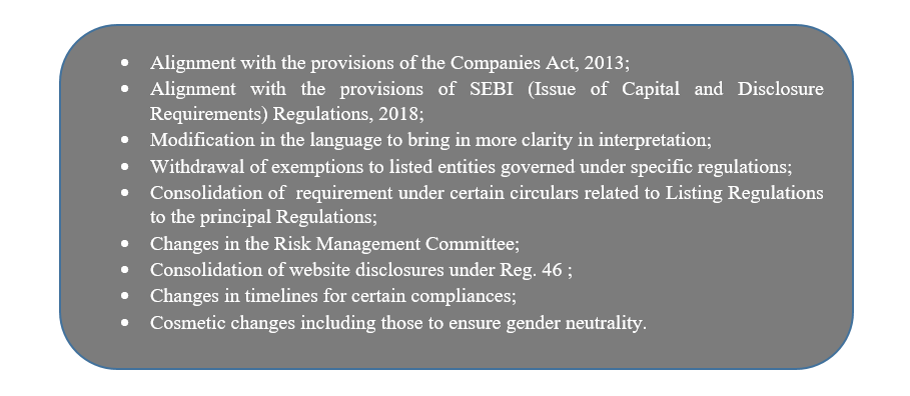
A gist of all the amendments under the Amendment Regulations have been captured in a snippet.

1.     Applicability of the Listing Regulations

In terms of Regulation 3 of SEBI (Listing Obligations and Disclosure Requirements) Regulations, 2013 (‘Listing Regulations’) the provisions of Listing Regulations are applicable to entities that list the designated securities on the stock exchange.

The Amendment Regulations clarify that the applicability of certain provisions of Listing Regulations based on market capitalisation will continue to apply even where the entities fall below the prescribed threshold.

While the market capitalisation may be derived for any day, the recognised stock exchanges viz. BSE Limited and National Stock Exchange of India Limited releases a list of listed entities based on market capitalisation periodically. However, the provisions under Listing Regulations become applicable based on market capitalisation as at the end of the immediate previous financial year.

The present amendment on the continuation of applicability of provisions even after the listed entity ceasing to be among the top 500, 1000, 2000 listed entities, as the case may be, seems inappropriate. The applicability of these provisions were originally introduced in view of the size of the listed entities that held major market cap. Indefinite applicability of the said provisions despite fall in the market capitalisation of the listed entity is more of a compliance burden. The provision should be amended by SEBI in line with the timeframe provided under Reg. 15 i.e. where a listed entity does not fall under the list of top 100, 500, 1000, 2000 for three consecutive financial years, the compliance requirement should cease to apply.

Therefore, a conjoint reading of both the provisions should be allowed to take a liberal interpretation in respect of the newly-inserted Regulation 3(2) as well, thereby relaxation of compliance requirements on completion of a look-back period of 3 consecutive financial years.

2.     Risk Management Committee

Regulation 21 of Listing Regulations requires the listed entities to constitute a Risk Management Committee (RMC).  A comparative study of the erstwhile and the amended provisions w.r.t RMC is given below –

Topic Erstwhile provisions Amended provisions
Applicability of RMC ·       On top 500 listed entities (Based on market capitalisation) ·       On top 1000 listed entities based on market capitalisation
Composition ·       Members of Board of Directors

·       Senior executives of listed entity

·       2/3rds IDs in case of SR Equity Shares

·       Minimum 3 members

·       Majority being members of board of directors

·       Atleast 1 Independent Director (ID)

·       2/3rds IDs in case of SR Equity Shares

Minimum no. of meetings One Two
Quorum Not specified ·    2 or 1/3rds of total members of RMC, whichever is higher

·       Including atleast 1 member of Board

Maximum gap between two meetings Not specified Not more than 180 days gap between two consecutive meetings
Roles and responsibilities The board of directors were to define the role and responsibility and delegate monitoring and reviewing of the risk management plan and such other functions, including cyber security. As provided under Part D of Schedule II, that inter alia  includes:

·       Formulating of risk management policy;

·       Oversee implementation of the same;

·       Monitor and evaluate risks basis appropriate methodology, processes and systems.

·       Appointment, removal and terms of remuneration of CRO.

Power to seek Information No such power. The same was only available with Audit Committee under Reg. 18 (2) (c). RMC has powers to seek information from any employee, obtain outside legal or other professional advice and secure attendance of outsiders with relevant expertise, if it considers necessary.

The roles and responsibilities of the RMC has now been specified in the Regulations itself, which were once left at the discretion of Board. The formulation of Risk Management Policy has also been delegated to the RMC, with particular contents of the policy being specified under the Schedule.

An important role of the RMC, among others, include review of the appointment, removal and terms of remuneration of Chief Risk Officer (CRO). The appointment of CRO is not a mandatory requirement under Listing Regulations. CRO is required to be appointed for all banking companies, and non-banking financial companies (NBFCs) having asset size of Rs. 50 billions or more, being registered as an Investment and Credit company, Infrastructure Finance Companies, Micro Finance Institutions, Factors, or Infrastructure Debt Funds. Further, the Insurance Regulatory and Development Authority of India (IRDAI) Corporate Governance Guidelines requires the insurance companies to appoint CRO.

The role of RMC further provides for co-ordination with other committees where the roles  overlap. It is seen that the risk management function is also laid upon the Audit Committee. Therefore, the roles of both the committees might be overlapping. In view of the same, some companies choose to constitute one joint committee combining the roles of both Audit Committee and RMC.  From the provisions providing for co-ordination of activities, it may also be taken as a clear indication that the committees cannot be merged into one, but co-ordinate where the activities require so.

Actionables –
  • Changes in the constitution of RMC / Constitution of RMC in case of first-time applicability;
  • Modification of the Risk Management Policy as per the Amendment Regulations;
  • Amending the existing charter of the Committee to align with the amendments.

While the Amendment Regulations are effective immediately, the changes cannot take place overnight. Therefore, it is advisable that the listed entities shall take the matter of constitution/ re-constitution of RMC in the ensuing Board Meeting.  The modification of Risk Management Policy will be then taken up by the RMC and can be done within a reasonable period of time.

What should be this period? A probable answer to this should lie in the proviso to clause (a) of Reg. 15 that permits a timeline of six months from the applicability to comply with corporate governance requirements as stipulated under regulations 17 to 27, clauses (b) to (i) and (t) of sub-regulation (2) of regulation 46 and para C, D and E of Schedule V. However, that is applicable only in case of companies covered in Reg. 15 (2) (a). Therefore, the time available is till June 30, 2021 as thereafter, the companies will be required to confirm on RMC composition in the quarterly filings done under Reg. 27.

3.     Overriding powers of LODR Regulations

Earlier, proviso to Regulation 15(2)(b) provided a clear stipulation of overriding effect of specific statute in case of conflicting provisions. The Amendment Regulations provides for deletion of the said proviso effective from September 1, 2021. No rationale seems to have been provided in the agenda[1] put up before SEBI at the board meeting for this major amendment.

Regulators viz. RBI, IRDA, PFRDA at times have specific corporate governance related compliances that are stricter and at times conflicting with the requirements of Listing Regulations. For eg. With respect to composition of Audit Committee for a public sector bank, RBI Circular of September, 1995 provides for following composition in case of public sector banks: (a) Executive Director of the Bank (Wholetime director in case of SBI) (b) two official directors (i.e. nominees of Government and RBI) and (c) Two non-official, non-executive directors (at least one of them should be a Chartered Accountant). Directors from staff will not be included in ACB. This is certainly conflicting with the composition provided in Reg. 18 of Listing Regulations.

Subsequent to September 1, 2021 these entities will be regarded as non-compliant of the provisions of Listing Regulations and may be subject to penalty in terms of SEBI Circular dated January, 2020.

4.     Reclassification of promoters into public – related exemptions and procedural changes

Regulation 31A of the LODR Regulations specifies the conditions and approvals post which the promoters can be re-classified into public shareholders. SEBI had proposed changes to the same in a consultation paper dated 23rd November, 2020. The consultation paper was critically analysed in our article. Amendments have been made on similar lines in Regulation 31A.

5.     Alignment with the provisions of the Companies Act, 2013

Certain amendments have been made to remove the gap between the provisions of LODR Regulations, with that of the Companies Act, 2013 as given below –

  • Separate meeting of independent directors – The requirement of conducting a separate meeting of the independent directors without the presence of any other member of the Board of the company is required under both the Companies Act, 2013 as well as the LODR Regulations. However, whereas the Companies Act requires one meeting in a financial year, the LODR Regulations required one meeting in a year (calendar year). Therefore, the same has been substituted with a “financial year” so as to align the requirements of both the governing laws.
  • Display of Annual Return on website – Section 92 read with allied rules requires the companies, having a website, to display its Annual Return on the website. New clause has been inserted under Regulation 46 of LODR Regulations that requires placing the Annual Return on the website of the company.
  • Changes in requirements pertaining to placing of financial statements on website – The audited financial statements of each of the subsidiaries was required to be  placed on the website prior to the Amendment Regulations. New provisos has been inserted under the same so as to avoid preparation of separate financial statements of the subsidiary company, where the requirements under the Companies Act, 2013 are met if the consolidated financial statements are placed instead of separate ones.

6.     Mandatory website disclosures

Regulation 46 of the LODR Regulations provides the mandatory contents to be placed on the website of a listed entity. Most of the disclosures were already existing under respective regulations viz. Reg 30, 43A etc. However, the same has been consolidated under regulation 46. This will now enable stock exchanges to levy penalty in terms of SEBI circular dated 22nd January, 2020.

7.     Analyst meet

The listed entity is required to disclose the schedule of analyst or institutional investor meet and the presentations made to them on its website under regulation 46 and on the website of the stock exchange under Schedule III. The Amendment Regulations have explained the term ‘meet’ to mean the group meetings and calls, whether digitally or by physical means. The Amendment Regulations will require the listed entity to upload the audio/ video recordings and the transcripts within the prescribed timeframe. The same is in line with SEBI’s Report on disclosures pertaining to analyst meets, investor meets and conference calls. However, the amendment does not cover disclosure of one-to-one investor/ analyst meet conducted with select investors recommended in the said Report.

8.     Consolidation of various SEBI circulars

Certain circulars of SEBI lay down various requirements to be complied with in relation to the LODR Regulations. The Amendment Regulations have consolidated the requirements under the principal LODR Regulations.

  • Requirement of Secretarial Compliance Report – While the requirement of Annual Secretarial Compliance report were applicable on the listed entities and its material subsidiaries since a few years back, the same has now been specifically provided under newly inserted sub-regulation (2) of Regulation 24A. Earlier, the practice came pursuant to a SEBI circular.
  • Timeline for report of monitoring agency regarding deviation in use of proceeds – Pursuant to the requirements of Regulation 32 of the LODR Regulations, the monitoring agency is required to give a report on the utilisation of proceeds of issue on a quarterly basis. While timelines were not specified in the LODR Regulations, the report was required to be given within 45 days from the end of the quarter. This timeline was pursuant to the SEBI circular dated 24th December, 2019 . Now, with the Amendment regulations, the same is specified under regulation 32(6) of the LODR Regulations.
  • Requirement of Business responsibility and sustainability report (BRSR)- SEBI had proposed a new format to replace the existing Business Responsibility Report. The proposal was finalised and the BRSR format has been made mandatorily applicable from FY 2022-23 onwards, vide SEBI circular dated April, 2021 . The same has also been consolidated under Regulation 34 of the LODR Regulations. A detailed discussion on BRSR is covered in our article.

Conclusion

The Amendment Regulations are very crucial and significant in nature. While on one hand, certain provisions are aligned with the Companies Act, 2013, whereas on the other hand, overriding powers have been given to LODR Regulations which will require the listed entities formed under special statute to comply with the LODR Regulations in entirety. Uniformity in timelines and relaxation in certain disclosure requirements will encourage ease of doing business, and the coverage of certain provisions extended to listed entities based on market capitalisation will have a remarkable impact on the corporate governance of listed entities.

[1] https://www.sebi.gov.in/web/?file=https://www.sebi.gov.in/sebi_data/meetingfiles/apr-2021/1619067328922_1.pdf#page=18&zoom=page-width,-17,763

Our other materials on the relevant topic can be read here –

  1. https://vinodkothari.com/2021/06/presentation-on-lodr-amendments/
  2. https://vinodkothari.com/2020/09/companies-amendment-act-2020/
  3. https://vinodkothari.com/2019/07/sebi-amends-lodr-in-relation-to-equity-shares-with-superior-rights/
  4. https://vinodkothari.com/2019/02/overlap-in-reporting-of-secretarial-compliance/
  5. https://vinodkothari.com/2018/12/faqs-on-sebi-listing-obligations-and-disclosure-requirements-amendment-regulations-2018/
  6. https://vinodkothari.com/2016/01/sebi-faqs-on-listing-regulations-2015-brings-ambiguity-rather-than-clarity/

Revised Regulatory Framework for IDs of listed entities in India

-Independence becomes stricter!

Payal Agarwal, Executive ( payal@vinodkothari.com )

Updated on 6th August, 2021

Introduction

The concept of independent directors was first introduced in the Desirable Corporate Governance Code issued by the Confederation of Indian Industry[1] followed by the recommendation in the Corporate Governance Committee constituted by SEBI and headed by Mr. Kumar Mangalam Birla[2] (Kumar Mangalam Birla Committee). Later in the year 2000, SEBI incorporated the recommendations of the Kumar Mangalam Birla Committee under Clause 49 of the Listing Agreement[3]. Independent directors have always been regarded as the means to strengthen the corporate governance framework in a public or a listed company.

Keeping in mind the intent of the lawmakers to introduce the requirement for having Independent Directors (IDs) on the board of certain companies, it is understood that SEBI cannot accept a situation where the IDs themselves turnout to either be ineffective for strengthening the corporate governance or act against the interest of the public shareholders. Therefore, with the intent to further strengthen the role and responsibility of IDs, SEBI had introduced a Consultation Paper[4] (Paper) on review of regulatory provisions related to IDs on 2nd of March, 2021. Through this Paper, SEBI had proposed to make stringent regulatory changes in the provisions of the Listing Obligation and Disclosure Requirements Regulations (LODR/ Listing Regulations) relating to

  • eligibility criteria of IDs,
  • role of Nomination and Remuneration Committee (NRC),
  • composition of Audit Committee (AC) and Nomination and Remuneration Committee (NRC)
  • appointment and removal procedure of IDs

Further, SEBI, in its Board Meeting held in July, 2021 discussed to review the regulatory framework applicable on IDs and incorporate amendments in the Listing Regulations based on public comments and discussions w.e.f. 1st January, 2022. However, the changes in the regulatory framework as notified on 3rd August, 2021 vide SEBI (Listing Obligations and Disclosure Requirements) (Third Amendment) Regulations, 2021 [the Amendment Regulations],was initially notified to be applicable with immediate effect whose applicability has now been deferred to the date as originally decided in the Board Meeting of SEBI, i.e., 1st January, 2021 .

A brief snippet on the changes can be accessed here.

This write up critically covers the changes in the regulatory framework for IDs pursuant to the Amendment Regulations and discusses the potential impact of the same on the working of a company including the corporate governance aspects.  The amendments are discussed below under the relevant heads.

1.Widening the criteria for independence

Regulation 16(1) of the Listing Regulations provides the definition of “independent director”. SEBI seeks to broaden the criteria of “independence” by expanding the outreach of the restrictions given under the said Regulation and at the same time standardising the cooling off period provided therein.

Amendments in line with the Paper

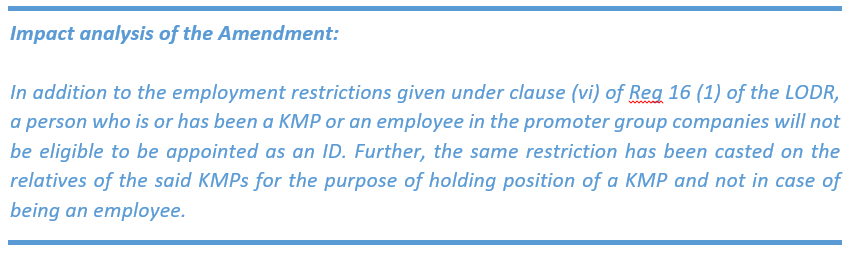
The Paper proposed two amendments in the independence criteria of IDs in addition to the extant definition which have been made applicable with the notification of the Amendment Regulations:

  • KMPs and employees of companies falling under the promoter group of the listed entity & relatives of such KMPs should not be eligible to act as an ID until a cooling off period of 3 years has passed.

This is in addition to the existing fetter on the KMP and employee of the listed entity, its holding, subsidiary or associate company.

  • Another amendment is with regard to increasing of the cooling-off period in Regulation 16(1)(iv) and Reg 16(1)(v) of the Listing Regulations.

Currently, the Regulations specify a cooling-off period of 2 years in case of material pecuniary transaction between a person or his relative and the listed entity or its holding, subsidiary or associate company. This has been increased to 3 years to make it similar to the other provisions of Regulation 16 where a cooling-off period of 3 years is required to be satisfied.

Amendments not proposed in the Paper

Certain amendments not proposed in the Paper but brought by means of the Amendment Regulations are given below:

  • The criteria under Regulation 16(b)(v) earlier provided only for the pecuniary relationship of the relatives of proposed ID with the company. This has been amended in line with Section 149(6)(d) of the Companies Act, 2013.
  • Further, a proviso has been inserted after Regulation 16(b)(vi)(A) providing a relief to the proposed ID appointment when the relative of such proposed appointee is a mere employee and not KMP.

Rationale behind the Amendment Regulations:

This amendment aims to make the independence criteria more broader and stricter so that there is no way by which the candidates influenced by promoter group entities can take undue benefit due to any loopholes in the language of law.

On the other hand, the amendment increasing the cooling off period is for making the same uniform all through the independence criteria.

Further, it has to be noted that the amendments are in harmonisation with the provisions of the Companies Act, 2013, as also contemplated in the Board meeting of SEBI and does not bring in any drastic changes in the existing requirements apart from looping in promoter related entities as well.

Actionable arising pursuant to the Amendments

  • Revised declaration to be obtained so as to ensure compliance with meeting the revised independence criteria as soon as possible.

2.Process for appointment/ re-appointment and removal of independent directors

The Paper proposed to bring a major change in the procedure of appointment/ re-appointment as well as removal of IDs by means of “dual approval”. However, the said proposal has not been brought under the current Amendment Regulations. The changes have been brought to have the following impact:

Matter Requirements under extant provisions Proposal under Paper Provisions as per Amendment Regulations
Appointment/ Removal of IDs Ordinary Resolution §  Dual approval (Special Resolution in case the proposal fails)

§  Prior approval of Shareholders

§  Special Resolution

§  Shareholder’s approval required within earlier of –

§  Next general meeting

§  3 months from appointment of  a person on board

Re-appointment of IDs Special Resolution Dual approval (Special Resolution in case the proposal fails)


Special Resolution


(no change from the existing provisions)

Filling of vacancy of IDs Later of the following –

§  Next board meeting

§  3 months from vacancy

Within 3 months from vacancy Within 3 months from vacancy

Further, in case of appointment of any other director in board, whether executive, non-executive, additional director, director appointed due to casual vacancy etc , every such appointment has to be regularised by the shareholders within a maximum period of 3 months from such an appointment.

Rationale for such Amendments

  • Requirement of passing a special resolution

While SEBI had, in its Paper, proposed the “dual approval” model in line with the legislative requirements of Israel and UK, especially in interest of the minority shareholders, the Board disclosed that majority of comments were against such proposal due to practical difficulties in implementation of the same, citing causes such as delay in appointment due to an unintended deadlock, voting skews in case of minority public shareholders having significant shareholding etc. Due to such practical difficulties, a balanced approach has been chosen to require a special resolution for all cases related to appointment, re-appointment as well as removal.

  • Time gap available to regularise the appointment by the shareholders

Similarly, as regards the proposed prior approval before appointment, the majority of comments dissented against the proposal citing reasons of additional compliance burden on companies, giving a midway suggesting that while the prior approval should not be mandated, a timeline should be provided within which the appointment should be approved by the shareholders.

Actionable pursuant to the Amendments

After the Amendment Regulations come into force, it would be necessary to regularise the appointment of all directors appointed in additional capacity within 3 months of the board meeting in which they were appointed by way of shareholders’ approval. Considering the fact that the amendments have been notified well in advance, the companies will not be able to excuse themselves for some further time after the amendments come into effect.

The amendments can be explained with the help of following examples –

1.A director has been appointed in additional capacity on 10th December, 2021. His appointment will have to be approved by shareholders within 3 months, i.e., 10th March, 2022.

2. A director has been appointed as additional director on 20th August, 2021 in the board of a company. The period of 3 months ends on 20th November, 2021. However, since the amendments are effective from 1st January, 2022, he may continue as an additional director in the board of the company till 31st December, 2021. However, if his appointment is not been approved by the shareholders within such period of time, he’ll have to resign from his position. The proposal of his appointment will have to be re-considered afresh by the NRC and board of the company, followed by a shareholders approval within 3 months.

3.Resignation of IDs

Through the Paper, it became clear that the intention of SEBI is to strictly monitor the resignation of the IDs where the real cause of resignation should be clearly known in place of the apparent cause the company and ID may try to show.

The Paper provided for a cooling off period of 1 year in two cases:

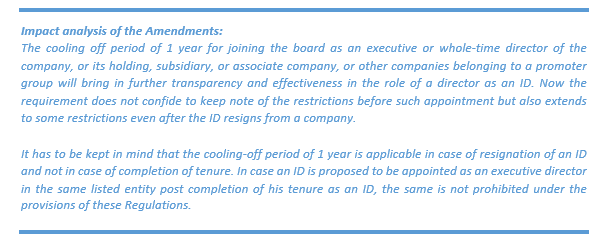
  • Where the ID resigns on account of discretionary reasons of pre-occupation, other commitments or personal reasons – Mandatory cooling period of 1 year before joining another Board as an ID;
  • Similar cooling period of 1 year in case of transition from ID to WTD in the same company.

 Further, the Paper also proposed that the complete resignation letter of the outgoing ID needs to be disclosed to the stock exchange. The same has been made effective vide the Amendment Regulations.

While the proposal of cooling-off period in case of transition of an ID as a whole-time director in the same company has been implemented by means of insertion of sub-regulation (11) in existing Regulation 25, the requirement of such cooling-off period has been further extended to the joining of such person as a whole-time or executive director in the holding, subsidiary, associate or other group companies belonging to the same promoter(s) as well.

The first proposal with regard to the cooling-off period in case of resignation due to personal / discretionary reasons has not been brought into force on account of comments received from public raising concerns over showing ingenious reasons in resignation letter to avoid falling into the cooling-off requirements, or compelled to work in pressurizing circumstances.

Rationale for such Amendments

The cooling off period of 1 year before transition of an ID as a WTD in the same company has been proposed to ensure there is no compromise in the independence of the director during his term as an ID.

It is observed that IDs often resign for reasons such as pre-occupation, other commitments or personal reasons and then join the boards of other companies. There is, therefore, a need to further strengthen the disclosures around resignation of Independent Directors. However, considering the comments received from majority of public, such a proposal has not been implemented.

4. Role of NRC in selection of candidates for the role of ID

The NRC is required to recommend the persons to be appointed as IDs in the board of the company. Though the Listing Regulations already requires the NRC to formulate criteria regarding such appointment, the role of NRC, in practice, does not suffice the intent of law properly.

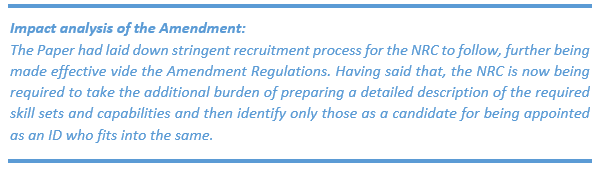
Therefore, vide the Amendment Regulations, SEBI has brought amendment to Para A of Part D of Schedule II of the Listing Regulations thereby specifying the following procedure for selection of candidates for the role of NRC. The procedure is in line with the proposal laid down in the Paper.

  • Evaluate the balance of skills, knowledge and experience
  • On the basis of above evaluation, prepare description of required roles and capabilities required for that particular appointment of ID
  • Identify the suitable candidate fitting the said description
  • For identifying persons, NRC may
    • use services of external agencies
    • May consider candidates from wide variety of backgrounds ( for diversity)
    • And consider time commitment of appointees
  • The person identified and recommend to the Board should possess capabilities as per description.

Rationale for such Amendment

While the law requires NRC to lay down detailed criteria of qualifications and attributes for directors, apparently there is a lack of transparency in the process followed by NRC. There is therefore, a need to prescribe disclosures regarding the process followed by NRC for selection of candidates for the post of ID.

Actionable pursuant to the Amendments

Any ID appointed on the board of a listed company after the Amendment Regulations come into effect, shall be appointed after following the due procedure as provided in the Amendment Regulations. This implies that even where the meeting of NRC for recommendation of appointment of a person as an ID is held before the Amendment Regulations coming into force, due process will be required to be followed. This is also required to ensure that the additional disclosures required to be made in the notice of general meeting for appointing IDs are available with the company (discussed in later parts of the article).

5.Modification in composition of NRC and AC

The Paper also sought to bring in some changes in the constitution of NRC and AC. The following changes were proposed –

  • NRC to comprise of 2/3rds of ID (earlier atleast one-half IDs required)
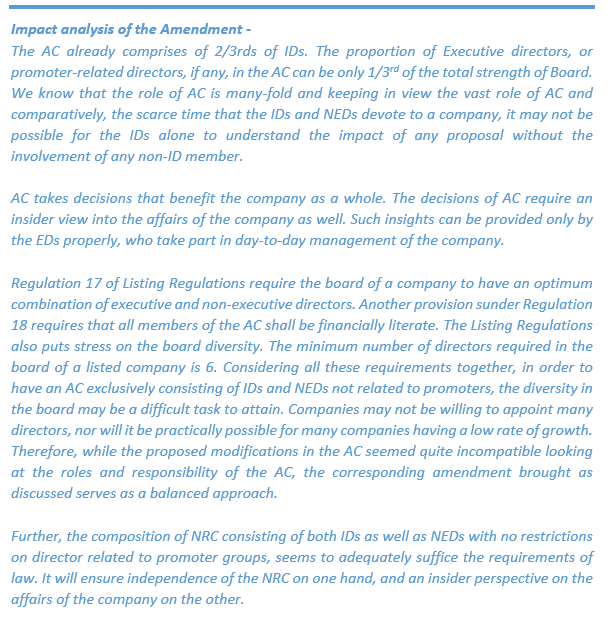
  • AC to comprise of 2/3rds of IDs and 1/3rds of Non-executive directors(NED) that are not related to promoter (presently, the AC requires atleast 3 members of which atleast 2/3rds shall be IDs)

The proposals have been implemented partially. While the changes in composition of NRC as proposed in the Paper has been made effective vide the Amendment Regulations, the changes in composition of AC has been rejected on account of decreasing flexibility of the companies.

Approval of Related Party Transaction by AC

Rather, an important amendment has been made to balance out between the flexibility of the companies on one end and the efficiency of the AC on another.  Post amendment, all related party transactions of the companies are required to be approved by only the IDs of the Audit Committee. The executive directors, who are a part of the AC, are not allowed to approve such transactions, however, restriction is not with respect to voting and it is understood that they may accord their dissent to a proposed related party transaction. However, practically, there may be rarely any instance, where the related party transaction, otherwise approved by the independent directors of an AC, has been dissented to by other members of the AC. Further, it shall apply to all the prospective related party transactions, and shall not affect the related party transactions which have already been approved prior to the amendments including the ones under omnibus approval.

A new proviso under Regulation 23(2) has been inserted as follows –

“Provided that only those members of the audit committee, who are independent directors, shall approve related party transactions.”

Rationale for such Amendment

Considering the importance of the Audit Committee with regard to related party transactions and financial matters, it was proposed that AC shall comprise of 2/3rd IDs and 1/3rd Non-Executive Directors (NEDs) who are not related to the promoter, including nominee directors, if any. However, the comments received from the public stakeholders have highlighted the risk of losing flexibility by the companies in case of such rigid composition. Therefore, in view of the same, while the composition of the AC has been kept intact, the requirement of only IDs approving the related party transactions have been made effective. The same serves as a balanced approach ensuring both flexibility of companies and efficiency of Audit Committee.

6.Enhanced disclosure requirements

The Amendment Regulations provide for some additional disclosure requirements in line with the amendments as follows:

At the time of appointment –

  • Details of companies from which the listed entities have resigned in the previous three years
  • Skills and capabilities required for the role
  • Manner in which the proposed appointee meets such requirements

At the time of resignation –

  • Complete letter of resignation
  • Names of listed entities in which the resigning director holds directorships, indicating the category of directorship and membership of board committees, if any

Actionable pursuant to the Amendments

In the light of the amendments, additional details shall be required to be made available to the shareholders for appointment of independent directors.

Similarly, in case of resignation, the letter of resignation and details of continuing directorship shall be made filed with the stock exchanges by the listed entity as received from the resigning ID.

7. Requirement of D&O Insurance

Earlier requirement Requirement post amendment
Applicable to Top 500 listed entities Top 1000 listed entities
With effect from 1st October, 2018 1st January, 2022

Conclusion

The changes brought vide the Amendment Regulations are extremely significant and will have a remarkable impact on the corporate governance of listed entities. More transparency may be achieved by means of these amendments like enhanced disclosure on resignation, appointment, selection of candidates as IDs, etc. of all, the amendments seek to check the interference of promoters at all levels of corporate governance and ensures much more independence to the IDs where the IDs will be independent in both letter and spirit. In areas where the proposals under the Paper seemed to be more rigid, the Amendment Regulations have allowed the companies to take breath in line with the comments received from the public shareholders. However, some amendments required immediate actionable, and especially, at this point of time, when most of the companies are having their AGMs, which was creating a hassle for the listed companies. However, SEBI has come up with a clarification deferring the applicability of the Amendment Regulations. Further, a proposal with respect to remuneration of IDs allowing stock-options to them has been dropped, atleast for the time being in the said Amendment Regulations.

[1] http://www.nfcg.in/UserFiles/ciicode.pdf

[2] http://www.nfcg.in/UserFiles/kumarmbirla1999.pdf

[3] https://www.sebi.gov.in/legal/circulars/feb-2000/corporate-governance_17930.html

[4] https://www.sebi.gov.in/reports-and-statistics/reports/mar-2021/consultation-paper-on-review-of-regulatory-provisions-related-to-independent-directors_49336.html

Our other articles on related topic can be accessed here –

  1. https://vinodkothari.com/2021/06/re-appointment-of-independent-directors-an-analysis/
  2. https://vinodkothari.com/2021/07/independent-directors-the-global-perspective/

SME Listing requires Compliance Certificate: Role of PCS Enhanced

CS Nidhi Ladha l corplaw@vinodkothari.com

Loader Loading…
EAD Logo Taking too long?

Reload Reload document
| Open Open in new tab

Download as PDF [266.31 KB]