MoF rolls out draft rules for foreign investment in Pension Funds

After 4 years of providing sectoral cap for the same.

Aanchal Kaur Nagpal | Executive

corplaw@vinod kothari.com

Pension Funds (‘PF’) are responsible for receiving contributions and managing pension corpus through various schemes[1] under National Pension System (‘NPS’) in accordance with the provisions specified by the PFRDA and carry out functions as per the directions of the NPS Trust. Presently, there are 3 companies registered as PF for government sector and 7 companies registered as PF for private sector. According to regulation 8(e) of the PFRDA (Pension Fund) Regulations, 2015[2], a sponsor of a PF is required to incorporate the pension fund as a separate limited company under the Companies Act, 2013. As on date, all existing PFs are unlisted companies.

Foreign investment in pension sector is permitted upto 49% under automatic route as per para F.9 of Schedule I to Foreign Exchange Management (Non-debt instruments) Rules, 2019 (‘NDI rules’). This was inserted in 2016 vide DIPP press note no. 2 of 2016[3].  Foreign investment in PF is required to be in accordance with Pension Fund Regulatory and Development Authority (PFRDA) Act, 2013 (‘PFRDA Act’). Foreign investment in PF is subject to the condition that entities investing in capital instruments issued by an Indian Pension Fund as per section 24 of the PFRDA Act are required to obtain necessary registration from the PFRDA and comply with other requirements as per the PFRDA Act[4] and Rules and Regulations framed under it for so participating in Pension Fund Management activities in India. An Indian pension fund needs to ensure that its ownership and control remains at all times with resident Indian entities as determined by the Government of India/ PFRDA as per the rules or regulation issued by them.

With a view to regulate foreign investment in PFs, the Ministry of Finance has introduced draft rules viz. Pension Fund (Foreign Investment) Rules, 2020 (‘Draft PF Rules) on 19th June, 2020 for public comments[5]. The Draft PF Rules continue to refer to FEMA (Transfer of Issue of Securities by a Person Resident outside India) Regulations, 2000 (‘TISPRO Regulations’) which was repealed in 2017 vide FEMA (Transfer of Issue of Securities by a Person Resident outside India) Regulations, 2017 and thereafter by FEMA (Non-Debt Instrument) Rules, 2019. Accordingly, the anomalies arising out of reference to TISPRO Regulations instead of NDI Rules are pointed in Annexure I.

Components of foreign investment

Foreign investment has been defined under rule 2(d) of the Draft PF Rules that means and includes investment made by following in the equity shares of a Pension Fund in India:

  • a foreign company, either by itself or through its subsidiary companies or its nominees; or
  • an individual; or
  • an association of persons, whether registered or not, under any law or a country outside India;
  • Foreign Venture Capital Invesment;
  • other eligible entities .

*Equity capital has been defined to have the same mean as section 43 of the Companies Act, 2013.

The total foreign investment will include both direct as well as indirect investment made by foreign investment.

Comment: The definition of foreign investment should be aligned with NDI Rules. The extent of foreign investment should be basis the investment made in equity instruments, as opposed to equity share capital.

Ceiling on quantum of foreign investment
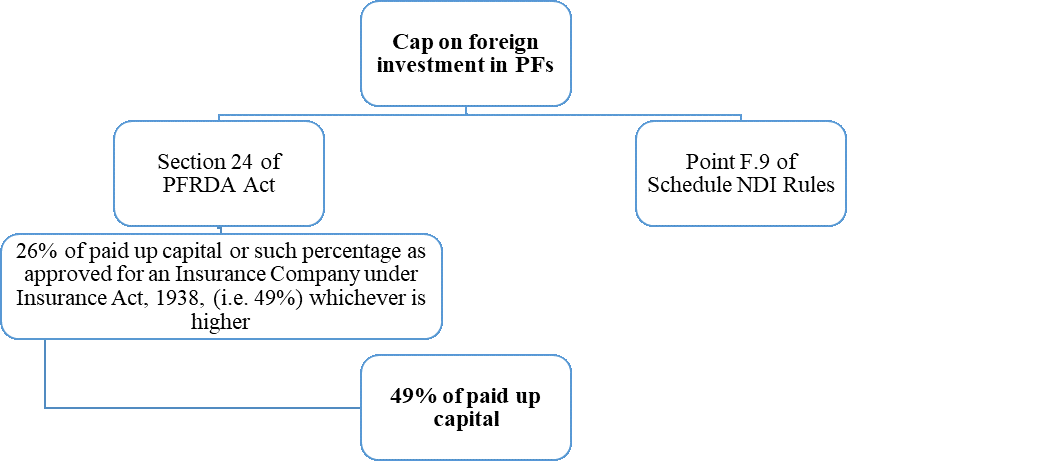
Both, the PFRDA Act and NDI Rules restrict foreign investment in PFs upto 49%. The Draft PF Rules also follow the lead of these provisions and state that the aggregate holding in a PF by foreign investors, including foreign portfolio investors, should not exceed 49% of its paid-up equity share capital. [Rule 3 of the Draft PF Rules]. Further, foreign investment up to 49% is allowed through automatic route. [Rule 5 of the Draft PF Rules]

The total foreign investment would be a total of direct and indirect foreign investment calculated as per the PFRDA regulations read with the FDI policy. [Rule 2 (p) of the Draft PF Rules]

Indian ownership and control at all times

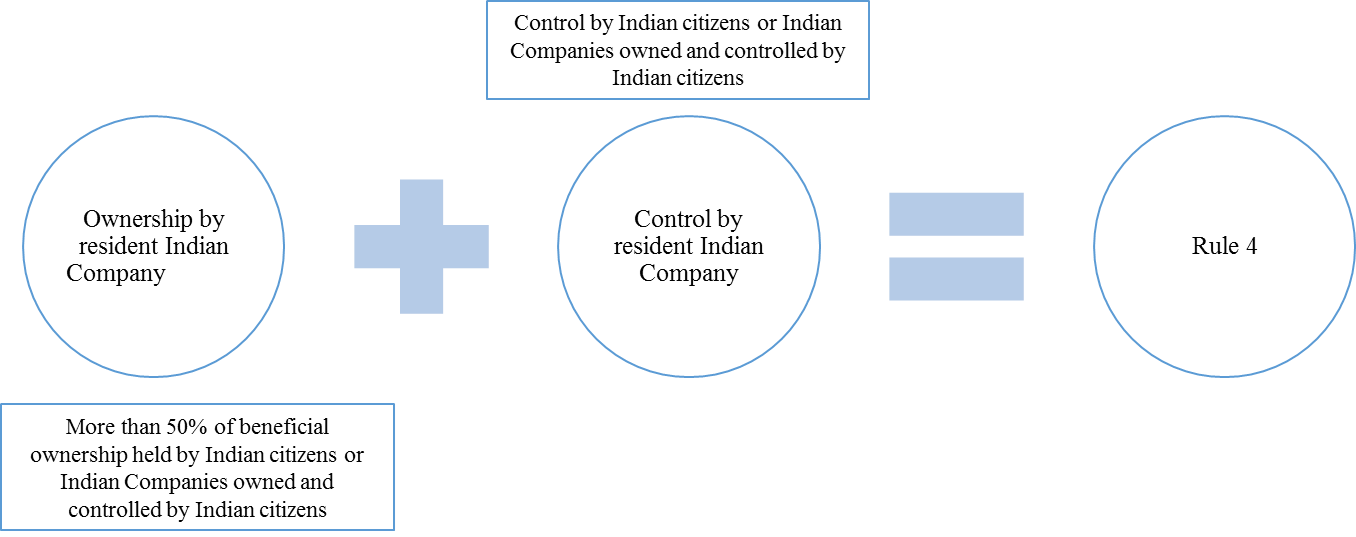
Rule 4 of the Draft PF Rules lays down that PFs in India must at all times ensure that their ‘ownership and control’ remains in the hands of resident Indian entities. For this purpose the rules have also defined ‘Indian Control’ and ‘Indian Ownership’ in Rule 2 (i) and (j) respectively. The same has been illustrated in the figure below:

This dual condition of ownership and control has been laid down to ensure that the decision making power of PFs stays with Indian investors at all times. PFs are vital institutional investors in the equity, debt and G-secs market. Handing out the controlling power to a foreign investor would affect the Indian capital markets and in turn the economy as a whole.
Foreign Portfolio Investment in PFs

FPI in PFs will be governed by the FEMA Regulations, 2000 along with SEBI (FPI) Regulations, 2019. [Rule 6 of the PF Rules]

Comment: The definition of foreign portfolio investment should be aligned with NDI Rules.

Increase in Foreign Investment in PFs

Pricing guidelines specified under FEM Regulations will have to be followed for increase in foreign investment of PFs.  [Rule 7 of the PF Rules]

Comment: Reference of Rule 21 of NDI Rules to be inserted.

The great wall for China

As a consequence of the COVID-19 pandemic lockdown as well as the increasingly strained relations between India and China, the former has imposed various restrictions on foreign investment by the latter.

The government has, vide the FEMA (NDI) Amendment Rules, 2020 dated 22nd April, 2020 posed the requirement of prior approval for any foreign investment by an entity of a country that shares land border with India in order to avoid opportunistic takeovers. This would even apply in cases where the beneficial ownership of the investment is situated in any of the restricted countries as well as to any case of transfer of ownership[1].

[1] To read out write-up on the same- https://vinodkothari.com/wp-content/uploads/2020/04/India-seals-its-borders-to-corporate-acquistions-ver-30.04.2020.p

In furtherance to this the Draft PF Rules specify that government approval will be required for investment in PF by foreign investors (entities as well as individuals) from any bordering countries including China. [Rule 8 of the Draft PF Rules]

Comment: Need to align with recent amendments made in Rule 6 (a) of NDI Rules restricting investments from countries sharing land border with India.

Link to our other articles:

  • MoF amends FDI norms for rights issue and insurance sector:

https://vinodkothari.com/2020/04/mof-amends-fdi-norms-for-rights-issue-and-insurance-sector/


  • Introduction to FEMA (NDI) Rules, 2019 and recent amendments

https://vinodkothari.com/2020/04/introduction-to-fema-ndi-rules-2019-and-recent-amendments/


  • India seals its borders to corporate acquisitions

https://vinodkothari.com/2020/04/india-seals-its-borders-to-corporate-acquisitions/


  • FPI can invest up to the sectoral cap in an Indian Company

https://vinodkothari.com/2020/04/fpi-can-invest-upto-the-sectoral-cap-in-an-indian-company/


Annexure I

Suggested amendments

Sr. no. Provision Details of the provision Remarks
1. Rule 2(d) ‘Foreign Investment means…..

xx

in the equity shares of a PF in India under clause (i) of sub regulation (1) of regulation 5 of the Foreign Exchange Management (Transfer of issue of security by a person resident outside India) Regulations, 2000


The definition of foreign investment makes reference to guidelines as specified under the TISPRO Regulations which have been repealed.


The corresponding provisions are covered under rule 6(a) of the NDI Rules.

2. Proviso to Rule 2(d) Provided that for the purpose of these rules, foreign investment shall include investment by Foreign Venture Capital Investment (FVCI) as permissible under regulation 6 of FEMA Regulations, 2000 As stated above, reference has been made to the repealed regulations.


Investments made by an FVCI are governed by rule 16 read with Schedule VII of the NDI Rules. As per the schedule, PFs are not included in the list of sectors permitted for investment by an FVCI. However, in the Draft PF Rules, the same is permitted and included under foreign investment.


3. Rule 2(f) Foreign portfolio investment means and includes investments in the equity share of a pension fund in India by Foreign Institutional Investors, Foreign Portfolio Investors, Non-Resident Indian, Qualified Foreign Investors and other eligible portfolio investor entities or persons in accordance with provisions contained in sub-regulations 2, (2A), 3, and 8 of Regulation 5 of FEMA Regulations, 2000


Firstly, reference has been made to the repealed regulations.


Secondly and more importantly, the definition is not in line with that provided under the NDI Rules and thus creating conflict.


According to the NDI Rules, foreign portfolio investment means any investment made by a person resident outside India through equity instruments where such investment is less than 10% of the post issue paid-up share capital on a fully diluted basis of a listed Indian company or less than 10% of the paid-up value of each series of equity instrument of a listed Indian company;


The Draft PF Rules consider FPI in equity shares (as defined under rule 2(c) which states that equity share capital will have the same meaning as defined under section 43 of the Companies Act, 2013) of the Company while the NDI Rules compute FPI on the basis of equity instruments (as defined under rule 2k of the NDI Rules).


Accordingly reference of ‘investing in equity shares’ should be substituted with ‘investing in equity instruments’ of PF in India.


Further, as per NDI rules, any foreign investment in an unlisted Company is treated as a foreign direct investment (FDI) irrespective of the quantum. In case of listed companies, investment up to 10% is treated as FPI. However, in case of the definition as provided under the Draft PF Rules, investment in equity shares of a PF would be treated as FPI. Furthermore, most of the PFs in India are unlisted companies. This creates huge discrepancy as to the fact whether foreign investment would be treated as FDI if it exceeds 10 % (as per NDI Rules) or PFI (as per Draft PF Rules)


Hence, alignment with the existing definition specified under rule 2(t) of the NDI Rules does not seem to be a relevant solution.


4. Rule 2(i) “Indian Control” of a pension fund means Control of a pension fund in India by resident Indian citizens or Indian Companies, which are owned and controlled by resident Indian citizens. According to Rule 23(7)(e) of the NDI Rules, “company controlled by resident Indian citizens” means an Indian company, the control of which is vested in resident Indian citizens and/ or Indian companies which are ultimately owned and controlled by resident Indian citizens……


According to Rule 23(7)(d) of the NDI Rules “control” shall mean the right to appoint majority of the directors or to control the management or policy decisions including by virtue of their shareholding or management rights or shareholders agreement or voting agreement…….


The definition under the Draft PF Rules more or less are similar to that provided under the NDI Rules. However, the term used in the former is ‘Indian control’ which should be aligned with the NDI Rules using the term ‘controlled by resident Indian citizens’.


Also, control has not been defined under the Draft PF Rules.


5. Rule 2(j) “Indian Ownership” of a pension fund in India means more than 50% of the equity capital in it is beneficially owned by resident Indian citizens or Indian companies, which are owned and controlled by resident Indian citizens provided that the manner of the computation of foreign holding of such Indian promoter or Indian investment company shall be construed with the relevant Rules and PFRDA Regulations/ Guidelines.


According to Rule 23(7)(b) of the NDI Rules, “company owned by resident Indian citizens” shall mean an Indian company where ownership is vested in resident Indian citizens and/ or Indian companies, which are ultimately owned and controlled by resident Indian citizens……


According to Rule 23(7)(a) of the NDI Rules, “ownership of an Indian company” shall mean beneficial holding of more than fifty percent of the equity instruments of such company…


Both the definitions specify the same percentage. However, the Draft PF Rules make reference to equity capital which has been defined therein to have the same meaning as that specified in section 43 of the Companies Act, 2013.  As per section 43, “equity share capital”, with reference to any company limited by shares, means all share capital which is not preference share capital. This means in case of Draft PF Rules, only equity capital will be considered. As opposed to this, the NDI Rules refer to equity instruments which include shares, convertible debentures, preference shares and share warrants subject to conditions specified.


The same should be aligned with the NDI Rules along with the terminology used.


6. Rule 2 (n) ‘Resident Indian investment’ shall have the same meaning assigned to it in the FDI policy issued from time to time.


In case there is a specific clause to that effect in the FDI Policy, then the same may be retained else, the definition should be modified to mean ‘investment made by a person resident in India not resulting in indirect foreign investment’.
7. Rule 2 (q) All other words and expression used in these rules but not defined, and defined in the Act and Rules, regulations made thereunder shall have the same meanings respectively assigned to them.


As certain terms may not be defined in PFRDA Act, Rules and Regulations but may be defined in NDI Rules, reference of NDI Rules should be included.
8. Rule 6 Foreign Portfolio Investment in a Pension Fund in India shall be governed by the provisions contained in sub-regulations 2, (2A), 3, and 8 of Regulation 5 of FEMA Regulations, 2000 and Securities Exchange Board of India (Foreign Portfolio Investors) Regulations


Reference has been made to the repealed TISPRO Regulation, 2000.


Corresponding provisions under NDI Rules

·     For regulation 5(2A) of the TISPRO regulations for investment by Foreign Portfolio investors- Chapter 4 read with Schedule II of the NDI Rules;

·     For regulation 5(3) of the TISPRO  regulations dealing with investment by Non-resident Indians and Overseas Corporate Body – Chapter V read with Schedule III and Chapter VI read with Schedule V of the NDI Rules;

·     For regulation 5(8) of TISPRO regulations dealing with investment in depository receipts- rule 6(d) read with Schedule IX of the NDI Rules.


Further, the TISPRO Rules mention of the Foreign Portfolio Scheme which was foregone in the TISPRO Regulations, 2017 and later by the NDI Rules as well.


9. Rule 8 A Government approval will be required for the investing entity or individual from any of the bordering countries including China.


While the Draft PF Rules make use of the term ‘bordering countries’, the same should be aligned with the NDI rules that makes reference to ‘a country which shares land border with India’.


[1] https://www.pfrda.org.in/index1.cshtml?lsid=187

[2] http://www.npstrust.org.in/sites/default/files/PFRDA_PFReg2015.pdf

[3] https://dipp.gov.in/sites/default/files/pn2_2016_1.pdf

[4] http://legislative.gov.in/sites/default/files/A2013-23.pdf

[5] By July 18, 2020.

SEBI’s measures towards resuscitation of financially “stressed” companies

Henil Shah | Executive

corplaw@vinodkothari.com

Introduction & Background

In layman’s term, a company with falling share prices, inability to pay off its obligations is said to be a company with financial distress. In most of the times, it is seen that the conventional means of fund raising such as borrowings, issuance of debt securities etc. do not work for such companies due to their ongoing stressed status even though generating cash is the foremost priority for them to fund their operations. Additionally, insolvency/ bankruptcy also becomes a matter of concern which may be caused due to the lack of funding and the resultant disruption in operation.

SEBI’s Primary Market Advisory Committee (PMAC) deliberated on the topic and came out with a Consultation Paper dated April 22, 2020[1] providing for the proposed measures for resuscitation of the stressed companies. The changes so proposed were w.r.t certain amendments under the SEBI (Issue of Capital and Disclosure Requirements) Regulations, 2018 (ICDR Regulations) and SEBI (Substantial Acquisitions of Shares and Takeovers) Regulations, 2011 (SAST Regulations). Based on the public comments, SEBI vide Notifications dated June 23, 2020 has prescribed the final text of the amendments under the ICDR Regulations[2] and SAST Regulations[3]

The article covers a brief synopsis and the relevant impact/ actionable pursuant to the said amendments.

Rationale behind the proposed changes

Preferential issue seems to be one of the most sought options of fund raising by the companies due to the administrative as well as regulatory convenience it carries. Further, knowing the probable investors ready to invest in the company makes a preferential issue one of the most commonly used ways for raising funds.

For a listed company, under a preferential issue, the issue price has to be determined as per the pricing provisions of Chapter V of ICDR Regulations. The ICDR Regulations provides the pricing mechanism for both frequently traded shares and infrequently traded shares.

In case of frequently trades shares, the price shall be determined as per the provisions of Regulation 164(1) (a) & (b) of the ICDR Regulations which are as follows.

Even though a preferential issue may be a convenient way of fund raising for a well performed company, the same may not be the case for a company with financial distress for the following reasons:

1.      Onerous pricing mechanism

Considering the continuous falling prices of the shares over a period of 26 weeks due to the company being in stress, the determination of the price as per the pricing mechanism provided in Regulation 164(1) (a) becomes too onerous for the investor. Further, the price under Regulation 164(1) (a) is much higher than that as determined as per Regulation 164(1) (b). Hence, the pricing mechanism acts as a major deterrent for the investors from subscribing to the shares offered under the preferential issue.

2.      Exemptions only to 5 QIBs restricting investor pool

Though the ICDR Regulations allow issuance to QIBs at a price determined as per regulation 164(1) (b) however, the same is restricted to only 5 QIBs and is not applicable to the investors other than QIBs thereby restricting the investor pool.

3.      Open offer obligations for the acquirer

Another roadblock which the issuers tend to face is from the view point of the investors i.e. an incoming investor who has an impending burden on complying with an open offer obligation in case where the subscription to the preferential offer leads to the triggering of the open offer obligations under SAST Regulations. In view of the procedural requirements and the huge costs involved, making an open offer discourages the investors seeking to have a substantial stake in the company in order to take control and thereby reverse the stress.

As per the extant provisions, the acquisition pursuant to a resolution plan approved under the Insolvency and Bankruptcy Code, 2016 is exempted from meeting the open offer obligations but no such exemption has been provided in case for acquisition in the financially distressed entity which are not under any resolution plan.

Rescue mechanism brought through the amendments

Insertion of regulation 164A in ICDR Regulations

The newly inserted provisions incorporate the changes that were proposed by PMAC into the existing regulations as discussed below:

When to consider a company at ‘stress’?

For a company to be classified as financially stressed and issue equity share in pursuance of regulation 164A of ICDR regulations it has meet certain conditions. Below is a comparative presentation between the text of the Consultation Paper and the final text of the Regulations. Further, any two of the three conditions shall have to be satisfied for considering a company as stressed.

PMCA Recommendations Final text of the Regulations Remarks
A listed company which has made disclosure of defaults on payment of interest/ principal amount of loans from banks/ financial institutions and listed and unlisted debt securities for 2 consequent quarters in terms of the SEBI Circular dated November 21, 2019[4] issued in this regard.


The issuer has disclosed the default relating to the payment of interest/ repayment of principal amount on loans from banks/ financial institutions/ NBFCs- ND-SI and NBFCs-D and/ or listed on unlisted debt securities in terms of SEBI circular dated November 21, 2019 and such default is continuing for a period of at least 90 days after occurrence of such default.


The amendment regulation in slight contrast to the PMAC recommendations provided shorter timeline for calculating continuity of the default.


Further, even though NBFCs-ND-SI and NBFCs- D already get covered under the definition of Financial Institution provided under RBI Act, they have been specifically covered under the list of creditors.

Existence of Inter-Creditor agreement in terms of Reserve Bank of India (Prudential Framework for Resolution of Stressed Assets) Directions 2019[5] (RBI Directions)


Same as PMCA Recommendations Inter-Credit agreement as provided in the RBI Directions stands for the agreement executed among all the lenders of a defaulting borrower, providing for ground rules for finalisation and implementation of resolution plan in respect to the borrower.
Credit rating of the listed instruments of the company has been downgraded to “D”. The credit rating of the financial instruments (listed or unlisted), credit instruments/ borrowings (listed or unlisted) of the listed company has been downgraded to “D” The final text of the amendments, in addition to the listed instruments, also brings unlisted instruments and as well as borrowings under its purview.

Pricing of preferential issue of shares of companies having stressed assets

Unlike the current pricing requirements as provided in Regulations 164(1) (a) & (b) of ICDR Regulations for a preferential issue, the price of the shares to be issued by a stressed company as aforesaid shall be a price which shall not be less than the average  of  the  weekly  high  and  low  of  the volume  weighted  average  prices  of  the  related  equity  shares quoted  on  a  recognised  stock  exchange  during  the  two  weeks preceding the relevant date. Therefore, the price as determined under Regulations 164(1) (a) & (b) of ICDR Regulations shall not be considered.

Negative list of proposed investors

The following person(s) shall not be eligible to participate in the preferential issue under Regulation 164:

  1. Persons/entities part of promoter or promoter group will not be eligible to participate in the preferential issue;
  2. Undischarged insolvent in terms of Insolvency and bankruptcy Code, 2016 (IBC, 2016);
  3. Wilful defaulter as per RBI guidelines issued under the Banking Regulations Act, 1949;
  4. A person disqualified to act as director as per Companies Act, 2013
  5. Person debarred from trading in securities or accessing securities market by SEBI and period of debarment has not been over
  6. Person declared as fugitive economic offender
  7. Person is convicted of offence punishable with imprisonment
    1. For a period of 2 years or more under any as specified under 12th schedule of IBC, 2016
    2. 7 years or more under any law for time being in force

and a period of 2 years has not been subsisted from his release form imprisonment.

  1. Person who has executed a guarantee in favour of a lender of the issuer and such guarantee has been invoked by the lender and remains unpaid in full or part.

Approval from shareholders falling under ‘public’ category

For companies with identifiable promoters

The amendments provides for an approval for the preferential issue by the majority of the shareholders in the ‘public’ category. The ‘public’ category of shareholders does not include promoter shareholders and also any proposed allottee who is already a holder of specified securities of the issuer. Therefore, the same is said to be an approval with majority of the minority.

For companies with identifiable promoters

For companies with no identifiable promoters, the resolution shall have to be passed by 3/4th majority. Though in this case, there is no specific mention in the Regulation as regards the eligibility of voting by the proposed allottees being a security holder in the issuer, the same should apply here also.

Contents of explanatory statement annexed with the notice of shareholder’s meeting

The proposed use of the issue proceeds shall be mentioned in the explanatory statement sent for the purpose of the shareholders resolution. This requirement is already in existence as the provisions of regulation 163 of ICDR Regulations and Rule 13 of the Companies (Share Capital and Debenture) Rules, 2014 do provide for mandatorily mentioning object for which the preferential issue is being made in the explanatory statement of the notice.

Restriction on use of proceeds

Additionally it’s restricted to use the issue proceeds for the purpose of repayment of loans from promoters/ promoter group/ group companies effectively deterring the companies to raise funds to pay-off its promoters.

Appointment of public financial institution or schedule commercial bank as monitoring agency:

As per the amendments, it shall be mandatory for the issuer company to appoint a monitoring agency whoc shall be responsible to submit report on quarterly basis to the issuer until 95% of the proceeds are utilised in the format as specified in Schedule XI ICDR Regulations. All though there is no requirement of appointing a monitoring agency as per the provisions of chapter V (Preferential Issue) requirement of ICDR Regulations, the concept of the monitoring agency is not new as several chapters of the regulations provide for appointment and functions to be performed by the monitoring agency in case where offer size exceeds a predefined limit.  However the considering issue by a financially stressed company there is no monetary limit set for the purpose of appointment of monitoring agency.

Responsibilities of Board of Directors

The board of directors and the management of the issuer shall be required to provide their comments on the findings in the report of monitoring agency and disseminate the same within 45 days of end quarter by publishing it on the website of the company as well as submitting the same with the stock exchange(s) were equity shares of the company are listed.

Responsibilities of Audit Committee

Additionally the audit committee of the issuer is entrusted with responsibility to monitor the utilization of the proceeds. This is nothing new the same already falls under the responsibility of the audit committee as laid in the SEBI (Listing Obligations and Disclosure Requirements), 2015.

Further, the audit committee of the company shall also be required to certify about the meeting of all conditions at the time of dispatch of notice and at the time of allotment.

Responsibilities of statutory auditors

The amendments require the statutory auditor also to certify about the meeting of all conditions at the time of dispatch of notice and at the time of allotment.

Lock in period

The allotment shall be lock-in for a period of 3 years from the date of trading approval.

Amendments to SAST Regulations

On same lines as mentioned in the Consultations Paper, SEBI has vide its amendments under the SAST Regulations inserted regulation 10 (2B) of SAST Regulations thereby granting immunity from open offer obligations to the investors under the preferential issue in compliance with regulation 164A of ICDR Regulations. Irrespective of the fact that equity shares are frequently traded or not.

Conclusion

Considering the stressed status of the company, it is believed that aligning the pricing requirement with that of pricing requirement in case of preferential issue to QIBs, shall effectively increase the pool of investors. Similarly, the proposed exemption from making of an open offer shall lessen the additional burden on an incoming investor to comply with the stringent requirements thereby attracting investors to put in money in such companies.

Accordingly, SEBI’s intention behind the changes may be said to be a welcome move as it will definitely help the financially stressed companies to revive.

Link to our other articles:

SEBI’s proposal to aid financially “stressed” companies: https://vinodkothari.com/2020/04/sebis-proposal-to-aid-financially-stressed-companies/

Prudential Framework for Resolution of Stress Assets: New Dispensation for dealing with NPAs: https://vinodkothari.com/2019/06/fresa/

[1] https://www.sebi.gov.in/reports-and-statistics/reports/apr-2020/consultation-paper-preferential-issue-in-companies-having-stressed-assets_46542.html

[2] http://egazette.nic.in/WriteReadData/2020/220093.pdf

[3] http://egazette.nic.in/WriteReadData/2020/220094.pdf

[4] https://www.sebi.gov.in/legal/circulars/nov-2019/disclosures-by-listed-entities-of-defaults-on-payment-of-interest-repayment-of-principal-amount-on-loans-from-banks-financial-institutions-and-unlisted-debt-securities_45036.html

[5] https://www.rbi.org.in/Scripts/NotificationUser.aspx?Id=11580&Mode=0

RBI amends mode of payment and remittance norms for units of Investment vehicles

Permits FPIs and FVCIs to use Special Non-Resident Rupee (SNRR) account 

CS Burhanuddin Dohadwala| Manager, Aanchal Kaur Nagpal| Executive

corplaw@vinodkothari.com

The Reserve Bank of India (‘RBI’) vide notification dated October 17, 2019 had  notified the Foreign Exchange Management (Mode of Payment and Reporting of Non-Debt instrument) Regulations, 2019[1] (‘the Regulations’) governing the mode of payment and reporting of non-debt instruments consequent to the Foreign Exchange Management (Non-Debt Instrument) Rules, 2019[2] framed by the Ministry of Finance, Central Government.

RBI has recently vide its notification dated June 15, 2020 notified Foreign Exchange Management (Mode of Payment and Reporting of Non-Debt Instruments) (Amendment) Regulations, 2020[3] amending Reg. 3.1 dealing with Mode of Payment and Remittance of sale proceeds in case of investment in investment vehicles.

Let us discuss few terms to understand the recent amendments to the Regulations.

Investment Vehicles under FEMA:

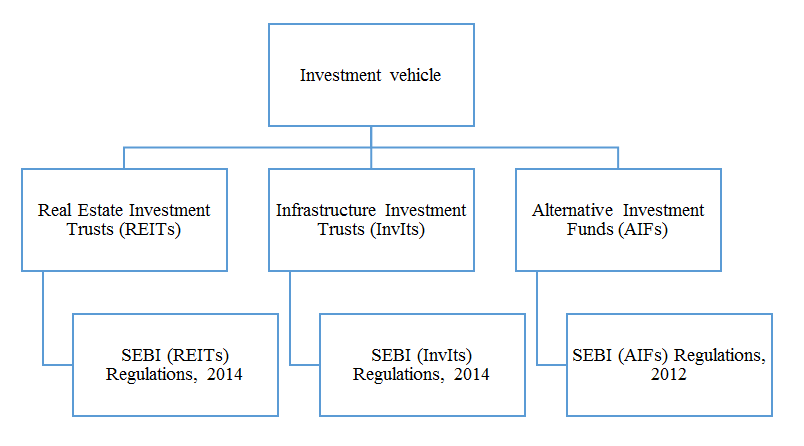
According to FEMA (Non-Debt Instruments) Rules, 2019, investment vehicles mean:

Different types of account available under FEMA (Deposit) Regulations, 2016[1] (‘Deposit Regulations’)

The following are the major accounts that can be opened in India by a non-resident:

Particulars Eligible Person
Non-Resident (External) Rupee Account Scheme-NRE Account

Non-resident Indians (NRIs) and Person of Indian Origin (PIOs)

Foreign currency (Non-Resident) account (Banks) scheme – FCNR (B) account
Non-Resident ordinary rupee account scheme-NRO account

Any person resident outside India.

Special Non-Resident Rupee Account – SNRR account

Any person resident outside India.

A significant advantage of SNRR over NRO is that the former is a repatriable account while the latter is non-repatriable.

What is Special Non-Resident Rupee (‘SNRR’) Account?

Any person resident outside India, having a business interest in India, may open SNRR account with an authorised dealer for the purpose of putting through bona fide transactions in rupees. The  business  interest,  apart  from  generic  business  interest,  shall  include the  following INR transactions, namely:-

  • Investments made  in  India  in  accordance  with  Foreign  Exchange  Management  (Non-debt Instruments)  Rules,  2019  dated  October  17,  2019  and  Foreign  Exchange  Management  (Debt  Instruments)
  • Import of  goods  and  services  in  accordance  with  Section  5  of  the  Foreign  Exchange  Management  Act  1999 Regulations,   2019;
  • Export of  goods  and  services  in  accordance  with  Section  7  of  the  Foreign  Exchange  Management  Act  1999;
  • Trade credit   transactions   and   lending   under   External   Commercial   Borrowings   (ECB)   framework;
  • Business related  transactions  outside  International  Financial  Service  Centre  (IFSC)  by  IFSC  units  at  GIFT  city  like  administrative  expenses  in  INR  outside  IFSC,  INR  amount  from  sale  of  scrap,  government  incentives  in  INR,  etc;

Rationale behind the amendment:

Position under Master Direction – Foreign Investment in India by RBI

According to Annex 8 of Master Direction – Foreign Investment in India by RBI, investment made by a PROI was permitted with effect from 13th September, 2016. The provisions specify that the amount of consideration of the units of an investment vehicle should be paid out of funds held in NRE or FCNR(B) account maintained in accordance with the Deposit Regulations as one of the modes of payment.

Further it also specifies that the sale/ maturity proceeds of the units may be remitted outside India or credited to the NRE or FCNR(B) account of the person concerned.

Position under the erstwhile provisions of the Regulations

Schedule II of the Regulations (Investments by FPIs) stated earlier that of units of investment vehicles other than domestic mutual fund may be remitted outside India.

However, balances in SNRR account were permitted to be used for making investment only in units of domestic mutual fund and not in Investment Vehicles.

As discussed above, the NRO account is a non-repatriable account while the SNRR account is a repatriable account. Due to the above provisions, investment in Investment Vehicles could not be transferred to the SNRR account for repatriation resulting in ambiguity.

Owing to the above and to increase the inflow of foreign investment, the Government has amended the said provision and allowed FPIs & FVCI to invest in listed or to be listed units of Investment vehicle.

Brief comparison of the pre and post amendment is covered in our Annexure I.

Annexure-I

Comparison of the pre and post amendment

Schedule Post amendment Prior to amendment Remarks
Schedule II w.r.t Investments by Foreign Portfolio Investors A.     Mode of payment

1.       The  amount  of  consideration  shall  be  paid  as  inward  remittance  from  abroad through banking channels or out of funds held in a foreign currency account and/ or a Special Non-Resident Rupee (SNRR) account maintained in accordance with the Foreign Exchange Management (Deposit) Regulations, 2016.


2.       Unless otherwise  specified in these regulations or the  relevant Schedules, the foreign  currency  account  and  SNRR  account  shall  be  used  only  and  exclusively for transactions under this Schedule.


A.     Mode of payment

1.       The amount of consideration shall be paid as inward remittance from abroad through banking channels or out of funds held in a foreign currency account and/ or a Special Non-Resident Rupee (SNRR) account maintained in accordance with the Foreign Exchange Management (Deposit) Regulations, 2016.

Provided balances in SNRR account shall not be used for making investment in units of Investment Vehicles other than the units of domestic mutual fund.

2.       The foreign currency account and SNRR account shall be used only and exclusively for transactions under this Schedule.


The erstwhile provisions restricted use of SNRR account balance for making investments in investment vehicles other than mutual funds.

As a result FPIs could not use their SNRR account and had to resort to other types of accounts for investment in investment vehicles such as REITs, and InViTs. The recent amendment has removed this restriction.

The amendment has been made to provide for the amendment made in Schedule VIII dealing with Investment     by     a     person resident outside India in an Investment Vehicle.

B.     Remittance of sale proceeds

The sale proceeds (net of taxes) of equity instruments and units of REITs, InViTs and domestic mutual fund may be remitted outside India or credited to the foreign currency account or a SNRR account of the FPI.

B.     Remittance of sale proceeds

The sale proceeds (net of taxes) of equity instruments and units of domestic mutual fund may be remitted outside India or credited to the foreign currency account or a SNRR account of the FPI.

The sale proceeds (net of taxes) of units of investment vehicles other than domestic mutual fund may be remitted outside India.

To align with the amendment made in Schedule VIII dealing with Investment     by     a     person resident outside India in an Investment Vehicle.
Schedule VII w.r.t Investment by a Foreign Venture Capital Investor (FVCI) For Para A(2):

Unless otherwise specified in these regulations or the relevant Schedules, the foreign currency account and SNRR account shall be used only and exclusively for transactions under this Schedule.

For Para A(2):

The foreign currency account and SNRR account shall be used only and exclusively for transactions under this Schedule.


The insertion has been made to align with the amendments proposed in Schedule VIII dealing with Investment     by     a     person resident outside India in an Investment Vehicle.

Schedule VIII w.r.t Investment     by     a     person resident  outside  India  in  an Investment Vehicle A.     Mode of payment:

The  amount  of  consideration  shall  be  paid  as  inward  remittance  from  abroad through  banking  channels  or  by  way  of  swap  of  shares  of  a  Special  Purpose Vehicle   or   out   of   funds   held   in   NRE   or   FCNR(B)   account   maintained   in accordance with the Foreign Exchange Management (Deposit) Regulations, 2016.

Further,  for  an  FPI  or  FVCI,  amount  of  consideration  may  be  paid  out  of  their SNRR  account  for  trading  in  units  of  Investment  Vehicle  listed  or  to  be  listed (primary issuance) on the stock exchanges in India.

A.     Mode of payment:

The amount of consideration shall be paid as inward remittance from abroad through banking channels or by way of swap of shares of a Special Purpose Vehicle or out of funds held in NRE or FCNR(B) account maintained in accordance with the Foreign Exchange Management (Deposit) Regulations, 2016.


Further, it is clarified that the SNRR account may be used for trading in units of listed as well as to be listed units of investment vehicles and the sale/ maturity proceeds can be credited to the said account.

B.     Remittance of Sale/maturity proceeds:

The  sale/  maturity  proceeds  (net  of  taxes)  of  the  units  may  be  remitted  outside India or may be credited to the NRE or FCNR(B) or SNRR account, as applicable of the person concerned.

B.     Remittance of sale/maturity proceeds

The sale/maturity proceeds (net of taxes) of the units may be remitted outside India or may be credited to the NRE or FCNR(B) account of the person concerned.


Link to our other articles:

Introduction to FEMA (NDI) Rules, 2019 and recent amendments:

https://vinodkothari.com/2020/04/introduction-to-fema-ndi-rules-2019-and-recent-amendments/

RBI rationalises operation of Special Non-Resident Rupee A/c:

https://vinodkothari.com/wp-content/uploads/2019/11/RBI-rationalises-operation-of-SNRR-Account.pdf


[1] https://vinodkothari.com/wp-content/uploads/2019/11/RBI-rationalises-operation-of-SNRR-Account.pdf

[1] http://egazette.nic.in/WriteReadData/2019/213318.pdf

[2] http://egazette.nic.in/WriteReadData/2019/213332.pdf

[3] http://egazette.nic.in/WriteReadData/2020/220016.pdf

Limits on creeping acquisition by promoters increased during COVID-19 crises

Shaifali Sharma | Vinod Kothari and Company

Introduction

SEBI has been taking several proactive measures to relax fund raising norms and thereby making it easier for companies to raise capital amid the COVID-19 pandemic. With a view to further facilitate fund raising by the companies, SEBI vide its notification dated June 16, 2020[1], has relaxed the obligation for making open offer for creeping acquisition under Regulation 3(2) of the Securities and Exchange Board of India (Substantial Acquisition of Shares and Takeovers) Regulations, 2011 (Takeover Code).

The relaxation allows creeping acquisition upto 10% instead of the existing 5%, for acquisition by promoters of a listed company for the financial year 2020-21. The relaxation is specific and limited to acquisition by way of a preferential issue of equity shares and therefore excludes acquisitions through transfers, block and bulk deals etc. Also recently, SEBI in its Board Meeting[2] held on June 25, 2020 has proposed to provide an additional option to the existing pricing methodology for preferential issue under which the minimum price for allotment of shares will be volume weighted average of weekly highs and low for twelve weeks or two weeks, whichever is higher.However, this new rule shall apply till December 31, 2020 with 3 years lock-in condition for allotted shares. Further, by way of the same notification, SEBI has also relaxed the provisions of voluntary open offer where an acquirer together with PAC will be eligible to make voluntary offer irrespective of any acquisition in the previous 52 weeks from the date of voluntary offer, this will promote investments into various companies in future.

This article tries to discuss on whether the relaxation given by SEBI to the promoters are as encouraging as it seems to be, when connected with the pricing norms for preferential issue under the SEBI (Issue of Capital and Disclosures Requirement) Regulations, 2018 (‘ICDR Regulations’) and how the new pricing methodology proposed by SEBI can leverage the situation.

What is Creeping Acquisition?

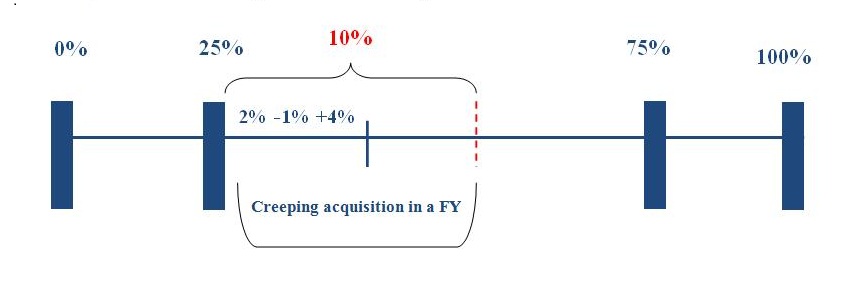
Creeping acquisition, governed by Regulation 3(2) of the Takeover Code, refers to the process through which the acquirer together with PAC holding more than 25% but less than 75%, to gradually increase their stake in the target company by buying up to 5% of the voting rights of the company in one financial year. Any acquisition of further shares or voting rights beyond 5% shall require the acquirer to make an open offer. Further, for the purpose of creeping acquisition, SEBI considers gross acquisitions only notwithstanding any intermittent fall. The same is projected in Figure 1 below. Also, in all cases, the increase in shareholding or voting rights is permitted only till the 75% non-public shareholding limit.

Figure 1: Creeping acquisition limit increased from 5% to 10%

Rationale for easing the norms of Creeping Acquisition

While the companies are currently struggling to manage their cash flows due to the financial challenges faced on account of COVID-19, the amendment will allow companies to raise funds from promoters to tide over their difficulties for the financial year 2020-21. This revision will also boost the sagging stock market and help sustain the stock prices of the company.

Promoters, on the other hand, owning 25% or more of the shares or voting rights in a company will be able to increase their shareholdings up to 10% in a year versus the previously allowed threshold limit of 5%.

Permutations and Combinations of Creeping Acquisition during FY 2020-21

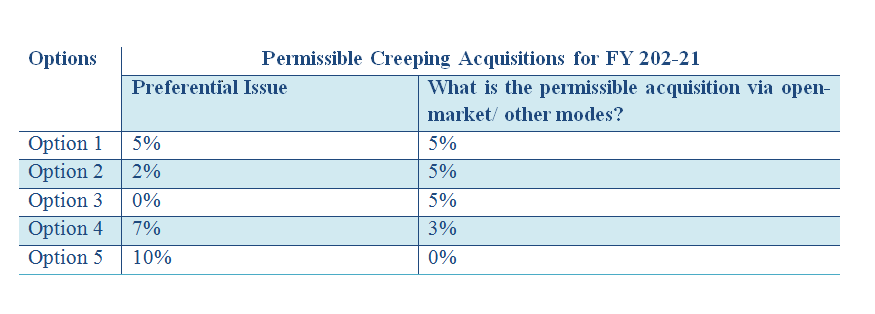
Since the enhanced 10% limit applies only in case of acquisition under preferential issue, the total acquisition of 10% may be achieved by any of the following combinations:

Option 1: Acquire upto 5% shares via open-market purchase or any other form and the remaining 5% shares can be acquired through subscribing to a preferential issue.

Option 2:Acquire 10% shares through preferential issue

Accordingly, in a block of 12 months of financial year 2020-21, if the promoterwants to acquire share through open market, bulk deals, block deals or in any other form, the 5% threshold shall remain in force and additional 5% can be acquired through preferential issue.

Identified below are the permitted acquisitions through open market, transfers or other forms in case promoter opts for preferential issue:

Whether the relaxation in open offer is actually encouraging when read with the pricing norms under ICDR Regulations?

As stated above, the relaxation can be availed only in the cases where the investments are done undera preferential issue. Regulation 164 of the SEBI (Issue of Capital and Disclosures Requirement) Regulations, 2018 (‘ICDR Regulations’) deals with the pricing norms under preferential issue. It provides that the issue price in cases where the shares have been listed for more than 26 weeks on a recognized stock exchange as on the relevant date, the issue price has to be higher of the following:

  1. the average of the weekly high and low of the volume weighted average price of the related equity shares quoted on the recognized stock exchange during the twenty six weeks preceding the relevant date; or
  2. the average of the weekly high and low of the volume weighted average prices of the related equity shares quoted on a recognized stock exchange during the two weeks preceding the relevant date.

The computation of the prices as per the above stated regulation will lead to a wide gap between the pricing at the beginning of the twenty-six week period and the current price when the company raises funds.

During this time of stock market crises, the stock prices of many companies have dropped sharply from their respective all-time high values recorded 6 months back. Further, in the cases where the market price is lower than the minimum price calculated as per ICDR Regulations for preferential issue, the promoters will be discouraged to acquire shares under preferential allotment as they will end up paying higher values.

Due to the challenges faced by the economy in view of COVID-19, the trading prices of the listed companies have gone down sharply. Accordingly, the price determined under ICDR Regulations may not be a motivating factor for the promoters to subscribe to the additional shares though, elimination of the costs involved in a public offer may compensate the same.

However, to curb the above situation, SEBI in its Board meeting held on June 25, 2020, has proposed an additional option to the existing pricing methodology for preferential issuance as under:

In case of frequently traded shares, the price of the equity shares to be allotted pursuant to the preferential issue shall be not less than higher of the following:

  1. the average of the weekly high and low of the volume weighted average price of the related equity shares quoted on the recognized stock exchange during the twelve weeks preceding the relevant date; or
  2. the average of the weekly high and low of the volume weighted average prices of the related equity shares quoted on a recognized stock exchange during the two weeks preceding the relevant date.

The new option will consider the weighted average price of equity shares preceding 12 weeks instead of the preceding 26 weeks and therefore reflect the accurate price during the pandemic period.  This may prove to be the solution to above crises,making fundraising through preferential issue easier for the corporates and simultaneously encouraging the promoters as well to infuse funds.

Compliances for preferential issue to promoters under PIT Regulations

Considering the fact that promoter is one of the designated person as per the SEBI (Prohibition of Insider Trading) Regulations, 2015 (‘PIT Regulations’), the companies, in addition to the procedural requirements for preferential issue prescribed under the Companies Act, 2013, ICDR Regulations and other applicable laws, shall also comply with the provisions of PIT Regulations.

Closure of trading window in case of preferential allotment

Designated persons and their immediate relatives shall not trade in securities when the trading window is closed. The trading restriction period shall apply from the end of every quarter till 48 hours after the declaration of financial results.

Further, the trading window shall also be closed when the compliance officer determines that a designated person (DP) or class of designated persons can reasonably be expected to have possession of unpublished price sensitive information (UPSI). Therefore, the trading window shall be closed and communicated to all DPs as soon as the date/notice of board meeting to approve issue of share via preferential allotment is finalized upto 2nd trading day after communication of the decision of the Board to the Stock Exchanges.

Accordingly, promoter/ class of promoters acquiring shares under preferential issue shall conduct all their dealings in the securities of the company only in a valid trading window i.e. once the trading widow is open subject to the pre-clearance norms prescribed under PIT Regulations and the Code of Conduct for prevention of insider trading of the Company.

Concluding Remarks

Given the lack of liquidity in the market, the proposed amendments maybe seen as an opportunity for target companies to raise capital from its promoters. Further, promoters can also infuse funds through equity issuance and will be able to increase their shareholding in the target company without the formalities of making the open offer.

Having said that since the market might take some time to recover, this relaxation provides a gateway for promoters to avoid open offer requirements which would otherwise have involved compliance burden on the promoter. However, the pricing factor may seem to be the only hindrance or a demotivation for actually availing this relaxation which seems to be resolved through the new pricing method proposed by SEBI in its Board meeting.

[1]To view the notification, click here

[2]https://www.sebi.gov.in/media/press-releases/jun-2020/sebi-board-meeting_46929.html

Other reading materials on the similar topic:

  1. ‘SEBI revisits Takeover Code’ can be viewed here
  2. ‘Takeover Code 2011’ can be viewed here
  3. ‘Decoding Takeover Code’ can be viewed here
  4. Our other articles on various topics can be read at: https://vinodkothari.com/

Email id for further queries: corplaw@vinodkothari.com

Our website: www.vinodkothari.com

Our Youtube Channel: https://www.youtube.com/channel/UCgzB-ZviIMcuA_1uv6jATbg

MCA’s exclusion period for registering charge poses threat for creditors!

Transacting by exception: Listed cos in India give substantive carve outs for RPTs

The article has been published in ICSI – WIRC-E Newsletter (June-July 2020 edition):
Refer page 43 of ICSI – WIRC-E Newsletter

Webcasting in virtual AGM

by Smriti Wadehra & Qasim Saif

(smriti@vinodkothari.com) (executive@vinodkothari.com)

Background

MCA considering the COVID-19 pandemic and the social distancing norms issued by the Government, realized that conducting physical AGM by companies within the prescribed timeline shall be difficult for this financial year. Accordingly, the Ministry vide its circular dated 5th May, 2020 has permitted holding of Annual General Meetings (AGM) through video conferencing[1] for all meetings conducted during the calendar i.e. till 31st December, 2020. The said circular read with previous circulars dated 13th April, 2020[2] and 8th April, 2020[3] prescribed a detailed procedure as to how companies can conduct their general meetings virtually.

While these circulars dealt with various perplexities arising from the thought of virtual general meetings, however, there was still some clarification pending on applicability of other requirements applicable on companies, for instance, the requirement of webcasting under regulation 44(6) of SEBI (Listing Obligation and Disclosure Requirements) Regulation, 2015.

We discuss the same as below.

Webcast vs Video conferencing

The very basic differentiation in the term webcast and video conferencing is that, the former only provides one-way participation rights but the later provides for a two-way communication. In reference to providing webcasting facility during the AGM, the shareholders can only watch and listen to the proceedings of the meeting but cannot participate in voting or ask queries whereas in video conferencing the shareholders have complete participation as in case of a physical general meeting. Webcasting is merely “live streaming” of the AGM.

Intent of webcast

The requirement for providing webcast facility was recommended by Kotak Committee[4] on Corporate Governance which provided:

“Reg 44A. Meetings of shareholders

The top 100 listed entities by market capitalization, determined as on March 31 of every financial year, shall provide one-way live webcast of the proceedings of all shareholder meetings held on or after April 1, 2018

The aforesaid recommendation was in addition to the recommendation w.r.t. e-voting facility which as per the existing provision of law, is closed at 5 p.m. of the previous day of the meeting, however, the committee recommended to shift the closure of e-voting facility to the day of meeting itself. The intent behind the recommendation was that the e-voting timeline expires before the meeting is held, accordingly, shareholders not attending the meetings in person are unable to take into account discussions at the meeting in order to make informed decisions.

Whereas, SEBI accepted the recommendations made by the Kotak Committee on 9th May, 2018 w.r.t. webcasting facility and inserted a new sub-regulation, however, the recommendation w.r.t e-voting is still in draft form. The provisions relating to webcast were made applicable to top 100 listed entities from 1st April, 2019.

The whole intent of conducting annual general meetings is the indispensable right to the shareholders of companies to meet the directors and auditors of the Company, at least once in a year. This has been the feature of corporate laws over the decades – based on the fact that the “managers” (directors) at least face the “owners” (shareholders) once. The law therefore, mandates physical meetings. However, with the rise of technology, call it necessity or evolution, the law embraced e-voting as a recognised means of voting (but not participation). Later, SEBI introduced the concept of providing one-way webcast facility for shareholders so as to increase participation of shareholders at meeting (though one-way).

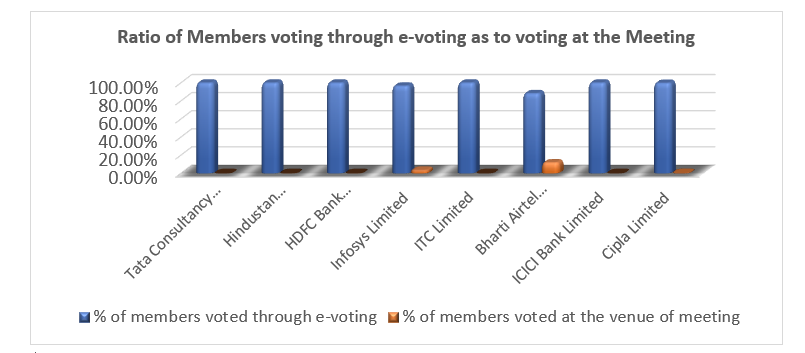
The data shows that attendance of shareholders at AGMs is even less than 5% of total number of shareholders at Meeting. Further, most of the shareholders (especially those residing in state other than where the AGM is conducted) find it more feasible to vote by way of e-voting. In the data[5] below, we can observe that on an average 95% of members of some well reputed companies vote through e-voting while on-site voting percentage is negligible. Therefore, it can be said, that the members do not really depend on meeting discussions to take a decision. However, webcast enables them to be apprised of the conduct of the meeting, shareholder queries, concerns, etc. raised at the meeting, etc.

Globally, countries like United States of America, Canada, United Kingdom, France, China and many such countries have permitted conducting meeting through video conferencing during the crisis. Further, the concept of webcasting is new for India. However, for many foreign countries including those named above have included providing of webcasting facility in shareholder’s meeting as a requirement of law.

Webcast facility in virtual AGM, whether required?

Now, the question is, where the AGM has itself gone ‘virtual’ (as mentioned above), is there really a requirement of webcasting? Note that SEBI has not provided any relaxation from webcasting as such.

It may be noted that video conferencing is nothing but participation through electronic means by shareholders remotely i.e. other than the venue of AGM. Therefore, where the company has already provided the facility of video conferencing to shareholders, webcast may not actually be needed. The purpose which the webcast intends to serve (dissipation of conduct of meeting) is well-served by the video-conferencing. In fact, in webcast the shareholders get only participation rights i.e. to hear and view the proceedings of meeting. However, in case of virtual AGM, the shareholders are provided with two-way participation rights i.e. can speak as well. Hence, provided two options, the shareholders will mostly opt for the latter.

The webcast, however, can be of relevance where the participation capacity is limited. In this regard, MCA circular dated 8th April, 2020 has prescribed minimum capacity allowance by companies conducting virtual AGM. For companies that are required to provide e-voting facility has to arrange capacity of minimum 1000 members at virtual AGM on first come first basis. This limit is minimum 500 members for companies not required to provide e-voting facility. Hence, the platform for conducting virtual AGM should provide for aforesaid minimum.

We all know that mostly large companies have lakhs of shareholders.  Therefore, if companies restrict the entry of shareholders on first come first basis i.e. does not allow participation right to all shareholders in virtual AGM (due to software limitations, etc.), in that case webcast facility should be provided (if required). However, if companies do not restrict any shareholder from participation in virtual AGM and is open for all shareholders irrespective of the number, in such cases providing separate facility for webcast may turn out to be a futile exercise.

[1] http://www.mca.gov.in/Ministry/pdf/Circular20_05052020.pdf

[2] http://www.mca.gov.in/Ministry/pdf/Circular17_13042020.pdf

[3] https://www.mca.gov.in/Ministry/pdf/Circular14_08042020.pdf

[4] https://www.sebi.gov.in/reports/reports/oct-2017/report-of-the-committee-on-corporate-governance_36177.html

[5]Source: https://www.livemint.com/opinion/online-views/covid-19-need-to-re-look-at-pre-digital-era-compliances-under-companies-act-11588585274712.html

Easing of DRF requirement

-by Smriti Wadehra

(smriti@vinodkothari.com)

-Updated as on 29th September, 2020

Pursuant the proposal of Union Budget of 2019-20, the MCA vide notification dated 16th August, 2019 amended the provisions of Companies (Share Capital and Debentures) Rules, 2014 [1].(You may also read our analysis on the notification at Link to the article) The said amended Rules faced a lot of apprehensions, especially, from the NBFCs as the notification which was initially expected to scrap off the requirement of creation of DRR for publicly issued debentures had on the contrary, rejuvenated a somewhat settled or exempted requirement of creation of debenture redemption fund as per Rule 18(7) for NBFCs as well.

As per the notification, the Ministry imposed the requirement for parking liquid funds, in form of a debenture redemption fund (DRF) to all bond issuers except unlisted NBFCs, irrespective of whether they are covered by the requirement of DRR or not. In this regard, considering the ongoing liquidity crisis in the entire financial system of the Country, parking of liquid funds by NBFCs was an additional hurdle for them.

Creation of DRR is somewhat a liberal requirement than creation of DRF, this is because, where the former is merely an accounting entry, the latter is investing of money out of the Company. Further, the fact the notification dated 16th August, 2019 casted exemption from the former and not from the latter, created confusion amidst companies. The whole intent of amending the Rule was to motivate NBFCs to explore bond markets, however, the requirement of parking liquid funds outside the Company as high as 15% of the amount of debentures of the Company was acting as a deterrent for raising funds by the NBFCs.

Considering the representations received from various NBFCs and the ongoing liquidity crunch in the economy of the Country along with added impact of COVID disruption, the Ministry of Corporate Affairs has amended the provisions of Rule 18 of Companies (Share Capital and Debenture) Rules, 2014 vide notification dated 5th June, 2020 [2]to exempt listed companies coming up with private placement of debt securities from the requirement of creation of DRF.

What is DRR and DRF?

Section 71(4) read with Rule 18(1)(c) of the Companies (Share Capital and Debentures) Rules, 2014 requires every company issuing redeemable debentures to create a debenture redemption reserve (“referred to as DRR”) of at least 25%/10% (as the case maybe) of outstanding value of debentures for the purpose of redemption of such debentures.

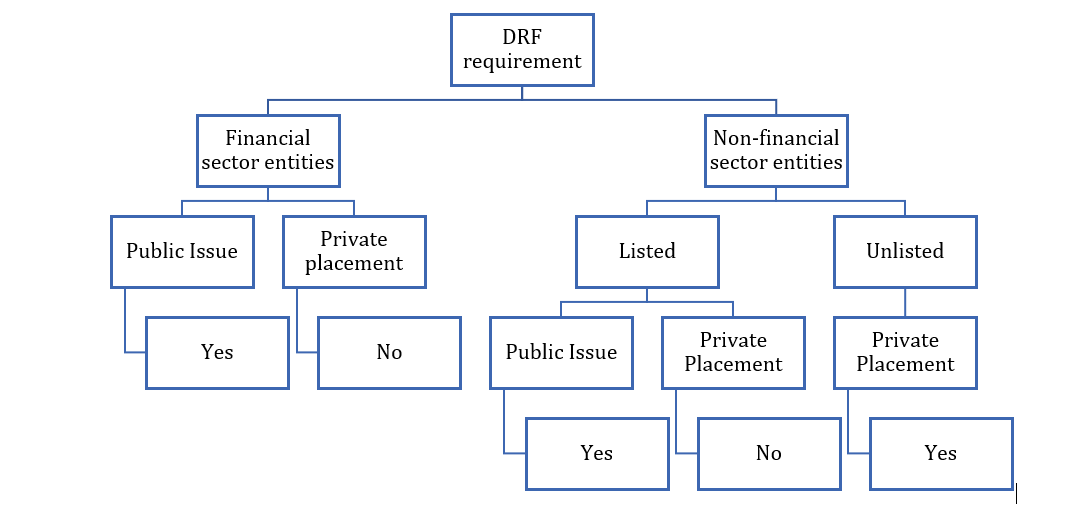
Some class of companies as prescribed, has to either deposit, before April 30th each year, in a scheduled bank account, a sum of at least 15% of the amount of its debentures maturing during the year ending on 31st March of next year or invest in one or more securities enlisted in Rule 18(1)(c) of Debenture Rules (‘referred to as DRF’).

The notification has mainly exempted two class of companies from the requirement of creation of DRF:

  1. Listed NBFCs registered with RBI under section 45-IA of the RBI Act, 1934 and for Housing Finance Companies registered with National Housing Bank and coming up with issuance of debt securities on private placement basis.
  2. Other listed companies coming up with issuance of debt securities on private placement basis.

However, the unlisted non-financial sector entities have been left out. In a private placement, the securities are issued to pre-selected investors. Raising debt through private placement is a midway between raising funds through loan and debt issuances to public. Like in case of bilateral loan arrangements, but unlike in case of public issue, the investors get sufficient time to assess the credibility of the issuer in private placements, since the investors are pre-identified.

The intent behind DRF is to protect the interests of the investors, usually when retail investors are involved, with respect to their claims on maturity falling due within a span of 1 year. This is not the case for investors who have invested in privately placed securities, where the investments are made mostly by institutional investors.

Further, companies chose issuance through private placement for allotment of securities privately to pre-identified bunch of persons with less hassle and compliances. Hence, the requirement of parking funds outside the Company frustrates the whole intent.

Further, it is a very common practice to roll-over the bond issuances, hence, it is not that commonly bonds are repaid out of profits; the funds are raised from issuance of another series of securities. This is a corporate treasury function, and it seems very unreasonable to convert this internal treasury function to a statutory requirement.

Though, in our view, the relaxation provided in case of private issuance of debt securities is definitely a relief, especially during this hour of crisis, but we are not clear about the logic behind excluding unlisted non-financial sector entities.

Even though, the financial sector (76%) entities dominate the issuance of corporate bonds, however, the share of the non-financial sector entities (24%) is not insignificant. Therefore, ideally, the exemption in case of private placements should be extended to unlisted non-financial sector entities as well.

A brief analysis of the amendments is presented below:


Practical implication

Pursuant to the MCA notification dated 16th August, 2019, the below mentioned class of companies were required to either deposit or invest atleast 15% of amount of debentures maturing during the year ending on 31st March, 2020 by 30th April, 2020. This has been extended till 31st December, 2020 for this FY 2019-20 by MCA due to the COVID-19 outbreak. However, pursuant to the amendment introduced by MCA notification dated 5th June, 2020 the status of DRF requirement stands as amended as follows:

Particulars DRF requirement as MCA circular dated 16th August, 2019 DRF requirement as per MCA circular dated 5th June, 2020
Listed NBFCs which have issued debt securities by way of public issue Yes. Yes. Deposit or invest before 31st December, 2020
Listed NBFCs which have issued debt securities by way of private placement Yes Not required as exempted.
Listed entities other than NBFC which have issued debt securities by way of private placement Yes Not required as exempted
Listed entities other than NBFC which have issued debt securities by way of public issue Yes Yes. Deposit or invest before 31st December, 2020
Unlisted companies other than NBFC Yes. Yes. Deposit or invest before 31st December, 2020

Please note that the aforesaid shall be applicable from 12th June, 2020 i.e. the date of publication of the notification in the official gazette. In this regard, if for instance companies which have been specifically exempted pursuant to the recent notification, have already invested or deposited their funds to fulfil the DRF requirement may liquidated the funds as they are no longer statutorily require to invest in such securities.

Synopsis of DRR and DRF provisions[2]

A brief analysis of the DRR and DRF provisions as amended by the MCA notification dated 16th August, 2019 and 5th June, 2020 has been presented below:

Sl. No. Particulars Type of Issuance DRR as per erstwhile provisions DRR as per amended provisions DRF as per erstwhile provisions DRF as per amended provisions
1. All India Financial Institutions Public issue/private placement × × × ×
2. Banking Companies Public issue/private placement × × × ×
3.


Listed NBFCs registered with RBI under section 45-IA of the RBI Act, 1934 and HFC registered with National Housing Bank Public issue


25% of value of outstanding debentures

×
Private Placement  × × ×
4. Unlisted NBFCs registered with RBI under section 45-IA of the RBI Act, 1934 and HFC registered with National Housing Bank Private Placement  

×


×


×


×

5.


Other listed companies Public Issue


25% of value of outstanding debentures

×
Private Placement


25% of value of outstanding debentures

× ×
6. Other unlisted companies Private Placement


25% of value of outstanding debentures


10% of the value of outstanding debentures


[1] http://www.mca.gov.in/Ministry/pdf/Circular_25032020.pdf

[2] This table includes analysis of provisions of DRR and DRF as per CA, 2013 and amendments introduced vide MCA notification dated 16th August, 2019 and 5th June, 2020.

Erstwhile provisions- Provisions before amendment vide MCA circular dated 16th August, 2019

Amended provisions- Provisions after including amendments introduced vide MCA circular 5th June, 2020


[1] https://www.mca.gov.in/Ministry/pdf/ShareCapitalRules_16082019.pdf

[2] http://www.mca.gov.in/Ministry/pdf/Rule_08062020.pdf