
Indian Securitisation in FY26: Securitised Paper Volumes grow, with originator and asset diversity
– Vinod Kothari & Chirag Agarwal | finserv@vinodkothari.com
Volumes of securitisation (which, of course, have always included bilateral assignments or so-called DA transactions) fell by 6% in FY 26, if the origination volume by Reliance group entities in the first half were to be excluded. However, the market has shown more originator diversity, with an increasing share of smaller issuers, including those tasting the market for the first time.
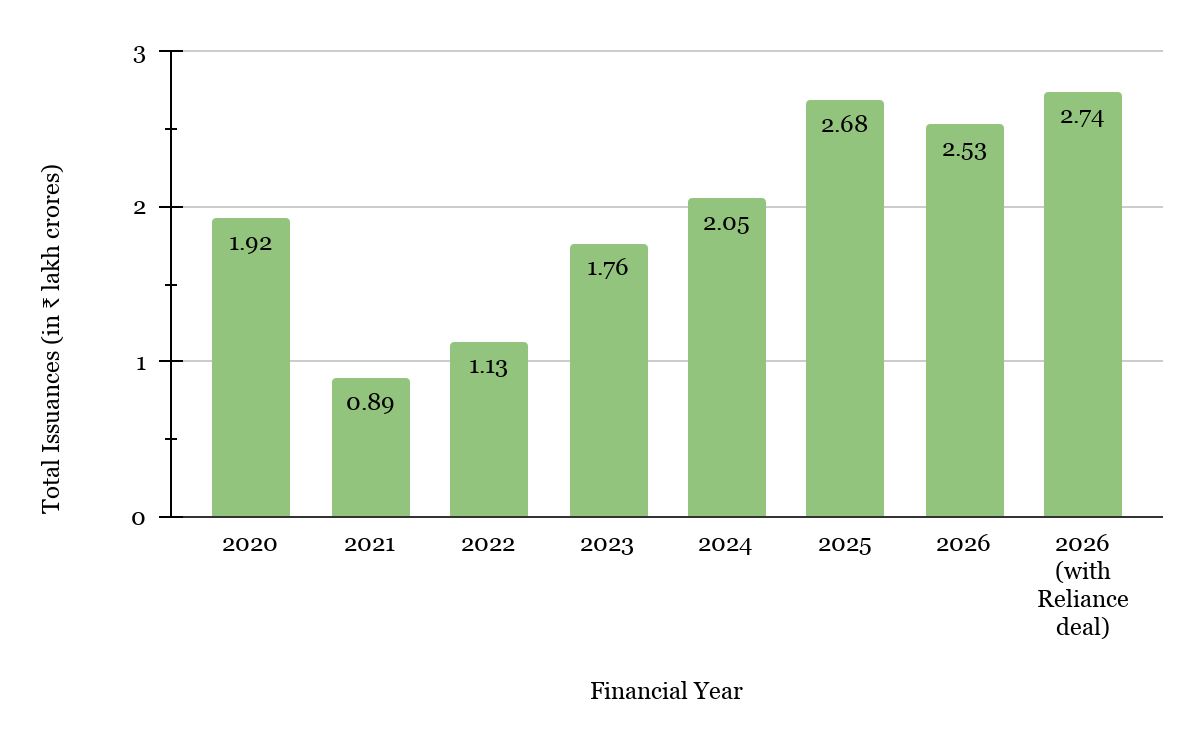
The dip in volumes is because of the larger issuers who were prominently absent or subdued – Shriram Finance as the largest issuer having raised on-balance sheet liquidity, and banking companies. However, the share of gold loans went up sharply, largely due to the sharp increase in gold prices and gold lending, Microfinance companies went more for securitisation, rather than direct assignment transactions.
For anyone studying the Indian securitisation market, it is important to note the following:
- Reported volumes in India include direct assignments, which, in international parlance, are not “securitisation” (pure bilateral loan sales). However, in India, traditionally, DA has been a close and quick proxy for securitisation, and hence, mostly included. In FY 26, the split of DA/PTC volumes shows PTC transactions having gained in proportion. One rating agency1 reports an increase of PTC volume percentage from 54% to 60%; another one2 shows the increase from 48% to 52%.
- Indian transactions mostly show LAP transactions as a part of MBS, whereas what the world reports as RMBS is quite small in India. Last year, there was a prominent transaction by LIC Housing Finance, through the NHB-promoted RDCL. There was no RDCL issuance this year. It seems that RMBS volume was either too small to be reportable, or was completely absent.
- Microfinance sector has been under some stress in the recent past; however, MFIs have increasingly resorted to PTC issuances, with small deal sizes. Some deal sizes are even below 100 crores. This is indicating greater diversity of issuers, and of course, yields and ratings.
- The market also seems to be showing larger acceptance for lower rated securities i.e., BBB+.
Overall, in a stressful global scenario, securitisation has stood firm. Non financial sector entities have shown increasing willingness to tap the market. Of course, SEBI regulations have to be more enabling.
Below, we give a detailed overview of the securitisation market, including a discussion on the asset classes.
NBFCs vs Banks
Securitisation volumes have been largely driven by NBFCs, which recorded a 30% year-on-year increase in value. In contrast, originations by banks have declined significantly.
Recent Securitisation Structures in India – A Mix of Tradition and Innovation
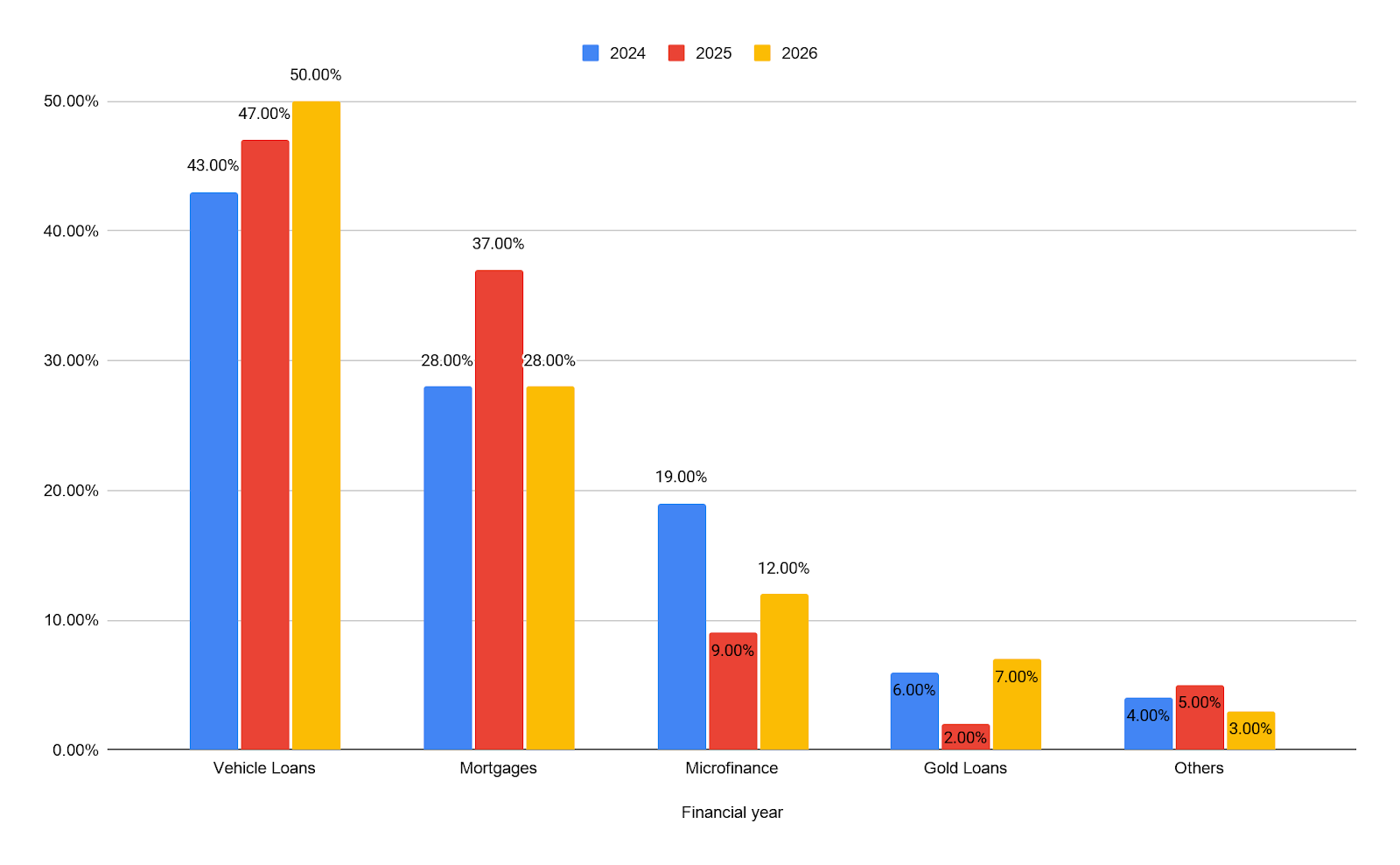
Among asset classes, vehicle loans (including commercial vehicles and two-wheelers) accounted for 50% of securitisation volumes (vs 47% in the corresponding period last fiscal). Mortgage-backed loans accounted for about 28% of securitisation volume (vs 37% in the last FY).
Vehicle loan-backed securitisations dominated the market, both in terms of number of deals and total value, reaffirming the sector’s strong position. This is consistent with the growth trend in vehicle loan originations during FY 25.
In addition to vehicle loans, originators also securitised receivables from a diverse set of underlying asset classes during Q4, including:
- Microfinance Loans
- Secured Business Loans
- Unsecured Business Loans
- Home Loans
- Unsecured Personal Loans
- Gold Loans
The continued diversification in underlying asset classes highlights the evolving maturity of India’s securitisation market and growing investor appetite across segments. The break-up of securitisation volumes across various asset classes have been presented below:
Securitisation of Vehicle Loans
The issuance volume for vehicle loan securitisation during FY26 was approximately ₹1.26 lakh crores. Most of the transactions were structured as single-tranche issuances. However, a few exceptions featured more layered structures comprising senior and equity tranches, or senior, mezzanine, and equity tranches.
In terms of credit ratings, the tranches were rated between A- and AAA. Notably, the senior tranches in the majority of transactions received high investment-grade ratings, typically falling within the AA+ to AAA range. This indicates strong investor confidence and reflects the underlying credit quality of the asset pools, supported by adequate credit enhancement mechanisms.
Further, replenishing structures were also observed commonly during FY26. These variations indicate growing sophistication in transaction structuring within the vehicle loan securitisation space, aimed at catering to different investor preferences, improving credit protection, and aligning with originator risk appetite. As the market matures, further innovation in structuring and risk mitigation features can be expected.
In terms of credit enhancements, most vehicle loan securitisation transactions during the last quarter of FY26 featured: cash collateral (CC) and overcollateralisation (OC), with the Excess Interest Spread (EIS) serving as the first layer of loss absorption.
Securitisation of Microfinance Loans
During FY26, the MFI sector has seen a revival after a period of stress during FY 25 and FY 24. This has been due to better credit underwriting of lenders, improving performance trends and granular pool characteristics. Further, after a period of stress, the lenders relied on time-tested borrowers rather than exploring new markets leading to higher average ticket size of loans. This has led to a growth in the volumes of securitisation of microfinance loans during FY26. The PTC issuance volume of microfinance institutions increased to 14% of total PTC issuance in FY26 from 6% of total PTC issuances in FY25. Most of the transactions were structured as a single tranche securitisation.
Further, most microfinance loan securitisation transactions during the quarter featured credit enhancement through two primary mechanisms: CC and overcollateralisation OC, with the EIS serving as the first layer of loss absorption.
Securitisation of pool of loans backed by Home Loans & LAP
The volume of mortgage backed securitisation has been low both in terms of number as well as in terms of amount of issuance. As compared to FY25, the total MBS issuances dropped to 28% of total issuance from 37%. The transactions featured a common waterfall matrix and had received an overall rating of AAA.
In terms of credit enhancement, CC and OC has been provided as a credit enhancement with the EIS serving as the first layer of loss absorption.
Securitisation of Gold Loans
Gold loan securitisation volumes in H2FY26 stood at approximately ₹18,500 crore, significantly higher than the ₹5,000 crore recorded for the whole of FY25.
The jump in gold lending securitisation may be due to increase in gold prices and resultant increase in the value of the collateral. As a result of this valuation spike, average ticket sizes have increased, indicating that as gold valuations rise, consumers are leveraging higher-value loans to meet their financing needs. Another reason for the increased origination may be removal of LTV restriction in case of income generating gold loans.
Securitisation of Unsecured Loans
As per rating rationales published by Care the securitisation volumes of unsecured loans (both personal and business) increased during FY26. Investors in unsecured loan transactions, are preferring the PTC route, due to the support provided by external enhancement. CC and OC have also been provided as a credit enhancement with the EIS serving as the first layer of loss absorption.
- Secure with Securitisation: Global Volumes Expected to Rise in 2025
- India securitisation volumes 2024: Has co-lending taken the sheen?
- Indian securitisation enters a new phase: Banks originate with a bang
- Securitisation: Indian market grows amidst global volume contraction
- Crisil report on securitisation volumes: https://www.crisilratings.com/en/home/newsroom/press-releases/2026/04/securitisation-deal-value-peaks-to-rs-2-55-lakh-crore-in-fiscal-2026.html ↩︎
- Care report on securitisation volumes
https://www.careratings.com/uploads/newsfiles/1775801608_FY26%20Retail%20Securitisation%20at%20Rs%202.53%20Trillion%20First%20Dip%20PostPandemic.pdf ↩︎
Leave a Reply
Want to join the discussion?Feel free to contribute!