
Bank group NBFCs fall in Upper Layer without RBI identification

– Dayita Kanodia | finserv@vinodkothari.com

RBI on December 5, 2025 issued RBI (Commercial Banks – Undertaking of Financial Services) (Amendment) Directions, 2025 (‘UFS Directions’) in terms of which NBFCs and HFCs, which are group entities of Banks and are therefore undertaking lending activities, will be required to comply with the following additional conditions:

  1. Follow the regulations as applicable in case of NBFC-UL (except the listing requirement)
  2. Adhere to certain stipulations as provided under RBI (Commercial Banks – Credit Risk Management) Directions, 2025 and RBI (Commercial Banks – Credit Facilities) Directions, 2025

The requirements become applicable from the date of notification itself that is December 5, 2025. Further, it may be noted that the applicability would be on fresh loans as well as renewals and not on existing loans. The following table gives an overview of the compliances that NBFCs/HFCs, which are a part of the banking group will be required to adhere to:

Common Equity Tier 1RBI (Non-Banking Financial Companies – Prudential Norms on Capital Adequacy) Directions, 2025Entities shall be required to maintain Common Equity Tier 1 capital of at least 9% of Risk Weighted Assets.
Differential standard asset provisioning RBI (Non-Banking Financial Companies – IncomeRecognition, Asset Classification and Provisioning) Directions, 2025Entities shall be required to hold differential provisioning towards different classes of standard assets.
Large Exposure FrameworkRBI (Non-Banking Financial Companies – Concentration Risk Management) Directions, 2025NBFCs/HFCs which are group entities of banks would have to adhere to the Large Exposures Framework issued by RBI.
Internal Exposure LimitsIn addition to the limits on internal SSE exposures, the Board of such bank-group NBFCs/HFCs shall determine internal exposure limits on other important sectors to which credit is extended. Further, an internal Board approved limit for exposure to the NBFC sector is also required to be put in place.
Qualification of Board MembersRBI (Non-Banking Financial Companies – Governance)Directions, 2025NBFC in the banking group shall be required to undertake a review of its Board composition to ensure the same is competent to manage the affairs of the entity. The composition of the Board should ensure a mix of educational qualification and experience within the Board. Specific expertise of Board members will be a prerequisite depending on the type of business pursued by the NBFC.
Removal of Independent DirectorThe NBFCs belonging to a banking group shall be required to report to the supervisors in case any Independent Director is removed/ resigns before completion of his normal tenure.
Restriction on granting a loan against the parent Bank’s sharesRBI (Commercial Banks – Credit Risk Management) Directions, 2025NBFCs/HFCs which are group entities of banks will not be able to grant a loan against the parent Bank’s shares. 
Prohibition to grant loans to the directors/relatives of directors of the parent BankNBFCs/HFCs will not be able to grant loans to the directors or relatives of such directors of the parent bank. 
Loans against promoters’ contributionRBI (Commercial Banks – Credit Facilities) Directions,2025Conditions w.r.t financing promoters’ contributions towards equity capital apply in terms of Para 166 of the Credit Facilities Directions. Such financing is permitted only to meet promoters’ contribution requirements in anticipation of raising resources, in accordance with the board-approved policy and treated as the bank’s investment in shares, thus, subject to the aggregate Capital Market Exposure (CME) of 40% of the bank’s net worth.  
Prohibition on Loans for financing land acquisitionGroup NBFCs shall not grant loans to private builders for acquisition and development of land. Further, in case of public agencies as borrowers, such loans can be sanctioned only by way of term loans, and the project shall be completed within a maximum of 3 years. Valuation of such land for collateral purpose shall be done at current market value only.
Loan against securities, IPO and ESOP financingChapter XIII of the Credit Facilities Directions prescribes limits on the loans against financial assets, including for IPO and ESOP financing. Such restrictions shall also apply to Group NBFCs. The limits are proposed to be amended vide the Draft Reserve Bank of India (Commercial Banks – Capital Market Exposure) Directions, 2025. See our article on the same here
Undertaking Agency BusinessReserve Bank of India (Commercial Banks – Undertaking of Financial Services) Directions, 2025 NBFCs/HFCs, which are group entities of Banks can only undertake agency business for financial products which a bank is permitted to undertake in terms of the Banking Regulations Act, 1949. 
Undertaking of the same form of business by more than one entity in the bank groupUFS DirectionsThere should only be one entity in a bank group undertaking a certain form of business unless there is proper rationale and justification for undertaking of such business by more than one entities. 
Investment RestrictionsRestrictions on investments made by the banking group entities  (at a group level) must be adhered to. 

Read our write-up on other amendments introduced for banks and their group entities here.

Other resources:
  1. FAQs on Large Exposures Framework (‘LEF’) for NBFCs under Scale Based Regulatory Framework
  2. New NBFC Regulations: A ready reckoner guide
  3. New Commercial Bank Regulations: A ready reckoner guide

Group-level regulation: RBI brings major regulatory restrictions on banks and group entities

– Team Vinod Kothari Consultants, finserv@vinodkothari.com

Basis a proposal made vide proposed regulation circulated on 4th October, 2024, (“Draft Proposal”), the RBI has released Reserve Bank of India (Commercial Banks – Undertaking of Financial Services) (Amendment) Directions, 2025, which put several significant restrictions on group entities of commercial banks, eventually leading to a group-wide regulation.

Veteran bankers are not surprised by the RBI’s move, though, with proposed introduction of expected losses, related party transactions and a lot more in the offing, this seems too much over too short a time.

In fact, when the non-operating financial holding company (NOFHC) model was recommended in 2013 by the Parliamentary Standing Committee on Finance, it was laid there that “(T)he general principle is that no financial services entity held by the NOFHC would be allowed to engage in any activity that a bank is permitted to undertake departmentally”. The idea of ring fencing of diverse activities was inspired by the need for controlling contagion, alleviation of regulatory arbitrage, etc. The RBI’s Internal Committee named P K Mohanty Working Group in 2020 also made similar recommendations.

The amendments are clearly aimed at curbing any possibility of regulatory arbitrage, which are currently observed. Loans against shares or acquisition finance (for which RBI’s proposals at bank level are still in draft stage), currently restricted for banks, are routed through group entities. Banks cannot fund land acquisition – the practice of general purpose corporate loans or privately placed debentures for construction companies is quite common. The extent of shareholding in entities is limited by the Banking Regulation Act, but not for group entities; therefore, private equity holdings are also funded through group companies. Most of the banking groups in the country have NBFCs and HFCs, as also several entities which have entangled operational and referral business with their parent banks.

The overall result is a complex network of activities with business and operational dependencies. A lot of rethink will be forced at group strategy level pursuant to the Directions, which, of course, were on the anvil for over 2 years now.

Read more

NBFCs shift to 4-snapshots a month for quicker credit reporting

Simrat Singh | finserv@vinodkothari.com

Similar amendments have been made for Commercial Banks, Local Area Banks, Small Finance Banks, Rural and Urban Co-operative Banks, RRBs, ARCs and AIFIs.

New Commercial Bank Regulations: A ready reckoner guide

– Team Corplaw | corplaw@vinodkothari.com

Under the consolidation exercise, more than 9,000 circulars and directions, issued up to October 9, 2025 have now been streamlined into 238 Master Directions, drafts for which were notified on October 10, 2025, covering 11 categories of regulated entities across 30 functional areas.

From November 28, 2025, all RBI-regulated entities are now governed by a completely new set of regulations.

We have prepared a complete comparative snapshot of the familiar regulations and their new avatars for commercial banks. Further, wherever applicable, we have highlighted the changes from the notified drafts, and added comfort comments where the regulations remain unchanged from the drafts.

See our other resources:

  1. RBI Master Directions 2025: Consolidated Regulatory Framework for NBFCs
  2. RBI norms on intra-group exposures amended
  3. 2025 RBI (Commercial Banks – Governance) Directions – Guide to Understanding and Implementation

RBI norms on intra-group exposures amended

– Payal Agarwal | payal@vinodkothari.com

Aligns intra group exposure norms with Large Exposure Framework; junks a 2016 framework for “large borrowers”

On 4th December, 2025,  less than a week after the massive consolidation exercise of RBI regulations, the RBI carried out amendments vide Reserve Bank of India (Commercial Banks – Concentration Risk Management) Amendment Directions, 2025, thus amending the recently consolidated Reserve Bank of India (Commercial Banks – Concentration Risk Management) Directions, 2025

Applicability of the Amendment Directions 

  • 1st January, 2026 – for Repeal of provisions on Enhancing Credit Supply for Large Borrowers through Market Mechanism. 
  • 1st April, 2026 – for other amendments
    • Banks may decide to implement such amendments from an earlier date
    • In case of any breach in exposure limits pursuant to the Amendment Directions, the exposures to be brought down within 6 months from the date of issuance of the Amendment Directions, i.e., 3rd June, 2026. 

Intent behind the Amendments and Key changes 

  • Repeal of requirements pertaining to credit supply to Large Borrowers through Market Mechanism (draft Circular proposing such repeal can be accessed here)
    • This is based on the Statement on Developmental and Regulatory Policies dated 1st October, 2025, wherein the extant guidelines pertaining to Large Borrowers were proposed to be withdrawn, in view of the reduced share of credit from the banking system to such large borrowers, and existence of LEF to address the concentration risks at an individual bank level. 
    • The repeal relates to a 2016 Notification (forming part of Chapter IV of the existing Concentration Risk Management Directions), whereby certain “specified borrowers” were identified, meaning those entities which had borrowed, on an aggregate from the banking system, including by way of private placed debt instruments, in excess of Rs 10000 crores.
    • There is a notable difference between LEF and the “specified borrowers” as covered by the 2016 Notification – the latter relates to large borrowers on an aggregate basis, whereas LEF still looks at the size of exposure relative to the Tier 1 capital of a single lender. However, the “specified borrower” regime is said to have lost its relevance. 
  • Alignment of requirements w.r.t. Intra-group transactions and exposures (ITEs) with the Large Exposure Framework (LEF) [see press release on the proposed amendments here]
    • Computation of exposure under ITEs to be made consistent with that under LEF 
    • Linking exposure thresholds for ITEs with Tier 1 capital instead of existing paid-up capital and reserves. 
  • Clarifications w.r.t. prudential treatment of exposures of foreign bank branches operating in India to their group entities

A track change version of the Reserve Bank of India (Commercial Banks – Concentration Risk Management) Directions, 2025, as amended vide the present Amendment Directions can be accessed here. 

Refer to our other resources here:

  1. 2025 RBI (Commercial Banks – Governance) Directions – Guide to Understanding and Implementation
  2. RBI Master Directions 2025:Consolidated RegulatoryFramework for NBFCs
  3. New NBFC Regulations: A ready reckoner guide

RBI Master Directions 2025:Consolidated RegulatoryFramework for NBFCs

– Team Finserv | finserv@vinodkothari.com

Read our articles on the topic here:

  • https://vinodkothari.com/2025/12/the-will-of-the-borrower-do-balance-transfers-count-as-loan-transfers/
  • https://vinodkothari.com/2025/12/rbi-consolidation-of-circulars/

Failure to disclose price sensitive information: SC upholds penalties

– Team Corplaw | corplaw@vinodkothari.com

When it comes to insider trading regulation breaches, it is the adverse headline value which is far more punitive than the amount of penalties. 

Bhagavad Gita says:

अकीर्तिं चापि भूतानि

कथयिष्यन्ति तेऽव्ययाम् |

सम्भावितस्य चाकीर्ति

र्मरणादतिरिच्यते  2/34

Reputation damage (अकीर्तिं ) for reputed people (सम्भावित ) is worse than death. That is to say, the more reputed one is, the more is the risk to reputational capital.

Therefore, every precedent teaches a lesson to all insiders and compliance officers to take calculated and conservative views,  when it comes to timely disclosure of price sensitive information.

A recent order of the Supreme Court (dated December 2, 2025) dismissed an appeal against SAT on a matter involving selective dissemination of an unpublished price sensitive information, thereby, affirming the penalty of Rs. 30 lakh levied by SAT. The issue revolved around whether or not a media report, resulting into a selective, inadvertent dissemination of unpublished price sensitive information, requires prompt public disclosure by the listed entity. 

The whole idea of fair disclosure of inside information is that there is no information asymmetry, as the same kills meaningful price discovery in the market. If there is a leakage of information, before any information is released by the company, that creates an asymmetry and non-democratic spreading of unconfirmed information or so-called rumour. In such a situation, the listed entity has to act and either confirm what is being rumoured, or deny, and it cannot remain silent. There, a stance that the information is not ripe for disclosure, does not work, as the information is already spreading. See our presentation on Verification of Market Rumour by listed entities & other related amendments and FAQs on Verification of Market rumour by Listed Entities.

With the recent amendments in the PIT Regulations clarifying that unverified events or information reported in print or electronic media cannot be considered as “generally available information”, this is no longer a question as to whether such information can escape the ambit of UPSI. In fact, regulations along with the stock exchange guidance have gone a long way in quantifying the market impact.

Prompt dissemination of selectively available information 

Reg 8(1) of PIT Regulations requires companies to put in place a Code for Fair Disclosure of Information, in accordance with the model Code provided under Schedule A. Para 1 of Schedule A requires prompt public disclosure of UPSI as soon as credible and concrete information comes into being in order to make such information generally available.This coincides with the requirement of disclosure of material events and information to the stock exchanges under Reg 30 of LODR. 

 Also, Para 4 of the Schedule 1  requires: Prompt dissemination of unpublished price sensitive information that gets disclosed selectively, inadvertently or otherwise to make such information generally available

While Principle 1 pertains to a general principle of making material information available to the public, Principle 4 seeks to fill the information asymmetry in case of an inadvertent leak of UPSI. 

In a May 2025 order, SAT has discussed the distinction between the application of disclosure requirements in the aforesaid principles: 

“Principle-1 requires it to ipso facto make prompt disclosure, as and when a credible and concrete information comes into being in order to make it ‘generally available’. Thus, if the UPSI is concrete and credible, the company would have already made its disclosure to make it generally available. But before such a stage is reached, and the UPSI gets disclosed selectively, then in such a scenario, even though the company was not required to make disclosure in accordance with Principle-1, Principle-4 makes it obligatory to make prompt disclosure to make information generally available to ensure compliance with general Principle–2.”

In the said ruling, one of the contentions of the Appellants was that the material information, on account of being published in media sources, becomes generally available. However, SAT observed that, “Till the information is disclosed by the company, it remains unauthenticated.”. In the absence of a clarity on the matter by the company to the investors and public at large, speculative information will keep floating around. As such, “selective leakage of the information, howsoever accurate or otherwise or complete or in bits and pieces, does not discharge the company from its responsibility of making prompt disclosure to make it generally available, moreso when such information has been classified by company as UPSI.”

Thus, while Reg 30(11) of LODR provides discretion to the listed entities (except top 250 listed entities based on market capitalisation) w.r.t. responding to market rumours, such discretion cannot override the requirements of the PIT Regulations. Also see our FAQs on Verification of Market rumour by Listed Entities

When does an internal development become good for sharing?

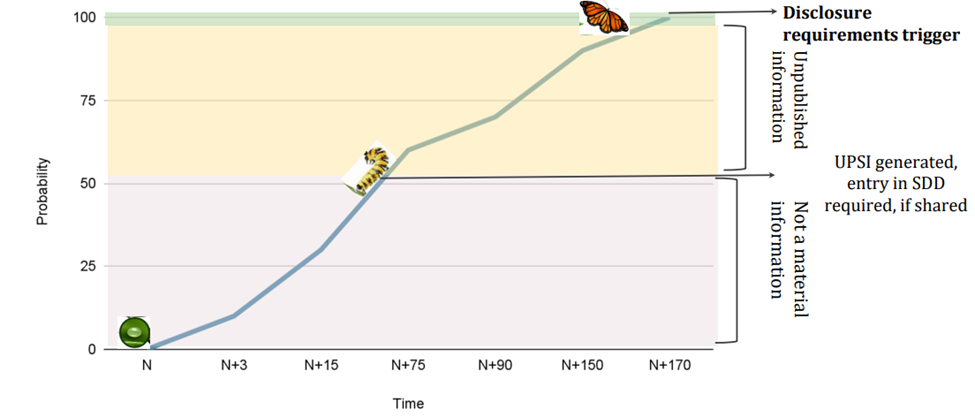
The metamorphosis of an internal development into UPSI and ultimately a disclosable event is based on its probability of occurrence, over that of non-occurrence. Generally speaking, once the probability of occurrence of an event is more than the probability of its non-occurence, UPSI may be said to have been germinated, thus, requiring preservation of such information and all related controls. 

See our presentation on verification of market rumour by listed entities & other related amendments.

Conclusion

While the SEBI Listing Regulations appear to grant leeway to listed entities to remain silent on rumours floating in the market, such leeway is not absolute and the PIT Regulations still require the listed entities to ensure public dissemination of information, where a leak of UPSI has occurred. While the Supreme Court dismissed the appeal, citing that the same has been comprehensively dealt with by SEBI and SAT on the basis of the factual matrix, the proceedings signal the SC’s stand that the principles underlying the PIT Regulations have to be upheld at all times, and if going by the principles, it is essential for the listed entity to speak, it cannot remain silent. 

In view of the significance of the subject, we are conducting a 12 hours Certificate Course on Insider Trading for Compliance Officers, see details here – https://vinodkothari.com/2025/11/12-hours-certificate-course-on-insider-trading-for-compliance-officers/

Our other resources:

  1. Presentation on verification of market rumour by listed entities & other related amendments
  2. FAQs on Verification of Market rumour by Listed Entities
  3. Verification of Market Rumour by listed entities & other related amendments
  4. FAQs on Verification of Market rumour by Listed Entities
  5. Prohibition of Insider Trading – Resource Centre

Call for Clarity: Employee Dues under IBC in light of the Social Security Code

Sikha Bansal and Neha Malu | resolution@vinodkothari.com

Treatment of employee dues under IBC has always been a matter of debate. While various judicial precedents have interpreted the provisions of the Code (see discussion later), however, the dilemma may revive with the notification of Code on Social Security, 2020 (“Social Security Code”). The Social Security Code now speaks of retirement benefits being paid in accordance with the priority under IBC; while Courts in the past have ruled that retirement dues will have to be paid beyond the priorities under IBC. Obviously, there was no reference to IBC in the labour laws before. Now that there is an explicit submission to IBC, does it result in a different interpretation as to the payment of dues such as provident fund, gratuity, pension, etc? 

In our view, it will be quite a long and costly way to try and get the reconciliation between the labour codes and IBC through jurisprudence; instead, whatever be the policy and intent of the lawmaker should be spelt clearly in the law itself, more so because a comprehensive amendment to the Code is imminent.

[A comparison of the provisions of Code on Social Security Code, 2020 with the erstwhile provisions of relevant Labour Laws is provided in the Annexure to this article]

Read more

The will of the borrower: Do Balance Transfers Count as Loan Transfers?

-Dayita Kanodia & Chirag Agarwal | finserv@vinodkothari.com

The RBI, as part of its recent consolidation exercise, has consolidated various instructions applicable to NBFCs and issued 34 Master Directions. Our analysis of these can be accessed here.

Loan transfers are now governed by the RBI (Non-Banking Financial Companies – Transfer and Distribution of Credit Risk) Directions, 2025 (‘Transfer Directions’), which assimilates the erstwhile TLE and Co-lending Directions. 

One notable change (which was not there in the Draft) appears in the provisions relating to transfer of loan exposures. Para 31 of the Directions provides a carveout for items which will be excluded from the purview of the Directions. One of the exclusions, which has existed since the 2012 Guidelines, is the exclusion for balance transfers. That exclusion has now been removed.

This change raises the question of whether NBFCs are now required to comply with the provisions of the Transfer Directions, even in cases where it is the borrower who requests the transfer of its loan account.

Case of Balance Transfer

Balance transfer is an arrangement where a borrower who has already availed credit from a particular RE identifies another lender willing to offer a loan at a lower interest rate. In such cases, the borrower requests the existing lender to pre-close the loan account using the funds provided by the new lender. The essence is that the transaction happens at the instance of the borrower.

While BTs can take place for a number of reasons, it generally happens when the borrower finds another lender offering loans at a lower interest rate. Other common BT causes include:

  1. Better Loan Terms: More flexible repayment schedules, lower processing fees, reduced foreclosure charges, or longer tenure options.
  2. Top-Up Loan Facility: The new lender may offer a top-up loan along with the transfer at attractive rates.
  3. Improved Customer Service: Borrowers often move due to dissatisfaction with the existing lender’s service quality, delays, or poor communication.
  4. Switching from Floating to Fixed (or vice versa): A borrower may want to change the interest type depending on market outlook or personal preference.
  5. Consolidation of Loans: Borrowers might transfer in order to consolidate multiple loans under one lender for easier management.

BTs typically take place in longer-term loans such as housing loans and LAP. 

Typically, the borrower is also charged a prepayment penalty when the existing lender pre-closes the loan account.

Is BT a case of Transfer?

As discussed above, balance transfer is not, per se, a transfer of the loan account between lenders; rather, it is a situation in which one lender effectively steps into the place of another at the request of the borrower.

It may also be noted that the Directions recognise only three modes of transfer of loan accounts:

  • Assignment 
  • Novation 
  • Loan participation

BT, however, does not fall under any of the above modes. 

Further, the introduction to the Transfer Directions states:

Loan transfers are essential to the development of a credit risk market, enabling diversification of credit risk originating in the financial sector and ensure the availability of market-based credit products for a diversified set of investors having commensurate capacity and risk appetite.

BT, on the other hand, does not achieve any credit-risk redistribution. The incoming lender is not purchasing risk, but issuing a fresh loan directly to the borrower. In essence, a balance transfer is not a credit risk transfer; rather a refinancing transaction driven by the borrower’s choice, without any movement of the underlying asset.

Situation for Banks

It may be noted that, in the case of banks, a specific exclusion has been provided for situations where the transfer of a loan account occurs at the instance of the borrower. In such cases, banks are required to comply with the provisions set out under Chapter III of Part C of the Reserve Bank of India (Commercial Banks- Transfer and Distribution of Credit Risk) Directions, 2025.

However, for banks, the concept of inter-bank transfer of loan accounts exists, whereas for NBFCs, there is only a pre-closure of the loan account by one lender using funds obtained from another lender.

Conclusion

Accordingly, in our view, the position for NBFCs in respect of balance transfers remains unchanged, and there is no requirement to comply with the provisions of the Transfer Directions. It must, however, be ensured that such borrower-initiated transfer requests are responded to by the concerned NBFC within 21 days, as required under Para 19 of Reserve Bank of India (Non-Banking Financial Companies – Responsible Business Conduct) Directions, 2025.

Our Other Resources