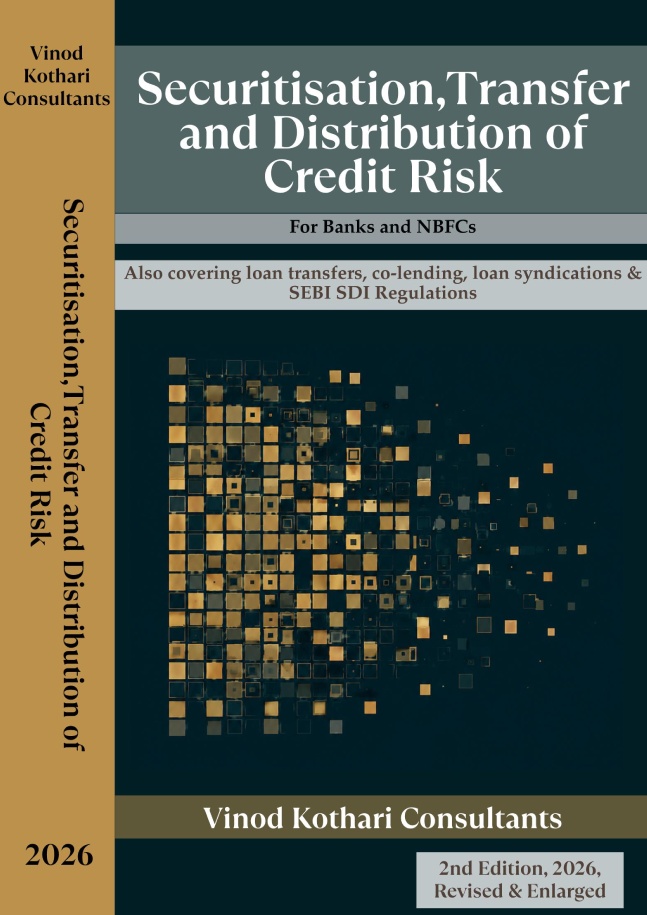
SECURITISATION & TRANSFER OF LOAN EXPOSURES – A comprehensive guide

We are pleased to announce updates on our book on Securitisation & Transfer of Loan Exposures

  • Get access to the updates via QR with the purchase of the book.
  • Updates include detailed commentary on SDI Regulations, STC, Accounting of Securitisation Transaction, Government Backed SRs and Many More

Updates launched at the 13th Securitisation Summit

Loader Loading…
EAD Logo Taking too long?

Reload Reload document
| Open Open in new tab

Download as PDF [460.90 KB]


State moneylending laws don’t apply to NBFCs, holds SC

Timothy Lopes, Manager | tim@vinodkothari.com

In a landmark judgment dated 10th May, 2022, the Supreme Court in Nedumpilli Finance Company Limited vs State of Kerala & ors[1] held that the money lending laws will not apply in the case of NBFCs regulated by RBI. This ends an age-old quarrel between the States and NBFCs.

Read more

MCA amends format of Forms SH-4 and PAS-4 to insert declaration on compliance with Government approval requirement under FEMA

Whether a private company can accept deposits from HUF?

Vinita Nair | corplaw@vinodkothari.com

Provisions of Law

According to Section 2(31)  of the Companies Act, 2013 ‘Deposit’ includes any receipt of money by way of deposit or loan or in any other form by a company, but does not include such categories of amount as may be prescribed in consultation with the Reserve Bank of India. The exclusions are cited in Rule 2 (1) (c) of Companies (Acceptance of Deposits) Rules, 2014 which are applicable to public and private companies.

Rule 2 (1) (c) (viii) of Deposit rules excludes amounts received from a person who, at the time of the receipt of the amount, was a director of the company or a relative of the director of the private company, provided that the person declares that the amount is his own fund and not borrowed. The private company is required to disclose the details of money so accepted in the Board’s report.

Read more

FAQs on compensation of Key Managerial Personnel and Senior Management under the Scale Based Regulatory Framework

Financial Services Division | (finserv@vinodkothari.com)

RBI had introduced the Scale Based Regulatory Framework: A Revised Regulatory Framework for NBFCs vide a circular dated October 22, 2021. Para 3.2.3 (h) of the circular dealt with ‘Compensation Guidelines’ which required that NBFCs shall put in place a Board approved compensation policy in order to address issues arising out of excessive risk taking caused by misaligned compensation packages.

In terms of the aforementioned para, the RBI subsequently issued a circular on April 29, 2022 detailing the ‘Guidelines on Compensation of Key Managerial Personnel (KMP) and Senior Management in NBFCs’

With these FAQs, we aim to address some of the key questions that may arise out of the guidelines and provide an understanding of the same.

1. Applicability

1.1. What is the basic intent of RBI for issuing the Compensation Guidelines for NBFCs?

Response: As per the SBR framework and the text of the notification, the purpose appears to be – (i) to address issues arising out of excessive risk taking caused by misaligned compensation packages and  (ii) to ensure that there is no conflict of interest.

Read more

The Credit Card Business for NBFCs

RBI Directions on Credit Cards and Co-branded Credit Cards issued by NBFCs

With the objective to provide general and conduct regulations relating to credit, debit and co-branded cards to banks and NBFCs, RBI, on April 21, 2022, has issued the Reserve Bank of India (Credit Card and Debit Card – Issuance and Conduct) Directions, 2022[1] (‘Directions’), to be applicable with effect from 1st July, 2022.

Read more

Like banks, NBFC-UL to maintain CET-1 capital

Manner of computation of CET-1  for NBFCs prescribed by RBI

– Qasim Saif | finserv@vinodkothari.com

Addressing risk faced by NBFCs and enhancing their capacity to absorb such risk has been a key point of consideration under the Scale Based Regulations (SBR) for NBFCs. SBR also intends to curb regulatory arbitrage available to very large NBFCs whose size of operations are more or less in line with that of banks.

Read more