Posts

RBI Trade Relief Directions: How is your company impacted?

– Team Finserv | finserv@vinodkothari.com

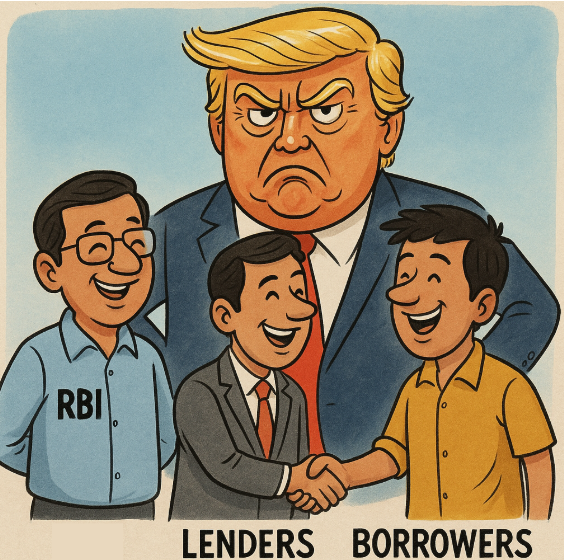
Call it Trump relief! The RBI announced relief measures on the 14th Nov to help the exporters of certain specified items, who may have availed export credit facilities from a regulated lender, whereby all regulated entities (REs) “may” provide a moratorium, from 1st September 2025 to 31st December, 2025. The grant of such a relief shall be based on a policy, consisting of the criteria for grant of the subject relief, and such criteria shall be disclosed publicly. Not only this, REs shall also make a fortnightly disclosure of the reliefs granted to eligible borrowers on a RBI format on Daksh portal.

The Reserve Bank of India (Trade Relief Measures) Directions, 2025 (‘Directions’) are applicable to NBFCs and HFCs as well. This is accompanied with amendment to Foreign Exchange Management (Export of Goods and Services) (Second Amendment) Regulations, 2025 for extension of the period for both realization/repatriation of export value (from 9 to 15 months) and the shipment of goods against advance payment (from 1 to 3 years).

Highlights:

  • Whether your company grants an export credit or not, if your borrower is the one who has availed export credit for export of specified goods or services, the borrower may approach you for the moratorium.
  • Are you bound to grant the moratorium? Answer is, no. However, basis a policy which is publicly hosted, you will consider the eligibility of the borrower. The relevant factors on which the eligibility will be examined may also form a part of the policy, and ideally, should include the extent of dependence on exports of specified items to the USA, tariff-based disruption in the cashflows, alternative markets and transitioning possibilities, etc.
  • Effective: Immediately. 
  • Actionables: (a) Framing of policy to consider the eligibility of affected borrowers; (b) Hosting the policy on public website; (c) Creating mechanism for receiving and transmission of borrower requests for the moratorium and giving timely responses to the same (d) RBI fortnightly reporting.

What is the intent?

To mitigate the disruptions caused by global headwinds, and to ensure the continuity of viable businesses.

Tariff impositions by the USA are likely to impact several exporters. There may be a ripple effect on penultimate sellers or other segments of the economy as well, but the intent of the Trade Relief Directions seems limited to the direct exporters only.

Which all regulated entities are covered?

The Directions are applicable to following entities:

  • Commercial Banks
  • Primary (Urban) Co-operative Banks, State Co-operative Banks and Central Co-operative Banks
  • NBFCs
  • HFCs
  • All-India Financial Institutions
  • Credit Information Companies (only with reference to paragraph 16 of these Directions).

Does it matter whether the RE in question is giving export credit facilities or not? In our view, it does not matter. The intent of the Directions is to mitigate the impact of trade disruptions. Of course, the borrower in question must be an exporter, must have an export credit facility outstanding as on 31st Aug 2025, and the same must be standard.

If these conditions are met, then the RE which holds the export credit, as also other REs (of course, the nexus between the trade disruption and the servicing of the credit facility will have to be seen) should consider the borrower for the purpose of grant of relief.

Relief may or may not be granted. 

Policy on granting relief

The consideration of the grant of relief will be based on a policy. 

Below are some of the brief pointers to be incorporated in the policy: 

  1. Purpose and Scope: define which loan products, sectors, or borrower categories are covered; effective period for granting relief
  2. Eligibility Criteria for borrowers
  3. Assessment criteria for relief requests received from the borrowers
  4. Authority responsible for approving such request
  5. Relief measures that can be offered to borrowers
  6. Impact on asset classification and provisioning
  7. Disclosure Requirements
  8. Monitoring and Review: Authority which is responsible for monitoring such accounts; periodicity of review

How is the assessment of eligible borrowers to be done?

In our view, the relevant information to be obtained from the candidates should be:

  • Total export over a relevant period in the past, say 3 years
  • Break up of export of “impacted items” and other item
  • Of the above, exports to the USA
  • Gross profit margin
  • Impact on the cashflows
  • Information about cancellation of export orders from US importers
  • Any damages or other payments receivable from such importers
  • Any damages or other payments to be made to the penultimate suppliers
  • Alternative business strategies – repositioning of markets, alternative buyer base, etc
  • Cashflow forecasts, and how the borrower proposes to pay after the Moratorium Period.

What sort of lending facilities are covered?

Please note the following from the preamble: “mitigating the burden of debt servicing brought about by trade disruptions caused by global headwinds and to ensure the continuity of viable businesses”. Therefore, clearly, the relief intended here is one where “trade disruptions” create such a burden on debt servicing, which may impact the viability of the business.

From this, it implies that the entity in question must be a business entity, and the loan in question should be a business loan. 

In our thinking, the following facilities seem covered:

  1. Export credits of all forms, including packing credit, funded as well as unfunded, letters of credit, etc.
  2. Buyer’s credit or facilities for inward acquisitions/purchases by an exporter
  3. Cash credits, overdrafts or working capital related facilities, intended for export business of impacted items.
  4. Term loans relating to an impacted business
  5. Loans against property, where the end use is working capital

Eligible and ineligible borrowers:

Eligible borrowers:

  • Borrowers who have availed credit for export
  • Borrower had an outstanding export credit facility from a RE as of August 31, 2025 (However, in case the borrower has a sanctioned facility pending disbursement as on Aug 31, the same shall not be eligible)
  • Borrower with all REs was/were classified as ‘Standard’ as on August 31, 2025

In our view, the following borrowers/ credit facilities are not eligible for the relief:

  • Individuals or borrowers who have not borrowed for business purposes
  • Home loans or loans against specific assets or cashflows, where the debt servicing is unconnected with the cash flows from an export business
  • Loans against securities or against any other financial assets
  • Gold loans, other than those acquired for business purposes
  • Car loans, loans against commercial vehicles or construction equipment, unless the borrower is engaged in export business and the cashflows have a nexus with such business
  • Borrower is engaged in exports relating to any of the sectors specified
  • Borrower accounts which were restructured before August 31, 2025
  • Accounts which are classified as NPA as on August 31, 2025

Consider a borrower who is not an exporter himself, but an ancillary supplier, supplying to a trading house. Will such a penultimate exporter be covered by the Relief Directions? In our view, the answer is negative, as the “eligible borrowers” are defined to mean an exporter.

Impacted items and impacted markets

The list of impacted items broadly covers a wide spectrum of manufacturing and export-oriented sectors, including marine products, chemicals, plastics, rubber, leather goods, textiles and apparel, footwear, stone and mineral-based articles, jewellery and precious metals, metal products, machinery, electrical and electronic equipment, automobiles and auto components, medical and precision instruments, and furniture and furnishing items.

Is it mandatory that the borrower shall be exporting to USA? While the Directions do not specifically mandate that the borrower shall be exporting to the USA, the concerned REs should, as part of their assessment, evaluate whether the borrower genuinely requires such relief measures and, in our view, should consider the extent to which the borrower depends on exports of the specified items to the USA.

Why have HFCs been covered?

Generally speaking, the servicing of home loans is not supposed to be based on business cashflows, and therefore, the impact of trade disruptions on servicing of a home loan does not seem easy to establish.

However, HFCs grant other credit facilities too, including LAP or business loans. Therefore, there is no carve out for HFCs as such. HFCs are also expected to prepare the policy referred to above and be sensitive to requests from impacted borrowers.

Is the moratorium retrospective?

Yes, clearly, the moratorium is retrospective, as it covers the period from 1st September to 31st December. This is the range over which the moratorium may be granted; of course, the decision as to how much moratorium, within the above maximum range, is warranted in the particular case, is that of the lender. Let us call the agreed moratorium as the Moratorium Period.

If the moratorium is granted from 1st Sept., then any payments which were due for the period covered by the Moratorium Period will  not be taken as having fallen due. This will have significant impact on the loan management systems:

  • Considering that we are already in the middle of November, the day count for any payments due during the part of the Moratorium Period will be set to zero. In other words, day count will stop during the Moratorium Period. Thus, if an account was showing a DPD status of 60 days as on Aug 31, 2025, the DPD count will remain at a standstill till the moratorium period is over.
  • However, in case a borrower has made payment during the moratorium period, will the DPD count decrease or will it remain the same? 

The RBI Directions state that the days past due (DPD) count during the moratorium period will be excluded. However, this does not imply that a borrower who makes payments during this period should be denied the corresponding benefit. In our view, if a payment is received from the borrower, the DPD count should accordingly be reduced.

  • Any payments already made during the part of the Moratorium Period already elapsed may be taken towards principal, or may be held to be adjusted against the future dues of the borrower, after the Moratorium Period. This should also, appropriately, be captured in the policy.
  • Further, for accounts for which the CIC reporting has already been done on or after Aug 31, 2025, and the lender decides to extend the moratorium benefit, it must be ensured that the DPD count is revised so as to reflect the status as on Aug 31, 2025. 

Do lenders have to necessarily grant moratorium, or grant partial interest/principal relief?

The RBI Directions do not mandate REs from granting such relief measures. Accordingly, the concerned RE will need to assess individual cases based on the sectors, the need for such relief and the extent to which such relief may be granted. 

Lenders may grant full moratorium during the Moratorium Period, or may grant relief as may be considered appropriate.

Do lenders take positive actions, or simply respond to borrower requests?

The lenders must establish a policy for granting such relief measures prior to extending any relief, as the authority to do so will be derived from this policy. As discussed above, the discretion to grant relief rests with the concerned RE; therefore, each request submitted by a borrower must be evaluated on an individual basis.

For this purpose, the following information must be obtained from the borrowers seeking relief:

  1. The concerned sector and how the same has been impacted necessitating such relief
  2. Information relating to the current financial condition of the business of the borrower
  3. Facilities taken and outstanding with other REs 

Non-compounding of interest during the Moratorium Period:

Para 9 (iii) provides that while interest will accrue during the Moratorium Period, but the interest shall be simple, that is, shall not be compounded.

This may require REs to tweak their loan management systems to stop the compounding of interest during the Moratorium Period. 

However, the actual population of affected borrowers for a particular RE may be quite limited. Hence, REs may do manual or spreadsheet-based adjustments for affected borrowers, instead of making adjustments to their LMS itself.

Recomputation of facility cashflows after Moratorium:

During the moratorium period, as per the RBI directive, the lender can only accrue simple interest. Accordingly, the IRR of the credit facility will have a negative impact unlike the covid moratorium where the compound interest loss was compensated by the central government. 

Further, it has also been provided that the accrued interest may be converted into a new term loan which shall however be repayable in one or more installments after March 31, 2026, but not later than September 30, 2026. Accordingly, the accrued interest should anyhow be received by September 30, 2026.

Similar moratoriums in the past

  • Moratorium on loans due to COVID-19 disruption: Refer to our write-up here.
  • Moratorium 2.0 on term loans and working capital: Refer to our write-up here.

Our write-ups on similar topics:

FAQs on refund of interest on interest

-Financial Services Division (finserv@vinodkothari.com)

The Supreme Court of India (‘SC’ or ‘Court’) had given its judgment in the matter of Small Scale Industrial Manufacturers Association vs UOI & Ors. and other connected matters on March 23, 2021. The said order of SC put an end to an almost ten months-long legal scuffle that started with the plea for a complete waiver of interest but edged towards waiver of interest on interest, that is, compound interest, charged by lenders during Covid moratorium.  While there is no clear sense of direction as to who shall bear the burden of interest on interest for the period commencing from 01 March 2020 till 31 August 2020. The Indian Bank’s Association (IBA) has made representation to the government to take on the burden of additional interest, as directed under the Supreme Court judgment. While there is currently no official response from the Government’s side in this regard, at least in the public domain in respect to who shall bear the interest on interest as directed by SC. Nevertheless, while the decision/official response from the Government is awaited, the RBI issued a circular dated April 07, 2021, directing lending institutions to abide by SC judgment.[1] Meanwhile, the IBA in consultation with banks, NBFCs, FICCI, ICAI, and other stakeholders have adopted a guideline with a uniform methodology for a refund of interest on interest/compound interest/penal interest.

We have earlier covered the ex-gratia scheme in detail in our FAQs titled ‘Compound interest burden taken over by the Central Government: Lenders required to pass on benefit to borrowers’ – Vinod Kothari Consultants>

In this write-up, we have aimed to briefly cover some of the salient aspects of the RBI circular in light of SC judgment and advisory issued by IBA.

Read more

Moratorium Scheme: Conundrum of Interest on Interest

Siddhart Goel

finserv@vinodkothari.com

Introduction

On September 03, 2020 the Hon’ble Supreme Court (the “court”) while dealing with several petitions on account of Covid related stress from various stakeholders, passed an interim order that that the accounts which have not declared NPA till August 31, 2020 shall not be declared NPA till further orders of the court.[1] Further in its September 10, 2020 order the court asked the government and RBI to file affidavit within two weeks to the court, on issues raised and relief granted thereto.[2]

The primary contention raised before the court for consideration was that the moratorium postpones the burden and does not eases the plight. It would be a double whammy on borrowers since Banks are charging compounded interest, and banks have benefitted during moratorium by charging compounded interest from customers.  The court in its order dated September 10, 2020 observed that individuals are more adversely affected during this period of pandemic. Therefore, the court from the government and RBI, with regard to charging of compound interest and credit rating/downgrading during moratorium period, has sought specific instructions.

Though the matter is sub judice, this write-up aims to provide a legal analyses to the contentions raised in front of the court on the above counts, since any action or direction on the above issues will have an impact on the wider financial system including all, i.e. borrowers, government, banks and other financial institutions as a whole.

Before directly getting into the analyses, it is important to consider material reliefs and incentives announced by RBI and Government of India in respect to COVID19 related regulatory package. A brief history of timelines on series of regulatory reforms to cope with the disruptions caused due to COVID19 is provided below:


Waiver of Interest on Interest during moratorium and Systemic Implications

The moratorium scheme deferred the repayment schedule for loans, and the residual tenor, was to be shifted across the board. This essentially meant that all the liabilities of customers towards their repayments (principal plus interests) were to be rescheduled and shifted across the board by the Banks and NBFCs. However, the scheme clearly stipulated that the interest should continue to accrue on the outstanding portion of the term loans during the moratorium period. Moratorium granted to the customers of banks and NBFCs was to reprieve borrowers from any immediate liability to pay. However, charging of interest on outstanding accrued amount is the center of concern in the matter.

The money has time value, which is often expressed as interest in banking parlance. This is one of the most fundamental principles in finance.  Rupee 1 today is more valuable from a year today. If interest is not paid, when it accrues, this in effect means, right to receive interest, which is a predictable stream of cash flow, is not available for reinvestment. Therefore, interest earned but not paid, should earn interest until paid. In debt markets, an obligation towards debt is valued in reference to yield to maturity or present value, all these rest on the compounding interest. These are generally in form of obligations on Banks and NBFCs on the liability side of their balance sheet. Bank deposits and interest thereon also attracts interest, which is adjusted towards total deposit amount of the customer. Therefore, interest on interest is a rule in finance and not a selective event.

Banking is no different to any other commercial business, besides it involves liquidity and maturity transformation and hence is highly leveraged. The short-term demand deposits from customers are converted into long-term loans to borrowers (‘maturity transformation’). Similarly, the customer deposits (liabilities of banks) are payable on demand, while on asset side receivables (repayment of principal and interest) are fixed on due dates (‘liquidity transformation’). It would be wrong to presume that NBFCs are any different from commercial banks. NBFCs largely rely on borrowings from Banks and other financial institutions by way of issuing debt instruments (CP, bonds, etc.), which is reflected on the asset side of the investing commercial banks and other financial institutions. Though obligation of payment on these debt instruments is not payable on demand, but they carry a substantial roll over and default risk.  Hence, these institutions are highly leveraged and inherently fragile by nature of their business. Needless to state that receivables on asset side of banks and NBFC also carry certain risk of default and therefore are inherently risky in nature.

Financial institutions and other investors in market, (like Money Market Funds, Pension funds and etc.) invest in debt of Banks and NBFCs on the basis of strength of assets held by them. These assets are in form of receivables from pool of loans or by way advances to underlying borrowers. Thus, participants in financial markets are highly interlinked and are adversely affected by asset deterioration as a rule. Banks and financial institutions bear credit risk (default risk) of the underlying borrowers on their balance sheet. This credit risk has already increased substantially and would be unfolding further due the impact of pandemic on wider economy.

The waiver of interest charged on interest accrued but not paid during the moratorium, would not only be a loss for the banks and NBFCs, but would also substantially dilute the value of assets held by them. This could lead to an asset liability mismatch on balance sheets of banks. Such waiver of interest on accrued amount could exacerbate the risk of banks and NBFCs defaulting on other financial institutions (‘systemic risk’). The foregoing of charging of interest on interest accrued during moratorium would mean banks and financial institutions partially baling out borrowers either from their own limited funds or from the borrowed funds of other financial institutions. Such a move could entail systemic risk and wider financial catastrophe. As risk of default from comparatively large diversified group of borrowers will be shifted and get concentrated in the balance sheets of banks and financial institutions.

Credit Rating Downgrades and Stressed Assets Resolution

The RBI moratorium notification dated March 27, 2020, freezes the delinquency status of the loan accounts, which have availed moratorium benefit under the scheme. This essentially meant that asset classification standstill will be imposed for accounts where the benefit of moratorium have been extended.[3] As it stands, the RBI, March 27, 2020 circular clearly stipulated that moratorium/deferment/recalculation of loans is provided to borrowers to tide over economic fallout due to COVID and same shall not be treated as concession or change in terms and conditions due to financial difficulty of the borrower.  In essence the rescheduling of payments and interest is not a default and should not be reported to Credit Information Companies (CICs).  A counter obligation on CIC was also imposed to ensure credit history of the borrowers is not impacted negatively, which are availing benefits under the scheme. The relevant excerpt from the notification stipulates as follows:

 “7. The rescheduling of payments, including interest, will not qualify as a default for the purposes of supervisory reporting and reporting to Credit Information Companies (CICs) by the lending institutions. CICs shall ensure that the actions taken by lending institutions pursuant to the above announcements do not adversely impact the credit history of the beneficiaries.”

 Further through notifications dated August 06, 2020 RBI introduced a special window scheme for Resolution of stress on account of COVID 19 (“Special Window”). Banks and financial institutions could restructure the eligible accounts under the Special Window without any asset classification downgrade of borrowers. The Special Window scheme included personal loans to individuals and other corporate exposures. It is relevant to realize that the resolution of stressed assets is highly subjective to borrower’s leverage, sector specific risks, and other financial parameters. Banks and Financial institutions are better placed to implement the resolution or restructuring of the assets (loan accounts) at bank level.

The moratorium scheme and the Special Window resolution framework dated August 06, 2020 (the “Schemes”) were highlights of discussions during the court proceedings extensively. The primary contentions were in respect to limited applicability of these schemes. The schemes and their benefits were available to borrowers whose accounts were standard and not more than 30 DPD as on March 01, 2020 with their respective banks and financial institutions.  Though the legal validity of the schemes were questioned directly in front of the court, but selective nature of schemes conferring benefit on to standard accounts (which are not more than 30 DPDs) only. The exclusion of other borrower accounts was criticised extensively.  But this could form as a part of separate issue, the primary concern here being asset down gradation and credit rating scores.

The Special Window restructuring scheme notification under its disclosures and credit reporting section made an onus on lending institutions to make disclosures on such re-structured assets in their annual financial statements along with other disclosures. However where accounts have been restructured under special facility, and involve ‘renegotiations’, it shall qualify as restructuring and the same shall be governed under credit information polices as applicable. The relevant clause is produced as is herein below:

 “54. The credit reporting by the lending institutions in respect of borrowers where the resolution plan is implemented under this facility shall reflect the “restructured” status of the account if the resolution plan involves renegotiations that would be classified as restructuring under the Prudential Framework. The credit history of the borrowers shall consequently be governed by the respective policies of the credit information companies as applicable to accounts that are restructured.” 

It is argued that the area of application and scope of both the schemes are entirely exclusive and independent remedies available to respective eligible borrowers. Under moratorium scheme the borrower gets benefit of liquidity since all the payments due during the period are deferred. While in the latter, i.e. restructuring scheme the borrower under stress can get their accounts restructured by way of implementing resolution plan without facing any asset classification downgrade upfront. In the latter case, only such restructurings involving ‘renegotiations’ will affect the credit history of the borrowers.

Conclusion

The intention of the RBI and the government was to provide relief to the borrowers, who were gasping for relief after the disruptions caused due to COVID 19. There is no doubt that the COVID-19 outbreak and subsequent lockdown has impacted all level of borrowers, ranging from small to large borrowers, including, individuals to corporates. It would be wrong to presume that those accounts, which were NPA or otherwise ineligible under the schemes, are not affected by the pandemic. Therefore it is always open for the government and RBI to introduce or implement any other scheme or some sort of reprieving mechanism for the ineligible borrowers. However, it is important to consider that even banks and financial institutions are no exception like any other businesses that have been affected by the pandemic; moreover they have been exposed to severe liquidity crunch and on the flip side are witnessing asset quality problems on their balance sheets. Any attempts to tamper or distort with the fundamental principle of finance (‘interest on interest’) or shifting the burden of it on banks and other financial institutions could have a much wider systemic ramifications than the current economic stress.

[1] https://main.sci.gov.in/supremecourt/2020/11127/11127_2020_34_16_23763_Order_03-Sep-2020.pdf

[2] https://main.sci.gov.in/supremecourt/2020/11127/11127_2020_36_1_23895_Order_10-Sep-2020.pdf

[3] Our detailed write up asset classification standstill is available at < https://vinodkothari.com/2020/04/the-great-lockdown-standstill-on-asset-classification/>