Posts

Japanese Capital Takes Flight in Indian Skies: India’s First JOLCO Leasing Deal 

Simrat Singh | Finserv@vinodkothari.com 

IndiGo has reportedly entered into a transaction to lease two aircraft through a Japanese Operating Lease with Call Option (JOLCO) structure, marking the first instance of an Indian airline accessing Japanese equity-backed aircraft financing. The structure involves Japanese investors and banks funding the acquisition of the aircraft through a leasing special purpose vehicle (SPV), which then leases the aircraft to the airline through a GIFT City based entity. This development comes barely a month after India notified the Protection of Interests in Aircraft Objects Rules, 2026, in January 2026 under an Act having the same name. The statute was itself notified in April 2025. Separately, India had made amendments to insolvency laws to fall in line with the Cape Town Convention [see MCA Notification dated 03.10.2023]. Notably, India had signed the Convention in the year 2008. 

The Cape Town Convention is all about creditor protection by providing clear and swift remedies to secure their interests in high value mobile equipment such as aircrafts. These legislations gave domestic legal effect to Cape Town Convention and its Aircraft Protocol Rules (discussed below). Aircraft lessors globally value their ability to repossess an aircraft if the airline in a domestic jurisdiction has suffered an insolvency event. The legal certainty of lessor’s rights is a major factor in international leasing transactions. This legal certainty, though already vindicated in  rulings such as Kingfisher1 could have been a major factor in consummation of this deal.

In this write-up, we briefly examine the JOLCO structure, the rationale for structuring the arrangement as an operating lease to enable depreciation benefits for the lessor and the importance of the Cape Town Convention in facilitating such cross-border aircraft leasing transactions. 

Introduction

Leasing is one of the most common ways of financing acquisition of aircraft by the global aviation sector. The share of leased aircraft has increased significantly over time, rising from around 10% of the global fleet in the 1970s to nearly 58% by the end of 2023. Against this global average, India exhibits an even higher reliance on leasing, with approximately 80% of its commercial aircraft fleet being leased.

India’s aviation sector has witnessed rapid growth in recent years. The country has emerged as one of the fastest-growing aviation markets in the world, recording around 241 million air passengers in 2024, making it the fifth-largest aviation market globally. Not only has air travel become a very commonly used mode of travel in a prosperous country, the Country has also enabled major infrastructural facilities by adding new airports, expanding existing ones, etc. The number of operational airports in India has increased from 74 in 2014 to about 163 by 2025.

Thus, leasing plays a dominant role in India’s aviation sector, with the majority of airline fleets being leased rather than owned. Historically, this market has been heavily reliant on overseas leasing hubs such as Ireland, with aircraft acquisitions commonly financed through structures such as export credit supported Loan Covered Risk Amount (LCRA) financing. Recognising this dependence, the Government of India launched Project RAFTAAR under the Ministry of Civil Aviation to develop an aircraft leasing ecosystem at GIFT City, with a working group of industry experts that included Mr. Vinod Kothari, which gave various proposals aimed at promoting aircraft leasing from India. (The report can be read here). The green shoots from this strategic initiative have now clearly started growing and blooming, with the number of registered aircraft lessors in IFSC growing to 33, which has leased 242 aviation assets including 90 aircrafts and 67 engines as on March 2025.

The JOLCO structure

A JOLCO transaction involves Japanese equity investors (institutions, HNIs etc.) and banks financing the acquisition of an aircraft through a SPV. The investors invest in the SPV through a Tokumei Kumiai structure which essentially grants a tax-pass through to the SPV, allowing the investors to claim income/losses of the SPV and depreciation on the SPV assets. The SPV uses the equity and bank debt to purchase the aircraft from the manufacturer and subsequently leases the aircraft to the airline (in the present case to the GIFT City WOS of the airline which will then sub-lease it to the airline) under a long-term operating lease arrangement with tenure of 8-10 years.

The airline pays periodic lease rentals to the SPV (in present case to GIFT City WOS which then in turn pays to the SPV) [see Fig 2 below], which are applied towards servicing the bank debt and providing returns to the equity investors. The structure includes a call option in favour of the airline, allowing it to purchase the aircraft at a pre-agreed price at the end of the lease term. The main advantage of this structure for the lessor-investors is the tax relief availed by them under Japanese tax laws (discussed below) and for the lessee, the reduced lease rentals as compared to other models. 

While the structure includes a call option in favour of the airline, this does not necessarily convert the lease into a finance lease. The call option is not a bargain purchase option, but is exercisable at a pre-agreed price that reflects the expected fair value of the aircraft at the end of the lease term. Since ownership does not automatically transfer and the option price is not nominal, the residual value risk/asset based risk remains with the lessor during the lease term. Accordingly, the arrangement continues to be characterised as an operating lease, allowing the lessor to retain tax ownership and claim depreciation under Japanese tax laws. Another reason for incorporating a call option is that the investors typically have no operational capability or commercial intent to take delivery of the aircraft at the end of the lease term. Since the aircraft is owned purely as a financial investment, the investors generally prefer that the airline either extend the lease or exercise the purchase option. The call option therefore provides a practical exit mechanism for the investors at the end of the lease period. The other conditions of the lease agreement, such as redelivery, are also designed so as to ensure that the call-option is exercised.

Rationale for selecting it as operating lease

JOLCO is an operating lease, which means the lessor SPV retains the risks and rewards of the asset. This retention is critical from a tax perspective, as it enables the Japanese investors to claim depreciation on the aircraft under Japanese tax rules. Japanese tax rules permit a declining balance depreciation method that front-loads expense recognition. For aircraft assets, the rates enable up to 20% depreciation2 annually which means that in the initial years the investors can claim a substantial amount of depreciation. This is contrasted with the typical tenure of the lease period which is around 10 years. For instance, if an aircraft costing USD 100 million allows depreciation deductions of USD 40 million over the initial 3 years, the rentals during the corresponding period will be much lesser, leaving the difference as a tax shelter. This depreciation expense, net of the lease rentals,  will be offsetted against the investors’ taxable domestic income in Japan, generating tax benefits that form a significant component of the investors’ overall return. Since part of the return in JOLCO is derived from these tax claims, the investors are able to accept relatively lower lease rentals, reducing the effective financing cost for the airline. Interest payments on the loan are also tax deductible for the investors. 
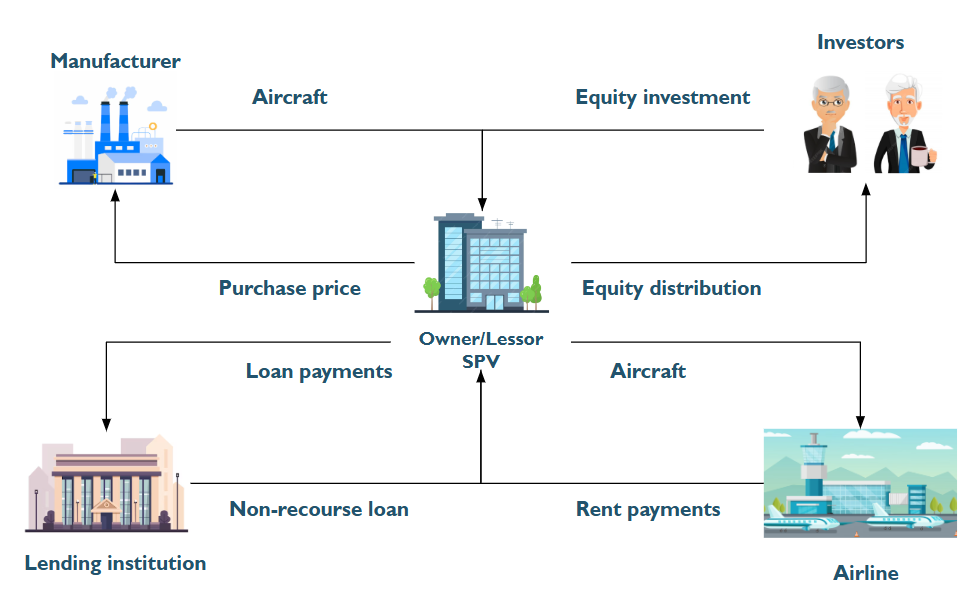
Fig 1: Structure of a JOLCO deal

A finance lease structure would not achieve the same outcome, as it transfers the risks and rewards of ownership to the lessee and may be characterised as a financing arrangement rather than a true lease. In such cases, the economic ownership of the asset may be regarded as residing with the user of the asset i.e. the airline, which could disallow the ability of the lessor investors to claim depreciation on the aircraft.

Role of GIFT CITY 

In the present JOLCO deal, the aircraft is expected to be leased by the Japanese SPV to the airline’s IFSC-based wholly owned subsidiary at GIFT City, which will then sub-lease it to the airline. Routing the transaction through GIFT City instead of a direct transaction between the Indian airline and foreign lessor ensures no tax leakage. The same is explained below:

  1. If the aircraft were leased directly by the Japanese SPV to IndiGo, the lease rentals would be characterised as ‘royalty’ for the use of industrial equipment under Section 9(1)(vi) of the Income Tax Act, 1961. Since the payer is an Indian resident and the aircraft is used in India, such royalty is deemed to accrue or arise in India, triggering withholding tax of 10% under Section 195;
  2. The insertion of an IFSC leasing entity at GIFT City helps mitigate this tax friction through provisions introduced specifically to develop India as an aircraft leasing hub:
    1. First, when the Indian airline pays lease rentals to the IFSC leasing entity, those payments do not attract withholding tax where the IFSC unit is availing the tax holiday under Section 80LA;
    2. Second, royalty income received by a non-resident lessor from the IFSC unit engaged in aircraft leasing is exempt from tax in India [see section 10(4F)]. As a result, lease rentals paid by the IFSC entity to the Japanese SPV would not be taxable in India;
    3. Third, the IFSC also provides capital gains relief for transfer of aircraft leased by IFSC units, enabling tax-efficient exit of the asset at the end of the lease cycle. In addition, the Government of Gujarat has waived stamp duty on aircraft leasing and financing transactions executed in IFSC, reducing transaction costs at the state level.

See more on aircraft leasing in GIFT IFSC here.
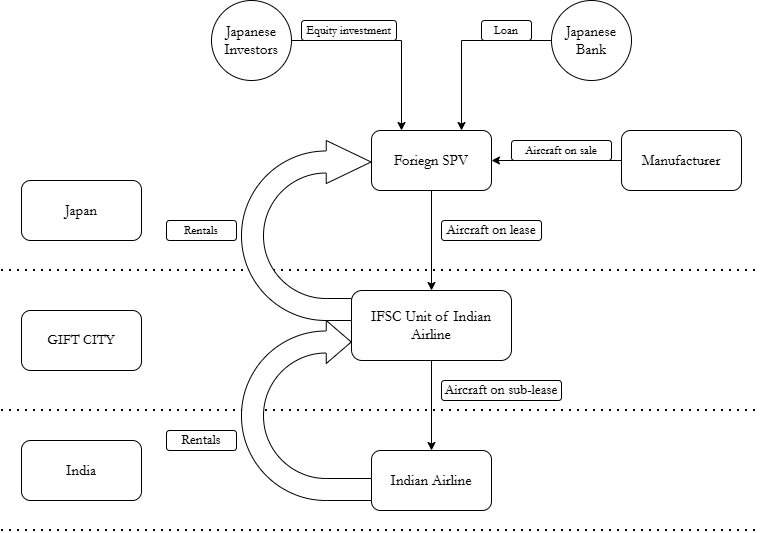
Fig 2: Deal structure

Significance of Cape Town Convention and IBC

For cross-border aircraft leasing transactions, lenders and lessors place much weightage on their ability to repossess the aircraft in the event of airline default. Financers require legal certainty that their ownership or security interests can be quickly enforced if payments stop. The Cape Town Convention on International Interests in Mobile Equipment establishes a uniform framework for registering and enforcing such interests including mechanisms such as time-bound possession. The importance of such protections became evident during the Go Air Insolvency where aircraft lessors faced significant difficulty repossessing aircraft due to the moratorium under the IBC (See our article on Go Air insolvency and Cape Town Convention here). 

In April 2025, India enacted the Protection of Interests in Aircraft Objects Act, 2025 and notified its rules in January 2026, giving domestic legal effect to the Cape Town Convention and its Aircraft Protocol Rules. The legislation is intended to align India’s aviation financing framework with global standards and facilitate quicker repossession and enforcement of lessor rights, improving investor confidence in leasing transactions involving Indian airlines. Upon a combined reading of the 2023 notification and the Protection of Interests in Aircraft Objects Act, 2025, the moratorium under Section 14 of the IBC will not prevent enforcement of rights in respect of aircraft objects covered under the Cape Town framework. Consequently, upon default by the lessee, creditors and lessors may exercise the remedies available under Articles 8 to 10 of the Cape Town Convention, including repossession, deregistration and export of the aircraft. This was important specially since the NCLAT ruling of Go Air3 upheld the moratorium on Go Air, which left international lessors in a limbo. 

  1.  DVB Aviation Finance Asia PTE Ltd. v. Directorate General of Civil Aviation, WP (C) 7661/2012 ↩︎
  2. Tegwan, 2025, Indian Journal of Law and Legal Research – ISSN: 2582-8878 ↩︎
  3. SMBC Aviation Capital Ltd. v. Interim Resolution Professional of Go Airlines (India) Ltd., (2023 SCC OnLine NCLAT 230) ↩︎

Aircraft leasing in IFSC

Team Finserv | finserv@vinodkothari.com

Loader Loading…
EAD Logo Taking too long?

Reload Reload document
| Open Open in new tab

Download as PDF [1.16 MB]

Our other resources on IFSC

  1. Ship leasing from IFSC: A new business takes shape
  2. Financial entities in IFSC: A primer
  3. Finance Companies / Units in International Financial Services Centre (IFSC)
  4. Budget 2023 and Gift IFSC: Making Things Happen
  5. Consultation paper on the proposed IFSCA (Payment Services) Regulations, 20XX: An Analysis
  6. IFSC Banking Units allowed to deal in Structured Finance Products
  7. Banking & Finance units in IFSC- A regulatory overview

Ship leasing from IFSC: A new business takes shape

Team finserv | finserv@vinodkothari.com

The International Financial Services Centre, from Gift City, was intended to enable leasing of aircrafts as well as ships. Such leases have traditionally been done from offshore jurisdictions, and the admitted intent of IFSC was to bring these businesses to IFSC.

Ship financing business in India and the world

India is a very important player in the global shipping market, and is ranked no 17 in terms of shipping volume. It has a coastline of about 7,517 km, with 12 major and 205 minor ports. Additionally, it is estimated that about 95% of India’s goods trade by volume and 70% by value is done through maritime transport.

Ship financing volume globally is about USD 500 billion, largely consisting of bank finance. There are two types of leases against ships: bare board charter, and voyage or time charter. In case of the former, the lessor merely provides the vessel, with neither the crew or any other services, whereas in case of the latter, the ship is provided on time basis, with all services.

India is a substantial importer of shipping freight. It is estimated that annually, Indian companies pay about $75 billion for seaborne freight to foreign shipping companies. 

Read more

Budget 2023 and Gift IFSC: Making Things Happen

Anirudh Grover, Executive | finserv@vinodkothari.com

Background and Existing Framework

The International Financial Services Centre (“IFSC”) situated in the GIFT city is deemed to be a quasi-foreign territory from the lens of Foreign Exchange Management Act, 1999 however a domestic area under the tax regime. The objective of setting up specified territory lies in the benefits an IFSC jurisdiction provides in the form of free flow of foreign transactions and investor confidence; this setting up is commonly termed as onshoring the offshore. 

In order to materialize the underlying objective, a specific regulatory framework has been designed which includes the incorporation of the following major entities:

  1. Finance Companies: The concept of Finance Companies are pari materia to the concept of non-banking financial companies, the unified regulator IFSCA has issued regulations specifically dealing with the concept of Finance Companies. The detailed write up of which can be found in our write up.
  2. Fund Management Entities (‘FMEs’): FMEs are entities which act as pooling vehicles for various kinds of investors, this concept of FME’s is equivalent to the concept of Alternative Investment Fund. A designated regulatory framework has been specially established by the unified regulatory for governing the framework of FMEs in IFSC, the details of which can be captured from our write up
  3. Banking Units: As far as Banking Units are concerned, the IFSCA has outlined a framework through which Indian banks or foreign banks can set up their shop in the form of branches in IFSC GIFT City. The IFSCA (Banking) Regulations, 2020 are the principal regulations governing the Banking Units established in the IFSC GIFT City. My colleague has already covered the regulatory overview on this aspect in our write up

Apart from these entities there are other entities as well which are running their businesses from IFSC GIFT City which includes Fintech Entities, Capital Market Intermediaries and Insurance Intermediaries. The Union Budget of 2022 paved the way for bringing fundamental changes in the IFSC jurisdiction which resulted in the establishment of a regulatory framework namely IFSCA (Setting up and Operation of International Branch Campuses and Offshore Education Centres) Regulations, 2022. By virtue of these regulations now Foreign Universities have been allowed to set up their base in IFSC. Further the Union Budget 2022 also laid the ground for establishment of an Arbitration Centre which would allow disputes to be resolved in record time. 

Albeit these announcements came out to be a key in evincing interest in the IFSC jurisdiction however it is perceived that there are certain pivotal areas of law which require further modifications/clarifications which is expected to be a part of the Union Budget of 2023.

Read more

Banking & Finance units in IFSC- A regulatory overview

– Siddarth Goel (finserv@vinodkothari.com)

Introduction- IFSCs

The stage of development of financial markets infrastructure in a country, amongst many other things, is a mirror of sound legal regulations, corporate governance, judicial certainty, and debtor protection regime within the country. The inflow of global capital is quintessential for financial markets development and allocation of adequate capital resources in growth sectors. In a move to make India a hub for global capital flow, Gujarat International Finance Tech-City (GIFT) has been established as a globally benchmarked International Financial Service Centre (GIFT-IFSC). GIFT-IFSC is India’s first dominant gateway for global capital flows in and out of the country.  The GIFT IFSC supports a gamut of financial services inter alia, banking, insurance, asset management, and other financial market activities. Prior to dealing with the regulatory framework governing financial units established in GIFT-IFSC, it is important to understand the broad function of an IFSC.

IFSCs are the Offshore Financial Centers (OFCs) that cater to customers outside their own jurisdiction. IMF defines OFCs as any financial center where the offshore activity takes place. However, this does not limit financial institutions in OFCs from undertaking domestic transactions. Therefore practical definition propounded by IMF is;

“OFC is a center where the bulk of financial sector activity is offshore on both sides of the balance sheet, (that is the counterparties of the majority of financial institutions liabilities and assets are non-residents), where the transactions are initiated elsewhere, and where the majority of the institutions involved are controlled by non-residents.”

Units set up in GIFT-IFSC can broadly be categorised on the basis of business activity intended to being undertaken by the entity.


This write-up covers regulations governing banking and financial services undertaken by Banking Units and Finance Companies set up in IFSC. The first part touches upon the benefits of setting up a unit in IFSC. The second part covers Banking Units and permitted financial activities. The third part covers Financial Companies in IFSC along with permissible activities and capital requirements. The fourth part covers financial service transactions to and fro between a financial unit based in IFSC and domestic tariff area (DTA). The last part deals with the applicable  KYC/PMLA compliances and the currency of transactions with units based in IFSC.

Read more

One-stop guide for all Regulatory Sandbox Frameworks

-Kanakprabha Jethani (kanak@vinodkothari.com)

Background

The International Financial Services Centres Authority Act, 2019 was enancted on December 19, 2019, providing powers to the International Financial Services Centres Authority (IFSCA) to regulate financial products, financial services and financial institutions in the International Financial Services Centres. Under such powers, the IFSCA has on October 19, 2020, introduced a Regulatory Sandbox (RS) framework[1], to develop a world-class FinTech hub at the IFSC located at GIFT City in Gandhinagar. Under the said framework, entities operating in the capital market, banking, insurance, and financial services space shall be granted certain facilities and flexibilities to experiment with innovative FinTech solutions in a test environment. The framework details among other things the eligibility criteria, applicability, process of application, and regulatory exemption for operating in the RS..

Further, there are already separate RS frameworks issued by the sectoral regulator for various market participants. Hence, it becomes crucial to understand the unique offering of this IFSC framework. The below write-up intends to discuss the same.

What is Regulatory Sandbox?

Regulatory sandboxes or RS is a framework that allows innovative projects to undergo live testing in a controlled environment where the regulator may or may not permit certain regulatory relaxations or may provide certain additional facilities for testing.

The objective is to allow new and innovative projects to conduct live testing and enable the approach of learning by doing. RSs are created to facilitate the development of potentially beneficial innovations, which are otherwise barred to operated due to the construct of the existing regulatory framework of the country.

We have a separate write-up on the concept, benefits, limitations and the history of RS, which may be referred here- https://vinodkothari.com/2019/04/safe-in-sandbox-india-provides-cocoon-to-fintech-start-ups/

Basic features of the IFSC RS Framework

The framework allows any person, including individuals, to make an application under the RS. This is a unique feature that allows not only businesses but students, researchers as well as professionals to apply. However, there is a geographical limit to this RS. It can only operate within IFSC GIFT city. Further, considering the need for information in such projects, the framework, as an additional step, shall provide the participants with access to market-related data, particularly, trading and holding data, which is otherwise not readily available, to enable them to test their innovations effectively before the introduction of such innovations in a live environment.

Comparison of basic features of various RS frameworks

Features IFSC framework RBI framework[2] SEBI framework[3] IRDA framework[4]
Frequency of application This is an on-tap framework. Hence, an application may be made anytime. Based on the cohort framework i.e. end-to-end sandbox. The RBI rolls out a theme based cohort, say digital payments, under which fintech intending to provide services relating to the theme shall apply.[5]


Applications can be made only when a cohort is live.

This is an on-tap framework. Hence, an application may be made anytime Based on the cohort approach.[6]
Applicability/Eligibility to apply Following intending to operate in the IFSC GIFT city.

·   All entities registered with SEBI, RBI,  IRDAI and PFRDA

·   All startups registered with Startup India and meeting the criteria of a start-up[7]

·   Companies incorporated and registered in India

·   Companies  incorporated  and  regulated  in FATF compliant  jurisdictions

·   Individuals who are citizens of India

·   Individuals from FATF compliant jurisdiction[8]

Fintech companies including startups, banks, financial institutions and any other company partnering with or providing support to financial services businesses which satisfies the detailed eligibility criteria laid down.[9] Entities registered with SEBI under section 12 of SEBI Act, 1992 ·   Insurers

·   Insurance intermediaries

·    any person (other than individual) having net worth of Rs. 10 lakhs or more in the previous financial year

·   Any other person recognized by IRDAI

Purpose Adding significant value to the existing offering in the capital market, banking, insurance or pensions sector in India/IFSC. For the introduction of innovative Products/Services in retail payments, money transfer services, marketplace lending, digital KYC, financial advisory services, wealth management services, digital identification services, smart contracts, financial inclusion products, cybersecurity products, mobile technology applications, data analytics, API services, applications under blockchain technologies, Artificial Intelligence and Machine Learning applications Adding  significant  value to the existing offering in the Indian securities market For promoting or implementing innovation in

insurance in India in any one or more of the following categories:

(a) Insurance Solicitation or Distribution

(b) Insurance Products

(c) Underwriting

(d) Policy and Claims Servicing

(e) Anv other category recognised by the Authority.

Timeline for review of the application 30 working days Around 4 weeks + 4 weeks + 3 weeks (including preliminary screening, test design, and application assessment) 30 days No timeline prescribed under the regulations
Testing duration Maximum 12 months, extendable upon request Maximum 12 weeks, extendable on request Maximum 12 months, extendable upon request Maximum 6 months, extendable on request
Exclusions No such exclusions


RS  shall not be available for the following:

·       Credit registry

·       Credit information

·       Crypto currency/Crypto assets services

·       Trading/investing/settling in crypto assets

·       Initial Coin Offerings, etc.

·       Chain marketing services

·       Any product/services which have been banned by the regulators/Government of India.


No such exclusions No such exclusions
Extending or exiting the RS ·      At the end of the testing period, relaxations provided on regulatory requirements shall expire.

·      Upon completion of testing, IFSCA shall decide whether to permit the innovation to be introduced.

·      The applicant may request for an extension period

·      The applicant may exit the sandbox on its own by giving a prior notice to IFSCA.

·      At the end of the sandbox period, the relaxations provided will expire and the entity must exit the RS.

·      In case an extension is required, the entity should apply to the RBI at least 1 month before the expiration thereof extended period.

·      The entity may also exit from the RS by informing the RBI, 1 month in advance.

·      At the end of the testing period, relaxations provided on regulatory requirements shall expire.

·      Upon completion of testing, SEBI shall decide whether to permit the innovation to be introduced.

·      The applicant may request for an extension period

·      The applicant may exit the sandbox on its own by giving a prior notice to SEBI.

·      Applicant may request IRDAI for extension for a maximum of 6 months

·      Applicant shall submit a report within 15 days of completion of testing period on how the proposal met the stated objectives, based on which the project may be launched under the extant regulatory framework

Revocation of the approval IFSCA may revoke the approval at any time before the end of the testing period, if the applicant:

·   fails to carry out risk mitigants.

·   Submits false information or conceals material facts in the application

·   Contravenes any applicable law

·   Suffers a loss of reputation

·   Undergoes into liquidation

·   Carries on business in a manner detrimental to users or the public

·   Fails to   address any   defects in the   project

·   Fails to implement directions given by IFSCA

The testing will be discontinued any time at the discretion of the RBI:

·   if the entity does not achieve its intended purpose

·   if the entity is unable to comply with the relevant regulatory requirements and other conditions

·   if the entity has not acted in the best interest of consumers

SEBI may revoke the approval at any time before the end of the testing period, if the applicant:

·   fails to carry out risk mitigants

·   Submits false information or conceals material facts in the application

·   Contravenes any applicable law

·   Suffers a loss of reputation

·   Undergoes into liquidation

·   Carries on business in a manner detrimental to users or the public

·   Fails to   address any   defects in the   project

·   Fails to implement directions given by IFSCA

The Chairperson of the IRDAI may revoke the permission so granted at any time, if it is of the view that the

activities carried out are not meeting the prescribed conditions/ are in violation of the provisions of applicable laws.


Conclusion

The IFSC RS framework seems to be drafted on lines of the RS framework issued by the SEBI. The only differentiating factor is the inclusion of all kinds of applicants operating for various purposes. Each of the frameworks discussed above has their peculiarities, and hence, the suitability to one’s design of business may vary. None of the RSs other than the ones introduced by IRDAI have been able to reap any concrete results lately. However, with the growing acceptance of technology, it is only a matter of time before we see various kinds of innovations in the way we transact every day.


[1] https://ifsca.gov.in/Viewer/Index/99

[2] https://www.rbi.org.in/Scripts/PublicationReportDetails.aspx?UrlPage=&ID=938

[3] https://www.sebi.gov.in/legal/circulars/jun-2020/framework-for-regulatory-sandbox_46778.html


[4] https://www.irdai.gov.in/ADMINCMS/cms/frmGeneral_NoYearLayout.aspx?page=PageNo3886

[5] After the introduction of the framework in August 2019, only 1 cohort has been announced i.e. in November 2019 themed ‘Retail Payments’ (https://www.rbi.org.in/Scripts/BS_PressReleaseDisplay.aspx?prid=48550)

[6] After introduction of Insurance Regulatory and Development Authority of India (Regulatory Sandbox) Regulations, 2019 in July 2019, 2 cohorts have been introduced:

[7] Definition of startups- https://www.startupindia.gov.in/content/dam/invest-india/Templates/public/198117.pdf

[8]List of FATF compliant jurisdictions- https://www.fatf-gafi.org/countries/

[9] Refer- https://vinodkothari.com/2019/04/safe-in-sandbox-india-provides-cocoon-to-fintech-start-ups/


Other related write-ups: