Will SEBI succeed in trying to create a much needed vibrant Bond Market?

By Rajeev Jhawar (rajeev@vinodkothari.com) [Updated as on November 27, 2018]

In a vibrant market, resides a healthy economy. On the Budget day, India sought to expand its bond market beyond the traditional ambit of sovereign debt. In pursuant to this, Securities and Exchange Board of India(SEBI) has initiated to diversify borrowings of Indian corporates by mandating to raise at least a quarter of their incremental funds from the bond market.

The regulator came out with a circular dated 26 November 2018, based on the concept paper released on 20 July,2018; targeting all listed entities (whose specified securities, or debt securities or non-convertible redeemable preference share are listed on SEBI’s recognized stock exchange) thereby addressing the liquidity problem persisting in the bond market, with an intention to create a robust secondary market for the debt securities in India.

For the entities following April-March as their financial year, the framework shall come into effect from April 01, 2019 and for the entities which follow calendar year as their financial year, the framework shall become applicable from January 01, 2020.

The requirements brought by SEBI and corresponding inferences

The regulator proposes that the Large Corporates (LC) that are listed companies (whose specified securities or debt securities or non- convertible redeemable preference shares are listed) (excluding Scheduled Commercial Banks) will have to compulsorily raise 25% of their incremental borrowings (being fresh long term borrowings during the FY) from the bond market in the financial year for which they are being identified as LC, as a part of corroborating the same. The term financial year here would imply April-March or January-December as may be followed by the entity.

As per the circular,large corporates would refer to entities

  • having outstanding long-term borrowings of Rs. 100 crores or above.Further, long term borrowings would mean any outstanding borrowing with original maturity of more than 1 year excluding external commercial borrowings(ECBs) and inter corporate borrowings between a parent and subsidiary and,
  • a credit rating of “AA and above”, where credit rating shall be of the unsupported(unsecured) bank borrowing or plain vanilla bonds of an entity, which have no structuring/ support built in; and in case, where an issuer has multiple ratings from multiple rating agencies, highest of such rating shall be considered for the purpose of applicability of this framework.

Lower rated corporates have been exempted from the framework for the time being due to the limited demand for such securities. It is believed that if the 25% norm is followed religiously, it would tantamount to increase bond flotation as more companies would be able to access the debt market. Besides, the government might limit corporates’ dependence on banks and the risk associated with it. However, there is a need for an expansion in the investor base for implementation of these rules.

Rationale

There is no secondary market for corporate bonds in India to speak of. The sorry state of affair could be because of illiquid debt market, bad press in case of default, risk averse attitude as well as dearth of investor’s awareness. On the bright aspect, bonds are ideal way to raise financing for a certain kind of long-gestation infrastructure project. Typically, infrastructure projects are capital-intensive and long-gestation. It takes years to roll out toll-roads, build flyovers and set up massive power generating plants. The project developer has no cash flow to service debt until the project is running and banks may not be considered a viable source as bank funding is short tenure, which would result in asset-liability mismatch.

It is also believed that a sound corporate bond market, would take a lot of pressure off banks, which are reeling under bad debts. Retail investors will also get a chance to invest in such projects via debt funds. In short, large exposure to risk would be substantiated with huge rewards.

Further, in order to ensure investors faith in the company, the rating of ‘AA and above’ has been given preference as corporates with such high rating would have less chance to default on its obligations towards the investors which was demonstrated in the consultation paper also.

Impact on Financier’s Interest

The entry barrier for lower rated corporate bonds would be demolished because the proposal might escalate the pool of investment grade issuers. So far, the small borrowers resorted mostly to institutional finance and inter-corporate deposits. The bond avenue would serve as an alternative for them to raise finance at a reasonable price keeping in mind investor’s perpetual keenness to diversify their investments. It may be useful to classify BBB-rated corporate bonds as investment grade and thus allow pension funds and insurance companies to enter that space.

Disclosure requirements for large entities [1]

A listed entity, identified as a Large Corporate(LC) under the instant framework, shall make the following disclosures to the stock exchanges, where its security(ies) are listed:

  • Within 30 days from the beginning of the FY, disclose the fact that they are identified as a LC, in the format as provided in the circular;
  • Within 45 days of the end of the FY, the details of the incremental borrowings done during the FY, in the formats as provided in the circular;
  • The disclosures made shall be certified both by the Company Secretary and the Chief Financial Officer, of the LC;
  • Further, the disclosures made shall form part of audited annual financial results of the entity.

Compliance

The LCs would need to disclose non-compliance as part of “continuous disclosure requirements”.For FY 19-20 & 20-21, the aforesaid requirement has to be met on an annual basis as on the last day of the FY.In case of failure, explanation as regards to the shortfall has to be made to the stock exchange (SE).

For FY 19-20 & 20- 21, no penalty but explanation will be required.From FY 21-22 onward, the minimum funding requirement has to be met over a block of 2 years. In case of any shortfall of the first year of the block is not met as on the last day of the next FY of the block, a monetary penalty of 0.2% of the shortfall amount shall be levied and paid to SE.The manner of payment of the penalty has not been provided in the Circular but SEs are expected to bring the same.The entity identified as a  large corporate  shall choose any one of the Stock Exchanges (where the securities are listed) for payment of the penalty.

The Stock Exchange(s) shall collate the information about the Large Corporates, disclosed on their platform, and shall submit the same to the Board within 14 days of the last date of submission of annual financial results.

Whether SEBI’s attempt would prove to be a boon or a bane, is likely to be seen as days unfold.


[1] https://www.sebi.gov.in/legal/circulars/nov-2018/fund-raising-by-issuance-of-debt-securities-by-large-entities_41071.html

Subordination of Operational Creditors under IBC: Whether Equitable?

Vinod Kothari and Sikha Bansal

The authors can be reached at resolution@vinodkothari.com


  1. Why this Article?

Section 53 of the Insolvency and Bankruptcy Code (IBC) puts unsecured financial creditors above the claims of the governments. These unsecured financial creditors may, actually, be even related parties, and therefore, the underlying financial transaction may be in the nature of accommodation provided by promoters or majority shareholders, often at the instance of lending banks. At the same time, there is no specific mention of the priority status of operational creditors, who are, therefore, left in the residual category of “any remaining debts and dues”, which is 2 notches below unsecured financial creditors.

Financial creditors in this case are unsecured; so are operational creditors. The law, however, puts one class of unsecured creditors two places ahead of the other, in the priority order of distribution. Is this subordination of unsecured operational creditors justified? Or, is it equitable? Is there an economic argument to contend that the suppliers of goods and services who supplied on credit, and therefore, contributed to working capital, should have lower ranking claim to their money than working capital financiers or other unsecured lenders?

This significant question is discussed in this article in the light of global insolvency laws.

  1. The Significance of Insolvency Priorities

Prioritisation of debts in liquidation, technically speaking, is specifying the stacking order in which different creditors of the insolvent debtor would be paid their dues.

Prioritisation of claims, commonly known as liquidation waterfall, is one of the most important aspects of insolvency laws, and has evolved globally over the decades of jurisprudence. Insolvent liquidation is obviously a case of shortfall of assets as against the claims, and therefore, who gets paid first, or does every get to share proportionally, is the key question. If food on the dining table at home is short, we will all share what we have, but we sometimes give priorities to children or the elderly. However, in insolvency waterfall, the concept of prioritisation is that unless the one ahead in the queue has eaten belly-full, the next person in the queue does not get to eat even a morsel. Hence, it is not merely a question of “how much”, it is a question of “whether at all”. Therefore, priority in distribution in liquidation is not merely a matter of place in the queue – it is whether a stakeholder gets paid at all, or how much it gets paid. Thus, the recovery rate, and therefore, loss given default (LGD –as bankers call it), is directly connected with the prioritisation.

Since the claim that a claimant files in liquidation proceedings is a property right of the claimant, the prioritisation deals with property rights; hence, any casual or unprincipled approach to prioritisation may be fatal to the inherent property rights of the claimants.

  1. Principles of Prioritisation

Priorities are specified considering the following fundamental factors –

(i) Contractual priorities: The priorities specified often recognize and respect different commercial bargains which creditors would have struck with the debtor. As stated in the UNCITRAL Legislative Guide on Law of Insolvency, this is to “preserve legitimate commercial expectations, foster predictability in commercial relationships and promote equal treatment of similarly situated creditors”. The preservation of contractual priorities in liquidation is based on the principle of certainty, such that creditors are certain of their rights at the time of entering into the contract. For instance, in secured lending, which is in the nature of an inter-creditor and debtor-creditor agreement, the secured lenders are given the first right on the secured assets, and in case the assets are relinquished, then preferential right on the aggregate cashflows of the entity.

(ii) Social considerations: Prioritisation policies very often reflect legitimate considerations for certain sections of the society or in public interest. For example, the workmen, and the employees. In India, the priority status was given to workmen after elaborate discussion by the Supreme Court in the case of National Textile Workers v. P.R. Ramkrishnan and Others, 1983 AIR 75 : 1983 SCR (1) 9, on workmen’s rights to be heard in winding up proceedings.

(iii) Sovereign considerations: Sometimes claims of the State or the Crown are given priority as preferential unsecured claims on the ground of protection of public revenue.

Given the varied nature of claims and obvious conflict arising on the question of their prioritisation, the UNCITRAL Legislative Guide on Law of Insolvency, therefore states –

“While many creditors will be similarly situated with respect to the kinds of claims they hold based on similar legal or contractual rights, others will have superior claims or hold superior rights. For these reasons, insolvency laws generally rank creditors for the purposes of distribution of the proceeds of the estate in liquidation by reference to their claims, an approach not inconsistent with the objective of equitable treatment.

Therefore, equitability is the key underlying principle to fixation of priorities.

  1. Prioritisation: Global Perspective

Globally, the principles, as discussed above, are followed in countries like USA, UK, Singapore and even India (under the Companies Act, 2013). For instance, as follows –

  • The Insolvency Act, 1986 of United Kingdom

Under the Insolvency Act, 1986, read with relevant rules, a secured creditor puts a value on security, and the office-holder can redeem the property at such value. Hence, a secured creditor has a superior right over the secured asset.

Section 175 read with section 386 and schedule VI to the Act and relevant rules, prescribes preferential debts which shall be paid in priority to all other debts. The preferential claims, such as debts due to inland revenue, customs and excise, social security contributions, contribution to occupational pension schemes, etc. rank above the claims of body of unsecured creditors. Such rank equally among themselves after the expenses of the winding up and shall be paid in full, unless the assets are insufficient to meet them, in which case they abate in equal proportions. Also, such preferential debts have priority over the claims of holders of debentures secured by, or holders of, any floating charge created by the company, and shall be paid accordingly out of any property comprised in or subject to that charge.

As is evident, there is no distinction between creditors as financial or operational.

  • Title 11 of the US Code

Section 706 read with sections 507 and 510 of the dictates the order in which distribution of property of the estate. First, property is distributed among priority claimants, as determined by section 507, and in the order prescribed by section 507. Second, distribution is to general unsecured creditors. Third distribution is to general unsecured creditors who tardily file. Fourth distribution is to holders of fine, penalty, forfeiture, or multiple, punitive, or exemplary damage claims.

Section 507 accords first priority to allowed administrative expenses and to fees and charges assessed against the estate. “Involuntary gap” creditors, are granted second priority, followed by wages, consumer creditors, and taxes (including employment taxes and transfer taxes).

Consumer creditors refer to those who have deposited money in connection with the purchase, lease, or rental of property, or the purchase of services, for their personal, family, or household use, that were not delivered or provided. This can be equated to home-buyers, customers who paid advances for the purchase of goods/services, etc.

Once again, there is no distinction between financial and operational creditors.

  • Singapore Companies Act

Section 328 of the Singapore Companies Act (as also the Singapore Bankruptcy Act, 1995) gives the order of payment if the winding up order is passed in respect of the company. In all modes of liquidation (voluntary and compulsory), all unsecured creditors share ratably in the assets of the company subject to exceptions for secured and preferential debts. Secured creditors stand outside the liquidation and if the security is inadequate, they may prove as unsecured creditors for the balance. Priority has been given to costs and expenses of winding up, various payments to workers and employees and taxes.

Here too, the law makes no distinction as to financial and operational creditors.

  • The Companies Act, 2013, India

Section 326 of the Companies Act, 2013 prescribes overriding preferential payments, i.e. workmen’s dues and unpaid dues of secured creditor who has realized its security. Subject to the provisions of section 326, section 327 specifies priority for debts like government dues, employee dues, etc. Such debts (as specified in section 327) shall rank equally among themselves and be paid in full, unless the assets are insufficient to meet them, in which case they shall abate in equal proportions, and shall have priority over the claims of holders of debentures under any floating charge created by the company, and be paid accordingly out of any property comprised in or subject to that charge.

  1. Creditor classification under the Insolvency and Bankruptcy Code, 2016

IBC makes, for the first time, distinction between financial and operational creditors, while simultaneously retaining the conventional classification of being secured or unsecured. The unique distinction between financial and operational creditors under IBC is based on a recommendation of BLRC which states –

“The Committee deliberated on who should be on the creditors committee, given the power of the creditors committee to ultimately keep the entity as a going concern or liquidate it. The Committee reasoned that members of the creditors committee have to be creditors both with the capability to assess viability, as well as to be willing to modify terms of existing liabilities in negotiations. Typically, operational creditors are neither able to decide on matters regarding the insolvency of the entity, nor willing to take the risk of postponing payments for better future prospects for the entity. The Committee concluded that, for the process to be rapid and efficient, the Code will provide that the creditors committee should be restricted to only the financial creditors.”

Therefore, it was the “capability to assess viability, and willingness to modify terms of existing liabilities in negotiations”, which inspired BLRC to prefer the financial creditors over the operational creditors. The financial creditors were presumed to be strong creditors able to decide on matters regarding the insolvency of the debtor and who are willing to take the risk of postponing payments. The operational creditors are not expected to bear the burden of postponing payments, let alone foregoing the claims, partly or wholly.  This argument may, questionably, be relevant for determining the eligibility to be on the creditors’ committee. But should the distinction continue right upto distribution priorities? For example, related parties do not have a place on the committee of creditors, but that does not deny their right in the waterfall, where they are at par with other unrelated parties. This, in turn, paves way for unscrupulous debtors and their related creditors to misuse the machinery for their benefit, at the cost of unsecured operational creditors.

The irony is, the unsecured operational creditors, being placed last, will get a soupçon only after the financial creditors have filled up their bellies, to the extent the plate has to offer. In fact, in many cases, the operational creditors might end up no payment at all, because most insolvencies are deep enough. All because of the prioritisation contemplated under section 53, as discussed below – which besides being applicable in liquidation, is also relevant for ascribing liquidation values under resolution plan.

  1. Prioritisation of Creditors under Section 53

Section 53 is the relevant section dealing with priorities in liquidation under the Code. The stakeholders have been distinguished and ranked as follows –

  1. IRP and liquidation costs;
  2. Workmen’s dues (for 24 months), and secured dues, if the security has been relinquished;
  3. Employees’ dues (for 12 months);
  4. Unsecured financial creditors;
  5. Government dues, and unpaid dues to secured creditor, if the security has been realized;
  6. Remaining debts and dues [which include, unsecured operational debts];
  7. Preference shareholders;
  8. Equity shareholders.

Notably, distinction under section 53 is a two-fold distinction – (i) secured/unsecured, and (ii) operational/financial. As regards secured creditors, it does not matter whether the creditor is financial or operational, since section 53(1)(b) uses the expression “secured”, and there is no indication as to the nature of debt (financial/operational) owed to such secured creditor. However, when it comes to unsecured creditors, unsecured financial creditors appear in the 4th rank; but unsecured operational creditors come in the 6th rank.

  1. Equitability of Prioritisation under section 53

As seen above, the unsecured financial creditors have been raised above government dues, while unsecured operational creditors merely become a part of the residual entry. It is important to question as to what could be the basis for this discrimination? Contractually, unsecured financial creditors and unsecured operational creditors stand in the same ranking. Now, if the statute pushes the operational creditors to two notches below the unsecured financial creditors, it is important to question the vires of the statute in doing so.

The idea of BLRC to distinguish financial and operational creditors for constitution of committee of creditors is still understandable. The objective might have been based on the consideration that the operational creditors are many, and diversified, and therefore, they may not be in a position to vote on a resolution plan. In any case, many of them may not have the financial acumen required to understand and vote on resolution plans. But if the discussion stretches to priority ranking in the waterfall as well, then there are essential questions of principle to be raised.

The BLRC, in its report [page 14], states –

“The Committee has recommended to keep the right of the Central and State Government in the distribution waterfall in liquidation at a priority below the unsecured financial creditors in addition to all kinds of secured creditors for promoting the availability of credit and developing a market for unsecured financing (including the development of bond markets). In the long run, this would increase the availability of finance, reduce the cost of capital, promote entrepreneurship and lead to faster economic growth.”

The BLRC recommendation, as above, justifies the preferential treatment of unsecured financial creditors over government dues but does not provide any reasoning for not treating unsecured financial and operational creditors at par.

  1. Economic argument of operational creditors

As such, the prioritisation under section 53 fails to consider and appreciate the following –

(i) An economy runs not merely on the financial system, but on the system of supply of goods and services. Goods and services are supplied for credit, which is why operational creditors arise. Supply of goods and services on credit becomes a part of the working capital for the entity, which exactly serves the same purpose as served by financial lenders.

(ii) Supply of goods and services on credit is a crucial part of the economy. The base of the economy of any country is its real sector; financial sector is important, but not at the cost of the real sector. Suppliers of goods and services, including MSMEs, are a part of the real sector.

(iii) How will MSMEs continue to supply goods and services on credit to their customers, if they were to be told that if the customer goes into a default, all the money will go first to bankers, and money will be paid to the suppliers only if there is a surplus left?


  1. Concluding Remarks

For the reasons discussed above, the distinction between unsecured creditors, inter-se, does not appear to be intelligible; or even if it is intelligible, it lacks economic rationale. The approach for prioritisation under section 53 does not seem to be consistent with the umbrella objective of equitable treatment. Read more

Indian Securitisation market opens big in FY 2019

By Rajeev Jhawar (rajeev@vinodkothari.com)

The financial year 2017-18 witnessed one of the major reforms in the country, that is, the exordium of Goods and Services Tax (GST). GST replaced the erstwhile central excise duty, sales tax and service tax laws, thereby changing the indirect tax regime entirely. This had large scale implications as the country had been an unfortunate hostage of apprehension, uncertainty and overhaul of various economic models.

As one would expect, whenever there has been a change, it has been accompanied with resistance and ambiguity. Unfortunately, it takes time for the certainty and safe harbour to surface, in the meantime ultra conservative opinions continue to rule the scene. The securitisation market in India was also affected by this change. Despite performing quite well in the first quarter of the last financial year, the market slowed down in the rest three quarters; this was mainly due to a difference in opinion with respect to applicability of the GST on assignment of receivables.

This issue was however settled by a set of FAQs issued by the GST Council on financial services[1]. The FAQs compared assignment or securitisation transactions with derivatives and hence termed it as a security for the purpose of GST laws. Under the current GST law, GST is not charged on securities. Therefore, vide these FAQs the confusion with respect to applicability of GST on assignment or securitisation transactions have been dispensed with. [Read our detailed analysis here].

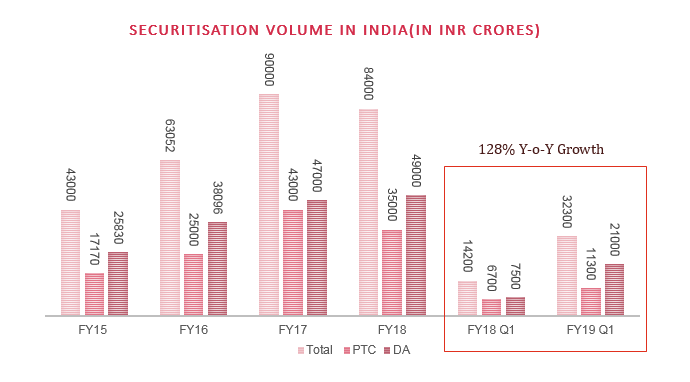
The securitisation industry reacted quickly after this and the volumes surged by 128 percent year-on-year to Rs 32,300 crore during the June quarter of FY 2019. Also as per the reports of ICRA, the PTC transaction volumes increased by around 69% to Rs. 11,300 crores as against Rs. 6,700 crores in Q1 FY2018 while the volumes for direct assignment transactions increased by around 180% to Rs. 21,000 crores in Q1 FY2019 as against Rs. 7,500 crores in Q1 FY2018.

The overall market growth was primarily driven by the increase in PTC issuance volumes. The last two years have seen the PTC market grow on the back of regulatory developments such as the revised Priority Sector Lending (PSL) guidelines which decreed banks to achieve various sub-targets within the overall PSL target and also progressively increased the PSL target for foreign banks. The year saw a growing number of non-banking finance companies (NBFCs) investing in PTCs primarily due to the higher yields attached to those instruments.

The PTC market has also benefitted from a growing investor base as a number of asset management companies (AMCs) restarted investments in securitisation transactions in FY2017. AMCs had earlier abstained from investing in securitised papers on account of tax-related concerns which have been subsequently resolved. Of the three major investor categories, namely banks, NBFCs and AMCs, the latter two made up the bulk of the investments in non-PSL securitisation.

The following graph shows the trend of securitisation and market composition (DAs versus PTCs) during the last three years.


Priority Sector Lending requirements is a major driver in the Indian securitisation market

The role of regulation in shaping the market is critical. The Indian securitization market is largely driven by the need to meet the priority sector targets for banks; therefore, the dependence on demand for priority sector loans is prodigious.

Priority sector lending targets are specific requirements laid down by the Reserve Bank of India (RBI), which require banking institutions to provide a specified portion of their total lending to a few specific sectors. Banks in India are required to direct at least 40% (32% in case of foreign banks having less than 20 branches) of their total credit to certain sectors categorized as priority sectors. Priority sector involves agriculture, education, MSME’s, housing, social infrastructure, renewable energy and others.

Higher PTC yields (yields observed in Q1 FY2019 in ICRA rated transactions was 75bp – 100bp higher compared to previous fiscal) may also have improved the attractiveness of PTCs vis-à-vis the other options available to banks for meeting PSL targets like PSLCs. The asset class wise break-up of PTC transaction has been shown in the table below:


Asset Class Share in Q1 FY 19 Share in Q1 FY 18 Share in FY 18
Vehicle Loans 57.50% 77.5% 70.00%
Home Loans 0.00% 3.70% 2.00%
Loan Against Property 0.00% 9.50% 5.00%
Micro Loans 22.8% 2.00% 17.00%
SME’s Loans 0.60% 1.80% 1.00%
Tractor Loans 0.00% 3.90% 2.00%
Lease Rentals 13.30% 0.00% 0.00%
Others(includes gold loans, two-wheeler loans, consumer durables and term loans) 5.80% 1.60% 3.00%
Total(in INR crore) 11,300 6,700 34,600

Source: Zeebiz

Also, the spurt in securitisation was despite a significant 47 per cent pick-up in trading of priority sector lending certificates (PSLCs), the hot pick of the market, to around Rs 86,300 crore during the quarter, as per rating agency ICRA. The PSLCs act as an alternative to securitisation for banks falling short of meeting the mandated PSL requirements. Mortgage loans dominated the securitisation volumes with a 79 per cent share, including 66 per cent home loans and 13 per cent loans against property, it said.


[1] http://www.cbic.gov.in/resources//htdocs-cbec/gst/FAQs_on_Financial_Services_Sector.pdf;jsessionid=52F0D0B52FE135C59E06F27806FB3194

Cross-Breeding of Entities: NCLT upholds the view!

Pammy Jaiswal

Partner, Vinod Kothari and Company

[corplaw@vinodkothari.com]

Background

Even though each time when law is amended, the stakeholders do expect the change will be a gap filing exercise or a step towards making it more liberal or strict, as the case may be. However, sometimes such amendment comes with a lacuna. Earlier under the Companies Act, 1956 (‘Act, 1956’), sections 391 – 394 dealt with the provisions of compromises, arrangements, amalgamation and reconstruction. The said provisions were re-casted under the Companies Act, 2013 (‘Act, 2013’) under sections 230 – 234. The said provision under the Act, 2013 suffers from a significant gap.

This write-up is an attempt to foreclose the lacuna under the new provision under law and how the quasi-judicial body has correctly interpreted the said gap in law. Read more

Can Liquidator’s Outreach Grab Guarantor’s Assets?

By Sikha Bansal  & Shreya (resolution@vinodkothari.com)


*The Article was first posted on the IndiaCorpLaw Blog (https://indiacorplaw.in/2018/07/can-liquidators-outreach-grab-guarantors-assets.html)

In Punjab National Bank v. Vindhya Vasini Industries Limited, [C.P. ( IB)-1170(MB)] the issue before the National Company Law Tribunal (“NCLT”), Mumbai Bench was whether a property belonging to the guarantor of the corporate debtor can be liquidated in the liquidation proceedings of the corporate debtor. The NCLT referred to section 60(2) of the Insolvency and Bankruptcy Code, 2016 (the “Code”) and held that the assets of the guarantor can be subjected to liquidation by virtue of the said section. The rationale given by the NCLT was that the financial debt in question was intricately linked with the property of the guarantor mortgaged under the same loan agreement on the basis of which the financial debt in question was sanctioned and hence cannot be segregated in the process of liquidation proceedings. Read more

New KYC norms for directors make a cell-phone, email & DSC mandatory for directors

Vinod Kothari

corplaw@vinodkothari.com


If you ever thought your life will be much better and tranquil without a cellphone on you, and without an email to stay connected, well, you may be right, but you cannot function as a director in companies. This is the fallout of the new DIR-3-KYC norms brought by the MCA[1]. The Rules require every director to file the KYC form by 31st August, 2018, post which the Directors’ Identification number (DIN) granted to the director shall be “de activated”. The Rules also lay that such de-activated DIN shall be re-activated only after the person has filed the KYC form.

One of the mandatory requisites of the new KYC form is that the director shall provide his cellphone number, his email id and file the eForm with his/her own digital signature (DSC). If you thought you may provide the cellphone number and email id of your children, or your assistants, you are mistaken, because the form goes on to say that the cellphone number and the email id shall be of the director himself.

Section 153 of the Companies Act makes it mandatory for any prospective director to apply for DIN. While there is nothing in the statute to say that on de-activation of the DIN, the director will lose his office as such, technically called vacation of office, it will not be surprised, if the Government, in its recent impetus to weed out shell companies and dummy directors, barges ahead and challenge the very directorship of such directors whose DINs stood deactivated.

Result – you cannot be a director, unless you have a cellphone number and email id. Legal experts may argue that being director in companies is basic freedom to carry business, as the right to carry business includes the right to carry it in corporate form as well, and there is nothing in the law of the land to make a cellphone or an email an existential necessity. Therefore, if there is a law that forces a corporate professional to have a personal cellphone number/ email- id, the law needs to be questioned.

Not having a personal cellphone is neither an evidence of laity nor anachronism. Several people use a limited insulation from communications technology as a way of life. There is no basis to contend that such persons are not fit to be corporate directors.

It may be argued that the qualifications of a director and the circumstances in which a director automatically vacates his office are all well defined in the law. De-activation of the DIN is not one of such circumstances. It may also be argued that there is an assurance in the MCA DIN rules that the DIN once granted has lifetime validity, and the question of its de-activation does not arise at all.

In order to file this eForm, all directors (Indian and foreign national) will have to obtain/ have their own email id, mobile number, specify the OTP in the eForm and sign with their own DSC. The consequence of false declaration is that the Director shall be liable under section 448 of the Act and under relevant provisions of the Indian Penal Code, 1860 and any other law as applicable, if any statement in the application is found to be false or any material fact is found to be have been omitted.

The MCA rules come in the wake of the Government’s resolve to weed out shell companies and dummy directors. It is apprehended that the 10-lakh odd companies have lots of directors who are men of straw, even though the requirement for DIN was introduced sometime in 2006.

[1] Insertion of new rule 12A in Companies (Appointment and Qualification of Directors) Rules, 2014 vide MCA notification dated 5th July, 2018