Rules of Restraint: RBI proposes revised norms on Related Party Lending and Contracting
– Team Finserv, finserv@vinodkothari.com
In its current hectic phase of revamping regulations, the RBI has issued Draft Directions for lending and contracting with related parties. Separate sets have been issued for commercial banks, other banks, NBFCs and financial institutions.
The definition of “related party” is more rationalised and improvised over the existing definitions in Companies Act or LODR Regulations. Loans above a “materiality threshold” [which is scaled based on capital in case of banks, and based on base/middle/upper layer status in case of NBFCs] will require board approval, and nevertheless, will require regulatory reporting as well as disclosure in financial statements. In case of contracts or arrangements with related parties, with the scope of the term derived from sec 188 (1) of the Companies Act, there are no approval processes, but disclosure norms will apply. In the case of banks, trustees of funds set up by banks are also brought within the ambit of “related persons”.
Read more →Legal issues in factoring business in India
Originally by Nidhi Bothra (2011) | Updated by Simrat Singh | finserv@vinodkothari.com
Credit Factoring or simply factoring is an asset backed means of financing (tripartite agreement between the buyer, seller and the factor), whereby the account receivables are assigned to a third party called factor for a discount, releasing the tied-up capital and providing financial accommodation to the Company. The origin of factoring goes back to the 14th century in England. Earlier, factoring was confined to textile and garment industries, but later was spread across various industries and markets. Factoring has been defined as:
“Credit factoring may be defined as a continuing legal relationship between a financial institution (the “factor”) and a business concern (the “client”) selling goods or providing services to trade customers (the “customers”) whereby the factor purchases the client’s book debts either without or with recourse to the client, and in relation thereto controls the credit extended to customers and administers the sales ledger.”
UNIDROIT Convention on International Factoring, 1988 defines factoring as follows:
“Factoring contract” means a contract concluded between one party (the supplier) and another party (the factor) pursuant to which:
- the supplier may or will assign to the factor receivables arising from contracts of sale of goods made between the supplier and its customers (debtors) other than those for the sale of goods bought primarily for their personal, family or household use;
- the factor is to perform at least two of the following functions:
- finance for the supplier, including loans and advance payments;
- maintenance of accounts (ledgering) relating to the receivables;
- collection of receivables;
- protection against default in payment by debtors;
- notice of the assignment of the receivables is to be given to debtors.
US accounting standard ASC 860-10-05-14 defines ‘factoring arrangements’ as:
Factoring arrangements are a means of discounting accounts receivable on a nonrecourse, notification basis. Accounts receivable in their entirety are sold outright, usually to a transferee (the factor) that assumes the full risk of collection, without recourse to the transferor in the event of a loss. Debtors are directed to send payments to the transferee
Though Europe provides largest volumes globally, factoring in Asia as well has been growing rapidly in the last few years. Global factoring volumes reached EURO 3.66 Trillion in 2024 (up 3.6% from the previous year)1. In Asia-Pacific, India was the fastest-growing market in the region, up 120% to EUR 38.2 billion.2
The purport of factoring is to assign the account receivables to be able to:
- Instantly convert receivables into case, that enable the companies to have funds to finance the day to day operations of the company;
- Helps in efficient collection of the receivables and protection against bad debts;
- Outsourcing sales ledger administration and
- Availing credit protection for receivables.
Typically in a factoring transaction, a seller gets a prepayment limit from the factor, then enters into a transaction with the buyer and submits the invoice; notice to pay etc to the factor. The factor makes upfront payment to the seller, as a percentage of invoice value based on criteria, such as, quality of receivables, number and quality of the buyers and seller’s requirements (80% – 95% of invoice value) and maintains the sales ledger of the seller and collects payment from buyer. The balance payment is made to the seller, net of charges. The seller is not required to open an LC or a bank guarantee.
The cost to the seller in factoring is the service fees, which is dependent on a) sales volume, b) number of customers, c) number of invoices and credit notes and d) degree of credit risk in the customer or the transaction.
Factoring and Bill Discounting
There is a very thin line of difference between factoring and bill discounting. Bill discounting unlike factoring is always with recourse to the client, whereas factoring may be with recourse or without. Generally there is no notice of assignment given to the customer in case of bill discounting and collections are done by the assignor , unlike factoring, where debt collection is done by the factor. Factoring can be called a financing and servicing function, whereas, bill discounting function is purely financial.
Types of Factoring
On the basis of geographical distribution
- Domestic Factoring
- Sales bill factoring
- Purchase bill factoring
- International Factoring – As international trade continues to increase, international factoring is being accepted as vital to the financial needs of the exporters and is getting the necessary support from the government, specifically in the developing countries to stimulate this mode of funding.
- Export factoring – It is seen as an alternative to letter of credit, as the importers insist on trading in open account terms. Export factoring eases the credit and collection troubles in case of international sales and accelerates cashflows and provides liquidity in the business.
On the basis of credit risk protection
- On recourse basis, wherein the factor can recover the amount from the seller, in case of non-payment of the amount to the factor. Thus, though the receivables have been assigned, the credit risk remains with the client.
- On non-recourse basis also called old line factoring, wherein the risk of non-payment of invoices is borne by the factor. However, the factor only bears credit risk in such transactions. In case non-payment is due to any other reason other than financial incapacity, such as disputes over quality of goods, breach of contract, set-offs or fraud , the factor does not assume liability and the risk remains with the client.
Other types:
- Advance factoring: In case of advance factoring, the factor provides financial accommodation and non-financial services. The factor keeps a margin while funding, which is called the client’s equity and is payable on actual collection.
- Maturity factoring: Here, the factor makes payment on a due date. This sort of funding is resorted to by clients who are in need of non-financial services offered by the factors.
- Supplier guarantee factoring: Also known as drop shipment factoring. This sort of factoring is common where the client acts as a mediator between the supplier and the customer.
Overview of factoring in India:
India’s factoring turnover in 2024 was around Euros 38,200 Million in total as compared to a total of Euros 3,894,631 million worldwide3 and the turnover over the last 7 years (2018-2024) has seen a tremendous growth; while that of Asia has risen 38% from 2018 to 2024 and is valued at Euros 3,894,631Million.
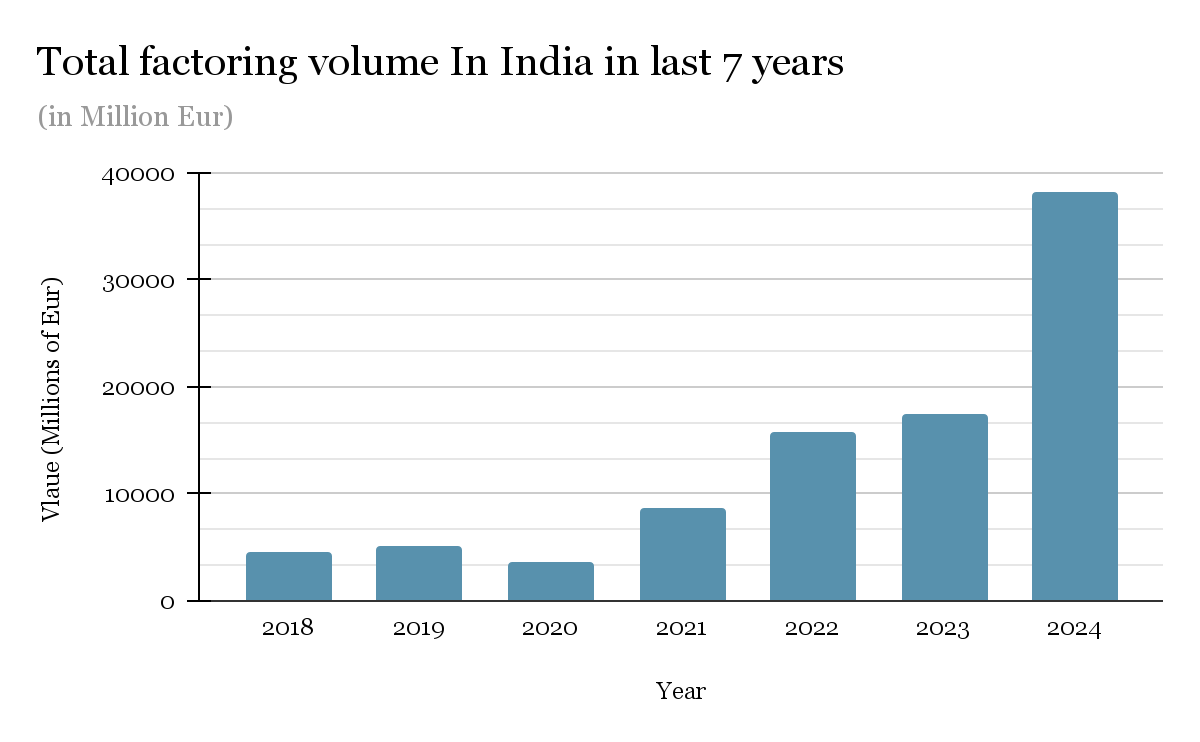
Fig 1: Factoring volumes in India: Source: FCI Annual Review 2025
Some of the challenges faced by the factoring companies in India are a) there was no specific law for assignment of debt, b) there was no recovery forum available to the factoring NBFCs such as DRT or under Sarfaesi Act, c) Lack of access to information on credit worthiness and d) assignment of debt involves heavy stamp duty cost.
UNCITRAL laws on assignment
Article 2 of the United Nations Convention on the Assignment of Receivables in International Trade defines ‘Assignment’ as –
“Assignment” means the transfer by agreement from one person (“assignor”) to another person (“assignee”) of all or part of or an undivided interest in the assignor’s contractual right to payment of a monetary sum (“receivable”) from a third person (“the debtor”). The creation of rights in receivables as security for indebtedness or other obligation is deemed to be a transfer;
The Factoring Regulation Act, 2011
In order to revive the business and render liquidity specifically to the small and medium enterprises, the Finance Minister, in the Parliament session held in March, 2011 had tabled a pilot bill to bring the factoring business in India under regulation. The Bill was passed as the Factoring Regulation Act, 2011
While the intent of the Act may be to stimulate the growth of factoring business in India, but a close look at the Act does not enumerate so. The Act is a regulation Act, but the need was for an Act to promote factoring and not so much to regulate. Some of the highlights of the Act are as mentioned below:
- The name makes it unclear whether the Act is for regulating assignment; factoring or both. Further it should have been a regulation of factor’s’ and nor factor, to be more appropriate.
- Section 2 (a) of the Act defines means transfer by agreement to a factor of an undivided interest, in whole or in part, in the receivables of an assignor due from a debtor…The definition talks about undivided interest to be assigned only and does not consider assignment of fractional interest within its ambit. This would mean that any assignment of fractional interest would not be covered under this definition. Further whether the assignment could be in terms of money, in terms of time or rate of interest is not clear from the definition.
- The definition of receivables, in Section 2(p) of the Act includes futures receivables as well, which is in line with international laws.
- Section 3(1) of the Act says –
No Factor shall commence or carry on the factoring business unless it obtains a certificate of registration from the Reserve Bank to commence or carry on the factoring business under this Act.
The definition should have said no ‘person’ shall commence or carry on the factoring business rather than using the term factor. A person shall only become a factor after obtaining a certificate of registration from the Reserve Bank as the section suggests. However the section already terms such a person as a ‘factor’, making the definition circular.
- Section 3(3) of the Act states every company carrying or commencing factoring business to be registered with RBI, and such companies would be classified as NBFCs and all the provisions applicable to NBFCs would be applicable here as well. Section 3(4) requires existing NBFCs to take a fresh certificate of registration, if they are principally engaged in the business of factoring. But the Act does not render clarity whether there would be a separate class of NBFCs carrying out factoring business.
- Section 7(3) states that in case the receivables are encumbered to any creditor, the assignee shall pay the consideration for such assignment to the creditor to whom the receivables have been encumbered. In case of fixed charge created over assets, the provisions of this section are well thought, however in case of floating charges, this would render several difficulties for the assignor. Most companies have fixed and floating charges created over their assets, the assets on which floating charge is created are regularly rotated in business and are only crystallized in case of default or non-payment. If the company was to assign such assets it would be practically impossible for the assignee to identify which receivables are currently subject to the floating charge, and to whom the consideration ought to be paid. This uncertainty could discourage assignments, create disputes between secured creditors and assignees, and undermine the commercial utility of receivables financing.
- Section 8 of the Act requires the notice of assignment to be given to the debtor, without which the assignee shall not be entitled to demand payment of the receivables from the debtor. However Section 7(2) of the Act, makes Section 8 redundant, as it states that on execution of agreement in writing for assignment of receivables, the assignee shall have ‘absolute right to recover such receivable and exercise all the rights and remedies of the assignor whether by way of damages or otherwise, or whether notice of assignment as provided in sub-section (1) of section 8 is given or not.’ This is not in line with the proviso to Section 130 (1) of the Transfer of Property Act, 1882 which mandates that the assignee will be able to recover or enforce the debt when the debtor is made party to the transfer or has received express notice of such an assignment.
- Section 8, 9 and 10 provide for the requirements of notice of assignment. The intent of Section 11 seems that even in case notice of assignment is not provided the debtor would not be absolved from his duties to make payment. However the section is worded as ‘till notice is served on the debtor, the rights and obligations in its contract with the assignor, shall remain unchanged, excepting the change of the party to whom the receivables are assigned which may become entitled to receive the payment of the receivable from the debtor;’ this means whether or not notice for assignment is provided the rights and obligations of the debtor towards the assignee would remain unaffected. If so was the intent of the Section, then there was no need for any notice of assignment to be given to the debtor, as by the virtue of this section read with section 7(2), the assignee would have all the right on receivables as that of the assignor.
- The UNCITRAL model law on assignment requires that notification of assignment of debt is to be given by either the assignor or the assignee, the assignee may not retain more than the value of its right in the receivable and notification of the assignment or a payment instruction is effective when received by the debtor. However, until the debtor receives notification of the assignment, the debtor is entitled to be discharged by paying in accordance with the original contract.
- Import factoring is not permitted as per Section 31(1) of the Act.
- Further recourse to the assignor is not permitted under the Act.
- The proposed law provides for compulsory registration of every transaction of assignment of receivable with the Central Registry to be set up under the Sarfaesi Act within a period of 30 days.
Factoring or financing transaction?
In Major’s Furniture Mart, Inc v. Castle Credit Corporation4, the question in consideration in the case was whether the transaction was a true sale or mere financing. Major’s was into retail sale of furniture and Castle into the business of financing such dealers as Major’s. Under an agreement, Major’s had sold its receivables to Castle, with full recourse against Major’s. The Court held the assignment of receivables by the furniture seller to the factoring company a case of financing and not assignment, as the factor had full recourse on the seller and the factor only paid a part of the total debt factored by him.
In another case of Endico Potatoes Inc. and others vs. CIT Group/Factoring Inc.5, in case of a factoring transaction, the court opined:
“Resolution of whether the “contemporaneous transfer,” as CIT describes Merberg’s assignment of accounts receivable to CIT and CIT’s loan advances to Merberg, constitutes a purchase for value or whether the exchange provides CIT with no more than a security interest, depends on the substance of the relationship between CIT and Merberg, and not simply the label attached to the transaction. In determining the substance of the transaction, the Court may look to a number of factors, including the right of the creditor to recover from the debtor any deficiency if the assets assigned are not sufficient to satisfy the debt, the effect on the creditor’s right to the assets assigned if the debtor were to pay the debt from independent funds, whether the debtor has a right to any funds recovered from the sale of assets above that necessary to satisfy the debt, and whether the assignment itself reduces the debt.
Major’s Furniture Mart, Inc. v. Castle Credit Corp.6, Levin v. City Trust Co.7, Hassett v. Sprague Electric Co.8, In re Evergreen Valley Resort, Inc.9. The root of all of these factors is the transfer of risk. Where the lender has purchased the accounts receivable, the borrower’s debt is extinguished and the lender’s risk with regard to the performance of the accounts is direct, that is, the lender and not the borrower bears the risk of non-performance by the account debtor. If the lender holds only a security interest, however, the lender’s risk is derivative or secondary, that is, the borrower remains liable for the debt and bears the risk of non-payment by the account debtor, while the lender only bears the risk that the account debtor’s non-payment will leave the borrower unable to satisfy the loan.
In CF Motor Freight v. Schwartz10, the court recharacterized what was labeled a factoring arrangement as a secured loan. The agreement expressly stated it was a “Factoring Agreement,” and each receivable was stamped as “sold and assigned.” The court even acknowledged that factoring typically involves the purchase of accounts receivable. Under the arrangement, the transferee advanced 86% of the invoice value upfront, with an additional 10% payable if and when collections were made. However, if a receivable was not collected within 60 days, the transferee could demand repayment from the transferor. Because of this recourse provision, the court concluded that the transferee had not truly assumed the risks associated with ownership and therefore treated the arrangement as a secured loan.
In Home Bond Co. v. McChesney11, the US Supreme Court held that certain contracts labeled as “purchases” of receivables were in fact loans secured by receivables, because the transferor retained the risk of non-payment (through repurchase obligations and collection duties), and the transferee’s “service charges” were essentially disguised interest. The ratio being that a transaction is a loan, not a sale, when the transferor bears the risks and costs of collection, even if the contract is formally styled as a sale. In Taylor v. Daynes12, the Utah Supreme Court stated that whether a sale has occurred depends not on labels or form but on whether the risks and benefits of ownership have been transferred to the transferee.
Another aspect considered by courts to determine whether it is a case of sale of receivables is alienability i.e. ability to transfer/resell for a profit. When an account is transferred, if the transferee has a right to alienate the acquired account, it is a case of sale and not financing. In Nickey Gregory Co. v. AgriCap, LLC, the court treated the transaction as a secured loan, partly because the transferee’s rights were closer to a lender’s, it did not have full indicia of ownership, including unrestricted alienability.
In a more recent case of Re: Qualia Clinical Service, Inc v. Inova Capital Funding, LLC; Inova Capital Funding, Inc, the bankruptcy court found that the invoice purchase agreement was clearly and unambiguously a financing arrangement. The court made that finding on the terms of the agreement itself. In particular, the court noted that the recourse provisions contained in section 7.02 of the agreement, which shift all collection risks to Qualia.
“….. “The question for the court then is whether the Nature of the recourse, and the true nature of the transaction, are such that the legal rights and economic consequences of the agreement bear a greater similarity to a financing transaction or to a sale.”
This agreement, which shifts all risk to Qualia, is a disguised loan rather than a true sale. Where the “seller” retains “virtually all of the risk of noncollection,” the transaction cannot properly be considered a true sale.
If the assignment alone did not reduce the obligation of the assignor towards the assignee and the assignee at any given point of time, directly demand the money from the assignor, there is no transfer of risk. If the primary risk of customer’s non-payment remained with the assignor, then it cannot qualify as a true sale.
Credit insurance and factoring:
Insurers are allowed to offer Trade Credit Insurance which provides protection to suppliers against the risk of non-payment for goods and services by buyers. Typically, it covers a portfolio of buyers and indemnifies the insured for an agreed percentage of the invoice value that remains unpaid. As per IRDAI (Trade Credit Insurance) Guidelines, 2021 (‘Guidelines’), the scope of cover may include commercial risks such as insolvency or protracted default of the buyer, as well as rejection of goods (either after delivery or before shipment, in cases where the goods were exclusively manufactured for the buyer). It may also extend to political risks, such as changes in law, war, or related disruptions; however, this protection is applicable only for buyers located outside India and in countries agreed upon under the policy.
The risks covered under the Guidelines are not exhaustive, and insurers may extend coverage to additional risks, provided these have a direct nexus with the delivery of goods or services. As per the Guidelines, Trade credit insurance policy may be issued to the following:
- Seller / Supplier of goods or services;
- Factoring company;
- Bank / Financial Institution, engaged in Trade Finance
As per the Guidelines, insurers are permitted to extend coverage for transactions involving factoring, reverse factoring on the TreDS platform (as clarified under the IRDAI circular dated 9 October 2023), and bill discounting. Lastly, insurance is available only in case of non-recourse factoring.
- FCI Annual Review 2025 ↩︎
- FCI Annual Review 2025 ↩︎
- Data from Factors Chain International http://www.factors-chain.com/?p=ich&uli=AMGATE_7101-2_1_TICH_L1403780046 ↩︎
- 602 F.2d 538; 1979 U.S. App. LEXIS 13808; 26 U.C.C. Rep ↩︎
- SECOND CIRCUIT Nos. 1751, 1961 Decided: October 2, 1995, ↩︎
- Supra ↩︎
- 482 F.2d 937, 940 (2d Cir. 1973) ↩︎
- 30 B.R. 642, 647-48 (Bankr. S.D.N.Y. 1983) ↩︎
- 23 B.R. 659, 660-61 (Bankr. D. Me. 1982) ↩︎
- 215 B.R. 947, 951 (Bankr. E.D. Pa. 1997) ↩︎
- 239 U.S. 568 (1916) ↩︎
- 118 Utah 61 (Utah 1950) ↩︎
See our other resources on Factoring:
- Transfer of Factoring receivables exempted from MHP
- PPT on Basics of Factoring
- India Factoring Report 2023
- Basics of Factoring in India
- Money advanced by factor in factoring – a loan or not?
- India Factoring Report 2013
- Export Factoring
- Fractured Factoring: Amendments may give a push to a potent trade finance solution
Budget, Bazaars and Bank Rate: Understanding inflation, GDP, Repo Rate etc.
Access the Youtube video at https://www.youtube.com/watch?v=EXH6Nt1fXdg
See our other resources on this topic:
Supreme Court Mandates Digital Accessibility: Action Points for Banks and NBFCs
– Harshita Malik | finserv@vinodkothari.com
Introduction
On April 30, 2025, the Supreme Court of India delivered a landmark judgment in Pragya Prasun & Ors. v. Union of India, declaring digital access as an intrinsic component of the fundamental right to life under Article 21. The Court issued comprehensive directions to make digital KYC processes accessible to persons with disabilities, particularly acid attack survivors and visually impaired individuals.
This judgment fundamentally transforms how banks and NBFCs must approach customer onboarding through digital means, with immediate compliance requirements and potential legal consequences for non-adherence.
Pursuant to the directives issued by the Supreme Court, the RBI has amended the Master Direction – Know Your Customer (KYC) Direction, 2016 (‘KYC Directions’) vide Reserve Bank of India (Know Your Customer (KYC)) (2nd Amendment) Directions, 2025 (‘KYC 2nd Amendment’).
Background: The Catalyst Case
The Petitioners’ Struggle
The petitioners in these cases highlight significant barriers faced by persons with disabilities in accessing digital KYC processes. WP(C) No. 289 of 2024 involved acid attack survivors who were unable to complete digital KYC, while WP(C) No. 49 of 2025 involves a visually impaired individual facing similar difficulties. A notable incident involved Pragya Prasun, who was denied the opening of a bank account due to her inability to perform the blinking required for liveness verification. These cases are grounded in the protections afforded by the Rights of Persons with Disabilities Act, 2016, and the fundamental right to life and personal liberty under Article 21 of the Constitution.
Current KYC Barriers Identified
The Court recognized that existing digital KYC processes create obstacles for persons with disabilities:
| Barrier Type | Specific Issues | Affected Population |
| Liveness Detection | Mandatory blinking, head movements, reading displayed codes | Acid attack survivors, visually impaired |
| Screen Compatibility | Lack of screen reader support, unlabeled form fields | Visually impaired persons |
| Visual Dependencies | Selfie capture, document alignment, front/back identification | Persons with visual impairments |
| Signature Verification | Non-acceptance of thumb impressions in digital platforms | Persons unable to sign consistently |
Legal Framework and Constitutional Mandate
Supreme Court’s Key Declarations
“Digital access is no longer merely a matter of policy discretion but has become a constitutional imperative to secure a life of dignity, autonomy and equal participation in public life.”
– Justice R. Mahadevan
The Supreme Court has firmly declared that digital access is no longer just a policy choice but a constitutional necessity to ensure individuals’ dignity, autonomy, and equal participation in society. This constitutional and legal mandate is grounded in several provisions: Article 21 guarantees the right to life with dignity, requiring digital services to be accessible to everyone; Section 3 of the Rights of Persons with Disabilities (RPwD) Act, 2016, ensures equality and prohibits discrimination against persons with disabilities; Section 40 mandates that all digital platforms adhere to established accessibility standards and Section 46 sets a two-year timeline within which service providers must achieve compliance with these accessibility requirements.
Supreme Court Directives: Banks & NBFCs Action Matrix
The Supreme Court issued twenty directives in the said judgement to ensure that services are not denied based on disability and digital services are accessible to all the citizens irrespective of the impairments. Most of these are for the regulators, while a few are for regulated entities.
Following is the list of actionables arising out of the directives for banks and NBFCs:
- Undergo mandatory periodic accessibility audits by certified professional[1], may involve PwD in user testing of apps/websites (SC directive ii);
- Procure or design devices or websites / applications / software in compliance of accessibility standards for ICT Products and Services as notified by Bureau of Indian Standards. This mandate applies to a broad spectrum of digital products and services, including :
- Websites and web applications;
- Mobile apps;
- KYC/e-KYC/video-KYC modules;
- Digital documents and electronic forms; and
- Hardware touchpoints (ATMs, self-service machines). (SC directive xi)
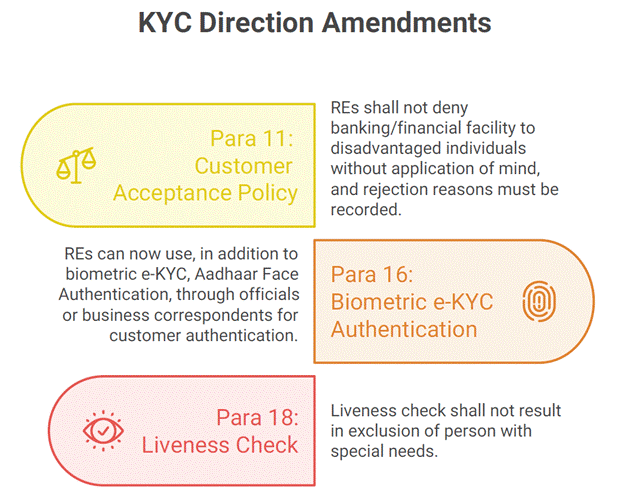
- Cannot reject PwD applications without proper human consideration, must record reasons for rejection. Banks and NBFCs may appoint a designated officer who shall be empowered to override automated rejections and approve applications on a case-by-case basis (SC directive xvi and KYC 2nd Amendment to Para 11 of the KYC Directions).
- In the process of customer due diligence, REs can accept Aadhaar Face Authentication as valid method for Authentication ( KYC 2nd Amendment to Para 16 of the KYC Directions).
- During the V-CIP process, REs cannot rely solely on eye-blinking for liveness verification. They must ensure liveness checks do not exclude persons with special needs. For this purpose, the officials of banks or NBFCs may ask varied questions to establish the liveness of the customer (KYC 2nd Amendment to Para 18(b)(i)).
Changes to the KYC Directions
Changes have been introduced in the KYC Directions via the KYC 2nd Amendment as a result of the SC verdict, these are captured in the diagram:
Implementation Plan
Based on the Supreme Court directive in Pragya Prasun & Ors. vs Union of India and the subsequent RBI notification, here is a comprehensive stage-wise action plan for implementing digital accessibility requirements for banks and NBFCs:
Phase 1: Immediate Compliance and Assessment
Actionables for REs under phase 1 are listed below:
- Stage 1.1: Current State Assessment
- Inventory all client facing platforms like digital platforms, mobile apps, websites, and KYC systems;
- Document current accessibility barriers and non-compliant features and identify high-risk areas requiring immediate attention.
- Stage 1.2: Policy Framework Development
- Amend the KYC Policy to incorporate accessibility clauses for PwD;
- Update existing KYC Policy to incorporate paper based KYC other than video based KYC (provided such verification methods shall not result in any discomfort to the applicant); and
- Make necessary changes to internal documents and SOPs to include disability-inclusive customer service protocols.
Phase 2: Technical Foundation and Alternative Methods
Actionables for REs under phase 2 are listed below:
- Stage 2.1: Alternative KYC Methods Implementation
- Implement alternative means of liveness detection other than blinking of an eye such as:
- Gesture-based verification (beyond eye blinking);
- Facial movement detection;
- Audio-based liveness checks; or
- Any other method feasible to the RE
- Provide notices regarding the alternative methods of KYC that the RE supports/provides to PwD
- In case of biometric based e-KYC verification, accept thumb impressions or AADHAAR face authentication or any other biometric alternatives.
- In case of paper-based KYC, strengthen offline processes as accessible alternatives in such a manner that the same shall not cause any discomfort to the applicant.
- Remove mandatory blinking requirements in video KYC.
- Implement alternative means of liveness detection other than blinking of an eye such as:
- Stage 2.2: Technical Infrastructure Updates
- Ensure that all digital platforms of the RE meet the accessibility standards for ICT Products and Services as notified by Bureau of Indian Standards
- Ensure that assistive technology is integrated into the current systems such as screen reader compatibility, voice navigation, etc.
- Stage 2.3: Data Capture Enhancements
- Modify KYC templates in such a way to add disability fields(type and percentage) to be able to serve better to the applicants
- Update database to capture disability-related information (including preferred communication and customer authentication methods) for appropriate service delivery
Phase 3: Process Redesign and Human Support
Actionables for REs under phase 3 are listed below:
- Stage 3.1: Human-Assisted Channels
- Establish dedicated helpline for PwD offering step-by-step assistance in completing the KYC process through voice or video support;
- Conduct staff sensitization and disability awareness programs across all offices/branches
- Authorise/allow support from nominated guardians/family members to assist in the KYC process
- In case of persons dependent on sign languages, video calling service with certified interpreters shall be provided
- Stage 3.2: Grievance Mechanism Setup
- May develop dedicated accessibility complaints system for disability-related issues
- Ensure manual assessment of rejected KYC applications
- Establish clear timelines and accountability for redressal of grievances
- Stage 3.3: Alternative Service Delivery
- Train BCs/agents for disability-inclusive KYC assistance
- Doorstep customer authentication for severely disabled applicants, provided that such facility shall not cause any discomfort to the applicant
Phase 4: Testing and Validation
Actionables for REs under phase 4 are listed below:
- Stage 4.1: User Acceptance Testing
- May involve PwD in testing phases
- Ensure a diverse disability testing- cover visual, hearing, physical, and cognitive impairments
- Ensure testing the complete customer journey from onboarding to service access
- Document and address all accessibility issues through feedback integration
- Stage 4.2: Third-Party Validation
- Engage an IAAP certified professional for conducting the accessibility audit
- Conduct security assessment of alternative authentication methods
Phase 5: Training and Capacity Building
Actionables for REs under phase 5 are listed below:
- Stage 5.1: Staff Development Programs
- Create comprehensive training modules for disability awareness and sensitivity, alternative KYC procedures, assistive technology usage, customer service best practices, etc.
- Conduct customized programs for different staff categories and ongoing skill development
- Stage 5.2: Vendor and Partner Training
- Ensure external partners such as BCs, tech-cendors, third-party service providers, etc. understand accessibility requirements
Phase 6 : Continuous Improvement and Compliance
Actionables for REs under phase 6 are listed below:
- Define the frequency of the accessibility audit and ensure that the audit is conducted on a regular basis (as per the decided frequency)
- Submit compliance status/plan of implementation to RBI as and when required
Closing Remarks
The Supreme Court’s judgment in the Pragya Prasun case elevates digital accessibility from a moral imperative to a constitutional mandate. Banks and NBFCs must view this not as a burden but as an opportunity to transform compliance into competitive advantage by becoming an accessibility leader.
[1] List of Empanelled Web Accessibility Auditors with Department of Empowerment of Persons with Disabilities, Ministry of Social Justice & Empowerment, Govt. of India.
Read More: Resources on KYC
FAQs on Co-lending Directions, 2025
Team Finserv (finserv@vinodkothari.com)
 Loading…

 Reload document
  Open in new tab
 Other Resources:
Bond Credit Enhancement Framework: Competitive, rational, reasonable
The RBI’s framework for partial credit enhancement for bonds has significant improvements over the last 2015 version
The RBI has released a new comprehensive framework for non-fund based support, including guarantees, co-acceptances, as well as partial credit enhancement (PCE) for bonds. The guidelines with respect to non-fund based facilities other than PCE are not applicable on NBFCs. The PCE framework has been significantly revamped, over its earlier 2015 version.
Note that PCE for corporate bonds was mentioned in the FM’s Budget 20251, specifically indicating the setting up of a PCE facility under the National Bank for Financing of Infrastructural Development (NaBFID).nd
The highlights of the new PCE framework are:

What is PCE?
Partial Credit Enhancement (PCE) is a risk-mitigating financial tool where a third party provides limited financial backing to improve the creditworthiness of a debt instrument. Provision of wrap or credit support for bonds is quite a common practice globally.
PCE is a contingent liquidity facility – it allows the bond issuer to draw upon the PCE provider to service the bond. For example, if a coupon payment of a bond is due and the issuer has difficulty in servicing the same, the issuer may tap the PCE facility and do the servicing. The amount so tapped becomes the liability of the issuer to the PCE provider, of course, subordinated to the bondholders. In this sense, the PCE facility is a contingent line of credit.
A situation of inability may arise at the time of eventual redemption of the bonds too – at that stage as well, the issuer may draw upon the PCE facility.
Since the credit support is partial and not total, the maximum claim of the bond issuer against the PCE provider is limited to the extent of guarantee – if there is a 20% guarantee, only 20% of the bond size may be drawn by the issuer. If the facility is revolving in nature, this 20% may refer to the maximum amount tapped at any point of time.
Given that bond defaults are quite often triggered by timing and not the eventual failure of the bond issuer, a PCE facility provides a great avenue for avoiding default and consequential downgrade. PCE provides a liquidity window, allowing the issuer to arrange liquidity in the meantime.
Who can be the guarantee provider?
PCE under the earlier framework could have been given by banks. The ambit of guarantee providers has been expanded to include SCBs, AIFIs, NBFCs in Top, Upper and Middle Layers and HFCs.
As may be known, entities such as NABFID have been tasked with promoting bond markets by giving credit support.
Who may be the bond issuers?
The PCE can be extended against bonds issued by corporates /special purpose vehicles (SPVs) for funding all types of projects and to bonds issued by Non-deposit taking NBFCs with asset size of ₹1,000 crore and above registered with RBI (including HFCs).
What are the key features of the bonds?
- REs may offer PCE only in respect of bonds whose pre-enhanced rating is “BBB minus” or better.
- REs shall not invest in corporate bonds which are credit enhanced by other REs. They may, however, provide other need based credit facilities (funded and/ or non-funded) to the corporate/ SPV.
- To be eligible for PCE, corporate bonds shall be rated by a minimum of two external credit rating agencies at all times.
- Further, additional conditions for providing PCE to bonds issued by NBFCs and HFCs:
- The tenor of the bond issued by NBFCs/ HFCs for which PCE is provided shall not be less than three years.
- The proceeds from the bonds backed by PCE from REs shall only be utilized for refinancing the existing debt of the NBFCs/ HFCs. Further, REs shall introduce appropriate mechanisms to monitor and ensure that the end-use condition is met.
What will be the form of PCE?
PCE shall be provided in the form of an irrevocable contingent line of credit (LOC) which will be drawn in case of shortfall in cash flows for servicing the bonds and thereby may improve the credit rating of the bond issue. The contingent facility may, at the discretion of the PCE providing RE, be made available as a revolving facility. Further, PCE cannot be provided by way of guarantee.
What is the difference between a guarantee and an LOC? If a guarantor is called upon to make payments for a beneficiary, the guarantor steps into the shoes of the creditor, and has the same claim against the beneficiary as the original creditor. For example, if a guarantor makes a payment for a bond issuer’s obligations, the guarantor will have the same rights as the bondholders (security, priority, etc). On the contrary, the LOC is simply a line of liquidity, and explicitly, the claims of the LOC provider are subordinated to the claims of the bondholders.
If the bond partly amortises, is the amount of the PCE proportionately reduced? This should not be so. In fact, the PCE facility continues till the amortisation of the bonds in full. It is quite natural to expect that the defaults by a bond issuer may be back-heavy. For example, if there is a 20% PCE, it may have to be used for making the last tranche of redemption of the bonds. Therefore, the liability of the PCE provider will come down only when the outstanding obligation of the bond issuer comes to less than the size of the PCE.
Any limits or restrictions on the quantum of PCE by a single RE?
The previous PCE framework restricted a single entity to providing only 20% of the total 50% PCE limit for a bond issuance. The sub-limit of 20% has now been removed, enabling single entity to provide upto 50% PCE support.
Further, the exposure of an RE by way of PCEs to bonds issued by an NBFC/ HFC shall be restricted to one percent of capital funds of the RE, within the extant single/ group borrower exposure limits.
Who can invest in credit-enhanced bonds?
Under the earlier framework, only the entities providing PCE were restricted from investing in the bonds they had credit-enhanced. However, the new Directions expand this restriction by prohibiting all REs from investing in bonds that have been credit-enhanced through a PCE, regardless of whether they are the PCE provider. The new regulations state that the same is with an intent to promote REs enabling wider investor participation.
This is, in fact, a major point that may need the attention of the regulator. A universal bar on all REs from investing in bonds which are wrapped by a PCE is neither desirable, nor optimal. Most bond placements are done by REs, and REs may have to warehouse the bonds. In addition, the treasuries of many REs make opportunistic investments in bonds.
Take, for instance, bonds credit enhanced by NABFID. The whole purpose of NABFID is to permit bonds to be issued by infrastructure sector entities, by which banks who may have extended funding will get an exit. But the treasuries of the very same banks may want to invest in the bonds, once the bonds have the backing of NABFID support. There is no reason why, for the sake of wider participation, investment by regulated entities should be barred. This is particularly at the present stage of India’s bond markets, where the markets are not liquid and mature enough to attract retail participation.
What is the impact on capital computation?
Under the new Directions the capital is required to be maintained by the REs providing PCE based on the PCE amount based on applicable risk weight to the pre-enhanced rating of the bond. Under the earlier framework, the capital was computed so as to be equal to the difference between the capital required on bond before credit enhancement and the capital required on bond after credit enhancement. That is, the earlier framework ensured that the PCE does not result into a capital release on a system-wide basis. This was not a logical provision, and we at VKC have made this point on various occasions2.
Round-Tripping Reined: RBI Rolls Out Relaxed Rules for Investments in AIFs
-Sikha Bansal, Senior Associate & Harshita Malik, Executive | finserv@vinodkothari.com
Background
The RBI’s regulatory approach to investments by Regulated Entities (REs) in Alternate Investment Funds (AIFs) has undergone a remarkable transformation over the past two years. Initially, the RBI responded to the risks of “evergreening”, where banks and NBFCs could mask bad loans by routing fresh funds to existing debtor companies via AIF structures, by issuing stringent circulars in December 20231 and March 20242 (collectively known as ‘Previous Circulars’). The December 2023 circular imposed a blanket ban on RE investments in AIFs that had downstream exposures to debtor companies, while the March 2024 clarification excluded pure equity investments (not hybrid ones) from this restriction. This stance aimed to strengthen asset quality but quickly highlighted significant operational and market challenges for institutional investors and the AIF ecosystem. Many leading banks took significant provisioning losses, as the Circulars required lenders to dispose off the AIF investments; clearly, there was no such secondary market.
In response to the feedback from the financial sector, as well as evolving oversight by other regulators like SEBI, the RBI undertook a comprehensive review of its framework and issued Draft Directions- Investment by Regulated Entities in Alternate Investment Funds (‘Draft Directions’) on May 19, 20253. The Draft Directions have now been finalised as Reserve Bank of India (Investment in AIF) Directions, 2025 (‘Final Directions’) on 29th May, 2025. The Final Directions shift away from outright prohibitions and instead introduce a carefully balanced regime of prudential limits, targeted provisioning requirements, and enhanced governance standards.
Comparison at a Glance
A compressed comparison between Previous Circulars and Final Directions is as follows –
| Particulars | Previous Circulars | Final Directions | Intent/Implication |
|---|---|---|---|
| Blanket Ban | Blanket ban on RE investments in AIFs lending to debtor companies (except equity) | No outright ban; investments allowed with limits, provisioning, and other prudential controls | Move from a complete prohibition to a limit-based regime. Max. Exposures as defined (see below) taken as prudential limits |
| Definition of debtor company | Only equity shares excluded for the purpose of reckoning “investment” exposure of RE in the debtor company | Equity shares, CCPSs, CCDs (collectively, equity instruments) excluded | Therefore, if RE has made investments in convertible equity, it will be considered as an investment exposure in the counterparty – thereby, the directions become inapplicable in all such cases. |
| Individual Investment Limit in any AIF scheme | Not applicable (ban in place) | Max 10% of AIF corpus by a single RE, subject to a max. of 5% in case of an AIF, which has downstream investments in a debtor company of RE. | Controls individual exposure risk. Lower threshold in cases where AIF has downstream investments. |
| Collective Investment Limit by all REs in any AIF scheme | Not applicable | Max 20%4 of AIF corpus across all REs | Would require monitoring at the scheme level itself. |
| Downstream investments by AIF in the nature of equity or convertible equity | Equity shares were excluded, but hybrid instruments were not. | All equity instruments | Exclusions from downstream investments widened to include convertible equity as well. Therefore, if the scheme has invested in any equity instruments of the debtor company, the Circular does not hit the RE. |
| Provisioning | 100% provisioning to the extent of investment by the RE in the AIF scheme which is further invested by the AIF in the debtor company, and not on the entire investment of the RE in the AIF scheme or 30-day liquidation, if breach | If >5% in AIF with exposure to debtor, 100% provision on look-through exposure, capped at RE’s direct exposure5 (see illustrations below) | No impact vis-a-vis Previous Circulars. For provisioning requirements, see illustrations later. |
| Subordinated Units/Capital | Equal Tier I/II deduction for subordinated units with a priority distribution model | Entire investment deducted proportionately from Tier 1 and Tier 2 capital proportionately | Adjustments from Tier I and II, now to be done proportionately, instead of equally. |
| Investment Policy | Not emphasized | Mandatory board-approved6 investment policy for AIF investments | One of the actionables on the part of REs – their investment policies should now have suitable provisions around investments in AIFs keeping in view provisions of these Directions |
| Exemptions | No specific exemption. However, Investments by REs in AIFs through intermediaries such as fund of funds or mutual funds were excluded from the scope of circulars. | Prior RBI-approved investments exempt; Government notified AIFs may be exempt | Provides operational flexibility and recognizes pre-approved or strategic investments.No specific mention of investments through MFs/FoFs – however, given the nature of these funds, we are of the view that such exclusion would continue. |
| Transition/Legacy Treatment | Not applicable | Legacy investments may choose to follow old or new rules | See discussion later. |
Key Takeaways:

Detailed analysis on certain aspects of the Final Directions is as follows:
Prudential Limits
Under the Previous Circulars, any downstream exposure by an AIF to a regulated entity’s debtor company, regardless of size, triggered a blanket prohibition on RE investments. The Final Directions replace this blanket ban with prudential limits:
- 10% Individual Limit: No single RE can invest more than 10% of any AIF scheme’s corpus.
- 20% Collective Limit: All REs combined cannot exceed 20% of any AIF scheme’s corpus; and
- 5% Specific Limit: Special provisioning requirements apply when an RE’s investment exceeds 5% of an AIF’s corpus, which has made downstream investments in a debtor company.
Therefore, if an AIF has existing investments in a debtor company (which has loan/investment exposures from an RE), the RE cannot invest more than 5% in the scheme. But what happens in a scenario where RE already has a 10% exposure in an AIF and the AIF does a downstream investment (in forms other than equity instruments) in a debtor company? Practically speaking, AIF cannot ask every time it invests in a company whether a particular RE has exposure to that company or not. In such a case, as a consequence of such downstream investment, RE may either have to liquidate its investments, or make provisioning in accordance with the Final Directions. Hence, in practice, given the complexities involved, it appears that REs will have to conservatively keep AIF stakes at or below 5% to avoid the consequences as above.
Now, consider a scenario – where the investee AIF invests in a company (which is not a debtor company of RE), which in turn, invests in the debtor company. Will the restrictions still apply? In our view, it is a well-established principle that substance prevails over form. If a clear nexus could be established between two transactions – first being investment by AIF in the intermediate company, and second being routing of funds from intermediate company to debtor company, it would clearly tantamount to circumventing the provisions. Hence, the provisioning norms would still kick-in.
Provisioning Requirements
Coming to the provisioning part, the Final Directions require REs to make 100 per cent provision to the extent of its proportionate investment in the debtor company through the AIF Scheme, subject to a maximum of its direct loan and/ or investment exposure to the debtor company, if the REs exposure to an AIF exceeds 5% and that AIF has exposure to its debtor company. The requirement is quite obvious – RE cannot be required to create provisioning in its books more than the exposure on the debtor company as it stands in the RE’s books.
The provisioning requirements can be understood with the help of the following illustrations:
| Scenario | Illustration | Extent of provisioning required |
|---|---|---|
| Existing investment of RE in AIF Scheme (direct loan and/or investment exposure exists as on date or in the past 12 months) | For example, an RE has a loan exposure of 10 cr on a debtor company and the RE makes an investment of 60 cr in an AIF (which has a corpus of 800 cr), the RE’s share in the corpus of the AIF turns out to be 7.5%. The AIF further invested 200 cr in the debtor company of the RE. | The proportionate share of the RE in the investment of AIF in the debtor company comes out to be 15 cr (7.5% of 200 cr). However, the RE’s loan exposure is 10 crores only. Therefore, provisioning is required to the extent of Rs. 10 crores. |
| Existing investment of RE in AIF Scheme (direct loan and/or investment exposure does not exist as on date or in the past 12 months) | Facts being same as above, in such a scenario, the provisioning requirement shall be minimum of the following two:-15 cr(full provisioning of the proportionate exposure); or-0 (full provisioning subject to the REs direct loan exposure in the debtor company) | Therefore, if direct exposure=0, then the minimum=0 and hence no requirement to create provision. |
Some possible measures which REs can adopt to ensure compliance are as follows:
- Maintain an up-to-date, board-approved AIF investment policy aligned with both RBI and SEBI rules;
- Implement robust internal systems for real-time tracking of all AIF investments and debtor exposures (including the 12-month history);
- Require regular, detailed portfolio disclosures from AIF managers;
- appropriate monitoring and automated alerts for nearing the 5%/10%/20% thresholds; and
- Establish suitable escalation procedures for potential breaches or ambiguities.
Further, it shall be noted that the intent is NOT to bar REs from ever investing more than 5% in AIFs. The cap is soft, provisioning is only required if there is a debtor company overlap. But the practical effect is, unless AIFs develop robust real-time reporting/disclosure and REs set up systems to track (and predict) debtor overlap, 5% becomes a limit for specifically the large-scale REs for practical purposes.
Investment Policy
The Final Directions call for framing and implementing an investment policy (amending if already exists) which shall have suitable provisions governing its investments in an AIF Scheme, compliant with extant law and regulations. Para 5 of the Final Directions does not mandate board approval of that policy, however, Para 29 of the RBI’s Master Directions on Scale Based Regulations stipulates that any investment policy must be formally approved by the Board. In light of this broader governance requirement, it is our view that an RE’s AIF investment policy should similarly receive Board approval. Below is a tentative list of key elements to be included in the investment policy:
- Limits: 10% individual, 20% collective, with 5% threshold alerts;
- Provision for real-time 12-month debtor-exposure monitoring and pre-investment checks;
- Clear provisioning methodology: 100% look-through at >5%, capped by direct exposure; proportional Tier-1/Tier-2 deduction for subordinated units; and
- Approval procedures for making/continuing with AIF investments; decision-making process
- Applicability of the provisions of these Directions on investments made pursuant to commitments existing on or before the effective date of these Directions.
Subordinated Units Treatment
Under the Final Directions, investments by REs in the subordinated units7 of any AIF scheme must now be fully deducted from their capital funds, proportionately from Tier I and Tier II as against equal deduction under the Previous Circulars. While the March 2024 Circular clarified that reference to investment in subordinated units of AIF Scheme includes all forms of subordinated exposures, including investment in the nature of sponsor units; the same has not been clarified under the Final Directions. However, the scope remains the same in our view.
What happens to positions that already exist when the Final Directions arrive?
As regards effective date, Final Directions shall come into effect from January 1, 2026 or any such earlier date as may be decided as per their internal policy by the REs.
Although, under the Final Directions, the Previous Circulars are formally repealed, the Final Directions has prescribed the following transition mechanism:
| Time of making Investments by RE in AIF | Permissible treatment under Final Directions |
| New commitments (post-effective date) | Must comply with the new directions; no grandfathering or mixed approaches allowed |
| Existing Investments | Where past commitments fully honoured: Continue under old circulars |
| Partially drawn commitments: One-time choice between old and new regimes |
Closing Remarks
The RBI’s evolution from blanket prohibitions to calibrated risk-based oversight in AIF investments represents a mature regulatory approach that balances systemic stability with market development, and provides for enhanced governance standards while maintaining robust safeguards against evergreening and regulatory arbitrage.
Of course, there would be certain unavoidable side-effects, e.g. significant operational and compliance burdens on REs, requiring sophisticated real-time monitoring systems, comprehensive debtor exposure tracking, board-approved investment policies, and enhanced coordination with AIF managers. Hence, there can be some challenges to practical implementation. Further, the success of this recalibrated regime will largely depend on the operational readiness of both REs and AIFs to develop transparent monitoring systems and proactive compliance frameworks.
- https://vinodkothari.com/2023/12/rbi-bars-lenders-investments-in-aifs-investing-in-their-borrowers/
↩︎ - https://vinodkothari.com/2024/03/some-relief-in-rbi-stance-on-lenders-round-tripping-investments-in-aifs/
↩︎ - https://vinodkothari.com/2025/05/capital-subject-to-caps-rbi-relaxes-norms-for-investment-by-res-in-aifs-subject-to-threshold-limits/ ↩︎
- The limit was 15% in the Draft Directions, the Final Directions increased the limit by 5 percentage points.
↩︎ - This cap at RE’s direct loan and/or investment exposure has been introduced in the Final Directions.
↩︎ - Para 29 of the RBI’s Master Directions on Scale Based Regulations stipulates that any investment policy must be formally approved by the Board.
↩︎ - SEBI, vide Master Circular for AIFs, had put restrictions on priority distribution model. Later, pursuant to Fifth Amendment to SEBI (AIF) Regulations, 2024, SEBI issued a Circular dated December 13, 2024 wherein certain exemptions were allowed and differential rights were allowed subject to certain conditions. See our article here. ↩︎
Let them pledge but don’t make it count: RBI’s clarification on voluntary pledge
Harshita Malik | finserv@vinodkothari.com

The Banking Puzzle
I was giving a collateral-free loan only, but the borrower didn’t agree – he voluntarily came and pledged family gold and silver jewellery!
This is perhaps the way Banks will be reacting after the RBI Clarificatory circular on Voluntary Pledge of Gold (‘Voluntary Pledge Circular’). The Voluntary Pledge Circular dated July 11, 2025 which addresses all Scheduled Commercial Banks (including RRBs & SFBs), State Co-operative Banks, District Central Co-operative Banks states that a a voluntary pledge of gold or silver as collateral by a borrower for an agricultural or MSME loan shall not amount to a violation of the Reserve Bank of India (Lending Against Gold and Silver Collateral) Directions, 2025 (‘Gold Lending Directions’), provided that the sanctioned amount is within the collateral-free limit laid down in the earlier RBI guidelines.
It may be noted that as per separate RBI circulars dated December 6, 2024 and July 24, 2017 farm lending upto Rs. 2 lacs and MSE lending upto Rs. 10 lacs shall be done without collateral.
This clarification by the regulator may enable lenders to circumvent the regulations by categorizing collateral as a voluntary pledge for loans within the collateral-free caps, whereas in reality, the borrower may have been directly or indirectly compelled to offer such collateral.
Further, the circular also makes reference to the Gold Lending Directions. A question may arise if the Gold Lending Directions will apply even in the case of voluntary pledge of gold.
The Gold Lending Directions should apply in all such cases of voluntary pledges to avoid a situation of regulatory arbitrage, where lenders could potentially bypass regulatory guidelines merely by categorizing the pledge as voluntary.
Our resources on the topic-
- Bank-NBFC Partnerships for Priority Sector Lending: Impact of New Directions – Vinod Kothari Consultants
- RBI revises Priority Sector Lending Norms
- Meeting priority sector lending shortfalls: One more option
- PSL guidelines reviewed for wider credit penetration
- The new PSL Master Direction and its Impact on NBFCs
Overview of RBI (Project Finance) Directions, 2025
Link to the YouTube video – https://www.youtube.com/watch?v=uCbe66Amk9w
Our article on the RBI (Project Finance) Directions, 2025