
AT1 bonds: blessed with perpetuity or cursed with mortality?: Will Yes Bank write-off sensitise investors to risks of AT1 bonds?

-Financial Services Division

(finserv@vinodkothari.com)

Introduction

In the Yes Bank restructuring proposed by the RBI[1], equity shareholders will not lose all their money, depositors, hopefully, will be fully protected, and other creditors may also sail safe. However, the first casualty is the investors in AT1 bonds, as the same have been fully written off. The returns on AT1 bonds are much lower than those on equity, and only a shade higher than those on Tier 2 bonds; however, in terms of being under the guillotine, they have come even ahead of equity. Sometimes, the risks of investing in an instrument are not understood until there is a casualty. Will the market now become jittery in AT1 investing? Will the cost of AT1 investing go up significantly, so that banks will have to cough up higher servicing costs as they raise AT1 bonds, as compared to Tier 2 bonds, unsecured bonds or secured bonds?

The article discusses the basic features of AT1 bonds and then gets into the impact of the Yes Bank write off on the market for AT1 bonds in India.

Concept of AT1 Bonds

The concept of Additional Tier-1 (AT1) Bonds was introduced by Basel III post the 2008 financial crisis, to protect depositors of a bank on a going concern basis. These bonds are also commonly known as Contingent convertible capital instruments (CoCos)[2]. AT1 or perpetual bonds are quasi debt instruments, which do not have any fixed maturity period. It bears higher risk compared with normal bonds. They are perpetuals as they do not have a redemption date, and are callable at the initiative of the issuer after a minimum period of five years. However, regulators may permit the exercise of call options within the first five years if it can be established that the bank was not in a position to anticipate the event at issuance.

If an issuing bank incurs losses in a financial year, it cannot make coupon payment to its bond holders even if it has enough cash. Further, the essential element of this instrument is that they are hybrid capital securities that absorb losses in accordance with their contractual terms when the capital of the issuing bank falls below a certain level. That is to say, in case the Common Equity Tier-1 (CET 1) ratio falls below a threshold level, the holders of such bonds shall bear the losses without the bank being liquidated.

As per the Basel III requirement, the terms and conditions of AT1 bonds must have a provision that requires such instruments, at the option of the relevant authority, to either be written off or converted into common equity upon the occurrence of the trigger event. Paragraph 55 of Basel III norms provide comprehensive criterions for an instrument to be included in Additional Tier 1 Capital. The relevant extract is reproduced herein below:

Instruments issued by the bank that meet the Additional Tier 1 criteria

  1. The following box sets out the minimum set of criteria for an instrument issued by the bank to meet or exceed in order for it to be included in Additional Tier 1 capital.
Criteria for inclusion in Additional Tier 1 capital
1.        Issued and paid-in
2.        Subordinated to depositors, general creditors and subordinated debt of the bank
3.        Is neither secured nor covered by a guarantee of the issuer or related entity or other arrangement that legally or economically enhances the seniority of the claim vis-à-vis bank creditors
4.        Is perpetual, i.e. there is no maturity date and there are no step-ups or other incentives to redeem
5.        May be callable at the initiative of the issuer only after a minimum of five years:

a.      To exercise a call option a bank must receive prior supervisory approval; and

b.      A bank must not do anything which creates an expectation that the call will be exercised; and

c.      Banks must not exercise a call unless:

                          i.    They replace the called instrument with capital of the same or better quality and the replacement of this capital is done at conditions which are sustainable for the income capacity of the bank[3]; or

                        ii.    The bank demonstrates that its capital position is well above the minimum capital requirements after the call option is exercised.[4]

6.        Any repayment of principal (eg. through repurchase or redemption) must be with prior supervisory approval and banks should not assume or create market expectations that supervisory approval will be given
7.        Dividend/coupon discretion:

a.      the bank must have full discretion at all times to cancel distributions/payments[5]

b.      cancellation of discretionary payments must not be an event of default

c.      banks must have full access to cancelled payments to meet obligations as they fall due

d.      cancellation of distributions/payments must not impose restrictions on the bank except in relation to distributions to common stockholders.

8.        Dividends/coupons must be paid out of distributable items
9.        The instrument cannot have a credit sensitive dividend feature, that is a dividend/coupon that is reset periodically based in whole or in part on the banking organisation’s credit standing.
10.     The instrument cannot contribute to liabilities exceeding assets if such a balance sheet test forms part of national insolvency law.
11.     Instruments classified as liabilities for accounting purposes must have principal loss absorption through either

(i)                conversion to common shares at an objective pre-specified trigger point or

(ii)              a write-down mechanism which allocates losses to the instrument at a pre-specified trigger point. The write-down will have the following effects:

a.    Reduce the claim of the instrument in liquidation;

b.    Reduce the amount re-paid when a call is exercised; and

c.    Partially or fully reduce coupon/dividend payments on the instrument.

12.     Neither the bank nor a related party over which the bank exercises control or significant influence can have purchased the instrument, nor can the bank directly or indirectly have funded the purchase of the instrument
13.     The instrument cannot have any features that hinder recapitalisation, such as provisions that require the issuer to compensate investors if a new instrument is issued at a lower price during a specified time frame
14.     If the instrument is not issued out of an operating entity or the holding company in the consolidated group (eg a special purpose vehicle – “SPV”), proceeds must be immediately available without limitation to an operating entity18 or the holding company in the consolidated group in a form which meets or exceeds all of the other criteria for inclusion in Additional Tier 1 capital

Incentive to issue AT1 Bonds

The foremost reasons for issuing AT1 Bonds is the fact that they satisfy the regulatory capital requirements. Most of the investors are private banks, mutual funds and retail investors, having a high risk appetite, while institutional investors are mostly restrained. Since the risk is higher, higher is the yield from these bonds. The rate of return is higher than those of higher-ranked debt instruments of the same issuer. It is dependent on their two factors – the trigger level and the loss absorption mechanism.

Priority order

The claims of the investors in AT1 Bonds and any interest accrued thereon is superior to the claims of investors in equity shares and perpetual non-cumulative preference shares, if any and any other securities that are subordinated to AT 1 Capital in terms of the Basel III Regulations.

However, the claims are subordinated to the claims of depositors, general creditors and any other securities of the issuer that are senior to AT 1 Capital of the Bank in terms of Basel III Regulations. Further, the stand pari passu without preference amongst themselves and other subordinated debt classified as AT1 Capital in terms of Basel III Regulations.

These bonds are neither secured nor covered by any guarantee of the issuer or any of its related entities or any other arrangement that legally or economically enhances the seniority of such claim as compared to the other creditors.

Rating of AT1 Bonds

AT1 Bonds issued by banks are usually rated by rating agencies as plain bonds even if the rating agency uses a tag ‘hybrid’.  However, they are assigned ratings as applicable for bonds. Earlier, the absence of a complete set of credit ratings for AT1 Bonds was a hurdle on its growth path. According to the S&P rating methodology, an AT1 Bond rating should be at least two to three notches below the issuer’s credit rating and cannot exceed BBB+[6]. Further downward notching is applied to instruments with triggers near or at the point of non-viability and to those that have a discretionary trigger. On average, given the higher risk, the rating for these bonds is one to four notches lower than the secured bond series of the same bank. For example, while SBI’s tier II bonds are rated AAA by CRISIL, its tier I long-term bonds are rated AA+.

Pricing and Yield

Though the risk is much more than a plain or any other structured bond, however, usually NBFCs and banks offer about 200-300 basis points higher than similar maturity debentures.

Since these bonds have no maturity date they can continue to pay the coupon forever. The issuer has the option to call back the bonds or repay the principal after a period of five years. While AAA rated tier II bond of a public sector bank may have an interest rate of around 7- 7.5% per annum, its AT1 Bond can carry a rate of around 9- 10% per annum. The attraction for investors is higher yield than secured bonds issued by the same entity. But along with the high yield there are certain risks as well; the option with issuer to skip coupon payment and maintaining a CET1 ratio of 5.125%, failing which the bonds can get written down or get converted into equity.

The pricing of AT1 Bonds is consistent with their position in banks’ capital structures. The main determinants of yields are the mechanical trigger level, the loss absorption mechanism, and the existence of a discretionary trigger.

Classification as AT1 Bonds

In some jurisdictions, the respective domestic law does not allow direct issuance of perpetual debt. There can be the following possible circumstances that may be eligible for recognition as AT 1 capital:

  • Dated instrument having terms and conditions that include an automatic roll-over feature,
  • Instruments with mandatory conversions into common shares on a pre-defined date,
  • Subordinated loans

Dated instruments that include automatic roll-over features are designed to appear as perpetual to the regulator and, simultaneously to appear as having a maturity to the tax authorities and/or legal system. This creates a risk that the automatic roll over could be subject to legal challenge and repayment at the maturity date could be enforced. As such, instruments with maturity dates and automatic roll-over features are not treated as perpetual.

An instrument may be treated as perpetual if it will mandatorily convert to common shares at a pre-defined date and has no original maturity date prior to conversion. However, if the mandatory conversion feature is combined with a call option (i.e. the mandatory conversion date and the call are simultaneous or near simultaneous), such that the bank can call the instrument to avoid conversion, the instrument will be treated as having an incentive to redeem and will not be permitted to be included in AT1 Capital.

Subordinated loans meeting all the criteria required for Additional Tier 1 or Tier 2 capital, can be included in the regulatory capital.

Write down and write-off

AT1 Bonds accounted for as liabilities are required to meet both the requirements for the point of non-viability and the principal loss absorbency requirements. To meet the point of non-viability trigger requirements, the instrument needs to be capable of being permanently written-off or converted to common shares at the trigger event. The trigger event is the earlier of[7]:

  • a decision that a write-off, without which the firm would become non-viable, is necessary, as determined by the relevant authority; and
  • the decision to make a public sector injection of capital, or equivalent support, without which the firm would have become non-viable, as determined by the relevant authority.
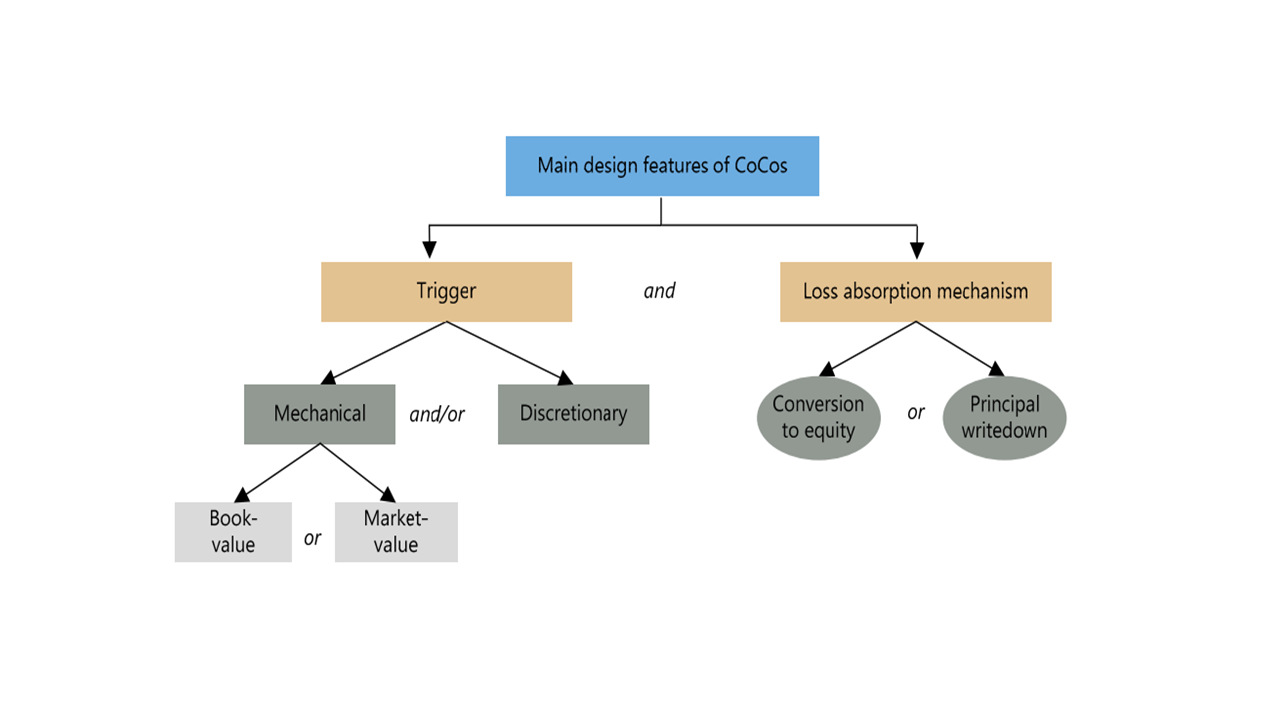
Source: CoCos: a primer

The write-down or conversion requirements for Additional Tier 1 instruments accounted for as liabilities, a temporary write-down mechanism is only permitted if it meets the following conditions:

  • The trigger level for write-down/conversion must be at least 5.125% Common Equity Tier 1 (CET1).
  • The write-down/conversion must generate CET1 under the relevant accounting standards and the instrument will only receive recognition in Additional Tier 1 up to the minimum level of CET1 generated by a full write-down/conversion of the instrument.
  • The aggregate amount to be written-down/converted for all such instruments on breaching the trigger level must be at least the amount needed to immediately return the bank’s CET1 ratio to the trigger level or, if this is not possible, the full principal value of the instruments.

Global scenario

AT1 bonds come with the basic feature of protecting the issuer from capital losses. When the issuer is in stress, these bonds extend a helping hand by absorbing the losses. For absorbing the losses, the issuer can either write-off, write-down or convert the AT1 bonds into equity. In fact, the terms of issue of AT1 bonds specifically provide for the method of absorbing losses. Following are a few examples of the methods of absorbing losses provided in the terms of issue of AT1 bonds:

  • Deutsche Bank intends of issue AT1 bonds in 2020[8], which would be subject to write-down provisions if its common equity tier 1 capital ratio will fall below 5.13%. as against 13.6% as of December 31, 2019. The securities are also subject to other loss-absorption features pursuant to the applicable capital rules.
  • Kookmin Bank issued CoCo Bonds in 2019[9] which can be written off in times of stress — with an interest rate of 4.35 per cent.

Companies have, in many instances, written-off or written-down AT1 bonds. Such as:

  • Erste has written-off billions of euros in AT1 bonds in 2014[10].
  • Bank of Jinzhou, in 2019[11], stopped paying coupon on its CoCo Bonds to protect its financial health.

Impact on Market for AT1 Bonds

Among the investors, mostly mutual funds and several individual investors, mostly high net worth individuals (HNIs), are exposed to Yes Bank issued AT 1 Bonds which are designed to absorb losses when the capital of the bank falls below certain levels. As of January 31, 2020, 11 mutual funds had exposure worth Rs 2,819 crore to bonds of the bank. Two schemes of Bank of Baroda Mutual Fund–Baroda Treasury Advantage Fund and Baroda Credit Risk Fund had investments worth Rs 53.69 crore in Tier 1 perpetual bonds of Yes Bank. UTI Mutual Fund holds investments worth nearly Rs 50 crore worth of holding in 9.5% perpetual bonds. Indiabulls Housing Finance had invested Rs 662 crore via AT1 Bonds. Several institutional investors are planning to come together to oppose the central bank’s proposal to write down Yes Bank’s perpetual bonds. Their main contention is that tier-I bonds are senior to equity, and cannot be written down without reducing equity.

Based on the information circulating in the market, the Information Memorandum (IM) of AT1 Bonds has provisions that in case there is a reconstitution or amalgamation of the bank under Sec 45 of Banking Regulation Act 1949, the bank will be deemed as non-viable and trigger for written-down / conversion of the AT1 Bonds will be activated. However, the IM sates it cannot be written down unless equity is also reduced.

AT1 bond holders are treated like equity holders. Hence repayment is not likely for these types of bonds. The Yes Bank scheme shall be an eye opener for the investors and is expected to adversely affect the market for AT1 Bonds. This is the first time ever in India that AT1 Bond investor got a hit on their investments. It is likely that the yield on such similar bonds would increase by around 200 basis points from existing levels.


[1] https://www.rbi.org.in/Scripts/BS_PressReleaseDisplay.aspx?prid=49479

[2] https://www.bis.org/publ/qtrpdf/r_qt1309f.pdf

[3] Replacement issues can be concurrent with but not after the instrument is called.

[4] Minimum refers to the regulator’s prescribed minimum requirement, which may be higher than the Basel III

Pillar 1 minimum requirement.

[5] A consequence of full discretion at all times to cancel distributions/payments is that “dividend pushers” are prohibited. An instrument with a dividend pusher obliges the issuing bank to make a dividend/coupon payment on the instrument if it has made a payment on another (typically more junior) capital instrument or share. This obligation is inconsistent with the requirement for full discretion at all times. Furthermore, the term “cancel distributions/payments” means extinguish these payments. It does not permit features that require the bank to make distributions/payments in kind.

[6] Standard & Poor’s (2011)

[7] https://www.bis.org/press/p110113.pdf

[8] https://finance.yahoo.com/news/deutsche-db-plans-offer-additional-131801196.html

[9] https://www.ft.com/content/523a5e62-9802-11e9-9573-ee5cbb98ed36

[10]https://www.washingtonpost.com/business/a-coco-bond-at-3375percent-the-markets-still-crazy/2020/01/23/7a9435ae-3db6-11ea-afe2-090eb37b60b1_story.html

[11] https://www.wsj.com/articles/ailing-chinese-bank-stops-paying-coupons-on-coco-bonds-11567424965

Majority of minority to ensure economic interest in transactions with related parties

SEBI’s proposal–came late, came correct

-CS Nitu Poddar, Tanvi Rastogi

corplaw@vinodkothari.com

Financial assistance to related entities is a quite a regular transaction. Considering the transfer of obligations, such transactions are subject to certain regulation under the Companies Act, 2013 (Act, 2013) and SEBI (Listing Obligations and Disclosure Requirements) Regulations, 2015 (LODR). However, despite the prohibitions and restrictions, there are several areas within the periphery of transactions with related parties which remain out of the ambit of law and therefore is beyond required checks. Following the proposal of changes in the provisions of RPT vide the report of the working group[1], SEBI has floated a consultative paper[2] on 06-03-2020 proposing certain changes to corporate guarantees being provided by a listed party on behalf of its promoter / promoter related entities, without deriving any economic benefit from such transaction.

In this article, we discuss the coverage of the current provisions, gap therein, need for the proposal and the proposed regime to bridge such gap.

Unrelated-related parties – remains unregulated

As compared to the Act, 2013, LODR has a wider definition of related party where it additionally covers related parties under AS-18 / IND AS-24 and also such member of promoter and promoter group which holds 20% of the total shareholding of the listed entity. Despite such wide definition, practically speaking, there may be several interested entities of the promoter which gets excluded from the technical criteria of being a related party due to absence of required shareholding and consequently transactions with them can easily sail through without being subject to required approvals. As such, currently, a listed entity can grant loan, give guarantee / security in connection of loan to / on behalf of an entity, which technically is not a related party, but either is a promoter or an entity in which the promoter has vested interest against the interest of stakeholders of the lending company.

Existing provisions regulating financial transactions

Currently, section 177, 185 and 186 of Act, 2013 are the major provisions governing any financial transactions. Section 188 of the Act, 2013, does not cover financial transaction within its coverage and therefore the same get ruled out anyway. Section 177 provides for scrutiny of inter-corporate loans as well as approval and modifications of all related party transactions. The challenge of this section are that firstly, transactions with interested unrelated party gets ruled out and   consequently the committee is left with the duty of a post mortem scrutiny and not a prior scanning of the transaction. Sec 186 provides for limits of financial transaction i.e giving of loan, investment, guarantee, security in connection with loan and also keeps a check on minimum rates to be charged in case of loan. Transactions beyond the limits require approval by special majority of the shareholders. Sec 185 talks about granting of loan to directors and director-interested entities. While there is complete prohibition of granting of such loan to the director himself or his relative / firm, loan can be granted to interested-companies, subject to approval by special majority of shareholders of the lender company.

To get such approval is not a tough task in a company with high promoter-holding, and the promoters can easily get their transaction through. Unlike sections 188 and 184 where the voting rights of the interested parties are restricted in the general meeting and board meeting respectively, section 185 and 186 does not provide for any such restrictions.

As per Reg 23 of LODR, related party transactions, which includes financial transactions as well, requires approval of shareholders by majority. This approval is by the majority of the minority as all entities falling under the definition of related parties cannot vote to approve the relevant transaction irrespective of whether the entity is a party to the particular transaction or not.

Proposed amendment – need and proposal 

It is to be noted that whenever there is a transaction with a promoter related entity, there may be a potential threat to the interest of the non-promoter group / minority shares. Accordingly, approval of the majority of such minority is to be essentially sought to ensure that the resources of the company are not been siphoned away / wrongly used / alienated by the promoters and that the interest of such minority is secured. As mentioned above, in the existing regime, question of approval from such majority of minority arise only for material RPTs under LODR.

Hence, all such transactions which does not fall under the category of “RPT” and / or “material” remains unguarded and thus putting the corporate governance of the company at stake.  SEBI, in its report on working group of RPT[3], has clearly put forward its intent to curb such influential transactions by the promoter / promoter group and to revise the definition of related party itself. Once the said proposal is made effective, all transactions with promoter / promoter group will be a RPT. However, inspite of such revision in the definition of RPT, only material transactions will require approval of minority shareholders.

Through the proposal in the consultative paper, SEBI intends to move a step ahead of what the working group discussed. SEBI now proposes to require all guarantee transactions, irrespective of the materiality to be approved by the majority of minority shareholders. Additionally, the directors of lending company are required to establish and record “economic interest” in granting of such guarantee.

Essence of voting by majority of minority

It is no approval, if the person seeking approval and granting approval is the same. In corporate democracy, approval is essentially ought to be sought from the class of people whose rights seem to be prejudiced from transaction proposed in the interest of another class. Reg 23 of LODR and sec 188 of Act, 2013 already recognises such majority of minority approval wherein all the related parties of the company refrain from voting.

Significance of “economic interest”

Any prudent mind would require risk and reward, benefit and burden to be shared proportionately. It is absolutely irrational to say that a listed company is extending guarantee / security in connection with loan but has no benefit in return.

It is to be noted that charging of guarantee commission or charging of interest is not to be misunderstood as presence of economic interest. There are charged only to keep the transaction at arm’s length. However, the exposure of the lender company is the amount of loan / amount guaranteed.

Few examples of embedded economic interest in a transaction can be as follows:

  1. A holding company extending loan to its wholly-owned subsidiary for funding acquisition of land for building of plant may be benefitted by the figures of such subsidiary at consolidated level;
  2. A listed company guaranteeing on behalf of another unrelated-related entity which is the customised raw material provider of the lending company

Different scenarios of financial transaction considering the proposal of SEBI:

S. No. Transaction between Existing provision Proposed amendment Analysis
1


Two unlisted companies Section 186 / 185, if  applicable Unlisted companies are not covered No Impact
2 Listed company with its related party – beyond materiality threshold Section 186 / 185, if  applicable and Reg 23- shareholders’ approval through resolution where no  related  party  shall  vote  to  approve Ensuring the economic interest + Prior  approval  from  the shareholders on a “majority of minority” basis Irrespective of the materiality, where there is any transfer of financial obligation, prior approval of unrelated shareholders will be required
3 Listed company with related party not within materiality threshold No requirement for shareholders’ approval Ensuring the economic interest + Prior  approval  from  the shareholders on a “majority of minority” basis Irrespective of the materiality, where there is any transfer of financial obligation, prior approval of unrelated shareholders will be required
4 Listed company with unrelated related party[4] No requirement prescribed under law

Open issues

  1. While the proposed amendment is absolutely on-point and timely amendment in the wake of several corporate scams in the recent past being witnessed by the country, however, it will achieve its intent if the same is not kept limited to guarantee / security in connection with loan, but also extended for granting of loan to such unrelated-related entities;
  2. Also, the list of entities is kept vague in the Paper (promoter(s)/ promoter group/ director / directors relative / KMP etc) and may be better clarified in the amendments, however, the intent seems to be quite clear to include any promoter / promoter group / management related entity;
  3. Lastly, it is not clear as to who should refrain from voting for majority of minority voting – all promoter / promoter group entities / all related parties of the listed entity;


[1] https://www.sebi.gov.in/reports-and-statistics/reports/jan-2020/report-of-the-working-group-on-related-party-transactions_45805.html

[2] https://www.sebi.gov.in/reports-and-statistics/reports/mar-2020/consultative-paper-with-respect-to-guarantees-provided-by-a-listed-company_46234.html

[3] SEBI Report on working group of RPT dated 27th January, 2020 ibid

[4] Includes promoters which may not fall under definition of related party – like promoter not holding any shareholding in the company

Read our article on proposed changes by working group of SEBI on Related Party Transactions here: https://vinodkothari.com/2020/01/expanding-the-web-of-control-over-related-party-transactions/

Read our articles on the topic of related party transactions here: https://vinodkothari.com/article-corner-on-related-party-transactions/

RESOLUTION VALUE MAY BE LOWER THAN LIQUIDATION VALUE?

-Richa Saraf

(richa@vinodkothari.com)

The Apex Court, vide its order dated 22.01.2020, in the matter of Maharasthra Seamless Limited vs. Padmanabhan Venkatesh & Ors.[1] held that there is no requirement that the resolution plan should match the maximized asset value of the corporate debtors. Reiterating the principle laid down in the case of Committee of Creditors of Essar Steel India Limited v. Satish Kumar Gupta[2], the Hon’ble Supreme Court held that once a resolution plan is approved by the committee of creditors (CoC), the Adjudicating Authority has limited power of judicial review.

The judgment of the Supreme Court boldly brings out the object of the Insolvency and Bankruptcy Code, 2016 (“Code”), i.e. “resolution before liquidation”. However, it will be pertinent to understand whether this ruling should be considered as a benchmark? Further, what will be the situation in case of liquidation? Whether sale under liquidation can be done for a value lower than the reserve price?

Below we analyse the ruling, seeking to answer the aforementioned questions.

Read more

Fintech Framework: Regulatory responses to financial innovation

Timothy Lopes, Executive, Vinod Kothari Consultants

finserv@vinodkothari.com

The world of financial services is continually witnessing a growth spree evidenced by new and innovative ways of providing financial services with the use of enabling technology. Financial services coupled with technology, more commonly referred to as ‘Fintech’, is the modern day trend for provision of financial services as opposed to the traditional methods prevalent in the industry.

Rapid advances in technology coupled with financial innovation with respect to delivery of financial services and inclusion gives rise to all forms of fintech enabled services such as digital banking, digital app-based lending, crowd funding, e-money or other electronic payment services, robo advice and crypto assets.

In India too, we are witnessing rapid increase in digital app-based lending, prepaid payment instruments and digital payments. The trend shows that even a cash driven economy like India is moving to digitisation wherein cash is merely used as a way to store value as an economic asset rather than to make payments.

“Cash is King, but Digital is Divine.”

  • Reserve Bank of India[1]

The Financial Stability Institute (‘FSI’), one of the bodies of the Bank for International Settlement issued a report titled “Policy responses to fintech: a cross country overview”[2] wherein different regulatory responses and policy changes to fintech were analysed after conducting a survey of 31 jurisdictions, which however, did not include India.

In this write up we try to analyse the various approaches taken by regulators of several jurisdictions to respond to the innovative world of fintech along with analysing the corresponding steps taken in the Indian fintech space.

The Conceptual Framework

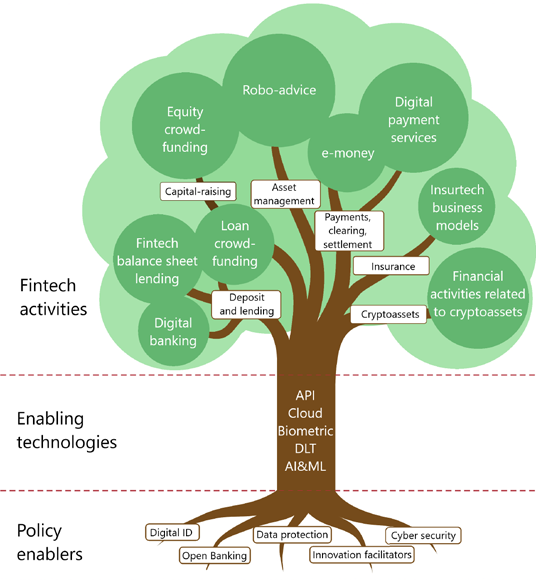
Let us first take a look at the conceptual framework revolving in the fintech environment. Various terminology or taxonomies used in the fintech space, are often used interchangeably across jurisdictions. The report by FSI gives a comprehensive overview of the conceptual framework through a fintech tree model, which characterises the fintech environment in three categories as shown in the figure.

Source: FSI report on Policy responses to fintech: a cross-country overview

Let us now discuss each of the fintech activities in detail along with the regulatory responses in India and across the globe.

Digital Banking –

This refers to normal banking activities delivered through electronic means which is the distinguishing factor from traditional banking activities. With the use of advanced technology, several new entities are being set up as digital banks that deliver deposit taking as well as lending activities through mobile based apps or other electronic modes, thereby eliminating the need for physically approaching a bank branch or even opening a bank branch at all. The idea is to deliver banking services ‘on the go’ with a user friendly interface.

Regulatory responses to digital banking –

The FSI survey reveals that most jurisdictions apply the existing banking laws and regulations to digital banking as well. Applicants with a fintech business model must go through the same licensing process as those applicants with a traditional banking business model.

Only a handful of jurisdictions, namely Hong Kong, SAR and Singapore, have put in place specific licensing regimes for digital banks. In the euro area, specific guidance is issued on how credit institution authorisation requirements would apply to applicants with new fintech business models.

Regulatory framework for digital banking in India –

In India, majority of the digital banking services are offered by traditional banks itself, mainly governed by the Payment and Settlement Systems Act, 2007[1], with RBI being the regulatory body overseeing its implementation. The services include, opening savings accounts online even through apps, facilitating instant transfer of funds through the use of innovative products such as the Unified Payments Interface (UPI), which is governed by the National Payments Corporation of India (NPCI), facilitating the use of virtual cards, prepaid payment instruments (PPI), etc. These services may be provided not only by traditional banks alone, but also by non-bank entities.

Fintech balance sheet lending

Typically refers to lending from the balance sheet and assuming the risk on to the balance sheet of the fintech entity. Investors’ money in the fintech entity is used to lend to customers which shows up as an asset on the balance sheet of the lending entity. This is the idea of balance sheet lending. This idea, when facilitated with technological innovation leads to fintech balance sheet lending.

Regulatory responses to fintech balance sheet lending –

As per the FSI survey, most jurisdictions do not have regulations that are specific to fintech balance sheet lending. In a few jurisdictions, the business of making loans requires a banking licence (eg Austria and Germany). In others, specific licensing regimes exist for non-banks that are in the business of granting loans without taking deposits. Only one of the surveyed jurisdictions has introduced a dedicated licensing regime for fintech balance sheet lending.

Regulatory regime in India –

The new age digital app based lending is rapidly advancing in India. With the regulatory framework for Non-Banking Financial Companies (NBFCs), the fintech balance sheet lending model is possible in India. However, this required a net owned fund of Rs. 2 crores and registration with RBI as an NBFC- Investment and Credit Company.

The digital app based lending model in India works as a partnership between a tech platform entity and an NBFC, wherein the tech platform entity (or fintech entity) manages the working of the app through the use of advanced technology to undertake credit appraisals, while the NBFC assumes the credit risk on its balance sheet by lending to the customers who use the app. We have covered this model in detail in a related write up[2].

Loan & Equity Crowd funding

Crowd funding refers to a platform that connects investors and entrepreneurs (equity crowd funding) and borrowers and lenders (loan crowd funding) through an internet based platform. Under equity crowd funding, the platform connects investors with companies looking to raise capital for their venture, whereas under loan crowd funding, the platform connects a borrower with a lender to match their requirements. The borrower and lender have a direct contract among them, with the platform merely facilitating the transaction.

Regulatory responses to crowd funding –

According to the FSI survey, many surveyed jurisdictions introduced fintech-specific regulations that apply to both loan and equity crowd funding considering the similar risks involved, shown in the table below. Around a third of surveyed jurisdictions have fintech-specific regulations exclusively for equity crowd funding. Only a few jurisdictions have a dedicated licensing regime exclusively for loan crowd funding. Often, crowd funding platforms need to be licensed or registered before they can perform crowd funding activities, and satisfy certain conditions.

Table showing regulatory regimes in various jurisdictions

Fintech-specific regulations for crowd funding
Equity Crowd Funding Equity and Loan Crowd Funding Loan Crowd Funding
Argentina           Columbia

Australia             Italy

Austria                Japan

Brazil                   Turkey

China                   United States

Belgium                Peru

Canada                 Philippines

Chile                      Singapore

European Union  Spain

France                   Sweden

Mexico                  UAE

Netherlands         UK

Australia

Brazil

China

Italy


Source: FSI Survey

Regulatory regime in India

  1. In case of equity crowd funding –

In 2014, securities market regulator SEBI issued a consultation paper on crowd funding in India[3], which mainly focused on equity crowd funding. However, there was no regulatory framework subsequently issued by SEBI which would govern equity crowd funding in India. At present crowd funding platforms in India have registered themselves as Alternative Investment Funds (AIFs) with SEBI to carry out fund raising activities.


  1. In case of loan crowd funding –

The scenario for loan crowd funding, is however, already in place. The RBI has issued the Non-Banking Financial Company – Peer to Peer Lending Platform (Reserve Bank) Directions, 2017[4] which govern loan crowd funding platforms. Peer to Peer Lending and loan crowd funding are terms used interchangeably. These platforms are required to maintain a net owned fund of not less than 20 million and get themselves registered with RBI to carry out P2P lending activities.


As per the Directions, the Platform cannot raise deposits or lend on its own or even provide any guarantee or credit enhancement among other restrictions. The idea is that the platform only acts as a facilitator without taking up the risk on its own balance sheet.

Robo- Advice

An algorithm based system that uses technology to offer advice to investors based on certain inputs, with minimal to no human intervention needed is known as robo-advice, which is one of the most popular fintech services among the investment advisory space.

Regulatory responses to robo-advice –

According to the FSI survey, in principle, robo- and traditional advisers receive the same regulatory treatment. Consequently, the majority of surveyed jurisdictions do not have fintech-specific regulations for providers of robo-advice. Around a third of surveyed jurisdictions have published guidance and set supervisory expectations on issues that are unique to robo-advice as compared to traditional financial advice. In the absence of robo-specific regulations, several authorities provide somewhat more general information on existing regulatory requirements.

Regulatory regime in India –

In India, there is no specific regulatory framework for those providing robo-advice. All investment advisers are governed by SEBI under the Investment Advisers Regulations, 2013[5]. Under the regulations every investment adviser would have to get themselves registered with SEBI after fulfilling the eligibility conditions. The SEBI regulations would also apply to those offering robo-advice to investors, as there is no specific restriction on using automated tools by investment advisers.

Digital payment services & e-money

Digital payment services refer to technology enabled electronic payments through different modes. For instance, debit cards, credit cards, internet banking, UPI, mobile wallets, etc. E-money on the other hand would mostly refer to prepaid instruments that facilitate payments electronically or through prepaid cards.

Regulatory responses to digital payment services & e-money –

As per the FSI survey, most surveyed jurisdictions have fintech-specific regulations for digital payment services. Some jurisdictions aim at facilitating the access of non-banks to the payments market. Some jurisdictions have put in place regulatory initiatives to strengthen requirements for non-banks.

Further, most surveyed jurisdictions have a dedicated regulatory framework for e-money services. Non-bank e-money providers are typically restricted from engaging in financial intermediation or other banking activities.

Regulatory regime in India –

The Payment and Settlement Systems Act, 2007 (PSS) of India governs the digital payments and e-money space in India. While several Master Directions are issued by the RBI governing prepaid payment instruments and other payment services, ultimately they draw power from the PSS Act alone. These directions govern both bank and non-bank players in the fintech space.

UPI being a fast mode of virtual payment is however governed by the NPCI which is a body of the RBI.

Other policy measures in India – The regulatory sandbox idea

Both RBI and SEBI have come out with a Regulatory Sandbox (RS) regime[6], wherein fintech companies can test their innovative products under a monitored and controlled environment while obtaining certain regulatory relaxations as the regulator may deem fit.  As per RBI, the objective of the RS is to foster responsible innovation in financial services, promote efficiency and bring benefit to consumers. The focus of the RS will be to encourage innovations intended for use in the Indian market in areas where:

  1. there is absence of governing regulations;
  2. there is a need to temporarily ease regulations for enabling the proposed innovation;
  3. the proposed innovation shows promise of easing/effecting delivery of financial services in a significant way.

RBI has already begun with the first cohort[7] of the RS, the theme of which is –

  • Mobile payments including feature phone based payment services;
  • Offline payment solutions; and
  • Contactless payments.

SEBI, however, has only recently issued the proposal of a regulatory sandbox on 17th February, 2020.

Conclusion

Technology has been advancing at a rapid pace, coupled with innovation in the financial services space. This rapid growth however should not be overlooked by regulators across the globe. Thus, there is a need for policy changes and regulatory intervention to simultaneously govern as well as promote fintech activities, as innovation will not wait for regulation.

While most of regulators around the globe have different approaches to governing the fintech space, the regulatory environment should be such that there is sufficient understanding of fintech business models to enable regulation to fit into such models, while also curbing any unethical activities or risks that may arise out of the fintech business.

[1] https://rbidocs.rbi.org.in/rdocs/Publications/PDFs/86706.pdf

[2] https://vinodkothari.com/2019/09/sharing-of-credit-information-to-fintech-companies-implications-of-rbi-bar/

[3] https://www.sebi.gov.in/sebi_data/attachdocs/1403005615257.pdf

[4] https://rbidocs.rbi.org.in/rdocs/notification/PDFs/MDP2PB9A1F7F3BDAC463EAF1EEE48A43F2F6C.PDF

[5] https://www.sebi.gov.in/legal/regulations/jan-2013/sebi-investment-advisers-regulations-2013-last-amended-on-december-08-2016-_34619.html

[6] https://www.rbi.org.in/Scripts/PublicationReportDetails.aspx?UrlPage=&ID=938

https://www.sebi.gov.in/media/press-releases/feb-2020/sebi-board-meeting_46013.html

[7] https://www.rbi.org.in/Scripts/BS_PressReleaseDisplay.aspx?prid=48550

[1] Assessment of the progress of digitisation from cash to electronic – https://www.rbi.org.in/Scripts/PublicationsView.aspx?id=19417

[2] https://www.bis.org/fsi/publ/insights23.pdf

Securitisation of performing assets: meaning of “homogenous pools”

Timothy Lopes, Executive, Vinod Kothari Consultants

finserv@vinodkothari.com

Standard asset securitisation in India is governed by the RBI securitisation guidelines of 2006[1] and 2012[2]. As one of the essential pre-requisites of a securitisation transaction, the underlying assets should represent the debt obligations of a ‘homogeneous pool’ of obligors. Subject to this condition of homogeneity, all on-balance sheet standard assets (except certain assets prescribed under the guidelines) are eligible for securitisation.

The question, then, arises as to what is the criteria for determining whether a pool of assets is homogeneous? In this write up we analyse the homogeneity criteria in the context of a securitisation transaction based on global understanding.

How is homogeneity assessed?

Basel III norms on Simple Transparent and Comparable (‘STC’) Securitisation transactions[3] lays down factors to be kept in mind while determining homogeneity as follows –

  • In simple, transparent and comparable securitisations, the assets underlying the securitisation should be credit claims or receivables that are homogeneous.
  • In assessing homogeneity, consideration should be given to –
    • Asset type,
    • Jurisdiction,
    • Legal system; and
    • Currency.
  • The nature of assets should be such that investors would not need to analyse and assess materially different legal and/or credit risk factors and risk profiles when carrying out risk analysis and due diligence checks.
  • Homogeneity should be assessed on the basis of common risk drivers, including similar risk factors and risk profiles.
  • Credit claims or receivables included in the securitisation should have standard obligations, in terms of rights to payments and/or income from assets and that result in a periodic and well-defined stream of payments to investors. Credit card facilities should be deemed to result in a periodic and well-defined stream of payments to investors for the purposes of this criterion.
  • Repayment of note-holders should mainly rely on the principal and interest proceeds from the securitised assets. Partial reliance on refinancing or re-sale of the asset securing the exposure may occur provided that re-financing is sufficiently distributed within the pool and the residual values on which the transaction relies are sufficiently low and that the reliance on refinancing is thus not substantial.

The basic intent behind a securitisation transaction is the tranching of risk. In order to tranche the risk, there must be similarity in terms of the risk attributes of the pool. If the risk is not homogeneous across different attributes of the pool the tranching of risk becomes difficult and defeats the intent of the transaction.

Further, the nature of assets in the pool must be homogenous. This means that the assets in the pool should be covered by similar legal risks or credit risks so that the investors need not analyse and assess materially different assets in a pool.

The EU Simple, Transparent and Standardised (‘STS’) securitisation Regulations[4] states the following–

“To ensure that investors perform robust due diligence and to facilitate the assessment of underlying risks, it is important that securitisation transactions are backed by pools of exposures that are homogenous in asset type, such as pools of residential loans, or pools of corporate loans, business property loans, leases and credit facilities to undertakings of the same category, or pools of auto loans and leases, or pools of credit facilities to individuals for personal, family or household consumption purposes.”

“The securitisation shall be backed by a pool of underlying exposures that are homogeneous in terms of asset type, taking into account the specific characteristics relating to the cash flows of the asset type including their contractual, credit-risk and prepayment characteristics. A pool of underlying exposures shall comprise only one asset type. The underlying exposures shall contain obligations that are contractually binding and enforceable, with full recourse to debtors and, where applicable, guarantors.”

Illustrations of a homogeneous pool

Whether a pool of comprising of commercial vehicles, trucks and tractors can be called homogeneous?

Prima facie the pool might appear to be homogeneous, however it is not so. The assets in this pool are different in terms of legal and credit risks. For instance, the credit risk arising out of a commercial vehicle loan and a tractor loan is far from similar, given the nature of the asset, value of assets and repayment power of the borrower of the asset, type of usage to which the asset.

Whether a pool of personal loans, business loans and loans against property can be called homogeneous?

The pool of loans would have to each be analysed individually given the material differences in their nature. Further the nature of collateral in each of these loans may be different leading to different risk attributes. Further it would have to be seen whether these loans have well defined stream of payments as well. Ultimately it is unlikely that this pool can be called homogeneous.

Conclusion

Homogeneity should be assessed from the viewpoint of risk attributes. There must be similarity in the nature of assets as well as collateral to ascertain homogeneity in terms of credit risks. Legal risks must also be analysed and should be homogeneous. These factors ultimately help investors in the due diligence process (while also making the transaction simple, transparent and comparable compliant) as well as make tranching of risks easier.

Read our related write ups on the subject of securitisation –

Basel III requirements for Simple Transparent and Comparable (STC) Securitisation –

https://vinodkothari.com/2020/01/basel-iii-requirements-for-simple-transparent-and-comparable-stc-securitisation/


[1] https://www.rbi.org.in/scripts/NotificationUser.aspx?Id=2723

[2] https://rbidocs.rbi.org.in/rdocs/notification/PDFs/C170RG21082012.pdf

[3] https://www.bis.org/bcbs/publ/d374.pdf

[4] https://eur-lex.europa.eu/legal-content/EN/TXT/PDF/?uri=CELEX:32017R2402&from=en

Regulated deposit takers: Whether need to intimate under BUDS?

Timothy Lopes, Executive, Vinod Kothari & Company

finserv@vinodkothari.com, corplaw@vinodkothari.com

Almost a year after the Banning of Unregulated Deposits Schemes Act, 2019[1] (BUDS Act/ Act) came into force, the Ministry of Finance has, vide notification dated 12th February, 2020, notified The Banning of Unregulated Deposits Schemes Rules, 2020[2] (BUDS Rules/ Rules).

The BUDS Act, was enacted with the intent to curb all unregulated deposits schemes being run by fraudulent means such as ponzi schemes. On the other hand, the BUDS Act lists out regulated deposit schemes, which are essentially regulated by MCA, SEBI, RBI, etc., such as collective investment schemes, alternative investment funds, portfolio management services, employee benefit schemes, mutual fund schemes, etc. regulated by SEBI; deposits accepted by NBFCs, etc. as regulated by RBI, insurance contracts regulated by IRDAI; schemes or arrangements made or offered by co-operative societies, chit funds, etc. regulated by the relevant State Government or Union Territory Government; housing finance companies regulated by the NHB; pension funds regulated by the PFRDA; pension schemes or insurance schemes framed under the Employees’ Provident Fund Miscellaneous Provisions Act, 1952; Deposits accepted or permitted under the provisions of Chapter V of the Companies Act, 2013 regulated by MCA.

The definition of deposit taker and meaning of deposit along with exclusions from the meaning, is specified under the Act. We have analysed the definitions in our related articles and write ups on the subject[3].

Designated authority

As a part of regulation, the law provides for collation of information pertaining to deposit takers.

As per Section 9 of the Act, the Central Government has the power to designate an authority (existing or already constituted)[4] which shall create, maintain and operate an ‘online database’ for information on ‘deposit takers’ operating in India. The Rules empower the designated authority to require any regulator or any competent authority (appointed under section 7 of the Act) or any other entity/person to submit to it any information in its possession relating to deposit takers in India. However, the authority is yet to be designated, inspite of the fact that the Rules have already come into force on 12th February, 2020.

Requirement of intimation by deposit-takers

As per section 10 of the Act, every deposit taker commencing its business after the commencement of the Act, is required to intimate the authority about its business in the form and manner to be prescribed. As per rule 7 of the Rules, the intimation is to be sent within a period of 30 days from the date of commencement of business.

A relevant question here, might be whether regulated deposit takers (say, AIFs, CISs, NBFC-D, etc.) will also be required to give intimation to the designated authority of commencement of business.

Note that the explanation to section 10 reads as under –

“Explanation.—For the removal of doubts, it is hereby clarified that—

  • the requirement of intimation under sub-section (1) is applicable to deposit takers accepting or soliciting deposits as defined in clause (4) of section 2; and
  • the requirement of intimation under sub-section (1) applies to a company, if the company accepts the deposits under Chapter V of the Companies Act, 2013.”

Clearly, explanation (a) above makes reference to definition of deposit under section 2(4) of the BUDS Act, to determine whether the deposit taker will be required to give intimation. Note that as per the definition of deposit under section 2(4), there is no explicit exclusion with respect to regulated deposit schemes. In fact, the explanation to clause 2(4) says that with respect to NBFCs, ‘deposit’ shall be interpreted in terms of RBI Act. Hence, it can be contended that all deposit takers undertaking regulated deposit scheme shall be required to send intimations to the designated authority.

However, explanation (b) includes companies accepting deposits under the Companies Act, which is a regulated deposit scheme under the BUDS Act [entry 9 of the First Schedule], as deposit taker which shall give an intimation under BUDS Act. Therefore, it can be argued that because of this explicit inclusion of one particular regulated deposit taking entity, all other regulated deposit takers will stand exempted from the requirement of giving intimations.

The foregoing indicates that the provisions are vague insofar the regulated deposit schemes are concerned. The discussion below seeks to find an answer.

The BUDS Bill, 2015 and Report of IMG

Clause 10 of the BUDS Bill, 2015 is the same as section 10 of the BUDS Act.

State Bank of India, in their submission to the Standing Committee on Finance[5] have opined on the provisions relating to Central Database, as there in the Bill, as under –

“The scope of the centralized database has been kept very wide and vague and it needs to have a list of all the companies which have been found in violation of the Bill and it should also maintain a list of all Government approved schemes.”

In case the requirement extends to all regulated deposit-takers there will be a tedious and added compliance burden on genuine business entities who are under the purview of regulators which already possess their data.

Further, it is highly unlikely that unregulated deposit takers will file an intimation to the authority. This was also the rationale given in the Report of the Inter-Ministerial Group (IMG) on the BUDS Bill, 2015[6].

The IMG stated about intimation requirement as under –

“Intimation of business by a Deposit Taking Establishment –

The intent of this provision is to prescribe an intimation requirement which will be applicable to all Deposit-taking Establishments. While it is unlikely that establishments operating Unregulated Deposit Schemes will comply with the said intimation requirements, compliance by Regulated Deposit Schemes may enable the State Government to detect deposit schemes which are operating without any registration. xxx”

Conclusion

In light of the discussions above, there seems to be a lack of sufficient clarity on the issue. However, it can be contended on the strength of explanation (b), that the explicit inclusion of companies accepting deposits under Companies Act, will lead to presumption that the law does not require other regulated deposit-takers to give intimation.

Further, the intention of the BUDS Act was not to cover regulated deposit takers at all. Imposing intimation requirements over regulated deposit takers would be unreasonable and counterproductive and should be meant to cover only unregulated deposit takers.

Ideally, the authority should request for the data from the Regulators which have a ready database at hand, rather than place a burden on each regulated deposit taking entity to intimate the authority.

There is a need for clarity on the provisions laid down in the Rules with respect to the online database. It would be unreasonably tedious to place an intimation burden on all deposit takers. The intent behind creating the database to detect unregulated deposit schemes should be effectively implemented rather than adding a burden of compliance to regulated entities carrying out genuine deposit taking activity. Further, the intent behind the creation of a Central Database of deposit takers is for early detection of unregulated deposit schemes. It seems as though the scope of the central database has been kept wide, as to how the database will detect unregulated deposit taking activity is yet to be seen.


[1] http://egazette.nic.in/WriteReadData/2019/209476.pdf

[2] http://egazette.nic.in/WriteReadData/2020/216125.pdf

[3] Readers may refer: https://vinodkothari.com/2019/02/presentation-on-banning-of-unregulated-deposit-schemes/

https://vinodkothari.com/2019/02/menace-of-illicit-deposit-schemes-pinned-down/

https://www.moneylife.in/article/a-nip-in-the-bud-ordinance-bans-unregulated-deposits/56428.html

https://www.moneylife.in/article/banning-unregulated-deposits-schemes-big-concern-for-small-businesses/56448.html

[4] Yet to be designated by the Central Government

[5] https://www.prsindia.org/sites/default/files/bill_files/SCR-The%20Banning%20of%20Unregulated%20Deposit%20Schemes%20Bill%2C%202018.pdf

[6] https://financialservices.gov.in/sites/default/files/Public%20Comments%20on%20the%20Report%20of%20the%20Inter-Ministerial%20Group%20on%20Deposit%20Taking_0.pdf

VIDEOCON RULING: SETTING A BENCHMARK FOR GROUP INSOLVENCY

Richa Saraf

(richa@vinodkothari.com)

It is common business practice for group entities to regularly engage in related party transactions such as cross collateralisation, guarantee comforts, tunnelling or significant influence arrangements. While such structures largely respect the separate legal status of the group companies, practice suggests such inter-linkages in business, operations and management often raise significant challenges when any one or more entity in the group become insolvent[1]. In such cases, for maximisation of value to the stakeholders and to enhance the prospects of resolution, creditors may seek for substantive consolidation.

Read more

The ‘net concentrate’ of ‘preference- Key takeaways from the SC ruling regarding preferential transactions

-Sikha Bansal

(resolution@vinodkothari.com)

The Hon’ble Supreme Court’s ruling in Jaypee [Civil Appeal Nos. 8512-8527 of 2019] stands as a landmark for two reasons – first, it deals with an otherwise unexplored periphery of vulnerable transactions in the context of insolvency, and secondly, it will have far-reaching impacts on how secured transactions are structured and the manner in which the lenders lend.

Read more