COVID-19 preparedness: some questions on MCA Form CAR-2020

Vinod Kothari and Company; corplaw@vinodkothari.com

Updated as on 23rd March, 2020

All companies and LLPs must have, by now, got mailers from the Ministry of Company Affairs about COVID-19 preparedness, and the need to file a web based form CAR 2020 i.e. Company Affirmation of Readiness towards COVID 19.

The MCA circular is nothing but a disaster management step from the Ministry, imploring upon all companies and LLPs to get sensitised to the need for handling this colossal challenge to humanity, India included. It will be an ironical travesty if the filing of the form is taken as a compliance requirement.

Therefore, in our view, what matters is the preparedness itself, not so much the task of having the so-called policy or the filing of the form itself.

However, the country has a few lakhs of companies, and the affirmation of preparedness by filing this form will be expected from all the companies. Hence, there is understandably a barrage of questions from clients and others.

We at Vinod Kothari & Company will be happy to contribute in our own little way; hence, if companies/LLPs have questions around this Form, we have thought it apt to put them down into this small guidance. We wish and pray that all of you stay safe during this challenging time.

1.     Whether the Advisory has any statutory backing?

Let us not even think of this as emanating from some power under the law. Neither do we have to search for such a power, nor question it. As human beings, not every action of ours arises out of legal obligations. It is a simple step by the Ministry towards sensitisation of the corporate sector, towards fulfilling an urgent social and human obligation.

2.     What are the steps being suggested through the Advisory?

Companies and LLPs are being advised to put in place an immediate plan to implement a ‘work from home’ policy as a temporary measure.

3.     What is the object of having such a plan?

The object of having such a plan is to ensure social distancing as advised by WHO and other public health authorities in the recent outbreak of COVID-19 which is required for preventing the rapid spread and transmission of the disease at community level.

4.     My company does not have any permanent employees. Am I still required to adhere to this policy?

If there are no permanent employees, it is all peace as far as your company is concerned. Go and file the form and say you have taken necessary steps.

5.     Whether the companies and LLPs will have to frame a written ‘work from home’ policy?

The Advisory suggests to have a plan to implement the work from home policy for the employees. In our view, the same is not required to be a written or formal policy. The word “policy” here should mean the steps to be taken by the organisation to provide the facility of working from home to its employees and the manner/ procedure to be followed to ensure the same. If there is a policy, typically, the policy is applied to all employees covered by it without discrimination. Further, the process and manner to be followed shall be different from organisation to organisation. Accordingly, in case of companies, the decision may be taken at management level, while in case of others, by the head of the organisation.

6.     What all does a work from home policy include?

As we said above, we are not envisaging this to be a formal document. However, please do consider the following:

  • Who all can be permitted to work from home – for those who have to be present, whether there is rotational or staggered presence?
  • What will be the weekly and daily working hours?
  • Whether necessary equipment or software is in place for working from home?
  • Whether there will be any revision in compensation and benefits paid to the employees?
  • Whether employees have adequate internet connection required for the job?
  • What level of dedication and concentration is expected from employees during working hours?
  • What will be the method of marking attendance or absence?
  • Who will review work of whom and how?
  • Revision in employees code of conduct
  • How to maintain and ensure confidentiality of information
  • Installation of necessary software for group discussions or meetings
  • To educate remote employees on basic security policies as for example use of VPN is a secure channel and better than public network
  • Establishment of virtual employee allowance or reimbursements for expenses such as internet, phone, electricity and other utilities
  • Strict adherence to do’s and don’ts issued by public health authorities from time to time
  • Date of implementation of this policy- with immediate effect till 31st March, 2020 (tentative date, maybe extended depending upon the situation)

7.     The circulars are being addressed to CEOs/directors. Is the action required to be taken at board/CEO level?

First of all, the actions expected are urgent – therefore, please do not wait for any formal processes or board resolutions. Whoever is in charge of putting administrative allocations may take such steps. Looking at the seriousness, it is expected that senior management is involved. However, it does not matter if there is any formal ratification or issue of circular, unless the organisation expects such formal internal documents.

8.     Till what time the work from home policy to be adopted?

Till 31st March, 2020. The same shall be reviewed by the appropriate authorities based on the evolving situation.

9.     What is the form CAR all about?

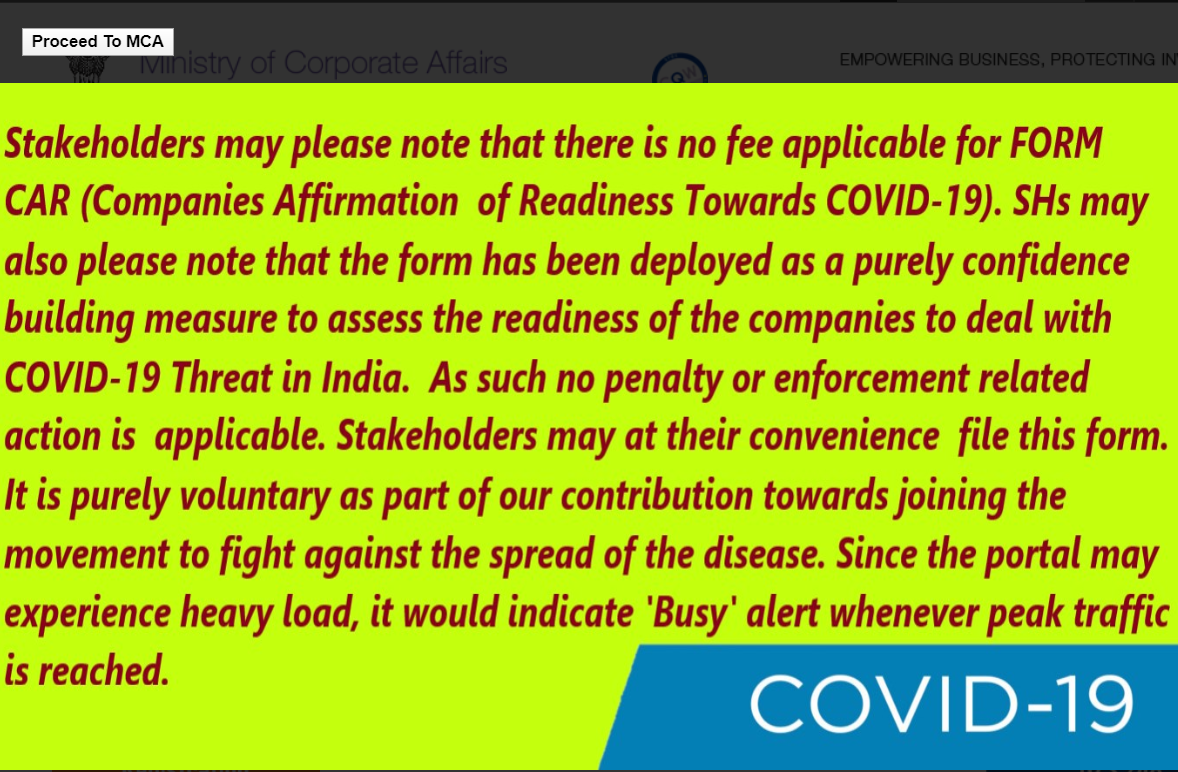
It is a web form deployed on 23rd March, 2020 by the Ministry. The same is a simple web based form requiring only an OTP based verification and does not require any digital signature for affirming or denying the adoption of work from home policy.

10. Is there a fee for filing form CAR?

There is no fee for filing the form. Seriously, we don’t even imagine there can be a fee.

11. Who will require to file the said form?

All companies and LLPs are expected to file the said form. There is no exclusion or exemption for OPCs, private companies or small companies. However, looking at the language of the applicability, partnership firms and proprietorship concerns have been kept outside the purview of filing CAR, 2020.

12. What is the timeline to file?

The web form CAR, 2020 is deployed on the MCA portal on 23rd March, 2020. Initially, the advice suggested to file it on the same day, however, later it was clarified that the same can be filed till 30th March, 2020.

13. What kind of information/ data to be reported?

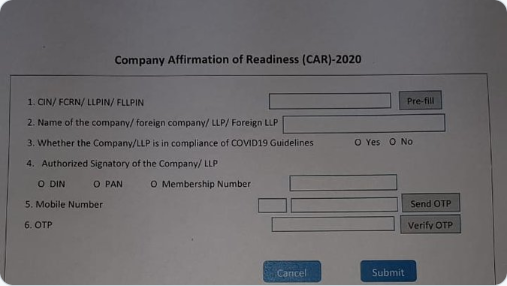
As per the twitter handle of the Hon’ble Minister of Finance and Corporate Affairs the possible format of the form shall contain the following:

  1. CIN/ FCRN/ LLPIN/ FLLPIN
  2. Name of the company/ foreign company/ LLP/ Foreign LLP
  3. Whether the company/ LLP is in compliance of COVID 19 Guidelines?
  4. Authorised Signatory of the company/ LLP
  5. DIN/ PAN/ Membership No. of the Authorised Signatory
  6. Mobile No.
  7. OTP

The step to step guide on filing CAR 2020 has been issued by MCA on 22nd March, 2020. The same can be viewed here.

14. Whether foreign company/ LLPs are also required to follow the Advisory?

The Advisory suggests all companies/ LLPs to file the form. The intent seems to include all the companies/ LLPs incorporated in India or companies/ LLPs not incorporated in India but having operations/ physical presence in India. The contents of the Form as provided in Query 9 above suggest the same.

15. What do the COVID 19 Guidelines mean?

There is no definition as such. However, it should mean the Advisory itself issued by the Govt. from time to time. One may refer to pages such as https://www.mygov.in/covid-19/?cbps=1.

16. Who is the Authorised Signatory of the company/ LLP for authenticating the form?

As referred to above, it seems that the authorised signatory may be a director, CS, CFO or any other person authorised to file the form. However, who is eligible to give such authority is not clear. In our view, in case of companies which have given general authority to the CS/ any director/ CFO to file necessary forms with the regulatory authorities from time to time, such authorised persons may file the form. In case of others, the same may be filed by the MD/ head of the organisation who looks after the day to day affairs or any person authorised by such MD/ head of the organisation.  Once again, we suggest there need not be a formal flow of authorisation, such as a resolution, for filing the form.

17. Whether the mobile no. has to be a registered mobile no.?

Since the form is an OTP verified form, the OTP is sent on the mobile no of the person who is authenticating the form and the same is prefilled on providing details of the authorised person.

18. What are the consequences of non- filing?

There is no penalty for non-filing of the form. Further the Advisory is not coming from any statutory requirement but out of a social obligation only, non- filing of the same may not lead to any penal consequences.

19. The Authorised Signatory may be the compliance officer. But how does the compliance officer certify the preparedness across the company, with so many locations?

The authorised signatory is not taking the burden upon himself. The signatory may, in turn, get confirmations from those who are involved, say, the HR head or similar positions.

20. In view of the lockdown/ shutdowns announced by the state governments for various places in India, does it mean lockout of operations by the corporate houses and giving leaves altogether?

Please note that shutdown does not mean shutdown of operation. Therefore, it still means work from home. The whole intent of shutdown is to control movement and not to control work.

21. Are the companies mandatorily required to file form CAR?

As per the information uploaded on MCA’s website, the filing of the form is on voluntary basis. Therefore, the company/ LLP (s) may take a call on filing. However, if one throws a question on whether they are required to take steps to combat COVID-19 by following government guidelines, please note that we have no doubt on answering this is positive. Everyone including the companies and LLPs are mandatorily required to take steps during this health emergency.

Remunerating NEDs and IDs in low-profit or no-profit years

Ambika Mehrotra

corplaw@vinodkothari.com

The role of non-executives (NEDs) and independent directors (IDs) in an organization in bringing their unbiased views, transparency and good governance in the corporate culture has already been recognized globally. The NEDs including IDs are not typically engaged in the day-to-day management but their responsibilities inter-alia include monitoring of the functioning of executive directors. This is quite essential in order to ensure that the decision making in the company is not dominated by individual choices.

As stated by Sir Vincent Powell-Smith in his book ‘Law and Practice Relating to Company Directors’, “apart from the working or executive directors, that is persons who are full-time executives, it is sometimes desirable to take in ” outside ” directors who have no association with the company other than as a director.”

It is to be noted that the unique role of such directors is evaluated by their ‘positive contribution’, in the board, as stated in the Report by Cadbury Committee[1], which is irrespective of the profits generated by the day to day business and working, However, the compensation for their contribution has always been linked to the profitability of the company by virtue of the provisions of Section 309 of the Companies Act, 1956 or corresponding Section 197 in the Companies Act, 2013.

Herein, it is pertinent to note that, while the role if NEDS/IDs demands them to bring independence to the board, the performance/profit based remuneration for non-executive directors has significant potential to conflict with their primary role in the organization. Accordingly, considering various stakeholder representations received by the Government regarding this inconsistency, the Company Law Committee (“CLC/Committee”) which was set up under the Chairmanship of Shri Injeti Srinivas in November, 2019[2] considered the need to have adequate compensation for such directors.

In line with same, the Central Government (CG) has recently laid down another set of amendments before the Lok Sabha on 17th March, 2020 by way of Companies (Amendment) Bill, 2020[3] (“CAB, 2020”). In this article we intend to discuss the said amendment along with the rationale behind the same.

Analysis of the amendments

The board is a mix of executives and non- executives, while the executives are being paid remuneration, the non- executives are only eligible for sitting fee and commission out of profits. Where the difference between the work domain is only as regards the day to day management of the company. Here, it is to be noted that although the non-executives do not involve in the everyday working of any organization, they carry the vintage of their experience in the company. It is interesting to note that while both the kind of directors bring in their bit of value in the company, however during a financial disrupt in a company, maybe through losses or inadequacy of profits, when there is a conflict in the minimum remuneration being paid, where the executive still receive the prescribed remuneration, the non-executives get to sacrifice their commission, which they were otherwise entitled to and they have to satisfy themselves with the sitting fee only.

In order to curb the said conflict, the CAB, 2020 has introduced provisions for allowing payment of adequate remuneration to NEDs in case of inadequacy of profits, by aligning the same with the provisions for remuneration to executive directors in such cases. This is backdrop of the discussion in the CLC Report which considered that the existing provisions in the CA, 2013, do not recognise payment of remuneration to non-executive directors, in case of losses or inadequate profits as it does for the managerial personnels in terms of Section 197 read with Schedule V.

Notably, the concept of minimum compensation to independent directors had also been incorporated in the Uday Kotak Committee report on Corporate Governance issued on October 5, 2017[4]. However, the above requirement of minimum remuneration did not extend to the case of inadequacy of profits.

While the Calcutta High Court in the matter of Hind Ceramics Ltd. vs Company Law Board And Ors[5] discussed that the minimum remuneration paid to the executives and non executives equally might severely impact the financial strength of the loss making entity in recovering the same for an uncertain term. However, on taking a close look at the active involvement of the non-executives in the company by virtue of their enhanced role and liabilities, it is required to re-consider the fact that the inconsistency in the payment of such non-executives as compared to the executives would not only de-incentivise the latter but also affect the retention of talented resources in a company.

Global Precedents

Considering the above, it may also be inferred that the limitation in the provisions of CA, 2013 w.r.t the payment of remuneration to IDs in case of losses or inadequacy of profits frustrates the whole intent of their unique role on the board. Even globally, various  countries have recognised that the level of remuneration for non-executive directors should reflect their time commitment and responsibilities of the role and not be linked to the performance of the company.

UK Corporate Governance Code

As per the UK Corporate Governance Code dated July 2018[6], which clearly provides that,

“Remuneration for all non-executive directors should not include share options or other performance-related element.”

The remuneration of non-executive directors is determined in accordance with the Articles of Association of the company or, alternatively, by the board.

OECD Report on Corporate Governance 

Similar provisions have been recommended in the Portuguese code of corporate governance, as referred in the report of the Organisation for Economic Co-operation and Development (OECD) based on Corporate Governance on Board Practices[7], which provides that the remuneration of the NEDs on the Board should not include a part depending on the performance or the value of the company.

ICGN’s Guidance on NED Remuneration

In addition to the above, the International Corporate Governance Network (ICGN) in its Guidance on Non-executive Director Remuneration[8] explains that the performance-based remuneration in any organisation has significant potential to conflict with a non-executive director’s primary role as an independent representative of shareholders. Although, ICGN is a strong advocate of performance-based concepts in executive remuneration, they do not uphold the same in case of remuneration to non- executives.

Conclusion

In view of the global stand in determining the remuneration to non-executives on  the basis of their value in the organisation without linking the same to the profits of the company, the amendments to be introduced vide the CAB, 2020 appear to be a boon for the IDs. At the same time, we cannot disregard the fact that, the concept of adequate compensation mentioned above applies to the companies facing losses or inadequacy of profits and it may be possible that this might increase the financial distress of the loss making company.  However, the positive aspect of the same still appears to be beneficial as regards the retention of experienced resources who shall remain motivated by being adequately remunerated.

Our other write- ups on similar topics may be viewed at:

  1. https://vinodkothari.com/2019/11/the-injeti-srinivas-committee-report-18-11-2019/
  2. https://vinodkothari.com/2019/11/clc-report-moving-company-law-a-step-closer-to-ease-and-peace/
  3. https://www.moneylife.in/article/norms-for-disqualification-of-directors-may-undergo-change/58842.html
  4. https://vinodkothari.com/category/corporate-laws/

[1] https://ecgi.global/sites/default/files/codes/documents/cadbury.pdf

[2] http://mca.gov.in/Ministry/pdf/CLCReport_18112019.pdf

[3] http://164.100.47.4/BillsTexts/LSBillTexts/Asintroduced/88_2020_LS_Eng.pdf

[4] https://www.sebi.gov.in/reports/reports/oct-2017/report-of-the-committee-on-corporate-governance_36177.html

[5] https://indiankanoon.org/doc/445116/

[6] https://www.frc.org.uk/getattachment/88bd8c45-50ea-4841-95b0-d2f4f48069a2/2018-UK-Corporate-Governance-Code-FINAL.pdf

[7] https://www.oecd.org/daf/ca/49081438.pdf

[8] https://www.top1000funds.com/pdf/ICGN_NED_Rem_Guidelines.pdf

RBI to regulate operation of payment intermediaries

Guidelines on regulation of Payment Aggregators and Payment Gateways issued

-Mridula Tripathi (finserv@vinodkothari.com)

Background

In this era of digitalisation, the role of intermediaries who facilitate the payments in an online transaction has become pivotal. These intermediaries are a connector between the merchants and customers, ensuring the collection and settlement of payment. In the absence of any direct guidelines and adequate governance practices regulating the operations of these intermediaries, there was a need to review the existing instructions issued in this regard by the RBI. Thus, the need of regulating these intermediaries has been considered cardinal by the regulator.

RBI had on September 17, 2019 issued a Discussion Paper on Guidelines for Payment Gateways and Payment Aggregators[1] covering the various facets of activities undertaken by Payment Gateways (PGs) and Payment Aggregators (PAs) (‘Discussion Paper’). The Discussion Paper further explored the avenues of regulating these intermediaries by proposing three options, that is, regulation with the extant instructions, limited regulation or full and direct regulation to supervise the intermediaries.

In this regard, the final guidelines have been issued by the RBI on March 17, 2020 which shall be effective from April 1, 2020[2], for regulating the activities of PAs and providing technology-related recommendations to PGs (‘Guidelines’).

In this article we shall discuss the concept of Payment Aggregator and Payment Gateway. Further, we intend to cover the applicability, eligibility norms, governance practices and reporting requirements provided in the aforesaid guidelines.

Concept of Payment Aggregators and Payment Gateways

In common parlance Payment Gateway can be understood as a software which enables online transactions. Whenever the e-interface is used to make online payments, the role of this software infrastructure comes into picture. Thinking of it as a gateway or channel that opens whenever an online transaction takes place, to traverse money from the payer’s credit cards/debit cards/ e-wallets etc to the intended receiver.

Further, the role of a Payment Aggregator can be understood as a service provider which includes all these Payment Gateways. The significance of the Payment Aggregators lies in the fact that Payment Gateway is a mere technological base which requires a back-end operator and this role is fulfilled by the Payment Aggregator.

A merchant (Seller) providing goods/services to its target customer would require a Merchant Account opened with the bank to accept e-payment. Payment Aggregator can provide the same services to several merchants through one escrow account without the need of opening multiple Merchant Accounts in the bank for each Merchant.

The concept of PA and PG as defined by the RBI is reproduced herein below:

PAYMENT AGGREGATORS (PAs) means the entities which enable e-commerce sites and merchants to meet their payment obligation by facilitating various payment options without creation of a separate payment integration system of their own. These PAs aggregate the funds received as payment from the customers and pass them to the merchants after a certain time period.

PAYMENT GATEWAYS (PGs) are entities that channelize and process an online payment transaction by providing the necessary infrastructure without actual handling of funds.

The Guidelines have also clearly distinguished Payment Gateways as providers of technological infrastructure and Payment Aggregators as the entities facilitating the payment. At present, the existing PAs and PGs have a variety of technological set-up and their infrastructure also keeps changing with time given the business objective for ensuring efficient processing and seamless customer experience. Some of the e-commerce market places have leveraged their market presence and started offering payment aggregation services as well. Though the primary business of an e-commerce marketplace does not come within the regulatory purview of RBI, however, with the introduction of regulatory provisions for PAs, the entities will end up being subjected to dual regulation. Hence, it is required to separate these two activities to enable regulatory supervision over the payment aggregation business.

The extant regulations[3] on opening and operation of accounts and settlement of payments for electronic payment transactions involving intermediarieswe were applicable to intermediaries who collect monies from customers for payment to merchants using any electronic / online payment mode. The Discussion Paper proposed a review of the said regulations and based on the feedback received from market participants, the Guidelines have been issued by RBI.

Coverage of Guidelines

RBI has made its intention clear to directly regulate PAs (Bank & Non-Bank) and it has only provided an indicative baseline technology related recommendation. The Guidelines explicitly exclude Cash on Delivery (CoD) e-commerce model from its purview. Surprisingly, the Discussion Paper issued by RBI in this context intended on regulating both the PAs & PGs, however, since PGs are merely technology providers or outsourcing partners they have been kept out of the regulatory requirements.

The Guidelines come into effect from April 1, 2020, except for requirements for which a specific deadline has been prescribed, such as registration and capital requirements.

Registration requirement

Payment Aggregators are required to fulfil the requirements as provided under the Guidelines within the prescribed timelines. The Guidelines require non-bank entities providing PA services to be incorporated as a company under the Companies Act, 1956/2013 being able of carrying out the activity of operating as a PA, as per its charter documents such as the MoA. Such entities are mandatorily required to register themselves with RBI under the Payment and Settlement Systems Act, 2007 (‘PSSA, 2007’) in Form-A. However, a deadline of June 30, 2021 has been provided for existing non-bank PAs.

Capital requirement

RBI has further benchmarked the capital requirements to be adhered by existing and new PAs. According to which the new PAs at the time of making the application and existing PAs by March 31, 2021 must have a net worth of Rs 15 crore and Rs 25 crore by the end of third financial year i.e. March 31, 2023 and thereafter. Any non-compliance with the capital requirements shall lead to winding up of the business of PA.

As a matter of fact, the Discussion Paper issued by RBI, proposed a capital requirement of Rs 100 crore which seems to have been reduced considering the suggestion received from the market participants.

To supervise the implementation of these Guidelines, there is a certification to be obtained from the statutory auditor, to the effect certifying the compliance of the prescribed capital requirements.

Fit and proper criteria

The promoters of PAs are expected to fulfil fit and proper criteria prescribed by RBI and a declaration is also required to be submitted by the directors of the PAs. However, RBI shall also assess the ‘fit and proper’ status of the applicant entity and the management by obtaining inputs from various regulators.

Policy formulation

The Guidelines further require formulation and adoption of a board approved policy for the following:

  1. merchant on-boarding
  2. disposal of complaints, dispute resolution mechanism, timelines for processing refunds, etc., considering the RBI instructions on Turn Around Time (TAT)
  3. information security policy for the safety and security of the payment systems operated to implement security measures in accordance with this policy to mitigate identified risks
  4. IT policy(as per the Baseline Technology-related Recommendations)

Grievance redressal

The Guidelines have put in place mandatory appointment of a Nodal Officer to handle customer and regulator grievance whose details shall be prominently displayed on the website thus implying good governance in its very spirit. This is similar to the requirement for NBFCs who are required to appoint a Nodal Officer. Also, it is required that the dispute resolution mechanism must contain details on types of disputes, process of dealing with them, Turn Around Time (TAT) for each stage etc.

However, in this context, the Discussion Paper provided for a time period of 7 working days to promptly handle / dispose of complaints received by the customer and the merchant.

Merchant on boarding and KYC compliance

To avoid malicious intent of the merchants, PAs should undertake background and antecedent check of the merchants and are responsible to check Payment Card Industry-Data Security Standard (PCI-DSS) and Payment Application-Data Security Standard (PA-DSS) compliance of the infrastructure of the merchants on-boarded and carry a KYC of the merchants on boarded. It also provides for some mandatory clauses to be incorporated in the agreements to be executed with the merchants.

Risk Management

For the purposes of risk management, apart from adoption of an IS policy, the PAs shall also have a mechanism to monitor, handle and report cyber security incidents and breaches. They are also prohibited to allow online transactions with ATM pin and store customer card credentials on the servers accessed by the merchants and are required to comply with data storage requirements as applicable to Payment System Operators (PSOs).

Reporting Requirements

The Guidelines provide for monthly, quarterly and annual reporting requirement. The annual requirement comprises of certification from a CA and IS audit report and Cyber Security Audit report. The quarterly reporting again provides for certification requirement and the monthly requirement demand a transaction statistic. Also, there shall be reporting requirement in case of any change in management requiring intimation to RBI within 15 days along with ‘Declaration & Undertaking’ by the new directors. Apart from these mainstream reporting requirements there are non-periodic requirements as well.

Additionally, PAs are required to submit the System Audit Report, including cyber security audit conducted by CERTIn empanelled auditors, within two months of the close of their financial year to the respective Regional Office of DPSS, RBI

Escrow Account Mechanism

The Guidelines clearly state that the funds collected from the customers shall be kept in an escrow account opened with any Schedule Commercial Bank by the PAs. And to protect the funds collected from customers the Guidelines state that PA shall be deemed as a ‘Designated Payment System’[4] under section 23A of PSSA, 2007.

Shift from Nodal to Escrow

The Discussion Paper proposed registration, capital requirement, governance, risk management and such other regulations along with the maintenance of a nodal account to manage the funds of the merchants. Further, it acknowledged that in case of nodal accounts, there is no beneficial interest created on the part of the PAs; the fact that they do not form part of the PA’s balance sheet and no interest can be earned on the amount held in these account. The Guidelines are more specific about escrow accounts and do not provide for maintenance of nodal accounts, which seems to indicate a shift from nodal to escrow accounts with the same benefits as nodal accounts and additionally having an interest bearing ‘core portion’. These escrow account arrangements can be with or without a tripartite agreement, giving an option to the merchant to monitor the transactions occurring through the escrow. However, in practice it may not be possible to make each merchant a party to the escrow agreement.

Timelines for settlement to avoid unnecessary delay in payments to Merchants, various timelines have been provided as below:

  1. Amounts deducted from the customer’s account shall be remitted to the escrow account maintaining bank on Tp+0 / Tp+1 basis. (Tp is the date of debit to the customer’s account against good/services purchased)
  2. Final settlement with the merchant
  3. In cases where PA is responsible for delivery of goods / services, the payment to the merchant shall be made on Ts + 1 basis. (Ts is the date of intimation by merchant about shipment of goods)
  4. In cases where merchant is responsible for delivery, the payment to the merchant shall be on Td + 1 basis. (Td is the date of confirmation by the merchant about delivery of goods)
  5. In cases where the agreement with the merchant provides for keeping the amount by the PA till expiry of refund period, the payment to the merchant shall be on Tr + 1 basis. (Tr is the date of expiry of refund period)

Also, refund and reversed transactions must be routed back through the escrow account unless as per contract the refund is directly managed by the merchant and the customer has been made aware of the same. A minimum balance requirement equivalent to the amount already collected from customer as per ‘Tp’ or the amount due to the merchant at the end of the day is required to be maintained in the escrow account at any time of the day.

Permissible debits and credits

Similar to the extant regulations, the Guidelines provide a specific list of debits and credits permissible from the escrow account:

  • Credits that are permitted
  1. Payment from various customers towards purchase of goods / services.
  2. Pre-funding by merchants / PAs.
  3. Transfer representing refunds for failed / disputed / returned / cancelled transactions.
  4. Payment received for onward transfer to merchants under promotional activities, incentives, cashbacks etc.
  • Debits that are permitted
  1. Payment to various merchants / service providers.
  2. Payment to any other account on specific directions from the merchant.
  3. Transfer representing refunds for failed / disputed transactions.
  4. Payment of commission to the intermediaries. This amount shall be at pre-determined rates / frequency.
  5. Payment of amount received under promotional activities, incentives, cash-backs, etc.

The aforesaid list of permitted deposits and withdrawals into an account operated by an intermediary is wider than those allowed under the extant regulations. The facility to pay the amount held in escrow to any other account on the direction of the merchant would now enable cashflow trapping by third party lenders or financier. The merchant will have an option to provide instructions to the PA to directly transfer the funds to its creditors.

The Guidelines expressly state that the settlement of funds with merchants will in no case be co-mingled with other business of the PA, if any and no loans shall be available against such amounts.

No interest shall be payable by the bank on balances maintained in the escrow account, except in cases when the PA enters into an agreement with the bank with whom the escrow account is maintained, to transfer “core portion”[5] of the amount, in the escrow account, to a separate account on which interest is payable. Another certification requirement to be obtained from auditor(s) is for certifying that the PA has been maintaining balance in the escrow account.

Technology-related Recommendations

Several technology related recommendations have been separately provided in the Guidelines and are mandatory for PAs but recommendatory for PGs. These instructions provide for adherence to data security standards and timely reporting of security incidents in the course of operation of a PA. It proposes involvement of Board in formulating policy and a competent pool of staff for better operation along with other governance and security parameters.

Conclusion

With these Guidelines being enforced the online payment facilitated by intermediaries will be regulated and monitored by the RBI henceforth. The prescribed timeline of April 2020 may cause practical difficulties and act as a hurdle for the operations of existing PAs. However, the timelines provided for registration and capital requirements are considerably convenient for achieving the prescribed benchmarks. Since PAs are handling the funds, these Guidelines, which necessitate good governance, security and risk management norms on PAs, are expected to be favourable for the merchants and its customers.


[1] https://www.rbi.org.in/scripts/PublicationReportDetails.aspx?ID=943

[2] https://www.rbi.org.in/Scripts/NotificationUser.aspx?Id=11822&Mode=0

[3] https://www.rbi.org.in/Scripts/NotificationUser.aspx?Id=5379&Mode=0

[4] The Reserve Bank may designate a payment system if it considers that designating the system is in the public interest. The designation is to be by notice in writing published in the Gazette, as per Payment System Regulation Act, 1998

[5] This facility shall be permissible to entities who have been in business for 26 fortnights and whose accounts have been duly audited for the full accounting year. For this purpose, the period of 26 fortnights shall be calculated from the actual business operation in the account. ‘Core Portion’ shall be average of the lowest daily outstanding balance (LB) in the escrow account on a fortnightly (FN) basis, for fortnights from the preceding month 26.


Our other write ups on NBFCs to be referred here https://vinodkothari.com/nbfcs/

Our other similar articles:

https://vinodkothari.com/2017/04/overview-of-regulatory-framework-of-payment-and-settlement-systems-in-india-by-anita-baid/

Bridging the gap between Ind AS 109 and the regulatory framework for NBFCs

-Abhirup Ghosh

(abhirup@vinodkothari.com)

The Reserve Bank of India, on 13th March, 2020, issued a notification[1] providing guidance on implementation of Indian Accounting Standards by non-banking financial companies. This guidance comes after almost 2 years from the date of commencement of first phase of implementation of Ind AS for NBFCs.

The intention behind this Notification is to ensure consistency in certain areas like – asset classification, provisioning, regulatory capital treatment etc. The idea of the Notification is not to provide detailed guidelines on Ind AS implementation. For areas which the Notification has not dealt with, notified accounting standards, application guidance, educational material and other clarifications issued by the ICAI should be referred to.

The Notification is addressed to all non-banking financial companies and asset reconstruction companies. Since, housing finance companies are now governed by RBI and primarily a class of NBFCs, this Notification should also apply to them. But for the purpose of this write-up we wish to restrict our scope to NBFCs, which includes HFCs, only.

The Notification becomes applicable for preparation of financial statements from the financial year 2019-20 onwards, therefore, it seems the actions to be taken under the Notification will have to be undertaken before 31st March, 2020, so far as possible.

In this article we wish to discuss the outcome the Notification along with our comments on each issue. This article consists of the following segments:

  1. Things to be done by the Board of Directors (BOD)
  2. Expected Credit Losses (ECL) and prudential norms
  3. Dealing with defaults and significant increase in credit risk
  4. Things to be done by the Audit Committee of the Board (ACB)
  5. Computation of regulatory capital
  6. Securitisation accounting and prudential norms
  7. Matters which skipped attention

1.   Things to be done by the BOD

The Notification starts with a sweeping statement that the responsibility of preparing and ensuring fair presentation of the financial statements lies with the BOD of the company. In addition to this sweeping statement, the Notification also demands the BOD to lay down some crucial policies which will be essential for the implementation of Ind AS among NBFCs and they are: a) Policy for determining business model of the company; and b) Policy on Expected Credit Losses.

(A) Board approved policy on business models: The Company should have a Board approved policy, which should articulate and document the business models and portfolios of the Company. This is an extremely policy as the entire classification of financial assets, depends on the business model of the NBFC. Some key areas which, we think, the Policy should entail are:

There are primarily three business models that Ind AS recognises for subsequent measurement of financial assets:

(a) hold financial assets in order to collect contractual cash flows;

(b) hold financial assets in order to collect contractual cash flows and also to sell financial assets; and

(c) hold financial assets for the purpose of selling them.

The assessment of the business model should not be done at instrument-by-instrument level, but can be done at a higher level of aggregation. But at the same time, the aggregation should be not be done at an entity-level because there could be multiple business models in a company.

Further, with respect the first model, the Ind AS states that the business model of the company can still be to hold the financial assets in order to collect contractual cash flows even if some of the assets are sold are expected to be sold in future. For instance, the business model of the company shall remain unaffected due to the following transactions of sale:

(a) Sale of financial assets due to increase in credit risk, irrespective of the frequency or value of such sale;

(b) Sale of cash flows are made close to the maturity and where the proceeds from the sale approximate the collection of the remaining contractual cash flows; and

(c) Sale of financial assets due to other reasons, namely, to avoid credit concentration, if such sales are insignificant in value (individually or in aggregate) or infrequent.

For the third situation, what constitutes to insignificant or infrequent has not been discussed in the Ind AS. However, reference can be drawn from the Report of the Working Group of RBI on implementation of Ind AS by banks[2], which proposes that there could be a rebuttable presumption that where there are more than 5% of sale, by value, within a specified time period, of the total amortised cost of financial assets held in a particular business model, such a business model may be considered inconsistent with the objective to hold financial assets in order to collect contractual cash flow.

However, we are not inclined to take the same as prescriptive. Business model of an entity is still a question hinging on several relevant factors, primarily the profit recognition, internal reporting of profits, pursuit of securitization/direct assignment strategy, etc. Of course, the volume may be a persuasive factor.

The Notification also requires that the companies should also have a policy on sale of assets held under amortised cost method, and such policy should be disclosed in the financial statements.

(B) Board approved policy on ECL methodology: the Notification requires the companies to lay down Board approved sound methodologies for computation of Expected Credit Losses. For this purpose, the RBI has advised the companies to use the Guidance on Credit Risk and Accounting for Expected Credit Losses issued by Basel Committee on Banking Supervision (BCBS)[3] for reference.

The methodologies laid down should commensurate with the size, complexity and risks specific to the NBFC. The parameters and assumptions for risk assessment should be well documented along with sensitivity of various parameters and assumptions on the ECL output.

Therefore, as per our understanding, the policy on ECL should contain the following –

(a) The assumptions and parameters for risk assessment – which should basically talk about the probabilities of defaults in different situations. Here it is important to note that the assumptions could vary for the different products that the reporting entity offers to its customers. For instance, if a company offers LAP and auto loans at the same time, it cannot apply same set of assumptions for both these products.

Further, the policy should also lay down indicators of significant increase in credit risk, impairment etc. This would allow the reporting entity in determining classifying its assets into Stage 1, Stage 2 and Stage 3.

(b) Backtesting of assumptions – the second aspect of this policy should deal with backtesting of the assumptions. The policy should provide for mechanism of backtesting of assumption on historical data so as to examine the accuracy of the assumptions.

(c) Sensitivity analysis – Another important aspect of this policy is sensitivity analysis. The policy should provide for mechanism of sensitivity analysis, which would predict the outcome based on variations in the assumptions. This will help in identifying how dependant the output is on a particular input.

Further, the Notification states that any change in the ECL model must be well documented along with justifications, and should be approved by the Board. Here it is important to note that there could two types of variations – first, variation in inputs, and second, variation in the model. As per our understanding, only the latter should be placed before the BOD for its approval.

Further, any change in the assumptions or parameters or the ECL model for the purpose of profit smothering shall seriously be frowned upon by the RBI, as it has clearly expressed its opinion against such practices.

2.   Expected Credit Losses (ECL) and prudential norms

The RBI has clarified that whatever be the ECL output, the same should be subject to a regulatory floor which in this case would be the provisions required to be created as the IRAC norms. Let us understand the situation better:

The companies will have to compute two types of provisions or loss estimations going forward – first, the ECL as per Ind AS 109 and its internal ECL model and second, provisions as per the RBI regulations, which has to be computed in parallel, and at asset level.

The difference between the two will have to be dealt with in the following manner:

(A) Impairment Reserve: Where the ECL computed as per the ECL methodology is lower than the provisions computed as per the IRAC norms, then the difference between the two should be transferred to a separate “Impairment Reserve”. This transfer will not be a charge against profit, instead, the Notification states that the difference should be appropriated against the profit or loss after taxes.

Interestingly, no withdrawals against this Impairment Reserve is allowed without RBI’s approval. Ideally, any loss on a financial asset should be first adjusted from the provision created for that particular account.

Further, the continuity of this Impairment Reserve shall be reviewed by the RBI going forward.

A large number of NBFCs have already presented their first financial statements as per Ind AS for the year ended 31st March, 2019. There were two types of practices which were followed with respect to provisioning and loss estimations. First, where the NBFCs charged only the ECL output against its profits and disregarded the regulatory provisioning requirements. Second, where the NBFCs computed provisions as per regulatory requirements as well as ECL and charged the higher amount between the two against the profits.

The questions that arise here are:

(a) For the first situation, should the NBFCs appropriate a higher amount in the current year, so as to compensate for the amount not transferred in the previous year?

(b) For the second situation, should the NBFCs reverse the difference amount, if any, already charged against profit during the current year and appropriate the same against profit or loss?

The answer for both the questions is negative. The provisions of the Notification shall have to be implemented for the preparation of financial statements from the financial year 2019-20 onwards, hence, we don’t see the need for adjustments for what has already been done in the previous year’s financial statements.

(B) Disclosure: The difference between the two will have to be disclosed in the annual financial statements of the company, format of which has been provided in the Notification[4]. Going by the format, the loss allowances created on Stage 1, Stage 2 and Stage 3 cases will have to be shown separately, similarly, the provisions computed on those shall also have to be shown separately.

While Stage 1 and Stage 2 cases have been classified as standard assets in the format, Stage 3 cases cover sub-standard, doubtful and loss assets.

Loss estimations on loan commitments, guarantees etc. which are covered under Ind AS but does not require provisioning under the RBI Directions should also be presented.

3.     Dealing with defaults and significant increase in credit risk

Estimation of expected losses in financial assets as per Ind AS depends primarily on credit risk assessment and identifying situations for impairment. Considering the importance of issue, the RBI has voiced its opinion on identification of “defaults” and “significant increase in credit risk”.

(A)Defaults: The next issue which has been dealt with in the Notification is the meaning of defaults. Currently, there seems to be a departure between the Ind AS and the regulatory definition of “defaults”. While the former allows the company to declare an account as default based on its internal credit risk assessments, the latter requires that all cases with delay of more than 90 days should be treated as default. The RBI expects the accounting classification to be guided by the regulatory definition of “defaults”.

 If a company decides not to impair an account even after a 90 days delay, then the same should be approved by the Audit Committee.

This view is also in line with the definition of “default” proposed by the BASEL framework for IRB framework, which is:

“A default is considered to have occurred with regard to a particular obligor when one or more of the following events has taken place.

 (a) It is determined that the obligor is unlikely to pay its debt obligations (principal, interest, or fees) in full;

 (b) A credit loss event associated with any obligation of the obligor, such as a charge-off, specific provision, or distressed restructuring involving the forgiveness or postponement of principal, interest, or fees;

 (c) The obligor is past due more than 90 days on any credit obligation; or

 (d) The obligor has filed for bankruptcy or similar protection from creditors.”

Further, the number of cases of defaults and the total amount outstanding and overdue should be disclosed in the notes to the financial statements. As per the current regulatory framework, NBFCs have to present the details of sub-standard, doubtful and loss assets in its financial statements. Hence, this disclosure requirement is not new, only the sub-classification of NPAs have now been taken off.

(B) Dealing with significant increase in credit risk: Assessment of credit risk plays an important role in ECL computation under Ind AS 109. Just to recapitulate, credit risk assessments can be lead to three possible situations – first, where there is no significant increase in credit risk, second, where there is significant increase in credit risk, but no default, and third, where there is a default. These three outcomes are known as Stage 1, Stage 2 and Stage 3 cases respectively.

 In case an account is under Stage 1, the loss estimation has to be done based on probabilities of default during next 12 months after the reporting date. However, if an account is under Stage 2 or Stage 3, the loss estimation has to be done based on lifetime probabilities of default.

Technically, both Stage 1 and Stage 2 cases would fall under the definition of standard assets for the purpose of RBI Directions, however, from accounting purposes, these two stages would attract different loss estimation techniques. Hence, the RBI has also voiced its opinion on the methodology of credit risk assessment for Stage 2 cases.

The Notification acknowledges the presence of a rebuttable presumption of significant increase in credit risk of an account, should there be a delay of 30 days or more. However, this presumption is rebuttable if the reporting entity has reasonable and supportable information that demonstrates that the credit risk has not increased significantly since initial recognition, despite a delay of more than 30 days. In a reporting entity opts to rebut the presumption and assume there is no increase in credit risk, then the reasons for such should be properly documented and the same should be placed before the Audit Committee.

However, the Notification also states that under no circumstances the Stage 2 classification be deferred beyond 60 days overdue.

4.   Things to be done by the ACB

The Notification lays down responsibilities for the ACB and they are:

(A) Approval of any subsequent modification in the ECL model: In order to be doubly sure about that any subsequent change made to the ECL model is not frivolous, the same has to be placed before the Audit Committee for their approval. If approved, the rationale and basis of such approval should be properly documented by the company.

(B) Reviewing cases of delays and defaults: As may have been noted above, the following matters will have to be routed through the ACB:

(a) Where the reporting entity decides not to impair an account, even if there is delay in payment of more than 90 days.

(b) Where as per the risk assessment of the reporting entity, with respect to an account involving a delay of more than 30 days, it rebuts that there is no significant increase in credit risk.

In both the cases, if the ACB approves the assumptions made by the management, the approval along with the rationale and justification should be properly documented.

5.   Computation of Regulatory Capital

The Notification provides a bunch of clarifications with respect to calculation of “owned funds”, “net owned funds”, and “regulatory capital”, each of which has been discussed here onwards:

(A) Impact of unrealised gains or losses arising on fair valuation of financial instruments: The concept of fair valuation of financial instruments is one of the highlights of IFRS or Ind AS. Ind AS 109 requires fair valuation of all financial instruments. The obvious question that arises is how these gains or losses on fair valuation will be treated for the purpose of capital computation. RBI’s answer to this question is pretty straight and simple – none of these of gains will be considered for the purpose of regulatory capital computation, however, the losses, if any, should be considered. This view seems to be inspired from the principle of conservatism.

 Here it is important to note that the Notification talks about all unrealised gains arising out of fair valuation of financial assets. Unrealised gain could arise in two situations – first, when the assets are measured on fair value through other comprehensive income (FVOCI), and second, when the assets are measured on fair value through profit or loss (FVTPL).

In case of assets which are fair valued through profit or loss, the gains or losses once booked are taken to the statement of profit or loss. Once taken to the statement of profit or loss, these gains or losses lose their individuality. Further, these gains or losses are not shown separately in the Balance Sheet and are blended with accumulated profits or losses of the company. Monitoring the unrealised gains from individual assets would mean maintenance of parallel accounts, which could have several administrative implications.

Further, when these assets are finally sold and gain is realised, only the difference between the fair value and value of disposal is booked in the profit and loss account. It is to be noted here that the gain on sale of assets shown in the profit and loss account in the year of sale is not exactly the actual gain realised from the financial asset because a part of it has been already booked during previous financial years as unrealised gains. If we were to interpret that by “unrealised gains” RBI meant unrealised gains arising due to FVTPL as well, the apparent question that would arise here is – whether the part which was earlier disregarded for the purpose of regulatory capital will now be treated as a part of capital?

Needless to say, extending the scope of “unrealised gains” to mean unrealised gains from FVTPL can create several ambiguities. However, the Notification, as it stands, does not contain answers for these.

In addition to the above, the Notification states the following in this regard:

  • Even unrealised gains arising on transition to Ind AS will have to be disregarded.
  • For the purpose of computation of Tier I capital, for investments in NBFCs and group companies, the entities must reduce the lower of cost of acquisition or their fair value, since, unrealised gains are anyway deducted from owned funds.
  • For any other category of investments, unrealised gains may be reduced from the value of asset for the purpose of risk-weighting.
  • Netting off of gains and losses from one category of assets is allowed, however, netting off is not allowed among different classes of assets.
  • Fair value gains on revaluation of property, plant and equipment arising from fair valuation on the date of transition, shall be treated as a part of Tier II capital, subject to a discount of 55%.
  • Any unrealised gains or losses recognised in equity due to (a) own credit risk and (b) cash flow hedge reserve shall be derecognised while determining owned funds.

(B) Treatment of ECL: The Notification allows only Stage 1 ECL, that is, 12 months ECL, to be included as a part of Tier II capital as general provisions and loss reserves. Lifetime ECL shall not be reckoned as a part of Tier II capital.

6.   Securitisation accounting and prudential norms

All securitisation transactions undergo a strict test of de-recognition under Ind AS 109. The conditions for de-recognition are such that most of the structures, prevalent in India, fail to qualify for de-recognition due to credit enhancements. Consequently, the transaction does not go off the books.

The RBI has clarified that the cases of securitisation that does not go off the books, will be allowed capital relief from regulatory point of view. That is, the assets will be assigned 0% risk weight, provided the credit enhancement provided for the transaction is knocked off the Tier I (50%) and Tier II (remaining 50%).

There are structures where the level of credit enhancement required is as high as 20-25%, the question here is – should the entire credit support be knocked off from the capital? The answer to this lies in the RBI’s Securitisation Guidelines from 2006[5], which states that the knocking off of credit support should be capped at the amount of capital that the bank would have been required to hold for the full value of the assets, had they not been securitised, that is 15%.

For securitisation transactions which qualify for complete de-recognition, we are assuming the existing practice shall be followed.

But apart from the above two, there can also be cases, where partial de-recognition can be achieved – fate of such transactions is unclear. However, as per our understanding, to the extent of retained risk, by way of credit enhancement, there should be a knock off from the capital. For anything retained by the originator, risk weighting should be done.

Matters which skipped attention

There are however, certain areas, which we think RBI has missed considering and they are:

  1. Booking of gain in case of de-recognition of assets: As per the RBI Directions on Securitisation, any gain on sale of assets should be spread over a period of time, on the other hand, the Ind AS requires upfront recognition of gain on sale of assets. The gap between the two should been bridged through this Notification.
  2. Consideration of OCI as a part of Regulatory Capital: As per Basel III framework, other comprehensive income forms part of Common Equity Tier I [read our article here], however, this Notification states all unrealised gains should be disregarded. This, therefore, is an area of conflict between the Basel framework and the RBI’s stand on this issue.


Read our articles on the topic:

  1. NBFC classification under IFRS financial statements: https://vinodkothari.com/wp-content/uploads/2018/11/Article-template-VKCPL-3.pdf
  2. Ind AS vs Qualifying Criteria for NBFCs-Accounting requirements resulting in regulatory mismatch?: https://vinodkothari.com/2019/07/ind-as-vs-qualifying-criteria-for-nbfcs/
  3. Should OCI be included as a part of Tier I capital for financial institutions?: https://vinodkothari.com/2019/03/should-oci-be-included-as-a-part-of-tier-i-capital-for-financial-institutions/
  4. Servicing Asset and Servicing Liability: A new by-product of securitization under Ind AS 109: https://vinodkothari.com/2019/01/servicing-asset-and-servicing-liability/
  5. Classification and reclassification of financial instruments under Ind AS: https://vinodkothari.com/2019/01/classification-of-financial-asset-liabilities-under-ind-as/


[1] https://www.rbi.org.in/Scripts/NotificationUser.aspx?Id=11818&Mode=0#F2

[2] https://rbidocs.rbi.org.in/rdocs/Content/PDFs/FAS93F78EF58DB84295B9E11E21A91500B8.PDF

[3] https://www.bis.org/bcbs/publ/d350.pdf

[4] https://rbidocs.rbi.org.in/rdocs/content/pdfs/NOTI170APP130320.pdf

[5] https://www.rbi.org.in/scripts/NotificationUser.aspx?Id=2723

Proposed changes in CSR Rules

Nitu Poddar and Tanvi Rastogi

corplaw@vinodkothari.com

Section 135 of Companies Act, 2013 dealing with the Corporate Social Responsibility (“CSR”) was amended vide the Companies (Amendment) Act, 2019 inter-alia requiring the provisions to change from “comply or explain” to “comply or suffer” by introducing penal provision for non-compliance. The amendment also provided for parking the unspent amount of ongoing projects in a separate account and any other unspent amount to Clean Ganga Fund or PMNRF or like. Amidst the decriminalisation (of offences under Companies Act) spree by the government, the introduction of penalty in the CSR provisions have surely not been welcomed by the corporates.

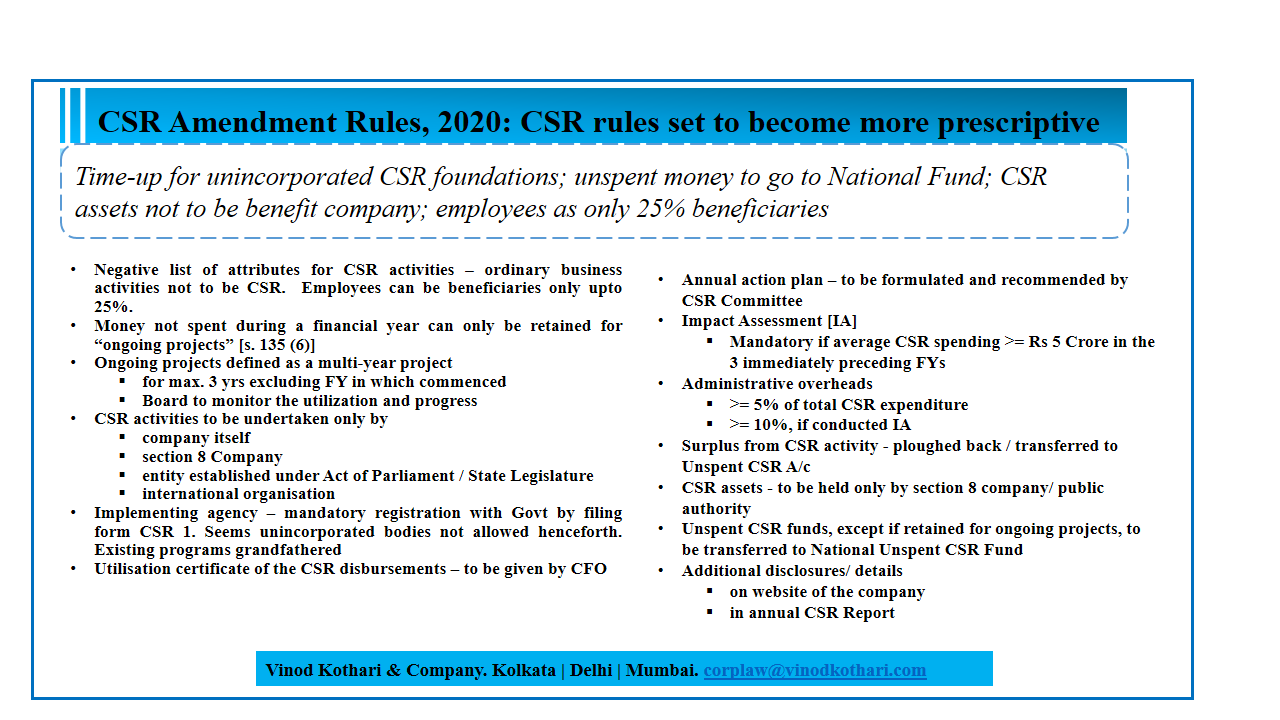
In any case, the provisions have not been made effective for want of respective change in the CSR Rules, 2014. Accordingly, MCA has proposed changes[1] in the CSR Rules vide proposal dated March 13, 2020. Substantial changes have been proposed viz. definition of ongoing projects, that the implementing agencies could be only section 8 companies or a government entity, registering of such implementing agencies by filing e-form CSR-1 with the MCA, CFO certificate, additional website disclosures, detailed CSR report, mandatory impact assessment to name a few.

In this write up, we discuss the impact of the significant proposal in the CSR Rules by the MCA.

Rule No Heading Proposal Remarks / Comments

Rule 2(1)(c)

Negative attributes of what will not be considered as “CSR” Corporate Social Responsibility (CSR)” means the activities undertaken by a Company in pursuance of its statutory obligation laid down in section 135 of the Act in accordance with the provisions contained in these Rules, but shall not include the following, namely-

  1. Activities undertaken in pursuance of normal course of business of the company.
  2. Any activity undertaken by the company outside India.
  3. Contribution of any amount directly or indirectly to any political party under section 182 of the Act.
  4. activities that significantly benefit the employees of the company and their families.

Provided that in case of any activity having less than twenty five percent employees as its beneficiary, then such activity shall be deemed to be CSR activity under these rules

The 4 items mentioned in the negative attributes of what would not include to be a CSR expenditure is not a new provision. This is already mentioned in the current Rule 4 from where it has been replaced in the definition clause.


Only addition is the clarification in clause (iv) w.r.t the extent to which the employees of the Company could be beneficiary of CSR program. The threshold is less than 25% of the total beneficiary of the CSR program.


What is not clarified is whether the threshold of 25% is with respect to value or number. To our mind, it should be the number of employees.


However, this would make the CSR provisions heavy with mechanical rules which people may contrive easily by scheming CSR spend wherein the number of employees benefitted is within the 25% threshold but the value attributed to them is much higher.

Rule 2(1)(e) Definition of CSR Policy “CSR Policy” means a statement containing the approach and direction given by the board of a company, as per recommendations of its CSR Committee, for selection, implementation and monitoring of activities to be undertaken in areas or subjects specified in Schedule VII of the Act. It is clear that unlike the current prevalent practice, where the board lists down the activities from schedule VII for its CSR, the board will have to do a strategic planning with respect to CSR activity to be undertaken by the company.
Rule 2(1)(h) Defining “ongoing projects” and rule thereto “Ongoing Projects” means a multi-year project undertaken by a Company in fulfillment of its CSR obligation having timelines not exceeding three years excluding the financial year in which it was commenced, and shall also include such projects that were initially not approved as a multi-year project but whose duration has been extended beyond a year by the Board based on reasonable justification.

In case of ongoing projects, the Board of a company shall monitor the implementation of the project with reference to the approved timelines and year wise allocation and shall be competent to make modifications, if any, for smooth implementation of the project within the overall permissible time period.


1.     The ongoing project can be a program of maximum 4 years (including the first year of commencement); – mere one-time spending surely cannot be a “project”. It requires continued expenditure over time.

2.     “Year” would surely mean financial year. Therefore if say a project has been commenced in the month of February, 2020, the three FY therefrom, will be FY 2022-2023.

3.     Year wise allocation will have to be made

4.     Basis reasonable justification, a bullet program can also be converted to an ongoing project by the board of directors

While the timeline of 4 years at one go is proposed, the gaps seems to be two-fold:

1.     What about the projects which may take longer than 4 years; so as to keep a close check on India Inc., seems like the govt. intends the companies to make budgets for 4 years and either implement it or transfer amount to the National CSR account

2.     Can such projects be extended after completion of the 4 years? – the answer to this seems to be positive

Rule 4 Modes of implementing CSR activities (1) The Board shall ensure that the CSR activities are undertaken by the company itself or through:

(a) a company established under section 8 of the Act, or

(b) any entity established under an Act of Parliament or a State legislature.

Provided that a company may also engage an international organization[2][3] for implementation of a CSR project subject to prior approval of the central government.


So far, a section 8 company, trust, or a society, having track record of three years in carrying out similar activity was qualified to be an implementing agency, however only section 8 companies are proposed to be retained to be an implementing agency. The language of clause b indicates that only incorporated entities will be eligible to be an implementing agency. However, the language here is quite vague.

Companies currently undertaking CSR through group foundations incorporated / established in any other form will have to look for other agencies as the CSR through in-house foundations seems to be over

Also international organisations identified under section 3 of United Nations (Privileges and Immunities) Act, 1947 can be appointed as implementing agency after approval of central government. This would mean that the Indian branch of such organisation will have to work in a schedule VII activity within India.

The method of seeking such prior approval is not proposed. This may require the involvement of Ministry of External Affairs.

Rule 4(1) Mandatory registration of implementing agency with the MCA Provided that such company/entity, covered under clause (a) or (b), shall register itself with the central government for undertaking any CSR activity by filing the e-form CSR-1 with the Registrar along with prescribed fee.

Provided further that the provisions of this sub-rule shall not affect the CSR projects or programmes that were approved prior to the commencement of the Companies (CSR Policy) Amendment Rules, 2020.

This is a fresh introduction. The template of the e-Form is present in the draft rules. Also, this would mean that, post these Draft Rules comes into force, these entities will not be hired as implementing agencies until they register themselves. This would lead to regulating of such implementing agencies.
Rule 4(3) Other role of international organisation A company may engage international organizations for designing, monitoring and evaluation of the CSR projects or programmes as per its CSR policy as well as for capacity building of their own personnel for CSR. The provision, using the word “may”, is directory and not mandatory. Accordingly, companies can take a call to appoint any other entity to undertake the prescribed overhead jobs in respect of CSR. In any case, the threshold allowed as administrative overhead will be applicable,
Rule 4(4) Board responsibility and CFO certification Board of a company shall satisfy itself that the funds so disbursed have been utilized for the purpose and in the manner as approved by it and Chief financial Officer or the person responsible for financial management shall certify to the effect. This is an extremely important proposal. In addition to the monitoring by the board, it requires the CFO or alike to give utilisation certificate of the disbursements made. This makes the role of monitoring all the more crucial.   This apart the, CFO will also be required to sign the annual CSR report.

This clause makes the CFO apparently responsible for the entire CSR provision without him being part of the CSR committee or the board of directors.

Probably, such certificate shall have to be placed before the CSR committee and / or the board – the draft rules are silent on this.

Rule 5 CSR Committee – responsibility to recommend annual action plan The CSR Committee shall formulate and recommend to the Board, an annual action plan in pursuance of its CSR policy, which shall include the following:

a)     the list of CSR projects or programmes that are approved to be undertaken in areas or subjects specified in Schedule VII of the Act;

b)     the manner of execution of such projects or programmes as specified in sub-rule (1) of Rule 4;

c)     the modalities of utilization of funds and implementation schedules for the projects or programmes; and

d)     monitoring            and            reporting mechanism            for            the            projects or programmes.

This seems to be an immediate actionable once the draft rules are effective.

While annual budget and areas of activities was being recommended by the CSR Committee, however, the manner of execution was something that was currently being decided by the board. Also, practically speaking, there used to be one of meeting of CSR in several cases in which the allocating of budget for next FY and approving and signing of the report of last FY used to be done.

However, it is proposed that the committee draws a detailed annual action plan to undertake CSR program. Reading the draft rules, it seems like the government is in full mood to get the management on their heels for effective implementation of the CSR provisions along with ensuring that such spent is making impact in the society.

Rule 8(3) Mandatory CSR impact assessment A company having the obligation of spending average CSR amount of Rs 5 Crore or more in the three immediately preceding financial  years in pursuance of sub section 5 of Section 135 of the Act, shall undertake impact assessment for their CSR projects or programmes, and shall disclose details of the same in its Annual Report on CSR.

 The impact assessment report is to be attached to the annual report [as per the annexure]


The High Level Committee on CSR[4] highlighted importance of the need and impact assessment for projects with higher outlays. This will help in bringing forth the areas requiring more attention, for there development.

Companies having minimum 5 cr of average CSR obligation in last 3 years shall have to undertake mandatory impact assessment. Interestingly, the report of such assessment is proposed to form part of the annual report.

There are several question around this:

1.     who does this assessment ? surely, the govt acknowledges that an outside entity can also be engaged for such assessment and therefore there is increased limits of allowed overhead expenditure for such companies who are mandatorily required to undertake such assessment

2.     also, it is to be noted that the CSR report as mentioned in the annexure, includes surplus from CSR in the total CSR obligation; – will this mean that where there is extraordinary surplus, compliance of this provision becomes applicable because of surplus ? it may in such cases prove to be waste of resources

Rule 7(1) Limit of overhead expenses The board shall ensure that the administrative overheads incurred in pursuance of sub-section (4) (b) of section 135 of the Act shall not exceed five percent of total CSR expenditure of the company for the financial year.

Provided that a company undertaking impact assessment, in pursuance of sub-rule (3) of Rule 8, may incur administrative overheads not exceeding ten percent of total CSR expenditure for that financial year

Discussed above
Rule 7(2) Surplus out of CSR program Any surplus arising out of the CSR projects or programmes or activities shall not form part of the business profit of a company and shall be ploughed back into the same project or shall be transferred to the Unspent CSR Account and spent in pursuance of CSR policy and action plan of the company.


Though it may seem to be amendment in this provision, however, there is no effective change. The surplus out of CSR activity was anyway prohibited to form part of business profits of the Company. This is just an explicit clarification to say that it has to be used back for CSR purpose only – either the same program from which such surplus has been generated or any other project as per CSR policy of the company.

What is missing is the time limit within which such surplus has to be transferred to the unspent account.

Rule 7(3) Title holder of CSR assets The CSR amount may be spent by a company for creation or acquisition of assets which shall only be held by a company established under section 8 of the Act having charitable objects or a public authority[5].

Provided that any asset created by a company prior to the commencement of Companies (CSR Policy) Amendment Rules, 2020, shall within a period of One hundred and eighty days from such commencement comply with the requirement of this rule, which may be extended by a further period of not more than ninety days with the approval of the board based on reasonable justification


This is another important proposal which says that any asset acquired / created for the purpose of CSR has to be in the name of a section 8 company or a public authority and cannot be held in the name of the company itself. Considering the quantum of CSR spent being carried through in-house foundations, its seems that this may be heavily opposed by the corporate houses.

Here asset is not defined. However, the intent seems to mean fixed assets only.

If otherwise, that would effectively mean that a section 8 company will have to be engaged for any CSR activity because one cannot think of any CSR activity without creation / acquiring of any asset.

180+90 days (extension with reasonable justification) time has been proposed for the compliance of this provision.

Rule 7(4) Unspent amount of ongoing projects to be transferred to Unspent CSR Account Unspent balance, if any, towards fulfilment of CSR obligation at the time of commencement of these Rules shall be transferred within a period of thirty days from the end of Financial Year 2020-21 to special account viz., ‘Unspent Corporate Social Responsibility Account’ opened by the company and such amount shall be spent by the company in pursuance of its obligation towards the Corporate Social Responsibility Policy within a period of three financial years from the date of such transfer, failing which, the company shall transfer the same to a Fund specified in Schedule VII, within a period of thirty days from the date of completion of the third financial year. From this provision it seems that the first year of transfer to unspent CSR amount is proposed to be for the FY 2020-21 i.e by 30th April, 2021.

However, the requirement mentioned in the annual CSR report (annexure to the draft rules) seems to suggest that the provision for transfer may be applicable for current FY i.e the unspent amount may be required to be transferred within 30th April, 2020.

Rule 9 Additional disclosures on the website of the company The Board of Directors of the company shall mandatorily disclose the composition of the CSR Committee, and CSR Policy and Projects approved by the Board on their website for public viewing, as per the particulars specified in the Annexure. This is again an important proposal for the companies which have / are required to have a functional website. This requires the companies to inter alia mandatorily disclose the CSR projects approved by the board. So far, this was only known from the annual report much after the end of the FY. This proposal indicates that the board will have to make a thought-through plan on the recommendation of the CSR Committee as the same will be displayed on its website and therefore cannot be changed as per the whims and fancies of the board.

This will also put check on the random on-off / philanthropic acts of the promoters which currently is, in many cases, being converted to CSR spent.

Rule 10 National Unspent Corporate Social Responsibility Fund The Central Government shall establish a fund called the “National Unspent Corporate Social Responsibility Fund” (herein after referred as “the Fund”) for the purposes of sub-section (5) and (6) of section 135 of the Act. The Fund shall be utilized for the purposes of undertaking CSR projects in the in areas or subjects specified in schedule VII of the Act. Provided that until such fund is created the unspent CSR amount in terms of provisions of sub-section (5) and (6) of section 135 of the Act shall be transferred by the company to any fund as specified in schedule VII of the Act.

The manner of administration, authority for administration of the Fund shall be in accordance with such guidelines as may be prescribed by the Central Government from time to time.

This is the proposed govt fund dedicated to undertake CSR activities.
Annexure Annual CSR Report Several additional details in line with the rest of the proposal:

1.     total CSR obligation to additionally include the surplus arising out of CSR profits

2.     CIN of implementing agencies

3.     Details of CSR amount spent / unspent for the financial year

4.     Details of CSR amount spent against ongoing projects for the financial year

5.     Details of CSR amount spent against other than ongoing projects for the financial year

6.     Amount spent in Administrative Overheads

7.     Details of CSR amount spent/ unspent for the preceding three financial years

8.     Details of CSR amount spent for ongoing projects of the preceding financial year(s)

9.     Amount transferred to ‘Unspent CSR Account’ pursuant to sub-rule (4) of Rule 7 of Companies (CSR Policy) Rules, 2014 for the financial year 2014-15 to 2019-20

10.  In case of creation or acquisition of asset, details relating to the asset so created or acquired through CSR spent in the financial year

11.  reason(s) if the company has failed to spend two per cent of the average net profit as per section 135(5)


Signing of the CSR Report: inter alia to be signed by Director or Chief Financial Officer

There are several additional details required in the report which is by and large in line with the additional requirement.


It may be noted that requirement of CIN of implementing agencies will be applicable for section 8 companies only.


While the proposed rules are quite technical, considering the intent of CSR, it should be broadly principle based then laden with heavy rules and the CSR committee could be laden with the onus of compliance of the provisions in such case.

In any case, looking at the Draft Rules, it seems to be loud and clear that gone are those days when the companies used to take the CSR provisions lightly by putting cliché explanations in the annual report for all the gaps for unspent amount. One cannot ignore that, as per CARO-2020, the auditor is also required to comment on the CSR provisions specifically with respect to the amount unspent and whether transferred to the unspent account.

While it would be taking the companies to task if the proposed amendments are brought into force before the end of the current FY, however, it will not be surprising looking at the trend of applicability of CARO-2020 and timing of this Draft Rules.


[1] http://feedapp.mca.gov.in/csr/pdf/draftrules.pdf

[2] International Organization” means an organization notified by the Central Government as an international organization under section 3 of the United Nations (Privileges and immunities) Act, 1947 (46 of 1947), to which the provisions of the Schedule to the said Act apply.”

[3] List of such recognised international organisation – refer footnote to section 3 and 4: http://www.mea.gov.in/Uploads/PublicationDocs/142_1947-The-United-Nations-Privileges-And-Immunities-Act-1947.pdf

[4] https://www.mca.gov.in/Ministry/pdf/CSRHLC_13092019.pdf

[5] Public Authority” means ‘Public Authority’ as defined in sub- clause (h) of section (2) of Right to Information Act, 2005.


Read our article on the topic of CSR here:

https://vinodkothari.com/2019/08/csr-a-corporate-social-responsibility-or-a-corporate-social-compulsion/

Read our article on changes proposed by the high level committee on CSR:

https://vinodkothari.com/2019/08/injeti-srinivass-committee-changes-recommended-in-provisions-of-corporate-social-responsibility/

For FAQs related to CSR click here:

https://vinodkothari.com/2014/02/corporate-s-ocial-r-esponsibility-faqs/

Cryptotrading’s tryst with destiny- Supreme Court revives cryptotrading, RBI’s circular struck down

-Megha Mittal

(mittal@vinodkothari.com

April 2018, the Reserve Bank of India (RBI) issued a “Statement on Developmental and Regulatory Policies” (‘Circular’) dated 06.04.2018, thereby prohibiting RBI regulated entities from dealing in/ providing any services w.r.t. virtual currencies, with a 3-month ultimatum to those already engaged in such services. Cut to 4th March, 2020- The Supreme Court of India strikes down RBI’s circular and upheld crypto-trading as valid under the Constitution of India.

Amidst apprehensions of crypto-trading being a highly-volatile and risk-concentric venture, the Apex Court, in its order dated 04.03.2020 observed that RBI, an otherwise staunch critic of cryptocurrencies, failed to present any empirical evidence substantiating cryptocurrency’s negative impact on the banking and credit sector in India; and on the basis of this singular fact, the Hon’ble SC stated RBI’s circular to have failed the test of proportionality.

In this article, the author has made a humble attempt to discuss this landmark judgment and its (dis)advantages to the Indian economy.

Read more