Posts

Delegation of powers by Board made prescriptive yet principle based

Governance Directions of Banks set to be amended effective September 1, 2026

– Vinita Nair and Saloni Khant |  finserv@vinodkothari.com

RBI continues its drive of regulatory reforms for the banking sector, with the recent one being the amendment proposed in the governance directions applicable to commercial banks i.e. Draft Reserve Bank of India (Commercial Banks – Governance) Amendment Directions, 2026 (Draft Directions) relating to policy and non-policy matters placed before the Board for approval, review, information etc. proposed to be made applicable from September 1, 2026. As indicated in RBI’s Statement on Developmental and Regulatory Policies, RBI has undertaken comprehensive review and rationalization of all earlier instructions in an endeavor to enable Boards to utilize its time effectively, and to facilitate a more focused and qualitative engagement on strategy and risk governance.

While, the Draft Directions provide a compilation of matters to be placed before the Board and those that can be delegated to a specific committee or any committee of board/ management, it also provides the principles to be considered by the board while delegating the matters thereby ensuring the adequate oversight of the board  on delegated matters. The amendment would primarily affect the manner in which information is placed before the board of banks, manner and extent of delegation of their powers to committees of board and/or management and reporting requirements for such matters.

The Draft Directions are applicable to both public sector banks and private sector banks.

In this piece, the authors analyse the proposed amendment, impact and indicate the likely actionables for Banks if the amendment is notified as is.

The Role of the Board

The Board of a Bank is expected to majorly focus on overseeing the risk profile of the Bank, monitoring the integrity of its business and control mechanisms, ensuring the expert management, and maximising the interests of its stakeholders. The Board always had the power to delegate certain items to management and board committees, in some cases by way of express provisions in RBI directions, guidelines. But at the same time, it must set and enforce clear lines of responsibility and accountability for itself as well as the senior management.

The Draft Directions draw a clear line between the matters to be dealt by the Board and the matters which can be delegated to committees with only material matters being placed before the Board. Further, a principle based approach is provided for the manner in which information is placed before the Board.

Principle Based Approach for matters to be placed before the Board

The objective of these principles is for the Board to consciously examine the areas where it devotes its valuable time and expertise. The principles require the Board to document express guidelines on the manner in which information is being placed before it.

The board is required to clearly articulate the matters reserved for its approval or to be brought to its notice for information or reporting, based on applicable laws and define the nature, level of detail and frequency of information required from the management. To optimize the time of the Board for real value addition, the chairperson of the Board shall have the primary responsibility of setting the agenda of the meeting.

The matters being placed before it or the Board committees, sub-committees or senior management must be reviewed periodically. This would enable the Board to examine and revoke delegation or further delegate responsibilities wherever required. The review must be detailed enough to include the timelines for circulation of agenda items, adequacy of information captured in the agenda, time allotted for important matters, etc.

The Powers of Delegation

The RBI (Commercial Banks – Governance) Directions, 2025 (existing Directions) provide for delegation of specific items viz. reviews dealing with various performance areas, monitoring of the exposures (both credit and investment) of the bank, review of the adequacy of the risk management process and upgradation thereof, internal control system, ensuring compliance with the statutory / regulatory framework, etc. to a Committee of Board. For ease of reference, the Draft Directions compile as well as draw a clear line between the matters to be dealt by the Board and the matters which can be delegated to committees with only material matters being placed before the Board.

This distinction would enable the Board to focus on its key areas of responsibility – risk and strategy governance and strengthens its powers of oversight over the risk management system, exposures to related entities and conformity with corporate governance standards[1].

Policy Matters

A list of policies which must be placed before the Board for its approval and which may be delegated for review are prescribed in Appendix-I of the Draft Directions. The Board is responsible for approving the policies at the time of framing and only periodical review is to be delegated to the committees. In case of any ‘material amendments’ (to be defined by the Board), the Board’s approval must be sought. Thus, the Board does not lose complete oversight.

Along with a major consolidating exercise, the Draft Directions also indicate policies where delegation is expressly allowed, even where the underlying directions/ guidelines did not expressly provide for the same. Accordingly, the amendments are enabling in nature in certain cases, as illustrated below:

ProvisionsContentsDelegation to
Para 7(3) and 7(4) of RBI (Commercial Banks – Undertaking of Financial Services) Directions, 2025Where the bank intends to function as a Professional Clearing Member in commodity derivatives, policy for-Specification of risk control measures and prudential norms for exposure limits for each trading member;Governing the bank’s exposure to trading members, ensuring consistency with the overall risk appetite and regulatory requirements.Risk Management Committee
Para 7(2) and 7(3) of the RBI (Commercial Banks – Miscellaneous) Directions, 2025Policy on- Courses / certifications required for specialised areas of operationsList of sensitive positions to be covered under mandatory leave requirementsAny Committee to which powers have been delegated by the Board.

Matters other than policy

Matters other than policies which must be placed before the Board for its approval, review or information are given in Appendix-II of Draft Directions. While several matters must be mandatorily taken up by the Board, the Board shall have the discretion to delegate certain matters even where the underlying directions/ guidelines did not expressly provide for the same. Accordingly, the amendments are enabling in nature in certain cases – for e.g. matters relating to risk assessment methodology for RBIA, Annual Audit Plan, analysis of incidents of operational risk failures & their impact to audit committee, matters relating to investment portfolio to risk management committee.

The Draft Directions also provide for discontinuation of about 6 matters at the discretion of the Board. In certain cases, such as ATM transactions including failed transactions and penalties paid, certain details are to be placed before the Board. The details must be forwarded to RBI along with the Board’s observations. The Draft Directions proposes that such review may be discontinued at the discretion of the Board. Accordingly, amendments would be required in the underlying laws as well.  Similarly in case of matters relating to loans to stockbrokers and market makers where the provisions mandate half-yearly review of the aggregate portfolio, its quality and performance by the Board, the board will have to exercise its discretion depending on the extent of exposure.

Proposed Omissions

Certain provisions of the existing Directions proposed to be omitted are as follows:

ParaProvision deals withVKC Remarks
14The Board should focus on the 7 themes of: Business Strategy, Risk, Financial Reports and their integrity, Compliance, Customer Protection, Financial Inclusion, Human ResourcesInstead of specifying the themes, the proposed amendment indicates that the ultimate responsibility for the bank’s performance, conduct and control rests with the Board and that it needs to ensure that sufficient time is dedicated to strategy and risk governance.
16Review of action taken on points arising from earlier meetings till the satisfaction of the boardBroader discretion provided to Banks to decide internal processes and articulate matters requiring its approval or to be brought for reporting or noting of information.
17Placing regulatory communication from RBI and the government along with supplementary information before the Board
18Delegation expressly permitted for: Reviews dealing with various performance areas and only a summary on each of the reviews may be put up to the Board at periodic intervals; Monitoring of the exposures (both credit and investment) of the bank; Review of the adequacy of the risk management process and upgradation thereof; Internal control system; Ensuring compliance with the statutory / regulatory framework, etc.A prescriptive list of permitted delegation has been specified by RBI, refer discussion below.
19Procedural technicalities relating to placing a summary of key observations by directors at the next board meeting and confirmation by directors for their observations, dissents etc. Broader discretion provided to Banks to decide internal processes.

Conclusion

The Draft Directions propose to optimise the time of the Board of Banks to focus on strategic and governance matters instead of operational matters. While this measure aims to boost the productivity of Banks and bring ease of doing business in the short term, once notified, several actionables would arise for Banks. Banks must examine their current decision making structure, at the level of the Board and delegation to committees, to understand how they would align it with the proposed amendments.


[1] Para 15 of the existing directions retained as para 11A of the Draft Directions.

Refer to our other resources:

  1. Representation for issues related to RBI (Commercial Banks – Credit Risk Management)(Amendment) Directions, 2026
  2. RBI Directions on Lending to Related Parties: Frequently Asked Questions
  3. Navigation Roadmap through New Consolidated RBI Directions – Presentation

Misplaced exemptions in the RPT framework for HVDLEs

Nitu Poddar, Partner | corplaw@vinodkothari.com

After over two years of implementing CG norms for HVDLE on a ‘comply or explain’ basis, a new Chapter VA has been inserted in the LODR on March 28, 2025, governing CG norms for pure HVDLEs. Among other things, the new chapter outlines the requirements relating to board and committee composition, subsidiary governance, RPT framework for HVDLEs, etc.

As regards the RPT framework, the one for HVDLE (reg 62K) introduces an additional requirement: consent from debenture holders through NOC from the debenture trustees. 

This criteria has been added to fix the “impossibility of compliance” (of getting approval from unrelated shareholders for material RPTs) in case of HVDLEs as most of these have either nil or negligible unrelated shareholders. This also underscores the requirement to protect the interest of the lenders, particularly the debenture holders – aligned with s. 186(5) of the Companies Act, 2013. 

However,  there are a few practical implementation issues and inconsistencies, possibly arising from the CG norms (prior to the LODR 3rd Amendment in 2024) for an equity listed entity (chapter IV) being the drafting template for this new chapter. This article highlights these issues, particularly those affecting 62K, given the structure of HVDLEs.

Structural difference between HVDLE and an equity listed company

Before beginning to list such inconsistencies, it is important to highlight the structural difference between an HVDLE and an equity listed company –  the very reason why a separate chapter for CG has been rolled out for an HVDLE! 

HVDLEs are mostly closely held companies with all or close to all shareholders being related parties, approval from unrelated shareholders often becomes an impossibility. Further, considering that the funding to HVDLEs is by the debenture holders, protection of their interest becomes paramount. Accordingly, approval from the debenture holders have been made mandatory for undertaking any material RPTs by a HVDLE. 

13.3.3  Since, both banks and debenture holders are lenders to the borrowing entity, it is felt that a similar approach should be adopted for debenture holders. This  provides  a  layer  of  protection  to  the  debenture  holders who might be at risk of unfair treatment due to some RPTs which may also have an impact on the repayment capability of an entity. It is noted that the debenture holders’ interest is intended to be safeguarded by a debenture trustee [SEBI Consultation Paper date October 31, 2024] 

Present exemptions  – some extra; some missing

Lets now discuss the inconsistencies that needs to be fixed:

  • Grant of exemptions w.r.t transaction between holding company and its wholly-owned subsidiaries and among WOS does not place well with HVDLEs. 

The shareholders of the holding and its WOS are effectively the same and any benefit / resources, if at all transferred to the WOS, in case of an RPT between a holding and WOS, is to consolidate in the holding company and remain within the enterprise. Therefore, such transactions are exempted u/r 23(5). But this theory holds correct in case of an equity listed company only where the interest of equity shareholders needs to be protected. 

However, in a debt-listed structure, the concern shifts from the ‘enterprise’ to the individual ‘entity’. The exposure of debenture holders is required to be protected.  A debenture holder may have exposure only to the WOS, not the holding company. In such case, exempting RPTs between the holding company and its WOS (or between two WOS) overlooks the distinct legal and financial obligations of each entity. The interest of debenture holder can be considered only by seeking “their” approval for a RPT. The relationship of holding company and WOS between the transacting company does not ensure any protection to the debenture holders. The exemption in 62K(7), mirroring 23(5), places debenture holders at the mercy of equity shareholders in the holding company – contradicting the spirit of the rest of Regulation 62K, which otherwise mandates their approval.

Think of a situation where a WOS (which has issued the debentures) upstreams value to its parent. While equity shareholders in the parent may remain unaffected, the WOS may be left with insufficient resources to repay its debenture obligations. Debenture holders cannot claim recourse against the parent; their exposure is limited to the WOS.

  • Exemptions in reg 23 brought through LODR 3rd amendment viz. w.r.t remuneration to KMPs and SMPs who are not promoters etc is missing in Reg 62K

Remuneration paid to KMP and SMP who are not promoters, payment of statutory dues, transactions between PSU and CG / SG which are exempted for an equity listed entity have not been replicated under 62K. There is no reason why these exemptions which are provided to an equity listed entity, shall not be provided to an HVDLE, when the underlying intent of these exemptions aligns with an HVDLE. 

Our related resources on the topic:

  1. SEBI strictens RPT approval regime, ease certain CG norms for HVDLEs
  2. Bo[u]nd to ask before transacting: High value debt issuers bound by stricter RPT regime
  3. Corporate governance norms for HVDLEs

SEBI proposes to ease HVDLEs from equity linked CG norms 

Several proposals on the way to ease compliance

-Pammy Jaiswal, Partner & Sourish Kundu, Executive (corplaw@vinodkothari.com)

Introduction:-

The applicability of CG norms (on a COREX basis) was extended to HVDLEs i.e. entities having an outstanding value of listed non-convertible debt securities of Rs. 500 Crore and above, by SEBI vide its notification dated 7th September, 2021. Following the extension thread for mandatory applicability of Corporate Governance (CG) norms under SEBI Listing Regulations (LODR) on High-Value Debt Listed Entities (HVDLEs) from FY 23-24  to FY 24-25  and again postponing it from 1st April, 2025, SEBI released another Consultation Paper (CP) on 31st October, 2024 containing several proposals to ease the compliance burden of HVDLEs.  A similar CP was issued earlier on 8th October, 2024 to review the CG norms primarily focusing on related party transactions (RPTs) [Our analysis on the same can be read here].

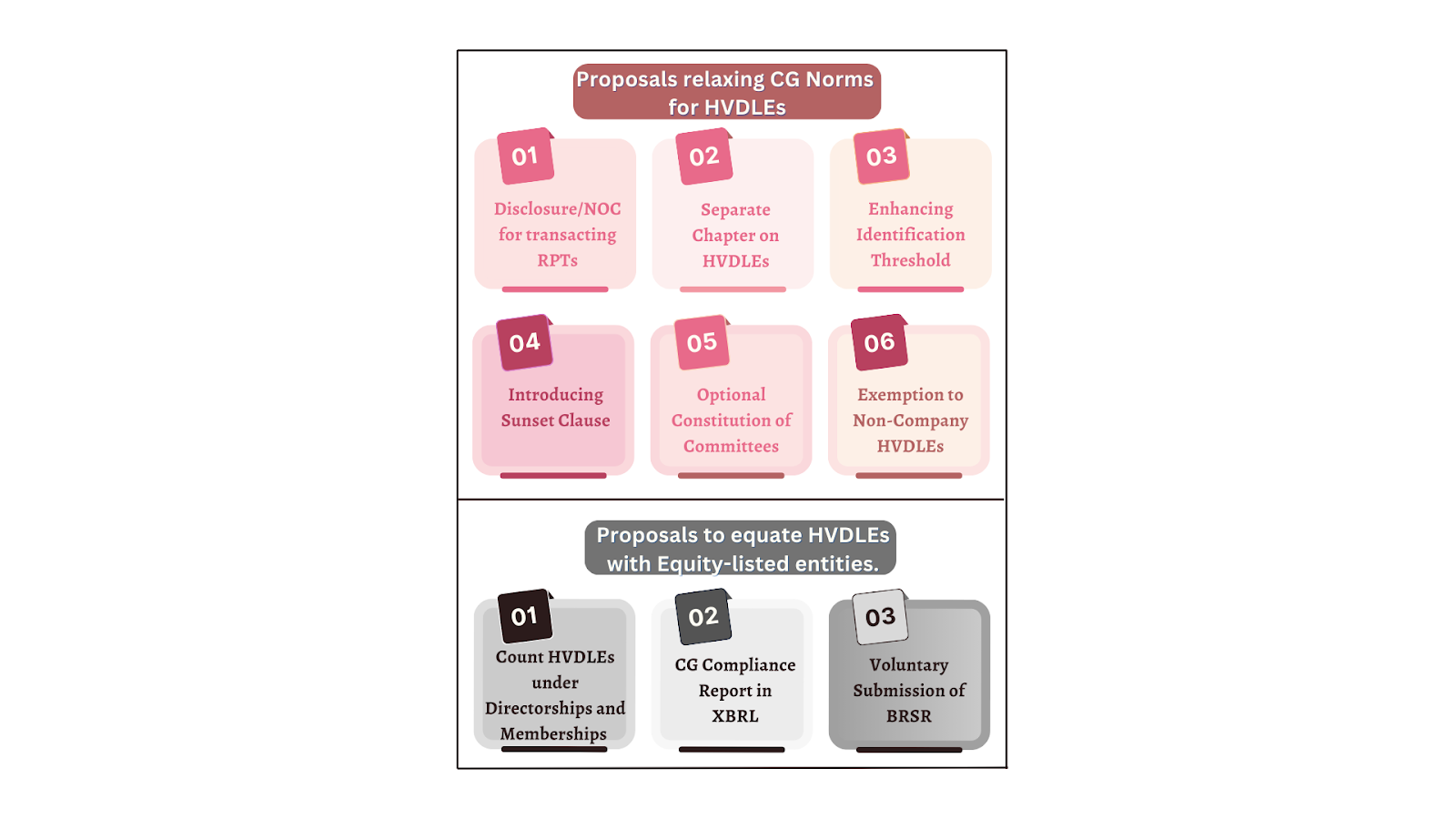
While the intent behind the CG norms being made applicable was to protect debenture holders and assimilate corporate governance amongst such issuer entities, the complexities associated with its implementation hindered the ease of doing business and increased the compliance burden manifold. The current CP delves into the comments received on the previous proposal as well as the issues that HVDLEs have been facing in practically implementing the CG norms (i.e. Regulations 16 to 27 of LODR, 2015). While it discusses the much needed and critical areas (CG chapter, mandatory committees, RPTs, etc.) where HVDLEs can be considered to be relieved and not be kept on the same pedestal as that of the equity listed entities, however, for some provisions (included for max no. of directorship, committee membership, XBRL filings, etc.), HVDLEs have been proposed to be roped in at par with entities with their specified securities listed. While each of the proposals have been discussed in detail below, a snapshot of the same can be seen in the diagram below:

Proposals relaxing CG Norms for HVDLEs 

  1. Providing In-Principle Declaration or obtaining No-Objection Certificate (NOC) from NCD holders in connection with RPTs:

One of the most crucial concerns for HVDLEs was the impossibility of compliance when it came to securing approvals for RPTs. The same was highlighted by SEBI in its earlier CP dated 8th February, 2023 wherein it was mentioned that 104 out of 138 HVDLEs as of 31st March, 2022,   comprised of shareholders with more than 90% of them being related parties (RPs). 

The current proposal is set against a reference to a banking transaction wherein the lender reserves the right to allow the borrower to enter into any transaction that might be unfavorable to the lender such as entering into RPTs. Thus, HVDLEs being of the nature of a borrower and the debenture holders being the lenders, it is paramount to protect the latter’s interests by enforcing such provisions as may be necessary and safeguarding them through a debenture trustee. 

In view of the same, the proposition has the following features:

  • Either provide an upfront declaration in the offer document with respect to the amount of RPTs proposed to be entered over the tenure of the NCDs along with the percentage of the same when compared with the issue size or obtain an NOC from the debenture trustee, who in turn needs to obtain it from the debenture holders (the majority not being related to the issuer) for all the material RPTs as and when they are required to be transacted;
    • VKCo Comments – Until the fine print of the regulations is rolled out, it is understood that only the broader limits of the estimated RPTs are required to be mentioned unless otherwise finer details are required which can become extremely difficult for these entities.Further, for the alternative requirement, there does not seem to be any incentive to first approach the debenture trustee and thereafter the trustee to approach the NCD holders, which can actually be done directly.
  • monitoring of the issue proceeds by a credit rating agency; and
  • declare the following in the offer document upfront and be maintained over the tenure of the NCDs:
    • debt-equity ratio, 
    • debt service coverage ratio; 
    • interest service coverage ratio and;
    • such other financial/ non-financial covenants 
  • VKCO Comments – Both the aforesaid proposals do not serve the exact purpose of maintaining controls over RPT. Also, these are also reflected in the financials to some extent.
  1. Introduction of a separate chapter for the governance of HVDLEs

LODR in its present form consists of 12 Chapters, each having its purpose and application. As far as the CG norms are concerned, HVDLEs are required to follow the provisions primarily centered around equity listed entities which, inter alia, relate to the composition of the Board of Directors, the constitution of various specialized committees, stipulations regarding RPTs and so on. Having said that, these provisions are not completely relatable to HVDLEs since the majority of these entities are purely debt listed without any other security being listed. Accordingly, it has been proposed to introduce a separate chapter on CG norms for HVDLEs distinct from the existing one for equity listed entities. 

VKCO Comments: While this proposal is noteworthy, however, instead of rolling out a new chapter, there could have been certain modifications in the existing regulations by way of a proviso to align with the needs of an HVDLE. Further, one also needs to wait to see the fine print of the provisions once the same is issued.

  1. Increase in threshold for being identified as an HVDLE 

Based on the data provided by NSDL as of 31st March, 2024, the number of pure debt listed entities with an outstanding of more than Rs. 500 crores is 166 (comprising of an aggregate outstanding of Rs. 13.54 lakh crores), of which 112 entities are those having an outstanding of more than Rs. 1,000 crores (comprising of an aggregate outstanding of Rs. 13.16 lakh crores). 

Further, referring to SEBI’s circular dated 19th October, 2023 in which the threshold limit of outstanding long-term borrowing was enhanced from  Rs.100  crore to Rs.1,000 Crore for the purpose of being identified as a Large Corporate called for introspection at the existing threshold of being identified as an HVDLE. Aligned with its objectives of tightening the regulatory regimes for debt listed entities and at the same time promoting ease of doing business in the corporate bond market, the proposal suggests doubling the limit from the present threshold of Rs. 500 crores to Rs. 1,000 crores.  

VKCo Comments: The proposal to enhance the extant threshold is encouraging in terms of governing the maximum value of outstanding debt while at the same time achieving the same without bearing the burden of compliance by an increased number of purely debt listed entities. Subsequently, effective implementation of such a proposal aligns it with the identification criteria of Large Corporates. 

  1. Introduction of “sunset provisions” for non-applicability of CG norms: 

The extant Regulation 3(3) of SEBI (LODR), 2015 provides for the applicability of the CG norms even when the value of the outstanding debt securities falls below the specified threshold forever. The same is in contradiction with respect to the period of applicability as compared to its equity counterpart wherein Regulation 15(2)(a) provides that the norms will have to be complied till such time that the equity share capital or net-worth of the listed entity falls and remains below the specified threshold for a period of three consecutive financial years. Accordingly, for the purpose of aligning the non-applicability, a similar sunset provision for HVDLEs too has been proposed. The proposal outlines that the CG norms shall continue to remain in force for HVDLEs till such time the value of outstanding debt listed securities (reviewed on the cutoff day being 31st March of every financial year) reduces and remains below the defined limits for a period of three consecutive financial years and further ensuring compliance within a period of six months from the date of a subsequent increase in the value above the trigger. The proposition also provides for disclosing such compliances in the Corporate Governance compliance report to be submitted on and following the third quarter of the trigger. 

VKCO Comments: The proposal is welcome since it clearly sets the HVDLEs free from the barrier of once an HVDLE so always an HVDLE. This proposal sets a clear nexus between the compliance and the size of the debt outstanding, for the protection of which in the very first place, the compliance triggered.

  1. Certain mandatory committees made optional

Regulations 19, 20 and 21 of LODR mandate the constitution of the Nomination and Remuneration Committee (NRC), Stakeholders Relationship Committee (SRC) and Risk Management Committee (RMC) respectively and provide for their composition, the number of meetings to be held, quorum, duties and responsibilities, among other things. The proposal recognises the difficulties of constituting multiple committees by HVDLEs and therefore, extends the option of either establishing such committees or ensuring delegation and discharge of their functions by the Audit Committee in the case of NRC and RMC and by the Board of Directors in case of SRC. 

VKCo Comments: Given the close construct of debt listed entities, it is often observed that the constitution of such committees becomes more of a hardship than in smoothening compliance and discussing specific matters. Accordingly, it looks appropriate to redirect the functions of NRC and RMC to the Audit Committee and that of the SRC to the Board. 

  1. Exemption to entities not being a Company

Several entities are not incorporated in the form of companies and therefore, are regulated by specific acts of the Parliament. The rationale behind this move lies in the fact that the administration of these entities is governed by such specific Acts subject to approval from the concerned Ministries. An exclusion on similar lines was granted to equity listed entities by way of Regulation 15(2)(b) which was later omitted w.e.f. 1s September, 2021 vide notification dated 5th May, 2021.

Further, it is awaited as to how effective and permanent such an exemption would be, but SEBI’s working group has proposed for dispensation of entities like NABARD, SIDBI, NHB, EXIM Bank and such other entities fulfilling the criteria as laid out above and application of CG norms to the extent that it does not violate their respective regulatory framework formulated by the concerned authorities. 

VKCo Comments: While SEBI refers to the introduction of similar exclusion for equity listed entities, however, it has also mentioned the subsequent amendment wherein the same was omitted. In any case, the instant proposal is a welcome change since it will help such entities to give preference to their principal statutes and not an ancillary one like LODR. 

Proposals to equate certain CG Norms for HVDLEs to that of equity listed entities: 

  1. Count HVDLEs under no. of directorships, and memberships of Committees:

    The extant provisions of Regulation 17A of LODR and Section 165 of the Companies Act, 2013 limit the number of directorship positions that a person can hold, with appropriate sub-limits being set out with respect to public companies and equity listed companies. Similarly, Regulation 26 of the SEBI (LODR), 2015 places ceiling limits on the number of memberships and chairmanships that a person can hold in committees across all listed entities, with explicit exclusion for such positions held in HVDLEs. 

    The instant proposal is for including the directors in HVDLEs as well as committee membership and chairpersonship positions held in HVDLE just as equity listed entities are included. 

    The same has been proposed in view of the fact that directorship is a significant position in any company and therefore, multiple directorships beyond a reasonable limit are likely to inhibit the ability of a person to allocate appropriate time to play an effective role in delivering its responsibilities including the timely repayment of debt.. 

    Further, the initial proposal for inclusion of HVDLEs in max no. of directorship allows a period of six months or till the next AGM to ensure compliance. 

    VKCO Comments: The rationale completely aligns with the proposal made and seems to be justified.

    1. Compulsory filing of CG Compliance Report in XBRL format:

    Pursuant to Regulation 27(2), which mandates the submission of a quarterly report on complying with CG norms by listed entities, the format of the report has been supervised by Annexure 3 under Section II-B of the Master Circular for compliance with the provisions of SEBI (LODR), 2015 by listed entities in case of equity listed entities and Annexure VII-A under Chapter VII of the Master Circular for listing obligations and disclosure requirements for Non-convertible Securities, Securitized Debt Instruments and/or Commercial Paper in case of HVDLEs. The issue arises from the practice adopted by HVDLEs in the instant case, where filings made on the website of the stock exchange have been made in PDF format thereby affecting the readability and clause-wise compliance monitoring. Unlike the above-mentioned proposals which aim at bringing about relaxations for HVDLEs, this particular proposal tightens the regime by binding the XBRL format that is consistent with what is being filed by equity listed entities, for the report to be submitted on a quarterly basis. 

    VKCo Comments: This proposal is with an objective to align and standardize the filing of quarterly CG compliance report for bringing parity as in the case of equity listed entities. 

    1. Voluntary submission of Business Responsibility and Sustainability Report (BRSR):

    This proposal originates from SEBI’s endeavour to inculcate good CG practices in HVDLEs, to be at par with equity listed entities. It is supported by Regulation 34(2)(f) which requires the top 1,000 listed entities (based on market capitalization) to include a BRSR in their annual report. It is pertinent to note in this respect that publishing of BRSR by HVDLEs is voluntary and not a mandatory requirement unless such an HVDLE also satisfies the criteria of the above-stated regulation. 

    VKCo Comments: The inclusion of a voluntary provision in the legislation with respect to a comprehensive report like BRSR is not likely to be submitted given the huge details under the BRSR. However, an opportunity to submit BRSR can be a game changer for an HVDLE from the perspective of being able to raise funds based on its reporting standards in this regard. 

    Concluding Remarks:

    The proposal under the CP provides hope for a breather when it comes to compliance with CG norms and at the same time introduces certain new requirements to maintain uniformity whether it is for the XBRL filing or inclusion of directorship and committee membership as well as chairmanship in an HVDLE for the max no. of such positions. It will also be interesting to see what is rolled out under the new chapter for HVDLEs as well as the fine print of provisions as far as RPT controls are concerned.

    Refer to our related resources below:

    Welcome Aboard Mr. 0101101: Inducting AI in corporate boardroom

    -Harshita Malik | corplaw@vinodkothari.com

    From zeroes and ones, to limitless possibilities, Artificial Intelligence (“AI”) has traversed a remarkable journey from theoretical concept to pervasive reality, revolutionizing industries, societies, and daily life. AI has significantly impacted various aspects of our daily lives and industries, including agriculture, finance, education, transportation, and entertainment. Corporate governance is also experiencing this transformation. This article provides an insight as to where AI stands in between the boardroom strife.

    Read more

    IRDAI notifies CG Regulations, 2024

    Mahak Agarwal | corplaw@vinodkothari.com

    Introduction

    The Guidelines for Corporate Governance (‘2016 Guidelines’) for insurers in India have been around for close to a decade now. These Guidelines were initially brought as an update to the then 2009 Guidelines for the purpose of aligning the same with the extensive changes to the governance of companies brought about by the Companies Act, 2013. As such, the new Guidelines were framed to be mostly in line with the Act of 2013 except certain provisions such as requiring the CEO to be a WTD of the Board (where the chairman is NED), prescribing fit and proper criteria for directors, requiring certain additional committees, having only profit criteria for CSR applicability, etc.

    Through the years, these Guidelines have served as a valuable source of direction in ensuring corporate governance for insurers; laying down guidance for the composition, roles and responsibilities of the Board, functions of various Board Committees, appointment and remuneration of KMPs, disclosures in financial statements, etc.

    Read more

    Corporate Governance: Miles Travelled and Miles to go

    Get your very own copy here

    Discover a comprehensive guide to Corporate Governance, offering an insightful journey through its evolution and key concepts. This book provides in-depth coverage across various areas, making it an essential read for professionals. Key highlights include:

    • Covers the complete ecosystem of corporate governance – board and its committees, independent directors, auditors, proxy advisors and shareholders
    • Extensive coverage on significant aspects such as conflicts of interest, information symmetry and corporate transparency
    • Futuristic focus: covers use of technology in corporate governance like the use of AI boardroom decisions
    • Sustainability and business responsibility covering directors’ liability for climate change, sustainability financing, reporting and CSR.
    • Substantial coverage on insider trading and related party transactions with guidance to practical implementation of complex provisions
    • Global coverage to understand international best practices with focus on Indian legislation so as to make a wider context for the readers.
    • Several chapters are supported by extensive, well-classified FAQs
    • Regulatory information updated till 30th June, 2024; Registered readers will be provided updates upto a limited time [check inside the Book for google form link]

    AGENDA – Felicitation meet-cum-Panel Discussion on Corporate Governance

    Register Here for the Panel Discussion on Corporate Governance

    Loader Loading…
    EAD Logo Taking too long?

    Reload Reload document
    | Open Open in new tab

    Download as PDF [144.04 KB]

    Felicitation Meet and Panel Discussion on Corporate Governance – from 1988 to Now

    Register here

    Agenda for the Panel Discussion

    About the Book

    Live on Youtube

    Loader Loading…
    EAD Logo Taking too long?

    Reload Reload document
    | Open Open in new tab

    Download as PDF [2.03 MB]

    Growing relevance of Audit Committee and IDs

    For boosting corporate governance framework

    – Pammy Jaiswal, Partner | pammy@vinodkothari.com

    Background

    In the era where the regulators are constantly bringing amendments to secure the stake and protect the interest of shareholders (including the stakeholders), it becomes imperative to understand the role, function and relevance of one such board committee being the ‘Audit Committee’ (hereinafter referred to as the ‘AC’) which has been given the responsibility to oversee and monitor several crucial matters after the board of directors. These functions are in the nature to ensure transparency and accountability (pillars of corporate governance) to a large extent. It has been seen in several cases in the past that lapses on the part of this committee often leads to major scams and corporate scandals.

    In this paper, the author has tried to explain the idea and intent of the law makers behind introducing the concept of the AC, its expected role and function in ensuring and boosting corporate governance given the terms of reference suggested under applicable laws in India with a brief global comparison.

    The entire Paper as was published by SSRN can be read here