In order to regulate mis-selling concerns for both products/ services of regulated entities and third-parties by a regulated entity, amendments have been issued ‘Advertising, Marketing and Sale of Financial Products and Services by Regulated Entities’, via two sets of amendment directions for Commercial Banks:
FAQs on Advertising, Marketing and Sale of Financial Products and Services, and agency activities: NBFCs here.
The Brochure for a half day workshop on June 26, 2025 (Physical-Bengaluru) where we will be discussing the Amendment Directions in detail can be accessed through here.
https://vinodkothari.com/wp-content/uploads/2023/06/vinod-kothari-logo.png00Staffhttps://vinodkothari.com/wp-content/uploads/2023/06/vinod-kothari-logo.pngStaff2026-06-23 14:47:192026-06-25 11:14:26FAQs on Advertising, Marketing and Sale of Financial Products and Services, agency and referral activities: Commercial Banks
Effective Date: The Amendment Directions propose an effective date of January 1, 2027, upon formal notification.
The amendments introduced go beyond mere consolidation of existing circulars; they introduce new obligations and structural changes to the governance norms. Key changes are given below, for banks, refer to our article here.
Important concepts defined: The Amendment Directions contain new definitions of key concepts relating to control and assurance functions, including ‘Assurance’, ‘Clawback’, ‘Compliance’, ‘Compliance Culture’, ‘Compliance Function’, ‘Compliance Risk’, ‘Control Functions’, ‘Internal Audit Function’, ‘Internal Audit Plan’, ‘Internal Controls’, ‘Risk Appetite’, ‘Risk Limits’, ‘Risk Management’, and ‘Risk Management Function’.
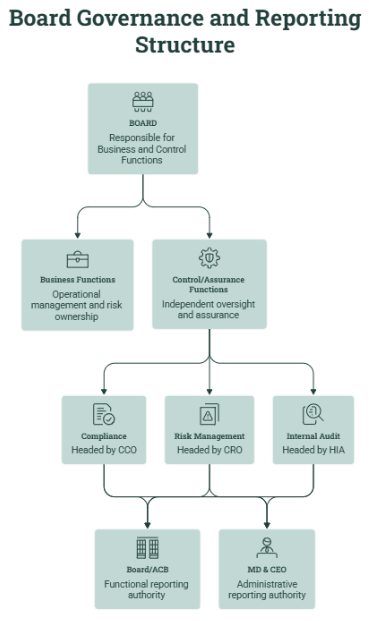
Common instructions for CRO, CCO and HIA: The Amendment Directions provide a unified set of provisions for the three heads of control and assurance functions, namely, Chief Risk Officer (CRO), Chief Compliance Officer (CCO), and Head of Internal Audit (HIA), covering eligibility, appointment conditions (seniority ≤2 levels below MD & CEO, Board approval, tenure ≥3 years, premature removal requiring Board approval), independence, and reporting lines (functional to Board/ACB; administrative to MD & CEO). Does this mean that the same person can be appointed as the CCO and HIA? Given that the role of the HIA includes oversight on compliance risk, it will be counter-intuitive to have the same person as the head of the compliance function as well as the head of internal audit. Similar instructions have also been introduced for banks.
Relaxation for Base Layer continues and further enhancement- Under the existing framework, the CCO framework was applicable on Middle Layer NBFC and appointment of CRO and RBIA Framework on those with an asset size more than ₹5000 crore, respectively. The said exemption for base layer NBFCs continues and further even includes the requirement of constituting the RMC.
₹5,000 crore threshold for mandatory RMC: NBFCs with total assets of ₹5,000 crore or above must constitute a RMC and establish a Risk Management Function headed by a CRO; the RMC is responsible for evaluating overall risks, including liquidity risk, and reporting to the Board. The existing regulations require the RMC to be constituted by all NBFCs irrespective of asset size, and hence, this may be seen as a major relaxation.
Quarterly Board meetings without Senior Management: CCO, CRO, and HIA must meet the Board or ACB at least once every quarter without the presence of Senior Management (including MD/CEO/WTD), and must have direct and unrestricted access to the Board/ACB to communicate concerns without management interference.
Stricter external hiring restrictions: Consultants, advisors, part-time auditors, or individuals who are neither on the NBFC’s payroll nor have a contractual employer-employee relationship with the NBFC shall not be appointed/designated as CRO, CCO, or HIA. The same criteria has been prescribed for banks as well.
Differentiated intimation timelines to RBI/NHB: For CCO and HIA (NBFC-ML and above), appointment/premature transfer/removal/exit/change in tenure must be reported to DoS, RBI/NHB at least five working days in advance, with candidate profile and fit & proper confirmation; for CRO, such intimation must be made within five working days, accompanied by the candidate’s profile.
CRO’s role in credit committee and override mechanism: CRO shall be an invitee to credit sanction/approval committee meetings without voting rights; where risk/exposure is assumed contrary to CRO advice without adequate mitigation, the responsibility rests with the next higher authority in the delegation matrix (except where the Board is the risk-assuming authority), and all such cases must be reported to the Board/RMCB.
Internal audit of Compliance and Risk Management Functions: The Compliance Function and Risk Management Function shall be subject to regular internal audit.
New tenure and audit-cycle mandates for Internal Audit: Staff posted to the Internal Audit Function shall ordinarily have a tenure of at least three years, and all significant activities shall be audited over a defined cycle ordinarily not exceeding three years, with high-risk areas reviewed more frequently.
RBIA adoption and NBFC-BL exemption: All NBFCs shall adopt a Risk-Based Internal Audit (RBIA) approach focusing on higher risk, materiality, systemic relevance, and supervisory concerns as given in Annex I-A of the Amendment Directions; adoption of RBIA is voluntary for NBFC-BL. As per the Companies Act, internal audit is applicable even on private companies having a turnover of ₹ 200 crore rupees or outstanding loans or borrowings exceeding ₹100 crore or more. This means that even Base Layer NBFCs can be subjected to internal audit requirements. However, risk-based internal audit will be applicable only in case of Middle Layer and above entities. RBIA is an audit methodology that focuses on identifying, assessing, and prioritising the most significant risks faced by an organisation, and allocating audit resources accordingly. Unlike traditional compliance-oriented audits, RBIA aligns audit activities with the NBFC’s risk management framework and strategic objectives. Refer to our article on RBIA – here.
Periodic external review for NBFC-UL Risk Management Function: NBFC-UL shall subject its Risk Management Function to periodic external review to benchmark practices and strengthen effectiveness. However, in the case of banks, all three functions- compliance, risk and internal audit are subject to external review.
Formal Risk Exposure Matrix (9-cell grid) & Risk Audit Prioritisation Matrix (Magnitude vs. Frequency): The Amendment Directions introduce two formalised, structured risk assessment and prioritisation tools under the RBIA framework (Annex I‑A).
Assumption of risk exposure contrary to the advice of CRO: If risk is taken contrary to the CRO’s advice without adequate mitigation, the responsibility lies with the next higher authority in the delegation matrix (except when the Board is the risk-assuming authority). All such cases must be reported to the Board/RMC.
Intimation of appointment to RBI/NHB: For CCO and HIA: Report appointment/premature transfer/removal/exit/change in tenure at least 5 working days in advance (pre-event intimation). Intimation to include profile and fit & proper confirmation by the competent authority. Appointment may be communicated to the candidate only after the five-day window, unless a contrary communication is received from RBI/NHB. For CRO: Report appointment/premature transfer/removal/exit/change in tenure within 5 working days (post-event intimation).
For ease of reference, the amendments have been classified into three categories and detailed below:
Changes Common for CCO, CRO and HIA
Provision
Draft Amendment Directions
Current Directions/Circulars
Rank
Not more than two levels below MD & CEO (for SPDs: not more than three level; for NBFC-BL: as per policy)
CCO shall be not below two levels from CEO; for NBFC-ML, relaxable by one further level
Appointment tenure
Ordinarily not less than three years with no explicit relaxation. Premature transfer/removal requires Board approval
Board permitted to relax the minimum three-year tenure by one year in exceptional cases for CCO.
External Hiring
External hiring permitted, however, consultants, advisors, part-time auditors, or individuals without employer-employee relationship with the NBFC.
External hiring permitted, no negative list prescribed
Reporting Line
Functional reporting: Board/ACB; Administrative: MD & CEO
Reporting by CCO to MD & CEO was the primary option; Board reporting was an alternative.
Quarterly meeting without senior management
Meet Board/ACB quarterly without Senior Management (including the MD / CEO / WTD)
CCO and CRO shall meet the Board or ACB at least once a quarter without the presence of the Senior Management (including the MD / CEO / WTD)
Intimation to RBI/NHB
For CCO and HIA:report appointment/premature transfer/removal/exit/change in tenure at least 5 working days in advance (pre-event intimation). Intimation to include profile and fit & proper confirmation by competent authority. Appointment may be communicated to the candidate only after the five-day window, unless a contrary communication is received from RBI/NHB
For CRO:Report appointment/premature transfer/removal/exit/change in tenure within 5 working days (post-event intimation)
Prior intimation was required for appointment of CCO without specifying a minimum period. Intimation to include Detailed profile of candidate, fit and proper certification by MD & CEO confirming the person meets prescribed supervisory requirements and rationale for changes, if applicable.
Internal audit
Compliance Function and Risk Management Function shall be subject to regular internal audit
No explicit requirement that Compliance must be audited by IA
Changes Specific to CRO
Provision
Draft Amendment Directions
Governance Directions
Threshold for RMC
NBFCs with assets ≥ ₹5,000 crore
All NBFCs
CRO’s role in credit decision
CRO shall be an invitee to the meetings of the credit sanction / approval committee, without any voting rights.
CRO shall have voting power and all members shall individually and severally be liable.
Contrary risk advice
Assumption of any risk / exposure, contrary to the advice of the CRO, without incorporating adequate risk mitigation measures, shall rest with the next higher authority in the delegation matrix.
No equivalent provision.
Risk Management Function duties
Ensure NBFC operates within risk appetite; assess risks independently – Implement NBFC-wide risk strategy aligned with Board-approved risk appetite; clear risk limits; allocate parameters – Robust information infrastructure for capital/liquidity, granular monitoring, consolidated reporting – Continuously evaluate exposures vs. limits; challenge business decisions; escalate critical issues to SM/Board/RMCB
CRO had similar duties but risk appetite/limits were not defined and escalation mechanism was not explicitly prescribed
External review of Risk Management Function
NBFC-UL shall subject Risk Management Function to periodic external review to benchmark practices and strengthen effectiveness
No explicit external review requirement for Risk Management Function
Changes in Internal Audit Function – RBIA
Provision
Draft Amendment Directions
RBIA Circular
Applicability of CRO
NBFC-ML and above (mandatory), thus, making it mandatory for ML entities irrespective of asset size; NBFC-BL (voluntary).
Deposit-taking NBFCs (all sizes) and non-deposit-taking NBFCs with assets ≥ ₹5,000 crore
Tenure of internal auditors
Staff posted to Internal Audit Function should ordinarily have a tenure of at least three years
No specified tenure for internal audit staff
Internal audit cycle
All significant activities audited over a defined cycle ordinarily not exceeding three years; high-risk areas to be reviewed more frequently
No specified audit cycle
Structured RBIA Framework
Risk Exposure Matrix (9-cell grid, inherent risk vs. control risk) and Risk Audit Prioritisation Matrix (magnitude vs. frequency) has been specified.
No such formal risk matrix was specified.
https://vinodkothari.com/wp-content/uploads/2023/06/vinod-kothari-logo.png00Staffhttps://vinodkothari.com/wp-content/uploads/2023/06/vinod-kothari-logo.pngStaff2026-06-11 17:06:482026-06-12 11:31:42Control and Assurance Functions for NBFCS- RBI Proposes Consolidation
RBI continues its drive of regulatory reforms for the banking sector, with the recent one being the amendment proposed in the governance directions applicable to commercial banks i.e. Draft Reserve Bank of India (Commercial Banks – Governance) Amendment Directions, 2026 (Draft Directions) relating to policy and non-policy matters placed before the Board for approval, review, information etc. proposed to be made applicable from September 1, 2026. As indicated in RBI’s Statement on Developmental and Regulatory Policies, RBI has undertaken comprehensive review and rationalization of all earlier instructions in an endeavor to enable Boards to utilize its time effectively, and to facilitate a more focused and qualitative engagement on strategy and risk governance.
While, the Draft Directions provide a compilation of matters to be placed before the Board and those that can be delegated to a specific committee or any committee of board/ management, it also provides the principles to be considered by the board while delegating the matters thereby ensuring the adequate oversight of the board on delegated matters. The amendment would primarily affect the manner in which information is placed before the board of banks, manner and extent of delegation of their powers to committees of board and/or management and reporting requirements for such matters.
The Draft Directions are applicable to both public sector banks and private sector banks.
In this piece, the authors analyse the proposed amendment, impact and indicate the likely actionables for Banks if the amendment is notified as is.
The Role of the Board
The Board of a Bank is expected to majorly focus on overseeing the risk profile of the Bank, monitoring the integrity of its business and control mechanisms, ensuring the expert management, and maximising the interests of its stakeholders. The Board always had the power to delegate certain items to management and board committees, in some cases by way of express provisions in RBI directions, guidelines. But at the same time, it must set and enforce clear lines of responsibility and accountability for itself as well as the senior management.
The Draft Directions draw a clear line between the matters to be dealt by the Board and the matters which can be delegated to committees with only material matters being placed before the Board. Further, a principle based approach is provided for the manner in which information is placed before the Board.
Principle Based Approach for matters to be placed before the Board
The objective of these principles is for the Board to consciously examine the areas where it devotes its valuable time and expertise. The principles require the Board to document express guidelines on the manner in which information is being placed before it.
The board is required to clearly articulate the matters reserved for its approval or to be brought to its notice for information or reporting, based on applicable laws and define the nature, level of detail and frequency of information required from the management. To optimize the time of the Board for real value addition, the chairperson of the Board shall have the primary responsibility of setting the agenda of the meeting.
The matters being placed before it or the Board committees, sub-committees or senior management must be reviewed periodically. This would enable the Board to examine and revoke delegation or further delegate responsibilities wherever required. The review must be detailed enough to include the timelines for circulation of agenda items, adequacy of information captured in the agenda, time allotted for important matters, etc.
The Powers of Delegation
The RBI (Commercial Banks – Governance) Directions, 2025 (existing Directions) provide for delegation of specific items viz. reviews dealing with various performance areas, monitoring of the exposures (both credit and investment) of the bank, review of the adequacy of the risk management process and upgradation thereof, internal control system, ensuring compliance with the statutory / regulatory framework, etc. to a Committee of Board. For ease of reference, the Draft Directions compile as well as draw a clear line between the matters to be dealt by the Board and the matters which can be delegated to committees with only material matters being placed before the Board.
This distinction would enable the Board to focus on its key areas of responsibility – risk and strategy governance and strengthens its powers of oversight over the risk management system, exposures to related entities and conformity with corporate governance standards[1].
Policy Matters
A list of policies which must be placed before the Board for its approval and which may be delegated for review are prescribed in Appendix-I of the Draft Directions. The Board is responsible for approving the policies at the time of framing and only periodical review is to be delegated to the committees. In case of any ‘material amendments’ (to be defined by the Board), the Board’s approval must be sought. Thus, the Board does not lose complete oversight.
Along with a major consolidating exercise, the Draft Directions also indicate policies where delegation is expressly allowed, even where the underlying directions/ guidelines did not expressly provide for the same. Accordingly, the amendments are enabling in nature in certain cases, as illustrated below:
Where the bank intends to function as a Professional Clearing Member in commodity derivatives, policy for-Specification of risk control measures and prudential norms for exposure limits for each trading member;Governing the bank’s exposure to trading members, ensuring consistency with the overall risk appetite and regulatory requirements.
Policy on- Courses / certifications required for specialised areas of operationsList of sensitive positions to be covered under mandatory leave requirements
Any Committee to which powers have been delegated by the Board.
Matters other than policy
Matters other than policies which must be placed before the Board for its approval, review or information are given in Appendix-II of Draft Directions. While several matters must be mandatorily taken up by the Board, the Board shall have the discretion to delegate certain matters even where the underlying directions/ guidelines did not expressly provide for the same. Accordingly, the amendments are enabling in nature in certain cases – for e.g. matters relating to risk assessment methodology for RBIA, Annual Audit Plan, analysis of incidents of operational risk failures & their impact to audit committee, matters relating to investment portfolio to risk management committee.
The Draft Directions also provide for discontinuation of about 6 matters at the discretion of the Board. In certain cases, such as ATM transactions including failed transactions and penalties paid, certain details are to be placed before the Board. The details must be forwarded to RBI along with the Board’s observations. The Draft Directions proposes that such review may be discontinued at the discretion of the Board. Accordingly, amendments would be required in the underlying laws as well. Similarly in case of matters relating to loans to stockbrokers and market makers where the provisions mandate half-yearly review of the aggregate portfolio, its quality and performance by the Board, the board will have to exercise its discretion depending on the extent of exposure.
Proposed Omissions
Certain provisions of the existing Directions proposed to be omitted are as follows:
Para
Provision deals with
VKC Remarks
14
The Board should focus on the 7 themes of: Business Strategy, Risk, Financial Reports and their integrity, Compliance, Customer Protection, Financial Inclusion, Human Resources
Instead of specifying the themes, the proposed amendment indicates that the ultimate responsibility for the bank’s performance, conduct and control rests with the Board and that it needs to ensure that sufficient time is dedicated to strategy and risk governance.
16
Review of action taken on points arising from earlier meetings till the satisfaction of the board
Broader discretion provided to Banks to decide internal processes and articulate matters requiring its approval or to be brought for reporting or noting of information.
17
Placing regulatory communication from RBI and the government along with supplementary information before the Board
18
Delegation expressly permitted for: Reviews dealing with various performance areas and only a summary on each of the reviews may be put up to the Board at periodic intervals; Monitoring of the exposures (both credit and investment) of the bank; Review of the adequacy of the risk management process and upgradation thereof; Internal control system; Ensuring compliance with the statutory / regulatory framework, etc.
A prescriptive list of permitted delegation has been specified by RBI, refer discussion below.
19
Procedural technicalities relating to placing a summary of key observations by directors at the next board meeting and confirmation by directors for their observations, dissents etc.
Broader discretion provided to Banks to decide internal processes.
Conclusion
The Draft Directions propose to optimise the time of the Board of Banks to focus on strategic and governance matters instead of operational matters. While this measure aims to boost the productivity of Banks and bring ease of doing business in the short term, once notified, several actionables would arise for Banks. Banks must examine their current decision making structure, at the level of the Board and delegation to committees, to understand how they would align it with the proposed amendments.
[1] Para 15 of the existing directions retained as para 11A of the Draft Directions.
https://vinodkothari.com/wp-content/uploads/2023/06/vinod-kothari-logo.png00Staffhttps://vinodkothari.com/wp-content/uploads/2023/06/vinod-kothari-logo.pngStaff2026-04-15 15:11:112026-04-15 15:19:42Delegation of powers by Board made prescriptive yet principle based
The RBI recently opened the avenues for banks to provide funding for acquisitions. For domestic banks, enabling changes were made videAmendment Directions on Capital Market Exposure dated 13.02.2026, covered in our write up here, and for global banks, the enabling amendments were made in ECB Regulations by relaxing the end-use restrictions vide notification here, covered in our write up here.
This write up discusses what is acquisition finance, what are the global structures and risks, and whether India will now be ushered in the new, arguably risky world of leveraged finance.
What is acquisition finance?
Acquisition finance, known by various names such as M&A finance, leveraged finance, LBO finance, etc is globally practiced by banks. Wherever there are inflexibilities or restrictions on banks lending for acquisitions, the gap has given room for private credit lenders, special situation funds and alternative investment funds to chip in – which is what accounts for the sharp rise in private credit funds. See our article on private credit AIFs here.
LBO financing added to approximately US $214 Billion globally for 2024. As per a 2024 S&P report, banks funded only about 23% of LBO financing globally with private debt players covering the other 77%. The reasons for such reduced share for banks include intensive capital charge applicable to banks, lower profitability on such loans and over-leverage risks (see discussion below).
Source: S&P Global
How is acquisition finance structured?
The end-use of acquisition finance is the control or significant holding over the target. Therefore, quite naturally, the collateral for acquisition finance are the shares of the target. Taking the collateral is intuitive, but the issue is, how is the loan repayment structured? The most logical way to structure an LBO is to align the loan repayment with the residual cash flows from the target. Hence, it is returns on equity from the target that pay the loan.
Lenders may quite structure the loan with the possibility of refinancing the acquisition, such that the initial funding term is not as long as the payback period of the target is. For example, a company borrows ₹500 Crores to acquire a business generating ₹100 Crores annually, repays only ₹20 Crores of loan each year for 5 years, leaving ₹400 Crores outstanding at maturity, which it then refinances with a new ₹400 Crores loan instead of fully repaying from operating cash flows. The key risk in such a case would be refinancing risk i.e. if credit markets tighten, the company may be unable to roll over the ₹400 Crores at maturity. There is also interest rate risk, as the new loan may be available only at a higher cost, increasing the debt burden.
Acquisition finance is quite risky, as it is funding the residual return which itself is impacted by all the risks of the target’s business; any downturn in performance directly impairs debt servicing capacity. It is a leverage created on structure, which itself is leveraged. Therefore, lenders may quite often be comfortable with the strength of the acquirer’s own business, etc. But the standalone strength of the cash flows of the target’s business is the ultimate comfort for an LBO investor.
Debt tranching in acquisitions
Usually a LBO is undertaken by multiple lenders so as to cut down on individual exposure and risk further and in such cases each lender may have varying risk and return expectations. In such a multi-lender LBO, instead of issuing one big, uniform loan, the capital stack is layered into tranches with different priority, pricing, maturity and covenants. Therefore, there can be senior and mezzanine debt, with tranches itself within these such as high-yield debt within the mezzanine tranche. The senior tranche typically ranks first in repayment and is secured against the company’s assets and cash flows, carrying lower interest with tighter covenants and amortization requirements.
Below this sits the mezzanine or subordinated debt, which ranks junior in the repayment waterfall, bears higher interest to compensate for greater risk. This is usually provided by non-banks and is secured by second-lien and may also be partially unsecured..
Equity sits at the bottom of the capital structure and represents the residual ownership in the company. It has no fixed repayment or guaranteed return; instead, equity holders receive whatever value remains after senior and mezzanine debt are fully repaid. Because it is last in priority, equity bears the highest risk and absorbs first losses if the company underperforms.
However, equity also captures all upside beyond debt obligations. As leverage increases, the amount of equity invested decreases, which magnifies potential returns if the company performs well and is sold at a higher value.
Sometimes, subordinated tranches may also carry a PIK or pay-in-kind feature, which implies that the periodic interest will not be serviced, but will be added to the outstanding exposure.
This layered structure allows risk to be allocated according to each lender’s appetite, reduces the overall cost of capital by pricing safer debt more cheaply and increases total borrowing capacity without overexposing any single lender.
The following chart is an illustration of a typical LBO capital structure with a bank (senior) debt of 50%, high yield debt is 15%, mezzanine is 15% and common equity is 20%. (source: hold.co):
Risks in acquisition finance
Acquisition finance is risky because it combines ownership transition, financial leverage and forward-looking projections all in one. The risks are interlinked; operational underperformance quickly becomes financial stress. Few of the risks for the lender are as follows:
Over-leverage risk: The acquisition is funded with high debt relative to cash flows. A small decline in earnings can disproportionately hurt repayments. For example, a company acquired at 6x EBITDA (₹600 debt on ₹100 EBITDA). EBITDA drops 20% to ₹80. Leverage jumps from 6.0x to 7.5x overnight.
Acquisition finance combines operating leverage (extent of fixed costs in the operating cashflows, from which the residual cashflows will arise) and financial leverage (such residual cash flows being financed by debt which carries fixed interest burden). That is what makes acquisition finance a bunch of two mutually exacerbating risks. Typically, the presence of operating leverage is balanced by keeping the financial leverage low: however, in this case, the two forms of leverage co-exist.
Projection/business case risk: Acquisition pricing may be based on forecasted synergies, ie , the combined disproportionate increase when the target comes into the group as well as growth, or margin expansion that may not materialize.
Beyond the above, financially, acquisition finance also faces valuation and cyclicality risk if the business was acquired at peak multiples or during an economic upcycle. Operationally, some of the risks in a typical M&A deal may also loom for the lender such as inadequate due diligence, top-talent attrition and integration issues.
Acquisition finance versus leveraged finance:
The two terms quite often overlap, but both refer to distinct aspects of a lending transaction. Acquisition finance specifically refers to purpose; leveraged finance, though mostly used for acquisitions, refers to the prevalence of high leverage, lower rating and cashflow-based funding structure.
Some definitions of “leveraged finance” may be pertinent, for instance, a 2021 thematic note by EBA on leveraged loans refers to a loan as ‘leveraged’, if some of the given conditions are met:
high indebtedness of the borrowing firm (e.g. debt to earnings before interest, taxes, depreciation and amortisation (EBITDA) ratio of four times (4x) or higher);
below investment grade credit rating for the loan (or borrower) (i.e. below BBB);
loan purpose to finance an acquisition (e.g. leveraged buyouts);
presence of a private equity sponsor (e.g. financing of borrowers owned by financial sponsors);
high loan spread at issuance.
This is based on a combination of definitions used by various regulators and data providers.
A definition based on combination of various aspects as per the policies prevalent in the financial sector industry was also given in the 2013 guidelines published by the US FRB as follows:
Proceeds used for buyouts, acquisitions, or capital distributions.
Transactions where the borrower’s Total Debt divided by EBITDA (earnings before interest, taxes, depreciation, and amortization) or Senior Debt divided by EBITDA exceed 4.0X EBITDA or 3.0X EBITDA, respectively, or other defined levels appropriate to the industry or sector.
A borrower recognized in the debt markets as a highly leveraged firm, which is characterized by a high debt-to-net-worth ratio.
Transactions when the borrower’s post-financing leverage, as measured by its leverage ratios (for example, debt-to-assets, debt-to-net-worth, debt-to-cash flow, or other similar standards common to particular industries or sectors), significantly exceeds industry norms or historical levels.
The end-use of leveraged finance are variegated: including mergers, acquisitions, re-capitalizations, refinancings, and equity buyouts, as well as for business and product line buildouts and expansions, whereas, acquisition finance has limited end-use.
Waves of regulatory concerns on leveraged finance:
Regulatory concerns on leveraged finance have been coming in waves – they come and recede. The oft-quoted “warning” was issued by the IMF in 2018 in its Global Financial Stability Report. The concerns lie in the ever-increasing volume of leverage loans coupled with deteriorating underwriting standards and credit quality as well as strong investor demands, resulting in fewer investor protection covenants. The BIS also raised concerns on the rise of the leveraged loans causing an increasing default rate in the US.
Since the Global Financial Crisis in 2008, regulators have, time and again, taken policy decisions to regulate the risks emanating from leveraged lending. In the context of US, reference may be made of a 2013 Interagency Guidance on Leveraged Lending read with the 2014 FAQs thereon setting out the expectations from financial institutions w.r.t. leveraged loans. In fact, guidelines for leveraged financing were issued in the US as early as in April 2001, subsequently replaced by the 2013 version.
Regulatory directives have been issued by the EU, coupled with a 2017 Guidance on Leveraged Transactions by the European Central Bank to address the risks of excessive leverage. The ECB Guidance lays down the minimum expectations from the credit institutions on leveraged transactions. A March 2019 briefing states that the 2017 guidance issued by ECB seems less effective than expected. It also refers to the warnings issued by international institutions as well as the US and EU authorities in relation to the potential risks of leveraged finance.
However, come the end of 2025, at least the US regulators have withdrawn their regulatory statements on leveraged finance, leaving it for banks to use their own prudence. The agencies, in fact, went to term leveraged finance as vital: “Leveraged lending plays a vital role in the U.S. financial system. It provides a wide range of businesses, including those that are highly indebted or highly leveraged or that have low obligor ratings..” It said the 2013 guidelines were overly restrictive and led to reduced activity by US banks.
The 2025 Global Financial Stability Report, however, continues to highlight the vulnerabilities associated with leveraged financing and the degrading credit quality: “Despite the wave of restructurings, liquidity remains strained among the more vulnerable borrowers in the leveraged loan and private credit markets. This has contributed to an increase in borrower downgrades”. “In reality, default rates, especially for leveraged loans, have been climbing, even though some of the defaults are voluntary liability management exercises, including debt exchanges…”
Impact of the RBI move
Are banks bracing up to jump into acquisition finance? Therefore, is the growing segment of the AIF market, private performing credit, going to be put to challenge?
In our estimate, it will be quite sometime before banks will really pose a competition to the fund industry. At the end of the day, banks are highly rule-driven, with multiple layers of approval processes and very tight corporate governance structures. Banks have RBI supervisors breathing down the neck. Acquisition finance needs flexibility, fast turnaround, structuring skills and bespoke terms which may be difficult for banks to match. At the same time, it is also important to note that most of the private credit funds also have a bank behind. Therefore, the move surely adds to the funding muscle that private credit funds will now enjoy – they will be able to “syndicate” acquisition finance by roping in bank lenders to take a share. In essence, it is a cake that will be shared. We also see distinct possibilities of structured funding transactions with banks taking a senior slice, and AIFs taking the role of a deal maker and risk taker.
Will the RBI move set the sails for leverage financing in India? There are several reasons to contend that the RBI’s move is far more conservative than expected by the typical leveraged finance landscape:
First, the RBI expects the acquirer’s rating to be at least BBB- (where the acquirer is an unlisted company), whereas leveraged finance is mostly below investment grade;
Second, the RBI has put a limit of D/E at consolidated level of 3: 1, leveraged finance, definitionally as well as by its very structure, works on higher levels of leverage;
Third, Section 19(2) of the Banking Regulation Act, 1949 imposes a limitation on banks by restricting them from holding shares in any company, whether as owner, pledgee or mortgagee, beyond 30% of the company’s paid-up share capital or 30% of the bank’s own paid-up capital and reserves, whichever is lower. Since leveraged buyouts commonly involve acquisition of controlling stakes with shares offered as primary security, this statutory cap constrains the extent to which banks can take equity as collateral, thereby further tempering the scope for large-ticket LBO financing.
Lastly, the apparent text of the RBI regulations on acquisition finance suggest that acquisition finance is permitted only to non-financial companies which also excludes a Core Investment Company (CIC) hence barring CICs from availing acquisition finance under the RBI framework.
https://vinodkothari.com/wp-content/uploads/2023/06/vinod-kothari-logo.png00Team Finservhttps://vinodkothari.com/wp-content/uploads/2023/06/vinod-kothari-logo.pngTeam Finserv2026-02-23 10:05:252026-02-23 10:05:50Leading to the world of LBOs: RBI opens up acquisition finance
Under the consolidation exercise, more than 9,000 circulars and directions, issued up to October 9, 2025 have now been streamlined into 238 Master Directions, drafts for which were notified on October 10, 2025, covering 11 categories of regulated entities across 30 functional areas.
From November 28, 2025, all RBI-regulated entities are now governed by a completely new set of regulations.
We have prepared a complete comparative snapshot of the familiar regulations and their new avatars for commercial banks. Further, wherever applicable, we have highlighted the changes from the notified drafts, and added comfort comments where the regulations remain unchanged from the drafts.
Effective Corporate Governance practices at banks plays a significant role in the banking sector and the economy as a whole. The banking industry in India witnessed governance failures in the past which seems to have triggered the need for the regulator to re-look at the governance guidelines for commercial banks in India.
RBI on 11th June, 2020 issued a discussion paper on the guidelines for Governance in Commercial Banks in India.
Scope of the webinar:
We intend to discuss the proposals put forth in the discussion paper in this webinar (expected duration around 90 mins) and comparing the proposed requirements with the existing ones.
Scope and applicability;
Overall responsibilities of the Board of Directors;
Duties of director;
Understanding and managing Conflict of Interest for banks;
Structure, composition and role of Board Committees;
Risk Governance Framework – The three lines of defence;
Separation of ownership from Management;
Whistle-blower mechanism.
Where:
On the internet, via Google Meet / Zoom Meeting
Please note that the webinar has a maximum capacity of 50, including the host, and entry is on first-come-first-enter basis.
Whether interactive:
Yes. Participants may post queries, either in advance or at the time of webinar. Participants may, based on feasibility, also be allowed to speak.
For registration:
Kindly mail with relevant details on – shaifali@vinodkothari.com.
https://vinodkothari.com/wp-content/uploads/2023/06/vinod-kothari-logo.png00Vinod Kothari Consultantshttps://vinodkothari.com/wp-content/uploads/2023/06/vinod-kothari-logo.pngVinod Kothari Consultants2020-06-18 10:09:522020-06-18 11:48:00Webinar on RBI discussion paper on Governance in Commercial Banks in India