RESOLUTION VALUE MAY BE LOWER THAN LIQUIDATION VALUE?

-Richa Saraf

(richa@vinodkothari.com)

The Apex Court, vide its order dated 22.01.2020, in the matter of Maharasthra Seamless Limited vs. Padmanabhan Venkatesh & Ors.[1] held that there is no requirement that the resolution plan should match the maximized asset value of the corporate debtors. Reiterating the principle laid down in the case of Committee of Creditors of Essar Steel India Limited v. Satish Kumar Gupta[2], the Hon’ble Supreme Court held that once a resolution plan is approved by the committee of creditors (CoC), the Adjudicating Authority has limited power of judicial review.

The judgment of the Supreme Court boldly brings out the object of the Insolvency and Bankruptcy Code, 2016 (“Code”), i.e. “resolution before liquidation”. However, it will be pertinent to understand whether this ruling should be considered as a benchmark? Further, what will be the situation in case of liquidation? Whether sale under liquidation can be done for a value lower than the reserve price?

Below we analyse the ruling, seeking to answer the aforementioned questions.

Read more

Fintech Framework: Regulatory responses to financial innovation

Timothy Lopes, Executive, Vinod Kothari Consultants

finserv@vinodkothari.com

The world of financial services is continually witnessing a growth spree evidenced by new and innovative ways of providing financial services with the use of enabling technology. Financial services coupled with technology, more commonly referred to as ‘Fintech’, is the modern day trend for provision of financial services as opposed to the traditional methods prevalent in the industry.

Rapid advances in technology coupled with financial innovation with respect to delivery of financial services and inclusion gives rise to all forms of fintech enabled services such as digital banking, digital app-based lending, crowd funding, e-money or other electronic payment services, robo advice and crypto assets.

In India too, we are witnessing rapid increase in digital app-based lending, prepaid payment instruments and digital payments. The trend shows that even a cash driven economy like India is moving to digitisation wherein cash is merely used as a way to store value as an economic asset rather than to make payments.

“Cash is King, but Digital is Divine.”

  • Reserve Bank of India[1]

The Financial Stability Institute (‘FSI’), one of the bodies of the Bank for International Settlement issued a report titled “Policy responses to fintech: a cross country overview”[2] wherein different regulatory responses and policy changes to fintech were analysed after conducting a survey of 31 jurisdictions, which however, did not include India.

In this write up we try to analyse the various approaches taken by regulators of several jurisdictions to respond to the innovative world of fintech along with analysing the corresponding steps taken in the Indian fintech space.

The Conceptual Framework

Let us first take a look at the conceptual framework revolving in the fintech environment. Various terminology or taxonomies used in the fintech space, are often used interchangeably across jurisdictions. The report by FSI gives a comprehensive overview of the conceptual framework through a fintech tree model, which characterises the fintech environment in three categories as shown in the figure.
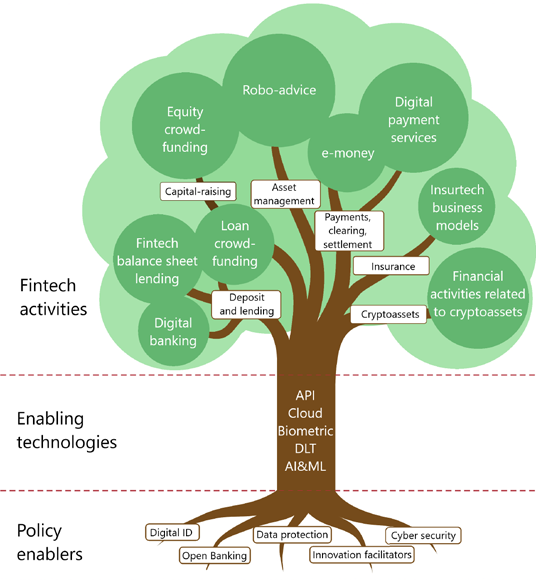
Source: FSI report on Policy responses to fintech: a cross-country overview

Let us now discuss each of the fintech activities in detail along with the regulatory responses in India and across the globe.

Digital Banking –

This refers to normal banking activities delivered through electronic means which is the distinguishing factor from traditional banking activities. With the use of advanced technology, several new entities are being set up as digital banks that deliver deposit taking as well as lending activities through mobile based apps or other electronic modes, thereby eliminating the need for physically approaching a bank branch or even opening a bank branch at all. The idea is to deliver banking services ‘on the go’ with a user friendly interface.

Regulatory responses to digital banking –

The FSI survey reveals that most jurisdictions apply the existing banking laws and regulations to digital banking as well. Applicants with a fintech business model must go through the same licensing process as those applicants with a traditional banking business model.

Only a handful of jurisdictions, namely Hong Kong, SAR and Singapore, have put in place specific licensing regimes for digital banks. In the euro area, specific guidance is issued on how credit institution authorisation requirements would apply to applicants with new fintech business models.

Regulatory framework for digital banking in India –

In India, majority of the digital banking services are offered by traditional banks itself, mainly governed by the Payment and Settlement Systems Act, 2007[1], with RBI being the regulatory body overseeing its implementation. The services include, opening savings accounts online even through apps, facilitating instant transfer of funds through the use of innovative products such as the Unified Payments Interface (UPI), which is governed by the National Payments Corporation of India (NPCI), facilitating the use of virtual cards, prepaid payment instruments (PPI), etc. These services may be provided not only by traditional banks alone, but also by non-bank entities.

Fintech balance sheet lending

Typically refers to lending from the balance sheet and assuming the risk on to the balance sheet of the fintech entity. Investors’ money in the fintech entity is used to lend to customers which shows up as an asset on the balance sheet of the lending entity. This is the idea of balance sheet lending. This idea, when facilitated with technological innovation leads to fintech balance sheet lending.

Regulatory responses to fintech balance sheet lending –

As per the FSI survey, most jurisdictions do not have regulations that are specific to fintech balance sheet lending. In a few jurisdictions, the business of making loans requires a banking licence (eg Austria and Germany). In others, specific licensing regimes exist for non-banks that are in the business of granting loans without taking deposits. Only one of the surveyed jurisdictions has introduced a dedicated licensing regime for fintech balance sheet lending.

Regulatory regime in India –

The new age digital app based lending is rapidly advancing in India. With the regulatory framework for Non-Banking Financial Companies (NBFCs), the fintech balance sheet lending model is possible in India. However, this required a net owned fund of Rs. 2 crores and registration with RBI as an NBFC- Investment and Credit Company.

The digital app based lending model in India works as a partnership between a tech platform entity and an NBFC, wherein the tech platform entity (or fintech entity) manages the working of the app through the use of advanced technology to undertake credit appraisals, while the NBFC assumes the credit risk on its balance sheet by lending to the customers who use the app. We have covered this model in detail in a related write up[2].

Loan & Equity Crowd funding

Crowd funding refers to a platform that connects investors and entrepreneurs (equity crowd funding) and borrowers and lenders (loan crowd funding) through an internet based platform. Under equity crowd funding, the platform connects investors with companies looking to raise capital for their venture, whereas under loan crowd funding, the platform connects a borrower with a lender to match their requirements. The borrower and lender have a direct contract among them, with the platform merely facilitating the transaction.

Regulatory responses to crowd funding –

According to the FSI survey, many surveyed jurisdictions introduced fintech-specific regulations that apply to both loan and equity crowd funding considering the similar risks involved, shown in the table below. Around a third of surveyed jurisdictions have fintech-specific regulations exclusively for equity crowd funding. Only a few jurisdictions have a dedicated licensing regime exclusively for loan crowd funding. Often, crowd funding platforms need to be licensed or registered before they can perform crowd funding activities, and satisfy certain conditions.

Table showing regulatory regimes in various jurisdictions

Fintech-specific regulations for crowd funding
Equity Crowd Funding Equity and Loan Crowd Funding Loan Crowd Funding
Argentina           Columbia

Australia             Italy

Austria                Japan

Brazil                   Turkey

China                   United States

Belgium                Peru

Canada                 Philippines

Chile                      Singapore

European Union  Spain

France                   Sweden

Mexico                  UAE

Netherlands         UK

Australia

Brazil

China

Italy


Source: FSI Survey

Regulatory regime in India

  1. In case of equity crowd funding –

In 2014, securities market regulator SEBI issued a consultation paper on crowd funding in India[3], which mainly focused on equity crowd funding. However, there was no regulatory framework subsequently issued by SEBI which would govern equity crowd funding in India. At present crowd funding platforms in India have registered themselves as Alternative Investment Funds (AIFs) with SEBI to carry out fund raising activities.


  1. In case of loan crowd funding –

The scenario for loan crowd funding, is however, already in place. The RBI has issued the Non-Banking Financial Company – Peer to Peer Lending Platform (Reserve Bank) Directions, 2017[4] which govern loan crowd funding platforms. Peer to Peer Lending and loan crowd funding are terms used interchangeably. These platforms are required to maintain a net owned fund of not less than 20 million and get themselves registered with RBI to carry out P2P lending activities.


As per the Directions, the Platform cannot raise deposits or lend on its own or even provide any guarantee or credit enhancement among other restrictions. The idea is that the platform only acts as a facilitator without taking up the risk on its own balance sheet.

Robo- Advice

An algorithm based system that uses technology to offer advice to investors based on certain inputs, with minimal to no human intervention needed is known as robo-advice, which is one of the most popular fintech services among the investment advisory space.

Regulatory responses to robo-advice –

According to the FSI survey, in principle, robo- and traditional advisers receive the same regulatory treatment. Consequently, the majority of surveyed jurisdictions do not have fintech-specific regulations for providers of robo-advice. Around a third of surveyed jurisdictions have published guidance and set supervisory expectations on issues that are unique to robo-advice as compared to traditional financial advice. In the absence of robo-specific regulations, several authorities provide somewhat more general information on existing regulatory requirements.

Regulatory regime in India –

In India, there is no specific regulatory framework for those providing robo-advice. All investment advisers are governed by SEBI under the Investment Advisers Regulations, 2013[5]. Under the regulations every investment adviser would have to get themselves registered with SEBI after fulfilling the eligibility conditions. The SEBI regulations would also apply to those offering robo-advice to investors, as there is no specific restriction on using automated tools by investment advisers.

Digital payment services & e-money

Digital payment services refer to technology enabled electronic payments through different modes. For instance, debit cards, credit cards, internet banking, UPI, mobile wallets, etc. E-money on the other hand would mostly refer to prepaid instruments that facilitate payments electronically or through prepaid cards.

Regulatory responses to digital payment services & e-money –

As per the FSI survey, most surveyed jurisdictions have fintech-specific regulations for digital payment services. Some jurisdictions aim at facilitating the access of non-banks to the payments market. Some jurisdictions have put in place regulatory initiatives to strengthen requirements for non-banks.

Further, most surveyed jurisdictions have a dedicated regulatory framework for e-money services. Non-bank e-money providers are typically restricted from engaging in financial intermediation or other banking activities.

Regulatory regime in India –

The Payment and Settlement Systems Act, 2007 (PSS) of India governs the digital payments and e-money space in India. While several Master Directions are issued by the RBI governing prepaid payment instruments and other payment services, ultimately they draw power from the PSS Act alone. These directions govern both bank and non-bank players in the fintech space.

UPI being a fast mode of virtual payment is however governed by the NPCI which is a body of the RBI.

Other policy measures in India – The regulatory sandbox idea

Both RBI and SEBI have come out with a Regulatory Sandbox (RS) regime[6], wherein fintech companies can test their innovative products under a monitored and controlled environment while obtaining certain regulatory relaxations as the regulator may deem fit.  As per RBI, the objective of the RS is to foster responsible innovation in financial services, promote efficiency and bring benefit to consumers. The focus of the RS will be to encourage innovations intended for use in the Indian market in areas where:

  1. there is absence of governing regulations;
  2. there is a need to temporarily ease regulations for enabling the proposed innovation;
  3. the proposed innovation shows promise of easing/effecting delivery of financial services in a significant way.

RBI has already begun with the first cohort[7] of the RS, the theme of which is –

  • Mobile payments including feature phone based payment services;
  • Offline payment solutions; and
  • Contactless payments.

SEBI, however, has only recently issued the proposal of a regulatory sandbox on 17th February, 2020.

Conclusion

Technology has been advancing at a rapid pace, coupled with innovation in the financial services space. This rapid growth however should not be overlooked by regulators across the globe. Thus, there is a need for policy changes and regulatory intervention to simultaneously govern as well as promote fintech activities, as innovation will not wait for regulation.

While most of regulators around the globe have different approaches to governing the fintech space, the regulatory environment should be such that there is sufficient understanding of fintech business models to enable regulation to fit into such models, while also curbing any unethical activities or risks that may arise out of the fintech business.

[1] https://rbidocs.rbi.org.in/rdocs/Publications/PDFs/86706.pdf

[2] https://vinodkothari.com/2019/09/sharing-of-credit-information-to-fintech-companies-implications-of-rbi-bar/

[3] https://www.sebi.gov.in/sebi_data/attachdocs/1403005615257.pdf

[4] https://rbidocs.rbi.org.in/rdocs/notification/PDFs/MDP2PB9A1F7F3BDAC463EAF1EEE48A43F2F6C.PDF

[5] https://www.sebi.gov.in/legal/regulations/jan-2013/sebi-investment-advisers-regulations-2013-last-amended-on-december-08-2016-_34619.html

[6] https://www.rbi.org.in/Scripts/PublicationReportDetails.aspx?UrlPage=&ID=938

https://www.sebi.gov.in/media/press-releases/feb-2020/sebi-board-meeting_46013.html

[7] https://www.rbi.org.in/Scripts/BS_PressReleaseDisplay.aspx?prid=48550

[1] Assessment of the progress of digitisation from cash to electronic – https://www.rbi.org.in/Scripts/PublicationsView.aspx?id=19417

[2] https://www.bis.org/fsi/publ/insights23.pdf

Securitisation of performing assets: meaning of “homogenous pools”

Timothy Lopes, Executive, Vinod Kothari Consultants

finserv@vinodkothari.com

Standard asset securitisation in India is governed by the RBI securitisation guidelines of 2006[1] and 2012[2]. As one of the essential pre-requisites of a securitisation transaction, the underlying assets should represent the debt obligations of a ‘homogeneous pool’ of obligors. Subject to this condition of homogeneity, all on-balance sheet standard assets (except certain assets prescribed under the guidelines) are eligible for securitisation.

The question, then, arises as to what is the criteria for determining whether a pool of assets is homogeneous? In this write up we analyse the homogeneity criteria in the context of a securitisation transaction based on global understanding.

How is homogeneity assessed?

Basel III norms on Simple Transparent and Comparable (‘STC’) Securitisation transactions[3] lays down factors to be kept in mind while determining homogeneity as follows –

  • In simple, transparent and comparable securitisations, the assets underlying the securitisation should be credit claims or receivables that are homogeneous.
  • In assessing homogeneity, consideration should be given to –
    • Asset type,
    • Jurisdiction,
    • Legal system; and
    • Currency.
  • The nature of assets should be such that investors would not need to analyse and assess materially different legal and/or credit risk factors and risk profiles when carrying out risk analysis and due diligence checks.
  • Homogeneity should be assessed on the basis of common risk drivers, including similar risk factors and risk profiles.
  • Credit claims or receivables included in the securitisation should have standard obligations, in terms of rights to payments and/or income from assets and that result in a periodic and well-defined stream of payments to investors. Credit card facilities should be deemed to result in a periodic and well-defined stream of payments to investors for the purposes of this criterion.
  • Repayment of note-holders should mainly rely on the principal and interest proceeds from the securitised assets. Partial reliance on refinancing or re-sale of the asset securing the exposure may occur provided that re-financing is sufficiently distributed within the pool and the residual values on which the transaction relies are sufficiently low and that the reliance on refinancing is thus not substantial.

The basic intent behind a securitisation transaction is the tranching of risk. In order to tranche the risk, there must be similarity in terms of the risk attributes of the pool. If the risk is not homogeneous across different attributes of the pool the tranching of risk becomes difficult and defeats the intent of the transaction.

Further, the nature of assets in the pool must be homogenous. This means that the assets in the pool should be covered by similar legal risks or credit risks so that the investors need not analyse and assess materially different assets in a pool.

The EU Simple, Transparent and Standardised (‘STS’) securitisation Regulations[4] states the following–

“To ensure that investors perform robust due diligence and to facilitate the assessment of underlying risks, it is important that securitisation transactions are backed by pools of exposures that are homogenous in asset type, such as pools of residential loans, or pools of corporate loans, business property loans, leases and credit facilities to undertakings of the same category, or pools of auto loans and leases, or pools of credit facilities to individuals for personal, family or household consumption purposes.”

“The securitisation shall be backed by a pool of underlying exposures that are homogeneous in terms of asset type, taking into account the specific characteristics relating to the cash flows of the asset type including their contractual, credit-risk and prepayment characteristics. A pool of underlying exposures shall comprise only one asset type. The underlying exposures shall contain obligations that are contractually binding and enforceable, with full recourse to debtors and, where applicable, guarantors.”

Illustrations of a homogeneous pool

Whether a pool of comprising of commercial vehicles, trucks and tractors can be called homogeneous?

Prima facie the pool might appear to be homogeneous, however it is not so. The assets in this pool are different in terms of legal and credit risks. For instance, the credit risk arising out of a commercial vehicle loan and a tractor loan is far from similar, given the nature of the asset, value of assets and repayment power of the borrower of the asset, type of usage to which the asset.

Whether a pool of personal loans, business loans and loans against property can be called homogeneous?

The pool of loans would have to each be analysed individually given the material differences in their nature. Further the nature of collateral in each of these loans may be different leading to different risk attributes. Further it would have to be seen whether these loans have well defined stream of payments as well. Ultimately it is unlikely that this pool can be called homogeneous.

Conclusion

Homogeneity should be assessed from the viewpoint of risk attributes. There must be similarity in the nature of assets as well as collateral to ascertain homogeneity in terms of credit risks. Legal risks must also be analysed and should be homogeneous. These factors ultimately help investors in the due diligence process (while also making the transaction simple, transparent and comparable compliant) as well as make tranching of risks easier.

Read our related write ups on the subject of securitisation –

Basel III requirements for Simple Transparent and Comparable (STC) Securitisation –

https://vinodkothari.com/2020/01/basel-iii-requirements-for-simple-transparent-and-comparable-stc-securitisation/


[1] https://www.rbi.org.in/scripts/NotificationUser.aspx?Id=2723

[2] https://rbidocs.rbi.org.in/rdocs/notification/PDFs/C170RG21082012.pdf

[3] https://www.bis.org/bcbs/publ/d374.pdf

[4] https://eur-lex.europa.eu/legal-content/EN/TXT/PDF/?uri=CELEX:32017R2402&from=en

Regulated deposit takers: Whether need to intimate under BUDS?

Timothy Lopes, Executive, Vinod Kothari & Company

finserv@vinodkothari.com, corplaw@vinodkothari.com

Almost a year after the Banning of Unregulated Deposits Schemes Act, 2019[1] (BUDS Act/ Act) came into force, the Ministry of Finance has, vide notification dated 12th February, 2020, notified The Banning of Unregulated Deposits Schemes Rules, 2020[2] (BUDS Rules/ Rules).

The BUDS Act, was enacted with the intent to curb all unregulated deposits schemes being run by fraudulent means such as ponzi schemes. On the other hand, the BUDS Act lists out regulated deposit schemes, which are essentially regulated by MCA, SEBI, RBI, etc., such as collective investment schemes, alternative investment funds, portfolio management services, employee benefit schemes, mutual fund schemes, etc. regulated by SEBI; deposits accepted by NBFCs, etc. as regulated by RBI, insurance contracts regulated by IRDAI; schemes or arrangements made or offered by co-operative societies, chit funds, etc. regulated by the relevant State Government or Union Territory Government; housing finance companies regulated by the NHB; pension funds regulated by the PFRDA; pension schemes or insurance schemes framed under the Employees’ Provident Fund Miscellaneous Provisions Act, 1952; Deposits accepted or permitted under the provisions of Chapter V of the Companies Act, 2013 regulated by MCA.

The definition of deposit taker and meaning of deposit along with exclusions from the meaning, is specified under the Act. We have analysed the definitions in our related articles and write ups on the subject[3].

Designated authority

As a part of regulation, the law provides for collation of information pertaining to deposit takers.

As per Section 9 of the Act, the Central Government has the power to designate an authority (existing or already constituted)[4] which shall create, maintain and operate an ‘online database’ for information on ‘deposit takers’ operating in India. The Rules empower the designated authority to require any regulator or any competent authority (appointed under section 7 of the Act) or any other entity/person to submit to it any information in its possession relating to deposit takers in India. However, the authority is yet to be designated, inspite of the fact that the Rules have already come into force on 12th February, 2020.

Requirement of intimation by deposit-takers

As per section 10 of the Act, every deposit taker commencing its business after the commencement of the Act, is required to intimate the authority about its business in the form and manner to be prescribed. As per rule 7 of the Rules, the intimation is to be sent within a period of 30 days from the date of commencement of business.

A relevant question here, might be whether regulated deposit takers (say, AIFs, CISs, NBFC-D, etc.) will also be required to give intimation to the designated authority of commencement of business.

Note that the explanation to section 10 reads as under –

“Explanation.—For the removal of doubts, it is hereby clarified that—

  • the requirement of intimation under sub-section (1) is applicable to deposit takers accepting or soliciting deposits as defined in clause (4) of section 2; and
  • the requirement of intimation under sub-section (1) applies to a company, if the company accepts the deposits under Chapter V of the Companies Act, 2013.”

Clearly, explanation (a) above makes reference to definition of deposit under section 2(4) of the BUDS Act, to determine whether the deposit taker will be required to give intimation. Note that as per the definition of deposit under section 2(4), there is no explicit exclusion with respect to regulated deposit schemes. In fact, the explanation to clause 2(4) says that with respect to NBFCs, ‘deposit’ shall be interpreted in terms of RBI Act. Hence, it can be contended that all deposit takers undertaking regulated deposit scheme shall be required to send intimations to the designated authority.

However, explanation (b) includes companies accepting deposits under the Companies Act, which is a regulated deposit scheme under the BUDS Act [entry 9 of the First Schedule], as deposit taker which shall give an intimation under BUDS Act. Therefore, it can be argued that because of this explicit inclusion of one particular regulated deposit taking entity, all other regulated deposit takers will stand exempted from the requirement of giving intimations.

The foregoing indicates that the provisions are vague insofar the regulated deposit schemes are concerned. The discussion below seeks to find an answer.

The BUDS Bill, 2015 and Report of IMG

Clause 10 of the BUDS Bill, 2015 is the same as section 10 of the BUDS Act.

State Bank of India, in their submission to the Standing Committee on Finance[5] have opined on the provisions relating to Central Database, as there in the Bill, as under –

“The scope of the centralized database has been kept very wide and vague and it needs to have a list of all the companies which have been found in violation of the Bill and it should also maintain a list of all Government approved schemes.”

In case the requirement extends to all regulated deposit-takers there will be a tedious and added compliance burden on genuine business entities who are under the purview of regulators which already possess their data.

Further, it is highly unlikely that unregulated deposit takers will file an intimation to the authority. This was also the rationale given in the Report of the Inter-Ministerial Group (IMG) on the BUDS Bill, 2015[6].

The IMG stated about intimation requirement as under –

“Intimation of business by a Deposit Taking Establishment –

The intent of this provision is to prescribe an intimation requirement which will be applicable to all Deposit-taking Establishments. While it is unlikely that establishments operating Unregulated Deposit Schemes will comply with the said intimation requirements, compliance by Regulated Deposit Schemes may enable the State Government to detect deposit schemes which are operating without any registration. xxx”

Conclusion

In light of the discussions above, there seems to be a lack of sufficient clarity on the issue. However, it can be contended on the strength of explanation (b), that the explicit inclusion of companies accepting deposits under Companies Act, will lead to presumption that the law does not require other regulated deposit-takers to give intimation.

Further, the intention of the BUDS Act was not to cover regulated deposit takers at all. Imposing intimation requirements over regulated deposit takers would be unreasonable and counterproductive and should be meant to cover only unregulated deposit takers.

Ideally, the authority should request for the data from the Regulators which have a ready database at hand, rather than place a burden on each regulated deposit taking entity to intimate the authority.

There is a need for clarity on the provisions laid down in the Rules with respect to the online database. It would be unreasonably tedious to place an intimation burden on all deposit takers. The intent behind creating the database to detect unregulated deposit schemes should be effectively implemented rather than adding a burden of compliance to regulated entities carrying out genuine deposit taking activity. Further, the intent behind the creation of a Central Database of deposit takers is for early detection of unregulated deposit schemes. It seems as though the scope of the central database has been kept wide, as to how the database will detect unregulated deposit taking activity is yet to be seen.


[1] http://egazette.nic.in/WriteReadData/2019/209476.pdf

[2] http://egazette.nic.in/WriteReadData/2020/216125.pdf

[3] Readers may refer: https://vinodkothari.com/2019/02/presentation-on-banning-of-unregulated-deposit-schemes/

https://vinodkothari.com/2019/02/menace-of-illicit-deposit-schemes-pinned-down/

https://www.moneylife.in/article/a-nip-in-the-bud-ordinance-bans-unregulated-deposits/56428.html

https://www.moneylife.in/article/banning-unregulated-deposits-schemes-big-concern-for-small-businesses/56448.html

[4] Yet to be designated by the Central Government

[5] https://www.prsindia.org/sites/default/files/bill_files/SCR-The%20Banning%20of%20Unregulated%20Deposit%20Schemes%20Bill%2C%202018.pdf

[6] https://financialservices.gov.in/sites/default/files/Public%20Comments%20on%20the%20Report%20of%20the%20Inter-Ministerial%20Group%20on%20Deposit%20Taking_0.pdf

VIDEOCON RULING: SETTING A BENCHMARK FOR GROUP INSOLVENCY

Richa Saraf

(richa@vinodkothari.com)

It is common business practice for group entities to regularly engage in related party transactions such as cross collateralisation, guarantee comforts, tunnelling or significant influence arrangements. While such structures largely respect the separate legal status of the group companies, practice suggests such inter-linkages in business, operations and management often raise significant challenges when any one or more entity in the group become insolvent[1]. In such cases, for maximisation of value to the stakeholders and to enhance the prospects of resolution, creditors may seek for substantive consolidation.

Read more

The ‘net concentrate’ of ‘preference- Key takeaways from the SC ruling regarding preferential transactions

-Sikha Bansal

(resolution@vinodkothari.com)

The Hon’ble Supreme Court’s ruling in Jaypee [Civil Appeal Nos. 8512-8527 of 2019] stands as a landmark for two reasons – first, it deals with an otherwise unexplored periphery of vulnerable transactions in the context of insolvency, and secondly, it will have far-reaching impacts on how secured transactions are structured and the manner in which the lenders lend.

Read more

EASE OF RECOVERY FOR NBFCS?

–  Ministry of Finance relaxes the criteria for NBFCs to be eligible for enforcing security interest under SARFAESI

-Richa Saraf (richa@vinodkothari.com)


The Ministry of Finance has, vide notification[1] dated 24.02.2020 (“Notification”), specified that non- banking financial companies (NBFCs), having assets worth Rs. 100 crore and above, shall be entitled for enforcement of security interest in secured debts of Rs. 50 lakhs and above, as financial institutions for the purposes of the said Act.

BACKGROUND:

RBI has, in its Financial Stability Report (FSR)[2], reported that the gross NPA ratio of the NBFC sector has increased from 6.1% as at end-March 2019 to 6.3% as at end September 2019, and has projected a further increase in NPAs till September 2020. The FSR further states that as at end September 2019, the CRAR of the NBFC sector stood at 19.5% (which is lower than 20% as at end-March 2019).

To ensure quicker recovery of dues and maintenance of liquidity, the Finance Minister had, in the Budget Speech, announced that the limit for NBFCs to be eligible for debt recovery under the SARFAESI is proposed to be reduced from Rs. 500 crores to asset size of Rs. 100 crores or loan size from existing Rs. 1 crore to Rs. 50 lakhs[3]. The Notification has been brought as a fall out of the Budget.

Our budget booklet can be accessed from the link below:

https://vinodkothari.com/wp-content/uploads/2020/02/Budget-Booklet-2020.pdf

ELIGIBILITY FOR INITIATING ACTION UNDER SARFAESI

To determine the test for eligible NBFCs, it is first pertinent to understand the terms used in the Notification.

The Notification provides that NBFCs shall be entitled for enforcement of security interest in “secured debts”. Now, the term “secured debt” has been defined under Section 2(ze) of SARFAESI to mean a debt which is secured by any security interest, and “debt” has been defined under Section 2(ha) as follows:

(ha) “debt” shall have the meaning assigned to it in clause (g) of section 2 of the Recovery of Debts Due to Banks and Financial Institutions Act, 1993 (51 of 1993) and includes-

(i) unpaid portion of the purchase price of any tangible asset given on hire or financial lease or conditional sale or under any other contract;

(ii) any right, title or interest on any intangible asset or licence or assignment of such intangible asset, which secures the obligation to pay any unpaid portion of the purchase price of such intangible asset or an obligation incurred or credit otherwise extended to enable any borrower to acquire the intangible asset or obtain licence of such asset.

Further, Section 2(g) of the Recovery of Debts Due to Banks and Financial Institutions Act, 1993, provides that the term “debt” means “any liability (inclusive of interest) which is claimed as due from any person by a bank or a financial institution or by a consortium of banks or financial institutions during the course of any business activity undertaken by the bank or the financial institution or the consortium under any law for the time being in force, in cash or otherwise, whether secured or unsecured, or assigned, or whether payable under a decree or order of any civil court or any arbitration award or otherwise or under a mortgage and subsisting on, and legally recoverable on, the date of the application and includes any liability towards debt securities which remains unpaid in full or part after notice of ninety days served upon the borrower by the debenture trustee or any other authority in whose favour security interest is created for the benefit of holders of debt securities.”

Therefore, NBFCs having asset size of Rs. 100 crores and above as per their last audited balance sheet will have the right to proceed under SARFAESI if:

  • The debt (including principal and interest) amounts to Rs. 50 lakhs or more; and
  • The debt is secured by way of security interest[4].

EFFECT OF NOTIFICATION:

An article of Economic Times[5] dated 07.02.2020 states that:

“Not many non-bank lenders are expected to use the SARFAESI Act provisions to recover debt despite the Union budget making this route accessible to more such lenders due to time-consuming administrative hurdles as well as high loan ticket limit.”

As one may understand, SARFAESI is one of the many recourses available to the NBFCs, and with the commencement of the Insolvency and Bankruptcy Code, the NBFCs are either arriving at a compromise with the debtors or expecting recovery through insolvency/ liquidation proceedings of the debtor. The primary reasons are as follows:

  • SARFAESI provisions will apply only when there is a security interest;
  • NBFCs usually provide small ticket loans to a large number of borrowers, but even though their aggregate exposure, on which borrowers have defaulted, is substantially high, they will not able to find recourse under SARFAESI;
  • For using the SARFAESI option, the lender will have to wait for 90 days’ time for the debt to turn NPA. Then there is a mandatory 60 days’ notice before any repossession action and a mandatory 30 days’ time before sale. Also, the debtor may file an appeal before Debt Recovery Tribunal, and the lengthy court procedures further delay the recovery.

While the notification seems to include a larger chunk of NBFCs under SARFAESI, a significant question that arises here is whether NBFCs will actually utilise the SARFAESI route for recovery?


[1] http://egazette.nic.in/WriteReadData/2020/216392.pdf

[2] https://m.rbi.org.in/Scripts/PublicationReportDetails.aspx?UrlPage=&ID=952

[3] https://www.indiabudget.gov.in/doc/Budget_Speech.pdf

[4] Section 2(zf) “security interest” means right, title or interest of any kind, other than those specified in section 31, upon property created in favour of any secured creditor and includes-

(i) any mortgage, charge, hypothecation, assignment or any right, title or interest of any kind, on tangible asset, retained by the secured creditor as an owner of the property, given on hire or financial lease or conditional sale or under any other contract which secures the obligation to pay any unpaid portion of the purchase price of the asset or an obligation incurred or credit provided to enable the borrower to acquire the tangible asset; or

(ii) such right, title or interest in any intangible asset or assignment or licence of such intangible asset which secures the obligation to pay any unpaid portion of the purchase price of the intangible asset or the obligation incurred or any credit provided to enable the borrower to acquire the intangible asset or licence of intangible asset.

[5] https://economictimes.indiatimes.com/industry/banking/finance/banking/not-many-nbfcs-may-use-sarfaesi-act-to-recover-loan/articleshow/74012648.cms
