MCA issues rules to squeeze out minority shareholding held in dematerialized form

Shaifali Sharma | Vinod Kothari and Company

corplaw@vinodkothari.com


Understanding minority squeeze out

‘Minority squeeze out’ demonstrates the power of majority shareholders to forcibly acquire shares from minority shareholders and drive them out to gain absolute control over the company.

Section 236 of the Companies Act, 2013 (‘Act, 2013’) sets out a process of squeezing out minority shareholder whereby any shareholder of the company, either alone or along with person acting in concert, holding 90% or more of the total issued equity share capital, may acquire the remaining equity shares of the company by giving an offer to the minority shareholders. This “Rule of Majority” principle was recognized in a landmark case Foss v. Harbottle, where it was held that that the minority shareholders are bound by the decision of the majority shareholders and the Courts do not interfere in the internal matters of the Company. However, the powers of majority should be exercised in reasonable manner which do not result into oppression of minority. Thus, the inherent protection under the law is that the acquisition shall take place at a fair value or higher value as determined by the valuer in accordance with Rule 27 of the (Compromise, Arrangements and Amalgamation) Rules, 2016 (‘CAA Rules, 2016’).

The section 236 was incorporated under the Act, 2013 on the recommendation of the Dr. J.J. Irani Committee Report on Company Law, 2005[1] for the reason reproduced below:

“The law should enable companies to purchase the stake of minority shareholders in order to prevent exploitation of such shareholders where a promoter has bought back more than 90% of the equity. Such purchase should, however, on the basis of a fair offer. Appropriate valuation rules for this purpose should be prescribed, or, the last known price prior to delisting, could be made the benchmark for such acquisitions.”

The purpose is to ensure a seamless takeover of a company, since in view of very smallholding of the minority shareholders; the minority shareholders neither will be able to participate in the management of the company nor will be able to seek redressal of their rights or have a meaningful participation in the company’s working. Therefore, to provide fair exit to the minority shareholders and to allow majority shareholders to exercise full control over the company, section 236 has been inserted under the Act, 2013.

This write-up endeavours to analyse (1) the existing process of acquiring minority shares held in physical form, (2) the practical difficulties for acquiring minority shares held in demat form and (3) the new rules introduced vide MCA notification[2] dated 17.12.2020 setting out the procedure of transferring minority shares held in demat form.

Modus Operandi of purchase of minority shareholding held in physical form

  1. Intimation to the Company

The acquirer holding 90% of the issued equity share capital of a company to inform the company of its intention to oust the minority shareholders in accordance with provisions of Section 236 of Act, 2013. At the same time, the minority shareholders can also offer their shares to be acquired to the acquirer in compliance prescribed provisions.

  1. Determining the fair value of shares for acquisition

Fair value of the shares of the Company whose shares are being transferred in accordance with Rule 27 (Compromise, Arrangements and Amalgamation) Rules, 2016.

Fair value of the shares of the company to be offered to the minority shareholders shall be calculated by a registered valuer in accordance with Rule 27 of the CAA Rules, 2016 which provides for evaluation criteria for listed companies as well as unlisted companies.

  1. Transfer Agent

The company whose shares are being transferred to the acquirer, shall act as a transfer agent for receiving and paying the price to the minority shareholders and for taking delivery of the shares and delivering such shares to the majority.

  1. Depositing of amount in separate account operated by the Company

 The majority shareholders are required to deposit an amount equal to the value of shares to be acquired by them, in a separate bank account to be operated by the company for payment to the minority shareholders, for atleast 1 year for payment to the minority shareholders and such amount shall be disbursed to the entitled shareholders within sixty days and even thereafter by the company.

  1. Despatch of offer letter and consideration by the company

The offer letter received from the acquirer will be dispatched to the shareholders along with the consideration.

  1. Physical delivery of shares

Minority shareholders shall on receipt of offer letter, provide for physical delivery of their shares to the company within the offer period.

The point of relevance is that, the word used is “physical delivery of shares” and not physical share certificates. Accordingly, physical delivery would cover delivery of both, shares held in physical form as well as shares held in dematerialized form by minority shareholders.

  1. In case of shares held in physical form, physical delivery will be evidenced by receipt of share certificates by the Company;
  2. In case of shares held in dematerialized form, physical delivery will be evidenced by the receipt of Delivery Instruction Slips (DIS) in favor of the acquirer. Upon submission of DIS, the Depository Participant processes the DIS and debits the clients account with the said number of shares. Simultaneously, the target demat account is credited with the same number of shares.

7. Failure to tender physical delivery of shares

In the absence of a physical delivery of shares by the shareholders within the time specified by the company, such shares shall be taken as cancelled and the transferor company shall be authorized to issue shares in lieu of the cancelled shares and complete the transfer by following the applicable transfer provision and dispatching the amount paid by the acquirer in advance.

Impracticability to acquire minority shareholding held in dematerialized form

In order to ensure smooth implementation of acquisition of minority shareholding, the Act, 2013 empowers the company whose shares are being transferred to issue new shares in lieu of the undelivered shares within the time specified.

While in case of shares held in physical form, section 236(6) of the Act, 2013 is clear to state that share certificates shall deemed to be cancelled for non-receipt of physical delivery of shares and the company is authorized to issue new shares in lieu of cancelled share certificates, however, there is a difficulty in implementing the same in case of shares held in dematerialized form.

The law is silent on the procedure to be followed by the company for transferring the shares held by minority shareholders in dematerialized form, in the absence of receipt of DIS from minority shareholders. The Depositories, without any clear instructions from Ministry of Corporate Affairs (‘MCA’) or Securities Exchange Board of India (‘SEBI’), does not permit transfer of shares to the demat account of acquirer by virtue of DIS signed by the company on behalf of the minority shareholder.

Therefore, the intent of the law behind the enforcement of section 236 remains unfulfilled in case of shares held in dematerialized form as the company would not be able to give effect to the transfer in the absence of any definitive procedure laid out to give effect to the same.

MCA new rules on purchase of minority shareholding held in dematerialized form

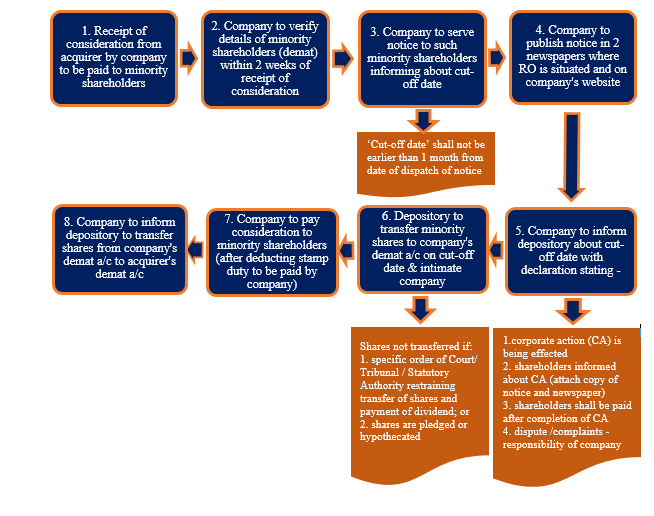
MCA has finally woken up to the need to enable companies to purchase minority shareholding held in demat form. The CAA Rules, 2016 has been amended vide MCA notification dated 17.12.2020 where a new Rule 26A has been introduced to provide process for purchase of minority shareholding held in demat form. The detailed step-by-step process highlighting the actionable for transferor company is explained below:

  1. Company to verify the details of minority shareholders holding shares in dematerialized form

The company shall within 2 weeks from the date of receipt of the amount equal to the price of shares to be acquired by the acquirer, verify the details of the minority shareholders holding shares in dematerialised form.

  1. Company to send notice to minority shareholders informing cut-off date

The company shall send notice to minority shareholders by registered post or by speed post or by courier or by email informing about a cut-off date on which the shares of minority shareholders shall be debited from their account and credited to the designated demat account of the company, unless the shares are credited in the account of the acquirer, as specified in such notice, before the cut-off date.

The cut-off date shall not be earlier than 1 month after the date of sending of the said notice. Also, if the cut-off date falls on a holiday, the next working day shall be deemed to be the cut-off date.

  1. Newspaper publication of notice served to minority shareholders

A copy of the notice served to the minority shareholders shall also be published simultaneously in two widely circulated newspapers (one in English and one in vernacular language) in the district in which the registered office of the company is situated and also be uploaded on the website of the company, if any.

  1. Company to inform depository about the cut-off date along with a list of declarations

Immediately after newspaper publication of notice, the company shall inform the depository w.r.t cut-off date and submit the following declarations stating that:

  1. The corporate action is being effected in pursuance of the provisions of section 236 of the Act;
  2. the minority shareholders whose shares are held in dematerialised form have been informed about the corporate action [a copy of the notice served to such shareholders and published in the newspapers to be attached];
  3. the minority shareholders shall be paid by the company immediately after completion of corporate action;
  4. any dispute or complaints arising out of such corporate action shall be the sole responsibility of the company.

For the purposes of effecting transfer of shares through corporate action, the Board of Directors of the company shall authorise the Company Secretary, or in his absence any other person, to inform the depository and to submit the documents as may be required.

  1. Depository to transfer the minority shares to company on the cut-off date

Except for the shares already credited in the account of the acquirer before the cut-off date by shareholders, the depository shall transfer of shares of the minority shareholders into the designated demat account of the company on the cut-off date and intimate the company.

Note: In case a specific order of Court or Tribunal, or statutory authority restraining any transfer of such shares and payment of dividend, or where such shares are pledged or hypothecated under the provisions of the Depositories Act, 1996, the depository shall not transfer the shares of the minority shareholders to the designated demat account of the company.

  1. Company to make payment to minority shareholders

The company shall immediately upon transfer of shares by the depository, disburse the price of the shares so transferred, to each of the minority shareholders after deducting the applicable stamp duty, which shall be paid by the company, on behalf of the minority shareholders, in accordance with the provisions of the Indian Stamp Act, 1899.

  1. Depository to transfer the minority shares from company’s demat account to acquirer’s demat account

One the payment is successfully disbursed to minority shareholders, the company shall inform the depository to transfer the shares of such shareholders, kept in the designated demat account of the company, to the demat account of the acquirer.

Note: The company shall continue to disburse payment to the entitled shareholders, where disbursement could not be made within the specified time, and transfer the shares to the demat account of acquirer after such disbursement.

A pictorial presentation giving step-by-step procedure to the above requirements is summarized below:
Concluding Remarks

The majority shareholders enjoy the right to squeeze out minority shareholders to gain control over the company in toto and attain a greater flexibility in decision making. While the process of acquisition of minority shares held in physical form is clearly established in the Act, 2013, however, companies were facing it practically difficult to implement in case minority shares are held in demat form. In the absence of any clear guidelines, squeezing out minority shareholders turned out as a challenge to implement.

The new rules notified by MCA are certainly a laudable solution facilitating the majority shareholders to smoothly acquire the shares held by minority shareholders in demat form.


Other reading materials on the similar topic:

  1. ‘Comparative Analysis of provisions enabling majority shareholders to squeeze out minorities’ can be viewed here
  2. ‘Minority Squeeze Out: A strong new provision under section 236 of the Companies Act, 2013’ can be viewed here
  3. ‘Takeover under Companies Act, 2013’ can be viewed here
  4. Presentation on ‘Minority-outs under Companies Act, 2013’ can be viewed here

Our Youtube Channel: https://www.youtube.com/channel/UCgzB-ZviIMcuA_1uv6jATbg


[1] H-ttp://www.nfcg.in/pdf/23-Irani%20committee%20report%20of%20the%20expert%20committee%20on%20Company%20law,2005.pdf

[2] http://egazette.nic.in/WriteReadData/2020/223774.pdf

SEBI proposes liberal provisions for promoter reclassification

Shaivi Bhamaria | Vinod Kothari and Company

corplaw@vinodkothari.com

Introduction

Reg. 31A of the SEBI (Listing Obligations and Disclosure Requirements) Regulations, 2015 (‘LODR Regulations’) lays down conditions pursuant to which promoters/ person belonging to promoter group of a listed entity can be reclassified as public shareholders. Reg. 31A (5) provides that if a public shareholder seeks to re-classify itself as promoter, it will have to make an open offer as per the provisions of SEBI (Substantial Acquisition of Shares and Takeovers) Regulations, 2011.

SEBI on November 23, 2020 has issued a Consultation Paper on Re-Classification of Promoter/ Promoter Group Entities and Disclosure of the Promoter Group Entities in the Shareholding Pattern[1] (‘Consultation Paper’) for public comments. At present SEBI has been granting relaxations from the requirements under reg. 31A of the LODR regulations on a case to case basis to promoters who have found reclassification difficult under current regulatory regime.  The said Paper has been issued on the basis of the recommendations of the Primary Market Advisory Committee (‘PMAC’) of SEBI in order to regularise the provisions relating to reclassification and minimise the need for providing relaxation on case-to-case basis.

Current Framework:

A summary of the present reclassification process is laid down below:

  1. The promoters/person belonging to promoter group seeking reclassification as public shareholders must satisfy the conditions laid down in reg. 31A (3) (b) of the LODR regulations;
  2. The listed entity must be in compliance with the conditions laid down in reg. 31A (3) (c) of LODR regulations;
  3. Promoters/person belonging to promoter group must make a request for re-classification to the board of directors of the listed entity. The request must contain the rationale for seeking re-classification and also a statement on how the conditions specified in reg. 31A (3) (b) are satisfied;
  4. The board after analysing the request must place the same along with its views, for approval of the shareholders in a general meeting. There should be a time gap of at least three months but not exceeding six months between the date of board meeting and the shareholder’s meeting;
  5. The request for re-classification should be approved in the general meeting by an ordinary resolution in which the promoter/ persons belonging to promoter group seeking re-classification cannot not vote to approve such re-classification request;
  6. Not later than 30 days from the date of approval by shareholders in general meeting, an application along with all relevant documents for re-classification must be made to the stock exchanges where the entity is listed. In case the entity is listed on more than one stock exchange, the concerned stock exchanges will jointly decide on the application.

Examples of case-to-case relaxation provided by SEBI

  1. Exemption from obtaining shareholders’ approval

In the informal guidance given to Alembic Pharmaceuticals Limited[2] SEBI had exempted the company from obtaining approval of shareholder for reclassification of 5 promoters as public shareholders inter-alia on the grounds that:

  1. The promoters cumulatively held 1.45% of the equity share capital of the company.
  2. They were senior citizens, leading independent lives and were not directly or indirectly connected with any activity of the company.
  3. They did not exercise any direct or indirect control over the affairs of the company, had never at any time held any position of key managerial personnel in the company.
  4. They did not had any special rights through formal or informal arrangements with the company or any promoter/person of the promoter group.
  5. They undertook that they would never be privy to any price sensitive information of the company

Further, in the informal guidance given to Gujarat Ambuja Exports Limited[3], SEBI had exempted the company from obtaining approval of shareholder for reclassification of one its promoters on the grounds that:

  1. the shareholding of the promoter was insignificant, constituting only 0.23% of the total paid up equity;
  2. Though being the son of a promoter, the said person was neither involved in the operations of the company nor was connected with the company.
  3. He did not exercise any direct or indirect control over the affairs of the company, did not have veto rights or special rights as to voting or control nor has any special information rights.
  4. Further the company had not entered into any shareholder agreement with him and he would never be privy to any price sensitive information of the company.

It is pertinent to note that SEBI in its interpretative letter had stated that the company would not be required to take shareholders’ approval, subject to compliance with the provisions of reg. 31A of LODR regulations. Reg, 31A of LODR regulations provide for shareholders’ approval, hence it was not very clear whether exemption from obtaining shareholders’ approval was granted or not.

Proposed amendments

1.      Relaxing the threshold of maximum voting rights allowed to be exercised by an outgoing promoter

At present reg. 31A (3) (b) (i) of LODR regulations provide that promoter/ persons belonging to promoter group seeking re-classification should not together hold more than 10% of the total voting rights in the listed entity.

The Consultation Paper proposes to increase the threshold of 10% to 15%, to enable those promoters who have shareholding of less than 15% but are no longer involved in the day-to-day control of the listed entity to opt-out from being classified as promoters, without having to reduce their share-holding.

2.      Suggestions for speeding up the process:

a.      Time limit within to place the reclassification request to be placed before the board

At present reg. 31A of LODR Regulations is silent on the time period within which the listed entity must place the reclassification request received from the promoter/ persons belonging to promoter group before the board, consequently as per SEBI’s data, in certain cases reclassification requests from promoter/ persons belonging to promoter group have not been placed before the Board, thereby ceasing the process in its initial phase.

To prevent this and streamline the process of reclassification, SEBI has proposed insertion of a time limit of one month receiving the reclassification request, within which the listed entity must place the same before its board of directors.

b.      Reduction in time period between board and shareholders meeting

As mentioned above, reg. 31A (3) (a) (ii) provides that the time gap between the meeting of the board at which the proposal for reclassification was accepted and the meeting of the shareholders, seeking approval for the same should be at least 3 months. The rationale behind the same was to give adequate time to the shareholders for considering the request of the promoter.

However, time gap 3 months resulted in an increase in the total time taken in the process. In order to increase both cost and time efficiency, the Consultation Paper proposes to reduce the minimum time gap from 3 months to 1 month.

3.      Extending the ambit of exemption from the procedure

a.      In case of reclassification is pursuant to an order/ direction of Government/ regulator

At present reg.  31A (9) provides exemption from the provisions of reg. 31A (3), (4) and (8)(a), (b) of LODR regulations in cases where re-classification of promoter/ persons belonging to promoter group is as per the resolution plan approved under s. 31 of the IBC, subject to the condition that the promoter seeking re-classification do not remain in control of the listed entity.

It is proposed to extend the said exemption to re-classification pursuant to an order/ direction of the Government/ regulator and/or as a consequence of operation of law since the re-classification is a natural consequence of the order/direction of the Government/ regulator.

b.      In case of reclassification of existing promoter pursuant to open offer

It is proposed to extend the exemption from procedure for re-classification to cases where the re-classification is pursuant to an open offer made in accordance with the provisions of SEBI (Substantial Acquisition of Shares and Takeover) Regulations, 2011 (‘SAST regulations’), subject to the satisfaction of following conditions:

  1. The intent of the existing promoters to re-classify has been disclosed in the letter of offer
  2. The promoter/ persons belonging to promoter group being reclassified fulfil the conditions mentioned in reg. 31A(3)(b) and the listed entity fulfils the conditions stipulated at reg. 31A(3)(c) of LODR regulations.

The rationale behind the exemption being that in cases where intent of reclassification has already been mentioned in the Letter of Offer, the requirement of promoter making an application is a mere procedural formality since the fact of re-classification is already present in the public domain.

c.       Cases where the outgoing promoter is absconding / non-cooperating

Exemption from the procedure for re-classification, is also proposed to be granted in cases where, pursuant to an open offer, a listed entity intends to re-classify erstwhile promoter/ persons belonging to promoter group but the promoter/ persons belonging to promoter group are not traceable or are not co-operative, but the same can be done after the fulfillment of the following conditions:

  1. The listed entity should demonstrate that efforts have been taken to contact the promoters through issuance of notices in newspapers, stock Exchange websites etc.
  2. Such promoters seeking re-classification should not remain in control of the listed entity

4.      Disclosure of names of promoter group entities in the shareholding pattern

Reg. 31 of LODR Regulations mandates that all entities falling under promoter/ promoter group are to be disclosed separately in the shareholding pattern.

As a matter of practice, several companies do not disclose names of persons in promoter/ promoter group who do not hold any shares.

It is to be noted that pursuant to the SEBI (Listing Obligations and Disclosures Requirements) (Sixth Amendment) Regulations, 2018[4] SEBI had, by virtue of by insertion of reg. 31(4) required that all entities falling under promoter and promoter group be disclosed separately in the shareholding pattern of listed entities appearing on the website of the stock exchanges in accordance with the formats specified by the SEBI . However, since the provisions of the Regulations still did not explicitly require entities to disclose the entire list of promoter/ promoter group irrespective of their shareholding, companies continued the practice of disclosing only those promoter/ promoter group entities that held shares in the company.  A detailed write-up on this insertion in Reg 31(4) can be read here.

To fill this gap, it has been proposed that all entities falling under promoter and promoter group be disclosed separately even if they do not hold shares in entity. Further it is proposed that listed entities obtain a declaration on a quarterly basis, from their promoters on the entities/ persons that form part of the ‘promoter group’.

Disclosures of all entities falling under promoter/ promoter group irrespective of the fact whether they hold shares in the listed entity hold all the more importance in light of the recent SEBI circular on Automation of Continual Disclosures under reg. 7(2) of SEBI (Prohibition of Insider Trading) Regulations, 2015 (‘PIT regulations’). In order to facilitate System Driven Disclosures (‘SDD’)[5]  pursuant to the said circular, the listed entities are  required to disclose to the designated depository the PAN number/ Demat account number (for PAN exempt entities) of all Promoters and promoter group so that the system can capture any trade in securities made by such entities.

Conclusion

Exemptions provided in the consultation paper in cases of open offer and order/ direction of Government/ regulator lead to reduction in compliance burden on the listed entity, further the proposed amendments w.r.t reduction in time gap between the board meeting and general meeting and the setting of time limit for placing the application before the board will lead to streamlining the entire process and bring efficiency in the same.

The clarification w.r.t to disclosure of names of promoter group entities holding ‘Nil’ shareholding and obtaining quarterly declarations from promoter may add to the compliance burden of listed entities at once, but in our view, should be effective in the long run.

Specific comments/suggestions on the Consultation Paper can be made to SEBI on or before December 24, 2020.


[1] For full text of the consultation paper see:

https://www.sebi.gov.in/web/?file=https://www.sebi.gov.in/sebi_data/attachdocs/nov-2020/1606126221923.pdf#page=4&zoom=page-width,-15,71

[2] For full text of the informal guidance see:

https://www.sebi.gov.in/sebi_data/commondocs/Alembic-sebiletter_p.pdf

[3] For full text of the informal guidance see:

https://www.sebi.gov.in/sebi_data/commondocs/oct-2017/gujaratsebi_p.pdf

[4] See: https://www.sebi.gov.in/legal/regulations/nov-2018/securities-and-exchange-board-of-india-listing-obligations-and-disclosure-requirements-sixth-amendment-regulations-2018_41051.html

[5] Circular no. SEBI/HO/ISD/ISD/CIR/P/2020/168 dated September 09, 2020 available at:

https://www.sebi.gov.in/web/?file=https://www.sebi.gov.in/sebi_data/attachdocs/sep-2020/1599654391917.pdf#page=1&zoom=page-width,-16,559

CKYCR becomes fully operational: The long-awaited format for legal entities’ information finally introduced

-Kanakprabha Jethani (kanak@vinodkothari.com)

Background

The Central KYC Registry (CKYCR) is a registry that serves as a central record for KYC information of all the customers of financial institutions. In India, the Central Registry of Securitisation Asset Reconstruction and Security Interest of India (CERSAI) has been authorised to carry out the functions of CKYCR. It was operationalised in 2016 beginning with collecting information on ‘individual’ accounts. Until now, the CKYCR did not have a feature to collect KYC information of legal entities.

The CERSAI has, in consultation with the RBI, prepared a template for submission of KYC information of legal entities (the same is yet to be published by CERSAI). The RBI has, through a notification dated December 18, 2020[1] (‘Notification’) directed financial institutions to begin submitting KYC information of legal entities w.e.f April1, 2021 (‘Notified Date’). The Master Direction – Know Your Customer (KYC) Direction, 2016 (‘KYC Directions’) have been updated in line with the said notification.

In this note we have discussed the implications for NBFCs, having customer interface, specifically.

Actionables for financial entities

In compliance with the existing KYC provisions on CKYCR and the Notification, NBFCs shall be required to take the following steps:

For customer who are legal entities, other than individuals and FPIs

  • Ensure uploading KYC data of legal entities whose loan account has been opened after the Notified Date; within 10 days of commencement of an account-based relationship with the customer. It is to be noted that the existing time limit for uploading the documents of individual accounts was 3 days.
  • Ensure uploading KYC records of legal entities on CKYCR, whose accounts are opened before the Notified Date, while undertaking periodic updation[2] or otherwise on receipt of updated KYC information from the customers. (When KYC information is uploaded during periodic updation or otherwise, it must be ensured that the same is in accordance with the CDD process as prevailing at such time.) Such uploading may not be required for loan accounts that are closed before undertaking the first periodic updation after the Notified Date.
  • Communicate the KYC identifier generated after uploading of KYC information to the customer.

 For individuals

  • Ensure that the existing KYC records of individual customers pertaining to loan accounts opened prior to April 01, 2017, should be incrementally uploaded on CKYCR at the time of periodic updation or earlier when the updated KYC information is obtained/received from the customers. (When KYC information is uploaded during periodic updation or otherwise, it must be ensured that the same is in accordance with the CDD process as prevailing at such time.) Such uploading may not be required for loan accounts that are closed before undertaking the first periodic updation after the Notified Date.
  • Ensure uploading KYC data of individual loan account opened after the Notified Date; within 10 days of commencement of an account-based relationship with the customer.
  • Communicate the KYC identifier generated after uploading of KYC information to the customer.

Clarification with respect to identity verification through CKYCR

There has been a confusion regarding validity of identity verification done by fetching KYC details from the CKYCR. While the provisions of the Prevention of Money Laundering Act, 2002 (PMLA) and rules thereunder as well as the operating guidelines clearly state that if the customer submits KYC identifier for identity and address verification, no other documents need to be obtained.

The KYC Directions have remained silent on the same for long. The Notification also clarified that-

“Where a customer, for the purpose of establishing an account based relationship, submits a KYC Identifier to a RE, with an explicit consent to download records from CKYCR, then such RE shall retrieve the KYC records online from CKYCR using the KYC Identifier and the customer shall not be required to submit the same KYC records or information or any other additional identification documents or details, unless –

  • there is a change in the information of the customer as existing in the records of CKYCR;
  • the current address of the customer is required to be verified;
  • the RE considers it necessary in order to verify the identity or address of the customer, or to perform enhanced due diligence or to build an appropriate risk profile of the client.”

Hence, for the purpose of verification, what is necessary is the KYC Identifier and an explicit consent from the customer to download his/her KYC information from the CKYCR.

Conclusion

The template for uploading KYC information of legal entities on the CKYCR portal has been formulated and shall be live on CERSAI Platform shortly. Financial institutions shall be required to ensure uploading of KYC information of legal entities w.e.f. the Notified Date. Further, additional obligations have been placed on financial institutions in terms of uploading KYC documents for existing customers and intimation of KYC identifier to all customers. Clarification regarding the validity of KYC verification using data from CKYCR is a welcome move.


[1] https://www.rbi.org.in/Scripts/NotificationUser.aspx?Id=12008&Mode=0

[2] As per para 38 of the KYC Directions- Periodic updation shall be carried out at least once in every two years for high risk customers, once in every eight years for medium risk customers and once in every ten years for low risk customers as per the prescribed procedure.

Impact of restructuring on ECL computation

-Aanchal Kaur Nagpal (aanchal@vinodkothari.com)

Introduction

The disruption throughout the globe due to the COVID-19 pandemic has hit the Indian economy as well significantly. The financial sector has experienced a massive blow due to the impact of the pandemic on the credit worthiness and repayment capacity of the overall general public. RBI has responded through various measures including allowing moratorium period, providing resolution framework for stressed accounts due to COVID-19 and numerous other measures.

The retail borrower segment of several banks and NBFCs has also been adversely affected by the disruption and hence, the lenders are contemplating ways to extend certain benefits to such borrowers them under the various circulars issued by the RBI and government. In this regard, restructuring or modification in terms of a loan is being done for economic or legal reasons, relating to the borrower’s financial difficulty. However, such restructuring may also have implications on the books of accounts, especially for IndAS compliant entities.

The following note discusses the meaning of ‘restructuring’ and it impact on the credit risk of the borrower.

Meaning of Restructuring

As per RBI norms on Restructuring of Advances by NBFC, A restructured account is one where the NBFC, for economic or legal reasons relating to the borrower’s financial difficulty, grants to the borrower concessions that the NBFC would not otherwise consider.

As per the Basel guidelines on prudential treatment of problem assets –definitions of nonperforming exposures and forbearance, definition of forbearance is as follows:

4.1. Identification of forbearance

  1. Forbearance occurs when:
  • a counterparty is experiencing financial difficulty in meeting its financial commitments; and
  • a bank grants a concession that it would not otherwise consider, irrespective of whether the concession is at the discretion of the bank and/or the counterparty. A concession is at the discretion of the counterparty (debtor) when the initial contract allows the counterparty (debtor) to change the terms of the contract in their favour (embedded forbearance clauses) due to financial difficulty.

The meaning of restructuring is modification in terms of a loan, which is done for economic or legal reasons, relating to the borrower’s financial difficulty. Usually, restructuring may be of various types. A credit weakness related restructuring is one which is done to assist the borrower to continue to service the facility. If such restructuring was not done, potentially, the borrower may not have been able to service the facility. Therefore, this is done with a view to avert a default. Yet another type of restructuring is a preponement of payments or early clearance of a loan. A third example has been given in the definition itself – for example, passing on the benefit of any interest rate increase or decrease in case of floating rate loans.

Change in credit risk

Under Indian Accounting Standard (Ind AS) 109 Financial Instruments (‘IndAS 109’), Expected Credit Loss (ECL) provision is computed for the loan accounts and it is important to determine whether restructuring should be considered as a factor in determining change in the credit risk characteristic of the borrower.

Significant Increase in Credit Risk (SICR), in the context of IFRS 9, is a significant change in the estimated Default Risk (over the remaining expected life of the financial instrument). The term ‘significant’ is not defined in IFRS-9 and thus SICR is determined using various internal and external indicators. The provisions of para 5.5.12 of IndAS 109[1] are self-explanatory on the point that if there has been a modification of the contractual terms of a loan, then, in order to see whether there has been a SICR, the entity shall compare the credit risk before the modification, and the credit risk after the modification.

While SICR indicators usually suffice during normal circumstances, but adjusting to the ‘new normal’ would require ‘new’ ways to consider SICR. The most important question that arises is whether modification in the loan terms to avoid a credit default due to COVID-19 disruption would lead to SICR.

International Guidance

  • As per the International Monetary Fund Report on The Treatment of Restructured Loans for FSI Compilation,

The BCBS (2017) defines loan forbearance as a situation in which (1) a counterparty is experiencing financial difficulty in meeting its financial commitments, and (2) a bank grants a concession that it would not otherwise consider, whether or not the concession is at the discretion of the bank and/or the counterparty. The Guide defines restructured loans as loans arising from rescheduling and refinancing of the original loan. Therefore, all forbearance measures are loan restructuring, but not all loan restructurings are forbearance measures.

Recently, in response to COVID-19 shock, the BCBS (2020) has clarified that when borrowers accept the terms of a payment moratorium (public or granted by banks on a voluntary basis) or have access to other relief measures such as public guarantees, these developments may not automatically lead to the loan being categorized as forborne. At the same time, banks would still need to assess the likelihood of the borrower’s rescheduled payments after the moratorium period ends.

  • The Indian Accounting Standard Board also released a clarification under ‘IFRS 9 and Covid-19’[2] stating that,

Entities should not continue to apply their existing ECL methodology mechanically. For example, the extension of payment holidays to all borrowers in particular classes of financial instruments should not automatically result in all those instruments being considered to have suffered an SICR.

  • According to the European Banking Authority’s Final Report on ‘Guidelines on reporting and disclosure of exposures subject to measures applied in response to the COVID‐19 crisis’[3],

More precisely, moratoria on loan payments that are in accordance with the EBA Guidelines on legislative and non‐legislative moratoria on loan repayments applied in the light of the COVID‐ 19 crisis do not trigger forbearance classification and the assessment of distressed structuring of loans and advances benefiting from these moratoria and they do not automatically lead to default classification. For example, if a performing loan is subject to a moratorium compliant with the GL on moratoria, which brings contractual changes to the terms of the loan, in the existing supervisory reporting this loan will continue to be reported under the category of performing exposures with no specific indication of the measures applied. However, it is also emphasised that the credit institutions should continue the monitoring and where necessary the unlikeliness to pay assessment of loans and advances that fall under the scope of these moratoria.

  • The Prudential Regulatory Authority of the Bank of England sent letters[4] to CEOs of various Banks guiding the following –

Our expectation is that eligibility for, and use of, the UK Government’s policy on the extension of payment holidays should not automatically, other things being equal, result in the loans involved being moved into Stage 2 or Stage 3 for the purposes of calculating ECL or trigger a default under the EU Capital Requirements Regulation (CRR). This expectation extends to similar schemes to respond to the adverse economic impact of the virus.

We do not consider the use of a Covid-19 related payment holiday by a borrower to trigger the counting of days past due or generate arrears under CRR. We also do not consider the use of such a payment holiday to result automatically in the borrower being considered unlikely to pay under CRR.

Firms are reminded to apply sound risk management practices regarding the identification of defaults. Firms should continue to assess borrowers for other indicators of unlikeliness to pay, taking into consideration the underlying cause of any financial difficulty and whether it is likely to be temporary as a result of Covid-19 or longer term

Our expectation is that a covenant breach or waiver of a covenant relating to a modification of the audit report attached to audited financial statements because of the Covid-19 pandemic should not automatically, other things being equal, trigger a default under CRR or result in a move of the loans involved into Stage 2 or Stage 3 for the purposes of calculating ECL. This expectation extends to other covenant breaches and waivers of covenants with a direct link to the Covid-19 pandemic.

A breach of the covenants of a credit contract is a possible indication of unlikeliness to pay under the CRR definition of default. However, a covenant breach does not automatically trigger a default. Rather, firms have scope to assess covenant breaches on a case-by-case basis and determine whether they indicate unlikeliness to pay.

  • The Accounting Standards Board of Canada[5] also took note of the guidance provided by IASB on guidance on applying IFRS 9 Financial Instrument. Further, it also took note of the guidance[6] provided by the Office of the Superintendent of Financial Institutions (OFSI) in Canada and specified that the guidance is consistent with the requirements in IFRS 9 and should thus be considered along with the guidance provided by the IASB. The OFSI, through its guidance, provided the following in relation to applying IFRS in extraordinary circumstances –

IFRS 9 is principles-based and requires the use of experienced credit judgement. Consistent with OSFI’s IFRS 9 Financial Instruments and Disclosures guideline, OSFI is providing guidance on three specific aspects of the accounting for Expected Credit Losses (ECLs) due to the exceptional circumstances arising from COVID-19. Deposit taking Institutions (DTIs) should also consider any additional guidance provided by the International Accounting Standards Board on the application of IFRS 9 in relation to COVID-19.

Under the IFRS 9 ECL accounting framework, DTIs should consider both quantitative and qualitative information, including experienced credit judgment, in assessing for significant increase in credit risk. In OSFI’s view, the utilization of a payment deferral program should not result in an automatic trigger, all things being equal, for significant increase in credit risk.

  • The International Public Sector Accounting Standards Board (IPSASB) released QnA[7] to provide insight into the financial reporting issues associated with COVID-19 government responses, and the relevant International Public Sector Accounting Standards (IPSAS). According to the same,

Given the economic severity associated with COVID-19, entities will need to review their portfolio of financial assets and assess whether an impairment is necessary.

Considering the aforesaid guidelines, all restructuring should not automatically be implied as SICR and the same should be based on facts after analyzing the background of credit worthiness of the borrower.

In case the restructuring is done under the disruption scenario then the same is not indicative of any increase in the probability of default. Accordingly, the same should ideally not be considered as a factor for considering SICR. Thus, if the restructuring is done for accounts that are stressed as a direct result of COVID-19, then the same shall not be treated as SICR.

However, if the restructuring is granted as a generalized option to all customers without any attention paid to reasons for such credit weakness, then the same is done to merely avoid credit difficulty or default of such borrowers which may not necessarily be caused by COVID-19.

Further, something like moratorium, which is granted for a systemic disruption such as a crisis of payment and settlements, natural calamities, etc. is for non-economic reasons, and therefore, may not be likened with a credit-weakness-related restructuring. In the current scenario, the general assumption may be that the credit default is directly associated with the COVID-19 pandemic in most cases.

Restructuring to all borrowers at a class level

A financial institution may also intend to modify the terms of the loan for the entire class as against a particular individual. If the underlying reason for such modification is the financial difficulty faced by the entire class due to Covid disruption, such that the modification is to tide over such difficulty and continue to service the loan, in our view, this will amount to restructuring and lead to a downgrade of asset classification. The underlying rationale is that a loan is a credit decision which is made looking at the prevailing situation at the time of extension of the credit. If the payment schedule is adjusted to take into consideration any change in situations that has happened subsequent to the grant of the credit, the same should be a case of deterioration in the credit quality of the loan. While going by the language of the regulation it seems to refer to only individual cases of restructuring, however, the fact that the entire class of borrower is facing the financial difficulty cannot be overlooked. Merely because the restructuring has been done for a class of borrowers does not mean the restructuring is not to avert a potential default.

Usually, the need for restructuring is identified at the individual exposure level to which concessions are granted due to financial difficulties of the respective borrower. Taking a decision to provide relief to an entire class of borrower instead of considering individual restructuring of each borrower account is a matter of prudence, which must be taken without compromising the interest of the Company, that is the lender.

Impact on IND AS treatment

Based on the aforesaid discussion, it can be inferred that the restructuring under the disruption scenario is not indicative of any increase in the probability of default. Accordingly, the same should ideally not be considered as a factor for considering SICR and in turn, should not result in shifting of the financial instruments from one stage to another. However, in case the account showed signs of credit weakness even before the restructuring, then there should be a shift from one stage to another.

Our related articles–


[1] If the contractual cash flows on a financial asset have been renegotiated or modified and the financial asset was not derecognised, an entity shall assess whether there has been a significant increase in the credit risk of the financial instrument in accordance with paragraph 5.5.3 by comparing:

(a) the risk of a default occurring at the reporting date (based on the modified contractual terms); and

(b) the risk of a default occurring at initial recognition (based on the original, unmodified contractual terms).

[2] ifrs-9-ecl-and-coronavirus.pdf

[3] Microsoft Word – Guidelines on Covid -19 measures reporting and disclosure.docx (europa.eu)

[4] Dear CEO Letter on Covid-19 IFRS 9 Capital Requirements and Loan Covenants (bankofengland.co.uk)

[5] IFRS 9 Expected Credit Losses and COVID-19 (frascanada.ca)

[6] OSFI Actions to Address Operational Issues Stemming from COVID-19 (osfi-bsif.gc.ca)

[7] IPSASB-Staff-QA-COVID-19-Relevant-Accounting-Guidance_0.pdf (ifac.org)

Benevolent move of SEBI for a more democratic shareholder participation

-Effectiveness however doubtful!

Abhishek Saraf | Vinod Kothari and Company

corplaw@vinodkothari.com

Background

SEBI observed that under the current remote e-voting framework, the participation of the public non institutional shareholders/ retail shareholders (shareholders) is at negligible level. One of the reasons behind such low participation may be due to reluctance of the shareholders to register with multiple e-voting service providers (ESPs) which provide the e-voting facility to the listed entities. Shareholders may be finding it a tedious task to register with multiple ESPs for casting their vote and maintain multiple user IDs and passwords for the said purpose.

In view of the same and with the intent to increase the optimum utilization of the remote e-voting process by shareholders, SEBI came out with consultative paper[1] on 5th March 2020 to review the e-voting mechanism as provided by various ESPs.

Based on the public comments on consultative paper, SEBI vide its circular[2] dated 09th December 2020 decided to enable the facility of a singly log in credential for the purpose of e-voting for all demat account holders.

This article covers the circular along with our analysis on the probable impact which SEBI intends to achieve by way of easing and at the same time securing the remote-e-voting process for shareholders.

Existing Mechanism

The existing mechanism requires shareholders to register themselves with ESPs and have a separate login credential for each ESP to be able to cast their vote on resolutions proposed to be passed at the general meetings. The same can be explained better with the help of the following example:

Suppose a shareholder Mr. S holds shares in 3 companies and these companies appoint different ESPs for providing remote e-voting facility to vote on the resolutions proposed to be passed at their respective general meeting.

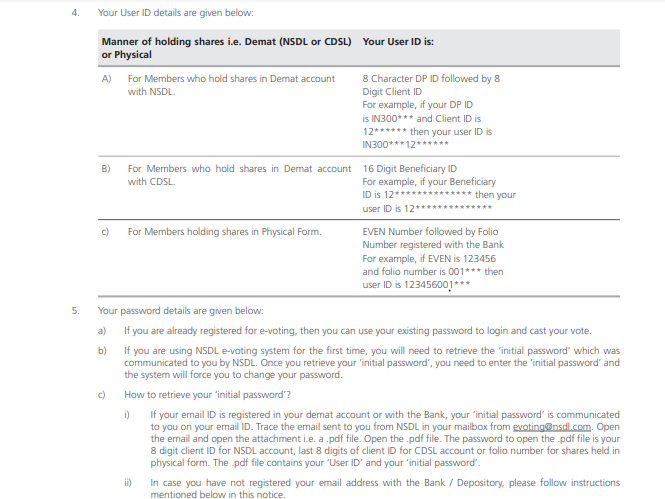
Now the shareholder shall register himself with all the 3 ESPs and have a separate login credential for each ESP to be able to cast his vote. Under the given situation, the shareholder may find it tedious and therefore, skip the whole process itself.  The notice calling the general meeting contains the instruction for logging in the portal of the Depository in the following manner:

SEBI’s move to increase remote-e-voting

With an intent to address the issue of negligible voting by the shareholders, SEBI has introduced a mechanism to make e-voting process more secure, convenient and simple for shareholders under which the shareholder will be allowed to cast their vote directly through their demat accounts/ Depositories/ Depositories Participants without having to go through the hassle of registering with various ESPs and maintaining a list of multiple user IDs and passwords. In the process, only a single login credential will be enough for the shareholders to participate in remote e-voting and register their vote in respect of any item.

The existing process as envisaged above will be replaced with a single doorstep which will be accessed by a single login credential under which the shareholder shall be allowed to vote without any further authentication by ESPs.

By taking the help of the above example, the new facility can be explained in the following manner-

Under the new facility, Mr. S does will not have to maintain login credentials for all the 3 ESPs but only have to register with the Depository either directly or through his demat accounts with Depsoitory Participants to have access to all the ESPs through a single log in without additional authentication with ESPs. This has been explained in detail below.

The facility shall be implemented in 2 phases.

Under Phase -1:

SEBI has instructed to implement the process as provided in Phase-1 within 6 months of the date of the circular (i.e. within 9th June 2021).

Shareholders with demat accounts have been provided the option to either directly register with Depositories to access the e-voting page of various ESPs through websites of the Depositories or accessing various ESP portals directly from their demat accounts, through the facility provided by the depository without any further authentication by ESPs, for participation in the e-voting process.

Under Phase-2:

SEBI has instructed to implement Phase 2 within 12 months from the completion of the process in Phase 1.

Under the 2nd phase, it has been proposed to further enhance the convenience and security of the system with the help of One Time Password (OTP) verification mechanism wherein the shareholders will be allowed to login through registered mobile number or E-mail based OTP verification as an alternate in place of logging through username and password for cases where shareholders have directly registered with the Depository

Further for logging in through demat account with the DPs, a second factor authentication using mobile or e-mail based OTP shall also be introduced after logging in.

While the SEBI circular requires implementation in two phases, the consultative paper was different on the following fronts:-

  • Consultative paper did not provide for implementation of the mechanism in a phased manner;
  • It was proposed that only the Depositories will be required to establish a dedicated helpline unlike the SEBI circular where both Depositories and ESPs are required to have a dedicated helpline;
  • The consultative paper proposed that the ESPs shall send details of the votes cast, to the shareholders, via SMS/ Email whereas the circular places the responsibility of sending a confirmatory SMS on the Depository based on the confirmation received from ESPs.
  • Sharing of necessary details and logs by Depositories with ESPs and sharing of electronic logs and other related information with respect to e-voting transactions with Depositories by ESPs as proposed in the consultative paper has been done away with in the circular.

To dos for Depositories and ESPs

Depositories

  • Accountable for authentication – The Depository has been made responsible to carry out the authentication of the shareholders and voting will be allowed by ESPs based on the Depository’s authentication.
  • Flash messages/ reminders – Another step taken to increase participation is SMS/ email alerts by the Depository to the demat account holders atleast 2 days prior to the date of the commencement of e-voting. The listed entity shall provide the details of its upcoming AGMs requiring voting to Depository who shall then send a SMS/ email alerts.
  • Dedicated helpline – Depositories to establish a dedicated helpline to resolve technical difficulties faced by shareholders relating to the e-voting facility

ESPs

  • Dedicated helpline- listed companies shall ensure that the ESPs engaged by them also provide a dedicated helpline in this regard.
  • Better Disclosure- To enable shareholders to take informed decisions while voting on any proposed resolution of a Company, ESPs has been instructed to provide web-link to the disclosures made by the Company on the stock exchange website and report on the website of the proxy advisors.

Conclusion

This framework for one stop log-in has only been made mandatory in respect of public non-institutional shareholders/ retail shareholders and the existing process may continue for all physical shareholders and shareholders other than individuals viz. institutions/ corporate shareholders. Further, SEBI’s perception on the current shareholder participation is based on its public consultation and is probably because, the shareholders are not taking the trouble of registering themselves with the various ESPs.

The step taken by SEBI towards a more democratic participation of the shareholders may be effective in the long run. However, its current effectiveness seems to be doubtful unless the shareholders for whom the same has been made, find it useful and be ready to implement the same.

Our other relevant resources on similar topic can be read here –

  1. https://vinodkothari.com/2020/05/faqs-on-conducting-agm-through-vc/
  2. https://vinodkothari.com/2020/05/resources-on-virtual-agm/
  3. https://vinodkothari.com/wp-content/uploads/2017/03/FAQs_on_e-voting_in_general_meetings.pdf


[1] https://www.sebi.gov.in/reports-and-statistics/reports/mar-2020/consultative-paper-on-e-voting-facility-provided-by-listed-entities_46213.html

[2]https://www.sebi.gov.in/legal/circulars/dec-2020/e-voting-facility-provided-by-listed-entities_48390.html 

Credit Cards Business- Regulatory nuances from issuance to co-branding