Impact of restructuring on ECL computation

-Aanchal Kaur Nagpal (aanchal@vinodkothari.com)

Introduction

The disruption throughout the globe due to the COVID-19 pandemic has hit the Indian economy as well significantly. The financial sector has experienced a massive blow due to the impact of the pandemic on the credit worthiness and repayment capacity of the overall general public. RBI has responded through various measures including allowing moratorium period, providing resolution framework for stressed accounts due to COVID-19 and numerous other measures.

The retail borrower segment of several banks and NBFCs has also been adversely affected by the disruption and hence, the lenders are contemplating ways to extend certain benefits to such borrowers them under the various circulars issued by the RBI and government. In this regard, restructuring or modification in terms of a loan is being done for economic or legal reasons, relating to the borrower’s financial difficulty. However, such restructuring may also have implications on the books of accounts, especially for IndAS compliant entities.

The following note discusses the meaning of ‘restructuring’ and it impact on the credit risk of the borrower.

Meaning of Restructuring

As per RBI norms on Restructuring of Advances by NBFC, A restructured account is one where the NBFC, for economic or legal reasons relating to the borrower’s financial difficulty, grants to the borrower concessions that the NBFC would not otherwise consider.

As per the Basel guidelines on prudential treatment of problem assets –definitions of nonperforming exposures and forbearance, definition of forbearance is as follows:

4.1. Identification of forbearance

  1. Forbearance occurs when:
  • a counterparty is experiencing financial difficulty in meeting its financial commitments; and
  • a bank grants a concession that it would not otherwise consider, irrespective of whether the concession is at the discretion of the bank and/or the counterparty. A concession is at the discretion of the counterparty (debtor) when the initial contract allows the counterparty (debtor) to change the terms of the contract in their favour (embedded forbearance clauses) due to financial difficulty.

The meaning of restructuring is modification in terms of a loan, which is done for economic or legal reasons, relating to the borrower’s financial difficulty. Usually, restructuring may be of various types. A credit weakness related restructuring is one which is done to assist the borrower to continue to service the facility. If such restructuring was not done, potentially, the borrower may not have been able to service the facility. Therefore, this is done with a view to avert a default. Yet another type of restructuring is a preponement of payments or early clearance of a loan. A third example has been given in the definition itself – for example, passing on the benefit of any interest rate increase or decrease in case of floating rate loans.

Change in credit risk

Under Indian Accounting Standard (Ind AS) 109 Financial Instruments (‘IndAS 109’), Expected Credit Loss (ECL) provision is computed for the loan accounts and it is important to determine whether restructuring should be considered as a factor in determining change in the credit risk characteristic of the borrower.

Significant Increase in Credit Risk (SICR), in the context of IFRS 9, is a significant change in the estimated Default Risk (over the remaining expected life of the financial instrument). The term ‘significant’ is not defined in IFRS-9 and thus SICR is determined using various internal and external indicators. The provisions of para 5.5.12 of IndAS 109[1] are self-explanatory on the point that if there has been a modification of the contractual terms of a loan, then, in order to see whether there has been a SICR, the entity shall compare the credit risk before the modification, and the credit risk after the modification.

While SICR indicators usually suffice during normal circumstances, but adjusting to the ‘new normal’ would require ‘new’ ways to consider SICR. The most important question that arises is whether modification in the loan terms to avoid a credit default due to COVID-19 disruption would lead to SICR.

International Guidance

  • As per the International Monetary Fund Report on The Treatment of Restructured Loans for FSI Compilation,

The BCBS (2017) defines loan forbearance as a situation in which (1) a counterparty is experiencing financial difficulty in meeting its financial commitments, and (2) a bank grants a concession that it would not otherwise consider, whether or not the concession is at the discretion of the bank and/or the counterparty. The Guide defines restructured loans as loans arising from rescheduling and refinancing of the original loan. Therefore, all forbearance measures are loan restructuring, but not all loan restructurings are forbearance measures.

Recently, in response to COVID-19 shock, the BCBS (2020) has clarified that when borrowers accept the terms of a payment moratorium (public or granted by banks on a voluntary basis) or have access to other relief measures such as public guarantees, these developments may not automatically lead to the loan being categorized as forborne. At the same time, banks would still need to assess the likelihood of the borrower’s rescheduled payments after the moratorium period ends.

  • The Indian Accounting Standard Board also released a clarification under ‘IFRS 9 and Covid-19’[2] stating that,

Entities should not continue to apply their existing ECL methodology mechanically. For example, the extension of payment holidays to all borrowers in particular classes of financial instruments should not automatically result in all those instruments being considered to have suffered an SICR.

  • According to the European Banking Authority’s Final Report on ‘Guidelines on reporting and disclosure of exposures subject to measures applied in response to the COVID‐19 crisis’[3],

More precisely, moratoria on loan payments that are in accordance with the EBA Guidelines on legislative and non‐legislative moratoria on loan repayments applied in the light of the COVID‐ 19 crisis do not trigger forbearance classification and the assessment of distressed structuring of loans and advances benefiting from these moratoria and they do not automatically lead to default classification. For example, if a performing loan is subject to a moratorium compliant with the GL on moratoria, which brings contractual changes to the terms of the loan, in the existing supervisory reporting this loan will continue to be reported under the category of performing exposures with no specific indication of the measures applied. However, it is also emphasised that the credit institutions should continue the monitoring and where necessary the unlikeliness to pay assessment of loans and advances that fall under the scope of these moratoria.

  • The Prudential Regulatory Authority of the Bank of England sent letters[4] to CEOs of various Banks guiding the following –

Our expectation is that eligibility for, and use of, the UK Government’s policy on the extension of payment holidays should not automatically, other things being equal, result in the loans involved being moved into Stage 2 or Stage 3 for the purposes of calculating ECL or trigger a default under the EU Capital Requirements Regulation (CRR). This expectation extends to similar schemes to respond to the adverse economic impact of the virus.

We do not consider the use of a Covid-19 related payment holiday by a borrower to trigger the counting of days past due or generate arrears under CRR. We also do not consider the use of such a payment holiday to result automatically in the borrower being considered unlikely to pay under CRR.

Firms are reminded to apply sound risk management practices regarding the identification of defaults. Firms should continue to assess borrowers for other indicators of unlikeliness to pay, taking into consideration the underlying cause of any financial difficulty and whether it is likely to be temporary as a result of Covid-19 or longer term

Our expectation is that a covenant breach or waiver of a covenant relating to a modification of the audit report attached to audited financial statements because of the Covid-19 pandemic should not automatically, other things being equal, trigger a default under CRR or result in a move of the loans involved into Stage 2 or Stage 3 for the purposes of calculating ECL. This expectation extends to other covenant breaches and waivers of covenants with a direct link to the Covid-19 pandemic.

A breach of the covenants of a credit contract is a possible indication of unlikeliness to pay under the CRR definition of default. However, a covenant breach does not automatically trigger a default. Rather, firms have scope to assess covenant breaches on a case-by-case basis and determine whether they indicate unlikeliness to pay.

  • The Accounting Standards Board of Canada[5] also took note of the guidance provided by IASB on guidance on applying IFRS 9 Financial Instrument. Further, it also took note of the guidance[6] provided by the Office of the Superintendent of Financial Institutions (OFSI) in Canada and specified that the guidance is consistent with the requirements in IFRS 9 and should thus be considered along with the guidance provided by the IASB. The OFSI, through its guidance, provided the following in relation to applying IFRS in extraordinary circumstances –

IFRS 9 is principles-based and requires the use of experienced credit judgement. Consistent with OSFI’s IFRS 9 Financial Instruments and Disclosures guideline, OSFI is providing guidance on three specific aspects of the accounting for Expected Credit Losses (ECLs) due to the exceptional circumstances arising from COVID-19. Deposit taking Institutions (DTIs) should also consider any additional guidance provided by the International Accounting Standards Board on the application of IFRS 9 in relation to COVID-19.

Under the IFRS 9 ECL accounting framework, DTIs should consider both quantitative and qualitative information, including experienced credit judgment, in assessing for significant increase in credit risk. In OSFI’s view, the utilization of a payment deferral program should not result in an automatic trigger, all things being equal, for significant increase in credit risk.

  • The International Public Sector Accounting Standards Board (IPSASB) released QnA[7] to provide insight into the financial reporting issues associated with COVID-19 government responses, and the relevant International Public Sector Accounting Standards (IPSAS). According to the same,

Given the economic severity associated with COVID-19, entities will need to review their portfolio of financial assets and assess whether an impairment is necessary.

Considering the aforesaid guidelines, all restructuring should not automatically be implied as SICR and the same should be based on facts after analyzing the background of credit worthiness of the borrower.

In case the restructuring is done under the disruption scenario then the same is not indicative of any increase in the probability of default. Accordingly, the same should ideally not be considered as a factor for considering SICR. Thus, if the restructuring is done for accounts that are stressed as a direct result of COVID-19, then the same shall not be treated as SICR.

However, if the restructuring is granted as a generalized option to all customers without any attention paid to reasons for such credit weakness, then the same is done to merely avoid credit difficulty or default of such borrowers which may not necessarily be caused by COVID-19.

Further, something like moratorium, which is granted for a systemic disruption such as a crisis of payment and settlements, natural calamities, etc. is for non-economic reasons, and therefore, may not be likened with a credit-weakness-related restructuring. In the current scenario, the general assumption may be that the credit default is directly associated with the COVID-19 pandemic in most cases.

Restructuring to all borrowers at a class level

A financial institution may also intend to modify the terms of the loan for the entire class as against a particular individual. If the underlying reason for such modification is the financial difficulty faced by the entire class due to Covid disruption, such that the modification is to tide over such difficulty and continue to service the loan, in our view, this will amount to restructuring and lead to a downgrade of asset classification. The underlying rationale is that a loan is a credit decision which is made looking at the prevailing situation at the time of extension of the credit. If the payment schedule is adjusted to take into consideration any change in situations that has happened subsequent to the grant of the credit, the same should be a case of deterioration in the credit quality of the loan. While going by the language of the regulation it seems to refer to only individual cases of restructuring, however, the fact that the entire class of borrower is facing the financial difficulty cannot be overlooked. Merely because the restructuring has been done for a class of borrowers does not mean the restructuring is not to avert a potential default.

Usually, the need for restructuring is identified at the individual exposure level to which concessions are granted due to financial difficulties of the respective borrower. Taking a decision to provide relief to an entire class of borrower instead of considering individual restructuring of each borrower account is a matter of prudence, which must be taken without compromising the interest of the Company, that is the lender.

Impact on IND AS treatment

Based on the aforesaid discussion, it can be inferred that the restructuring under the disruption scenario is not indicative of any increase in the probability of default. Accordingly, the same should ideally not be considered as a factor for considering SICR and in turn, should not result in shifting of the financial instruments from one stage to another. However, in case the account showed signs of credit weakness even before the restructuring, then there should be a shift from one stage to another.

Our related articles–


[1] If the contractual cash flows on a financial asset have been renegotiated or modified and the financial asset was not derecognised, an entity shall assess whether there has been a significant increase in the credit risk of the financial instrument in accordance with paragraph 5.5.3 by comparing:

(a) the risk of a default occurring at the reporting date (based on the modified contractual terms); and

(b) the risk of a default occurring at initial recognition (based on the original, unmodified contractual terms).

[2] ifrs-9-ecl-and-coronavirus.pdf

[3] Microsoft Word – Guidelines on Covid -19 measures reporting and disclosure.docx (europa.eu)

[4] Dear CEO Letter on Covid-19 IFRS 9 Capital Requirements and Loan Covenants (bankofengland.co.uk)

[5] IFRS 9 Expected Credit Losses and COVID-19 (frascanada.ca)

[6] OSFI Actions to Address Operational Issues Stemming from COVID-19 (osfi-bsif.gc.ca)

[7] IPSASB-Staff-QA-COVID-19-Relevant-Accounting-Guidance_0.pdf (ifac.org)
New Model of Co-Lending in financial sector

Scope expanded, risk participation contractual, borders with direct assignment drawn 

-Team Financial Services (finserv@vinodkothari.com)

[This version dated 20th March, 2021]

Co-lending is coming together of entities in the financial sector – mostly, something that happens between banks and NBFCs, or larger banks and smaller banks. Financial interfaces between different financial entities may take the form of securitisation, direct assignment, co-lending, banking correspondents, loan referencing, etc.

While direct assignment and securitisation have been around for quite some time, co-lending was permitted by the RBI under its existing guidelines on ‘Co-origination of loans between banks and NBFC-SIs for granting loan to the priority sector’[1]. As per the Statement on Developmental and Regulatory Policies issued by the RBI dated October 9, 2020, it was decided to expand the scope of co-lending, currently permitted only for NBFC-SIs, to all NBFCs. Accordingly, the RBI came, vide notification on co-lending by banks and NBFCs (Co-Lending Model/CLM)[2] dated November 5, 2020, with a new regulatory framework for co-lending, of course, in case of priority sector loans. The CLM supersedes the existing guidelines on co-origination.

There is no clarity, still, on whether the non-priority sector loans (PSL  or Non-PSL) will also be covered by this regulatory discipline, or any discipline for that matter. In this write-up, we explore the key features of the co-lending regime, and also get into tricky questions such as applicability to non-PSL loans, the borderlines of distinction between direct assignments and co-lending, the sharing of risks and rewards, etc.

Applicability

The erstwhile Regulations for priority sector lending covered co-lending transactions of Banks and Systemically Important NBFCs. However, under the Co-Lending Model.The CLM covers all NBFCs (including HFCs) in its purview.

There is a whole breed of new-age fintech companies using innovative algo-based originations, and aggressively using the internet for originations, and these companies pass a substantial part of their lending to either larger NBFCs or to banks. Thus, the expanded ambit of the Co-Lending Model will increase the penetration and result into wider outreach, meet the objective of financial inclusion, and potentially, reduce the cost for the ultimate beneficiary of the loans. Smaller NBFCs have their own operational efficiencies and distribution capabilities; hence, this is a welcome move.

Further, the RBI has excluded foreign Banks, including wholly owned subsidiaries of foreign banks, having less than 20 branches, from the applicability of the CLM. Also, Small Finance Banks, Regional Rural Banks, Urban Cooperative Banks and Local Area Banks have been excluded from the applicability of CLM.

An interesting question that comes up here is whether such exclusion should be construed as a restriction on such entities from entering into co-lending transactions, or a relaxation from the applicability of the Co-Lending Model? It may be noted that the CLM a precondition for PSL treatment of the loans. This is clear from the title ‘Co-Lending by Banks and NBFCs to Priority Sector’. The intent is not to put a bar on existence of co-lending arrangements outside the CLM. That is to say, if the loan, originated by the principal co-lender, is a priority sector loan, then the participating co-lender will also be able to treat the participant’s share of the loan as a PSL, subject to adherence to the conditions specified in CLM. The implication of this is that where the loan does not meet the conditions of CLM, then the participating bank will not be able to accord a PSL status, even though the loan in question is a PSL loan.

With that rationale, in our view, there is no absolute prohibition in the excluded banking entities from being a co-lender. However, if the major motivation of the co-lending mechanism under the CLM is the PSL tag, that tag will not be available to the excluded banks, and hence, the very inspiration for falling under the arrangement may go away. This is also clear from the PSL Master Directions[3] which recognises co-origination of loans by SCBs and NBFCs for lending to the priority sector and specifically excludes RRBs, UCBs, SFBs and LABs.

Applicability date and the fate of existing transactions

In the absence of any specified timelines, the CLM supersedes the existing co-lending guidelines with immediate effect. However, it specifies that outstanding loans in terms of the erstwhile guidelines would continue to be classified under priority sector till their repayment or maturity, whichever is earlier.

This would mean grandfathering of existing loans, and not existing lending arrangements. That is to say, if there are existing co-lending arrangements, but the loan in question has not yet originated, even existing co-lending arrangements will have to abide with the Co-Lending Model. Needless to say, any new co-lending arrangements will nevertheless have to abide by the Co-Lending Model.

As we note below, one of the very important features of the Co-Lending Model is that risk-sharing and loan-sharing do not have to follow the same proportion. Additionally, it is possible for the participating bank to have an explicit recourse against the originating co-lender. This feature was not available under the earlier framework. This alone may be a sufficient motivation for existing CLMs to be revised or redrawn.

Co-lending, Outsourcing and Direct Assignment – new borderlines of distinction

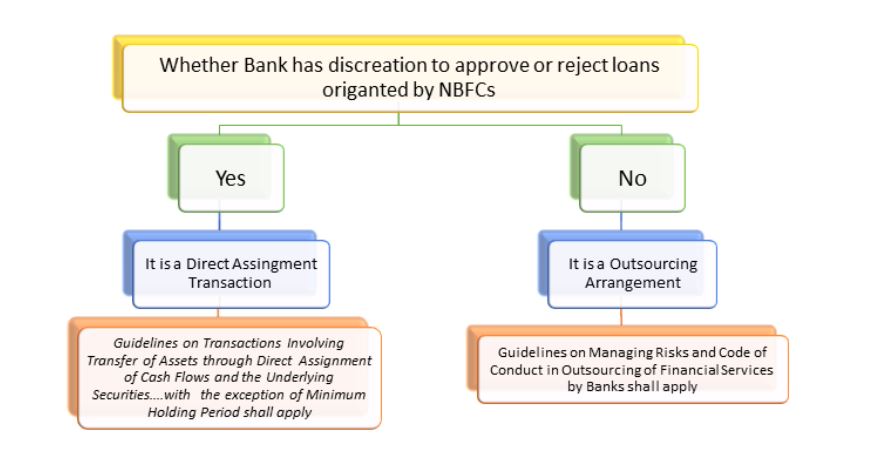
For the purpose of entering into co-lending transactions, banks and NBFCs will have to enter into a ‘Master Agreement’. Such agreement may require the bank either to mandatorily take the loans originated by the NBFC on its books or retain discretion as to taking the loans on its books.

Where the participating bank has a discretion as to taking its share of the loans originated by the originating partner, the transaction partakes the character of a direct assignment. Para 1(c) of the CLM says that ”…if the bank can exercise its discretion regarding taking into its books the loans originated by NBFC as per the Agreement, the arrangement will be akin to a direct assignment transaction. Accordingly, the taking over bank shall ensure compliance with all the requirements in terms of Guidelines on Transactions Involving Transfer of Assets through Direct Assignment of Cash Flows and the Underlying Securities….with the exception of Minimum Holding Period (MHP) which shall not be applicable in such transactions undertaken in terms of this CLM.

That would mean, a precondition for the arrangement being treated as a CLM is that the participating bank takes the loans originated by the originating partner without discretion exercisable on a cherry-picking basis.

Does this mean that irrespective of whether the loan originated by the originating partner fits into the credit screen of the bank or not, the bank will still have to take it, lying low? certainly, this is not the intent of the CLM This is what comes form clause 1(a)- ‘…..the partner bank and NBFC shall have to put in place suitable mechanisms for ex-ante due diligence by the bank as the credit sanction process cannot be outsourced under the extant guidelines.’

Thus, even in case the bank gives a prior, irrevocable commitment to take its share of exposure, the same shall be subject to an ex-ante due diligence by the bank. Ex-ante obviously implies a prior  As per the outsourcing guidelines for banks[4], the credit sanction process cannot be outsourced. Accordingly, it must be ensured that the credit sanction process has not been outsourced completely and the bank retains the right to carry out the due diligence as per its internal policy. Notwithstanding the bank’s due diligence exercise, the co-lending NBFC shall also simultaneously carry out its own credit sanction process.

The conclusion one gets from the above is as follows:

  • The essence of co-lending arrangement is that the participating bank relies upon the lead role played by the originating bank. The originating bank is the one playing the fronting role, with customer interface. The credit screens, of course, are pre-agreed and it will naturally be incumbent upon the originating bank to abide by those. Hence, on a case by case basis or so-called “cherry picking” basis, the participating bank is not selecting or dis-selecting loans. If that is what is being done, the transaction amounts to a DA.
  • Subject to the above, the participating bank is expected to have its credit appraisal process still on. Where it finds deviations from the same, the participating bank may still decline to take its share.

It is important to note that if DA comes into play, the requirements such as MHP, MRR, true sale conditions will also have to be complied with. However, co-lending transactions do not have any MHP requirements, unlike in case of either DA or securitiastion. Of course co-lending transactions do have a risk retention stipulation, as the CLM require a 20% minimum share with the originating NBFC. Hence, the intent of the RBI is that co lending mechanism must not turn out to be a regulatory arbitrage to carry out what is virtually a DA, through the CLM.

(Almost) A new model of direct assignments: assignments without holding period

Para 1 c. of the Annex seems to be leading to a completely new model of direct assignments – direct assignments without a holding period, or so-called on-tap direct assignments. Reading para 1 c. suggests that while co-lending takes the form of a loan sharing at the very inception, the reference in para 1 c. is to loans which have already  been originated by the NBFC, and the participating bank now cherry-picks some or more of those loans. The cherry-picking is evident in “if the bank can exercise its discretion regarding taking into its books the loans originated by NBFC”. However, unlike any other direct assignment, this assignment happens on what may be called a back-to-back arrangement, that is, without allowing for lapse of time to see the loan in hindsight.

In essence, there emerge 3 possibilities:

  • A non-discretionary loan sharing, which is the usual co-lending model, where the originating co-lender has a minimum 20% share.
  • A discretionary, on-tap assignment, where the originating assignor needs to have a minimum 20% share
  • A proper direct assignment, with minimum holding period, where the assignor needs to have a minimum 10% share.

The on-tap assignment referred to above seems to be subject to all the norms applicable to a direct assignment, other than the minimum holding period.

Interest Rates

The erstwhile guidelines require that the interest rate charged on the loans originated under the co-lending guidelines would be calculated as per Blended Interest Rate Calculations, that is to say the rate shall be calculated by assigning weights in proportion to risk exposure undertaken by each party, to the benchmark interest rate of the respective lender.

The current guidelines require that the interest rate shall be an all inclusive rate that is mutually agreed by the parties. However it shall be ensured that the interest rate charged is not excessive as the same would breach the provisions of fair practice code, which is to be compulsorily complied.

This change would provide flexibility to the lenders and also ensure that the cost incurred in tracing and disbursals to remote sectors as well as enhanced risk exposure is appropriately compensated.

Determining the roles

Under the erstwhile provisions, it was mandatory that the share of the co-lending NBFC shall be at least 20%. The same has been retained in the CLM as well, requiring NBFCs to retain a minimum of 20% share of the individual loans on their books.

Under the CLM, the co-lending NBFC shall be the single point of interface for the customers. Further, the grievance redressal function would also have to be carried out by the NBFC.

Operational Aspects

Escrow Account

For the purpose of disbursals, collections etc. an escrow account should be opened. The co-lending banks and NBFCs shall maintain each individual borrower’s account for their respective exposures. It is only for the purpose of avoiding commingling of funds, that an escrow mechanism is required to be placed. The bank and NBFC shall, while entering into the Master Agreement, lay down the rights and duties relating to the escrow account, manner of appropriation etc.

Creation of Security

The manner of creation of charge on the security provided for the loan shall be decided in the Master Agreement itself.

Accounting

Each of the lenders shall record their respective exposures in their books. The asset classification and provisioning shall also be done for the respective part of the exposure. For this purpose, the monitoring of the accounts may either be done by both the co-lenders or may be outsourced to any one of them, as agreed in the Master Agreement. Usually, the function of monitoring remains with the NBFC (since, it has done the origination and deals with the customer.)

Non-PSL loans: whether the framework would apply in pari materia?

The guidelines on CLM have been issued for co-lending of loans that qualify for the purpose of priority sector lending. This does not bar lenders from entering into co-lending transactions outside the purview of these guidelines. The only difference it would make is such loans would not be eligible to be classified as loans to the priority sector (which is the primary motive for banks to enter into co-lending transactions).

This seems to form a view that the guidelines would not at all be applicable in case of non-priority sector loans. However, for a transaction to be a co-lending transaction, there has to be adequate risk sharing between the co-lenders. Hence, the guidelines on CLM shall be applicable in pari-materia.

[1] https://www.rbi.org.in/Scripts/NotificationUser.aspx?Id=11376&Mode=0

[2] https://www.rbi.org.in/Scripts/NotificationUser.aspx?Id=11991&Mode=0

[3] https://www.rbi.org.in/Scripts/NotificationUser.aspx?Id=11959&Mode=0

[4] https://www.rbi.org.in/scripts/NotificationUser.aspx?Id=3148&Mode=0


Other related write-ups:


Modes of Restructuring of Stressed Accounts

Our detailed write-ups on these frameworks may be referred here:


Fractured Factoring: Amendments may give a push to a potent trade finance solution


Our other write-ups on Factoring:


https://vinodkothari.com/wp-content/uploads/2017/03/FAQs_on_factoring_by_RBI-1.pdf

https://vinodkothari.com/wp-content/uploads/2017/03/Export_Factoring.pdf


RBI takes steps to prepare for the aftermath of the pandemic

-Kanakprabha Jethani (kanak@vinodkothari.com)

Background

On October 9, 2020, the RBI released its Statement of Developmental and Regulatory Policies[1] which lays down the next steps of the RBI in the direction of coping up with the impact of the pandemic. The intended moves of the RBI seem to ensure preparing the financial sector to support the economy get in track with the new normal. Below are a few highlights proposed by the RBI with respect to the financial sector.

With respect to capital adequacy of banks

Banks and NBFCs are required to maintain certain capital ratios prescribed by the RBI. As for banks, they are required to maintain a Capital to Risk-weighted Assets Ratio (CRAR) of 9%. For the calculation of risk-weighted assets, the RBI prescribes the weights to be assigned to each on and off the balance sheet assets of the banks.

Increase in the size- limit for regulatory retail portfolio

The RBI has prescribed 75% risk weight for the ‘regulatory retail portfolio’ of banks. For an exposure to qualify into the regulatory retail portfolio[2], the following conditions are required to be met:

  • The exposure shall towards an individual person or persons or small business;
  • The exposure shall be in the form of revolving credits, line of credit, term loans and leases, student and educational loans and small business facilities and commitments;
  • No aggregate exposure to one counterparty should exceed 0.2% of the overall regulatory retail portfolio;
  • The maximum aggregated retail exposure to one counterparty should not exceed Rs. 5 crores.

The above limit of Rs. 5 crores has now been increased to Rs. 7.5 crores for fresh facilities and incremental qualifying exposures. This has been done with an intent to reduce the cost of credit and to harmonisation the regulations with the Basel guidelines[3]. This measure is expected to increase the much-needed credit flow to the small business segment.

Revision in risk weights

The risk weights for housing loans to individuals have also been changed. The table below shows the change in risk weighting requirements:

Earlier Risk weighting requirements[4]

Outstanding Loan LTV ratio (%) Risk Weight (%)
Upto Rs. 30 lakhs <=80 35
>80 and <=90 50
Above Rs. 30 lakhs and upto Rs. 75 lakhs <=80 35
Above Rs. 75 lakhs <=75 50

Revised requirement:

LTV ratio (%) Risk Weight (%)
<=80 35
>80 and <=90 50

Under the existing regulations, differential risk weights are assigned to individual housing loans, based on the size of the loan as well as the loan-to-value ratio (LTV). In order to rationalise the risk weights, the regulator has linked them to LTV ratios only for all new housing loans sanctioned up to March 31, 2022. This measure is expected to give a fillip to the real estate sector. However, the determination of LTV is still linked to the size of the loan[5]. Hence, there is only a minimal change with this revision of limits, which is not likely to have much impact on housing loans extended by banks.

Wider inclusion with respect to priority sector lending

Loans co-originated by banks and NBFC-SIs were allowed to qualify for priority sector lending targets[6]. The RBI has now allowed loans co-originated by banks with NBFC-NSIs and HFCs as well for qualifying as priority sector loans. The detailed guidelines in this regard are awaited.

There already exist co-lending arrangements between banks and smaller NBFC and HFCs, however, they are not regulated by any specific guidelines. Though in spirit most of these arrangements are structured in accordance with the existing guidelines for NBFC-SI, however, some of the norms may be a challenge to implement- one of them being the minimum risk sharing of 20% by way of direct exposure by the NBFC.

Conclusion

These steps introduced by the RBI are not exactly a major move taken by the regulator, however, several such changes may have an impact in the long run. Further, the inclusion of NBFC-NSIs and HFCs in the scope of co-origination guidelines is a welcome move and is expected to work in the benefit of smaller NBFCs and HFCs.


[1] https://www.rbi.org.in/Scripts/BS_PressReleaseDisplay.aspx?prid=50480

[2] Refer: https://www.rbi.org.in/scripts/BS_ViewMasCirculardetails.aspx?id=4353

[3] Refer: https://www.bis.org/publ/bcbs128b.pdf

[4] https://www.rbi.org.in/Scripts/NotificationUser.aspx?Id=10995&Mode=0

[5] Refer: https://www.rbi.org.in/Scripts/BS_ViewMasCirculardetails.aspx?id=9851

[6] Refer: https://www.rbi.org.in/Scripts/NotificationUser.aspx?Id=11376&Mode=0


The new PSL Master Direction and its Impact on NBFCs

-Siddharth Goel (finserv@vinodkothari.com)

Introduction

The Reserve Bank of India (RBI) issued Master Directions-Priority Sector Lending (PSL) Targets and Classification on September 4, 2020 (‘Master Directions’).[1] The Master Directions consolidates various circulars and guidelines issued by RBI with respect to PSL.

The changes made in the Master Directions primarily deal with targets and sub-targets for classification of loans as priority sector loans. Further there are some addition of new sectors in Eligible categories, along with increase in lending limit of some of the existing eligible categories for priority sector lending.

Our detailed write-up on the topic can be viewed here.

Changes in priority sector norms do not have a direct impact on the NBFCs, but they have an indirect impact. Banks are allowed to acquire loans under Direct Assignment arrangements or invest in pass through certificates backed by loans which qualify the definition of PSL, in order to meet the prescribed targets. Mostly, the banks acquire these receivables from NBFCs who does the origination of the loans. Additionally, banks also engage in co-lending arrangements with NBFCs to originate PSLs. Therefore, it is worthwhile to examine the impact of these changes on NBFCs.

Co-origination of loans by Banks for lending to Priority Sector

RBI through its vide notification RBI/2018-19/49 dated September 21, 2018 issued guidelines on Co-origination of loans by Commercial Banks and NBFC-ND-SI (“Co-origination Guidelines”).[2] These guidelines excluded Regional Rural Banks (RRBs) and Small Finance Banks (SFBs). Essentially, the banks could claim priority sector status in respect of its share of credit while engaging in the co-origination arrangement with NBFC under the Co-origination Guidelines. Provided, the priority sector assets on the bank’s books should at all times be without recourse to the NBFC.

It is pertinent to note that the PSL Master Directions under its para 25 covers Co-origination of loans by Banks and NBFC-ND-SI. The Master Direction specifically excludes, RRBs SFBs and Urban Co-Operative Banks (UCBs) and Local Area Banks (LABs) under the above para. Moreover, the Master Directions under the said para, specifically stipulates that detailed guidelines in this regard are to be governed as provided under Co-origination Guidelines dated September 21, 2018. Hence there are no changes intended to be introduced vis-a-vis Master Direction, to the co-origination of loans by banks and NBFCs.

PSL- Lending by Banks to NBFCs for On-Lending

In the earlier regime, after the review of Priority sector lending by banks to NBFC for On-Lending notification dated August 13, 2019[3], RBI through its notification dated March 23, 2020,[4] extend the priority sector classification for bank loans to NBFCs for on-lending for the FY 2020-21. Further, existing loans disbursed under the on-lending model continued to be classified under Priority Sector till the date of repayment/maturity. The extension notification also stipulated an overall capping limit for calculating bank’s total priority sector lending as produced herein below;

“3. Bank credit to registered NBFCs (other than MFIs) and HFCs for on-lending will be allowed up to an overall limit of five percent of individual bank’s total priority sector lending. Further, banks shall compute the eligible portfolio under on-lending mechanism by averaging across four quarters, to determine adherence to the prescribed cap.”

Para 22 of the Master Directions governs Bank loans to registered NBFCs (other than MFIs). It is highlighted that there is no change in sub-category for On-lending by NBFC, and limits also remain unchanged. The above para in the Master Direction, clearly stipulates that on-lending will be eligible for classification as priority sector under respective categories which is subject to the following conditions:

(i) Agriculture: On-lending by NBFCs for ‘Term lending’ component under Agriculture will be allowed up to ₹ 10 lakh per borrower.

(ii) Micro & Small enterprises: On-lending by NBFC will be allowed up to ₹ 20 lakh per borrower.

The above dispensation is valid up to March 31, 2021 and will be reviewed thereafter. However, loans disbursed under the on-lending model will continue to be classified under Priority Sector till the date of repayment/maturity. Caping of overall limit of Bank Credit to 5 percent has been prescribed under para 24 of the Master Directions.

Investments by Banks in Securitised Assets & Direct Assignment

Investments by banks in securitised assets or assignment/outright purchase of a pool of assets, representing loans by banks and financial institutions to various categories of priority sector, except ‘others’ category, are eligible for classification under respective categories of priority sector depending on the underlying assets. However, earlier the requirement was that the interest rate charged to the ultimate borrower in securitised assets and in case of transfer of assets through direct assignment, shall be capped at Base Rate of the investing bank plus 8 percent per annum.

Therefore, investments by banks, in securitised assets and purchase of assets originated by NBFCs in eligible sectors had to comply with above capping in order to qualify as eligible for PSL. To encourage MSME lending in smaller areas where cost of intermediation is high for the smaller NBFCs, the UK Sinha committee in its report has proposed the cap at Base Rate of the investing bank plus 12% per annum initially and periodical review thereafter. The intent of the recommendation stood on the grounds that price caps are not applicable to banks when they originate directly through branches.

Accordingly, such capping limit has been relaxed and as per the as per the revised requirement the all-inclusive interest charged to the ultimate borrower by the originating entity should not exceed the External Benchmark Lending Rate (EBLR)/ MCLR of the investing bank plus appropriate spread which will be communicated separately. It is expected that the RBI shall be separately communicating the limits to the banks.

The aforesaid relaxation in the interest rate capping would widen the eligibility of loans originated by the NBFCs for securitisation and direct assignment to banks, for meeting the PSL requirement.

Adjustments for weights in PSL Achievement

To address the regional disparities in flow of credit at the district level, currently districts have been ranked on the basis of per capita credit flow. Higher weight (125%) is assigned to the incremental priority sector credit in districts with low per capita credit flow. Similarly, lower weight (90%) has been assigned to incremental PSL in districts with comparatively higher credit flow. The higher PSL credit (125 %) districts are specified in ANNEX-I A and districts with comparatively low PSL credit (90%) are specified in ANNEX-IB of the Master direction. Districts not mentioned in either of the Annex will be having weightage of 100%. PSL incremental credit shall be applicable from F.Y. 2021-2022 onwards.

Thus, for the purpose of above incentives, banks will get incremental PSL credit, if they invest as following:

  • Investment in securitsed assets/direct assignment/outright purchase, of loans originated by NBFCs from high priority districts. The entire investment in PTCs made by the banks, the proportion which is represented by those as priority districts will be weighted at 125% and low priority districts at 90% and others at 100%.
  • On-lending by Banks to NBFCs, wherein NBFCs are further lending in districts with high priority.
  • Incremental credit incentive will be available to Banks, on proportion of their share of loans, to district with high priority under Co-Origination model.

Impact of new Master Directions on NBFCs

The new Master Direction does not seem to impact legal relationship between banks and NBFCs in respect to co-origination of loans and co-lending materially, since all the regulations are similar to the earlier PSL regime. However, the incentives introduced by way of incremental PSL credit to Banks will channel the credit to districts with low credit penetration. Therefore, banks will be benefitted by dealing with NBFCs having portfolio of loans (eligible for PSL) and presence in districts with lower credit penetration.

Further, change in capping, of investments by Banks in securitised assets and direct assignment/ outright purchase of loans, originated by NBFCs is intended to cover loans originated with higher spreads. Further lending to new sub sectors introduced through Master Direction, would also qualify towards PSL target investments by Banks.

The indicative list of new sub-sectors and sub-sectors with enhanced credit limit is reproduced herein below for ready reference.

Agriculture Lending Including Farm Credit (Allied Activities), lending for Agriculture Infrastructure and Ancillary Activities. ·        Inclusion of loans to farmers for installation of stand-alone Solar Agriculture Pumps and for solarisation of grid connected Agriculture Pumps.

·        Inclusion of loans to farmers for installation of solar power plants on barren/fallow land or in stilt fashion on agriculture land owned by farmer

·        Inclusion of loans up to ₹50 crore to Start-ups, as per definition of Ministry of Commerce and Industry, Govt. of India that are engaged in agriculture and allied services.

·        Inclusion of loans up to ₹2 lakh to individuals solely engaged in Allied activities without any accompanying land holding criteria. This change is in line with recommendation by M.K. Jain Committee7.

·        Inclusion of loans for construction of oil extraction/ processing units for production of bio-fuels, their storage and distribution infrastructure along with loans to entrepreneurs for setting up Compressed Bio Gas (CBG) plants.

·        Laying of Indicative list conveying permissible activities under Food Processing Sector as recommended by Ministry of Food Processing Industries.

·        A credit limit of ₹5 crore per borrowing entity has been specified for Farmers Producers Organisations (FPOs)/Farmers Producers Companies (FPCs) undertaking farming with assured marketing of their produce at a pre-determined price. This inclusion is as per the M.K Jain Committee Recommendations8.


Other Finance to MSMEs In line with the series of benefits being extended to MSMEs, loans up to ₹50 crore to Start-ups, as per definition of Ministry of Commerce and Industry, Govt. of India that confirm to the definition of MSME has been included under the PSL catergory. (On the basis of recommendations by UK Sinha Committee, to financially incentivise the startups in India)


Housing Loans


·        Increase in Loans up to ₹ 10 lakh (earlier ₹ 5 lakh) in metropolitan centres and up to ₹6 lakh (earlier 2 ₹ Lakh) in other centres for repairs to damaged dwelling units.

·        Bank loans to governmental agency for construction of dwelling units or for slum clearance and rehabilitation of slum dwellers subject to dwelling units with carpet area of not more than 60 square meters. Under the earlier regime, it was based on cost of dwelling unit which was ₹ 10 lakh per unit.

·        Inclusion of bank loans for affordable housing projects using at least 50% of FAR/FSI (Floor Area Ratio/ Floor Space Index) for dwelling units with carpet area of not more than 60 sq.m.


Social Infrastructure


Inclusion of loans up to a limit of ₹ 10 crore per borrower for building health care facilities including under ‘Ayushman Bharat’ in Tier II to Tier VI centres. This is in addition to the existing limit of ₹5 crore per borrower for setting up schools, drinking water facilities and sanitation facilities including construction/ refurbishment of household toilets and water improvements at household level, etc.


Renewable Energy Increase in loan limit to ₹ 30 Crore for purposes like solar based power generators, biomass-based power generators, wind mills, micro-hydel plants and for non-conventional energy based public utilities etc. This is to boost renewable energy sector, the earlier limit was up to ₹ 15 Crore.


[1]https://rbidocs.rbi.org.in/rdocs/notification/PDFs/MDPSL803EE903174E4C85AFA14C335A5B0909.PDF

[2] https://rbidocs.rbi.org.in/rdocs/notification/PDFs/NT49BAA4688D36A64EAF8DB0BFD99C6FC54C.PDF

[3] https://www.rbi.org.in/Scripts/NotificationUser.aspx?Id=11659&Mode=0

[4] https://www.rbi.org.in/scripts/FS_Notification.aspx?Id=11828&fn=2754&Mode=0


Our related write-ups


Resolution Framework for Covid-19-related stress

Other related write-ups: