Archive for year: 2021
Moving towards sustainable finance through sustainable bonds
SLBs awe-inspiring issuers and investors ! Payal Agarwal, Executive (payal@vinodkothari.com) ESG or Environmental, Social and Governance concerns are been on a high focus in recent times. The issues are not only been addressed by the environmentalists, but the corporate world is also becoming more and more attentive towards the ESG concerns and devising various ways and means to collate them with their operational activities. One of the various such treads in this regard is the issuance of ESG focussed bonds, which is gradually becoming a popular trend in the global economy, India being no exception. These bonds give a boost to sustainable finance, helping issuers raise finance and investors ensuring their investments fulfil their sustainability goals.
Legal framework in India
In India, the green bonds[1] are one of the most popular and legally recognised means of raising sustainable finance. SEBI, vide its circular dated May 30, 2017 has issued “Disclosure Requirements for Issuance and Listing of Green Debt Securities” which are in addition to the general requirements under the SEBI (Issue and Listing of Debt Securities) Regulations, 2008. Amidst the constant push towards business sustainability and responsibility conduct through reporting for listed entities[2], India also recognised the need for such ESG debt securities in the Consultation Paper released on draft International Financial Service Centres Authority (Issuance and Listing of Securities) Regulations. The said consultation paper provides for a framework for issuance and listing of securities, including ESG debt securities in the stock exchanges under the IFSC region in India. Now, the International Financial Service Centres Authority (Issuance and Listing of Securities) Regulations, 2021 (“IFSC Regulations”) provide a framework for listing of “ESG debt securities”. In this article, we will discuss the internationally recognised means of raising sustainable finance and the present and potential capacities of India in raising such sustainable finance by means of ESG debt securities.
Meaning and types
As the name suggests, ESG bonds or debt securities are debt instruments that are linked to or contribute to the development of ESG concepts in some way or the other. The International Capital Market Association (ICMA) recognises 4 types of bonds that are interested in sustainable financing –  Further separate guidelines[3] have been issued by ICMA in respect of each of these bonds. A snapshot showing comparative between these 4 types of bonds is as follows –
 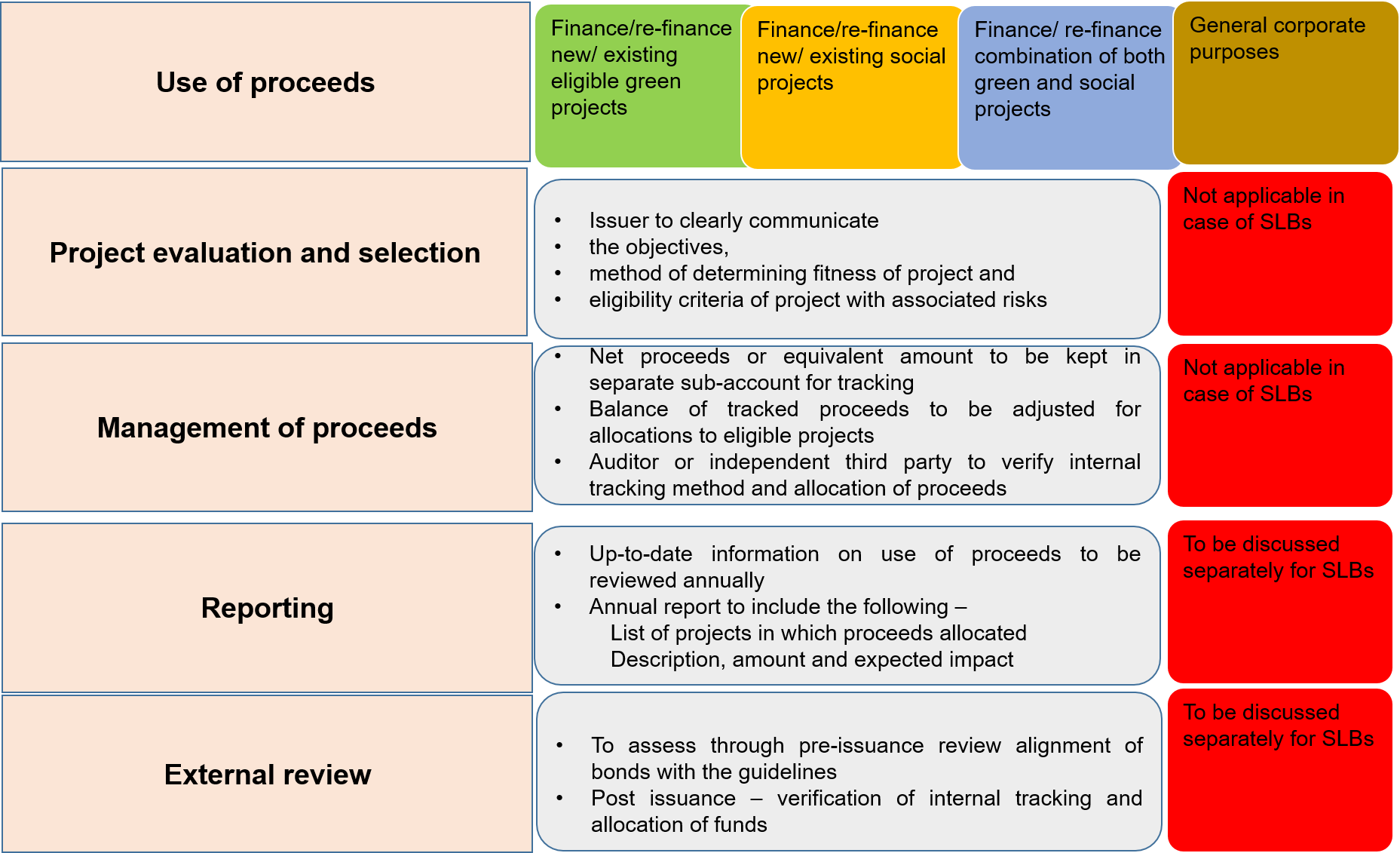 A study of these guidelines show that the SLBs are quite different from other sources of sustainable finance, being “general corporate funds” instead of “use of proceeds” funds. Therefore, the same has been discussed separately in later parts of this article. Further, the categories of projects in which proceeds of green bonds, social bonds, and sustainable bonds can be used have been listed below (the list is illustrative) –
 Similar standards have been issued by the Climate Bonds Standard Board that recognises only green bonds, Association of South East Asian Nations (ASEAN) having set different standards for green bonds, social bonds and sustainable bonds. Similar standards have also been issued by the European Union for green bonds and social bonds. It is noteworthy that all these standards are voluntary in nature and aligned with the ICMA Guidelines with some modifications of their own. The IFSC Regulations also recognise all the 4 types of bonds as ESG debt securities, issued as under any of the aforesaid guidelines.
Sustainability-linked bonds (SLBs) – where lies the uniqueness?
As discussed above, internationally there are four types of recognised ESG bonds, which are also proposed to be imbibed in the legal framework in India. While the first three being in the nature of “use-of-proceeds” bonds, the Sustainability-linked bonds or SLBs have distinguishing features. The SLBs rests on five key pillars, as follows –  The SLBs require companies to frame key performance indicators and Sustainability Performance Targets. To give an example, a company may frame its sustainability performance target to reduce its greenhouse gas (GHG) emissions by 20% compared to that of the year 2018 as baseline. In this case, the key performance indicators can be reduction of CO2 emissions, reduction of carbon footprint etc.
Growth of ESG bonds
The Environmental Finance – Sustainable Bonds Insight, 2021 provides 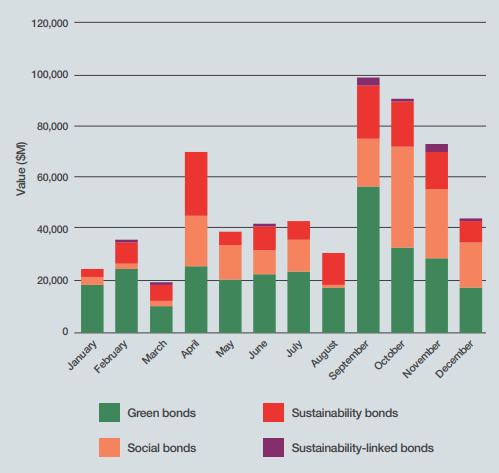 data analytics in respect of the various types of sustainable bonds issued during the year 2020. The data shows high volume of green and social bonds issued during the year as compared to sustainable bonds and SLBs, which are relatively new and evolving concept. While the figures show a comparative between different types of ESG bonds issuance, it also provides an insight on the increasing volume of the ESG bonds being issued in the Covid era (an increase in the bonds issuance in the months of September, October and November).
Present position v/s potential growth
The Report shows a comparison of the development of sustainable bond market in the recent years and an estimate of what is expected in the current year 2021. It demonstrates clearly that the sustainable bond market is expected to rise further in the upcoming areas.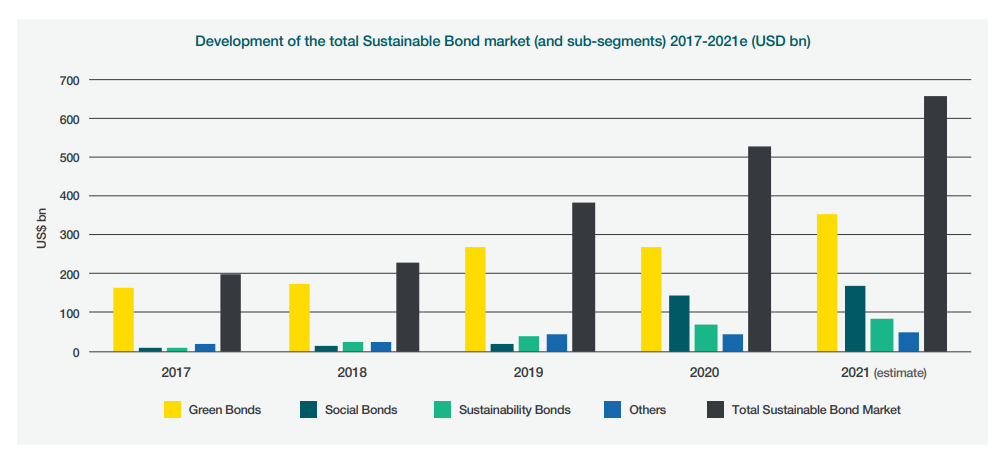
Growth of ESG bond market in India in recent times
In India, the ESG bonds issuance is witnessing an evident upshot. However, the same has not found much investors’ interest in the country. Nevertheless, the Indian issuer companies have still been able to raise much funds from the issuance of ESG bonds from global investors. The below chart clearly demonstrates the increase in funds raised by way of issue of ESG bonds[4].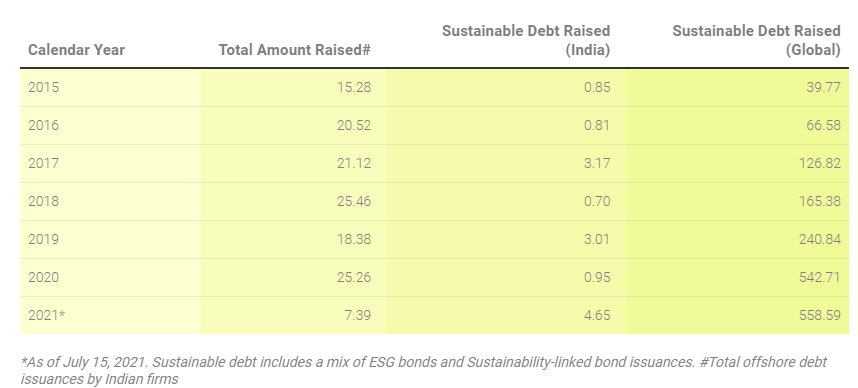 Some of the big Indian issuers of ESG focussed bonds include GreenCo, JSW Hydro Energy, Shriram Transport Finance Company, India Green Power Holdings, ReNew Power, Ultratech Cement Ltd etc. Sustainability linked bonds or SLBs, as discussed, is relatively new and innovative concept in the podium of ESG bonds in the world. India has made a remarkable entry in this field with Ultratech Cement Limited[5], issuing SLBs, thereby, being the first company in India and second in Asia to issue SLBs. The company has raised a total of 400 million USD equivalent to Rs. 2900 crores by way of issuance of such SLBs. The same has been listed in the Singapore Exchange Securities Trading Limited[6].
ESG Bonds – Motivations for the Issuer and Investor
Issuer’s perspective
- Cost advantage due to yield reduction – The yield payment in respect of ESG bonds are relatively lower than that of other conventional bonds[7]. A reason for such lower yields is increase in demand with limited supply of such bonds. An example may be the issuance of green bonds by Italian Government[8], which was oversubscribed by 10 times.
- Role as corporate citizens – The ESG bonds contribute to demonstrating the role of issuers as responsible corporate citizens, spending the proceeds generally on sourcing of renewable energy, pollution reduction, climate change initiatives.
- Attracts responsible investors – The ESG bonds align with social development goals (SDGs) and principles of responsible investing (PRI) thereby attracting socially responsible investors whose investment decisions are more of impact-oriented than yield-based.
- Seen as ethical companies – The companies issuing ESG bonds are looked upon as ethical companies by the stakeholders thereby helping in demonstrating a good corporate image.
Some additional advantages motivation lies for issuance of SLBs –
- Flexibility of designing structure – The main feature of SLB is that it gives a flexibility to the issuers to design their issued bonds in their own way.
- Flexibility with regard to use of proceeds – Another flexibility is with regard to the use of issue proceeds which need not necessarily be towards promoting green projects, social projects or the like. Therefore, the companies are free to use the proceeds for their operational activities without giving a second thought on whether the same qualifies as a green project or social project.
- Motivation for fulfilment of ESG targets – The SLBs put a “step-up” on the coupon rate of the bonds in case the issuer misses its ESG target. Therefore, it gives an additional economic interest for the issuers to fulfil their ESG targets.
Investor’s perspective
It is said that behind the investors’ growing interest in ESG bonds lies two reasons – (i) values-driven and (ii) value-driven. While the investors, as part of their responsibility towards the society and environment, consider ESG in their investment analysis, that is not the only reason investors are investing in ESG bonds. Another reason that drives the investors in supporting ESG concerns and investing in ESG bonds is the long term perspective and the expectation of deriving great value from their investment portfolio. The investors believe that a company that invests in the ESG concerns and addresses the ESG issues properly, are more likely to earn profits in the long term. Therefore, while the investors are demonstrating their values and responsible behaviour by choosing ESG focussed bonds, they are also booking adequate profits for themselves in the long run. Now, with the new SLBs coming into picture, the investors are likely to get more benefits out of their investment in the ESG bonds in the form of SLBs. The terms of SLBs are designed as such that the investors get a “step-up” or hike in the coupon rates as and when the issuer misses a pre-defined target (identified as SPTs).
Sustainability-linked bonds (SLBs) – investors always at the winning end
The concept of SLBs comes with a very interesting feature – where investor benefits on the issuer missing its ESG target. Since the investor is making profits on the cost of compromise in ESG responsibilities by issuer, therefore it is controversial that how can an investor show his ESG responsibility at a time when it is making profits on failure to reach ESG targets? However, that is not the case. Another viewpoint towards the case maybe that the investors are motivating their issuers in reaching their ESG targets, and where they fail to do, the investors cast a penalty on the issuer. Whatever the case may be, in both the scenarios, investors are the one who are at the winning side. A recent interesting case of issue of ESG bonds in the form of SLBs may be discussed here. A Japanese firm, Nomura Research Institute Ltd, has issued ESG bonds with the “variable bond characteristics” as below –
- Where the issuer reaches target – early redemption of debts
- Where the issuer misses target – extra yield to investors
In both the cases, the investors will be benefitted. In the first case, the investor will earn return on their investments early, so they will be in possession of their funds again at a shorter span of time. On the contrary, in the second case, though the funds of the investors will be locked for a longer time, the same will bring them higher yield. So, the investors, are very well in a win-win position in all probable cases.
Requirements for listing of ESG debt securities in India
The Ministry of Finance has notified the IFSCA (Issuance and Listing of Securities) Regulations, 2021 or the IFSC Regulations. It is a unified framework for various kinds of securities and is framed with the main intent of consolidating the regulatory requirements in order to access the global capital with more ease and less complexity. The concept of ESG bonds have been specifically recognized and captured under Chapter X of the said Regulations. However, it has to be noted that these IFSC regulations are applicable only for the IFSC-listed companies. No specific framework is provided for ESG bonds for other domestic companies in India outside the scope of IFSC Regulations. The same can still be taken as a guidance for other domestic issuances. While the requirements for issuance and listing of ESG bonds are given in Chapter X, the same is in addition to those under Chapter IX of the Regulations. Please note that, Chapter IX lays down the requirements for issuance and listing of debt securities. By “debt securities” is meant the non-convertible debt securities, as is clear from the definition of “debt securities” under Regulation 2(e) of the Regulations. The additional requirements for the ESG bonds are as follows –
- An independent external review is required to be obtained in order to satisfy that the issue of ESG bonds are in line with internationally recognised standards set for ESG bonds, the principles of ICMA being one of them.
- Review may be in the form of verification, certification, second party opinion, or scoring/rating.
- The most important requirement under ESG investing is disclosure and reporting The same is being discussed here under a separate head.
- Impact report is important in order to measure the actual impact of the projects in which the ESG funds have been spent.
Disclosure and reporting
As also envisaged by the Sustainability-linked bond principles of ICMA, disclosure is a main pillar of ESG investing. The IFSCA Regulations also focusses on the disclosure requirements. Under the IFSCA Regulations, the following disclosures are required to be made –
- The objectives of the issue of debt securities
- The process followed for selection and evaluation of projects
- The system employed for tracking deployment of issue proceeds
- Intended vs actual utilisation of issue proceeds
- Specific projects to which the issue proceeds have been disbursed/ allocated.
Further, in case of SLBs, the reporting guidance as under the ICMA Guidelines shall apply.
Applicability to other listed entities not covered under IFSC Regulations
The IFSC Regulations are not applicable to companies other than those listed under the jurisdiction of IFSC Authority. However, the IFSC Regulations are in alignment with other internationally-recognised principles in this regard. We have taken examples of some Indian companies like JSW Steel, Ultratech Cement, Adani Energy, Shriram Transport Finance Co. Ltd, Ultratech Cement etc which provides disclosures and follow the requirements of external review in line with the ICMA Guidelines and IFSC Regulations, which re-iterate requirements of ICMA and other internationally recognised guidelines.
Conclusion
As the world has approached the twentieth century, a shift has become apparent towards more grounded aspects of life – rather than just profit earning. Earlier, it was believed that the corporate world has only one motive – the profit earning motive. However, the focus has now been modified to include various other aspects as well. With instruments like ESG bonds, the efforts are being made to include sustainability in the economy, so that both can progress side-by-side. As the statistics above suggest, India is nowhere lagging behind in the ESG investing. This may be seen as one of the probable cause that IFSCA has included ESG bonds as a specified security in its Listing Regulations. The IFSCA Regulations do not introduce the ESG bonds in India for the first time, rather it just seeks to regulate issuance of the same by means of express regulations in this regard.
Our resource center on Business Responsibility and Sustainable Reporting can be accessed here –
[1] Our article on the same can be read here [2] Read our articles on the same here [3] Green Bond Principles Social Bond Principles Sustainability Bond Guidelines Sustainability-linked Bond Principles [4] https://www.refinitiv.com/ [5] See Page 4 of the Annual Report here [6] Listing confirmation can be accessed here [7] Asian Development Outlook – 2021 [8] Read this here Our other related resources –
- https://vinodkothari.com/2014/03/prospects-green-bonds-rise/
- https://vinodkothari.com/2017/05/guidelines-for-issuance-of-green-bonds/
- https://vinodkothari.com/wp-content/uploads/2017/03/India_plans_to_tap_Green_Bonds-1.pdf
- https://vinodkothari.com/2020/08/cartload-of-details-in-brsr-a-challenge-ahead-for-elaborate-reporting/
- https://vinodkothari.com/2020/08/brr-in-process-to-become-a-fully-loaded-electronic-form/
- https://vinodkothari.com/2021/03/esg-concerns-on-corporate-governance-in-india/
- https://vinodkothari.com/2021/07/corporate-responsibility-towards-climate-change-uk-leads-regulatory-measures/
An Insolvency Resolution Process sans Claims – A Defunct Process?
- Devika Agrawal, Executive (resolution@vinodkothari.com )
Introduction
Under the provisions of Insolvency and Bankruptcy Code, 2016 (IBC), the determining criteria for insolvency is a definite default, rather than financial sickness or ‘inability to pay’ . While the latter is certainly suggestive of a larger state of insolvency, where the company may be unable to pay its outstanding debts, the former does not necessitate the same. Hence, the likelihood of an application for initiation of CIRP on the basis of an isolated event of default/ non-payment, sans a financial stress in the company, cannot be ruled out.
Owing to such uncertainty, it may so happen that an application, initiated on the basis of such an isolated event of default, is admitted before the adjudicating authority without any other cases of defaults by the company. Naturally, there would be no claims to file except that of the applicant. If it were to happen, it forces one to ponder as to how CIRP will proceed, and if at all there is something to resolve.
CIRP without claims?
As per the Code, CIRP commences after an application has been admitted by the AA. Once an application is admitted by the AA, an Interim Resolution Professional is appointed, who is responsible for invitation and collation of claims, and subsequent constitution of the committee of creditors (‘CoC’). All decisions with respect to the corporate debtor’s business are thereafter taken with the approval of CoC, including approval of Resolution Plan or passing of a resolution for liquidation of the Corporate Debtor. Hence, it can be said that the CoC, constituted on the basis of the claims, drives the CD through the process till revival/ liquidation, as the case may be.
However, in a rather odd situation, when no claims are received after the initiation of CIRP, how will the IRP constitute CoC? In essence, when no claims are received by the Interim Resolution Professional (‘IRP’) after the initiation of CIRP, the questions that would arise are (aside, the broader question as to whether there was at all a need for resolution, will remain) – how is the CIRP likely to proceed, how will IRP constitute CoC, and most importantly, what is it for which the IRP should invite resolution plans? Does non-receipt of any claims by the creditors prove that the Corporate Debtor is, in fact, not a defaulter?
Books of the corporate debtor/public announcement
At the first instance, the books of the corporate debtor will assist in determining whether at all the CD has liabilities (financial/operational, otherwise). It may be the case that the CD does not have any liability at all (besides that pertaining to the creditor who filed the application). In such a case, attempts can be made by the CD and the Creditor to arrive at an agreement among themselves, instead of proceeding with CIRP and having the CD jammed in a situation of Moratorium.
However, there may be cases where the books acknowledge liabilities but there are no claimants. This might pose practical difficulties for the IRP because if no claims are received, the constitution of CoC would become impossible which in turn would lead to the CIRP coming to a complete halt. Occurrence of such a situation might necessitate the following actions to be taken by the IRP-
- sending of individual mails, requesting claims, to the Financial creditors so that, at least, a CoC can be constituted.
- ensure that the public announcement, inviting claims of creditors, are made in accordance with the manner laid down in the CIRP Regulations and in newspapers with wide reach.
- if, in case, no claims are received despite of efforts being made by the IRP, a final attempt should be made by the IRP by way of re-issuance of public announcement
Say, even after these efforts, no one shows up. There is a stage set, but there are no creditors to run the show. In such cases, what can the IRP do? We can explore the following alternatives.
Section 12A of Insolvency and Bankruptcy Code, 2016
Prior to section 12A of the Code, the withdrawal of an admitted insolvency resolution process was not expressly provided for. However, in view of reasons like a post-admission settlement or restructuring, the need to allow such withdrawal was realised – Section 12A of the Code enables withdrawal of the applications filed under Section 7, 9 or 10 of IBC, post its admission, if the committee of creditors (CoC) approves of such withdrawal by a voting share of at least ninety percent.
The very fact that section 12A mandates the approval of CoC as a precondition for withdrawal, there is no occasion to apply the said provisions before the constitution of CoC. A deeper reading of section 12A further indicates that the application for withdrawal must be filed by the very applicant who initiated the process. The reason is simple, the cause initiated by one cannot be withdrawn merely by virtue of a majority of others. Thus, the fact that withdrawal can be done only at the behest of the original applicant and with the consent of at least 90% CoC members maintains the much required trade off.
However, in the given state of affairs, the devil lies in the fact that no claims have been received so as to constitute the CoC. Further, to assume that the applicant who, at the first place, initiated the application, and thereafter chose to remain missing in action would initiate the withdrawal process, seems rather bizarre.
Even if one were to assume the possibility of withdrawal application by such a creditor, would the very filing be construed as a mere pressure tactic for recovery of claims? If yes, the same would attract penal provisions under the Code, and as such the Applicant would be liable for the consequences.
Knocking the Doors of NCLT
From the above discussion, we understand that a situation as such would indeed put the IRP/ RP in a pickle. Another probable way out could be an application being filed by the IRP/ RP under section 60 (5) of the Code thereby praying for annulling the process or directing the original applicant to file an application under section 12A.
Further, in Swiss Ribbons (P) Ltd. v. Union of India (Supra)[1], the Hon’ble Supreme Court made it clear that “at any stage where the committee of creditors is not yet constituted, a party can approach the NCLT directly, which Tribunal may, in exercise of its inherent powers under Rule 11 of the NCLT Rules, 2016, allow or disallow an application for withdrawal or settlement…….”
Thus, on the strength of the aforesaid order and the power and jurisdiction in section 60 (5), the IRP/ RP may take necessary steps before the Hon’ble Bench.
Such entanglement would leave the IPR/ RP in the middle of the sea, so to say that he can neither continue the CIRP in absence of the CoC, nor proceed for withdrawal as per section 12A.
Corporate Debtor – a Defaulter or no
Another line of thought that arises in the given facts could be whether the Corporate Debtor can be construed as a ‘defaulter’. In the given case, since no claims are received after the initiation of CIRP, can it be assumed that the Corporate Debtor has not defaulted in the payment of dues of any other creditor except for that of the applicant. Based on this assumption, can it be said that the CD is not a defaulter?
The above straight jacket assumption would not hold good as it is important to note that another probable situation that could arise is that the default of other creditors is apparent from the books of accounts of the Corporate Debtor. In such cases, if no claims are received by the IRP, the IRP may, in furtherance to the mandatory public announcement, send a mail to the banks/ financial creditors, inviting claims from them so that at least the CoC can be constituted and the CIRP can proceed.
While the above situation is a rather odd one, it would indeed be an interesting situation to understand the possible course of action that the IPs could resort to, and the role of the Adjudicating Authorities in such cases.
RBI eases norms on loans and advances to directors and its related entities
Payal Agarwal, Executive, Vinod Kothari & Company ( payal@vinodkothari.com )
RBI has recently, vide its notification dated 23rd July, 2021 (hereinafter called the “Amendment Notification”), revised the regulatory restrictions on loans and advances given by banks to directors of other banks and the related entities. The Amendment Notification has brought changes under the Master Circular – Loans and Advances – Statutory and Other Restrictions (hereinafter called “Master Circular”). The Amendment Notification provides for increased limits in the loans and advances permissible to be given by banks to certain parties, thereby allowing the banks to take more prudent decisions in lending.
Statutory restrictions
Section 20 of the Banking Regulation Act, 1949 (hereinafter called the “BR Act”) puts complete prohibition on banks from entering into any commitment for granting of loan to or on behalf of any of its directors and specified other parties in which the director is interested. The Master Circular is in furtherance of the same and specifies restrictions and prohibitions as below –
*since the same does not fall within the meaning of loans and advances for this Master Circular
Loans and advances without prior approval of Board
The Master Circular further specifies some persons/ entities that can be given loans and advances upto a specified limit without the approval of Board, subject to disclosures in the Board’s Report of the bank. The Amendment Notification has enhanced the limits for some classes of persons specified.
| Serial No. | Category of person | Existing limits specified under Master Circular | Enhanced limits under Amendment Notification |
| 1 | Directors of other banks | Upto Rs. 25 lacs | Upto Rs. 5 crores for personal loans
(Please note that the enhancement is only in respect of personal loans and not otherwise) |
| 2 | Firm in which directors of other banks interested as partner/ guarantor | Upto Rs. 25 lacs | No change |
| 3 | Companies in which directors of other banks hold substantial interest/ is a director/ guarantor | Upto Rs. 25 lacs | No change |
| 4 | Relative(other than spouse) and minor/ dependent children of Chairman/ MD or other directors | Upto Rs. 25 lacs | Upto Rs. 5 crores |
| 5 | Relative(other than spouse) and minor/ dependent children of Chairman/ MD or other directors of other banks | Upto Rs. 25 lacs | Upto Rs. 5 crores |
| 6 | Firm in which such relatives (as specified in 4 or 5 above) are partners/ guarantors | Upto Rs. 25 lacs | Upto Rs. 5 crores |
| 7 | Companies in which relatives (as specified in 4 or 5 above) are interested as director or guarantor or holds substantial interest if he/she is a major shareholder | Upto Rs. 25 lacs | Upto Rs. 5 crores |
Need for such changes
The Master Circular was released on 1st July, 2015, which is more than 5 years from now. Considering the inflation over time, the limits have become kind of vague and ambiguous and required to be revisited. Moreover, the population all over the world is facing hard times due to the Covid-19 outbreak. At this point of time, such relaxation can be looked upon as the need of the hour.
Impact of the phrase ‘Substantial interest’ vs ‘Major shareholder’
The Master Circular uses the term “substantial interest” to generally regulate in the context of lending to companies in which a director is substantially interested.
The relevant places where the term has been used are as below –
| Completely prohibited | Allowed with conditions | |
| Section 20(1) of the BR Act – for companies in which directors are substantially interested | Para 2.2.1.2. of Master Circular – for companies in which directors of other banks are substantially interested – upto a limit of Rs. 25 lacs without prior approval of Board
|
|
| Para 2.1.2.2. of Master Circular – for companies in which directors are substantially interested | Para 2.2.1.4. of Master Circular – for the companies in which the relatives of directors of any bank are substantially interested – upto Rs. 25 lacs without prior approval of Board | After amendment, the para stands modified as – for the companies in which the relatives of directors of any bank are major shareholders – upto Rs. 5 crores without prior approval of Board |
While the Amendment Notification itself provides for the meaning of “major shareholder”, the meaning of “substantial interest” for the purposes of the Master Circular has to be taken from Section 5(ne) of the BR Act which reads as follows –
- in relation to a company, means the holding of a beneficial interest by an individual or his spouse or minor child, whether singly or taken together, in the shares thereof, the amount paid up on which exceeds five lakhs of rupees or ten percent of the paid-up capital of the company, whichever is less;
- in relation to a firm, means the beneficial interest held therein by an individual or his spouse or minor child, whether singly or taken together, which represents more than ten per cent of the total capital subscribed by all the partners of the said firm;
The above definition provides for a maximum limit of shareholding as Rs. 5 lacs, exceeding which a company falls into the list of a company in which director is substantially interested. The net effect is that a lot of companies fall into the radar of this provision and therefore, ineligible to take loans or advances from banks.
However, the Amendment Notification provides an explanation to the meaning of “major shareholder” as –
“The term “major shareholder” shall mean a person holding 10% or more of the paid-up share capital or five crore rupees in paid-up shares, whichever is less.”
This eases the strict limits because of which several companies may fall outside the periphery of the aforesaid restriction. Having observed the meaning of both the terms it is clear that while ‘substantial interest’ lays down strict limits and therefore, covers several companies under the prohibition list, the term ‘major shareholder’ eases the limit and makes several companies eligible to receive loans and advances from the bank subject to requisite approvals thereby setting a more realistic criteria.
The BR Act was enacted about half a century ago when the amount of Rs. 5 lacs would have been substantial, but not at the present length of time. Keeping this in mind, while RBI has substituted the requirement of “substantial interest” to “major shareholder” in one of the clauses, the other clauses and the principal Act are still required to comply with the “substantial interest” criteria, thereby, keeping a lot of companies into the ambit of restricted/ prohibited class of companies in the matter of loans and advances from banks.
Other petty amendments
Deeming interest of relative –
The Amendment Notification has the effect of inserting a new proviso to the extant Master Circular which specifies as below –
“Provided that a relative of a director shall also be deemed to be interested in a company, being the subsidiary or holding company, if he/she is a major shareholder or is in control of the respective holding or subsidiary company.”
This has the effect of including both holding and subsidiary company as well within the meaning of company by providing that a major shareholder of holding company is deemed to be interested in subsidiary company and vice versa.
Explanations to new terms –
The Amendment Notification allows the banks to lend upto Rs. 5 crores to directors of other banks provided the same is taken as personal loans. The meaning of “personal loans” has to be taken from the RBI circular on harmonisation of banking statistics which provides the meaning of personal loans as below –
Personal loans refers to loans given to individuals and consist of (a) consumer credit, (b) education loan, (c) loans given for creation/ enhancement of immovable assets (e.g., housing, etc.), and (d) loans given for investment in financial assets (shares, debentures, etc.).
Other terms used in the Amendment Notification such as “major shareholder” and “control” has also been defined. The meaning of “major shareholder” has already been discussed in the earlier part of this article. The meaning of “control” has been aligned with that under the Companies Act, 2013.
Concluding remarks
Overall, the Amendment Circular is a welcoming move by the financial market regulator. However, as pointed out in this article, several monetary limits under the BR Act have become completely incohesive and therefore, needs revision in the light of the current situation.
Home Buyers under IBC & Case Studies
Ever since the Jaypee and Amrapali cases, home buyers have been under the scanner. From orders of the Hon’ble Supreme Court to multiple amendments in the Insolvency and Bankruptcy Code, measures have been taken to protect the interest of the home buyers. While earlier, the home buyers were treated as ‘other creditors’, that is, neither operational nor financial, with the landmark ruling in Chitra Sharma v. Union of India, there status as financial creditors was established – the same also found place in the Code by way of amendments in section 7 of the Code.
In this presentation, we discuss the provisions w.r.t. Home Buyers under the Code and a detailed case study of the Amrapali Case and Jaypee Infratech Case.