
Slaying the slain: the law about strike-off of companies

By Nikita Snehil, (corplaw@vinodkothari.com)

Striking off of the names of companies for having remained inoperative has been a concept which has always been there, both under the 1956 Act, and under the 2013 Act. Striking-off of defunct companies is a provision in law for chopping the dead wood – if the company has lost its substratum, and there is nothing in the company, then the long process of winding up is not relevant for the company, and the RoC can strike off the name of the company as if the company never existed. Striking-off of companies is an option that exists both with the company, and with the RoC.

However, the recent massive clean-up operation, whereby RoCs started issuing public notices[1] in April, 2017 to strike off the name of the companies from the register of companies and to dissolve them unless a cause is shown to the contrary, within thirty days from the date of the notice, has come to centre of focus. Thereafter, on September 5, 2017 the government confirmed that names of over 2.09 lakh companies have been struck off from the Register of Companies for failing to comply with regulatory requirements.

There are several words which are doing rounds currently – defunct companies, shell companies, benami companies, and so on. They all mean completely different things. Defunct company is what the Companies Act talks about – a company which is left with no substance; it is either inoperative, or has no assets or liabilities. The word “shell company”, commonly used in tax parlance, refers to such companies which are merely a shell, that is, hiding the identity of the real owners. Obviously, the current environment of the drive against black money suggests that the word has been used to refer to companies which might have been used for money-laundering. The word benami company might have similar connotations.

However, the Companies Act term “defunct” companies never really smelled about money laundering or a device to shield the identity of real owners. Therefore, over the years, the concept has been innocuous. In the current environment, however, the various expressions above have all been mixed up, as if to conclude that defunct companies were being used for money-laundering. If the company is really defunct, and there is no substance into it, it seems paradoxical to relate it to money laundering operations. The fact that there is no real asset or no real liability should mean that there is nothing in the company, including any evidence of untaxed wealth. However, the confusion between defunct companies and black money is quite evident in the MCA press release[2] issued on September 6, 2017 said that the action of the MCA “would not only help in checking the menace of black money” but would help the ease of doing business in India. The Press Release also sounded like a shock to the directors of such struck-off companies, as it said 3 important points:
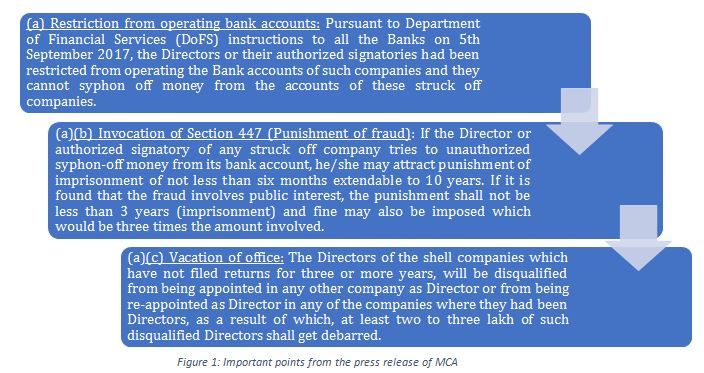

This article endeavours to understand the provisions of the law about striking off of names of companies and the impact thereof on directors’ disqualifications.

Enabling provision of the law

As per Section 248 of the Companies Act, 2013 (‘Act’) which deals with the power of Registrar to remove name of company from register of companies:

“(1) Where the Registrar has reasonable cause to believe that—
(a) a company has failed to commence its business within one year of its incorporation;

(b) [omitted]

(c) a company is not carrying on any business or operation for a period of two immediately preceding financial years and has not made any application within such period for obtaining the status of a dormant company under section 455,

he shall send a notice to the company and all the directors of the company, of his intention to remove the name of the company from the register of companies and requesting them to send their representations along with copies of the relevant documents, if any, within a period of thirty days from the date of the notice.”

Therefore, though the public notice issued by the RoC stated the reference of Section 248 of the Act, it is pertinent to note that the said Section empowers the RoC to strike the names of the Companies only in two cases. But almost all the shell companies does not seem to have triggered any of the above two conditions.

Section 248 Vs Section 455 of the Act

Another section which empowers RoC to remove the name of a company from the register of members is Section 455 of the Act. As per the provisions of Section 455 of the Act, which deals with the provisions of dormant company:

“(4) In case of a company which has not filed financial statements or annual returns for two financial years consecutively, the Registrar shall issue a notice to that company and enter the name of such company in the register maintained for dormant companies.

(5) A dormant company shall have such minimum number of directors, file such documents and pay such annual fee as may be prescribed to the Registrar to retain its dormant status in the register and may become an active company on an application
made in this behalf accompanied by such documents and fee as may be prescribed.

(6) The Registrar shall strike off the name of a dormant company from the register of dormant companies, which has failed to comply with the requirements of this section.”

The section states the following procedure to be adopted by the the dormant company and the RoC:

(a) RoC may remove the name of an inactive company from the register of members and put the same in the register of dormant companies.
(b) The dormant company shall then comply with the requirements and retain its dormant status or make an application to become an active company.
(c) Thereafter, if the dormant company fails to comply with the requirements of the section, then the RoC can finally remove the name of such company from the register of dormant company as well.

However, in the current situation, the above mentioned procedure is not followed by the RoCs and names of the companies are directly struck off from the register of members.

Hence, there does not seems to be an enabling section under which the RoC has struck off the names of the companies.

Vacation of office of Directors

As per the Press release issued by MCA, the next move of MCA will be to compel the Directors of such shell companies which have not filed returns for three or more years to vacate the office.

Provisions of law:

Section 164 (2) of the Act, which deals with the disqualifications of appointment of directors, provides the following:

“No person who is or has been a director of a company which—

(a) has not filed financial statements or annual returns for any continuous period of three financial years; or

(b) has failed to repay the deposits accepted by it or pay interest thereon or to redeem any debentures on the due date or pay interest due thereon or pay any dividend declared and such failure to pay or redeem continues for one year or more,

shall be eligible to be re-appointed as a director of that company or appointed in other company for a period of five years from the date on which the said company fails to do so.”

Further, Section 167(1)(a) of the Act directs that the office of a director shall become vacant in case he incurs any of the disqualifications specified in section 164 of the Act.

Therefore, reading both the sections, it can be concluded that, the directors of such companies will:

1. have to vacate their office, due to the disqualification incurred;

2. not be able to be re-appointed as a director of that company;

3. not be eligible to be appointed in any other companies as well.

The second and third effect will last upto a period of five years from the date on which the said company fails comply with the provisions of section 164 (2) of the Act.

Having said so, there arises a further question:

‘Does disqualification to section 164(2)(b) of Act will also apply to directors newly appointed in the company?’

It is important to note the starting lines of section 164(2)(b), which read as follows:

“No person who is or has been a director of a company which xxX”

Thus, to attract disqualification under section 164(2)(b), it is important that the individual has to be on the board of the company when the default actually happened.

Therefore, even new directors of such company will attract the disqualification, inspite of the fact that they were not at all involved in such non-compliance. Basically, the intent of law might be to deter companies from defaulting, which would demotivate any new director to join the company.

Applicability of the law – prospective or retrospective?

Sections 164 and 167 came into force on April 1, 2014. However, the disqualifications under Section 164 (2) cannot become applicable as on April 1, 2014 for any annual filings not done in any of the previous financial years. The provisions were initially inapplicable to private companies. Section 164 (2) curtails the right of directors of such companies to continue as directors, casts a new burden, imposes a new liability on such directors for having defaulted in filing financial statements for any 3 continuous financial years.

It was discussed in the Supreme Court Judgment in case

of Maharaja Chintamani Saran Nath … vs State Of Bihar And Ors on 7 October, 1999[3] that the true principle is that Lex prospicit non respicit (law looks forward not back). As Willes, J. said, retrospective legislation is `contrary to the general principle that legislation by which the conduct of mankind is to be regulated ought, when introduced for the first time, to deal with future acts, and ought not to change the character of past transactions carried on upon the faith of the then existing law.

However, in the recent case law of “Vikram Ahuja Vs. Greenstone Investments Pvt. Ltd. and ors., before the NCLT, Mumbai Bench, decided on November 11, 2016”[4], one of the point for discussion and decision before the Hon’ble bench was:

“whether the disqualification set forth in Section 164(2)(a) read with 167(1) (a) of the Act has retrospective effect or not?”.

The Hon’ble Tribunal, after considering various case laws considered that “this provision has to be read as applicable to the situations where non-filing has started, at the most in the past and continuing while this enactment has come to into existence and also to future non-filing”. Also, it has been provided that, the statute providing posterior disqualification on past conduct does not become a retrospective one because a part of a requisition for its action is drawn from a time antecedent to its passing.

Therefore, the applicability of the Section, whether retrospective or prospective is still debatable.

Legal position of the company after strike-off

By virtue of a legal process, a company is born as a separate legal entity, so is its death process. In case of dissolution of a company pursuant to the company’s name being removed from the Register by the ROC in terms of Section 248 of the Act, the corporate status of an entity ceases to subsist, its functionality stops and for all practical purposes corporate activities come to an end.

Liability of directors

The pertinent question that arises here is that whether the liability of directors and other officers of the company struck off from the records will continue and whether it could be enforced. The answer to this is yes.

The relevant clause of Section 248 of the Act provides the followings:

“(7) The liability, if any, of every director, manager or other officer who was exercising any power of management, and of every member of the company dissolved under sun-section (5), shall continue and may be enforced as if the company had not been dissolved.”

Accordingly, it can be drawn that notwithstanding the company’s dissolution, the liabilities of its directors and officers who exercised powers along with its members continue, remain unaltered and enforceable. However, the dissolution does not makes any enhancement to the enforcement of the liabilities affecting the personal capacity of the abovementioned persons.

A view can be taken that the dissolution under section 248 is not a state complete extinction. Instead it is a state of suspension for a period of twenty years from the date of dissolution, as upon the revival of the company, all its rights and liabilities are restituted with retrospective effect from the date of strike-off.

Assets of the company

Another concern for a company whose name has been struck-off by the ROC is that there may be properties and rights vested in or held on trust for the company, cash balances of the company and other current or non-current assets of the company while it was functional. The fate of such assets is a question to be addressed.

Section 352(2) and 352(7) of the Act deals with the unclaimed or undistributed estate of a company, but these sections becomes applicable where there is a liquidator involved in winding up of a company. In case a company is dissolved in pursuance of Section 248, there is no liquidator appointed. Hence, the operative part of Section 352 is not applicable in the dissolution of a company under Section 248.

A reference can be drawn from the Companies Act of England, which has a provision stating that the property of dissolved company shall be bona vacantia. The Escheat over which no one has a claim is known as bona vacantia. The term can be expressed as ‘abandoned property’ too. In bona vacantia there is no owner of the property and the State merely takes possession of the property, which is an abandoned one. In India there is no such corresponding provision in the Act. However, as per the laws in India, the property of an estate dying without leaving lawful heirs passes to the government by escheat or as bona vacantia. Similarly, it can be inferred that the property of a dissolved company shall also pass to the government by escheat or as bona vacantia, including any subsisting interest of the company on the date of dissolution.

Though, it can be established that the doctrine of bona vacantia will be applicable for a company dissolved under section 248, however, whether the same shall come into operation immediately or after a lapse of the prescribed time period of twenty years is a debatable matter.

Effect of company notified as dissolved

As per Section 250 of the Act, where a company stands dissolved under section 248, it shall on and from the date mentioned in the notice issued by RoC in the Official Gazette, shall cease to operate as a company and the Certificate of Incorporation issued to it shall be deemed to have been cancelled from such date except for the purpose of realising the amount due to the company and for the payment or discharge of the liabilities or obligations of the company.

Recent judgements:

NCLT, at its hearing of Principal Bench at New Delhi, on March 14, 2017, in the case of Poly Auto System Pvt. Ltd. Vs. RoC Delhi[5], held that the Registrar of Companies has to comply with the comprehensive procedural obligations before passing the final order of striking off the name of the company from the register of members. The casual approach of the RoC which would lead to abrupt conclusion will not be a legal act. And the Tribunal ordered for restoration of the name of the Company in the register of members.

Similarly, the present act of the government of striking off the names of more than 2 two lakh companies, seems not to consider the post effect of such dissolution.
So, it will be interesting to see how the assets and liabilities of the companies will be managed – will there be appointment of any liquidator? How will the liabilities of the creditors will be discharged? Will the balances of the cash rest with the government? These are the few questions which will have to be addressed by the government in the due course.

Remedial Action

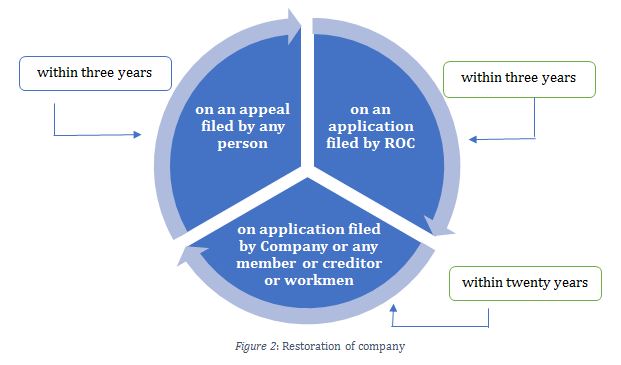
Section 252 of the Act empowers the Tribunal, to pass an order for the restoration of company which has been struck off by the ROC, in the following manner:
(a) Appeal filed by any person:

Any person aggrieved by the order of the RoC may file an appeal before the Tribunal within 3 years of the order passed by RoC and if the Tribunal is of the opinion that the removal of name of company is not justified in view of the absence of any of the grounds on which the order was passed by the ROC, it may pass an order for restoration of the name of the company in the register of companies after giving a reasonable opportunity of making representations and of being heard to the ROC, the company and all the persons concerned. The genuine companies, which have been struck off, will move to file an appeal to the NCLT in this case.

(b) Application filed by ROC:

The ROC may, within a period of three years from the date of passing of the order dissolving the company under section 248, file an application before the Tribunal seeking restoration of name of such company if it is satisfied that the name of the company has been struck off from the register of companies either inadvertently or on the basis of incorrect information furnished by the company or its directors. Genuine companies may make representations to prove their innocence or bonafide reason of such non-filings, pursuant to which RoC may on valid reasons but within a period of three years, restore the name of such companies.

(c) Application filed by company or any member or creditor or workmen:

The Tribunal, on an application made by the company, member, creditor or workman before the expiry of 20 years from the publication in the Official Gazette of the notice of dissolution of the company, if satisfied that:

1) the company was, at the time of its name being struck off, carrying on business or in operation; or
2) b) otherwise it is just that the name of the company be restored to the register of companies,

may order the name of the company to be restored to the register of companies. Further, the Tribunal may also pass an order and give such other directions and make such provisions as deemed just for placing the company and all other persons in the same position as nearly as may be as if the name of the company had not been struck off from the register of companies.

Therefore, in the present situation, it will be best for the genuine companies to make representations/ applications to the RoCs proving that the companies are not involved in any fraudulent activities or involved in syphoning of funds through illicit activities. The representations/ applications may convince the RoC to restore the names of the genuine companies.


[1] http://www.mca.gov.in/MinistryV2/roc.html

[2] http://pib.nic.in/newsite/PrintRelease.aspx?relid=170579

[3] https://indiankanoon.org/doc/1293868/

[4] http://nclt.gov.in/Publication/Mumbai_Bench/2016/397_398/Greenstone%20Investments%20Pvt.%20Ltd.%2022.11.2016_.pdf

[5] http://nclt.gov.in/interim_orders/principal/14.03.2017/Poly%20Auto%20Systems%20Pvt.%20Ltd..pdf
HC disallows parallel proceedings in NCLT and debt recovery tribunal

While the company moved the NCLT on its own seeking to obtain this ‘moratorium’, the guarantors found it an alibi to seek relief from the earlier DRT case – Richa Saraf. Read More

POWER TO ARREST AS PER COMPANIES ACT, 2013

By Smriti Wadehra, (corplaw@vinodkothari.com).

The Companies Act, 2013 (‘Act’) empowers the Central Government to inspect the books of accounts of a company, to direct special audit, to order investigation into the affairs of a company and to launch prosecution for violation of the Act. These inspections are designed to ensure that the companies conduct their affairs in accordance with the provisions of the Act, and there is no mismanagement which may adversely affect the interest of the stakeholders. It further also keeps a check on any unfair practices prejudicial to public interest that is being resorted to by any company or a group of companies.

In light of this and the rise in financial crime, the need for a specialised agency to do cutting edge investigation and ensure quick closure of cases was necessitated. Accordingly, section 212 was introduced in the Act, however, the provisions of section relating to Serious Fraud Investigation Office (SFIO), was notified only on 1st April, 2014 except sub-section (8) to (10). SFIO is a multi-disciplinary organisation, consisting of experts, for detecting and prosecuting or recommending for prosecution of white collar crimes and frauds.

The main intent of SFIO is to prosecute corporates liable for corporate offence under the Act. Since, the definition of offence was not very clear and references were provided to various sections of the Act, there was a need to clear the ambiguity in this regard. In this regard, Companies (Amendment) Act, 2015 substituted the references to the section of offences with “Offences covered under section 447 of the Act”[1].

POWER TO ARREST

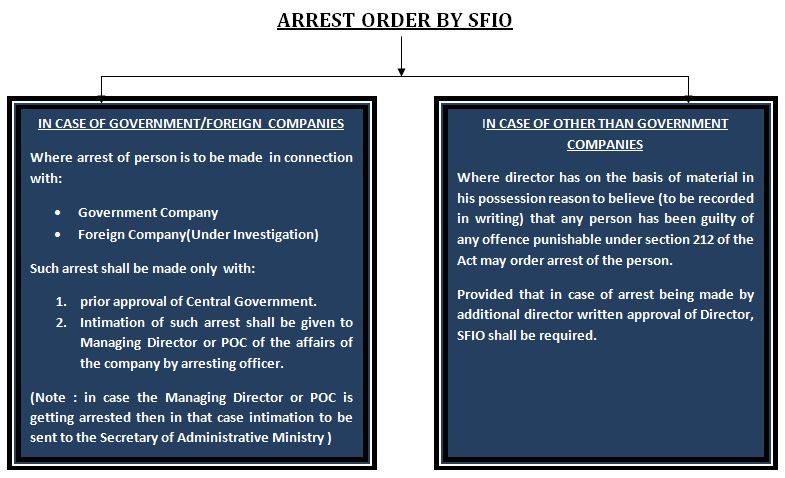
Ministry has recently come out with a notification G.S.R. 1062(E)[2] dated 24th August, 2017 making the provisions of section (8) to (10) of section 212, applicable and bestowing the power to arrest on the Act. The provisions of the section specifically lays down that every Director, Additional Director or Assistant Director of SFIO, authorised by the Central Government may by general or special order, if it has reasons to believe on the basis of material in his possession that any person under investigation is guilty of any offence punishable under sections referred to in sub-section (6), may arrest such person and shall, as soon as may be, inform him of the grounds for such arrest. Further, the provisions of Sub-section (9) and (10) of the section, provides light on the procedure of conducting such arrest by the Director and rules as mentioned below. These rules shall come into force from the date of their publication in Official Gazette i.e. 24th August, 2017.

PROCEDURAL REQUIREMENTS

  • The Director, Additional Director or Assistant Director, while exercising powers under sub-section (B) of section 212 of the Act, shall sign the arrest order together with personal search memo in the Form appended to these rules and shall serve it on the arrestee and obtain written acknowledgement of service.
  • The Director, Additional Director or Assistant Director shall forward a copy of the arrest order along with the material in his possession and all the other documents including personal search memo to the office of Director, SFIO in a sealed envelope with a forwarding letter after signing on each page of these documents, so as to reach the office of the Director, SFIO within twenty four hours through the quickest possible means.
  • An arrest register shall be maintained in the office of Director, SFIO and the Director or any officer nominated by Director shall ensure that entries with regard to particulars of the arrestee, date and time of arrest and other relevant information pertaining to the arrest are made in the arrest register in respect of all arrests made by the arresting officers. Entry shall be made immediately on receipt of documents.
  • The provisions of the code of criminal Procedure, 1973(2 of 1974), relating to arrest shall be applied mutatis mutandis to every arrest made under this Act
  • Arrest order together with supporting papers shall be preserved for a period of five years from:

(i) Date of judgement or final order of Trial court (in cases where judgement has not impugned in appellate court),OR

(ii) Date of disposal of the matter before appellate court (in case the judgement is impugned)

[WHICHEVER IS LATER]

CONCLUSION

Although it was difficult to prevent white-collar crime or corporate crimes, it wasn’t necessarily difficult to commit the same. This is the reason why the evolution of SFIO was important. SFIO has emerged with the main object of improving work practices among the corporates by imposing corporate criminal liability. If an individual who has committed a crime cannot be identified and there is no mechanism for corporate prosecution, the harmful practices would continue unbated. To avoid such a situation, SFIO acts as a corporate watchdog for critical research into corporate power and its doings. To conclude, we can say that corporate crimes are much in vogue today, and so are the methods to tackle them.


[1] http://www.mca.gov.in/Ministry/pdf/AmendmentAct_2015.pdf

[2] http://www.mca.gov.in/Ministry/pdf/companiesArrestsconnectionSFIORule_25082017.pdf

FAQs on Ind AS 116: The New Lease Accounting Standard

By Vijaylakshmi Agarwal (finserv@vinodkothari.com)

Understanding Impact

  1. What is this new Standard all about, in brief?

The standard provides a new method for lease accounting. Ind AS 116 is largely converged with IFRS 16 Leases. Ind AS is expected to replace Ind AS 17 WEF from its proposed effective date being for annual periods beginning on or after 1st April, 2019. Essentially, lessee accounting undergoes major change, while lessor accounting largely remains unchanged. As for lessee, the existing distinction between financial and operating leases (whereby the former was on the balance sheet, and the latter was off-balance sheet) goes away, and in case of every lease (other than exceptions, discussed below), the lease comes on the balance sheet as a right-to-use (RTU) asset and a corresponding lease liability representing its obligation to make lease payments. Read more

SEBI aborts brightening of fine lines of control

By CS Vinita Nair, (finserv@vinodkothari.com)

SEBI at its Board meeting held on March 12, 2016[1] discussed and decided on several important matters, one of them being approving for initiation of public consultation process regarding Bright line Tests for Acquisition of ‘Control’ under the SEBI (SAST) Regulations, 2011[2] (SAST). Acquisition of control, in case of listed entities, entails making an open offer under SAST.

Control has been defined, by way of an inclusive definition, under various laws in India and internationally. The crux of the definition of ‘control’ under various laws has been discussed in Annexure 1. Primarily, the salient features of definition of ‘control’ are as under:

  • The right to appoint a majority of directors
  • The right to control the management
  • The right to control the policy decision

Such rights may be exercised by a person, directly or indirectly. The rights may accrue by virtue of shareholding, management rights, shareholder agreements, voting agreements or in any other manner. However, in case of contractual agreements, assessment of acquisition of control becomes complex and requires consideration of facts. It has been represented to SEBI to amend the definition of control, thereby shifting it from a principle based definition to rule based definition, in order to avoid multitude of opinions. In a given scenario multiple regulators may all be applying the test of control from different perspectives and arriving at differing results which may lead to ambiguity and confusion in the market

In view of the same, SEBI, in the Discussion paper, had proposed following two options to identify bright lines for control:

Option 1:- Framework for Protective Rights

Option 2:- Adopting a numerical threshold

The definition of ‘control’ under the SAST may be amended such that control is defined as:

(a) the right or entitlement to exercise at least 25% of voting rights of a company irrespective of whether such holdings gives de facto control; and/or

(b) the right to appoint majority of the non-independent directors of a company.”

This article analyses the proposed definition of control in the light of past judgments, committee reports etc. The Discussion paper was put open for public comments till April 14, 2016.

Background

‘Control’ as explained in case of Subhkam Ventures v/s SEBI

Decision of Securities Appellate Tribunal (SAT) in case of M/s Subhkam Ventures (I) Private Limited versus SEBI[3] . The recital of the agreement entered into with MSK Projects (India) Limited and its promoters, provided that Subhkam is only a financial investor and will neither be regarded as the promoter nor acquire control and management of the target company for any reason. Subhkam argued that open offer was made under Regulation 10[4] of SAST, 1997 while SEBI insisted that control was acquired and therefore Regulation 12[5] was also required to be disclosed to enable shareholders to make an informed decision.

SAT explained the difference in case of proactive and reactive power and clarified that control, means creating or controlling a situation by taking the initiative and not reacting. It is a positive power and not a negative power. In case of Subhkam, the intent behind incorporating protective clauses in the shareholder’s agreement was to ensure that the target company does not undergo any paradigm shift from its present position without Subhkam’s knowledge and approval. Such provisions did not grant control but enabled Subhkam to oppose a proposal, provided fetters to protect the investment made. SAT allowed the appeal by inferring that none of the clauses of the agreement, individually or collectively demonstrates control in the hands of the appellant.

Being a key issue, SEBI appealed the SAT order before Supreme Court. Supreme Court, on November 16, 2011 stated that ‘keeping in view the above changed circumstances, it is in the interest of justice to dispose of the present appeal by keeping the question of law open and it is also clarified that the  impugned order passed by the SAT will not be treated as a precedent.

Deliberations on ‘Control’ in TRAC[6] report

The Committee concluded that a holding level of 25% of voting rights permits the exercise de facto control (Para 2.6). The existence or nonexistence of control over a listed company would be a question of fact, or at best a mixed question of fact and law, to be answered on a case to case basis. Any blanket provision whereby a right to say “no” is in all circumstances deemed to either constitute “control” or not to constitute “control” may be liable to misuse (Para 3.3). Acquisition of de facto control, and not just de jure control should expressly trigger an open offer (Para 3.6). The Committee had recommended the definition of “control” be modified to include “ability” in addition to “right” to appoint majority of the directors or to control the management or policy decisions would constitute control. It further clarified that a director or officer of the target company would not be regarded as being in control merely by virtue of holding such position (Para 3.7).

The Committee examined the possibility of introducing a whitewash provision in the Takeover Regulations on the lines of international practice i.e. an open offer would not be required if a material majority of the shareholders of the target company were to pass a resolution waiving the open offer. The rationale for such a framework is that an open offer is ultimately made for the benefit of the shareholders and it is well within the shareholders‘ rights to renounce such a benefit if they so desire (Para 12.17). However, the whitewash provisions were not incorporated in SAST, 2011 in the absence of robust regulations on proxy solicitation, and given the realities of the Indian market, any provision for shareholder waiver for an open offer may not be in the best interests of investors at large.

Veto rights – protective rights not amounting to exercise of ‘control’

As was explained under SAT order in case of Subhkam Ventures v/s SEBI, veto rights are protective in nature rather than participative in nature. Veto rights are fetters for the purpose of good governance and aimed to protect the investments made from the whims and fancies of the promoters who manage the company. On similar lines, an illustrative list of protective rights has been provided which may be granted to an investor subject to following conditions is provided by way of Annexure 2:

  • The investor must invest atleast 10% or more in the target company;
  • Approval by way of majority of minority i.e. approval of public shareholder’s needs to be obtained and such rights needs to be incorporated in Articles of Association.
  • In case of IPO, the existing agreements to stand cancelled/ modified or suspended till approval is obtained in the aforesaid manner post listing of shares.

However, there still remains a likelihood of this leading to further complexities in assessment of control owing to ambiguity in interpretation.

Adopting numerical threshold

In view of the provisions relating to passing of special resolutions under Companies Act, 2013 and trigger limit for determining control under SAST being 25%, it was proposed to regard 25% as the threshold level for trigger of control in Indian listed companies. Further, it was proposed to determine control on the basis of right to appoint non-independent directors and not majority of directors. The reason for the same being Regulation 17 of SEBI (Listing Obligations and Disclosure Requirements) Regulations, 2015 prescribes the composition of Board.

As compared to aforesaid option, this approach would reduce the uncertainty in assessment of acquisition of ‘control’, however, will not be able to capture control derived by way of special rights.

Stakeholders’ Comments and opinions

SEBI vide a Press Release dated September 08, 2017[7] informed that a number of comments from various stakeholders including industry bodies, intermediaries, advocates and investors were received on the Discussion paper issued on March 14, 2016. No particular option garnered overwhelming support amongst the stakeholders. SEBI also received the views of the Ministry of Corporate Affairs (MCA) and the Reserve Bank of India in this regard.

Few stakeholders including the MCA opined that changing the current definition of ‘control’ may reduce the regulatory scope and may be prone to abuse and hence, the current definition of ‘control’ may not be changed. Instead the stakeholders opined that it would be more appropriate to take decisions on a case-to-case basis. Further, it may be noted that the Justice Bhagwati Committee which was constituted in the year 1995 to review the SEBI (Substantial Acquisition of Shares and Takeovers) Regulations, 1994, had recommended a broad definition of control and opined that it should be left to SEBI to decide whether there has been an acquisition of control on the basis of facts of each case.

Conclusion

SEBI intended to align the definition of control, in line with the recommendations and deliberations made in report submitted by TRAC, justification given in the aforesaid SAT order. However, pursuant to the comments and opinions received from the various stakeholders and authorities it is felt that any change or dilution in the definition of control would have far reaching consequences since a similar definition of ‘control’ is used in the Companies Act, 2013 and other laws.  Consequently, it has been decided to not to proceed with the amendment and to continue with the practice of ascertaining acquisition of ‘control’ as per the extant definition in the SAST.

Annexure 1

Sr. no Act/ Regulations Parameter for determining control Exclusions, if any
1. SEBI (SAST) Regulations, 2011 ·         right to appoint majority of the directors or to

·         control the management or policy decisions


exercisable by a person or persons acting individually or in concert, directly or indirectly, including by virtue of their shareholding or management rights or shareholders agreements or voting agreements or in any other manner

·         Mere holding of position of a director or officer in the target company.
2. SEBI (Listing Obligations and Disclosure Requirements) Regulations, 2015 As defined under SAST  
3. SEBI (Issue of Capital and Disclosure Requirements) Regulations, 2009 As defined under SAST, 1997 (same as above) ·         Where there are two or more persons in control over the target company, the cesser of any one of such persons from such control shall not be deemed to be a change in control of management nor shall any change in the nature and quantum of control amongst them constitute change in control of management:

Provided that the transfer from joint control to sole control is effected in accordance with clause (e) of sub-regulation (1) of regulation 3.

4. Companies Act, 2013 Similar to definition under SAST. Exclusions not included.
5. Consolidated FDI Policy, 2015 & FEM ( Transfer or issue of security by a person resident outside India) Regulations, 2000 Similar to definition under SAST. Exclusions not included.
6. Competition Act, 2002 ·     controlling the affairs or management by—

o   one or more enterprises, either jointly or singly, over another enterprise or group[8];

o   one or more groups, either jointly or singly, over another group or enterprise;

7. AS-18 ·     (a) ownership, directly or indirectly, of more than one half of the voting power of an enterprise, or

·     (b) control of the composition of the board of directors in the case of a company or of the composition of the corresponding governing body in case of any other enterprise, or

·     (c) a substantial interest in voting power and the power to direct, by statute or agreement, the financial and/or operating policies of the enterprise

 
8. Ind AS-27 ·     power to govern the financial and operating policies of an entity so as to obtain benefits from its activities.  
9. IFRS 10 ·     Ownership of more than half the voting right of another entity  Power over more than half of the voting rights by agreement with investors

·     Power to govern the financial and operating policies of the other entity under statute/ agreement

·     Power to remove/appoint majority of directors

·     Power to cast majority of votes.

 
10. City Code on Takeovers and Mergers, UK ·     Control means an interest, or interests, in shares carrying in aggregate 30% or more of the voting rights (as defined below) of a company, irrespective of whether such interest or interests give de facto control.  
11. Takeover Guide, Canada ·     A “control person” is a person (or person within a combination of persons who are acting in concert) which holds a sufficient number of shares to affect materially the control of the target (and, if the ownership is greater than 20%, the person(s) are deemed, in the absence of evidence to the contrary, to hold a sufficient number of shares to affect materially the control).  
12. The Singapore Code on Takeovers and Mergers ·     Effective control means a holding, or aggregate holdings, of shares carrying 30% or more of the voting rights (as defined below) of a company, irrespective of whether that holding (or holdings) gives de facto control. “Acquiring effective control” of a company refers to a situation where a person and parties acting in concert with him, who previously held in aggregate less than 30% of the company’s voting rights, increase their aggregate holding of voting rights in the company to 30% or more.

·     “Consolidating effective control” in a company refers to a situation where a person and parties acting in concert with him, who already owned between 30% and 50% of the company’s voting rights, increase their aggregate holding of voting rights in the company by more than 1% within a 6 month period.

 
13. Malaysian Code on Takeovers and Mergers 2010 ·     Does not define control


14. Takeover Guide, Japan ·     Does not define control  


Annexure 2

Illustrative list of protective rights that do not amount to exercise of “control”, including quorum[9] rights for meetings involving matters stated below:

  • Appointment of Non executive Chairman/ Vice Chairman without any casting vote;
  • Appointment of investor’s nominee as observer of Board, without any voting or participation rights;
  • Covenants stipulated by banks, NBFCs etc granting loan on commercial basis, provided the rights are customary to the lending business
  • Non exclusive and Mutually beneficial commercial agreements, approved by the Board where the Board of target company has the right to terminate the agreement;
  • Veto rights in case of following matters that are not part of the ordinary course of business[10] or involve governance issues would be regarded as protective rights.
    • Amendment of MoA & AoA adversely impacting the investor’s rights;
    • Alteration to the capital structure of the company;
    • Change of statutory auditors;
    • Material[11] divestment, transfer or disposal of an undertaking or material subsidiary of the target company;
    • RPTs entered not in ordinary course of business or not on an arm’s length basis;
    • Material[12] acquisition of any companies, bodies corporate, business, undertaking or joint ventures;
    • Incurring indebtedness, granting loans, providing guarantees or creating security in excess of thresholds prescribed under Act, 2013 without shareholder approval;
    • winding up of the company or making a general assignment for the benefit of the creditors of the company and/or the subsidiaries or admitting in writing the inability of the company to repay its debts when they become due;
    • write-off of any of the receivables, loans and advances, investment or investments or inventories outside the ordinary course of business[13]

[1] http://www.sebi.gov.in/cms/sebi_data/pdffiles/33245_t.pdf

[2] http://www.sebi.gov.in/cms/sebi_data/attachdocs/1457945258522.pdf

[3] http://www.sebi.gov.in/satorders/subhkamventures.pdf

[4] Acquisition of fifteen per cent or more of the shares or voting rights of any company.

[5] Acquisition of control over a company.

[6] Takeover Regulations Advisory Committee – set up under the chairmanship of Mr. C Achuthan. Report was submitted on July 19, 2010  – http://www.sebi.gov.in/cms/sebi_data/attachdocs/1287826537018.pdf

[7] http://www.sebi.gov.in/media/press-releases/sep-2017/acquisition-of-control-under-the-sebi-substantial-acquisition-of-shares-and-takeovers-regulations-2011_35891.html

[8] “group” means two or more enterprises which, directly or indirectly, are  in a position to —

(i) exercise twenty-six per cent or more of the voting rights in the other enterprise; or

(ii) appoint more than fifty per cent of the members of the board of directors in the other enterprise; or

(iii) control the management or affairs of the other enterprise;

[9] If two meetings are not quorate, the next meeting would be deemed to have quorum despite the absence of the investor nominees.

[10] The company will be required to formulate a policy defining the parameters that will be ‘outside the ordinary course of business’.

[11] The company will be required to formulate a policy defining the parameters that will be ‘material’.

[12] The company will be required to formulate a policy defining the parameters that will be ‘material’.

[13] The company will be required to formulate a policy defining the parameters that will be ‘outside the ordinary course of business’

SEBI requires disclosure by banks in case of NPA divergence

By Mayank Agarwal, (finserv@vinodkothari.com)

The banking sector is one of the pillars for economic development of any country, and any well balanced and healthy economy is largely dependent on a transparent and credible banking system. In recent years, the Indian economy has recognized the importance of a well-regulated and fundamentally strong banking framework and made it one of its priorities to clear out the vast amount of unhealthy practices and activities that tread on the fine line of regulation. A slew of new policies which led to clearer recognition norms, stricter disclosure requirements, more hands-on approach by the Reserve Bank of India (RBI) and an overall environment that is much more transparent than before are all testimony to the fact that the banking institutions are in for a major overhaul. The introduction of practices such as Asset Quality Review (AQR), restructuring norms and the introduction of Insolvency and Bankruptcy Code (IBC) by the RBI were steps aimed towards a fundamentally cleaner banking system. Read more

Standard Procedure for Valuation to be followed by HFCs.

By Shreya Routh, (finserv@vinodkothari.com)


Housing Finance Company (HFC) is a type of non-banking financial institution which is primarily engaged in the business of providing home loans and other related products. Unlike other Non-Banking Financial Companies which are governed under the regulatory framework of RBI, HFCs are regulated by the National Housing Banks (NHB). Collateral securities are accepted against loans advanced by HFCs which include the property for which loan has been granted and some other collaterals as well. Since properties serve as the underlying asset on which financing is given, the amount of loan advanced depends upon the value of the collateral offered. Read more

CONSTITUTIONAL VALIDITY OF INSOLVENCY AND BANKRUPTCY CODE

By Richa Saraf, (legal@vinodkothari.com) Read more