Posts

Dividends Denied: Why InvIT SPV CashFlows Don’t Flow Up

Simrat Singh | Finserv@vinodkothari.com

REITs and InvITs are often discussed together as parallel innovations in India’s capital markets, reflecting a push towards deploying capital in real estate and infrastructure. Both frameworks were introduced in 2014, share a trust-based structure and are subject to broadly similar regulatory principles, including mandatory cash distribution requirements and both also have a common tax provision in section 115UA of Income Tax Act, 1961 (section 223 in the 2025 Tax Act). Comparatively, InvITs have witnessed a significantly stronger growth, largely driven by the government’s sustained push towards infrastructure development. The data clearly reflects this divergence. As of April, 2026, there are 6 registered REITs and 28 InvITs in India, managing an AUM of ₹2,50,000 Crores and ₹6,20,000 Crores respectively. Among the InvITs, Road sector InvITs dominate the total AUM. (see our write-up on distribution of AUM of InvITs here). Notable, the national monetisation pipeline 2.0 proposed monetization of approx ₹3,35,000 Crores worth of highway assets under InvIT/TOT models (see our write-up on this here). 

While InvITs are required to distribute 90% of their cash flows, the underlying SPVs, mandated to be in company form, are constrained by dividend distribution rules that rely on accounting profits rather than actual cash generation. In sectors such as roads and power, where assets are finite-life concession rights or long term power purchase agreements, such assets are subject to heavy amortisation which leads to SPVs report book losses despite generating steady cash flows. As a result, cash exists within the SPV but cannot be upstreamed efficiently as dividends. This issue stems from treating InvITs on par with REITs despite differences in investments and nature of assets and from disallowing flexibility in the legal form of SPVs.

Industry workaround has been towards debt-heavy (thin capitalisation) structures, enabling distributions through interest and loan repayments, though these might raise tax issues (discussed below). Beyond such workarounds, more durable solutions are explored in line with international models like US Master Limited Partnerships and Singapore Business Trusts such as permitting dividend declarations based on cash flows rather than accounting profits, reconsidering the mandated company form of SPVs to allow more flexible structures such as trusts or LLPs etc.

Nature of investments by REITs and InvITs

REITs and InvITs are different in the sense that one invests in a property and looks at long term appreciation/rentals. The other looks at an infra asset which gives cash flows only for a certain period

REITs hold income-generating real estate assets with no fixed economic life. These assets can be retained, redeveloped/renovated or replaced over time. At the SPV level, there is no restriction on holding multiple assets and the portfolio of assets can be managed through acquisitions and divestments.

In contrast, InvITs, particularly in the road sector, hold assets that are inherently finite. These assets are in the form of concession rights and are intangible assets where the concessioning authority (usually NHAI) grants a right to operate and collect revenue for a defined period, say 15 to 20 years. Note that the road asset is not the asset that is taken on the balance sheet of the SPV, rather it is the intangible right to collect revenue on the road that is capitalised. At the end of the concession period, the asset reverts back to the concessioning authority, leaving no residual economic value. At this stage, the SPV merely becomes a shell entity, holding in itself only residual litigations or tax demands awaiting its eventual outcome of being wound-up.

Moreover, there are certain constraints imposed by the concession agreement entered into between the SPV and NHAI. Under standard concession agreements, each road project is required to be housed in a separate SPV. Which is why the name of the SPVs are in the style “[Name of Road Stretch] Tollway/Toll Road Private Limited”. The “one project, one SPV” model prevents aggregation of road assets within the same SPV and keeps the rights, obligations and risk allocation clearly demarcated. While this mandatory housing of each project in a separate private limited entity has its advantages, such as lender protection, bankruptcy remoteness and clarity in enforcement of contractual rights, it also creates rigidity for the InvIT. 

The inability to pool assets or recycle assets within the SPVs prevents capital recycling. Unlike REIT SPVs, InvIT SPVs cannot recycle capital either by selling assets or acquiring new ones within the same entity. As a result, while REITs can operate vehicles with a perpetual asset base, InvITs function as portfolios of wasting assets that are depleted over time and cannot be replaced within the same SPV. 

Distribution requirement and the dividend constraint

Both REITs and InvITs (and their SPVs/HoldCos) are required to distribute at least 90% of their net distributable cash flows. This distribution can occur through interest on loan, loan repayment or dividends from the SPVs. The challenge for InvITs arises at the SPV level, in the case of dividend distribution. Under Section 123 of the Companies Act, a company can declare dividends only out of distributable profits or accumulated reserves. The books of such SPVs are loaded with high upfront capitalisation of construction costs and subsequent recognition of a concession asset. This asset is depreciated (or amortised in case of intangible assets such as concession right) over the concession period along with the amortization of the earlier capitalised expenditure, leading to significant non-cash expenses in the profit and loss account which continues to hit the Profit and Loss account even when the SPV starts collecting cash. As a result, even when the SPV generates operating cash flows from toll collections, it remains in ‘book losses’ for a portion of the concession life. The consequence is that such SPV is unable to declare dividend distribution to the InvIT despite the availability of cash.

Depreciation on a non-replaceable asset?

Accounting principles require allocation of asset cost over its useful life. This is conceptually sound for assets that are expected to be replaced or reinvested in. A machinery may be required to be replaced once its useful life is over, therefore, it is only prudent to set aside a part of the cost so there is enough cushion when the entity goes to replace the machinery. 

In the case of REITs, this logic holds good. Depreciation reflects the wear and tear of the replaceable asset and the entity has the ability to reinvest/replace the asset over time (i.e. purchase a new rent yielding building in the same SPV). The economic cycle supports the accounting treatment.

For InvIT SPVs especially in the road sector, the asset is not replaced at the end of its life; it is handed back to the concessioning authority. The SPV has no ability to deploy accumulated depreciation (or amortization in case of an intangible asset) towards acquisition of a new asset. Its economic life is co-terminus with the concession period. This creates a disconnect between accounting profits and economic cash flows. Depreciation suppresses book profits without corresponding economic relevance in terms of asset replacement within the SPV.

International comparisons 

Singapore’s Business Trusts

Singapore offers the clearest analogy to and resolution of this problem. The Business Trusts Act 2004 (BTA), administered by the Monetary Authority of Singapore (MAS), created a hybrid structure that combines features of a company (separate legal personality, professional management) with features of a trust (cash-based distributions). The defining advantage of the Singapore Business Trust (BT) is stated explicitly in the legislation and was articulated in the MAS’s explanatory brief for the Business Trusts (Amendment) Bill 2022:

“A key advantage of a BT structure is the ability of a trust to pay dividends to unitholders out of its cash profits. In contrast, a company can only pay dividends out of its accounting profits (i.e. after deducting non-cash expenses such as depreciation). The BT structure is thus particularly suited to businesses with stable growth and high cash flow.”

Singapore listed 15 Business Trusts as of 2026, covering assets including power generation, toll roads, and shipping. For infrastructure BTs, the cash-based distribution right is central to the investment proposition. Critically, the BT does not interpose a company-form SPV between the trust and the infrastructure asset; the trust itself holds the operational assets. This avoids the Section 123-equivalent constraint that would arise if a company-form subsidiary were the operating entity.

The Singapore model, however, is not directly transplantable to the Indian road sector context for the reason explained above ie NHAI’s requirement for a company-form concessionaire. 

The US Master Limited Partnership Model

In the United States, the Master Limited Partnership (MLP) structure, originally developed for oil and gas pipelines and subsequently applied to other infrastructure sectors, avoids the dividend constraint through the partnership form. Partnerships are not subject to corporate dividend restrictions; distributions to limited partners (akin to unitholders in InvITs) are made based on cash available for distribution, a metric that is equivalent to NDCF and adds back non-cash charges including depreciation and amortisation. Interestingly, MLPs typically grant the General Partner (GP is somewhat analogous to the investment manager in an InvIT), a share in the distributable cash flows through Incentive Distribution Rights (IDRs). These rights are structured on a tiered basis, such that as distributions to Limited Partners increase, the GP becomes entitled to a progressively larger share of incremental cash flows. This creates a performance-linked incentive for the GP to enhance distributable cash. At the same time, the GP retains discretion over the quantum of cash to be distributed versus retained.

Possible approaches

In the original consultation process leading to the introduction of InvITs, SEBI did take note of international structures such as the Master Limited Partnerships in the United States, which allow cash-based distributions without being constrained by law dividend rules. However, there was no discussion on the legal form of the SPV and the final regulations settled on a company structure for underlying entities. Had there been flexibility to allow SPVs to be structured as trusts and/or LLPs, the present issue may not have arisen in the first place.

Thin capitalisation

A commonly adopted workaround is to maintain a thinly capitalised SPV, with the bulk of funding structured as loans from the InvIT rather than equity investment. In such cases, distributions are routed primarily through interest payments and loan repayments instead of dividends, a structure widely used in InvIT arrangements. However, this approach may attract limitations under Section 94B of the Income Tax Act, 1961 (section 177 in the 2025 Act), which operates as a Specific Anti-Avoidance Rule (SAAR) on excessive interest deductions. The provision applies where an Indian borrower incurs interest expenditure exceeding ₹1 crore in respect of debt from a non-resident associated enterprise (or even third-party debt backed by such an enterprise). In such cases, the deduction for interest is restricted to 30% of EBITDA or the actual interest payable to associated enterprises, whichever is lower and any excess interest is disallowed. Accordingly, in InvITs where non-residents usually hold the majority of the units, thin capitalisation may lead to disallowance of interest deductions for SPVs.

Allowing Dividend Declaration Based on NDCF

A more targeted solution would be a targeted regulatory relaxation by the Ministry of Corporate Affairs, permitting dividend declaration by InvIT SPVs based on NDCF rather than accounting profits. This would essentially create a sector-specific carve-out from Section 123’s profit test for companies that are 100% subsidiaries of registered InvITs or HoldCos of InvITs. 

Tweaking the legal form of the SPV

One possible approach is to reconsider the legal form of SPVs. Allowing SPVs to be structured as trusts could align the distribution framework more closely with cash flows rather than accounting profits. However, this would require a shift in regulatory and contractual frameworks as SEBI and NHAI both need to be onboarded on this. This solution seems far-fetched as Road assets vesting in a trust is a scenario which NHAI will not be comfortable with.

Conclusion

The principle is clear: regulation must follow the nature of the asset, not force the asset into an ill-fitting form. To mandate distribution without enabling it is, as in the tale of King Canute, to command the tide to rise while forbidding it a shore. An instruction complete in form, but wanting in effect. India’s InvIT framework is, without a doubt, a notable financial innovation, a bridge that has opened public infrastructure to private capital and supported the National Monetisation Pipeline. But the task is not merely to invite capital but to also ensure that the channels through which it flows are kosher. The present framework, in treating REITs and InvITs as parallel structures, overlooks divergence. While REITs rest on perpetuity of assets, InvITs are built on finite-life concessions that steadily deplete. This mismatch, compounded by accounting norms, contractual structures of NHAI and the Companies Act, creates a distribution bottleneck, where cash is generated but cannot be cleanly upstreamed. Industry has found workarounds, principally by way of intercompany loans. But the issue warrants policy attention. We can take guidance from comparative regimes, such as the Singapore Business Trust framework and U.S. MLPs and recognise infrastructure as a cash-flow distribution business and permit distribution mechanisms that reflect this reality. It is therefore imperative that SEBI, MCA, and NHAI act in concert to resolve this misalignment. Only then can InvITs evolve from a promising innovation into a durable pillar of India’s infrastructure architecture.

See our other resources on InvITs:
  1. InvITs and REITs: Regulatory actions for more enabling environment
  2. PPT on InvITs
  3. Roads to Riches: A snapshot of InvITs in India
  4. CG norms for REITs and InvITs aligned with equity-listed entity

InvITs and REITs: Regulatory actions for more enabling environment 

Simrat Singh | Finserv@vinodkothari.com 

SEBI has issued a Consultation Paper on 05.02.2026 proposing amendments to the InvIT Regulations related to end-use of borrowings, status of SPVs and investment in under-construction projects. Further, it has also proposed to enhance the investible options for both REITs and InvITs w.r.t liquid mutual funds. 

InvITs and REITs have continued on a strong upward growth trajectory. As of November 2025, the aggregate AUM of 27 InvITs stood at approximately ₹7,00,000 Crores after growing at a CAGR of approx 18% per annum since FY 21. The assets spann nine infrastructure sectors including roads, telecom, and power, as well as emerging asset classes such as warehouses and educational infrastructure. Reflecting their expanding scale and leverage capacity, aggregate borrowings of InvITs have crossed ₹2,03,000 Crores1. In contrast, REITs continue to trail InvITs in terms of scale, with the combined AUM of the five listed REITs amounting to approximately ₹2,35,000 Crores during the same period.2 May refer to our article “Roads to Riches: A Snapshot of InvITs in India”. 

SEBI has consistently sought to create a more enabling regulatory environment for these vehicles. A notable example is the classification of REIT units as equity for mutual funds (as discussed below), which sought to enhance institutional participation and liquidity. Complementing these regulatory efforts, the Union Budget 2026 introduced several targeted measures to deepen infrastructure financing, including the proposed Partial Credit Enhancement (PCE) framework and the creation of a dedicated infrastructure fund (see our write-up on the Budget 2026 here). Lastly, RBI in its Statement on Developmental and Regulatory Policies also allowed Banks to lend to REITs, putting them on same footing as InvITs (see our write-up on RBI’s Statement here). Taken together, these developments indicate that the growth trajectory of InvITs and REITs is expected to remain firmly positive.

Read more

Regulator’s February Bonanza: RBI’s  Sweet Surprises for NBFCs

Team Finserv | finserv@vinodkothari.com

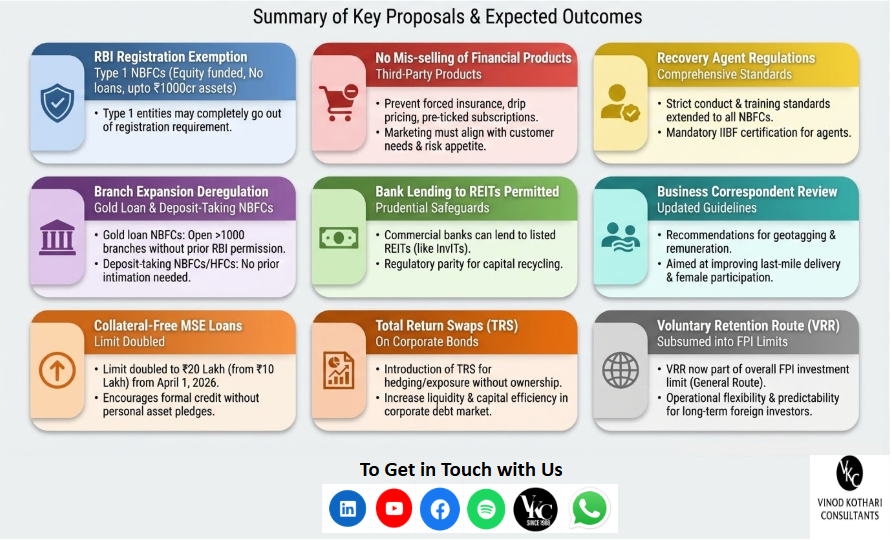
The Budget 2026 may not have brought any significant regulatory amendments or reliefs for the financial sector entities, however, the regulator has proposed a box full of surprises for the regulated entities. The Statement on Developmental and Regulatory Policies dated February 6, 2026 has proposed various significant changes. The measures span a wide spectrum, from exempting Type 1 NBFCs (with no public funds and no customer interface) from registration, to stricter norms on sale of third-party products, a harmonised recovery agent framework, permission for bank lending to REITs and an increase of collateral-free loan limits for MSMEs, among others. While the detailed guidelines for each of the proposals are yet to be issued, we provide a quick snapshot and implications of these proposals.

1.    Exemption from RBI registration for  Type 1 NBFCs upto Rs 1000 crores in assets

After several years of regulatory supervision over investment companies and small size NBFCs, the RBI has proposed to exempt NBFCs having no public funds and customer interface, with asset size not exceeding ₹1000 crore, from the requirement of registration. This will bring such NBFCs, which are commonly referred to as Type 1 NBFCs, outside the purview of RBI supervision, compliance and reporting requirements.

Earlier, access to public funds and customer interface were factors for applicability of several regulations, but not for complete exemption.

What is Customer Interface[1]

Para 6(4) of under the RBI (NBFCs – Registration, Exemptions and Framework for Scale Based Regulation) Directions, 2025 (“RBI Master Directions”) defines customer interface as  “interaction between the NBFC and its customers while carrying on its business”

In essence, customer interface exists where an NBFC directly deals with customers in the course of its business, such as sourcing borrowers, communicating loan terms, collecting repayments, or addressing grievances. The concept focuses on direct dealing/direct public engagement between the NBFC and its customers in the conduct of its business.

Entities engaged in capital market transactions such as trading in shares, investments etc are not seen as having customer interface.

As to whether lending intragroup results in customer interface, the question is contentious – see our article here. .

Currently, NBFCs that do not have any customer interface are exempt from the fair lending practice norms, KYC norms, CIC reporting requirements are such other customer centric compliances.

What is “Public Funds”

Public funds is defined under RBI Master Directions as “includes funds raised either directly or indirectly through public deposits, inter-corporate deposits, bank finance and all funds received from outside sources such as funds raised by issue of Commercial Papers, debentures etc. but excludes funds raised by issue of instruments compulsorily convertible into equity shares within a period not exceeding five years from the date of issue.”

The expression public funds is much wider than public deposits; public deposits are only one part of it. Public funds broadly mean all funds raised by an NBFC from sources other than its own or self-funds. The definition is inclusive and covers multiple forms of debt funding, while also leaving room for other similar sources. Importantly, public funds are to be understood in contrast with self-funds, such as equity capital, which represent ownership and not fundraising. Funds raised from group entities are generally not regarded as public funds; however, if a group entity merely acts as a conduit for funds raised from the outside sources, such funds will still carry the character of public funds due to the direct and clear nexus with the public source.

The use of public funds is a key trigger for prudential regulation, as the RBI seeks to ensure safety and stability where public money is involved. In the absence of access to public funds, NBFCs are exempted from complying with prudential regulations,  liquidity risk management framework and LCR norms.

Why Customer Interface and Public Funds Are Important

The RBI uses customer interface and public funds as risk filters to determine the extent of regulatory oversight required for an NBFC. Entities that neither deal with external customers nor raise public funds are considered to pose minimal consumer and systemic risk.

In line with this risk-based approach, the RBI has proposed to exempt NBFCs with no customer interface and no public funds, and with asset size not exceeding ₹1,000 crore, from the requirement of registration.

2.    No mis-selling of third party Financial Products

Banks and NBFCs routinely distribute third-party products alongside extending their core financial services. Such distribution is undertaken both through physical branches and through digital lending applications and platforms. It has, however, been frequently observed that certain banks and NBFCs take undue advantage of borrowers by using deceptive practices and dark patterns to sell third party products.

Dark patterns are tricky user interfaces “that benefit an online service by leading users into making decisions they might not otherwise make. Some dark patterns deceive users while others covertly manipulate or coerce them into choices that are not in their best interests[2]. Hence, there comes a need to regulate the same. The Central Consumer Protection Authority (“CCPA”), issued the Guidelines for Prevention and Regulation of Dark Patterns, 2023 to regulate such practices.

Digital lenders themselves may quite often be employing practices such as:

  • Drip pricing: elements of pricing which are not disclosed.
  • BNPL offerings: Please make it clear that after the so-called free credit period, if you choose to convert the purchase into financing, the same will start incurring interest. Give the offer to pay and avoid interest.
  • Adding subscriptions, donations or other discretionary items with EMIs or borrower payouts, if they are pre-ticked
  • Repeated and persistent messages or calls to avail credit facility Reduced ROI for a limited period to create false demand
  • Not opting for insurance in case of asset finance is shown as shaming the borrower of agreeing to keep the asset unsecured
  • Pressuring the borrower to share personal information like Aadhaar or credit card details, even when the information is not mandatory
  • Hiding the cancellation option to opt out of the loan/ close the loan during the cooling off period

Accordingly, there is a felt need to ensure that third party products and services that are being sold at the bank counters or lending platforms are suitable to customer needs and are commensurate with the risk appetite of individual clients. It has therefore been decided to issue comprehensive instructions to REs on advertising, marketing and sales of financial products and services. The draft instructions in this regard shall be issued shortly for public consultation.

3.    Proposed comprehensive regulation for Recovery Agents

RBI has, from time to time, reminded lenders that they shall remain fully responsible for activities outsourced by them and, accordingly, are accountable for the conduct of their service providers, including recovery agents. In particular, the regulator has emphasised that lenders must ensure that neither they nor their agents engage in any form of intimidation or harassment, whether verbal or physical, during debt recovery.

While detailed guidelines governing the conduct of recovery agents are prescribed for HFCs, similar comprehensive guidelines are currently not specifically extended to NBFCs. RBI has now proposed that it will harmonise all the extant conduct-related instructions on engagement of recovery agents and other aspects related to the recovery of loans for all regulated entities.


An important requirement for recovery agents was with respect to the training of recovery agents. The recovery agents engaged by HFCs are required to undergo the training as prescribed by Indian Institute of Banking and Finance (IIBF) and obtain the certificate from the institute. If such training and certification requirements for recovery agents are extended to NBFCs, it will increase compliance and operational costs due to training expenses, certification fees, and time invested in upskilling agents. NBFCs may also need to strengthen their internal processes for onboarding, monitoring, and periodic re-certification of recovery agents. However, while this may raise short-term costs, it is likely to improve the quality of recoveries, reduce customer complaints and conduct risk, and strengthen long-term operational discipline.

4.    Deregulated branch expansion

As per the RBI Branch Authorisation Directions, NBFC-ICCs engaged in the business of lending against gold collateral are required to obtain prior approval of the RBI to open branches exceeding 1,000. Further, deposit-taking NBFCs and HFCs are required to inform the RBI and NHB, respectively, before opening any branch.

RBI has proposed to dispense with the requirement of prior approval or intimation for opening branches by such NBFCs. The change is likely to reduce hurdles in opening new branches for gold loan NBFCs, allowing them to expand more quickly and grow their operations.

Type of NBFCErstwhile RequirementProposed Requirement
Deposit Taking NBFCsPrior Intimation for the opening of branchesNo need for prior intimation
HFCsPrior Intimation to NHB before opening any branchNo need for prior intimation
NBFC-ICC (involved in gold lending)Prior approval is required for branches exceeding 1000No need for prior approval

The draft amendment directions have been issued here.

5.    Bank Lending to REITs permitted

Banks were originally not permitted to lend to either InvITs or REITs, as these vehicles were created to refinance banks’ exposures in completed projects using market-based investor funds. While bank lending to InvITs was later allowed, subject to a prudential framework prescribed by the RBI. Banks must have a Board-approved policy governing InvIT exposures, covering appraisal, sanctioning, internal limits, and monitoring.

Prior to lending, banks are required to assess critical parameters including sufficiency of cash flows at the InvIT level, ensure that the combined leverage of the InvIT and its underlying SPVs remains within approved limits, and continuously monitor SPV performance, as the InvIT’s repayment capacity depends on these SPVs; banks must also consider the legal aspects of lending to trust structures, particularly enforcement of security. Lending is permitted only where none of the underlying SPVs with existing bank loans is facing financial difficulty, and any bank finance used by InvITs to acquire equity in other entities must comply with existing RBI restrictions.Lending to REITs, however, continued to be prohibited.

Regulatory Cap on Bank Investment in REITs/InvITs:

  • A bank shall not invest more than 10% of the unit capital of any single REIT or InvIT.
  • Such investment shall be within the overall ceiling of 20% of the bank’s net worth applicable to all direct investments in shares, convertible bonds/debentures, units of equity-oriented mutual funds, and exposures to AIFs.

In view of the strong regulatory, disclosure, and governance framework applicable to listed REITs, it is now proposed to permit commercial banks to lend to REITs, subject to appropriate prudential safeguards. At the same time, the existing lending framework for InvITs will be harmonised with the safeguards proposed for REITs to ensure consistency and parity across both structures.

The proposal allows banks to lend to REITs within a well-defined risk framework, ensuring financial stability is not compromised. The proposal brings regulatory consistency between REITs and InvITs, creating a more uniform and predictable regime. At the same time, it enables efficient recycling of capital from completed real estate and infrastructure projects, supporting new lending without adding significant systemic risk.

  • Review of the Business Correspondent Guidelines

A Business Correspondent (‘BC’) acts as an extension of a bank itself, to provide banking related services in areas which do not have access to such services. The intent of the BC model is financial inclusion, in order to connect everyone to the banking system. The scope includes among other things, creating awareness about savings and other products and education and advice on managing money and debt counselling, processing and submission of applications to banks, etc.

The activities to be undertaken by the BCs would be within the normal course of the bank’s banking business, but conducted through the BCs at places other than the bank premises/ATMs. Thus, the scope would not just be limited to marketing, sourcing and distribution of financial products, rather, it would be extended to provide banking services to the customers from the place of business of the BC.

Business Correspondents have been functioning as critical enablers of last mile access to financial services, particularly in respect of underserved, rural, and remote locations.  Presently, BCs are regulated through RBI (Commercial Banks – Branch Authorisation) Directions, 2025. The Directions outline the eligibility criteria, due diligence requirements, oversight and monitoring, scope of activities, etc for engaging a Business Correspondent by banks.

RBI had set up a committee, consisting of officials from RBI , Department of Financial Service, Indian Banking Association and NABARD, to comprehensively examine their operations and make suitable recommendations for enhancing their efficiency. Discussions were held on action points of the previous meeting, Geotagging of BCs, Development of BC portal, Penalties imposed by banks on CBCs, Caution Money required from CBCs, BC Remuneration, participation of women in BC workforce etc.

Based on the Committee’s recommendations, the related regulatory guidelines are being reviewed, and the draft amendment directions will be issued shortly.

7.    Collateral free loan limit for MSEs doubled to Rs 20 lacs

In 2010, following the RBI Working Group’s report (released March 6, 2010) on the Credit Guarantee Scheme (CGS) under CGTMSE, RBI mandated banks via circular in May 2010 to provide collateral-free business loans up to Rs. 10 lakh to Micro and Small Enterprises (MSEs).

A collateral-free business loan is an unsecured loan for business needs, requiring no pledge of assets like house, car, or property as mortgage until repayment backed by CGTMSE guarantee cover.

MSEs are defined under the MSMED Act, 2006 and require mandatory Udyam Registration for eligibility, bank loans, priority sector benefits, and CGTMSE coverage—along with no blacklisting, viable project, and engagement in approved manufacturing/service/retail activities. Classifications:
Micro enterprise  (investment in plant/machinery ≤ Rs. 2.5 crore; turnover ≤ Rs. 10 crore);
Small enterprise  (investment ≤ Rs. 25 crore; turnover ≤ Rs. 100 crore); and
Medium enterprise  (investment ≤ Rs. 125 crore; turnover ≤ Rs. 500 crore).​
Banks must enforce this at branches, linking CGS/CGTMSE usage to staff evaluations for strict compliance. This remains the existing statutory requirement for MSE lending.

RBI has decided to raise the collateral-free loan limit for MSEs  from Rs. 10 lakh to Rs. 20 lakh, applicable to loans sanctioned or renewed on or after April 1, 2026, aiming to improve formal credit access, entrepreneurial activity, and last-mile delivery for collateral-scarce MSEs.

This policy shift represents a watershed moment for India’s grassroots economy, effectively doubling the financial runway for the nation’s most resilient entrepreneurs. By aligning with the PMMY ceiling, the policy ensures that a business’s potential rather than a proprietor’s personal property dictates its growth.  This extra funding allows small businesses to move beyond daily expenses and finally invest in better machinery or technology to compete. Furthermore, it opens doors for women and young owners who may not own property to get formal bank support based purely on their performance. Ultimately, this change encourages more businesses to register officially, clearing the path for millions of small units to scale up and create more jobs without the fear of losing personal assets.

8.    Total Return Swaps on Corporate Bonds

A Total Return Swap (TRS) is a derivative contract where a protection buyer exchanges the variable total return of an asset for a fixed return, shielding them from volatility. In this setup, the protection buyers swap the “total return” from the asset pool, with a return computed at a fixed spread on a base rate, say LIBOR. Protection sellers in a TRS guarantee a prefixed spread to protection buyers, who in turn, agree to pass on the actual collections and actual variations in prices on the credit asset to protection sellers. Essentially, the protection seller gains market exposure without a large upfront investment, while the protection buyer hedges their risk. Since protection sellers receive the total return from the asset, protection sellers also have the benefit of upside, if any, from the reference asset.

In India, the corporate bond market has historically lacked deep liquidity. To solve this, the Union Budget 2026 and the RBI have proposed introducing TRS specifically for corporate bonds and credit indices.

This development is a strategic shift toward “capital-efficient” investing. For business professionals, this means institutional investors can now gain exposure to corporate debt or hedge their existing bond portfolios without locking up massive amounts of capital on their balance sheets. By allowing the market to trade the “risk” and “returns” of bonds separately from the bonds themselves, the RBI aims to boost liquidity and make it easier for companies across various credit ratings to raise funds. Ultimately, this reform bridges a critical gap in India’s financial ecosystem, transforming the corporate bond market into a more active, transparent, and globally competitive space.

The draft amendment directions have been issued here.

  • Voluntary Retention Route subsumed into FPI investment limits

Voluntary retention route for investment bonds and G-secs has been merged and made a part of the limit assigned for regular investments by FPIs; as a result, FPIs that commit to keep funds for at least 3 years may escape the minimum residual maturity requirement and the limits on investment in a bond issue by a single FPI. This introduces significant flexibility for those FPIs that are sure of staying invested in India for a long term, avoiding opportunism while granting them significant flexibility.

According to the Master Direction – Reserve Bank of India (Non-resident Investment in Debt Instruments) Directions, 2025, there are 5 channels of investments in debt instruments by non-resident investors.  Under the VRR Route, FPIs are granted various operational exemptions, easing the investment process.  VRR was introduced to encourage long term FPI investment in Indian debt markets by offering a dedicated investment channel with greater flexibility.

Given the strong utilisation of the VRR limits and to improve predictability and ease of doing business, the RBI has now decided to subsume VRR investments within the overall FPI investment limits under the General Route, while also providing additional operational flexibilities to FPIs investing through the VRR.

The detailed mechanism governing such limits has been notified here.


[1] Refer to our detailed write up on this topic- https://vinodkothari.com/2025/09/all-in-the-group-and-still-a a-customer/

[2] Arvind Narayanan and Others, March 2020

Economic Survey 2026: Key Insights on Infrastructure Financing

Simrat Singh | finserv@vinodkothari.com

This year’s Economic Survey focuses less on the expansion of credit and more on the quality and sustainability of credit. In infrastructure financing for instance, the Survey notes that the emphasis shifts from the sheer scale of investment to project quality and risk allocation. In this short note, we explore major observations of the Survey w.r.t infrastructure financing and microfinance. 

Infrastructure financing

The Survey 2026 treats infrastructure financing not as a question of “how much more to spend, but how to finance better.” The message is clear: public capital expenditure will continue to lead, but the future of infrastructure finance lies in diversification and market-based instruments, with InvITs and REITs playing a pivotal role.

Public capex still has the lion’s share

The Survey firmly reaffirms public capital expenditure as the backbone of India’s infrastructure push. Government capital expenditure has nearly doubled between FY22 and FY26, underscoring the public sector’s continued leadership in financing infrastructure.

At the same time, the Survey highlights why high public spending alone is not sufficient. Weak project preparation, delays in statutory clearances and rigid contracting structures are identified as key contributors to financial stress in infrastructure projects. The underlying message being that better-prepared projects attract better financing. Public expenditure must increasingly focus on de-risking projects upfront, rather than merely funding asset creation.

Moving away from bank-dominated financing

A gradual move away from infrastructure financing being overly dependent on bank credit is observed. While banks remain important, the Survey recognises the limits of using short-term deposits to fund long-gestation infrastructure assets. Instead, financing growth is increasingly coming from:

  1. NBFCs;
  2. Capital markets;
  3. Pooled investment vehicles such as InvITs and REITs

This shift is seen as essential to reduce systemic risk and prevent a repeat of infrastructure-led stress on bank balance sheets.

Infrastructure Investment Trusts

InvITs are no longer presented as a niche product. The Survey positions them as core infrastructure financing institutions, especially for mature, revenue-generating assets.

Their role is threefold:

  1. Attract long-term institutional capital such as pension and insurance funds;
  2. Remove operational assets from bank balance sheets, reducing asset-liability mismatches;
  3. Enable asset recycling, freeing capital for new infrastructure creation.

Importantly, the Survey sees InvITs less as tools for raising fresh debt for infrastructure spending and more as mechanisms for capital rotation i.e. monetising what is already built to finance what needs to be built next.

InvITs and PPPs: Financing the second half of the project life

The Survey draws a quiet but important distinction between greenfield and brownfield risk. While banks still dominate construction-stage financing, InvITs have become the preferred vehicle for post-construction assets, particularly in roads, power transmission, ports, and telecom. Majorly due to the regulatory requirement of having at least 80% completed and revenue generating assets.

This has strengthened PPP outcomes by:

  1. Providing exits to developers; 
  2. Improving liquidity in infrastructure markets;
  3. Making infrastructure a credible asset class for long-term investors

The proposed launch of the first government-owned public InvIT in 2026 signals the government’s intent to embed InvITs deeper into public asset management, not just private monetisation.

Regulation catching up with financing reality

Supporting this transition, the Survey recognises important regulatory reforms for infrastructure financing such as:

  1. RBI’s Project Finance Directions, 2025 (now subsumed into Credit Facilities Directions), which improve stress recognition, align infrastructure definition and prevent evergreening by introducing stage-based disbursal of funds etc. (Our video explaining the project finance directions can be accessed here and our article on the same can be accessed here);
  2. SEBI’s Small and Medium REIT (SM REIT) framework which has lowered the minimum asset size threshold from ₹500 crore to ₹50 crore and introduced a scheme-based structure, allowing multiple sub-₹500 crore asset pools to be housed within a single SM REIT which expands the universe of monetisable real estate assets and facilitates the participation of smaller, stabilised commercial properties in regulated pooled vehicles.
  3. From 1 January 2026, SEBI has classified Mutual Fund and Specialised Investment Fund (SIF) investments in REITs as equity-related instruments. A move which would introduce much needed liquidity in the REIT space.

What the Survey does and does not claim

The Survey is careful not to oversell InvITs. They are not substitutes for public capex, nor solutions for early-stage project risk. Their success depends on stable cash flows and regulatory certainty. But within those limits, InvITs represent a correction in India’s infrastructure finance model, one that shifts risk away from bank balance sheets and towards diverse long-term capital aligned with infrastructure economics.

Read our other resources

Climate Finance: domestic resources insufficient to bridge funding gaps

Microfinance and NBFC-MFIs in Economic Survey 2026

Roads to Riches: A snapshot of InvITs in India

Simrat Singh – corplaw@vinodkothari.com | finserv@vinodkothari.com

Introduction

An Infrastructure Investment Trust (InvIT) is a pooled investment vehicle designed to facilitate collective investment in infrastructure assets. It allows investors to earn returns from assets such as roads, power plants, and telecom towers without direct ownership. Structured as a trust, InvITs generate revenue through various avenues such as toll collections, power tariffs and lease payments etc depending upon the underlying asset class. This mode of investment provides investors with a stable income stream through regular dividends while offering potential capital appreciation.

InvITs attract both institutional and retail investors seeking long-term, predictable returns, making them a crucial instrument in bridging the funding gap for infrastructure development. By serving as an efficient alternative to traditional financing methods, they contribute significantly to the sector’s growth and sustainability.

This article explores the progress of InvITs in India, examining the key asset classes they encompass, emerging asset categories, and a brief overview of the regulatory framework governing their operations.

InvITs: Journey so far

Since the launch of India’s first InvIT, the IRB InvIT Fund, in March 2016, InvITs have evolved significantly. Since FY 2020, InvITs have mobilized a remarkable ₹129,267 crore, helping bridge a portion of the USD 1.4 trillion investment required in infrastructure to achieve India’s goal of a $5 trillion economy by 2030.

Source: SEBI’s statistics on Fund raising by REITs and InvITs

InvITs have emerged as a viable investment avenue for those seeking long-term, stable returns. Foreign investors hold a substantial share of equity in InvITs, reflecting the strong global interest in India’s infrastructure sector. However, retail participation remains limited due to a lack of awareness and high ticket size. As of September 30, 2024, the total AUM of InvITs stood at ₹5.87 lakh crore. Calculating returns on InvITs can be challenging, especially for privately placed InvITs, due to the lack of readily available data. However, when it comes to capital appreciation in publicly listed InvITs, returns have generally been unimpressive (a glimpse of this is shown in the chart below which has been prepared after analysing the listing price and the price as on 1.04.2024 of units of Public InvITs). This is primarily because investors in these units prioritize steady income through interest and dividend payments over capital gains. At this juncture, it will be interesting to note that out of the 25 registered InvITs in India, only 5 have had public issues.

Overview of asset classes under InvITs

Legally, any asset listed under the Ministry of Finance notification dated October 7, 2013, can be included in an InvIT. However, in practice, as of March 31, 2024, InvITs primarily manage assets worth ₹5.87 lakh crore in the following categories and in the following proportions:

Source: CareEdge Ratings

After reviewing the websites and placement memorandums of all the InvITs registered in India, we can categorize them based on the following asset classes in which they operate:

Sr. No.Name of InvITUnderlying asset class
1Digital Fibre Infrastructure TrustTelecom & data transmission
2Altius Infra Trust
3Capital Infra TrustRoads
4Highways Infra trust
5IRB InvIT Fund
6Shrem Invit
7Roadstar Infra Investment Trust
8Interise Trust
9Oriental InfraTrust
10Nxt-Infra Trust
11Maple Infrastructure Trust
12IRB Infrastructure Trust
13Indus Infra Trust
14Cube Highways Trust
15Athaang Infrastructure Trust
16Anantham Highways Trust
17Powergrid Infrastructure Investment TrustPower transmission
18IndiGrid Infrastructure Trust
19Energy Infrastructure TrustPipeline infrastructure
20TVS Infrastructure TrustWarehousing
21NDR InvIT Trust
22Intelligent Supply Chain Infrastructure Trust
23Sustainable Energy Infra TrustRenewable energy
24Anzen India Energy Yield Plus Trust
25SchoolHouse InvITEducational infrastructure

Revenue generation mechanisms by asset class

Telecom

Telecom InvITs, such as Digital Fibre Infrastructure Trust (DFIT) and Altius Infra Trust, generate revenue by leasing telecom infrastructure to operators. DFIT, for instance, owns and operates fiber optic networks leased to large companies like Reliance Jio. It also earns interest income from its 51% stake in Jio Digital Fibre Private Limited (JDFPL). Altius generates revenue through long-term Master Service Agreements (MSAs), including rental charges, location premiums and infrastructure expansion fees. These structured agreements ensure predictable cash flows, enhancing the financial resilience of telecom InvITs.

Power Transmission

One of the major players in this sector, Powergrid Infrastructure Investment Trust (PGInvIT) generates revenue through long-term Transmission Service Agreements (TSAs), typically spanning over 35 years. These agreements ensure stable income by collecting transmission charges from power distribution companies (DISCOMs) and state electricity boards. Revenue is pooled and managed by the Central Transmission Utility of India Limited, reducing counterparty credit risks and ensuring timely payments.

Road Infrastructure

One of the most popular and growing asset class, road InvITs generate income through:

  1. Toll Collections: Vehicles pay toll charges for road usage.
  2. Annuity payments: The government or contracting authority makes periodic payments for a specified period to ensure steady cash flows.
  3. Hybrid models: A combination of toll income and government annuities under the Hybrid Annuity Model.

For example, National Highways Infra Trust (NHIT), backed by the National Highways Authority of India (NHAI), monetizes highway assets under the Built-Operate-Transfer (BOT) model. NHIT raised ₹46,000 crore through InvIT issuances, providing investors with steady income while enabling NHAI to reinvest in new projects.

Warehousing

Warehousing InvITs in India generate revenue primarily through long-term lease agreements with logistics companies, e-commerce firms, and manufacturers. These leases often follow a triple net lease, ensuring stable cash flows.

  1. TVS Infrastructure Trust manages 10.6 million square feet of Grade A warehousing and leases these assets to major corporations such as Amazon and Nestlé.
  2. NDR InvIT Trust reported a 5.65% revenue growth in Q3 FY 2025, with a 98% occupancy rate.
  3. Intelligent Supply Chain Infrastructure Trust, sponsored by Reliance Retail, follows a similar leasing model.

Pipeline Infrastructure

As on date there is only one InvIT which operates pipeline assets and it generates revenue through tariff-based gas transportation fees, regulated by the Petroleum and Natural Gas Regulatory Board. This InvIT secures long-term contracts and capacity reservation fees, ensuring stable revenue. They also benefit from interconnection fees with third-party pipelines, expanding income streams.

Educational Infrastructure

SchoolHouse InvIT, India’s first educational asset focused InvIT, earns revenue by leasing school and student housing properties to educational institutions under long-term agreements (15-30 years). The triple net-lease model, where tenants cover maintenance, property tax, and insurance, ensures minimal revenue leakage.

Overview of regulatory landscape for InvITs

The SEBI (Infrastructure Investment Trusts) Regulations, 2014 (‘InvIT Regulations’) categorize InvITs into three types. The key conditions related to their issuance, distribution, and borrowings are summarized in the table below:

FeaturePublic Private ListedPrivate Unlisted
Mode of initial offerPublic issuePrivate placementPrivate placement
Minimum asset valueRs. 500 Cr.Rs. 500 Cr.Rs. 500 Cr.
Minimum initial offer sizeRs. 250 Cr.Rs. 250 Cr.Rs. 250 Cr.
Listing requirementMandatoryMandatoryNot permitted
Minimum subscription in initial offer from any investorINR 10,000 – INR 15,000INR 1 Crore / 25 CroreINR 1 Crore / 25 Crore
Distribution requirementAt least 90% of NDCF ; at least once every six monthsAt least 90% of NDCF; at least once every yearAt least 90% of NDCF; at least once every year
Permitted investorsCan invite funds from public as well (subject to minimum public float as per Reg 14(1A) Institutional investors and body corporates, whether Indian or foreignInstitutional investors and body corporates, whether Indian or foreign
Borrowing limitUp to 25% of asset value – no approval required
More than 25% but up to 49% of asset value:Obtain credit ratingApproval of unit holders
More than 49% but up to 70% of asset value:AAA ratingRecord of at least 6 distributions.Approval of unit holders. (75%)
As per trust deed
Number of investorsMinimum 20Minimum 5 and maximum 1,000Minimum 5 and maximum 1,000

Lock-in requirements for sponsors. 

To ensure that sponsors maintain a minimum stake in the investment, Regulation 12 of the InvIT Regulations outlines the following lock-in requirements based on a gliding platform approach.

Minimum holding periodLock-in requirement
For a period of 3 years from listing. (Units in excess of 15% to be locked in for a period of 1 year from listing)15% of total Units
From the beginning of 4th year and till the end of 5th year from the date of listing 5% of total Units or Rs. 500 crores, whichever is lower 
From the beginning of 6th year and till the end of 10th year from the date of listing3% of total Units of the InvIT or Rs. 500 crores, whichever is lower
From the beginning of 11th year and till the end of 20th year from the date of listing 2% of total Units of the InvIT or Rs. 500 crores, whichever is lower 
after completion of the 20th year from the date of listing 1% of total Units of the InvIT or Rs. 500 crores, whichever is lower 

Applicability of the Listing Regulations, 2015

Regulation 26G of the InvIT Regulations specifies the applicability of certain provisions of the Listing Regulations to InvITs, with necessary modifications. These provisions includes: 

  1. Constitution of the following:
    1. Audit Committee
    2. Nomination and Remuneration Committee
    3. Stakeholder Relationship Committee
    4. Risk Management Committee
  2. Limits on maximum number of Directorships
  3. Appointment and qualification of Independent Directors

Conclusion

InvITs have significantly transformed India’s infrastructure investment landscape, providing an alternative financing mechanism that bridges the funding gap while offering investors stable returns. Their evolution from road and power transmission assets to emerging categories like warehousing, pipeline infrastructure, and educational institutions highlights their growing versatility. Despite challenges such as limited retail participation and moderate capital appreciation in public InvITs, the segment continues to attract institutional investors, particularly foreign investors, signaling strong confidence in India’s infrastructure sector.

As the regulatory framework evolves to enhance transparency, governance, and investor confidence, InvITs are poised to play an even greater role in India’s economic growth. By enabling long-term capital infusion into essential infrastructure projects, they not only support the nation’s $5 trillion economy vision but also ensure sustainable development across key sectors. Looking ahead, increased awareness, improved accessibility, and regulatory refinements could unlock further potential for InvITs, making them a more attractive and robust investment avenue in the years to come.

Fractional property shares: Come either as Small REIT, or wind up

Avinash Shetty & Kaushal Shah | corplaw@vinodkothari.com

Updated as on 21st March, 2024

Loader Loading…
EAD Logo Taking too long?

Reload Reload document
| Open Open in new tab

Download as PDF [200.46 KB]

Read our other resources on REITs here:

  1. Fractional ownership schemes: Distinguishing between investment schemes and shared ownership of real assets
  2. CG norms for REITs and InvITs aligned with equity-listed entity
  3. Residual income from REITs and InvITs now covered under section 56 of Income-tax Act.
  4. REIT and InvIT unitholders with 10% aggregate holding get Board nomination rights

REIT and InvIT unitholders with 10% aggregate holding get Board nomination rights

Avinash Shetty, Assistant Manager | corplaw@vinodkothari.com

Proposals approved in SEBI Board Meeting held on June 28, 2023: Mandatory Listing of NCDs | Revised sponsor holding in REITs/InvITs and more…

Kaushal Shah, Executive | kaushal@vinodkothari.com

Loader Loading…
EAD Logo Taking too long?

Reload Reload document
| Open Open in new tab

Download as PDF [164.05 KB]

CG norms for REITs and InvITs aligned with equity-listed entity

Kaushal Shah, Executive | kaushal@vinodkothari.com

SEBI prescribed format for reporting CG compliance

Background

In order to promote transparency and safeguard the interests of unitholders, SEBI recognizes the importance of streamlined governance practices for Real Estate Investment Trusts (REITs) and Infrastructure Investment Trusts (InvITs). With the existence of 5 registered REITs and 21 InvITs, SEBI aims to establish effective mechanisms that ensure the flow of accurate information and provide protection to unitholders. This article explores the significance of streamlined governance practices in the REIT and InvIT sectors, highlighting SEBI’s efforts in fostering transparency and accountability.

Based on various representations received on the applicability of Corporate Governance (‘CG’) norms on ‘REITs and InvITs, SEBI in its Board meeting held on December 20, 2022, approved the introduction of CG-related provisions in SEBI (Real Estate Investment Trust) Regulations, 2014 (‘REITs Regulations’)[1] and SEBI (Infrastructure Investment Trust) Regulations, 2014, (‘InvITs Regulations’)[2] vide notification dated February 14, 2023. SEBI harmonized the requirements with SEBI (Listing Obligations and Disclosure Requirements) Regulations 2015, (‘LODR/ Listing regulations’) in relation to following areas, modified considering the structure of REITs and InvITs:

Read more

Residual income from REITs and InvITs now covered under section 56 of Income-tax Act.

– Kaushal Shah, Executive | kaushal@vinodkothari.com

Background

Real Estate Investment Trusts (REITs) and Infrastructure Investment Trusts (InvITs) are two of the most important investments in the real estate and infrastructure sectors. REITs provide investors with a way to invest in real estate without having to own physical assets, while InvITs allow investors to invest in infrastructure projects without taking on the risk associated with owning physical assets. Both REITs and InvITs offer investors an opportunity for diversification, income generation, and capital appreciation and also provide them with the option of liquidity. As per recent trends, they are becoming increasingly popular among both institutional and retail investors looking to diversify their portfolios.

One of the key aspects which make REITs & InvITs is the tax transparency they provide owing to their structure. The  ‘pass-through’ status means that the income generated would be taxed in the hands of the unit holders, and that the business trust will not be liable to pay any tax on the same.

As per the extant provisions the taxation of REITs as a business trust shall be as per the following:

Read more