
Posts

Factoring DLG into ECL: Relief, But Not A Free Pass

Vinod Kothari & Chirag Agarwal | finserv@vinodkothari.com
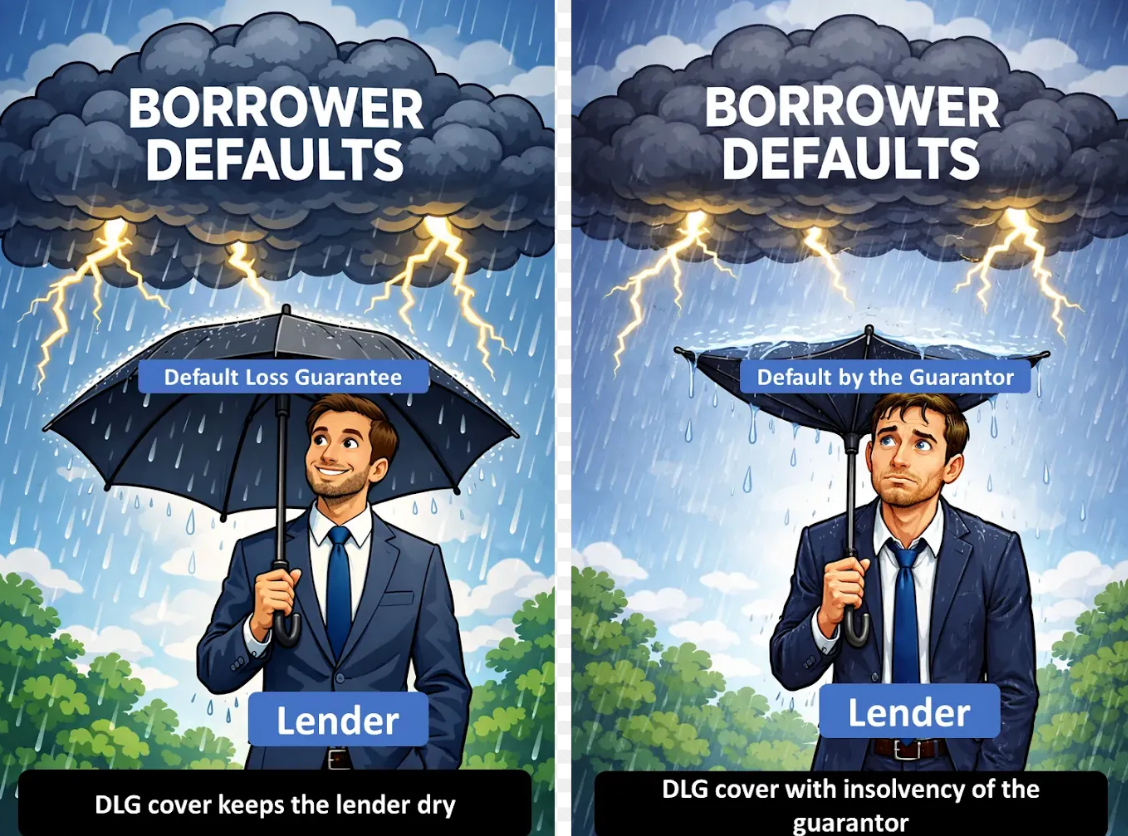
RBI had earlier directed NBFCs to compute expected credit loss (ECL) without considering the impact of any default loss guarantees (DLGs) obtained from its lending service provider (LSP). We had published a short note explaining why this position was debatable (See our article on the topic here) and had also made a formal representation to RBI on the issue. 

Back to the present, RBI has issued an amendment to the IRACP Directions, 2025 (dated February 13, 2026), permitting lenders to factor in DLG while determining provisions under the ECL framework across all stages.

Further, RBI has also specified that upon every event of invocation of DLG, the DLG cover reduces to the extent of invocation. Accordingly, REs shall recompute their ECL provisioning requirements across stages, after duly adjusting for the reduced DLG cover.

With these clarifications now in place, the next question that arises is: How should Regulated Entities (REs) appropriately factor DLG into their ECL computations? The article below discusses the above question at length.

How to factor in DLG in ECL computation?

Let us understand this in simple terms. Suppose a lender estimates that the expected loss on a loan pool is 3.8%. If the lender has received a guarantee of 5%, backed by fixed deposits that are lien-marked in its favour. The  guarantee is sufficient to cover the expected loss. In such a case, effectively, the lender does not expect to bear any loss. On the other hand, if the expected loss is 6.8% and the guarantee covers only 5%, then the lender’s net expected loss would be the balance 1.8%.

However, this adjustment assumes that the guarantee will actually be honoured when required. A guarantee does not, however, eliminate risk completely; it merely shifts the risk of default or loss from the borrower to the guarantor, up to the guaranteed amount.  

DLG & bankruptcy remoteness

The DLG guidelines specify the forms in which a DLG can be obtained. DLG can be accepted in any one of the following forms:

  • Cash deposited with the RE; 
  • Fixed Deposit maintained with a Scheduled Commercial Bank with a lien marked in favour of the RE; 
  • Bank Guarantee in favour of the RE

Accordingly, DLG can only be obtained in fully funded forms, thus eliminating any question of incurring credit loss on such a guarantee. Does that mean that even in case of insolvency of the DLG provider the lender will have the right to invoke the guarantee? The answer to this is negative. Because unlike in the case of bankruptcy-remote SPV, the guarantor is an operating entity, and is prone to the risk of insolvency.

In case of initiation of insolvency proceedings, all the assets of an insolvent entity form part of the insolvency administration/liquidation estate and are beyond the reach of the creditors. The proceeds from the realisation of assets are paid to the creditors in accordance with the waterfall mechanism as specified under section 53 of the IBC, 2016 . 

Accordingly, it becomes important to determine how each permitted form of DLG would be treated in the event of insolvency of the DLG provider.

  • Cash deposited with RE: The cash deposited with the lender is actually a liability held in the books till the same is invoked. As per Section 36 of IBC 2016, assets that may or may not be in possession of the corporate debtor including but not limited to encumbered assets form part of the liquidation estate. Accordingly, cash deposited by the DLG provider with RE would form part of the liquidation estate of the guarantor.
  • Lien marked FD: Similar to cash deposited with RE, the lien marked FD will also form part of the liquidation estate.
  • Bank Guarantee: In the case of a bank guarantee, the credit exposure effectively shifts from the original guarantor to the issuing bank. Given that scheduled commercial banks are subject to stringent regulation and supervision, the risk of insolvency in banks is generally remote. Accordingly, the probability of default in such a structure is unlikely to be impacted.

So, even if the DLG is structured as a funded guarantee, the actual invocation can become complicated if the DLG provider goes into insolvency before such invocation. In such a situation, the lender may not be able to simply invoke the guarantee and take the money. Instead, it may have to submit its claim and wait for distribution under the insolvency process, where payments are made in the statutory priority order. 

Under the waterfall mechanism, secured creditors rank alongside workmen’s dues. Now, in most DLG structures, the guarantor is a fintech entity or a co-lender. These entities typically do not have significant workmen-related liabilities. This may mean that the lender’s priority position is relatively stronger. 

Further, the actual invocation process of the DLG should also be considered. For instance, cash held with the lender can be easily invoked and adjusted as compared to a lien-marked FD or bank guarantee, where there could be procedural delays. 

Illustration: Consider a loan pool of ₹100 crore where the gross ECL rate is estimated at 6.8% (for the static pool covered by the guarantee), resulting in a gross ECL of ₹6.8 crore. The lender has a DLG cover of 5% of the pool (₹5 crore), structured as a lien-marked fixed deposit provided by a fintech sourcing partner. While the DLG is funded, there remains a risk that the guarantor may become insolvent. The first relevant question here is whether we will take a probability of default (PD) as per Stage 1 (12 months PD), or Stage 2/3 (lifelong PD). While the guarantor in question is not in default at all, however, given that the 6.8% ECL is a combination of Stage 1 as well as Stage 2/3 loans, in our view, the PD for the guarantor, to remain conservative, should be the lifelong PD over the tenure of the loans. Let us assume a 20% Probability of Default (PD) for the guarantor. Next question is assessment of Loss Given Default (LGD). As discussed above, the lender has the benefit of full security in form of lien on the fixed deposit, however, there may be depletion of the same on account of first priority in the waterfall, that is, costs of insolvency and bankruptcy process. On a conservative basis, we may, therefore, assume a 10% LGD. Thus, the expected loss on the DLG cover would therefore be 20% × 10% = 2%. 

As a result, the ECL computation may now be:

= 5%*2% + 1.8% = 1.9%

Based on the aforesaid discussion, in our view, while the guarantee is funded the lender may have to adjust the probability of default to factor in the risk of insolvency, particularly where the guarantee is funded in the form of a cash deposit or a lien marked FD. 

Which funded form of DLG is most suited?

As per the analysis, the various options of funded DLG can be ranked basis the maximum consideration allowable for ECL computation:

  1. Bank guarantee:  Being bankruptcy remote and easiest to invoke
  2. Cash deposit: May have to consider the risk of guarantor’s bankruptcy but the invocation would be easier
  3. Lien marked Fixed Deposit: May have to consider the risk of guarantor’s bankruptcy and invocation may involve procedural delays

However, given that there will not be a sizable or material difference in the quantum of counter guarantee risk, the selection of the options for ECL computation may not be significant. 

Can we help this situation?

One of the ways to mitigate the risk of insolvency is by structuring the guarantee in such a way that the guarantee may be invoked upon the occurrence of an adverse material change in the financial condition of the guarantor. In other words, other than the occurrence of losses in the pool, if there are events of default such as adverse material change, insolvency of the guarantor etc., the lender may invoke the guarantee.

Early invocation upon identifiable stress on the part of the guarantor could help the lender realise the guarantee amount before the commencement of insolvency proceedings.

However, such clauses must be appropriately incorporated and drafted in the DLG agreement to ensure the following:

  • A clear definition of “adverse material change”
  • Identifiable trigger events
  • Clarity on invocation mechanism

Impact of DLG invocation on ECL computation 

RBI has also provided a clarification that upon every event of invocation of DLG, the DLG cover reduces to the extent of invocation. Accordingly, REs would be required to recompute their ECL provisioning requirements across stages, after duly adjusting for the reduced DLG cover.

Pool-based guarantees presuppose that the pool is static. This is purely intuitive because if the pool is dynamic, new loans will continue to enter the pool, and therefore, the guarantor’s exposure will keep spreading over a continuing flow of new loans. 

Where the pool is static, the loans gradually get repaid (amortised) over time. As borrowers repay their instalments, the outstanding amount of the loan pool keeps reducing. Since the exposure is shrinking, the ECL on that pool will also typically reduce over time, assuming normal performance. Therefore, whether the utilisation of the DLG on account of pool defaults may cause the ECL computation to increase? This may be so for 2 reasons: one, usual terms of DLG invocation will be the full amount of the defaulted loan will be recovered (due to escalation of the entire principal outstanding). Thus, while the performing loans amortise over time, the non-performing loans are fully recovered once they reach “default”, causing the utilisation of the DLG to run faster than the amortization of the performing loans. Second reason is that once the pool actually starts defaulting, there may be a reason to provide higher estimates of probability of default as well.

Integral part of the contractual terms: Is DLG required to form part of the loan agreement? 

Para 36A of the IRAC Directions read with the principles under Ind AS 109 provides that credit enhancements may be considered while computing ECL only where such enhancements are “integral to the contractual terms.”  The expression “integral to the contractual terms” is taken from the definition of “credit loss” in Ind AS 109. Credit losses are measured after considering the expected cashflows from an asset. Those cashflows will factor in the recovery of any collateral, or credit enhancements, as long as the said credit enhancement is integral to the contractual terms.

What exactly is the meaning of “integral to the contractual terms”? Are we expecting the guarantee (DLG in the present case) to be a part of the terms of the loan contract? That would never be the case, as the so-called guarantee (which may legally be regarded as an indemnity contract) is a bilateral contract between the lender and the DLG provider. Neither is the borrower aware of the guarantee, nor is it desirable to have the borrower know of the guarantee, for obvious reasons. 

IFRS 9 uses the same language. US ASC has more elaborate discussion on this. Para 326-20-30-12 says:

The estimate of expected credit losses shall reflect how credit enhancements (other than those that are freestanding contracts) mitigate expected credit losses on financial assets, including consideration of the financial condition of the guarantor, the willingness of the guarantor to pay, and/or whether any subordinated interests are expected to be capable of absorbing credit losses on any underlying financial assets. However, when estimating expected credit losses, an entity shall not combine a financial asset with a separate freestanding contract that serves to mitigate credit loss. As a result, the estimate of expected credit losses on a financial asset (or group of financial assets) shall not be offset by a freestanding contract (for example, a purchased credit-default swap) that may mitigate expected credit losses on the financial asset (or group of financial assets)

There has been a significant discussion on whether the benefit of a guarantee or credit enhancement which is not a part of the contractual terms of the loan can be factored in ECL computation. From discussions before the IASB, as back as in 2018, two conditions for recognising the benefit of credit enhancements were discussed:

  1. part of the contractual terms; and
  2. not recognised separately by the entity.

The second condition is easy to understand. For example, if the risk of default is hedged by a credit default swap, the value of the same, amounting to a derivative, is separately recognised. Hence, the question of factoring the same while computing ECL does not arise. However, the first condition, relating to contractual terms of the asset, still remains vague.

One may try to get some clues in the US FASB discussions, where para 326-20-30-12 has been interpreted in technical interpretations. In addition, there is a definition of “freestanding contracts” under the Glossary of ASC 326:

A freestanding contract is entered into either:

a. Separate and apart from any of the entity’s other financial instruments or equity transactions

b. In conjunction with some other transaction and is legally detachable and separately exercisable.

The “forming integral part of the contractual terms” does not warrant the principal contract to provide for the guarantee or the credit enhancements. Insisting on the same will be counter-intuitive, except in case of trilateral contracts. However, the conditions indicate that the guarantee or credit enhancement integrates and becomes an inseparable part of the underlying loan or group of loans. For example, if the group of loans was to be transferred, is it such that the benefit of the guarantee may stay iwth the originator and loans may be transferred, or the guarantee travels along with the loans? If the latter is the case, there is no doubt that in reality, the guarantee has become an embedded part of the loan transaction.

Another factor may be the contractual association between the loan cashflows and the payout from the credit enhancements. Some relevant considerations:

  • Is the guarantee specific to the contractual cashflows from the loans?
  • Does the guarantor pay what the original loan asset would have paid, or pays independent of the contractual cashflows?
  • If the lender subsequently recovers the cashflows from the asset, is the payout from the guarantee restored back to the guarantor?

The presence of these factors will suggest the integration or embedding of the guarantee into the contractual cashflows from the loans.

Conclusion

While the recent amendment by the RBI brings welcome clarity by allowing DLG to be factored into ECL computation, lenders must approach this carefully and realistically. A DLG can reduce the expected loss, but it does not make the risk disappear, as the DLG provider itself faces the risk of insolvency. The form of the guarantee, its enforceability, and the possibility of invocation- all of these matter in assessing the true level of protection. REs should not treat DLG as a mechanical deduction from ECL, but as a risk mitigant that requires thoughtful evaluation, continuous monitoring, and recalibration as the pool amortises and the cover reduces.

See our other resources:
  1. Expected credit losses on loans: Guide for NBFCs;
  2. Expected to bleed: ECL framework to cause ₹60,000 Cr. hole to Bank Profits;
  3. Impact of restructuring on ECL computation.

Co-lending and Default Loss Guarantees

Our resources on Digital Lending – https://vinodkothari.com/category/financial-services/digital-lending/

Our resources on Co-lending – https://vinodkothari.com/co-lending/

Lending Together Rewinded 

Other Resources:

  1. Resources on co-lending
  2. Co-lending and loan sourcing: Draft Directions seek to end Discretionary Co-lending
  3. RBI issues Co-lending Directions, 2025
  4. FAQs on Co-lending Directions, 2025
  5. Shastrartha 21: Co-lending Directions

Cash in Hand, But Still a Loss? 

RBI mails to NBFCs to disregard DLG in expected loss computation


– Vinod Kothari & Dayita Kanodia (finserv@vinodkothari.com)

Background

RBI has recently been directing NBFCs to compute ECL without factoring in the impact of DLGs obtained1. This stance appears to stem from the regulator’s perception that fintech-issued guarantees carry inherent risk and may expose NBFCs to potential losses.

As per Ind AS 109, Expected Credit Loss (ECL) model is used for the recognition and measurement of impairment on financial assets. ECL is a forward-looking approach that requires entities to recognize credit losses based on expectations of future defaults.

The Default Loss guarantee Guidelines (‘DLG Guidelines’) allow LSPs, (both regulated and unregulated) to provide DLG to the extent of 5% of the portfolio amount to the lender. The DLG Guidelines specify the forms in which such DLG can be obtained. 

In terms of para 22 of the DL Guidelines, 

“RE can accept DLG only in one or more of the following forms:

  1. Cash deposited with the RE;
  2. Fixed Deposit maintained with a Scheduled Commercial Bank with a lien marked in favour of the RE;
  3. Bank Guarantee in favour of the RE”

Accordingly, DLGs can only be obtained in fully funded forms thus eliminating any question of incurring credit loss on such guarantee. 

RBI Directive to NBFCs

RBI has directed NBFCs to maintain ECL without giving effect to the DLGs obtained in accordance with the DLG Guidelines. In this respect, the following should be taken into consideration:

  • A regulatory prescription, without a regulatory backing, and in fact, going against the regulation:
    • There is a well-laid process for the RBI coming with a regulation, and in fact, now, the RBI has decided to come up with a consultation process, impact assessment etc before coming with a regulation. 
    • Dictating a certain treatment with respect to ECL is nothing short of a regulation – if this sort of generic requirements keep coming from the supervisors, then the very dividing line between supervision and regulation is lost.
  • Let accounting standards prevail; auditors and accountants know what ECL to provide:
    • Annex II of the SBR Directions provides that NBFCs shall follow applicable accounting standards. The ECL provisioning, known as impairment loss, comes from para 5.5.13 of Ind AS 109. The detailed requirements of how ECL is to be estimated has been laid in that standard.
    • Admittedly, whether and how much ECL write down is required, and whether such ECL estimation does or does not give effect to a fully-funded guarantee, is a matter for the accountants and auditors to deal with. We find little reason for the regulator to step into what is clearly an accounting standard domain.
  • If there is a funded guarantee, how can losses met by such guarantee be disregarded?
    • As per DLG guidelines, the guarantee has to be either fully funded, or fully backed by bank guarantee. It is true that even if a credit loss is backed by a guarantee, it is merely shifting of the exposure – from the borrower to the guarantor. But in this case, the guarantee is equivalent to cash. If the lender has a cash collateral to back up the guarantee, there is no reason to not give the benefit of the same in ECL estimation.
    • For example, if for a certain loan pool, the ECL estimation is 3.8%, and the lender has a guarantee of 5% backed by fixed deposits lien-marked to the lender, will the lender have any expected loss? The answer is negative. If the ECL estimation was, say, 6.8% and the guarantee is 5%, clearly the lender’s ECL will be 1.8%. Thus, there is no reason to disregard the funded guarantee while estimating ECL.
  • If a company cannot incur loss to the extent of the guarantee, and it still creates an impairment loss, it is actually creating a reserve and not a provision, and therefore, compromising its true and fair view:
    • The RBI expects lenders to disregard the guarantee and create ECL as if the guarantee did not exist. This will be like creating a loss where the losses actually cannot hit the lender. Therefore, the ECL becomes a reserve, and given that the entity is hitting the P/L with a loss that will not hit the lender, the entity is compromising its true and fair view.
  • The RBI has reasons to have no trust on the fintechs for the guarantee they give, but it is fully funded.

In light of this, the RBI’s emails sent to various lenders are objectionable, and such emails create a precedent of creating a regulation without going through the regulatory process.

Accordingly, in our view, NBFCs should be allowed to follow their applicable accounting standards while computing the ECL provisions.

Our resources:

  1. FAQs on Default Loss Guarantee in Digital Lending
  2. Capital Treatment, Loan Loss Provisioning and Accounting for Default Loss Guarantees
  1.  https://economictimes.indiatimes.com/industry/banking/finance/rbi-tightens-default-loss-guarantee-rule-nbfcs-to-exclude-cover-on-fintech-sourced-loans/articleshow/121420936.cms?from=mdr
    ↩︎

Lend, Recover, Replenish: A guide to revolving lines of credit

“Chivalry is like a line of credit. You can get plenty of it when you do not need it.”

— Nellie L. McClung

Dayita Kanodia | Finserv@vinodkothari.com

In the realm of financial management, having access to a flexible and readily available source of funds can be a game-changer for individuals and businesses alike. One such financial tool that offers this flexibility is a revolving line of credit. Often misunderstood or overlooked, revolving lines of credit are versatile financial instruments that can provide quick access to funds when needed.

A revolving line of credit is a type of loan arrangement that provides borrowers with access to a predetermined amount of funds, which they can borrow, repay, and borrow again as needed. Unlike traditional term loans, where you receive a lump sum upfront and repay it over a set period with fixed payments, a revolving line of credit offers ongoing access to funds that can be drawn upon at any time, up to the credit limit.

Revolving line of credits has been defined as a committed loan facility allowing a borrower to borrow (up to a limit), repay, and re-borrow loans.These are also known as revolving credit facilities, replenshing loans, revolving loans,  or just revolver. 

How Does it Work?

When one opens a revolving line of credit, there is an approval for a certain credit limit based on factors such as creditworthiness, income, and other financial obligations. Once approved, funds can be accessed from the credit line as needed, either by writing checks, using a debit card, making online transfers, or withdrawing cash, depending on the terms of the agreement.

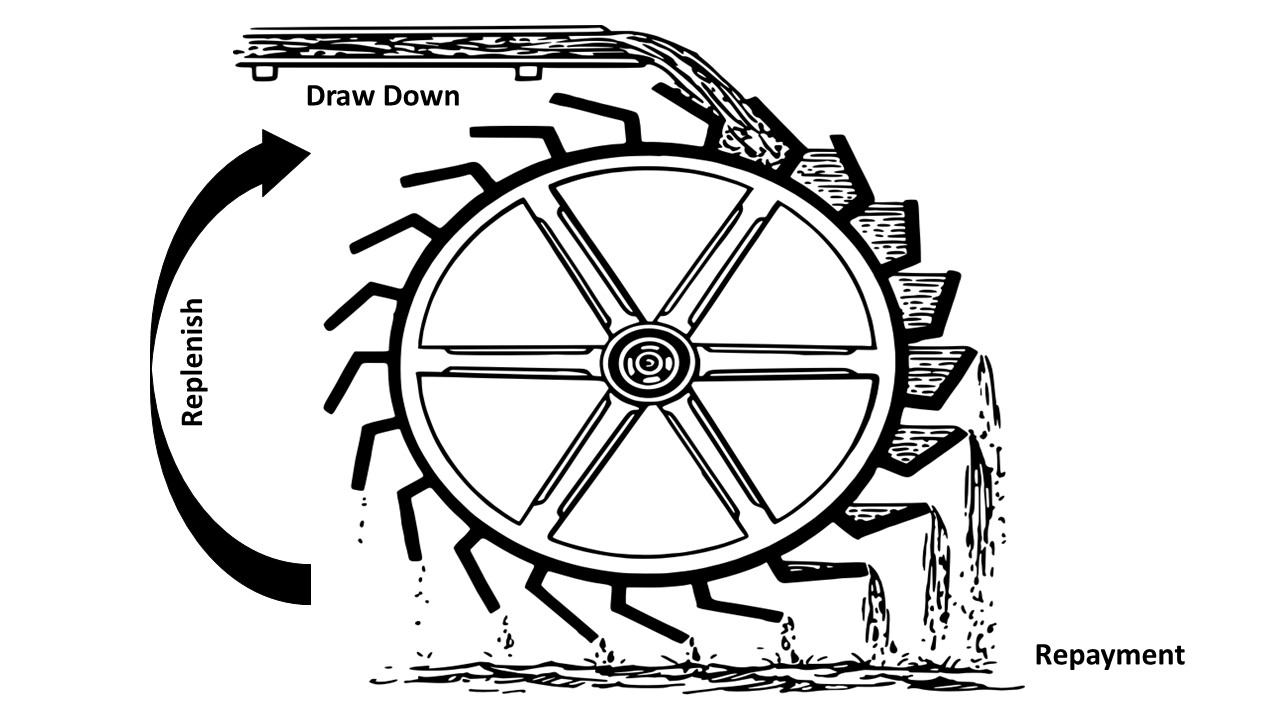
The line of credit is drawn down as disbursements occur. However, the limit is reinstated to the extent repayment is made by the borrower. Obviously, the borrower is free to repay the whole or a part of the limit anytime, and there is no question of any prepayment charge. 

It is not as though a revolving line of credit will continue to revolve all the time – the lender may set a renewal date, and if the facility is not renewed, the lender may convert it into either an instalment credit, or one payable in one or more tranches at a defined time. During the period the facility remains revolving, the borrower services interest.

It is also important to note that during such time, and for such amount, the facility is not used not used fully, the lender still keeps a commitment to lend alive, which has both liquidity burden as well as regulatory capital charge for the lender. Therefore, it is perfectly okay for a lender to provide for a commitment charge for the unutilised facility amount. 

Features of Revolving Lines of Credit

  • Revolving Nature: Unlike traditional term loans, revolving lines of credit allow borrowers to repeatedly borrow and repay funds without the need to reapply for a new loan each time.
  • Interest on Utilized Amount: Interest is typically charged only on the amount of credit actually used, rather than on the entire credit limit. This can result in lower interest costs for borrowers who do not fully utilize their credit line.
  • Variable Interest Rates: Interest rates on revolving lines of credit may be variable, meaning they can fluctuate over time based on market conditions. This can be advantageous if rates decrease but may pose risks if rates rise.
  • No Fixed Repayment Schedule: Unlike term loans with fixed monthly payments, revolving lines of credit typically have no fixed repayment schedule. Borrowers can repay the borrowed amount on their own timeline, as long as they make at least the minimum required payments.
  • Credit Renewal: As long as the borrower meets the terms and conditions of the credit agreement, revolving lines of credit can be renewed indefinitely, providing ongoing access to funds.

Lines of credit and its types

The US Federal Reserve has distinguished between revolving and non-revolving lines of credit. It says, 

“Revolving credit plans may be unsecured or secured by collateral and allow a consumer to borrow up to a prearranged limit and repay the debt in one or more installments. Credit card loans comprise most of revolving consumer credit measured in the G.19, but other types, such as prearranged overdraft plans, are also included. Nonrevolving credit is closed-end credit extended to consumers that is repaid on a prearranged repayment schedule and may be secured or unsecured. To borrow additional funds, the consumer must enter into an additional contract with the lender.”

Credit can be classified as:

Revolving Credit: A fixed line of credit is determined from where draw down take place. The line of credit then gets reinstated on repayment by the borrower.

Non-Revolving Credit: They provide borrowers with access to funds up to a predetermined credit limit which does not get reinstated on repayments being made. To borrow additional funds, a new contract has to be entered into.

Installment Credit: Installment credit involves borrowing a specific amount of money upfront and repaying it over a set period in equal installments, typically including both principal and interest.

Non-installment Credit: In case of non-installment credit, repayment does not happen in equal installments over a period of time but there is generally a bullet repayment made by the borrower.

Types of revolving lines of credit

Revolving lines of credit come in various types, each tailored to meet specific needs and circumstances:

Personal Revolving Line of Credit: 

This type of credit is designed for individual consumers and can be used for various personal expenses, such as home renovations, unexpected medical bills, or debt consolidation. Personal revolving lines of credit offer flexibility in borrowing and repayment, allowing individuals to access funds as needed.

Working Capital Revolving Line of Credit: 

Businesses often use this type of credit to manage cash flow, finance day-to-day operations, purchase inventory, or cover short-term expenses. Working capital revolving lines of credit provide flexibility for businesses to access funds when needed and repay them as cash flow allows, helping to smooth out fluctuations in revenue and expenses.

Secured and Unsecured Revolving Line of Credit: 

Secured lines of credit require collateral, such as real estate, inventory, or equipment, to secure the credit line. Because the lender has the security of collateral, secured lines of credit typically offer lower interest rates and higher credit limits compared to unsecured lines of credit.

Unsecured lines of credit do not require collateral. Instead, the creditworthiness of the borrower determines the credit limit and terms of the line of credit. Interest rates for unsecured lines of credit may be higher, and credit limits lower, compared to secured lines, but they offer the advantage of not requiring collateral.

Home Equity Line of Credit (HELOC): 

A HELOC is a revolving line of credit that is secured by the equity in a borrower’s home. Homeowners can borrow against the equity in their home up to a certain limit, using the home as collateral. HELOCs often have lower interest rates compared to other forms of credit and may offer tax benefits, but they carry the risk of foreclosure if payments are not made.

Revolving Credit Cards: 

Credit cards are a common form of revolving line of credit. They allow cardholders to make purchases up to a certain credit limit, repay the balance, and then borrow again up to the credit limit. Revolving credit cards typically have variable interest rates and may offer rewards or cashback incentives.

Maintenance of Regulatory Capital

According to para 5.9.3 of the Basel III Master Circular, revolving lines of credit can be considered as retail claims for regulatory capital purposes and included in a regulatory retail portfolio if they meet certain conditions. :

However, it is important to understand that a revolving facitliy has a drawn amount (and therefore, on-balance sheet exposure), and the undrawn amount (which is off balance sheet exposure). 

Para 5.15.2 (iv) of the Basel III Circular states that, 

“Where the non-market related off-balance sheet item is an undrawn or partially undrawn fund-based facility, the amount of undrawn commitment to be included in calculating the off-balance sheet non-market related credit exposures is the maximum unused portion of the commitment that could be drawn during the remaining period to maturity. Any drawn portion of a commitment forms a part of bank’s on-balance sheet credit exposure.”

Accordingly, say there is a credit facility for Rs.100 lakh (which is not unconditionally cancellable) where the drawn portion is Rs. 60 lakh, the undrawn portion of Rs. 40 lakh will attract a Credit Conversion Factor of 20 per cent. 

The credit equivalent amount of Rs. 8 lakh (20% of Rs.40 lakh) will be assigned the appropriate risk weight as applicable to the counterparty/rating to arrive at the risk weighted asset for the undrawn portion. The drawn portion (Rs. 60 lakh) which forms a part of the bank’s on-balance sheet credit exposure will attract a risk weight as applicable to the counterparty/rating.

Liquidity Risk 

According to para 131 of the Basel III: The Liquidity Coverage Ratio and liquidity risk monitoring

tools any contractual loan drawdowns from committed facilities and estimated drawdowns from revocable facilities within the 30-day period should be fully reflected as outflows. 

In case of committed credit facilities to retail and small business customers, banks have to assume a 5% drawdown of the undrawn portion whereas in case of non-financial corporates, drawdown has to be assumed for 10% of the undrawn amount.

Can revolving lines of credit be Transferred or Securitised ?

Transfer of Revolving Lines of Credit:

In case of a revolving line of credit, there is typically an undrawn amount. Accordingly, the transfer can only happen for the amount already drawn. However, in terms of the RBI Master Direction – Reserve Bank of India (Transfer of Loan Exposures) Directions, 2021 (‘TLE Directions’), the requirement of Minimum Holding Period (‘MHP’) needs to be fulfilled. This MHP requirement is of 3 months for loans having tenure of upto 2 years. Therefore, for loans having very short tenure, it may not be possible to fullfill the same. 

Accordingly, although there is no express prohibition from transferring the line of credit exposure, it may not be practical to do so. 

Securitisation of revolving lines of credit:

As per para 6(d) of the Master Direction – Reserve Bank of India (Securitisation of Standard Assets) Directions, 2021 (‘SSA Directions’) securitisation of revolving credit facilities is not permitted. Accordingly, revolving lines of credit cannot be securitised. 

Obtaining Default Loss Guarantee for Revolving Lines of Credit

Default Loss Guarantee(DLG) can only be obtained for digital loans. Since, revolving credit facilities (say, credit cards) may be offered through digital means it is important to discuss if DLG can be obtained for revolving lines of credit. The RBI FAQs (FAQ No.10) on Default Loss Guarantee (‘DLG FAQs) have prohibited REs from entering into DLG arrangements with respect to revolving lines of credit. 

For other non-digital revolving lines of credit provided, the bar on synthetic securitisation continues to apply and therefore, no default loss guarantee can be obtained. 

Conclusion

In a world where financial needs can arise unexpectedly, having access to a revolving line of credit can be invaluable. However, it’s essential for lenders to understand the regulatory requirements and implications associated with these credit facilities to ensure compliance and mitigate risks effectively.

Related Articles – 

Personal revolving lines of credit by NBFCs: nuances and issues

The Credit Card Business for NBFCs

FAQs on Default Loss Guarantee in Digital Lending