Posts

RBI Clarifies Uniform Asset Classification Under Co-Lending Confined to the Co-Lent Exposure Only

Background

The Co-Lending Arrangements Directions, 2025 (now subsumed within Para B of the RBI (Non-Banking Financial Companies — Transfer and Distribution of Credit Risk) Directions, 2025) introduced a requirement for uniform borrower-level asset classification across co-lending partners. Paragraph 124 of the Directions provides:

“NBFCs shall apply a borrower-level asset classification for their respective exposures to a borrower under CLA, implying that if either of the REs classifies its exposure to a borrower under CLA as SMA / NPA on account of default in the CLA exposure, the same classification shall be applicable to the exposure of the other RE to the borrower under CLA. NBFCs shall put in place a robust mechanism for sharing relevant information in this regard on a near-real time basis, and in any case latest by end of the next working day. “

The intent of this provision, read alongside RBI’s long-standing IRACP framework, was clear: credit stress is a condition of the borrower, not of a specific loan. Once any co-lender classified its share of the co-lent exposure as SMA or NPA, the other co-lender was required to mirror that classification for its own share.

The Interpretive Question

The phrase “under the CLA” in paragraph 124 gives rise to 2 divergent methods:

  1. Borrower-level classification applies across all exposures of a co-lender to the borrower, including non-co-lent loans, once any default arises in the co-lent exposure; or
  2. The uniform classification obligation is confined to the co-lent exposure itself. A default in the co-lent loan does not compel reclassification of the co-lender’s non-colent loans to the same borrower, nor does a default in an independent loan trigger any obligation under paragraph 124.

We had earlier made a case for interpretation 1 above in our write-up Does Co-lending Make Default a Communicable Disease? keeping in mind the principle of borrower-level asset classification under IRACP norms. However, an RBI clarification received by a regulated entity provides otherwise. 

The RBI Clarification

RBI has clarified that the uniform asset classification requirement under paragraph 124 is limited to the exposure under the co-lending arrangement. It does not extend to independent loans of a co-lender to the same borrower that are outside the CLA.

The implications of this clarification are as follows:

  • Co-lent loan defaults:
    • If Co-Lender 1 classifies its share of the co-lent loan as SMA/NPA, Co-Lender 2 must apply the same classification to its share of that loan. However, Co-Lender 2 is not required, solely on account of the co-lent loan defaulting, to reclassify any separate, independent loan it holds to the same borrower outside the CLA.
  • Standalone loan of Co-Lender 2 defaults i.e. default in an independent loan:
    • A default or downgrade by Co-Lender 2 on a non-CLA loan to the same borrower does not, of itself, trigger any information-sharing obligation or classification consequence for Co-Lender 1 under paragraph 124.

It is, however, also worthwhile to mention that REs continue to remain independently subject to their own borrower-level classification obligations under the IRACP norms. Where a co-lender has knowledge of default in a borrower’s other obligations, its own prudential framework may require appropriate classification of its standalone exposures. Further, with fortnightly CIC reporting coming in effect from July 2026, co-lenders will have near-regular visibility into a borrower’s credit profile across lenders. It would therefore be increasingly difficult for a co-lender to retain a favourable asset classification on a standalone exposure where the borrower’s credit record reflects a default on other loans. 

Impact on Ind AS entities is also worth noting. While the RBI clarification limits the uniform asset classification requirement to the co-lent exposure, entities following Ind AS may still need to evaluate whether a default on the co-lent loan constitutes a Significant Increase in Credit Risk (SICR) for the borrower. The occurrence of default on any material obligation may indicate deterioration in the borrower’s creditworthiness and could be a relevant factor in assessing the staging of other exposures to the same borrower. Accordingly, even though asset classification consequences may not extend beyond the co-lent exposure, the information regarding such default may influence the ECL assessment and provisioning for other loans held by the lender, depending on its ECL framework.

Does Co-lending Make Default a Communicable Disease?

How to ensure uniform asset classification under co-lending

Simrat Singh | finserv@vinodkothari.com

Asset classification under RBI regulations has always been anchored to the borrower, not to individual loan facilities. Once a borrower shows repayment stress in any exposure, it is no longer reasonable to treat the borrower’s other obligations as unaffected; prudence requires that all other facilities to that borrower reflect the same level of stress. Even the insolvency law reinforces this borrower-level approach to default by allowing CIRP to be triggered irrespective of whether the default is owed to the applicant creditor or not (see Explanation to section 7 of the IBC)

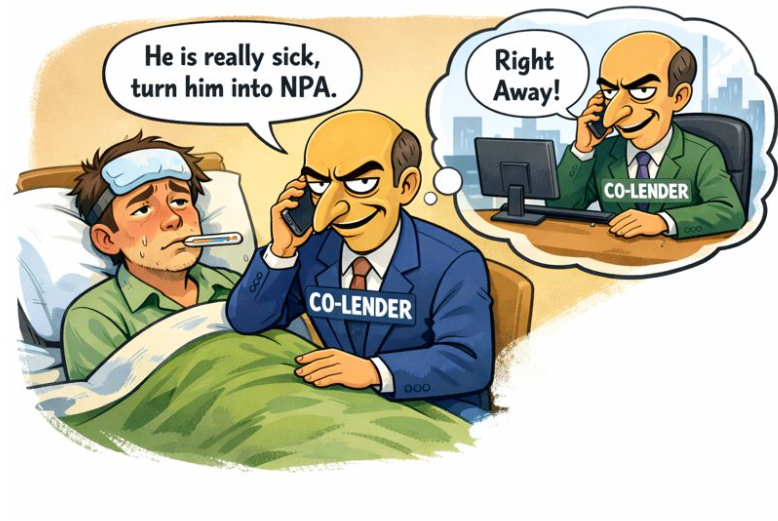
This borrower-level approach is not unique to India. Globally, the Basel framework also defines default at the obligor level – the core idea being that credit stress is a condition of the borrower, not of a single loan. In other words, when a borrower sneezes financial distress, all his loans catch a classification cold.

Position under the earlier co-lending framework

Under the earlier 2020 framework for priority sector co-lending between banks and NBFCs, each RE applied its own asset classification norms to its respective share of the co-lent loan (see para 13 of 2020 framework). This allowed situations where the same borrower and same loan could be classified differently in the books of the two co-lenders. While operationally convenient, this approach sat uneasily with the borrower-level logic of RBI’s IRACP norms and diluted the consistency of credit risk recognition in a shared exposure.

Position under the Co-Lending Arrangements Directions, 2025

The 2025 Directions [now subsumed in Para B of the Reserve Bank of India (Non-Banking Financial Companies – Transfer and Distribution of Credit Risk) Directions, 2025] resolve this inconsistency by requiring uniform asset classification across co-lenders at the borrower level (see para 124 reproduced below for reference).

124. NBFCs shall apply a borrower-level asset classification for their respective exposures to a borrower under CLA, implying that if either of the REs classifies its exposure to a borrower under CLA as SMA / NPA on account of default in the CLA exposure, the same classification shall be applicable to the exposure of the other RE to the borrower under CLA. NBFCs shall put in place a robust mechanism for sharing relevant information in this regard on a near-real time basis, and in any case latest by end of the next working day.

Therefore, where one co-lender classifies its share of a co-lent exposure as SMA or NPA, the other co-lender must apply the same borrower classification to its share of the same exposure. It was an extension of RBI’s long-standing borrower-wise classification principle into a multi-lender structure.

Why “under the CLA” cannot be read in isolation

However, the wording of paragraph 124 has, in practice, been interpreted by some lenders in a much narrower manner. The phrase “under the CLA” has been read to mean that the classification of the other co-lender’s share would change only if the borrower defaults on the co-lent exposure itself. On this interpretation, where a borrower defaults on a separate, non-co-lent loan, lenders may in their books follow borrower level classification but they need not share such information with the co-lending partner since there is no default in the co-lent loan.

This approach, however, runs contrary to the regulatory intent and represents a classic case where the literal reading of a provision is placed in conflict with its underlying purpose. Market practice reflects this divergence. Traditional lenders have generally adopted a conservative approach, applying borrower-level classification across exposures irrespective of whether the default arises under the CLA. Certain other lenders, however, have taken a more aggressive position, limiting classification alignment strictly for defaults under the co-lent exposure. The conservative approach is more consistent with RBI’s prudential framework and intent, which has always treated credit stress as a condition of the borrower rather than of a particular loan structure.

Implications for other exposures to the same borrower

Once borrower-level classification is accepted as the governing principle, the consequence is straightforward: any other exposure that a co-lender has to the same borrower must also reflect the borrower’s SMA or NPA status, even if that exposure is not part of the co-lending arrangement. Let us understand this by way of examples.

Scenario 1: Multiple Loans, No Co-Lending Exposure 

A borrower has three separate loans:

  1. L1: 100% funded by A
  2. L2: 100% funded by B
  3. L3: 100% funded by C

Although A, B and B may be co-lending partners with each other in general, none of the above loans are under a co-lending arrangement (CLA).

Treatment: Since there is no co-lent exposure to the borrower, paragraph 124 of the Directions does not apply. Each lender classifies and reports its own loan independently, as per its applicable asset classification norms. There is no obligation to share asset-classification information relating to these loans among the lenders.

Scenario 2: One Co-Lent Loan and Other Standalone Loans

A borrower has three loans:

  1. L1: Co-lent by B (80%) and A (20%)
  2. L2: 100% funded by A (not co-lent)
  3. L3: 100% funded by C (not co-lent)

Case A: Default under the Co-Lent Loan

If B classifies its 80% share of L1 as NPA:

  • A’s 20% share of L1 must also be classified as NPA, even if it was standard in A’s books. While given that the asset classification norms for different REs are aligned and the invocation of any default loss guarantee also does not impact the asset classification; there does not seem to be any reason for a difference in the asset classification of the co-lenders in this case.  
  • Since asset classification is borrower-level, A must also classify L2 as NPA, even though L2 is not under a co-lending arrangement.
  • L3 remains unaffected, as C is not a co-lender to the same borrower and there is no requirement for B or A to share borrower-level information with C.

Case B: Default under a Non-Co-Lent Loan by any one of the Co-Lenders

If A classifies L2 as NPA:

  • Since asset classification is borrower-level, A must also classify L1 as NPA
  • B’s 80% share of L1 must also be classified as NPA
  • L3 remains unaffected, as C is not a co-lender to the same borrower and there is no requirement for B or A to share borrower-level information with C.

Case B: Default under a Non-Co-Lent Loan of a Third Lender

Assume L3 is classified as NPA by C, while L1 and L2 remain standard.

  • There is no impact on the books of B or A.
  • C is not required to share information on L3 with B or C, as there is no co-lending exposure between them for this borrower.

Note that borrower-level asset classification and information sharing activates only where there is a co-lending exposure to the borrower. Once such an exposure exists, any default in any loan of a co-lender triggers borrower-level classification across all exposures of that lender, including standalone loans. However, lenders with no co-lending exposure to the borrower remain outside this information-sharing loop. May refer the below chart for more clarity:

Fig 1: Decision chart for asset classification of loans under co-lending

Information Sharing and Operational Impact

To make borrower-level classification work in practice, the 2025 Directions require co-lenders to put in place information-sharing arrangements. Any SMA or NPA trigger must be shared with the other co-lender promptly and, in any case, by the next working day. It requires aligned IT systems so that both lenders update their books on the borrower at the same time, or as close to real time as possible.

Conclusion

The 2025 Directions reinforce a long-standing regulatory principle: credit stress belongs to the borrower, not to a specific loan or lender. Uniform borrower-level classification and timely information sharing are essential to preserve consistency in risk recognition across co-lenders. While this increases operational complexity, it aligns co-lending practices with RBI’s prudential intent.

See our other resources on co-lending.

The Great Lockdown: Standstill on asset classification

– RBI Governor’s Statement settles an unwarranted confusion

Timothy Lopes, Executive, Vinod Kothari Consultants

finserv@vinodkothari.com

Background

In the wake of the disruption caused by the global pandemic, now pitted against the Great Depression of 1930s and hence called The Great Lockdown[1], several countries have taken measures to try and provide stimulus packages to mitigate the impact of COVID-19[2]. Several countries, including India, provided or permitted financial institutions to grant ‘moratorium’, ‘loan modification’ or ‘forbearance’ on scheduled payments of their loan obligations being impacted by the financial hardship caused by the pandemic.

The RBI had announced the COVID-19 Regulatory Package[3] on 27th March, 2020. This package permitted banks and other financial institutions to grant moratorium up to 3 months beginning from 1st March, 2020. We have covered this elaborately in form of FAQs.[4]

However, there was ambiguity on the ageing provisions during the period of moratorium. That is to say,  if an account had a default on 29th February, 2020, whether the said account would continue to age in terms of days past due (DPD) as being in default even during the period of moratorium. Our view was strongly that a moratorium on current payment obligation, while at the same time expecting the borrower to continue to service past obligations, was completely illogical. Such a view also came from a judicial proceeding in the case of Anant Raj Limited Vs. Yes Bank Limited dated April 6, 2020[5]

However, the RBI seems to have had a view, stated in a mail addressed to the IBA,  that the moratorium did not affect past obligations of the customer. Hence, if the account was in default as on 1st March, the DPD will continue to increase if the payments are not cleared during the moratorium period.

Read more