The International Financial Services Centre, from Gift City, was intended to enable leasing of aircrafts as well as ships. Such leases have traditionally been done from offshore jurisdictions, and the admitted intent of IFSC was to bring these businesses to IFSC.
Ship financing business in India and the world
India is a very important player in the global shipping market, and is ranked no 17 in terms of shipping volume. It has a coastline of about 7,517 km, with 12 major and 205 minor ports. Additionally, it is estimated that about 95% of India’s goods trade by volume and 70% by value is done through maritime transport.
Ship financing volume globally is about USD 500 billion, largely consisting of bank finance. There are two types of leases against ships: bare board charter, and voyage or time charter. In case of the former, the lessor merely provides the vessel, with neither the crew or any other services, whereas in case of the latter, the ship is provided on time basis, with all services.
India is a substantial importer of shipping freight. It is estimated that annually, Indian companies pay about $75 billion for seaborne freight to foreign shipping companies.
https://vinodkothari.com/wp-content/uploads/2023/06/vinod-kothari-logo.png00Vinod Kothari Consultantshttps://vinodkothari.com/wp-content/uploads/2023/06/vinod-kothari-logo.pngVinod Kothari Consultants2023-11-02 16:24:082023-11-02 16:25:49Ship leasing from IFSC: A new business takes shape
The heart of insolvency law is the priority order or the waterfall given in sec. 53, and one of the very crucial issues in the priority of secured creditors is whether statutory claims will rank at par with secured creditors by virtue a provision in the respective laws giving the Government a status of a secured creditor, or will have to rank at the fifth priority as provided by sec. 53 (1) (e), there is a situation of uncertainty.
Essentially, the statute will have to step in, because courts can only interpret the law as seen and read by the courts; courts cannot mend the law to meet what might have been the design of the law. On the contrary, if the lawmakers leave the law as is, liquidators will have to face claims, as they already are facing, from state governments claiming equality of ranking with secured creditors, even though many liquidations might have already closed or distributed their assets.
https://vinodkothari.com/wp-content/uploads/2023/06/vinod-kothari-logo.png00Vinod Kotharihttps://vinodkothari.com/wp-content/uploads/2023/06/vinod-kothari-logo.pngVinod Kothari2023-11-01 19:04:552023-11-01 22:54:38Rainbow versus Raman: A Riddle so crucial and so hard to resolve
https://vinodkothari.com/wp-content/uploads/2023/06/vinod-kothari-logo.png00Team Corplawhttps://vinodkothari.com/wp-content/uploads/2023/06/vinod-kothari-logo.pngTeam Corplaw2023-11-01 11:00:452023-11-01 11:00:45Mandatory demat for private companies: Highlights of the 27th October notification
In a world where information is power and financial well-being is paramount, credit plays a pivotal role in shaping our opportunities and choices. Your credit history is a mirror reflecting your financial trustworthiness, and it’s closely monitored by Credit Information Companies (CICs) and Credit Institutions (CIs). RBI in its Statement on Developments and Regulatory Policies released with the Bi-monthly Monetary Policy Statement 2023-24 on April 6, 2023 announced that a comprehensive framework will be put in place for strengthening and improving the efficacy of the grievance redress mechanism and customer service provided by the CICs and CIs. Additionally, it was announced that a compensation mechanism will be put in place for delayed updation/rectification of credit information by the CICs and CIs . Accordingly, RBI have introduced two comprehensive frameworks on October 27, 2023 titled “Strengthening of customer service rendered by Credit Information Companies and Credit Institutions” and “Framework for compensation to customers for delayed updation/ rectification of credit information”
While the first circular deals with strengthening of customer services provided by the CICs and CIs in relation to access and use of credit information, the other one provides for a comprehensive compensation framework where the CICs or CIs fail to address the customer requests/ complaints within a specified period of time.
The objective of this article is to underscore the key provisions of the circular and identify actionable steps that CIs should take in response.
https://vinodkothari.com/wp-content/uploads/2023/06/vinod-kothari-logo.png00Team Corplawhttps://vinodkothari.com/wp-content/uploads/2023/06/vinod-kothari-logo.pngTeam Corplaw2023-10-30 17:05:022023-11-01 10:34:11Mandatory conversion of share warrants issued under CA 1956 into demat securities - Snippet on MCA Notification
https://vinodkothari.com/wp-content/uploads/2023/06/vinod-kothari-logo.png00Team Corplawhttps://vinodkothari.com/wp-content/uploads/2023/06/vinod-kothari-logo.pngTeam Corplaw2023-10-30 16:51:412023-11-01 10:41:57Designated Persons to reveal beneficial owners:Summary of the 27th October notification
Share warrants are one of the widely used means to raise funds, particularly, in case of start-ups. MCA has recently notified the Companies (Prospectus and Allotment of Securities) Second Amendment Rules, 2023 (“Amendment Rules”) vide which Rule 9 has been amended to require mandatory conversion of the existing share warrants issued by public companies under the erstwhile Companies Act, 1956 (“Erstwhile Act”) into dematerialised form of securities.
Following this amendment, a significant question comes up to be addressed is whether public companies will not be allowed to issue share warrants altogether? We attempt to decode the implications of the present amendment in this write up.
Actionables under the present amendment
The newly inserted sub-rule (2) and (3) to Rule 9 of the PAS Rules requires every unlisted company to –
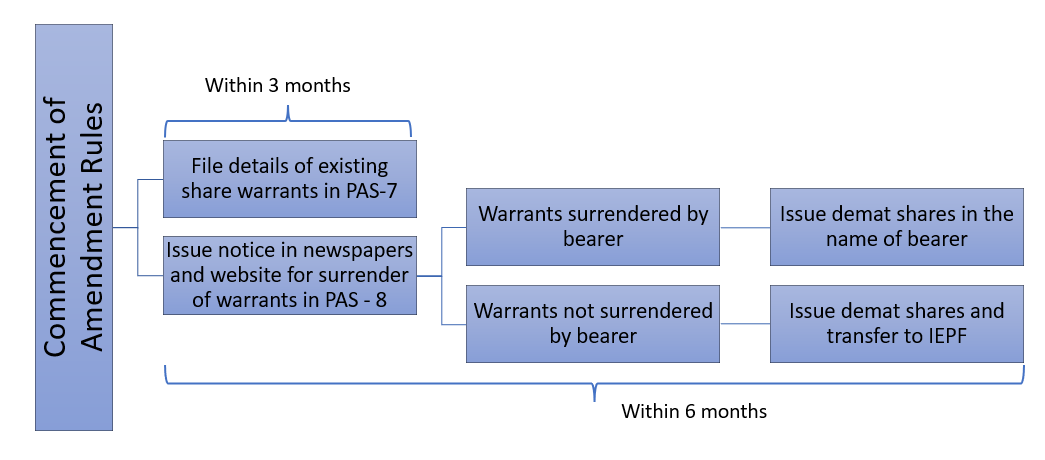
File the details of existing share warrants with the ROC in form PAS-7 within 3 months from the commencement of the Amendment Rules, i.e., by 27th January 2024,
Require bearers of the share warrants to surrender the same and issue dematerialised shares in the name of such bearer within 6 months from the commencement of the Amendment Rules, i.e., by 27th April, 2024, and
Convert the unsurrendered share warrants into demat shares and transfer the same to IEPF
The company shall be required to issue notice for the bearers of share warrants in form PAS-8 on its website as well as two newspapers – in vernacular language, having wide circulation in the district and in English language having wide circulation in the state in which the registered office of the company is situated.
Share warrants covered under the present amendment
In the context of the newly inserted sub-rule (2) of Rule 9, the term share warrants is to be interpreted in a much restricted sense. The provision refers to “share warrants prior to commencement of the Companies Act, 2013 and not converted into shares”, which implies share warrants issued under the Erstwhile Act only. In this regard, one may refer to section 114 of the Erstwhile Act that allowed public companies to issue “bearer warrants” entitling the bearer of such warrants to the shares specified therein. The same was referred to as “share warrants” under the said Act, and the shares contained therein can be transferred through mere delivery of the warrant.
The present amendment requires mandatory surrender of such “share warrants” in the form of “bearer warrants” against issuance of shares in dematerialised form.
Permissibility for issuance of share warrants under the Companies Act, 2013 (“Act”)?
As mentioned above, the “share warrants” referred to under the Amendment Rules are limited to the bearer warrants issued in accordance with the Erstwhile Act, and do not extend to all share warrants which companies issue under the various provisions of law.
In general context, share warrants are actually written options to subscribe to the shares of a company on pre-agreed terms at a future date. Such warrants are fairly common in the corporate world on account of the benefits associated with the same, and the present amendment cannot be said to rule out the possibility of issuance of such share warrants. Share warrants are directly or indirectly recognised under various provisions of law, for instance:
The definition of “securities” as provided for in section 2(h) of the Securities Contracts (Regulation) Act also includes “rights or interest in securities”. Share warrants are, in fact, a right to acquire securities at a future date, and therefore, well covered under the definition of securities
The SEBI (Issue of Capital and Disclosure Requirements) Regulations, 2018 contains specific provisions with respect to issuance of share warrants.
The Foreign Exchange Management (Non Debt Instruments) Rules, 2019 also refers to the term “share warrants” within the overall definition of “equity instruments” and contains specific provisions with respect to the same.
The Act refers to the conversion of “warrants” as a permissible mode for issuance of shares during the restricted period post buyback u/s 68(8) of the Act. It also contains references to employee “stock options”, which, by nature are equivalent to share warrants.
While the Act does not mention at several places under it about share warrants, however, at few places, like the provisions under section 68 dealing with buy back of securities as well as reference to employee “stock options”, which, by nature are equivalent to share warrants are given the Act.
Therefore, there are no explicit provisions that prohibit the issuance of share warrants by unlisted companies, and the same, being a “security” can very well be issued by a company, whether listed or unlisted, in compliance with the applicable provisions of law to meet the required funding as well as investment objectives.
Concluding remarks
The Amendment Rules aim at the wiping out of the bearer share warrants, since the legal and beneficial ownership of the shares are non-traceable in such a case. However, that does not eliminate the concept of share warrants as a whole, that are issued to an identified set of persons, and follows a due procedure laid down in the law for transfer of such warrants. Although not expressly defined under the Act, the concept of share warrants is legally recognised under various laws and are being widely issued by Indian companies, whether listed or unlisted, including private companies. The current set of amendments will have no impact on the permissibility of issuing share warrants issued under the Act and other laws as mentioned hereinabove.
https://vinodkothari.com/wp-content/uploads/2023/06/vinod-kothari-logo.png00Team Corplawhttps://vinodkothari.com/wp-content/uploads/2023/06/vinod-kothari-logo.pngTeam Corplaw2023-10-28 23:55:412023-11-09 12:26:45Share warrants under cloud - are companies not allowed to issue share warrants?
The concept of “beneficial owner” or BO is well-established under the Companies Act, 2013 by way of section 89 and 90 read with the rules made thereunder. The primary onus of declaration of beneficial interest lies on the person holding such beneficial interest. For the purpose of assigning responsibility to one or more person with respect to the compliance with the said provisions, Rule 9 of the Companies (Management and Administration) Rules, 2014 (“MGT Rules”) has been amended vide the Companies (Management and Administration) (Second Amendment) Rules, 2023 introducing the concept of “designated person” for the purpose of the said section. The amendment has been notified and made applicable from the date of its publication in the official gazette, i.e, 27th October, 2023.
Functions of a designated person
The concept of “designated person” has been brought in vide sub-rule (4) of Rule 9 of the MGT Rules. It requires “every company” to designate a person to be responsible for “furnishing, and extending co-operation for providing, information to the Registrar or any other authorised officer with respect to beneficial interest in shares of the company.” Therefore, a person, identified as a designated person under this rule, would be expected to be aware of, and therefore, take all reasonable steps to become aware, of the person holding “beneficial interest” in the shares of the company.
The applicability of the requirement to identify a designated person is not limited only to such companies that have received declarations with respect to “beneficial interest”, but extends to every company. It is upon the ROC/ other authorities to seek information with respect to beneficial interest from any company, and any such information, as and when sought, will be required to be provided by the designated person identified under this rule.
Who can be a designated person?
Sub-rule (5) of Rule 9 deals with the person qualified to be a designated person. It requires one of the following to act as a “designated person”:
CS of the company, if the company is required to appoint a CS (as per section 203 of the Act), or
any KMP of the company (as defined u/s 2(51) of the Act), or
every director of the company, in case the company does not have a CS or other KMPs.
Therefore, a company may, acting through its board of directors, preferably through a duly passed board resolution in this regard, designate the CS, or any of the KMPs or directors of the company to act as a designated person. The use of the term “every director” does not imply that all directors shall be identified as “designated person”, rather, it would mean that either of the directors can be designated under the aforesaid rule.
“Deemed” designated person
The provisions are applicable immediately, and therefore, till the time a company designates a person for compliance with the aforesaid, the following persons shall be deemed to be designated person:
CS of the company, if the company is required to appoint a CS (as per section 203 of the Act)
In case a CS has not been appointed, every Managing Director or Manager of the company,
In the absence of both (a) and (b), every director of the company.
Disclosure of details of a designated person
The details of the designated person are required to be disclosed in the annual return. The annual return is an e-form filed with ROC, and the present change would require a modification in the existing format so as to facilitate the provision of such information. Further, since the provisions are applicable from 27th October, 2023, the disclosure should be applicable for the annual return filed for FY 23-24 and onwards.
Any changes in the designated person is also required to be intimated to the ROC in e-form GNL-2. No timeline has been specified for filing the same, but should be filed within a reasonable period of time.
The introduction of the concept of “designated person” with respect to the “beneficial interest” in the shares of a company, will have the impact of assigning responsibility and accountability on the designated person with respect to compliance with the provisions of the Act relating to beneficial interest. Recently, many companies have received advisories from the ministry to ensure compliance with the provisions of declaration of beneficial ownership, and the present amendment would act as a “single point assistance” to the authorities in their inspection of companies with respect to compliance with declaration of “beneficial interest”.
https://vinodkothari.com/wp-content/uploads/2023/06/vinod-kothari-logo.png00Payal Agarwalhttps://vinodkothari.com/wp-content/uploads/2023/06/vinod-kothari-logo.pngPayal Agarwal2023-10-28 18:19:162025-12-01 17:49:12Designated to reveal beneficiary identity: all companies mandated to name one
Two major amendments have been notified by MCA on 27th October, 2023 impacting all companies, and majorly the private companies. These include the Companies (Management and Administration) (Second Amendment) Rules, 2023 introducing the concept of “designated person” with respect to beneficial interest in shares of a company[1] and the Companies (Prospectus and Allotment of Securities) Second Amendment Rules, 2023 (“PAS Amendment Rules”). The PAS Amendment Rules encompass two major amendments: (i) with respect to the bearer share warrants under the erstwhile Companies Act, 1956, and (ii) mandatory dematerialisation for all private companies excluding small companies. In this write-up, we briefly discuss the amendments with respect to mandatory dematerialisation of securities for the private companies and the implications thereto.
Regulatory basis of present amendment
Sub-section (1A) was inserted under Section 29 of the Companies Act 2013 (“the Act”) facilitating the Central Government to prescribe such class or classes of unlisted companies for which the securities shall be held and/ or transferred in dematerialised form only. In exercise of the powers conferred under the said section, Rule 9B has been inserted vide the PAS Amendment Rules specifying the requirement of mandatory dematerialisation of securities issued by private companies.
Applicability of mandatory dematerialisation on private companies
The mandatory dematerialisation requirement is applicable on all securities of every private company, excluding small companies[2] and government companies. The provisions are applicable with immediate effect, and a timeline of 18 months is provided from the closure of the financial year in which a private company is not a small company for the compliance with the mandatory dematerialisation requirements.
For example, a private company (other than a company that is a small company as on 31st March, 2023) is required to comply with mandatory dematerialisation of securities within a period of 18 months from the end of FY 22-23, i.e., on or before 30th September 2024.
In case a company ceases to be a small company after 31st March, 2023, the timeline of 18 months triggers from the close of the financial year in which it ceases to be a small company. Therefore, if a company ceases to be a small company at any time during FY 23-24, the timeline of 18 months will trigger from 31st March, 2024 and therefore, shall be complied with by 30th September 2025.
Applicability on a wholly-owned subsidiary
Rule 9B of the PAS Rules, enforcing mandatory dematerialisation of the securities of private companies, is applicable on all private companies other than the following:
Small company, and
Government company
In case of unlisted public companies, sub-rule (11) of Rule 9A extends a similar exemption from dematerialisation requirements. The said sub-rule covers the following public companies –
Nidhi company,
Government company, and
A wholly owned subsidiary.
It is important to note that a wholly owned subsidiary, though exempt from the dematerialisation requirements under Rule 9A, similar exemption does not extend to a private company under Rule 9B. Therefore, currently it seems that a wholly-owned subsidiary, incorporated in the form of a private company, is not exempt from dematerialisation requirements.
Further, for a private company that is a wholly-owned subsidiary of a public company, and therefore, a deemed public company, it remains an open question as to whether it will be exempt under sub-rule (11) of Rule 9A or the provisions of Rule 9B will apply.
The position may be summarised as below –
Nature of wholly-owned subsidiary
Nature of holding company
Applicability of dematerialisation provisions
Public company
Public company
Exempt under Rule 9A(11)
Public company
Private company
Exempt under Rule 9A(11)
Private company
Private company
Covered under Rule 9B as of now
Private company
Public company
The same being a deemed public company, there is no clarity on whether Rule 9A applies or Rule 9B. If considered to be a private company – covered under Rule 9B If considered to be a public company – exempt in terms of Rule 9A(11)
Compliances applicable to private companies
A private company, covered under the provisions of mandatory dematerialisation shall –
Issue all securities in dematerialised form only;
Facilitate dematerialisation of all existing securities (as and when request is received from the holder of such securities);
Ensure that the entire holding of its promoters, directors and KMPs are held in dematerialised form only, prior to making any offer for issuance or buyback of securities
Apart from the aforesaid, the compliances applicable to an unlisted public company under sub-rule (4) to (10) of Rule 9A are also applicable to private companies. These include –
Application with depository for dematerialisation of all existing securities and securing ISIN for each type of security;
Inform the existing security holders about the facility of dematerialisation;
Make timely payment and maintenance of security deposit with the depository, RTA and STA as may be agreed between the parties;
Complies with all applicable regulations, directions and guidelines with respect to dematerialisation of securities of a private company;
File a return in form PAS-6 with ROC on a half yearly basis within 60 days from conclusion of each half of the financial year, with respect to reconciliation of the share capital of the company;
Bring to the notice of the depositories, any difference in the issued capital by the company and the capital held in dematerialised form;
The grievances of any security holders under this rule (Rule 9B) to be filed with IEPF Authority, and the same, in turn, shall initiate any action against a depository or depository participant or RTA or STA, as may be required, after prior consultation with SEBI.
Compliances applicable to the holders of securities of a private company
As for persons holding securities of a private company, while the mandatory dematerialisation cannot be enforced by the private company, the same is expected to be taken care of by way of sub-rule (4) of Rule 9B that requires –
Dematerialisation of securities by the securityholder, before the transfer of such securities; and
Subscription to the securities issued by a private company, in dematerialised form only
Therefore, the mandatory dematerialisation of securities of a private company is ensured through placing restrictions on both a private company and the holders of securities issued by the same.
Consequences of non-compliance
There are no specific penal provisions governing the non-compliance with the provisions of section 29 of the Act read with Rule 9B of the PAS Rules, and therefore, general penal provisions under section 450 of the Act should apply.
Section 450 specifies the following: “If a company or any officer of a company or any other person contravenes any of the provisions of this Act or the rules made thereunder, or any condition, limitation or restriction subject to which any approval, sanction, consent, confirmation, recognition, direction or exemption in relation to any matter has been accorded, given or granted, and for which no penalty or punishment is provided elsewhere in this Act, the company and every officer of the company who is in default or such other person shall be liable to a penalty of ten thousand rupees, and in case of continuing contravention, with a further penalty of one thousand rupees for each day after the first during which the contravention continues, subject to a maximum of two lakh rupees in case of a company and fifty thousand rupees in case of an officer who is in default or any other person.”
Implications of the present amendment
The existence of shell companies and personification of shareholders is not a rare scenario, and such a situation is likely to be more common in case of a private company, unlike a public company. Historically, dematerialisation of shares is looked upon by the government as a means to curb black money[3]. As for listed companies and unlisted public companies[4], the dematerialisation of securities is already a mandatory requirement. With the present amendments being notified, the private companies have also been covered by the mandatory dematerialisation requirements.
As on 31st January, 2023, more than 14 lac companies registered with MCA comprising 95% of the total active companies are private companies, out of which approximately 50,000 companies are small companies[5]. Thus, with the mandatory dematerialisation for private companies coming into existence, a large number of companies will be forced to move towards dematerialisation of shares. Further, while the company can be held accountable for the mandatory dematerialisation of securities held by promoters, directors and KMPs, given the closely held nature of private companies, barely any securityholder (particularly shareholders) will remain outside the purview of the same.
Further, it is clarified that, in no way such a mandatory dematerialisation for private companies can be taken to mean that the restriction on transfer of shares of such a company is relaxed, and adequate systems can be implemented at the depository’s level to ensure compliance with the basic distinguishing characteristic of a private company and thereby have filters before executing any transfer of securities.
[2] As per the definition under the Act read with the rules made thereunder, a small company means a company, other than a public company, having paid up share capital not exceeding Rs. 4 crores and turnover not exceeding Rs. 40 crores. Further, the following cannot be a small company –
(A) a holding company or a subsidiary company;
(B) a company registered under section 8; or
(C) a company or body corporate governed by any special Act.
https://vinodkothari.com/wp-content/uploads/2023/06/vinod-kothari-logo.png00Payal Agarwalhttps://vinodkothari.com/wp-content/uploads/2023/06/vinod-kothari-logo.pngPayal Agarwal2023-10-28 17:03:082023-11-01 11:02:47Diktat of demat for private companies
The Reserve Bank of India (“RBI” or “Regulator”) plays a pivotal role in India meeting its anti-money laundering (AML) and combating financing of terrorism (CFT) obligations as part of its membership with the Financial Actions Task Force (FATF). As the Regulator of the credit sector and payment systems it does so by ensuring the implementation of robust and up-to-date Know Your Customer (KYC) norms vide its Master Direction – Know Your Customer (KYC) Direction, 2016 (“KYC Directions”). With a possible FATF evaluation around the corner, on October 17, 2023, the RBI introduced significant amendments to these KYC directives through its notification titled – Amendment to the Master Direction on KYC (“Amendment”), impacting various regulated entities, including Non-Banking Financial Companies (NBFCs).



 Reload document
  Open in new tab