
Compound financial instruments- A paradigm shift in accounting concepts

By Rahul Maharshi (rahul@vinodkothari.com, ifrs@vinodkothari.com) 

Introduction

Financial instruments accounting has been one of the highlighting issues in implementation of Ind AS in India. Several new concepts have been introduced and compound financial instrument (CFI) is one of them.

Explained in para 28 of Ind AS 32, a CFI is a financial instrument which is a non-derivative financial instrument that, from the issuer’s perspective, contains both liability and equity component. Therefore, when characteristics of both, liability and equity are fused into one instrument, it gives rise to a CFI.

It is usually observed, as a way of raising funds, many companies go for issuing debt instruments with a conversion feature in it. A bond which is convertible into fixed number of shares of the issuer would generally be preferred over a plain vanilla bond, since there lies a convertibility feature which would be an incentive for the investor over and above the interest income on such a bond. Additionally, if the issuer company is one which is positively growing, the investor would reap out fair amount of benefits with the help of a convertibility option.

Therefore, this makes CFI an interesting topic to discuss. In this article, we intend to discuss the manner of treatment, recognition, classification and various other intricacies associated with CFIs.

Compound financial instrument from investors perspective

The accounting treatment with respect with CFI prescribed in Ind AS 32 deals with the issuer’s books of accounts only, there is no special treatment required in the books of the investor. A CFI is nothing but a financial asset in the books of an investor.

A CFI is required to be accounted for in the books of an investor as a financial asset till redemption, however, at the time of redemption, if the instrument is converted into equity, the same will require reclassification for subsequent measurement of the financial asset as a whole by the investor.

Compound financial instrument vs. Hybrid financial instrument

Yet another new concept in the Ind AS is that of hybrid financial instrument. Differentiating the same with CFI; a hybrid financial instrument, or a hybrid contract is one which has an embedded derivative sitting on a host contract. From an investor’s point of view, a host contract can be of any kind, such as a financial asset or a non-financial asset.

If the host contract is a non-financial asset, the embedded derivative will be required to be separated from the host contract subject to the requirements given in para 4.3.3 of Ind AS 109. After separation, the host contract shall be required to be accounted for in accordance with the appropriate Ind AS(s).

For example, a lease agreement with variable lease payments adjusted to the change in a benchmark interest rate such as LIBOR would result in a hybrid instrument with the host contract being the lease agreement i.e. a non-financial asset and an embedded derivative being the variability feature of the lease payments being leveraged. The lease agreement should be accounted for as per Ind AS 17- Leases and the derivative feature may be required to be accounted for as per Ind AS 109 subject to para 4.3.3.

A host contract being a financial instrument (viz. being a financial asset) is required to be accounted for by the investor as explained in the earlier section.

However, for the purpose of this article, emphasis is required to be given on the treatment of a CFI being a host contract with an embedded derivative (such as a call option) from an issuer’s point of view. Ind AS 32 provides that the value of the derivative embedded on CFI is required to be included in the liability component of the CFI.

It is to be noted that the equity conversion option in a CFI, on a standalone basis, is not a derivative. The derivative that is required to be included in the liability component are those which qualify to be a derivative as defined under Ind AS 109.

The concept of CFI and a Hybrid contract is diagrammatically explained below:
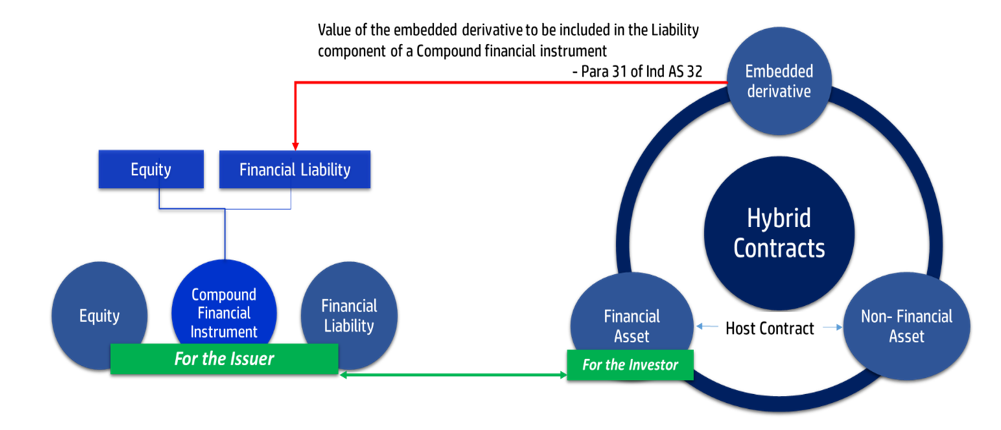
The above diagram can be seen as an example of deriving concepts from application of two Ind AS(s) viz. Ind AS 109 and Ind AS 32. By interpretation, it exhibits the notion that a CFI is in fact, a type of a hybrid contract, but a hybrid contract is not a type of a CFI. Nevertheless, this notion can be questioned on the ground that both the instruments are required to be looked at from different perspectives.

The distinctions between a hybrid contract and a CFI can be tabulated as below:

Basis of distinction Hybrid contract/ Hybrid financial instrument Compound financial instrument
Governing Ind AS for accounting Ind AS 109 Financial Instruments Ind AS 32 Financial Instruments- Presentation
Nature Derivative Derivative /Non- derivative
Split accounting Based on conditions given in para 4.3.3 of Ind AS 109 Mandatory in all cases
Resultant instruments after splitting Financial assets, non-financial assets, financial liability, non-financial liability  and/or equity Equity and financial liability

Split Accounting in case of a CFI

The incidence or event of testing a financial instrument to be a CFI or not is not only to be done at the issuance or on a periodic basis, rather whenever the terms of the contract of a financial instrument reveal a dual character i.e. of equity as well as liability, the same should be classified and accounted for.

The steps involved in accounting for a CFI from the perspective of an issuer is diagrammatically represented below:
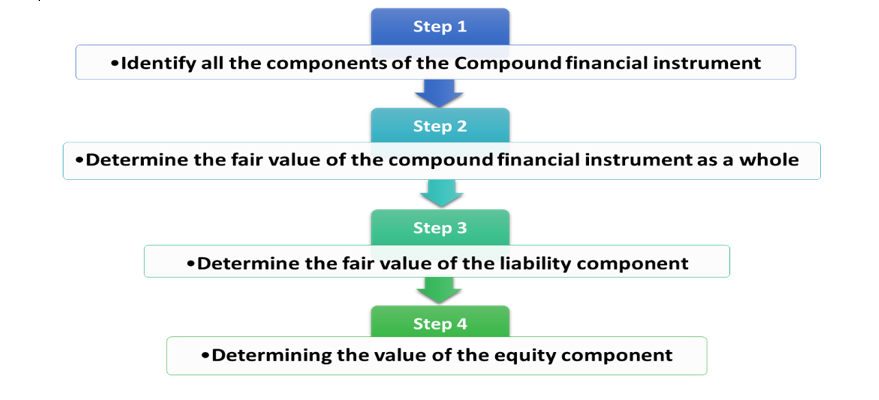
Step 1: Identification of the components of the CFI:

Identifying the components of CFI into equity and liability from the issuer’s perspective is done by checking the terms and conditions provided in the contract of the financial instrument.

For example, an issuer issues 7% Optionally Convertible Debentures, convertible into a fixed number of shares. This would mean that the obligation towards debenture holder can be discharged either by payment of cash or by issuing a fixed number of the equity shares of the issuer. The liability component here being the issuer’s obligation to pay 7% interest and the potential redemption of the debenture in cash at maturity. The equity component here being the holder’s call option for the issuer’s shares.

Step 2:  Determination of fair value of CFI as a whole

The fair value of the CFI as a whole would normally be the transaction price as provided in para B5.1.2A of Ind AS 109. In case the transaction has not taken place under market conditions, then the principles of Ind AS 113 would be applied to derive at the fair value of the financial instrument as a whole.

Step 3: Determination of the fair value of the liability component:

Fair value of the liability component is the present value of the contractually determined stream of future cash flows discounted at the rate of interest applied at that time by the market to instruments of comparable credit status and providing substantially the same cash flows, on the same terms but without the convertibility option.

The act of discounting the cash flows of the instrument as a whole with the discounting rate being the rate of interest prevailing in the market on a debenture without the conversion option is done to derive the value of the liability component.

Now if the instrument as a whole has an embedded derivative, like a call option on the equity shares, the liability component is inclusive of the value of the derivative embedded in the CFI.

Step 4: Determine value of the equity component:

The equity component of a CFI is nothing but the residual amount left after subtracting the liability component as computed in step 3 from the fair value of the CFI as a whole (step 2).

This is fairly evident from the definition of equity as provided in para 11 of Ind AS as below:

“An equity instrument is any contract that evidences a residual interest in the assets of an entity after deducting all of its liabilities.”

Also, once the value of the equity component of a CFI is determined, being the residual amount, it is not re-measured or reclassified till final settlement. In cases of conversion, there can merely be a change within equity. Any kind of cost associated with the issue of the CFI shall be proportionately allocated to the liability and equity components.

Since the liability component of a CFI satisfies the definition of a financial liability as per Ind AS 32, the same is required to be subsequently accounted for in accordance with the principles of subsequent measurement of financial liabilities as provided in para 4.2 of Ind AS 109 viz. at Fair value through profit or loss (FVTPL) or at amortised cost method.

Examples

Example 1: 9% Preference shares with partial conversion and partial redemption

Company M has issued 10,000 9% Preference shares having face value Rs. 100 each with mandatory dividends and mandatory conversion of 50% preference shares into equity and balance 50% redemption at the end of 3 years from the date of issue. Market rate for Preference shares with similar credit status and other features except the conversion feature is 12%p.a.

The preference share has two components – (1) Contractual obligation for payment of mandatory dividend and mandatory redemption of 50% Preference shares. (2) Mandatory conversion of 50% Preference shares into equity.

The first component is a financial liability because the same consist of contractual obligation to pay cash and the entity does not have an unconditional right to avoid delivering cash.

The second component is equity since there is mandatory conversion into equity shares, which, in substance, signifies that the amount for the equity is already prepended even before receiving the shares in reality.

The values of equity and liability components are calculated as follows:

Present value of Principal payable at the end of the 3 years (Rs. 5,00,000 discounted at 12% for 3 years)= Rs.3,55,890.

Present value of contractual obligation to pay dividends in arrears for 3 years (Rs. 90,000 discounted at 12% for 3 years) = Rs. 2,16,165

Total financial liability= Rs.5, 72, 055.

Therefore, equity component= fair value of CFI, say Rs. 10,00,000 less financial liability component i.e. Rs. 5,72,055=Rs. 4,27,945.

Subsequent year’s profit and loss account is charged with interest amortisation at 12% on the financial liability component and dividend expense of Rs. 90,000 each.

Example 2: 6% optionally convertible debentures (OCDs)

X ltd (issuer) has issued 6% p.a. debentures to Y Ltd. (holder) for a consideration of Rs. 30 lakhs. The holder has an option to convert these debentures to a fixed number of equity instrument of the issuer anytime up to a period of 3 years. If the option is not exercised by the holder, the debentures are redeemed at the end of 3 years. The prevailing market rate for similar debentures without the conversion feature is 9% p.a.

The instrument has two components – (1) Contractual obligation that is conditional on holder exercising his right to redeem, and (2) conversion option with the holder.

The first component is a financial liability because the entity does not have an unconditional right to avoid delivering cash. The other component, conversion option with the holder, is an equity feature.

The values of liability and equity component are calculated as follows:

Present value of principal payable at the end of 3 years (Rs. 30 Lakhs discounted at 9% for 3 years)= Rs. 23,16,550.

Present value of interest payable in arrears for 3 years (Rs. 1,80,000 discounted at 9% for each of 3 years) = Rs. 4,55,632

Total financial liability= Rs. 27,72,182.

Therefore, equity component= fair value of CFI, say Rs. 30 Lakhs less financial liability component i.e. Rs. 27, 72,182=Rs. 2, 27,818.

In subsequent years the profit is charged with interest of 9% on the debt instrument.

Example 3: Accounting for Compound financial instrument on date of transition

On 1st April, 2015, X Ltd. issued 50,000, 7% convertible debentures of face value of Rs. 100 per debenture at par. The debentures are redeemable on 31st March 2020 or these may be converted into ordinary shares at the option of the holder. The interest rate for equivalent debentures without the conversion rights would have been 10%. The date of transition to Ind AS is 1st April, 2017.

As per previous Indian GAAP, the given instrument has been accounted for as a non-current liability and corresponding interest expense of Rs. 3,50,000 each for 2 years should have been charged directly to profit and loss account.

On the date of transition to Ind AS, i.e. 1st April, 2017, the Company has to account for the instrument as a compound financial instrument as per para 28 of Ind AS 32. Subsequently, the value of debt component and equity component has to be calculated (viz. split accounting).

Therefore, for the remaining 3 years, there will be an interest expense at Rs. 3,50,000 each and at the end of 3rd year the instrument either gets redeemed or gets converted into ordinary shares of the Company.

On 1st April, 2017

Value of Debt:

Present value of interest payable for 17-18, 18-19 & 19-20 = (Rs. 3,50,000 discounted at 10% for each of the 3 years)= Rs. 8,70,398

Present value of Principal at the end of 3rd year i.e. as on 31st March, 2020 = (Rs. 50,00,000 discounted at 10% for 3 years) = Rs. 37,56,574

Value of Debt component= Rs. 37,56,574 + 8, 70,398 =Rs.46,26,972

Value of equity component= Rs. 50,00,000-46,26,972=3,73,028

Therefore, on the date of transition i.e. 1/4/2017 amount of Rs. 50,00,000 being the Fair value of CFI will be split into debt & equity as given above.

For the coming 3 years, the following treatment shall be done by the X Ltd.

Particulars 2017-18 2018-19 2019-20
Opening debt component 46,26,972 47,33,669 48,57,015
(+)Interest amortisation @ 10% 4,62,697 4,73,365 4,85,702
(-)Interest expense at 3.5 lakhs p.a 3,50,000 3,50,000 3,50,000
Closing balance of debt component   47,33,669 48,63,635 50,00,000

Conclusion

The move towards substance over form and fair value accounting is fairly reflected with the introduction of the concept of CFI. There has been a fundamental shift in the understanding when a contract is put to test in light of Ind AS governing financial instruments. The instruments which were erstwhile treated to be debt are currently being treated as equity. This is primarily dependant on the notion that equity capital is the amount of money not repaid, accordingly an instrument convertible into equity capital should also be treated as equity. Therefore, a CCD is shown as a CFI.

However, in the midst of split accounting of a CFI, there are certain issues which are of concern to entities in doing the same. The major challenge to stakeholders lies in treatment of the equity component of the CFI from Income tax perspective, since there arises a MAT implication.

On the date of transition to Ind AS, there arises a tax implication on the already issued instruments which require reclassification as a CFI in the current Ind AS regime. The equity component of the CFI is required to be included in the “transition amount” defined in sub-section 2(C) of section 115JB of the Income Tax Act, 1961.

This results in taxing the one-fifth amount of the equity component for 5 years. The same has been further clarified by the CBDT circular dated 25th July, 2017[1] stating that the equity component of a CFI is to be included in the transition amount and further be taxed for MAT purposes over a period of five years. The same is seen as a burden on companies transitioning from erstwhile Indian GAAP to Ind AS because the equity component is not excluded from the purview of book profits as computed for MAT purposes.

Nevertheless, we feel the concept is relatively new to the Indian context and the same shall be developed over a period of time.


[1] https://www.incometaxindia.gov.in/Communications/Circular/Circular_24_%202017.pdf

Notional income tax on issue of shares by closely held applicable not applicable under Sec.56(2) (vii a), clarifies CBDT

-Million dollar question: Can the same be extended to Sec. 56(2)(x) ?

By Yutika Lohia (yutika@vinodkothari.com)

The abolition of Gift Tax Act in the year 1998 paved way for one of the most dynamic sections of the Income Tax Act, 1961, – Section 56(2). Under this section all kinds of incomes and gains which were from sources other than the sources mentioned in the Act at that time was brought under the purview of Income Tax. Now, incomes and gains arising out of such transactions which were structured to pass on assets to some other party without any consideration or with inadequate consideration was subject to be taxed under this section.

While the Section 56(2) gave the authorities a tool to keep check on the transactions structured to merely launder unaccounted income, it also brought in many questions with itself. The CBDT has since been releasing clarification to address the questions as well as making changes to the section to cover all lose ends of laundering unaccounted incomes.

Recently Central Board of Direct Taxes (CBDT) in its circular dated 31st December, 2018 came up with a clarification to address the question –

Does the terms “receives” with regards to section 56 (2)(viia) include receiving shares of companies (where public are not substantially interested) by way of issues of shares by way of fresh issue/ bonus issue/ issue of rights shares/ transaction of similar nature?

Before we get to the clarification lets first analyse the sections – 56(2)(vii), 56(2)(viia) , 56(2)(viib) & 56(2)(x)

Analysis of Section 56(2)(vii) Section 56(2)(viia) Section 56(2)(viib) & Section 56(2)(x)

Section 56(2)(vii) Section 56(2)(viia) Section 56(2)(viib) Section

56(2)(x)

Applicable to Individual/ HUF Firm/ Company (closely held) Company (closely held) Person as per section 2(31) of the IT Act, 1961
Applicable on 1. Money

2. Immovable Property

3.Property other Immovable Property

Shares of closely held company 1.Issue of Shares 1. Money

2. Immovable Property

3.Property other Immovable Property

Applicable date From  1st October, 2009 to 31st March, 2017 From 1st June, 2010 to 31st March, 2017 From 1st April, 2013 From 1st April, 2017


Section 56(2)(viia) of the IT Act, 1961 was inserted by Finance Act, 2010. Referring to the memorandum of Finance Act, 2010[1] clause (viia) was incorporated in section 56 to prevent the practice of transferring unlisted shares at a price which was different from the fair market value (i.e no or inadequate consideration) of the shares and also include within its ambit transactions undertaken in shares of the company (not being a company in which public are substantially interested) either for inadequate consideration or without consideration where recipient is a firm or a company (not being a company in which public are substantially interested).

In a layman’s term the act of receiving means to receive something which was already in existence and the act of creation of the that particular thing.

Similarly receipt of shares of shares by way of fresh issue/ bonus issue/ issue of rights shares/ transaction of similar nature is an act of creation of the securities and not transfer of the same. The CBDT in its circular dated 31st December, 2018has clarified the same. section 56(2)(viia) is applicable to transactions involving subsequent transfer of the shares form the initial receiver to some third party, and not time of issuance of such shares.

It is palpable that the shares would be treated as goods only when it comes into existence and issuance of shares is the act of bringing the shares into existence. The word “receives” with respect to section 56(2)(viia) would not include issuance of shares within its ambit.

The intent of insertion of clause (viia) to section 56 was to apply anti-abuse provision i.e transfer of shares for no or inadequate consideration, it is hereby clarified by the CBDT circular that section 56(2)(viia) of the Act shall apply in cases where a company (not being a company in which public are substantially interested)  or a firm receives the shares  of the company (not being a company in which public are substantially interested) through transfer for no or inadequate consideration. Hence section 56(2)(viia) of the Act shall not be applicable on fresh issue of shares by the specified company.

Taxation of fresh issue of shares comes under the purview of section 56(2)(viib).

The Subhodh Menon case in context to Section 56

Recently the Income Tax Appellate Tribunal (ITAT) in the case of The Assistant Commissioner of Income Tax Vs. Shri Subhodh Menon[2], order dated 7th December, 2018 held that a shareholder cannot be taxed under section 56(2)(vii)(c) of the IT Act, 1961 so long as the shares are allotted to the holder on a proportionate basis (right shares), even if such shares are allotted at a value lower than the fair market value.

Drawing from the above case law, right shares issued at a value below the fair market value to individual/ HUF where allotment is disproportionate will not be taxable under section 56(2)(vii)(c) of the IT Act, 1961. Shares issued higher than proportion offered (based on shareholding) shall attract tax provisions.

Conclusion

The Union Budget 2017[3] introduced the section 56(2)(x) of the IT Act, 1961 widening the scope of Income from other sources and also clubbing section 56(2)(vii) & section 56(2)(viia).  Income Tax shall not be chargeable at normal rate for fresh issue of shares for closely held companies.

Since the offence that section 56(2)(viia) was trying to curb is the same as section 56(2)(x), the question still lies, whether the term “receives” clarified in the CBDT circular shall have the same analogy for Section 56(2)(x)? Simply put, whether section 56(2)(x) of the Act will also be limited to transfer of existing shares and not cover fresh issue of shares?


[1] https://www.indiabudget.gov.in/ub2010-11/mem/mem1.pdf

[2] http://itatonline.org/archives/wp-content/uploads/Subodh-Menon-shares.pdf

[3] https://www.indiabudget.gov.in/budget2017-2018/ub2017-18/memo/memo.pdf

Slump sale, a supply of goods or service under GST?

By Yutika Lohia (finserv@vinodkothari.com)

Introduction

India is en-route to turn itself into a 21st century super-economy fuelled by the unprecedented growth of its business enterprises. Business may grow in two ways – either in an organic way or inorganic. The former refers to the internal forces of the enterprises which are re-organised to bring in development and growth into the business, whereas, in case of inorganic growth, the company goes into corporate restructuring to re-align its external facade to fuel the planned development and growth. In today’s fast moving corporate environment, corporate restructuring happens to be the most ideal tool to win an advantage in this pursuit.

Business restructuring is a comprehensive process, be it financial or technological or market or organisational. Business can be re-arranged by way of mergers, demergers, disinvestments, takeovers, strategic alliance or slump sale.

This article focusses on implications of GST on slump sale.

Concept of Slump Sale

The concept of slump sale comes from the Income Tax Act, 1961. The IT Act, in section 2(42C) defines “slump sale” as – “slump sale” means the transfer of one or more undertakings as a result of the sale for a lump sum consideration without values being assigned to the individual assets and liabilities in such sales.”  Further as per explanation 1 to section 2(19AA), “undertaking” shall include any part of an undertaking or a business activity taken as whole, but does not include individual assets or liabilities or any combination thereof not constituting a business activity.

Therefore, slump sale contains the following conditions:

  • Sale of one or more undertaking,
  • No individual value should be assigned to assets and liabilities, and the same to be sold for a lump sum consideration, and
  • All assets and liabilities of the undertaking must be transferred.

Transfer of all assets and liabilities

One of the major precondition of a slump sale transaction is that all assets and liabilities of the business undertaking must be transferred to the buyer.

As per Section 50B of IT Act, the cost of acquisition of such sale shall be the net worth (book value of assets and liabilities) of the undertaking.

Explanation 1 provides the method of computing the net worth of an undertaking or a division sold on slump sale basis. As per Explanation 1 “For the purposes of this section, “net worth” shall be the aggregate value of total assets of the undertaking or division as reduced by the value of liabilities of such undertaking or division as appearing in its books of account.”  This definition is no different from the meaning of the expression ‘net worth’, as is commonly understood in the accounting parlance.

There are various judicial pronouncements where there is difference of opinion that it is not essential to transfer all assets and liabilities for a transaction to qualify for a slump sale. That is to say, that even if some assets are retained by the transferor and the undertaking after such transfer carries out its business activities without any obstruction, it shall still qualify to be a slump sale. The same has been substantiated by Bombay High Court[1] in its ruling.

Since all assets and liabilities are to be transferred in a slump sale, it is important for one to understand the concept of going concern which is discussed at length below.

Going Concern Concept

The terminology “going concern” is not precisely mentioned in the definition of slump sale. Transfer as a going concern means transfer of a business or a unit which is capable of being carried on by a purchaser as an independent business. To constitute a slump sale, it is not necessary that the business is ongoing at the time of its transfer.

Going Concern is a fundamental accounting assumption and Accounting Standard 1, Disclosure of Accounting Policies defines it as follows:

“The enterprise is normally viewed as a going concern, that is, as continuing in operation for the foreseeable future. It is assumed that the enterprise has neither the intention nor the necessity of liquidation or of curtailing materially the scale of the operations.”

To constitute a slump sale all the assets and liabilities of the undertaking are to be transferred. Therefore it can be said that companies whose operations are shut and is into liquidation may also opt for slump sale provided the conditions mentioned above are met. The intention of such condition is to ensure that the business will continue in the new hands with regularity and a nature of permanency.\

Further it is not necessary that the entity should be a profit making company. The only valid point to be considered for a transfer to constitute as a “going concern” to mean if it constitutes a business activity capable of being run independently for a foreseeable future. Such views were taken In the Matter of M/S. Indo Rama Textiles Ltd[2]

The term “going concern” has no place in the GST Act. However one can refer to the pronouncement of the Advance Authority Ruling in case of Rajashri Foods Pvt Ltd for the same as mentioned below:\

A going concern is a concept of accounting and applies to the business of the company as a whole. Transfer of a going concern means transfer of a running business which is capable of being carried on by the purchaser as an independent business. Such transfer of business as a whole will comprise comprehensive transfer of immovable property, goods and transfer of unexecuted orders, employees, goodwill etc.

The transfer of business assets implies where the part of assets are transferred and not the whole business, i.e. the liabilities remain in the books of the transferor, whereas in transfer of business all assets and liabilities are transferred together. The concept of transfer of going concern comes handy when the business as a whole is transferred, however case laws and analysis do suggest the likelihood of transfer of assets as a going concern.

Slump sale: supply of good or supply of service under GST Act?

To understand the applicability of GST on a slump sale transaction, it is imperative to throw light on the word “supply” under the GST Act. It is explicitly discussed that for GST to be levied, there must be a case of “supply”. Therefore, we shall now refer the scope of supply as mentioned in Section 7 of the (Central Goods and Services Tax Act 2017 (CGST Act) which is as follows:

“(1) For the purposes of this Act, the expression “supply” includes––

  • all forms of supply of goods or services or both such as sale, transfer, barter, exchange, licence, rental, lease or disposal made or agreed to be made for a consideration by a person in the course or furtherance of business;”

XX

Supply includes activities such as sale, transfer, barter etc for a consideration in the course or furtherance of business. From this we can infer that the activities shall take place in the course or furtherance of business. Coming to slump sale, the transaction is neither during the course of business nor in persistence of business. However since the word “includes” has been used in the definition in Section 7 (1) of the CGST Act, the scope of supply goes beyond the course or furtherance of business. Therefore the transfer as a going concern shall also be treated as “supply” under GST.

As slump sale is considered to be a supply under GST, we should now understand if the same constitutes to be goods or services.

The term goods has been defined under section 2(52) of the CGST Act as:

“(52)“goods” means every kind of movable property other than money and securities but includes actionable claim, growing crops, grass and things attached to or forming part of the land which are agreed to be severed before supply or under a contract of supply;”

Further definition of “Service” as per section 2(102) of the CGST Act defines the term service as:

“(102)“services” means anything other than goods, money and securities but includes activities relating to the use of money or its conversion by cash or by any other mode, from one form, currency or denomination, to another form, currency or denomination for which a separate consideration is charged.”

Clause 4(c) of Schedule II of CGST Act states that

“(c) where any person ceases to be a taxable person, any goods forming part of the assets of any business carried on by him shall be deemed to be supplied by him in the course or furtherance of his business immediately before he ceases to be a taxable person, unless—

            (i) the business is transferred as a going concern to another person; or

             (ii) the business is carried on by a personal representative who is deemed to be a taxable person.”

Schedule II of the CGST Act talks about activities to be treated as a supply of good or supply of service wherein Clause 4, transfer of business assets has been considered as supply of goods. In Clause 4(c ) transfer of business as a going concern does not constitute as supply of goods.

As per the definition of services, anything other than goods is called a service. Business transferred as a going concern is excluded from the list of supply of goods. Since the schedule specifically excludes this activity, it becomes very obvious that transfer of business as a going concern is considered to be a supply of service.

Ministry of Finance vide its notification[3] no 12/2017- Central Tax (Rate) dated 28th June 2017, came out with a list of supply of services and further brought clarity on “service by way of transfer of a going concern, as a whole or an independent part thereof” in serial no 2 of the said notification to constitute under supply of service. Further, activity of transfer of a going concern shall have “nil” rate of tax on such supply.

Since the notification talks about the activity of transfer of a going concern as a supply of service and the same is exempt from the purview of GST. Similarly Schedule II of the CSGT Act excludes transfer of business as a going concern as supply of goods, the same shall be considered as a supply of service and GST shall be levied.

It shall be inferred that transfer of a going concern as a whole or a part there or transfer of business as a going concern is tax-exempt under GST and transfer of business assets will have GST implications.

The above can be further justified by referring to the judgement passed by the Tax Authority of Advance Ruling in Karnataka in the case of Rajashri Foods Pvt Ltd[4] where it was decided that subject to the condition that the unit being transferred is a going concern, it will be considered as a supply of service and the same shall be exempt from the payment of GST to the extent leviable under sub section (1) of Section (9) of the CGST Act, 2017.

Itemisation of assets for levy of GST

In a slump sale, assets proposed to be transferred consist of both movable and immovable property i.e. land, building, stock, plant and machinery etc. Since these assets and liabilities are sold together for a lump sum consideration it does not tantamount to a “mixed supply” under GST.

Let us first understand the concept of mixed supply under GST

Section 2(74) of the CGST Act defines mixed supply as under:

“(74) “mixed supply” means two or more individual supplies of goods or services, or any combination thereof, made in conjunction with each other by a taxable person for a single price where such supply does not constitute a composite supply.”                     

To constitute a mixed supply, there has to be two or more supplies of goods or services and they have be in conjunction with each other. Therefore if the item in the bundle are neither goods nor services, it will not be considered a mixed supply under GST.

Let us understand the same with the help of an example. Suppose the assets being transferred to the buyer are plant & machinery, land and stock for a single price. Here there are more than one good transferred in the transaction. The bundle is not exclusively that of goods or services or both. The same will not qualify to be a mixed supply as land being transferred is excluded from the purview of GST (As per Schedule III of the GST Act which enumerates items which are neither supply of good nor supply of services).

Referring to the above example we may say that all legs of the definition should be satisfied for it to become a mixed supply. Merely because multiple items are sold for a single price should not, by the very fact render them as “mixed supply”. In so far as movable assets being concerned, it would be treated as supply of goods and is likely to attract GST.

Conclusion

Slump sale may be of an on-going business/unit or transfer of a stalled business/unit where the intent of the transferee is to run the entity. It can be said that that when there is a transfer of business and not of that of assets, in order to insulate from GST, it would require evaluation whether transfer is as a going concern or not.

The transaction of transfer of business as a whole of one of the units in the nature of going concern amounts to supply of service. The notification holds good, but subject to the condition that the unit is a going concern and therefore the same shall be free from the GST purview.

To summarise the above discussed concept

  • Transfer of business assets: Supply of goods
  • Transfer of business: Supply of Service
  • Transfer of business/ or a part thereof as a going concern : Supply of service and exempt via notification

Revival of companies will definitely be more cost effective than setting up a new structure altogether. Also this will give a push to the investors to take over such companies and create more job opportunities in India.


[1] https://indiankanoon.org/doc/1182478/

[2] https://indiankanoon.org/doc/135651533/

[3]http://www.cbic.gov.in/resources//htdocscbec/gst/Notification12CGST.pdf;jsessionid=D5B61ED295EAEE2B9E0361CAE1525D0F

[4] http://gst.kar.nic.in/Documents/General/06_RAJASHREE_LIMITED.pdf

Servicing Asset and Servicing Liability: A new by-product of securitization under Ind AS 109

(finserv@vinodkothari.com)

Securitisation has gained popularity in India in the recent times, however, one more concept that has grown parallel to it is, direct assignment. In fact, at times, direct assignments have overpowered securitisation in the Indian market[1]. Financial institutions have been using these extensively to address their liquidity issues. However, if there is anything that affected the financial institutions dearly, then it is the change in the accounting treatment under the Indian Accounting Standards (Ind AS).

Read more

Classification and reclassification of financial instruments under Ind AS

By Team IFRS & Valuation Services (ifrs@vinodkothari.com) (finserv@vinodkothari.com)

Background

As India moves into Indian Accounting Standards (Ind AS), one standard which the accountants will be wary about is the Ind AS 109: Financial Instruments. This standard is an adaption of the International Financial Reporting Standard 9.  Ind AS 109 specifically provides for the manner in which the financial assets and financial liabilities are to be dealt with the books of the accounts. This standard itself is incomplete, as to draw a meaningful conclusion to any matter relating to financial asset or financial liability, one will also have to refer to the Ind AS 32. Read more

Accounting for Direct Assignment under Indian Accounting Standards (Ind AS)

By Team IFRS & Valuation Services (ifrs@vinodkothari.com) (finserv@vinodkothari.com)

Introduction

Direct assignment (DA) is a very popular way of achieving liquidity needs of an entity. With the motives of achieving off- balance sheet treatment accompanied by low cost of raising funds, financial sector entities enter into securitisation and direct assignment transactions involving sale of their loan portfolios. DA in the context of Indian securitisation practices involves sale of loan portfolios without the involvement of a special purpose vehicle, unlike securitisation, where setting up of an SPV is an imperative.

The term DA is unique to India, that is, only in Indian context we use the term DA for assignment of loan or lease portfolios to another entity like bank. Whereas, on a global level, a similar arrangements are known by various other names like loan sale, whole-loan sales or loan portfolio sale.

In India, the regulatory framework governing Das and securitisation transactions are laid down by the Reserve Bank of India (RBI). The guidelines for governing securitisation structures, often referred to as pass-through certificates route (PTCs) were issued for the first time in 2006, where the focus of the Guidelines was restricted to securitisation transactions only and direct assignments were nowhere in the picture. The RBI Guidelines were revised in 2012 to include provisions relating to direct assignment transactions.

Read more

PENAL INTEREST WITHIN THE SCOPE OF GST OR NOT?

By Beni Agarwal (beni@vinodkothari.com)

Introduction

A recent advance ruling has thrown the financial industry off its balance. The pre-ruling opinion amongst the industry members has been refuted and yet another item has been brought within the ambit of GST, that is, penal interest or overdue interest. Before the aforesaid advance ruling, which we have discussed at length later on, there were various views circulating in the market. Some said penal interest should be charged to GST, while others said that it is nothing but interest for using the amount for the extended period of time.

However, all these speculations have been put to rest, first, by a set of frequently asked questions on GST on financial services, and second, by the aforesaid advance ruling. In this write-up we intend to discuss the outcome of the advance ruling and comment on how justified the decision is.

Background

After the imposition of GST since 1st July, 2017, various supplies have been brought within the ambit of GST. There are some supplies which have been exempted from GST levy vide notification no 12/2017- Central tax (Rate) dated 28.06.2017, by way of powers vested with the Central Government through section 11 of CGST Act 2017. One such supply that is exempted is services by way of extending deposits, loans or advances, in so far as the consideration is exempt by way of interest or discount. Based on the exemption and its interpretation that such penal interest is nothing but additional interest, the view was that penal interest too shall not be subject to GST. However, the FAQs on Banking Sector[1], issued by GST Council, clarified that additional interest charged on delay or default in payment of installment by the customer shall be included in the taxable value of supply. The recent advance ruling in the case of Bajaj Finance Limited, [2]would give additional weightage to the FAQs.

Earlier Stance

In case of a loan transaction, it was argued that the overdue interest was merely a stepped-up interest, for the period for which the contractual terms of the loan had been in breach. Overdue interest is, admittedly, nothing but interest, albeit at a higher rate. It could not be argued that a delayed payment for a loan led to any service. Typically, interest is based on the tenure for which the loan is due/overdue. If there is an element which is charged disregarding the tenure, that is, on absolute basis, it may, then, not qualify to be interest, and hence, become chargeable to GST.

Advance Ruling by the Adjudicating Authority

In case of Bajaj Finance Limited, an advance ruling has been passed on 6/08/2018 on imposition of GST on penal interest.

In the said case, BFL gave loan to customers for a specific period repayable in EMIS including principal and interest amount. Failure to pay within the due date attracts penalty charges based on a certain percentage. In the process, BFL agreed to tolerate the act of delayed payment in lieu of penalty.

The following questions were asked and answered:

Q1.  Whether the penal interest is to be treated as interest for the purpose of exemption under Sr 27 of Notification no 12/2017- Central tax ( Rate) dated 28.06.2017, Sr no 27 of Maharashtra State Notification No 12/2017- State Tax ( Rate) dated 29.06.2017, and Sr no 28 of Notification No 9/2017 Integrated Tax (Rate) dated 28.06.2017?

Answered in the negative.

Q2. If the answer to the above is negative, whether the activity of collecting penal interest by BFL would amount to a taxable supply under the GST?

                Answered in the affirmative. The said activity squarely falls under clause 5(e) of the Schedule II of GST Act, 2018 and therefore such amounts received, would attract tax liabilities under GST.

Hence, basis the above mentioned advance ruling, interest on penal charges shall be liable to GST.

Treatment of Penal Interest under Service Tax Regime

Interest on loans were outside the scope of Service Tax in the pre GST period. Lending as a service was first time brought within the ambit of Service Tax on 10.09.2004 , by an amendment in the definition of banking and other financial services’ under section 65(12) of Finance Act, 1994. At the same time, with effect from 10.09.2004, by virtue of clause (viii) of

Explanation 1 under section 67 of Finance Act, 1994 , the following was added:

“SECTION 67. Valuation of Taxable Services for charging service tax: For the purposes of this chapter, the value of taxable services shall be the gross amount charged by the service provider for such service rendered by him.

Explanation 1. For the removal of doubts, it is hereby declared that the value of taxable service, as the case maybe includes …

But does not include ...

(viii) interest on loans.”

Thus, from 10.9.2004, interest on loan was out of the purview of Service Tax under section 67.

However, from 19.04.2006, the valuation provisions contained in Finance Act was shifted to Service Tax ( Determination of Value) Rules , 2006, which provided the following:

“6. Cases in which commission, costs, etc will be included or excluded-

  • Subject to the provisions of Section 67, the value of taxable services shall include-
  • Subject to the provisions contained in sub rule(1), the value of any taxable services, as the case may be, does not include

(iv) interest on loan”

Hence from 19.04.2006, interest on loans was excluded from value of taxable services by way of Service Tax (Determination of Value) Rules, 2006.

Further, from 1.07.2012 to 30.06.2017, interest on loan was exempted under Negative List clause(n) of Section 66D of Finance Act, 1994. The same read as under:

SECTION 66D. Negative List of Services: The negative list shall comprise of the following services, namely-

(n) services by way of-

(i) extending deposits, loans or advance in so far as the consideration is represented by way of interest or discount

Thus, throughout the period before GST, interest on loan was excluded from levy of tax by way of provisions as stated above.

Rationale behind the current Ruling

Imposition of GST on penalty by the name of penal charges, penal interest or penalty is backed by the following arguments:-

  • Schedule II, entry 5 of CGST Act, includes services in the scope of supply as “agreeing to the obligation to refrain from an act, or to tolerate an act or a situation, or to do an act “. Thus, it is contended that there is a service of tolerating an act because there is toleration of the act of default or situation of default of the loanee or borrower by the Lender in exchange for default charges named as penal interest. The nomenclature does not alter the substance of the transaction. Penal charges are charges on over-due amount. Thus, penal charges falls within the scope of supply under the CGST Act, Section 7.
  • EMI calculation is done based on the amount of loan and the total tenure of loan. Interest is calculated keeping in mind the total life of the loan over which the principal shall be outstanding as reduced by the installments paid. Delay or default in payment of EMI is not factored in. The contention that it is separately charged and hence it is in the nature of interest, is invalid. This is because, the percentage of charge is on a per month basis of default. It does not encompass the entire life of the loan. It arises only when there is a default or delay and it is calculated for that period of delay. This is obviously not factored in as there is no encouraging effect of the erring activity on the part of the borrower. Hence, it is not an additional interest. Moreover, these are in the form of compensation charged for tolerating the act of default or delay and not in the nature of interest capturing the time value of money.
  • Default charges are defined within a specified range, say 2 % to 5 % and varies from customer to customer. Moreover, a specified percentage is generally set beyond which the charges will not go. This is not the characteristic of interest.

Critical Analysis of the Ruling

The ruling has caused a jolt to the financial industry. There are several contentions that seem impractical and not carefully thought of. First of all, to state that penal charge is a compensation to tolerate an act is not completely justified. Penal interest is deterrent in nature as the lender is deterring or discouraging the borrower from delaying the payment by imposing a penalty. It is in the nature of additional interest on overdue amount. Interest charged is exempt from GST ambit which implies that it is not considered as supply to tolerate an act. If that is the case, then how can additional interest be considered as something to tolerate an act of delay or over-due. Its nature is similar to interest and interest is considered as a rate for incorporating time value of money and not classified as an act to tolerate the period in which the lender was devoid of that money.

Further, it is a top up on the rate of interest that is charged on the loan amount. Interest rate is the amount of money charged by the lender for usage of money which is calculated keeping in mind the time value of money. Penal interest is an add-on to the normal interest rate. If interest is considered as time value of money, then how can additional interest be considered any different? Penal interest is the interest rate charged on the over-due amount which is just a notch up on the existing rate.

To contend that the penal interest charged deviates from the nature of interest, because it is varying in nature, is a little funny. This implies that specifying a range of top up like 2% to 4% as against a fixed 10 % is grave enough to challenge the nature of interest. To state that the rate of penalty charged is varying from customer to customer and hence drifts away from the nature of interest is quite strange. The selection of rate of interest and charging them on customer basis should not be a point to declare that penal interest digresses from basic interest. There are a set of factors that determine the rate of interest to be charged from different customers.

Also, it is very important to note that charging GST in a sector that is already under the brunt of Non-Performing Assets (NPAs) is quite damaging to the banking and financial sector. We are talking of a sector where default or NPAs is a norm. The sector is already burdened with NPA and the problem is aggravated further by imposition of GST. Penal charges are collected by banks and it is their liability to pay to the Government. Whether or not they can shift the burden to the customers is a matter left on the banks. We are speaking about the customers who have made the delay or default and hence they are not the ones with best payment ability or willingness. Indeed it is very much possible that the ultimate burden may not be shifted to the customers and stay with the banks only. This burden of GST in addition to NPAs is definitely not a welcome change for banks and banking sector.

Argument for the earlier view taken

By way of notification no 12/2017- Central tax ( Rate) dated 28.06.2017, under serial no 27, services by way of extending deposits, loans or advances, in so far as the consideration is exempt by way of interest or discount( other than interest in connection with credit card services) have been excluded from the levy of GST.

Further clause (zk) of para 2 of the said notification defines interest as “interest payable in any manner in respect of monies borrowed or debt incurred (including a deposit, claim or other similar right or obligation) but does not include any service fee or other charge in respect of the monies borrowed or debt incurred or in respect of any credit facility which has not been utilized.”

Penal Interest are meant to include overdue charges on non-payment of installment on the due date. This was meant for compensating the lender for the time value lost for the extended use of loan proceeds. EMI amount factors in the interest portion for the tenure of the loan, but these additional charges are over and above the interest factored in.

Section 7 (1)(d) of CGST Act refers to Schedule II to include services that shall be considered supply. Entry 5 of Schedule II, includes the following as supply “agreeing to the obligation to refrain from an act, or to tolerate an act or a situation, or to do an act “.

It was argued that the expression to tolerate an act cannot be said to include situation wherein penal charges are imposed on the erring party for delayed or non-payment. This is because, this is not the intention at the very inception, to undertake the activity of default or delay with no hindrance from the other party. The clause of penalty is created with a deterrent effect so that the activity is not repeated by the erring party.

Furthermore, the international laws like Australian Law does not impose GST on penal interest.

Potential impact of the Ruling on the Financial Industry

Penal Interest shall be subject to GST as per the recent AAR ruling, as it is not ruled to be in the nature of additional interest, but it is classified as supply under GST. The AAR ruling has adopted a position which is contrary to the historical approach adopted by financial services industry.

– Increase the working capital burden of Financial Institutions: The output GST liability shall block the working capital thereby increasing the working capital requirements. 18% GST on penal interest amount shall be required to be paid to the government by the banks. The output GST shall be recorded in the books as a liability payable.  This liability did not arise till now and hence there was no additional burden on the working capital of financial institutions. But with the new ruling, financial institutions will face a working capital crunch.

– Pinch on the customers’ pocket: The amount of interest on loans or deposits or advances did not attract service tax during pre GST era and does not attract tax during the current GST tax regime as well. However, the penal interest is not in the nature of interest and hence shall be chargeable to GST. The banks may transfer the GST payable on penal charges to customers. This will pinch the pocket of the customers.

– Increased litigation: The ruling has gone against the long standing opinion in the financial industry and it is not going to be accepted without any further appeals. This may give rise to potential dispute and may register appeals in higher platforms. Also as these rulings serve as precedents for other cases, it will give rise to several related litigations in the process.

Conclusion

Putting an end to the industry-wide confusion , AAR has ruled, based on the provision in Schedule II, entry 5 of CGST Act 2017, that penal charges shall be considered a supply under GST and hence be a part of value of taxable supplies. According to the ruling, imposition of penal charges indicate a clear understanding between the parties that in case of delay in payment of the agreed upon amount, a penal charge shall be imposed which will be payable by the person in default as consideration for act of tolerance done by the lender. The consideration is clearly in monetary terms. Penalty by whatever name called, be it penal charges or penal interest or additional interest shall be subject to GST as a taxable supply. The ruling does not appear to be practical as it defies the very basic concept of time value of money.

Moreover, it might turn out to be an impediment for the banks and other financial institutions in the NPA-laden finance industry, due to the added disadvantage of GST on penalty. Given the current situation in the country, in most of the cases, it is the banks or the lenders who will have to take the hit. In case of distressed loans, where recovery of principal itself is questionable, expecting the borrower to cough up another 18% on the penal interest is highly irrational.

In all likelihood, this might call for further appeals in the higher forums, as the decision most likely, shall not go down well amongst the industry players.


[1] https://mahagst.gov.in/sites/default/files/ddq/GST%20ARA%20ORDER-22.%20BAJAJ%20FINANCE%20LTD.pdf

[2] http://gstcouncil.gov.in/sites/default/files/faq/FAQs_on_Financial_Services_Sector.pdf

IMPACT OF FAIR VALUE CHANGES ON RETAINED EARNINGS DURING FIRST TIME IND AS ADOPTION

By Beni Agarwal (beni@vinodkothari.com)

Read more