
Option to exit: Type 1 NBFCs get continuing deregistration option
– Team Finserv | finserv@vinodkothari.com
Existing companies may apply within 6 months of 1st July; new companies may avoid registration on satisfying Type 1 and asset size conditions
The RBI’s relief to exempt pure investment companies from exemption from regulation, is now in final shape. We have earlier commented on the draft Amendment Directions. The final amendments in Directions, notified on 29th April, 2026, accept some of the public feedback. However, the condition that the NBFC seeking exemption should not have any debt on the liability, nor any debt on the asset side, even if from/to group entities, remains.
The exemption window opens on 1st July, based on asset size, no customer interface, no public funds and some other conditions (discussed below). The window remains till 31st Dec., 2026; however, even in future, it will be open for NBFCs to opt to exit from registration.
Earlier reading of the draft could have suggested that the exemption notification will apply only for NBFCs having “Type 1” registration; on reading of the final text, it seems that the Type 1 tag shall not be mandatory; it will be sufficient if the conditions are being satisfied.
Therefore, in our view, a large number of NBFCs, which are purely equity funded and have investments in capital market instruments, will be eligible for seeking exemption. It is a different issue that, as interactions with several NBFC consultants in Kolkata (which is the nursery for such NBFCs) reveals, that consultants are not in favour of seeking exemption, and see a value in the continuation of registration and regulations.
So, what are the conditions:
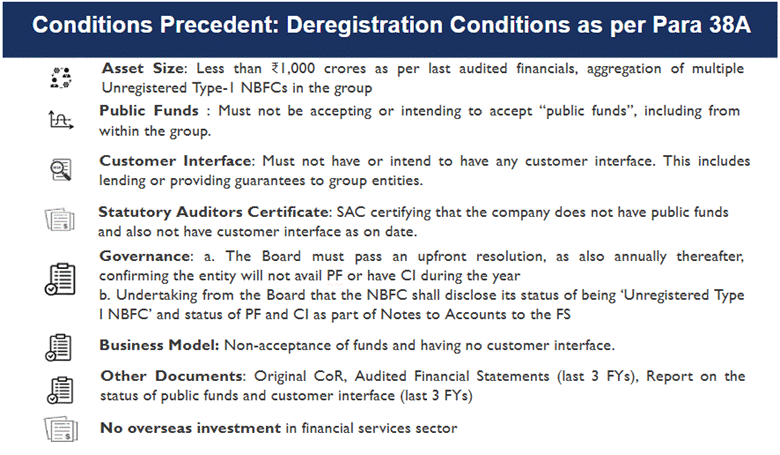
- No automatic exemption: It is not that you qualify, and come out of registration. In fact, those proposing to come out have to make an application, based on the financials for the last 3 years. In these financial statements, there must be no direct or “indirect” access to “public funds” (including loans from loans from directors/shareholders), nor should there be any lending within the group or outside. This position shall be supported by auditors’ certificate. It is with these conditions that the RBI may, on being satisfied about the business model, grant exemption.
- Customer includes my own group: The meaning of ‘customer interface’ has been clarified to say it includes customer-oriented activity like lending or providing a guarantee, including to ‘entities in the Group’, its shareholders, its directors, or providing any other “product or service” to a customer. “Any other product or service” typically refers to customer-centric financial distribution services like mutual funds, bonds, etc.
- Money from director/shareholder will be “public” funds: For the purpose of determining public funds, any amount received from the directors and/or shareholders of the NBFC shall also be treated as public funds. Even, money availed through margin trading facility shall be classified as public funds.
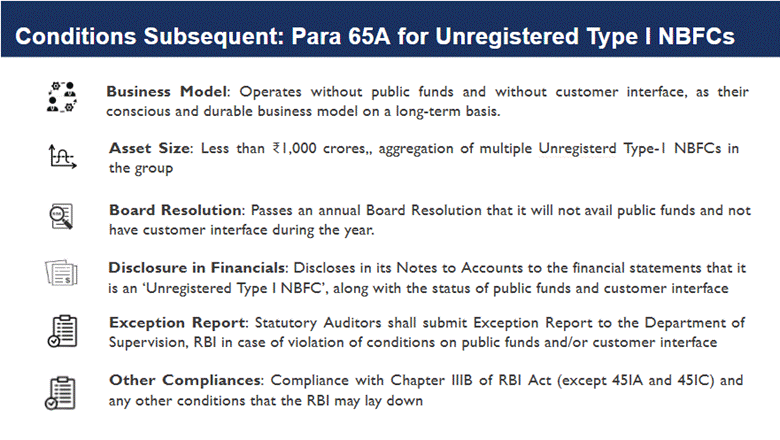
- Timelimit for making application by existing NBFCs: Type I NBFC registered with RBI as on July 1, 2026, and fulfilling the prescribed criteria for exemption, may make an application to RBI, for deregistration within a period of six months, by December 31, 2026. It has been clarified that the existing NBFCs, that may subsequently meet the exemption conditions, can also apply for exemption in such future point in time. Further, the unregistered Type I NBFCs shall continue to satisfy the exemption criteria and pass a board resolution at the beginning of the financial year that the company will not avail public funds and will also not have customer interface during the year.
- Does it mean the Balance Sheet as on 31st March, 2026 should be clean? Practically, that is what we would feel. While the applications will start going from 1st July, the same will be based on “audited financials”, which obviously will be that one for FY 26. Therefore, as we had suggested during our earlier write ups, it would be ideal for companies to clean up their statements so as to have a balance sheet with no debt on either side or liability side.
- Discretion of RBI: RBI shall consider the requests for deregistration if it is satisfied that NBFC is functioning with a conscious business model to operate without availing public funds and without having customer interface. Hence, the fate of deregistration is in the hands of the regulator.
- Aggregation of assets of group companies: It will not be possible to split assets across different entities to qualify for the exemption. The final rules make it clear that assets of unregistered type I NBFCs shall be consolidated with other type 1 NBFCs in the “group” for determining the eligibility to seek exemption. The meaning of “group” here will be taken as per RBI’s definition of “companies in the group”.
- Overseas investment requires registration: Unregistered Type I NBFC, in case it intends to undertake overseas investment in the financial services sector, it shall require registration. Further, unregistered Type I NBFCs shall not undertake overseas investment in the non-financial sector.
- Continued Supervision from RBI: Exemption is from registration requirement (45IA) and requirement to transfer profits to reserve funds (45IC); however, they would continue to be subject to the provisions of Chapter IIIB of the RBI Act, 1934 . Further, the RBI has reserved the right to issue necessary instructions specifically to ‘Unregistered Type I NBFCs’ in case any concerns/ risks are observed.
- Conditions for new entities: New entities intending to claim the exemption must satisfy these conditions- No access to public funds, no customer interface, less than ₹1000 Cr asset size, passing of annual Board resolution to not access PF and CI, disclosure in financial statements. Further, in case of violation of conditions on public funds and/or customer interface, the statutory auditor shall submit an exception report to the RBI.
Conditions for deregistration application:
Analysis of options available to Type 1 NBFCs
| Type of NBFC | Options Available |
| NBFCs holding Type I Registration as on July 1, 2026 (Effective Date) | Option 1: Apply for deregistration Option 2: Continue to remain as Type I NBFC |
| Entities that fulfil the conditions for Unregistered Type I NBFC, after July 1, 2026 | Option 1: Satisfy the conditions under 66A and remain unregistered [see box on Conditions Subsequent] Option 2: Apply for registration as Type I NBFC |
| NBFCs not having a customer interface and public funds and having an asset size below ₹1000 crores, but not registered as Type I | Option 1: Apply for deregistration Option 2: Apply for registration as Type I NBFC to avail regulatory exemption Option 3: Maintain status quo |
| NBFCs not having a customer interface and public funds and having asset size above ₹1000 crores, but not registered as Type I | Option 1: Apply for registration as NBFC Type I Option 2: Apply for registration as NBFC Type II, in case of changes in business model |
What happens to NBFCs not availing public funds and having customer interface but not registered as Type 1?
Several NBFCs that have been registered with the RBI before the concept of Type 1 was introduced in 2016 may not have the CoR as a Type 1 NBFC in spite of the fact that as on date they don’t have access to public funds nor any customer interface. Such an NBFC with an asset size less than ₹1000 crores as per the latest audited financial, will still have an option to apply for deregistration, subject to the satisfaction of the conditions prescribed. However, such NBFCs in case they decide to maintain the status quo will not be eligible for the regulatory exemptions available to Type 1 NBFCs.
What about new entities that meet PBC criteria?
If an entity carries investment activity with owned funds, within a limit of ₹1000 crores, does it need RBI registration? The answer seems to be – no. Such a company obviously does not have to go through the rigour of seeking registration first, and then qualifying for an exemption.
The company in question still has to satisfy the exemption conditions; and the auditor will need to give an exception report. The meaning of exception report is that if there is a breach of any of the conditions of exemption, or there is any breach of any other provisions of the law, the auditor shall be required to make an exception report.
Notably, CARO Order also requires auditors to comment on adherence to RBI regulations, which, in future, will include these conditions too.
Whether assets of multiple group entities will be aggregated?
Explanation II of para 38A provides that in case there are multiple unregistered Type I NBFCs in the Group, the asset size of all such Unregistered Type I NBFCs shall be aggregated to see the limit of ₹1,000 crore.
What if I have accepted intra-group loans/granted intra-group loans, but resolve not to do so in future
Are the exemption conditions, that there is no access to public funds and no customer interface, merely a statement of intent, or must also be borne out by the conduct in any of the past 3 financial years? Looking at the definition in para 6 (14A), which reads “Not accepting public funds and not intending to accept public funds”, and likewise, “Not having customer interface and not intending to have customer interface”, it appears that the exemption conditions are both a statement of fact as well as intent. If one is negated by the fact, a mere statement of intent may not help.
However, assume there are isolated instances of intra-group loans taken or intra-group loans given. The transactions are not indicating a “business model”, at least the ones on the asset side. Are we saying that the breach of the conditions of “no public funds” and “no customer interface”, at any time during the last 3 years, will disentitle the exemption?
We do NOT think so. There are two reasons to say this:
- First, no one can cleanse the past. There is no reason to deny the exemption if the Company has cleaned up the asset side and liability side by 31st March, 2026, and resolves not to make neither of the “two sins” ever in future. Taking any other view will be unreasonable and not keep up to the intent of the regulator.
- Secondly, the language itself is clear: Para 38A (2) (iii) talks about the status of public funds and customer interface in the last 3 years. Para 38A (2) (iv) and (v) refer to auditors’ certificate and the board resolution, both referring to the position as on date, and not the past. Therefore, if the past has been undone by 31st March, 2026, we see a strong reason to qualify the exemption, except if the level of activity is indicative of “conscious business model”.
Three financial years: which years?
In our view, since the deregistration application has to be made within December 31, 2026, the audited financials for FY 25-26 must have been prepared. Hence, the last three financial years that would be considered are FY 23-24, 24-25 and 25-26. If one makes an exemption application subsequently, of course, 3 consecutive financial statements become relevant.
Our representations: Some accepted
It is usually hard to get a relief from a regulator, as relief is seen as a prize that you earn. If the idea was based on the premise that what does not matter for the financial system, and is still being regulated, is a burden both for the regulator and for the regulated, there would have been a more welcoming approach to exemption[1]. We had interface with regulatory team of the RBI on the proposed changes:
- The extension of the definition of “public funds” to include borrowings from shareholders and directors is quite unreasonable. For private companies, deposits from shareholders and directors are exempt by law; in the case of public companies too, loans from directors are exempt. Even if we don’t lean on the law, what is taken from directors and shareholders cannot partake the character of “public”. There cannot be an element of public interest in intra-group transactions, and as a financial regulator, RBI could not have been concerned with intra-group financial accommodations. Despite representations on the issue, the RBI has continued the provision.
- The definition of “customer” service to include loans to group entities is equally unexplainable. The tested definition of “customer” in case of banks/financial entities is someone who customarily avails the services of such an entity. The only intent of the regulator could have been the conduct of business concerns, primarily customer service. A group entity borrowing from another group entity is not expecting customer service standards. However, this also did not find favour with the regulator, merely for the reasons such as KYC, credit bureau filing etc.
- Our representation, that the exemption should be a continuing one, has been accepted.
[1] See also, Bhargavi Zaveri Shah and Dr Harsh Vardhan: https://theprint.in/opinion/counting-on-law/rbi-shrinking-nbfc-regulation/2915007/
Other resources on the topic:
If a company has three Unregistered CIC having no customer Interface and Public Fund. The aggregate size of the CIC is more than 1000 Cr. It is necessaty to register all the CIC as NBFC Type 1