
Open but Guarded Gates: Relaxations for Border-Country Investments
Vinita Nair, Joint Managing Partner and Ankit Singh Mehar, Assistant Manager | corplaw@vinodkothari.com
Updated on May 4, 2026
A 15th March 2026 Press Note from Department for Promotion of Industry and Internal Trade (DPIIT) implements the cabinet decision to align investments from land-border countries (LBCs) with “beneficial owner” definition of PMLA. Accordingly, where investments come from a non-LBC, where beneficial ownership traces back to LBC, either to a citizen of LBC or an entity set up there, the investments will be allowed only in approval mode. In our view, even if there are multiple such citizens or entities, the amendment requires an aggregation of the investments of all LBC citizens or entities.

The 15th March DPIIT Press note 2 (‘PN2’) was preceded by a decision of Central Government, on March 10, 2026 (‘CG press release’) relaxing the restrictions placed in 2020 on FDI from countries sharing land-border with India (LBC) by (a) prescribing a strict approval timeline of 60 days in case of specified sectors/activities of manufacturing in capital goods, electronic capital goods, electronic components etc and (b) by allowing certain investments under automatic route where the investors have non-controlling LBC Beneficial Ownership of up to 10%. The objective is to facilitate ease of doing business and attract FDI inflows especially in critical sectors.
Effective date of amendment
DPIIT issued Press Note 2 of 2026 dated March 15, 2026 (PN2) amending the Consolidated FDI Policy with respect to eligible investors (Para 3.1.1). PN2 shall take effect from the date of notification of amendment in NDI Rules. A corresponding amendment in Rule 6 of the FEMA (Non-Debt Instruments) Rules, 2019 (‘NDI Rules’) was notified and published in gazette on May 2, 2026. Accordingly, the amendment takes effect from May 2, 2026.
Background
Since April 2020, in terms of rule 6 of NDI Rules and FDI Policy, prior approval of the government is required for any investment made by an entity from LBC or where the beneficial owner of an investment into India (a) – is situated in LBC; or (b) is a citizen of such LBC. Likewise, any transfer of ownership of existing or future FDI that results in the beneficial ownership of the investment shifting to a person who is a citizen of, or situated in, a LBC also requires prior government approval.
These requirements were notified pursuant to Press Note No 3 dated April 17, 2020 and subsequent notification of FEMA (Non Debt Instruments) Amendment Rules, 2020. Refer to our earlier write-up titled India seals its borders to corporate acquisitions dealing with the said press note. Our earlier you-tube video covering the overview of FDI can be accessed here.
In order to meet the objectives of Aatmanirbhar Bharat and increase FDI inflows, India has decided to revisit the restrictions placed during Covid pandemic to curb opportunistic takeovers/acquisitions by Chinese companies. In this article we discuss the changes approved and notified by way of PN2 and amendments made in NDI Rules effective May 2, 2026.
- Investments received from LBC
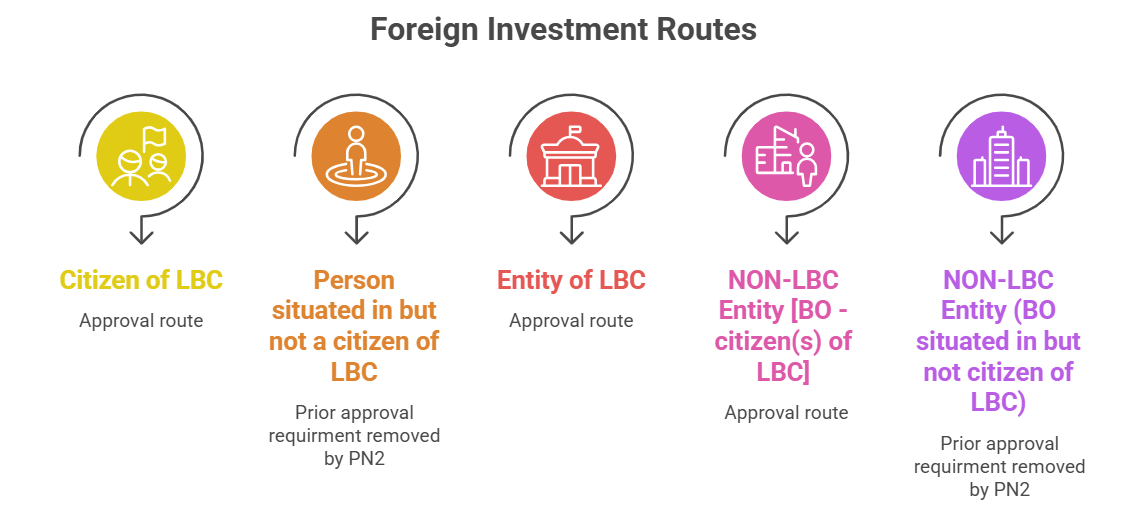
Prior approval of the government is now required for any investment made by an entity or citizen from LBC. The approval requirement also extends to investments made in India where the beneficial owner of an investment into India is a citizen of LBC.
The restriction arising on account of being ‘situated in LBC’ has been deleted. This relaxes the requirement for individuals of different nationalities situated in LBC investing in India or receiving ESOPs from Indian companies, as they will no longer require government approval.
Accordingly, the amended position is as under:
- Investments received from non – LBC with BO of investments based in LBC
Prior approval of the government is now required for any investment by PROI from non-LBC, where the beneficial owner of an investment into India is a citizen/entity of LBC.
Meaning of ‘beneficial owner of an investment into India’:
Let us first understand the meaning of “investor entity”.
It means the beneficial owner(s) of the investor entity incorporated or registered in a country other than LBC. Manner of identifying the beneficial owner(s) of the investor entity will be as discussed below in Clause 4.
- Applicability in case of transfer of ownership
Prior approval is required for any direct or indirect transfer of ownership of existing or future FDI in an Indian entity that results in the beneficial ownership of the investment into India shifting to an entity or a citizen of LBC.
- Scope of ‘beneficial owner’ (BO)
As per PN 2 and NDI Rules, the manner of identifying BO is aligned with Section 2(1)(fa) of the Prevention of Money-laundering Act, 2002 read with Rule 9 (3) of Prevention of Money Laundering (Maintenance of Records) Rules, 2005 (PML Rules). The reference to PML rules is mainly for the thresholds (refer below).
BO will be construed as vested with the LBC if the citizen(s) of LBC or entity (ies) incorporated/ registered with LBC has/ have the ability to hold rights/ entitlements in excess of thresholds under PML rules or exercise control over the investor entity or ultimate control over the investee i.e the Indian entity in any manner:
- directly or indirectly,
- individually or cumulatively,
- independently or collectively,
- whether acting together or otherwise.
Whether holdings by different citizens or entities of LBC to be aggregated?
In our view, yes. The intent is to allow investments from entities where the investors from LBC hold a non-controlling interest. Therefore, one will have to consider all investments put together. The approval requirements have been further clarified by way of following illustrations:
Illustration 1
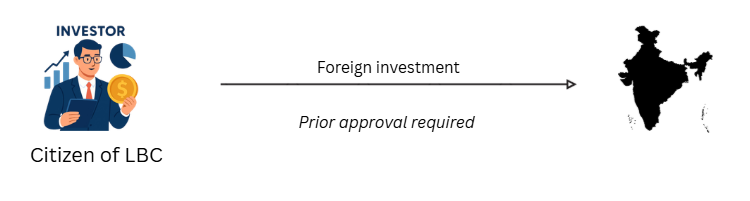
Illustration 2
Illustration 3
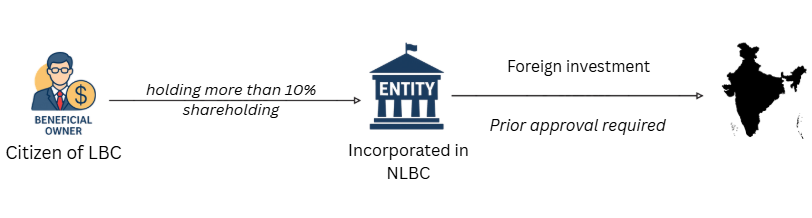
Illustration 4
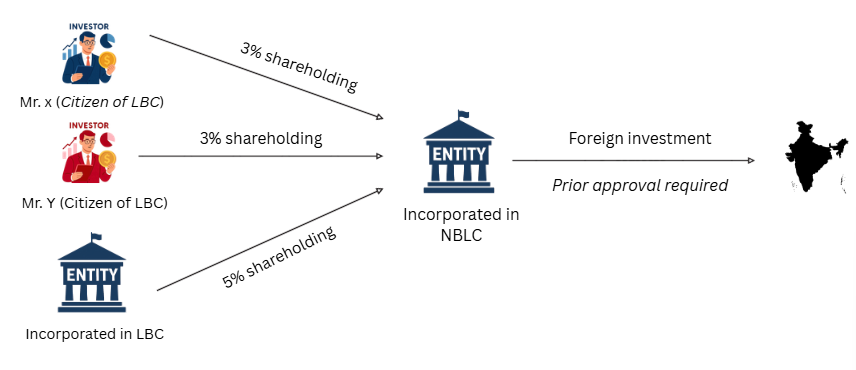
One might argue that if neither of the persons referred above i.e. Mr. X or Mr. Y or Entity incorporated in LBC, are qualifying as ‘beneficial owners’ under PMLA Rules on a standalone basis, then why do we need to aggregate their shareholding?
Here, reference needs to be made to the language of the proviso to Para 3.1.1.(c) of the FDI Policy and Explanation 2 to NDI Rules, which requires considering the rights/entitlements held – directly or indirectly, individually or cumulatively, independently or collectively, whether acting together or otherwise. The language seems to indicate that aggregation needs to be done irrespective of whether the person in question is acting independently or collectively or whether they are acting together or otherwise. Hence, in our view, one has to consider if investors of the Non-LBC with BO from LBC cumulatively hold in excess of the prescribed thresholds.
- Ambit of ‘beneficial owner’under PMLA
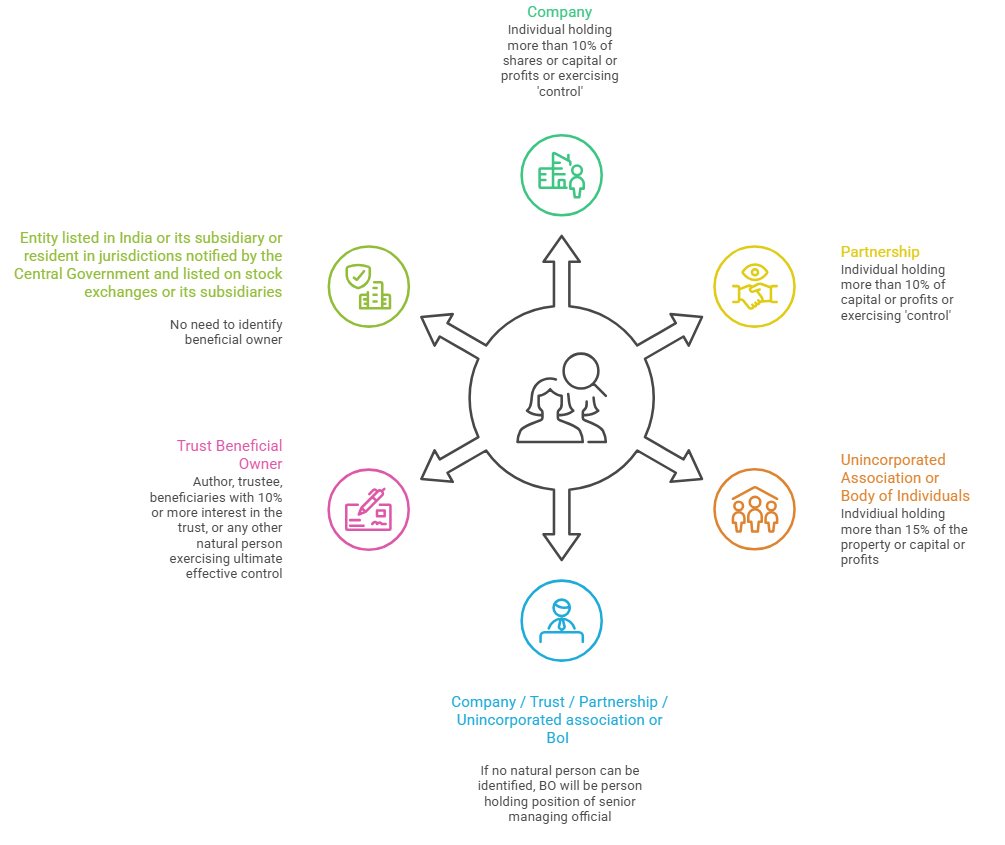
- Investments with non-controlling stake permitted under Automatic route
As per Para 3.1.1(d) of the amended FDI Policy, investments from an investor entity having any direct or indirect ownership by a citizen or an entity of LBC not requiring prior government approval shall be subject to reporting requirements as per the SOP laid down by DPIIT and prescribed by RBI.
- Investments by Multilateral Bank or Fund of which India is a member
The amended proviso to Rule 6 (a) of the NDI Rules clarifies that any Multilateral Bank (like World Bank, Asian Development Bank, Asian Infrastructure Investment Bank, New Development Bank etc.) or Fund (like International Monetary Fund, International Fund for Agricultural Development etc) of which India is a member shall not be treated as an entity of a particular country, nor any country would be treated as beneficial owner of any investments made by such Bank/Fund in India. This was not provided in PN2 and clarified vide amendment in NDI Rules.
- Other proposals approved in the CG press release pending notification
Fixed 60 days timeline for government approval for critical sectors
Presently, the timeline for obtaining government approval for FDI ranges between 12–14 weeks.
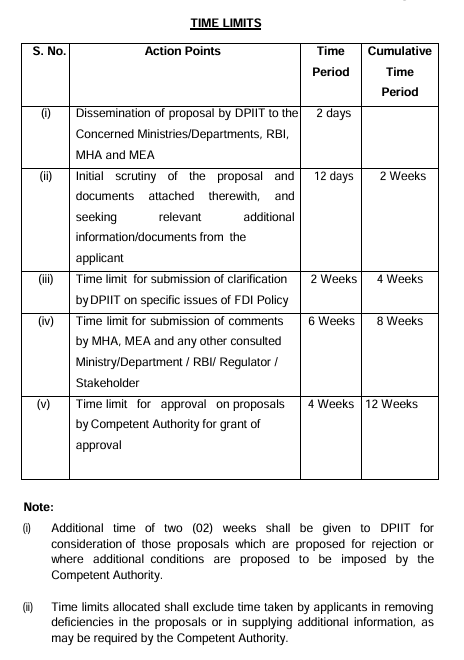
Source: Annexure V of SOP for Processing FDI Proposals
In cases where the investee entities are engaged in the specified sectors / activities concerning manufacturing of Capital goods, Electronic capital goods, Electronic components, Polysilicon and ingot-wafer etc. a timeline of 60 days shall be adhered to for government approval, in view of the criticality. The list will be provided by DPIIT. The majority shareholding and control of such Investee entities should be with the residents.
The Government will continue to assess the proposals on a case to case basis and accord approval. Recently, an electronics manufacturer company received MEITY approval for receiving investment of 26% in a joint venture from a Chinese investor.
Way forward
As discussed in the CG press release, the existing restrictions to cases where LBC investors only have non-strategic, non-controlling interests were seen as adversely affecting investment flows from investors including global funds such as PE/ VC funds. By loosening the said restrictions cautiously, greater FDI inflows and speedier fundraising can be encouraged, particularly into startups and deep techs while protecting the nation’s security interests. The relaxed norms aim to increase access to technology, facilitate ease of doing business for Indian entities and strengthen India’s position as an attractive destination for investment and manufacturing.
Refer our other resources on FDI here
Good presentation and narrative with illustrative. Shall be shared with colleagues.
What shall be the position,
1. if LBC entity transfers to another LBC entity more than 10% stake in Indian company which was under automatic route under pre-PN3 dispensation?
2. if LBC entity transfers to an Indian entity more than 10% stake in Indian company which was under automatic route under pre-PN3 dispensation?
Kindly find responses to queries mentioned below:
1. As per para 3.1.1 (b) of Consolidated FDI Policy read with Rule 6 (a) of NDI Rules, if existing FDI held by an LBC entity (held under automatic route pre-PN3 dispensation) transfers to another LBC entity stake in an Indian company, this subsequent change on account of transfer will require prior approval of CG.
2. If an LBC entity transfers its more than 10% stake (held under automatic route pre-PN3 dispensation) in an Indian company to an Indian entity, one needs to ascertain who has the beneficial ownership of the transferee Indian entity. In the event of the transfer of ownership of any existing or future FDI in an entity in India, directly or indirectly, results in the beneficial ownership with any entity or citizen of LBC, then prior approval of CG will be required.