News on Securitization in Singapore: REITs and CMBS in Singapore

Market developments:

Being what it is – a trading, investment banking and tourism hub, commercial real estate in Singapore is a major exposure for most commercial banks. Therefore, unsuprisingly, securitisation in Singapore has mostly been focussed around the commercial real estate sector.Outstanding loans against commercail real estate by commercial banks and financial institutions stood at Sing $ 72.2 billion as of March 2003, which is 42% of the total loans and advances by financial institutions.

With the introduction of REITs, activity focussed on CRE became all the more prominent.

Capital market funding into commercial real estate in Singapore has taken 3 forms – mortgage backed bonds, CMBS and REITs. Mortgage-backed bonds are traditional on-balance sheet funding instruments.

REITs are ownership-based instruments that securitise the ownership of a commercial real estate. REITs are typically listed and the market value of REIT units appreciates/moves along with the market perception of the value of the real estate. REITs may achieve further yield enhancement by combining a securitisation structure with a REIT – as has been done in some of the recent transactions.

Securitisation of the famous Raffles complex in 2001 marked one of the significant CMBS transactions in Singapore. Fitch, which recently rated a REIT-securitisation transaction named Orion Prime has listed several CMBS deals in Singapore, as under:

  • Silver Maple 2002
  • Silver Maple 2003
  • CapitaRetail
  • Silver Loft
  • Silver Maple 2004
  • Emerald
  • WinMall
  • Platinum AC1
  • Emerald

The REIT activity in Singapore picked up with offerings by CapitaMall Trust (CMT) and Ascendas REIT (A-REIT) – both of which received overwhelming support. Currently there are 5 REITs listed on the Singapore stock exchange. Fortune REIT relates to properties in Hong Kong but has listing on Singapore exchange. CapitaCommercial relates to commercial properties in Singapore.

Securitisation by REITs has emerged as a unique way out for the leveraging limit put in by MAS regulations on REITs.


Reported by: Vinod Kothari

News on Covered Bonds: Why Covered Bonds in India: An Interview

1st December, 2012:

Vinod Kothari

[The following is the text of an interview given by Vinod Kothari for an international journal, and is being produced here for the benefit of readers]

1)How did you become involved with the "Working Group for promoting RMBS and other alternative Capital Market Instruments – Covered Bonds"?

The Working Group was constituted by the National Housing Bank. Securitisation, particularly RMBS, has been lying on a very low key in India over several years, and NHB has most appropriately thought of exploring what are the reasons that kept is subdued, and what could be done to reinvigorate it. As regards covered bonds, since covered bonds are widely being perceived as the alternative on-balance sheet option for RMBS and are increasingly being tried outside of the European cradle, it is quite obvious for NHB to explore possibility of introducing the same to India.

Taking me as a part of the Group might have been due to my regular involvement with both the instruments – securitisation and covered bonds, primarily from an international perspective.

2)Why is India looking at introducing covered bonds now?

As an option for refinancing mortgages, it makes eminent sense for mortgage originators to have several options. The RMBS option has its own appeal. In India, substantial reason for demand for securitised instruments is the "priority sector" investment criteria for banks – that is, banks need a certain part of their banking credit towards the so-called priority sector. Securitised instruments qualify as priority sector investment, if the underlying loans are priority-sector loans. Hence, there is a good reason for demand for RMBS backed by low-ticket housing loans.

But then, RMBS has its own problems – the amortisation of principal is uncertain, and investors get prepayment volatilities. Investors tend to overprice their investment due to the risks associated with volatile payments. In addition, securitisation transactions in India are also subjected to tax issues.

If institutional investors are looking at smooth long-term investments, with no prepayment risk, and yet solid backing of a housing loan portfolio, the covered bond option seems ideal. Of course, there is no priority sector benefit here, but there are lots of institutional investors such as mutual funds and insurance companies who are not covered by these requirements. So, for a whole class of investors, covered bonds are much better than RMBS.

Covered bonds do not exist in India as of now – but given the flexibility of Indian law as a common law jurisdiction, there is no reason for covered bonds not existing in India.

So, it is so very timely that NHB thought of this idea. The Report, that comes on NHB platform, would not only open the door to NHB-intermediated covered bonds as recommended by the Report, but also self-issued covered bonds.

3)In our understanding, the group suggests the following structure: covered bonds issued by banks/HFCs, with the NHB fulfilling the role of an SPV by having a beneficial interest in the cover pool. Can you confirm that?

The Report looks at two possible structures – SPV-intermediated structures, and NHB-intermediated structure. In the first case, it is an SPV acquiring legal title over the cover pool and providing its own guarantee to the bondholders – the structure is very much the same as in case of UK transactions.

In the second option, NHB comes where we had SPV in the first case. NHB acquires legal title over the cover pool and provides assurance to investors to use the proceeds of the cover pool to pay investors in case of a default by the issuer of the bonds.

There are several merits of the second option over the first one. NHB is the regulator of the housing sector, and enjoys several statutory powers, including the power to change the management of a housing finance originator. In the event the default of an issuer happens due to managerial reasons, NHB may take corrective actions and avoid a default. Second, transfer of cover pool assets to NHB may happen under a statutory provision – avoiding the costly process of a true sale. Third, in terms of investor perception, NHB putting its name to the bonds has a great booster effect for investor interest.

In short, the NHB-intermediated model will be a unique model for other countries also to follow.

4)How did the NHB receive the set proposals put forward by the working group in October 2012?

NHB is very receptive. Indications are that the NHB will like to move the regulatory changes on a fast track. There is a minor amendment of the NHB Act involved – which requires the concurrence of the RBI and the Parliament. This may take some time, but NHB is surely keen to move it fast.

5)What is going to happen next? Does parliament need to approve the regulation? Do you see any obstacles head?

Parliament only approves the minor amendment of the NHB Act, which is helpful, but not essential. The Regulations may be announced by NHB itself. The legislative amendment has to move first. So, the only obstacle could be the time and urgency lost in the process of NHB to RBI to cabinet to Parliament.

6)When would you expect the first covered bond issuance to be and by whom?

Once again, if the passing of the legislative amendment could be expedited and put in the winter session of the Parliament, then may be we can see the first covered bond issuance in early 2013. Otherwise, it will go to May 2013 or so.

Most likely, it would be one of the better-rated issuers – say HDFC. Given its rating, HDFC does not need covered bond – but there may be a good reason for NHB to prevail upon a better-rated issuer to bring the first issuance to the market – to set the ball rolling.

7)Regarding ratings, what range of upnotching would you expect covered bonds to achieve above Indian banks/HFCs?

The 3 primary considerations for the notching up are robustness of legal structure, asset liability mismatches, and liquidity arrangements. The first one is clear – if NHB steps in. The second and the third are structure-dependent. If these are kept under control, I would expect notching up to 6 notches.

8)What kind of investors would Indian covered bonds be likely to attract (i.e. national, international)?

National – as we mentioned before – institutional investors such as mutual funds, insurance companies and employee benefit funds have a very strong reason to invest in housing-finance assets.

International – hedging costs are still quite high. All inclusive cost works out to almost the same as the cost of domestic borrowing. In addition, external commercial borrowing by financial institutions is tightly regulated. So, this option may not be open in the near term.


Reported by: Vinod Kothari

News on Securitization in Singapore: Revival of Securitisation in Singapore

October 24, 2013:

Singapore is clearly witnessing a surge in its securitisation activities with two Singapore firms having completed its private placements of assets backed securities in just a week [1].Even issuers are now looking at securitisation to diversify their sources of funding as banks run up against single borrower limits and as they review their risk weighted assets amid tighter banking regulations.

Currently in the Asia-pacific region, Singapore is offering most favourable conditions for development of securitisation [2]. Although Singapore banks have strong liquidity, there appears to be a growing desire to improve its already robust financial ratios. The prospect of increased global competition compels Singapore banks to improve their operating efficiency and to source lower-cost funding.

Recent statistics indicate that Singapore’s economy is recovering from negative growth. Retail sales, share indices, and property prices and purchases are all on the rise. Banks are competing fiercely on the basis of loan pricing to build up their mortgage loan portfolios, much like before the recession. Besides pricing, lenders are prepared to assume more risk, sometimes refinancing mortgage loans at 100% of the loan outstanding, regardless of the current market value.

Singapore has enjoyed very stable economic performance with steady GDP growth. The success of securitisation transactions has bankers in Singapore betting on a revival of the securitisation market and suggesting more deals are in work. In addition, the government is leaving no stones unturned in promoting Securitisation in the country.

Notes :

  1. See http://www.thejakartaglobe.com/business/securitizations-resurface-in-singapore/
  2. See http://pages.stern.nyu.edu/~igiddy/ABS/singaporeabs.htm

Reported by: Paridhi Bagaria

News on Securitisation in Singapore

This page updated regularly deals with securitization developments in Singapore. If you have any news or development to contribute to this, please write to me.

Updates:

See a news item on a synthetic CLO in Singapore by DBS Bank.

Market developments:

One of the earliest transactions in Singapore is the end-1998 securitisation of real estate receivables by a company called Neptune Orient Line. This was a sale and leaseback of an office property funded by 10 year fixed rate mortgage backed bonds.

The major securitisation transactions in Singapore have involved commercial real estate, residential sales progress payment, credit card receivables, bonds and loans. An article by Ng Kah Hwa in Nov. 2000 issue of Journal of International Banking Law says that so far, a total of Sing $ 1.92 billion worth of bonds have been sold in the domestic market via 6 commercial properties and one residential condominium.

One of the notable deals in Singapore market has been that by DBS Bank. This was in June 2000 – it is an asset backed short term notes program. In 1999, DBS Land, a property company, raised Sing $ 1.3 billion by securitising three office buildings in three separate deals.

Diners Club has also to its credit a recent transaction. This was a 300 year Sing $ 100 million transaction backed by credit card receivables.

Legal features:

Singapore by and large adopts the English common law system.

Assignment of actionable claims requires legal notice to the debtor under sec. 4 (6) of the Civil Law Act. Hence, in order to avoid debtor notification, assignments in Singapore will have to be equitable assignment. [For meaning of equitable assignments, see report on Malaysia – click here.] Equitable assignment has its own risks, such as existence of prior or superior claims, rights of set-off etc. Not being the legal owner of the receivables, the securitisation SPV cannot bring claims against debtors in its own name and would have to depend on the originator.

In case of mortgage loans, the transfer of receivable would also entail the transfer of the underlying mortgage, which would require compulsory registration with Registrar of Titles and Deeds.

See below for Monetary Authority of Singapore’s regulatory pronouncement on the subject.

Tax laws:

Income-tax issues relating to securitisation in Singapore are the same as in most other countries. There is no specific provision relating to securitisation.

Singapore has a Goods and Services Tax (GST). GST is not applicable on issue or transfer of “debt securities”. It is felt that the definition of “debt securities” in Para 3 of the Fourth Schedule to the GST Act is wide enough to exclude securitised notes from the applicability of GST.

Stamp duties are applicable on the assignment of mortgages at a rate of Sing $ 500. Securitisation of other receivables is exempt from stamp duty pursuant to amendments made effective from Feb. 28, 1998.

Regulatory measures:

An annual report for the Monetary Authority of Singapore (MAS) indicated that the regulatory guidelines for capital adequacy treatment in case of securitisation are expected to be finalised by the third quarter of 1999. The regulatory guidelines of MAS were finalised sometime in September, 2000. The text has been further amended in July 2006 – click here to visit securitisation laws page.

News on Securitization: Is Britain the new capital for Islamic Finance?

November 3, 2013 :

London recently hosted the 9th World Islamic Economic Forum at Excel Center, where UK revealed its plans to become the first country outside the Muslim world to sell Shariah-compliant Islamic bonds (sukuk) as early as 2014.[1] Sukuk would be valued at about 200 million pounds ($320 million).[2] In addition, the London Stock Exchange will be creating an Islamic Market Index.

Approximately 40 percent of the world’s 25 fastest growing markets are within Muslim-majority countries.[3] About 60 percent of the world’s sukuk is issued from Malaysia.[4] Outside the Islamic world, London is ranked as the number one centre for Islamic finance- it is the European base for several Middle East banks and a major centre for Middle East investors.

Britain first announced plans for a sovereign sukuk 5 years ago, but that issue never materialised as the country’s Debt Management Office decided the structure was too expensive and would not going to be value for money.[5] However, several projects in the UK in the recent years such as Thames Water, Barclays, Sainsburys, Harrods and the Olympic Village had significant contributions by Islamic financiers. The government established an Islamic financial task force in March 2013 to review subjects ranging from banking regulation to standards for Islamic finance education.[6] Britain also has more banks compliant with the principles of Islamic finance than any other Western country.[7] Britain has taken steps to support new businesses to grow across the Islamic world such as the formation of government partnership with the Shell Foundation to create a new 4.5 million pounds grant to boost the work of the Nomou initiative,[8] a growth fund that provides skills and finance to small businesses across the Middle East and the Gulf.

Through sukuk issuances, UK might come at par with Dubai and Kuala Lumpur in Islamic finance.

Notes :

  1. https://www.gov.uk/government/speeches/world-islamic-economic-forum-prime-ministers-speech
  2. https://www.gov.uk/government/speeches/world-islamic-economic-forum-prime-ministers-speech
  3. http://www.aawsat.net/2013/10/article55320863
  4. http://www.bnm.gov.my/index.php?ch=en_speech&pg=en_speech_all&ac=281&lang=bm
  5. http://www.thedailybell.com/printview/params/id/34707/printview/
  6. https://www.gov.uk/government/news/government-launches-first-islamic-finance-task-force–2
  7. https://www.gov.uk/government/speeches/world-islamic-economic-forum-prime-ministers-speech
  8. .http://www.9thwief.org/CMSPages/GetFile.aspx?guid=e30e987a-54eb-4024-a4df-337ad71bcdf6

Reported by: Shambo Dey

Resolution versus creditors’ rights India strongly needs to tame the SARFAESI Act

-Vinod Kothari and Soma Bagaria | corplaw@vinodkothari.com

Loader Loading…
EAD Logo Taking too long?

Reload Reload document
| Open Open in new tab

Download as PDF [2.50 MB]

News on Covered Bonds: Covered Bonds-The Canadian Coverage

28th December, 2012:

Covered Bonds are seen as an effective alternative to securitisation and the world seems to be all promoting the instrument by making necessary regulatory amendments or devising new enactments[1].

Canada too is set to follow the trend globally. Canada Housing and Mortgage Corporation (CMHC), the country's national housing agency has announced the details of the legal framework for Canadian covered bonds[2].

The National Housing Act (the Act) in Canada is the legislation governing the construction of new houses, the repair and modernization of existing houses, and the improvement of housing and living conditions. As part of the 2012 Federal Budget[3], amendments were made to the National Housing Act charging CMHC with administering a legal framework for covered bonds. The provisions relevant to covered bonds are contained inPart I.1 Section 21.5-21.66 of the Act.

The important provisions are:

  • Eligible Issuer: A Federal Financial Institution
  • Eligible Assets:  Loans made on the security of residential property that is located in Canada and consists of not more than four residential units; or any prescribed assets.
  • Assets to be excluded: Certain loans cannot be held as covered bond collateral, e.g. a loan made on the security of residential property if the loan is insured by the CMHC.
  • Registry: CMHC is to establish and maintain a registry containing details of registered issuers, registered programs, other prescribed information
  • Regulations: The Ministry of Finance has been conferred power to make Regulations to carry out the provisions of the Part, including modifying the definition of covered bonds or covered bond collateral.

     CMHC feels that the framework will support financial stability by helping lenders diversify their sources of funding and attract more investors from off shore markets as well.

The issuers of covered bonds will have access to an alternative source of funding and will gain a broader investor base since some international investors are restricted from purchasing bonds issued under a non-legislative framework. For the investors, the benefits come in the form of high standards of disclosure in tune with international best practices; statutory protection, dual recourse to the issuer as well as the cover pool. The ultimate beneficiary will be the market.

CMHC has issued a Covered Bonds Guide for easy understanding of the framework.

The step by the Canadian Regulators comes as an incentive to boost the global covered bonds market, where financial regulators of some countries like Norway are seeing covered bonds as risk accelerators for banks[4].


[1] As for example, in India, recently a Working Group constituted by National Housing Bank, the apex housing agency, submitted its Report that suggests a unique structure for introducing covered bonds in India: the NHB-intermediated structure. The Working Group report can be viewed herehttps://vinodkothari.com/CB%20news/covered%20bonds%20with%20NHB%20Intermediation%20coming.htm.

Vinod Kothari was a member of the Group, also see Covered Bonds with NHB intermediation coming, by Vinod Kothari.

[2] http://www.cmhc-schl.gc.ca/en/corp/nero/nere/2012/2012-12-17-1600a.cfm

[3] Chapter 3.2


Reported by: Sikha Bansal

News on Covered Bonds: DBS all set to issue first covered bonds of Singapore

January 7, 2013

Monetary Authority of Singapore (MAS) came out with a consultation paper on guidelines for issue of covered bonds by the banks of Singapore. The paper titled "Covered Bonds Issuance by Banks Incorporated in Singapore" was issued in March last year. Since then the paper was put up for public and industry comments for almost a year.

DBS bank is already preparing and pressing for structural reforms to issue covered bonds once the regulations are approved and are in line. DBS working closely with Deutsche Bank and Barclays are all set to be the first to issue the first covered bonds of Singapore. DBS is likely to face tough competition from the Australian banks which are pricing their covered bonds at a cheaper rate. Thus, penetrating the market with a tight pricing policy seems to the primary objective of DBS. The currency denomination is yet to be determined for the issue. Europe is speculated to be the favorable buyers of the covered bonds with their vast experience in this area and familiarity of the structure.

Singapore banks are eagerly waiting for the final guidelines to be approved. Due to their little experience in securitisation, structural standardization of the loans to be used as collaterals need to paid heed with a constant supervision.

Reported by: Piyush Sinha

News on Covered Bonds: Covered Bonds volume declines in 2012 as European banks rely on alternative liquidity sources

Covered Bonds volume declines in 2012 as European banks rely on alternative liquidity sources

February 2, 2013

The world witnessed a steep fall in the issuance of covered bonds during the last year. The main reason behind this is assumed to be the consumer behavior- which in due course had resorted to cheaper liquidity available from the central banks. However, international rating agency Standard & Poor's (S&P) opines that lower issuance costs and a host of maturing bonds in 2013 will keep the volume of covered bonds at par. Based on their analysis, Standard & Poor's came out with a report on covered bond's performance captioned "Covered Bonds face another tough year" on January 24, 2013.

The report consists an overview and a critical analysis about the performance of covered bonds last year along with the predictions of 2013. S&P evaluated and analyzed the following pointers:

  1. European covered bonds issuance benchmark: S&P placed its analysis on data available from J P Morgan which showed a fall in the issuance volume in the European countries.
  2. Bonds maturing in 2013: Bonds amounting to approximately 160 billion Euros are scheduled to mature this year which may drive many players back into the market.
  3. Participation from new jurisdictions such as Australia and Belgium.
  4. Sudden increase in the credit risk related to a certain mortgage covered bonds programs in the European market.
  5. Effect of the Asset Default Risk and its subsequent Overcollateralization Levels
  6. Effect of degradation of sovereign creditworthiness on the covered bonds market.

Changing Figures

Covered bond issuance started well in the beginning of 2012, with transaction volumes already exceeding Euro40 billion[1]. But increasing funding pressures forced the banking regulatory bodies to press for better legislations for covered bonds as a secure source. In this mounting pressure many have continued working on (e.g., the U.S. and Belgium) or finally implemented (e.g., Australia) new covered bond laws in 2011. However, from the short-term viewpoint, due to the euro-zone fallout risks started creeping up and brought

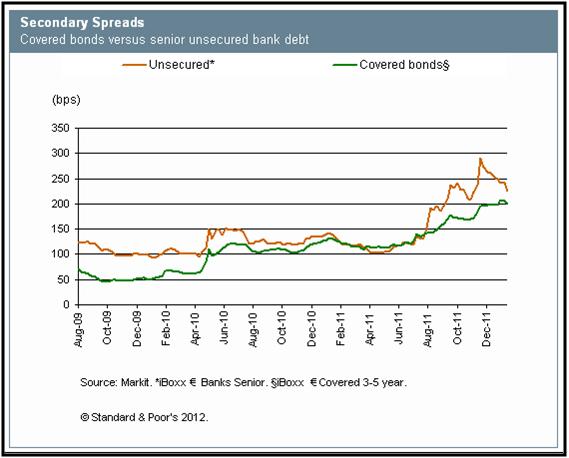
covered bonds issuance to a standstill. There was a 20% drop in the total volume of covered bonds issued in 2012 as compared to 2011. Investor placed volumes had a dip of approximately 40% in most of the European countries as compared to 2011. The graph below depicts the fall in global issuance of covered bonds as compared to unsecured bank debt.

S&P published a special report titled "Global Demand for Covered Bonds is Growing" wherein it stated that 2011 symbolized enough dynamism for the covered bonds market. Global issuance touched about 300 billion Euros with a very diverse set of issuers. Unfortunately, this acceleration was somehow hindered and the global turnout stated declining in 2012. An immense stress in credit markets in the second half of 2012 stalled new issues. Better and diversified options available to the investors from banks have changed the course of this asset backed security to a large extent but the market players are hopeful that the situation will be soon restored.

S&P Report Covered Bonds Outlook 2012: Is the Shine Coming Off?http://www.standardandpoors.com/spf/upload/Ratings_EMEA/CoveredBondsOutlook2012IsTheShineComingOff.pdf


Reported by: Piyush Sinha