
Posts

Avoid Turning Your Referral Partner into a DSA/LSP

Simrat Singh | Finserv@vinodkothari.com

RBI regulatory framework for banks and NBFCs recognise entities such as LSPs and DSAs, but do not define the term “referral partner”. Consequently, several lenders engage referral partners under agreements that merely replicate the DSA arrangement with a change in the nomenclature but without altering its substance. This is a risky approach. Courts have held that the existence of an agency relationship depends on the rights created between the parties, not on the title of the agreement. Therefore, if a referral partner agreement authorises the intermediary to represent the lender or perform functions ordinarily discharged by a DSA or outsourced agent, the intermediary may be regarded as a DSA irrespective of its contractual designation. Accordingly, while drafting a referral partner agreement, equal attention must be paid not just to the scope of what can be done but also  what the agreement does not permit. To understand the difference between a LSP, Referral partner and DSA, may refer to our resource Referral or Representation? The Fine Line Between LSP, DSA and Referral Partner.

Set out below are contractual provisions that should be avoided in an agreement with a referral partner.

  1. Do not confer authority to make commitments: Such authority is inconsistent with a mere referral arrangement and indicates an agency relationship. The agreement should not permit the referral partner to:
    1. assure loan sanction;
    2. quote specific interest rates since that is a function of borrower risk and lender’s credit evaluation and interest rate model;
    3. commit timelines for approval or disbursement; or
    4. make any representation which is binding on the lender
  2. Do not permit the referral partner to hold itself out as representing the lender: A referral partner should not portray itself as the lender’s representative or create the impression that it is authorised to act on the lender’s behalf. Accordingly, the agreement should prohibit the intermediary from describing itself as the lender’s agent or representative, using the lender’s name or branding in a manner that suggests an affiliation beyond a referral arrangement, or making any statement or representation that could lead customers to believe that it has authority to act for or bind the lender. 
  3. Do not permit collection or processing of loan applications and loan repayments: These functions form part of customer acquisition, onboarding and servicing, which are characteristics of DSAs or LSPs. A referral partner should not collect or verify KYC documents and/or scrutinise applications and collect customer information/documents in any manner. Further, activities such as identity verification, obtaining customer consents, conducting due diligence or facilitating KYC should remain with the lender or its authorised service providers. A referral partner should not participate in the lending process beyond introducing the customer.
  4. Keep performance obligations limited to referrals: The referral partner should not be evaluated based on portfolio quality; recovery performance; or loan servicing metrics. Performance obligations should relate only to successfully introducing prospective customers. 
  5. No compensation linked to lending functions or loan performance: A success-based referral fee, by itself, does not create an agency relationship. However, the consideration should not be linked to underwriting, servicing, collections, portfolio performance, recoveries or any other lending function. The agreement should make it clear that the referral fee is payable solely for successful referrals and not for performing any activity connected with the lending process.
  6. Do not authorise communication of lending decisions/negotiation: All customer communications should originate directly from the lender. The referral partner should not communicate sanction or rejection of applications; loan terms; deficiencies in documentation; repayment schedules; or disbursement confirmation. Further, negotiation on behalf of the lender is a strong indicator of representation/agency. The agreement should not authorise the intermediary to negotiate pricing; tenure; collateral requirements; repayment schedules; or restructuring terms.
  7. Do not assign post-disbursement responsibilities: Its role should ordinarily cease once the customer has been introduced. The referral partner should not undertake collections; recovery; repayment follow-ups; customer grievance handling; restructuring assistance; or foreclosure processing.
  8. Avoid clauses indicating exclusive representation: Clauses requiring the intermediary to exclusively promote the lender’s products or act as its sales representative reinforce the impression that the intermediary is representing the lender rather than merely referring customers.
  9. Avoid excessive operational control: Compliance obligations may be imposed, but they should not amount to day-to-day supervision. Operational control is a recognised indicator of agency. Accordingly, the agreement should avoid prescribing detailed supervision clauses or detailed operational instructions unrelated to regulatory compliance.
  10. Include non-agency provisions: The agreement should expressly provide that:
    1. the referral partner is an independent contractor;
    2. the relationship between the parties is on a principal-to-principal basis;
    3. it has no authority to represent or bind the lender;
    4. the referral partner shall not collect, process, or handle customer documents, KYC records, or sensitive customer information;
    5. all lending decisions are taken exclusively by the lender;
  11. Avoid agency terminology: Last but not the least, expressions such as authorised representative; sales representative; marketing representative; branch; agent; or authorised person should be avoided throughout the agreement because the language used often reflects the intended legal relationship.
Multi-lender LSPs – Compliance & Considerations 

– Aditya Iyer, Manager (Legal) (finserv@vinodkothari.com)

  1. The illusion of choice – a consumer’s woe

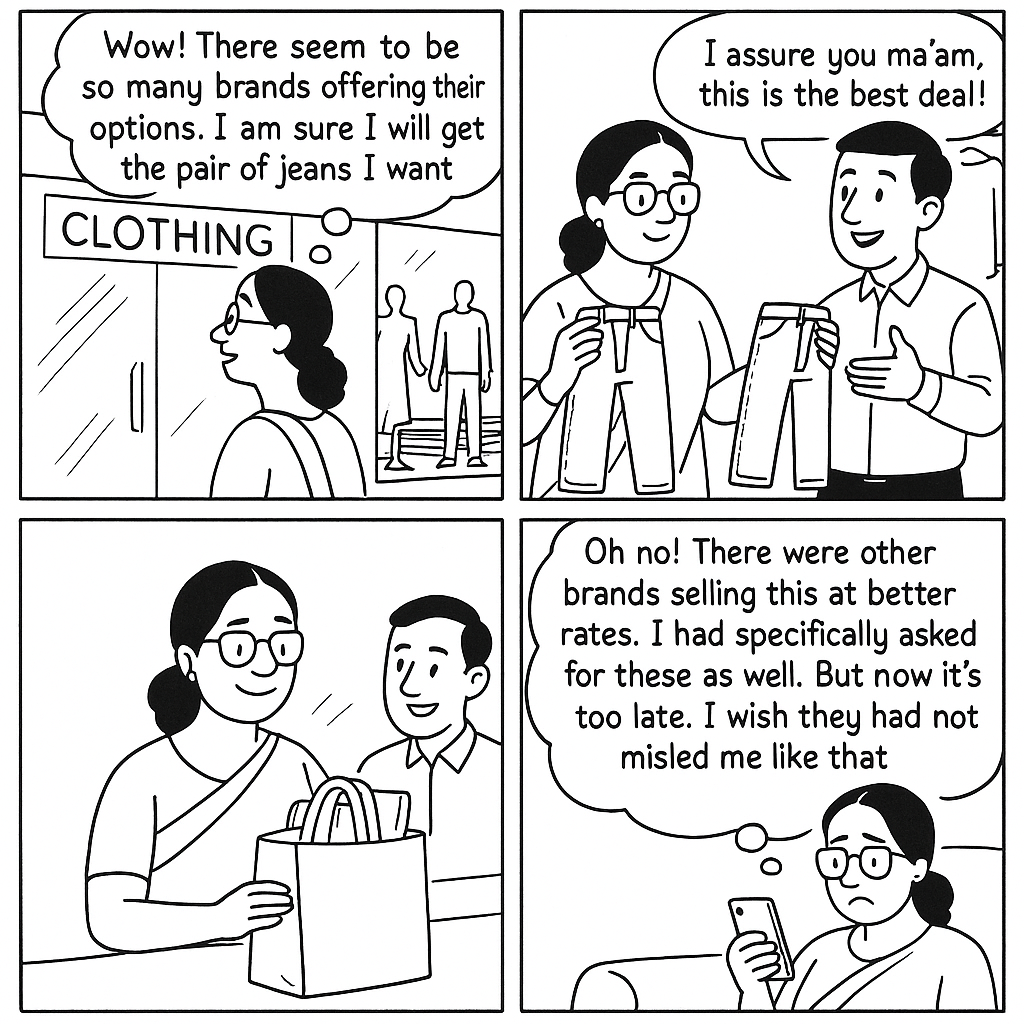
Consider this: you’re out shopping on a Saturday afternoon for a perfect pair of jeans. You stop by a store that retails multiple brands and boasts the best variety. With a salesperson to guide you, you make your pick after careful diligence and comparison, and finally check out.  Hours later, however, you discover that certain brands were selling better trousers at a lower price point, in the very same store, but these were deliberately obscured from your vision. Now, you feel duped, hurt and confused.

It’s still the same product. However, what has changed is your ability to make an informed choice. What’s worse, indeed, is that you were made to believe that you had an informed choice. 

A sincere consumer, shopping for trousers from a multi-brand store. 

  1. Multi-lender LSPs (MLLs)

Drawing parallels from the above, in the lending space, a similar tale unfolds. There is an emerging class of platforms that operate as Multi-lender LSPs (MLLs). These MLLs undertake the sourcing function for multiple lenders against a given product. For instance, Partner ‘A’ may act as a sourcing agent via its platform for unsecured personal loans offered by Lenders X, Y, and Z. 

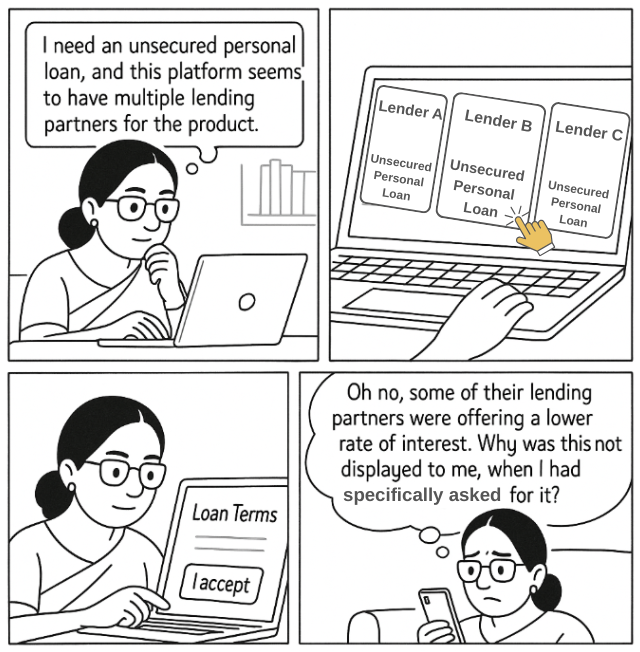
In this case, the consumer may be onboarded onto the platform and be under the impression that they are making an informed choice, and receiving an impartial display of all options for the given loan product. If this is indeed the case, then there is no issue. However, it is possible that due to factors including (a) certain Lender-LSP Arrangements, and (b) differences in the commission received from various lenders, the loan product of a particular lender may be pushed to the borrower. The borrower may also be influenced towards making a particular selection through the use of deceptive design practices designed to subvert their decision-making process (Dark Patterns – for more, see our resource here)

Here, the lack of choice and transparency, and insufficient disclosure in the sourcing process would be an unfair lending practice. And unlike a simple pair of trousers, here the consumer’s hard-earned money and personal finances are at stake. 

A similar tale unfolds on a multi-lender platform. 

  1. Requirements for REs under the Digital Lending Directions, 2025 
  • Para 6 of the DL Directions

In order to protect the borrower and their right to choose, the RBI vide the Digital Lending Directions, 2025 (‘DL Directions’) has prescribed additional requirements upon REs contracting with such MLLs (refer to our article on the DL Directions here). 

These requirements under Para 6 of the DL Directions are applicable upon “RE-LSP arrangements involving multiple lenders”, and pertain to: 

  • The borrower being provided a digital view of all the loan offers which meet the borrower’s requirements. 
  • A view of the unmatched lenders as well.
  • The digital view would have to include the KFS, APR, and penal charges if any of all the lenders, to display terms in a comparable manner. 
  • The content displayed should be unbiased and objective, free from the influence of any dark patterns or deceptive design practices designed to favour a given product. 

The RBI’s annual report for FY 2024-2025 also reveals that the rationale behind these additions was to mitigate risks arising out of LSPs that display the loan offers in a discretionary way, and “which seldom display all available loan offers to the borrower for making an informed choice”. These requirements were, of course, first published via the Draft Guidelines on ‘Digital Lending – Transparency in Aggregation of Loan Products for Multiple Lenders’ (our team’s views on the same may be found here).

  • Multi-lender LSP v. LSP working for multiple lenders – Is there a difference? 

Although this may not be immediately apparent from the language, the “RE-LSP arrangements involving multiple lenders” being contemplated here (in our view) are not RE-LSP arrangements where a single LSP is contracting with multiple REs, each for a separate product, but rather the MLLs described above.

For example, consider a scenario where the LSP works with Lender ‘A’ for vehicle loans, Lender ‘B’ for personal loans, Lender ‘C’ for gold loans and so on. Would this then be considered a Multi-lender LSP requiring compliance under Para 6 of the DL Directions? In our view, no. 

Here, because each borrower has only a single lender for a particular product, there is no question of their ability to choose being prejudiced, or there being a need to draw a comparison between the terms offered by multiple lenders. Hence, the requirements under Para 6 of the DL Directions would not be applicable upon REs contracting with such LSPs. 

Such requirements would only become relevant in the case where the LSP is undertaking sourcing for multiple lenders against a particular product. In such a case, because the borrower is under the impression that they have a choice, it becomes crucial to protect the borrower’s ability to make that choice (in an informed, transparent, and non-discriminatory manner). 

  1. Consumer Protection Act, 2019 

Additionally, with reference to the above scenario, under Section 2(9) of the Consumer Protection Act, the following (amongst others) have been recognised as consumer rights (upon violation of which the consumer can seek redressal): 

  • Right to be informed: “the right to be informed about the quality, quantity, potency, purity, standard and price of goods, products or services, as the case may be, so as to protect the consumer against unfair trade practices”
  • Access to competitive prices: “the right to be assured, wherever possible, access to a variety of goods, products or services at competitive prices”. 

In our view, with respect to MLLs, this may be interpreted to mean that the borrower has a right to be informed of the comparable options and to receive an impartial, unbiased, and competitive display of the terms to enable their decision-making.

Finally, it is to be noted that such MLLs, would also qualify as “E-Commerce Entities” under the Consumer Protection (E-Commerce) Rules, and the said rules inter alia cast a duty upon such entities to ensure that they do not adopt any unfair trade practice, whether in course of business on its platform, or otherwise [Rule (4)(2)]. Under the E-commerce Rules, a “marketplace e-commerce entity” is an e-commerce entity providing an information technology platform to facilitate transactions between buyers and sellers. Marketplace e-commerce entities are required to ensure that: 

  • All the details about the sellers necessary to help the buyer make an informed decision at the pre-purchase stage are “displayed prominently in an appropriate place on its platform” 

To the extent MLLs would meet this definition, they would also need to ensure the same.
