
Posts

The Case For Regulating Private Credit Funds

Simrat Singh | Finserv@vinodkothari.com
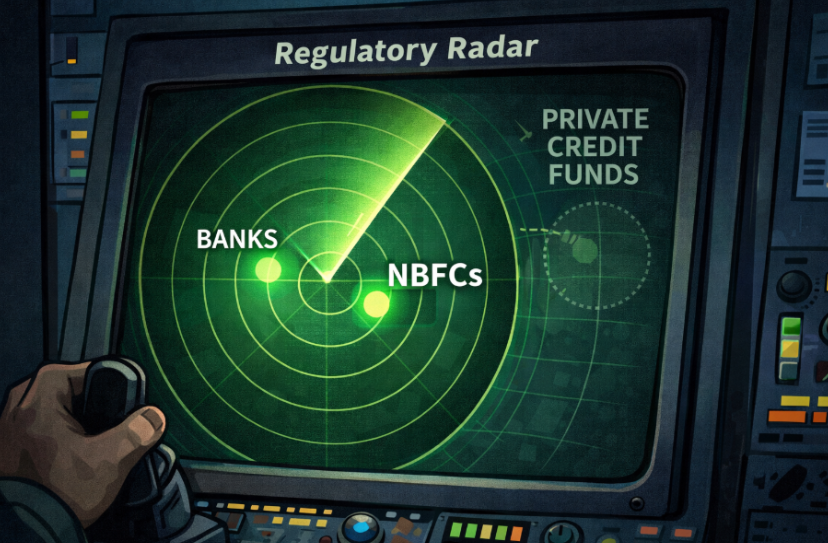
Private credit is, in essence, shadow banking without corresponding discipline. Market reports indicate that Private Credit in India (and globally) is beginning to show signs of stress. Several global private credit fund managers have reportedly frozen withdrawals amid rising investor withdrawals. Given that private credit by its very nature is supposed to be illiquid, even a modest redemption pressure may hamper the ability of the fund manager to honor the withdrawals. Although this type of liquidity risk is limited in Indian private credit funds since they are usually close-ended category II funds in which investors are mandated to stay invested throughout the tenure of the fund. However, other risks such a opacity still loom. An equally important issue is the regulatory asymmetry, with private credit funds being regulated far less stringently than banks, NBFCs and other comparable lending institutions. Private credit funds take money from investors and lend to businesses; so do banks and NBFCs. Both carry systemic risks and can trigger panic on failure. Yet, only one is properly regulated. 

In our earlier write-up on private credit funds we tried to list down the differences between regulated entities and these funds, a distinction which highlights the scarcity of controls and oversight in a lending fund that is expected in a lending vehicle. Notable examples include no uniform credit appraisal, no standardised reporting of performance of borrowers, no CRAR-like minimum capital requirement, no interest rate risk model etc. One may argue that the very absence of these requirements is what makes private credit funds tailor their deals according to the needs of the investee company; payment-in-kind, income-aligned repayment schedules are some of the examples. However, the absence of discipline also introduces opacity and potential systemic risks. Regulators globally have flagged these lending vehicles due to their opacity and market-wide risk (eg. RBI pointed out the systemic risk of private credit in its June 2024 Financial Stability Report). However, no action/mitigation measure has been taken as of now. In our view, atleast provisioning and NPA reporting-like safeguards should be there in such vehicles.

Note that these funds are not completely unregulated, SEBI AIF Regulations contain some safeguards such as concentration cap, valuation norms, no leverage at fund level etc. but these are generic safeguards and are not made keeping in mind the risks involved in a lending-based fund vehicle. 

The case for regulatory intervention, therefore, is not about imposing bank-like rigidity, but about ensuring appropriate discipline for bank-like activities. Whether such oversight should fall within the domain of the RBI, given its expertise in regulating lending institutions, remains an open question. The more immediate concern is that these entities continue to operate outside a robust prudential framework. Importantly, the relatively small share of private credit funds in overall corporate lending (currently less than 2%) should not serve as a justification for regulatory inaction. Risks do not become relevant only at scale; by the time they do, the cost of inaction is often far greater. It is therefore for regulators to move beyond a form-based approach and adopt a substance-based framework for such lending vehicles.

AIF Regulatory framework evolves from light-touch to right-hold

Simrat Singh | Finserv@vinodkothari.com

When AIF Regulations were formally introduced in 2012, the regulatory approach was deliberately light. The framework targeted sophisticated investors, allowing flexibility with limited oversight. Over the years, however, AIFs have become significant participants in capital markets. Market practices over the decade exposed regulatory loopholes and arbitrages. For example, some investors who did not individually qualify as QIBs accessed preferential benefits indirectly through AIF structures and investors who were restricted to invest in certain companies started investing through AIF making AIF an investment facade. There were concerns regarding circumvention of FEMA norms as well1. In the credit space, regulated entities such as banks and NBFCs started channeling funds through AIFs to refinance their stressed borrowers, raising concerns around loan evergreening2. These developments prompted regulatory response. RBI first issued two circulars, one in 2023 and the other in 2024. Finally, in 2025 formal directions governing investments by regulated entities in AIFs were also issued3. These Directions introduced exposure caps and provisioning requirements.4 

While the RBI addressed prudential risks arising from regulated entities’ participation in AIFs, SEBI focused on investor protection, governance within the AIF ecosystem and curbing the regulatory arbitrages. First it mandated on-going due diligence by AIF Managers5. It then mandated specific due diligence6 of investors and investments of AIF to prevent indirect access to regulatory benefits. Fiduciary duties of sponsors and investment managers and reporting obligations were progressively codified through circulars. Managers were expected to maintain transparency vis-a-vis their investment decisions, maintain written policies including ones to deal with conflict of interest with unitholders and submit accurate information to the Trustee. What were once broad, principle-based expectations have evolved into detailed, enforceable rules. Regulatory tightening has been matched by a more assertive enforcement approach. SEBI’s recent settlement order7 against an AIF underscores its increasing scrutiny of governance lapses, mismanagement of conflicts and inaccurate reporting. This clearly signals that any compliance gaps will no longer be overlooked and are likely to attract regulatory action. In a separate adjudication order, SEBI imposed penalties on both the Trustee and the Manager for the delayed winding-up of the scheme, underscoring that accountability within an AIF structure extends to all key parties and is not limited to the Manager alone.  

However, SEBI’s approach has not been solely restrictive. Alongside regulatory tightening, it has also sought to preserve commercial flexibility and respond to market needs. Examples include the introduction of the co-investment framework8 for AIFs, framework for offering differential rights to select investors and a revamp for angel funds9.

Together, these measures are reshaping the regulatory landscape for AIFs and their managers. Investors can no longer rely on AIF structures to indirectly obtain regulatory advantages otherwise unavailable to them. As AIFs have grown in scale and importance, what is emerging is a more transparent, prudentially sound and closely supervised regulatory regime designed to align investor protection and commercial flexibility.

  1. See SEBI’s Consultation paper on proposal to enhance trust in the AIF ecosystem ↩︎
  2. See our write-up on AIFs being used for regulatory arbitrages here. ↩︎
  3.  RBI (Investment In AIF) Directions, 2025 ↩︎
  4. See our detailed analysis of the Directions here. ↩︎
  5. See our write-up on ongoing due diligence for AIFs here ↩︎
  6. See our FAQs on specific due diligence of investors and investments of AIFs here. ↩︎
  7. See the complete order here ↩︎
  8. See our write-up on co-investments here. ↩︎
  9. See our write-up on changes w.r.t Angel Funds here ↩︎

Chinese Non-banking financial entities in precarious state

Vinod Kothari, Director | finserv@vinodkothari.com

One of the trust companies defaults; other casualties likely

Chinese financial system is opaque and intriguing, for any outside trying to understand it. Regulatory framework is also mostly spasmodic, and given the fact that Chinese regulators do not follow global institutions or their regulations, Chinese institutions have developed along their own lines.

One of the non-banking financial entities in China is “trust companies”, somewhat similar to private collective investment vehicles or alternative investment funds seen elsewhere. These trust companies mostly invest in activities closely mimicking the lending of banks, while at the same time not being regulated as such. The size of the shadow banking industry in China, better known as “non banking financial intermediaries” (NBFIs) is huge, and is the second largest in the world, next only to the USA. Of the NBFIs, trust companies were estimated to be about USD 4 trillion, and 79% of the trust companies are based out of China, as per data as of end-December, 2021, appearing in the NBFI  report of the Financial Stability Board.

Read more