
COVID-19 preparedness: some questions on MCA Form CAR-2020

Vinod Kothari and Company; corplaw@vinodkothari.com

Updated as on 23rd March, 2020

All companies and LLPs must have, by now, got mailers from the Ministry of Company Affairs about COVID-19 preparedness, and the need to file a web based form CAR 2020 i.e. Company Affirmation of Readiness towards COVID 19.

The MCA circular is nothing but a disaster management step from the Ministry, imploring upon all companies and LLPs to get sensitised to the need for handling this colossal challenge to humanity, India included. It will be an ironical travesty if the filing of the form is taken as a compliance requirement.

Therefore, in our view, what matters is the preparedness itself, not so much the task of having the so-called policy or the filing of the form itself.

However, the country has a few lakhs of companies, and the affirmation of preparedness by filing this form will be expected from all the companies. Hence, there is understandably a barrage of questions from clients and others.

We at Vinod Kothari & Company will be happy to contribute in our own little way; hence, if companies/LLPs have questions around this Form, we have thought it apt to put them down into this small guidance. We wish and pray that all of you stay safe during this challenging time.

1.     Whether the Advisory has any statutory backing?

Let us not even think of this as emanating from some power under the law. Neither do we have to search for such a power, nor question it. As human beings, not every action of ours arises out of legal obligations. It is a simple step by the Ministry towards sensitisation of the corporate sector, towards fulfilling an urgent social and human obligation.

2.     What are the steps being suggested through the Advisory?

Companies and LLPs are being advised to put in place an immediate plan to implement a ‘work from home’ policy as a temporary measure.

3.     What is the object of having such a plan?

The object of having such a plan is to ensure social distancing as advised by WHO and other public health authorities in the recent outbreak of COVID-19 which is required for preventing the rapid spread and transmission of the disease at community level.

4.     My company does not have any permanent employees. Am I still required to adhere to this policy?

If there are no permanent employees, it is all peace as far as your company is concerned. Go and file the form and say you have taken necessary steps.

5.     Whether the companies and LLPs will have to frame a written ‘work from home’ policy?

The Advisory suggests to have a plan to implement the work from home policy for the employees. In our view, the same is not required to be a written or formal policy. The word “policy” here should mean the steps to be taken by the organisation to provide the facility of working from home to its employees and the manner/ procedure to be followed to ensure the same. If there is a policy, typically, the policy is applied to all employees covered by it without discrimination. Further, the process and manner to be followed shall be different from organisation to organisation. Accordingly, in case of companies, the decision may be taken at management level, while in case of others, by the head of the organisation.

6.     What all does a work from home policy include?

As we said above, we are not envisaging this to be a formal document. However, please do consider the following:

  • Who all can be permitted to work from home – for those who have to be present, whether there is rotational or staggered presence?
  • What will be the weekly and daily working hours?
  • Whether necessary equipment or software is in place for working from home?
  • Whether there will be any revision in compensation and benefits paid to the employees?
  • Whether employees have adequate internet connection required for the job?
  • What level of dedication and concentration is expected from employees during working hours?
  • What will be the method of marking attendance or absence?
  • Who will review work of whom and how?
  • Revision in employees code of conduct
  • How to maintain and ensure confidentiality of information
  • Installation of necessary software for group discussions or meetings
  • To educate remote employees on basic security policies as for example use of VPN is a secure channel and better than public network
  • Establishment of virtual employee allowance or reimbursements for expenses such as internet, phone, electricity and other utilities
  • Strict adherence to do’s and don’ts issued by public health authorities from time to time
  • Date of implementation of this policy- with immediate effect till 31st March, 2020 (tentative date, maybe extended depending upon the situation)

7.     The circulars are being addressed to CEOs/directors. Is the action required to be taken at board/CEO level?

First of all, the actions expected are urgent – therefore, please do not wait for any formal processes or board resolutions. Whoever is in charge of putting administrative allocations may take such steps. Looking at the seriousness, it is expected that senior management is involved. However, it does not matter if there is any formal ratification or issue of circular, unless the organisation expects such formal internal documents.

8.     Till what time the work from home policy to be adopted?

Till 31st March, 2020. The same shall be reviewed by the appropriate authorities based on the evolving situation.

9.     What is the form CAR all about?

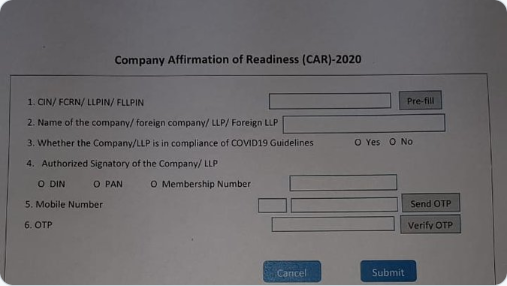
It is a web form deployed on 23rd March, 2020 by the Ministry. The same is a simple web based form requiring only an OTP based verification and does not require any digital signature for affirming or denying the adoption of work from home policy.
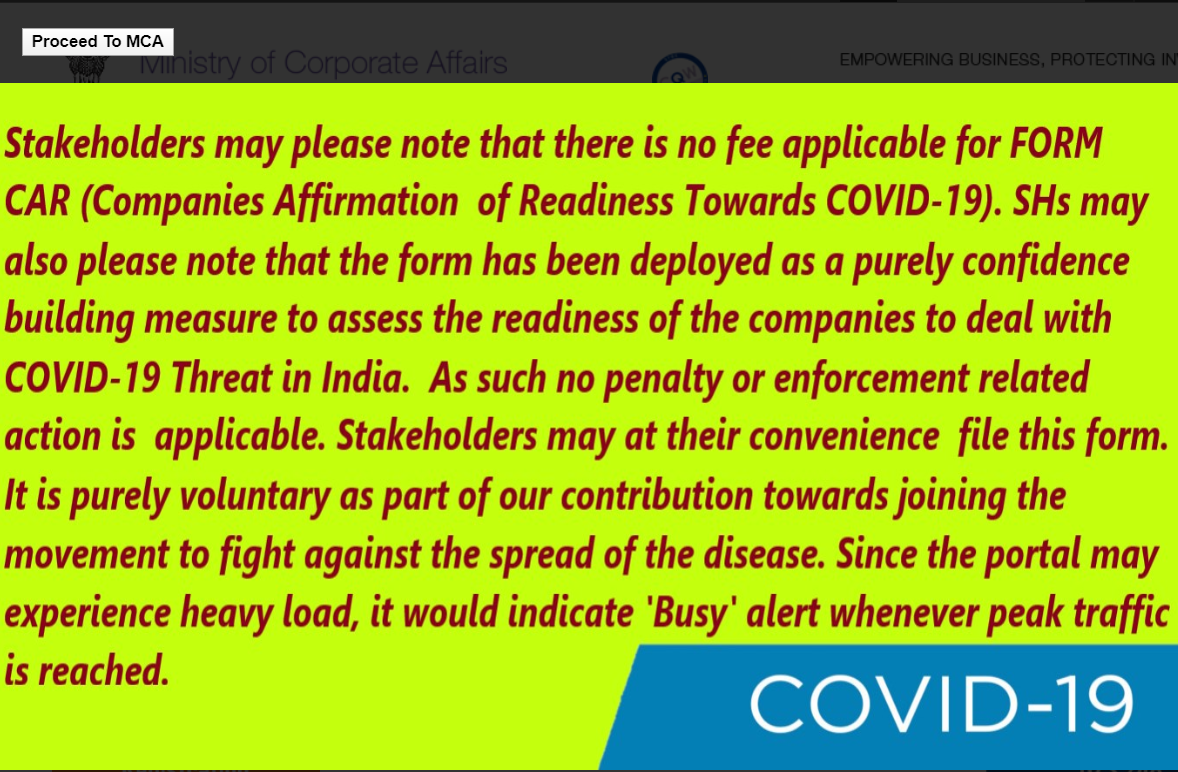
10. Is there a fee for filing form CAR?

There is no fee for filing the form. Seriously, we don’t even imagine there can be a fee.

11. Who will require to file the said form?

All companies and LLPs are expected to file the said form. There is no exclusion or exemption for OPCs, private companies or small companies. However, looking at the language of the applicability, partnership firms and proprietorship concerns have been kept outside the purview of filing CAR, 2020.

12. What is the timeline to file?

The web form CAR, 2020 is deployed on the MCA portal on 23rd March, 2020. Initially, the advice suggested to file it on the same day, however, later it was clarified that the same can be filed till 30th March, 2020.

13. What kind of information/ data to be reported?

As per the twitter handle of the Hon’ble Minister of Finance and Corporate Affairs the possible format of the form shall contain the following:

  1. CIN/ FCRN/ LLPIN/ FLLPIN
  2. Name of the company/ foreign company/ LLP/ Foreign LLP
  3. Whether the company/ LLP is in compliance of COVID 19 Guidelines?
  4. Authorised Signatory of the company/ LLP
  5. DIN/ PAN/ Membership No. of the Authorised Signatory
  6. Mobile No.
  7. OTP

The step to step guide on filing CAR 2020 has been issued by MCA on 22nd March, 2020. The same can be viewed here.

14. Whether foreign company/ LLPs are also required to follow the Advisory?

The Advisory suggests all companies/ LLPs to file the form. The intent seems to include all the companies/ LLPs incorporated in India or companies/ LLPs not incorporated in India but having operations/ physical presence in India. The contents of the Form as provided in Query 9 above suggest the same.

15. What do the COVID 19 Guidelines mean?

There is no definition as such. However, it should mean the Advisory itself issued by the Govt. from time to time. One may refer to pages such as https://www.mygov.in/covid-19/?cbps=1.

16. Who is the Authorised Signatory of the company/ LLP for authenticating the form?

As referred to above, it seems that the authorised signatory may be a director, CS, CFO or any other person authorised to file the form. However, who is eligible to give such authority is not clear. In our view, in case of companies which have given general authority to the CS/ any director/ CFO to file necessary forms with the regulatory authorities from time to time, such authorised persons may file the form. In case of others, the same may be filed by the MD/ head of the organisation who looks after the day to day affairs or any person authorised by such MD/ head of the organisation.  Once again, we suggest there need not be a formal flow of authorisation, such as a resolution, for filing the form.

17. Whether the mobile no. has to be a registered mobile no.?

Since the form is an OTP verified form, the OTP is sent on the mobile no of the person who is authenticating the form and the same is prefilled on providing details of the authorised person.

18. What are the consequences of non- filing?

There is no penalty for non-filing of the form. Further the Advisory is not coming from any statutory requirement but out of a social obligation only, non- filing of the same may not lead to any penal consequences.

19. The Authorised Signatory may be the compliance officer. But how does the compliance officer certify the preparedness across the company, with so many locations?

The authorised signatory is not taking the burden upon himself. The signatory may, in turn, get confirmations from those who are involved, say, the HR head or similar positions.

20. In view of the lockdown/ shutdowns announced by the state governments for various places in India, does it mean lockout of operations by the corporate houses and giving leaves altogether?

Please note that shutdown does not mean shutdown of operation. Therefore, it still means work from home. The whole intent of shutdown is to control movement and not to control work.

21. Are the companies mandatorily required to file form CAR?

As per the information uploaded on MCA’s website, the filing of the form is on voluntary basis. Therefore, the company/ LLP (s) may take a call on filing. However, if one throws a question on whether they are required to take steps to combat COVID-19 by following government guidelines, please note that we have no doubt on answering this is positive. Everyone including the companies and LLPs are mandatorily required to take steps during this health emergency.
Remunerating NEDs and IDs in low-profit or no-profit years

Ambika Mehrotra

corplaw@vinodkothari.com

The role of non-executives (NEDs) and independent directors (IDs) in an organization in bringing their unbiased views, transparency and good governance in the corporate culture has already been recognized globally. The NEDs including IDs are not typically engaged in the day-to-day management but their responsibilities inter-alia include monitoring of the functioning of executive directors. This is quite essential in order to ensure that the decision making in the company is not dominated by individual choices.

As stated by Sir Vincent Powell-Smith in his book ‘Law and Practice Relating to Company Directors’, “apart from the working or executive directors, that is persons who are full-time executives, it is sometimes desirable to take in ” outside ” directors who have no association with the company other than as a director.”

It is to be noted that the unique role of such directors is evaluated by their ‘positive contribution’, in the board, as stated in the Report by Cadbury Committee[1], which is irrespective of the profits generated by the day to day business and working, However, the compensation for their contribution has always been linked to the profitability of the company by virtue of the provisions of Section 309 of the Companies Act, 1956 or corresponding Section 197 in the Companies Act, 2013.

Herein, it is pertinent to note that, while the role if NEDS/IDs demands them to bring independence to the board, the performance/profit based remuneration for non-executive directors has significant potential to conflict with their primary role in the organization. Accordingly, considering various stakeholder representations received by the Government regarding this inconsistency, the Company Law Committee (“CLC/Committee”) which was set up under the Chairmanship of Shri Injeti Srinivas in November, 2019[2] considered the need to have adequate compensation for such directors.

In line with same, the Central Government (CG) has recently laid down another set of amendments before the Lok Sabha on 17th March, 2020 by way of Companies (Amendment) Bill, 2020[3] (“CAB, 2020”). In this article we intend to discuss the said amendment along with the rationale behind the same.

Analysis of the amendments

The board is a mix of executives and non- executives, while the executives are being paid remuneration, the non- executives are only eligible for sitting fee and commission out of profits. Where the difference between the work domain is only as regards the day to day management of the company. Here, it is to be noted that although the non-executives do not involve in the everyday working of any organization, they carry the vintage of their experience in the company. It is interesting to note that while both the kind of directors bring in their bit of value in the company, however during a financial disrupt in a company, maybe through losses or inadequacy of profits, when there is a conflict in the minimum remuneration being paid, where the executive still receive the prescribed remuneration, the non-executives get to sacrifice their commission, which they were otherwise entitled to and they have to satisfy themselves with the sitting fee only.

In order to curb the said conflict, the CAB, 2020 has introduced provisions for allowing payment of adequate remuneration to NEDs in case of inadequacy of profits, by aligning the same with the provisions for remuneration to executive directors in such cases. This is backdrop of the discussion in the CLC Report which considered that the existing provisions in the CA, 2013, do not recognise payment of remuneration to non-executive directors, in case of losses or inadequate profits as it does for the managerial personnels in terms of Section 197 read with Schedule V.

Notably, the concept of minimum compensation to independent directors had also been incorporated in the Uday Kotak Committee report on Corporate Governance issued on October 5, 2017[4]. However, the above requirement of minimum remuneration did not extend to the case of inadequacy of profits.

While the Calcutta High Court in the matter of Hind Ceramics Ltd. vs Company Law Board And Ors[5] discussed that the minimum remuneration paid to the executives and non executives equally might severely impact the financial strength of the loss making entity in recovering the same for an uncertain term. However, on taking a close look at the active involvement of the non-executives in the company by virtue of their enhanced role and liabilities, it is required to re-consider the fact that the inconsistency in the payment of such non-executives as compared to the executives would not only de-incentivise the latter but also affect the retention of talented resources in a company.

Global Precedents

Considering the above, it may also be inferred that the limitation in the provisions of CA, 2013 w.r.t the payment of remuneration to IDs in case of losses or inadequacy of profits frustrates the whole intent of their unique role on the board. Even globally, various  countries have recognised that the level of remuneration for non-executive directors should reflect their time commitment and responsibilities of the role and not be linked to the performance of the company.

UK Corporate Governance Code

As per the UK Corporate Governance Code dated July 2018[6], which clearly provides that,

“Remuneration for all non-executive directors should not include share options or other performance-related element.”

The remuneration of non-executive directors is determined in accordance with the Articles of Association of the company or, alternatively, by the board.

OECD Report on Corporate Governance 

Similar provisions have been recommended in the Portuguese code of corporate governance, as referred in the report of the Organisation for Economic Co-operation and Development (OECD) based on Corporate Governance on Board Practices[7], which provides that the remuneration of the NEDs on the Board should not include a part depending on the performance or the value of the company.

ICGN’s Guidance on NED Remuneration

In addition to the above, the International Corporate Governance Network (ICGN) in its Guidance on Non-executive Director Remuneration[8] explains that the performance-based remuneration in any organisation has significant potential to conflict with a non-executive director’s primary role as an independent representative of shareholders. Although, ICGN is a strong advocate of performance-based concepts in executive remuneration, they do not uphold the same in case of remuneration to non- executives.

Conclusion

In view of the global stand in determining the remuneration to non-executives on  the basis of their value in the organisation without linking the same to the profits of the company, the amendments to be introduced vide the CAB, 2020 appear to be a boon for the IDs. At the same time, we cannot disregard the fact that, the concept of adequate compensation mentioned above applies to the companies facing losses or inadequacy of profits and it may be possible that this might increase the financial distress of the loss making company.  However, the positive aspect of the same still appears to be beneficial as regards the retention of experienced resources who shall remain motivated by being adequately remunerated.

Our other write- ups on similar topics may be viewed at:

  1. https://vinodkothari.com/2019/11/the-injeti-srinivas-committee-report-18-11-2019/
  2. https://vinodkothari.com/2019/11/clc-report-moving-company-law-a-step-closer-to-ease-and-peace/
  3. https://www.moneylife.in/article/norms-for-disqualification-of-directors-may-undergo-change/58842.html
  4. https://vinodkothari.com/category/corporate-laws/

[1] https://ecgi.global/sites/default/files/codes/documents/cadbury.pdf

[2] http://mca.gov.in/Ministry/pdf/CLCReport_18112019.pdf

[3] http://164.100.47.4/BillsTexts/LSBillTexts/Asintroduced/88_2020_LS_Eng.pdf

[4] https://www.sebi.gov.in/reports/reports/oct-2017/report-of-the-committee-on-corporate-governance_36177.html

[5] https://indiankanoon.org/doc/445116/

[6] https://www.frc.org.uk/getattachment/88bd8c45-50ea-4841-95b0-d2f4f48069a2/2018-UK-Corporate-Governance-Code-FINAL.pdf

[7] https://www.oecd.org/daf/ca/49081438.pdf

[8] https://www.top1000funds.com/pdf/ICGN_NED_Rem_Guidelines.pdf

Proposed changes in CSR Rules

Nitu Poddar and Tanvi Rastogi

corplaw@vinodkothari.com

Section 135 of Companies Act, 2013 dealing with the Corporate Social Responsibility (“CSR”) was amended vide the Companies (Amendment) Act, 2019 inter-alia requiring the provisions to change from “comply or explain” to “comply or suffer” by introducing penal provision for non-compliance. The amendment also provided for parking the unspent amount of ongoing projects in a separate account and any other unspent amount to Clean Ganga Fund or PMNRF or like. Amidst the decriminalisation (of offences under Companies Act) spree by the government, the introduction of penalty in the CSR provisions have surely not been welcomed by the corporates.

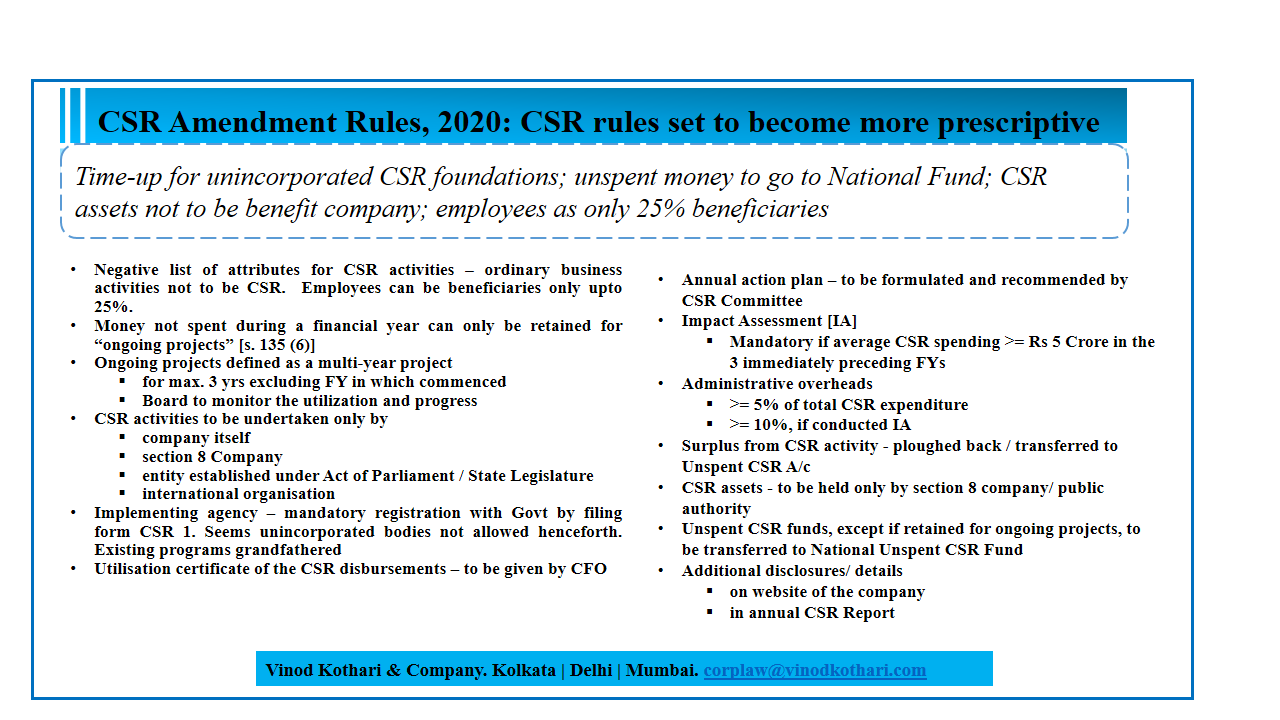
In any case, the provisions have not been made effective for want of respective change in the CSR Rules, 2014. Accordingly, MCA has proposed changes[1] in the CSR Rules vide proposal dated March 13, 2020. Substantial changes have been proposed viz. definition of ongoing projects, that the implementing agencies could be only section 8 companies or a government entity, registering of such implementing agencies by filing e-form CSR-1 with the MCA, CFO certificate, additional website disclosures, detailed CSR report, mandatory impact assessment to name a few.

In this write up, we discuss the impact of the significant proposal in the CSR Rules by the MCA.

Rule No Heading Proposal Remarks / Comments

Rule 2(1)(c)

Negative attributes of what will not be considered as “CSR” Corporate Social Responsibility (CSR)” means the activities undertaken by a Company in pursuance of its statutory obligation laid down in section 135 of the Act in accordance with the provisions contained in these Rules, but shall not include the following, namely-

  1. Activities undertaken in pursuance of normal course of business of the company.
  2. Any activity undertaken by the company outside India.
  3. Contribution of any amount directly or indirectly to any political party under section 182 of the Act.
  4. activities that significantly benefit the employees of the company and their families.

Provided that in case of any activity having less than twenty five percent employees as its beneficiary, then such activity shall be deemed to be CSR activity under these rules

The 4 items mentioned in the negative attributes of what would not include to be a CSR expenditure is not a new provision. This is already mentioned in the current Rule 4 from where it has been replaced in the definition clause.


Only addition is the clarification in clause (iv) w.r.t the extent to which the employees of the Company could be beneficiary of CSR program. The threshold is less than 25% of the total beneficiary of the CSR program.


What is not clarified is whether the threshold of 25% is with respect to value or number. To our mind, it should be the number of employees.


However, this would make the CSR provisions heavy with mechanical rules which people may contrive easily by scheming CSR spend wherein the number of employees benefitted is within the 25% threshold but the value attributed to them is much higher.

Rule 2(1)(e) Definition of CSR Policy “CSR Policy” means a statement containing the approach and direction given by the board of a company, as per recommendations of its CSR Committee, for selection, implementation and monitoring of activities to be undertaken in areas or subjects specified in Schedule VII of the Act. It is clear that unlike the current prevalent practice, where the board lists down the activities from schedule VII for its CSR, the board will have to do a strategic planning with respect to CSR activity to be undertaken by the company.
Rule 2(1)(h) Defining “ongoing projects” and rule thereto “Ongoing Projects” means a multi-year project undertaken by a Company in fulfillment of its CSR obligation having timelines not exceeding three years excluding the financial year in which it was commenced, and shall also include such projects that were initially not approved as a multi-year project but whose duration has been extended beyond a year by the Board based on reasonable justification.

In case of ongoing projects, the Board of a company shall monitor the implementation of the project with reference to the approved timelines and year wise allocation and shall be competent to make modifications, if any, for smooth implementation of the project within the overall permissible time period.


1.     The ongoing project can be a program of maximum 4 years (including the first year of commencement); – mere one-time spending surely cannot be a “project”. It requires continued expenditure over time.

2.     “Year” would surely mean financial year. Therefore if say a project has been commenced in the month of February, 2020, the three FY therefrom, will be FY 2022-2023.

3.     Year wise allocation will have to be made

4.     Basis reasonable justification, a bullet program can also be converted to an ongoing project by the board of directors

While the timeline of 4 years at one go is proposed, the gaps seems to be two-fold:

1.     What about the projects which may take longer than 4 years; so as to keep a close check on India Inc., seems like the govt. intends the companies to make budgets for 4 years and either implement it or transfer amount to the National CSR account

2.     Can such projects be extended after completion of the 4 years? – the answer to this seems to be positive

Rule 4 Modes of implementing CSR activities (1) The Board shall ensure that the CSR activities are undertaken by the company itself or through:

(a) a company established under section 8 of the Act, or

(b) any entity established under an Act of Parliament or a State legislature.

Provided that a company may also engage an international organization[2][3] for implementation of a CSR project subject to prior approval of the central government.


So far, a section 8 company, trust, or a society, having track record of three years in carrying out similar activity was qualified to be an implementing agency, however only section 8 companies are proposed to be retained to be an implementing agency. The language of clause b indicates that only incorporated entities will be eligible to be an implementing agency. However, the language here is quite vague.

Companies currently undertaking CSR through group foundations incorporated / established in any other form will have to look for other agencies as the CSR through in-house foundations seems to be over

Also international organisations identified under section 3 of United Nations (Privileges and Immunities) Act, 1947 can be appointed as implementing agency after approval of central government. This would mean that the Indian branch of such organisation will have to work in a schedule VII activity within India.

The method of seeking such prior approval is not proposed. This may require the involvement of Ministry of External Affairs.

Rule 4(1) Mandatory registration of implementing agency with the MCA Provided that such company/entity, covered under clause (a) or (b), shall register itself with the central government for undertaking any CSR activity by filing the e-form CSR-1 with the Registrar along with prescribed fee.

Provided further that the provisions of this sub-rule shall not affect the CSR projects or programmes that were approved prior to the commencement of the Companies (CSR Policy) Amendment Rules, 2020.

This is a fresh introduction. The template of the e-Form is present in the draft rules. Also, this would mean that, post these Draft Rules comes into force, these entities will not be hired as implementing agencies until they register themselves. This would lead to regulating of such implementing agencies.
Rule 4(3) Other role of international organisation A company may engage international organizations for designing, monitoring and evaluation of the CSR projects or programmes as per its CSR policy as well as for capacity building of their own personnel for CSR. The provision, using the word “may”, is directory and not mandatory. Accordingly, companies can take a call to appoint any other entity to undertake the prescribed overhead jobs in respect of CSR. In any case, the threshold allowed as administrative overhead will be applicable,
Rule 4(4) Board responsibility and CFO certification Board of a company shall satisfy itself that the funds so disbursed have been utilized for the purpose and in the manner as approved by it and Chief financial Officer or the person responsible for financial management shall certify to the effect. This is an extremely important proposal. In addition to the monitoring by the board, it requires the CFO or alike to give utilisation certificate of the disbursements made. This makes the role of monitoring all the more crucial.   This apart the, CFO will also be required to sign the annual CSR report.

This clause makes the CFO apparently responsible for the entire CSR provision without him being part of the CSR committee or the board of directors.

Probably, such certificate shall have to be placed before the CSR committee and / or the board – the draft rules are silent on this.

Rule 5 CSR Committee – responsibility to recommend annual action plan The CSR Committee shall formulate and recommend to the Board, an annual action plan in pursuance of its CSR policy, which shall include the following:

a)     the list of CSR projects or programmes that are approved to be undertaken in areas or subjects specified in Schedule VII of the Act;

b)     the manner of execution of such projects or programmes as specified in sub-rule (1) of Rule 4;

c)     the modalities of utilization of funds and implementation schedules for the projects or programmes; and

d)     monitoring            and            reporting mechanism            for            the            projects or programmes.

This seems to be an immediate actionable once the draft rules are effective.

While annual budget and areas of activities was being recommended by the CSR Committee, however, the manner of execution was something that was currently being decided by the board. Also, practically speaking, there used to be one of meeting of CSR in several cases in which the allocating of budget for next FY and approving and signing of the report of last FY used to be done.

However, it is proposed that the committee draws a detailed annual action plan to undertake CSR program. Reading the draft rules, it seems like the government is in full mood to get the management on their heels for effective implementation of the CSR provisions along with ensuring that such spent is making impact in the society.

Rule 8(3) Mandatory CSR impact assessment A company having the obligation of spending average CSR amount of Rs 5 Crore or more in the three immediately preceding financial  years in pursuance of sub section 5 of Section 135 of the Act, shall undertake impact assessment for their CSR projects or programmes, and shall disclose details of the same in its Annual Report on CSR.

 The impact assessment report is to be attached to the annual report [as per the annexure]


The High Level Committee on CSR[4] highlighted importance of the need and impact assessment for projects with higher outlays. This will help in bringing forth the areas requiring more attention, for there development.

Companies having minimum 5 cr of average CSR obligation in last 3 years shall have to undertake mandatory impact assessment. Interestingly, the report of such assessment is proposed to form part of the annual report.

There are several question around this:

1.     who does this assessment ? surely, the govt acknowledges that an outside entity can also be engaged for such assessment and therefore there is increased limits of allowed overhead expenditure for such companies who are mandatorily required to undertake such assessment

2.     also, it is to be noted that the CSR report as mentioned in the annexure, includes surplus from CSR in the total CSR obligation; – will this mean that where there is extraordinary surplus, compliance of this provision becomes applicable because of surplus ? it may in such cases prove to be waste of resources

Rule 7(1) Limit of overhead expenses The board shall ensure that the administrative overheads incurred in pursuance of sub-section (4) (b) of section 135 of the Act shall not exceed five percent of total CSR expenditure of the company for the financial year.

Provided that a company undertaking impact assessment, in pursuance of sub-rule (3) of Rule 8, may incur administrative overheads not exceeding ten percent of total CSR expenditure for that financial year

Discussed above
Rule 7(2) Surplus out of CSR program Any surplus arising out of the CSR projects or programmes or activities shall not form part of the business profit of a company and shall be ploughed back into the same project or shall be transferred to the Unspent CSR Account and spent in pursuance of CSR policy and action plan of the company.


Though it may seem to be amendment in this provision, however, there is no effective change. The surplus out of CSR activity was anyway prohibited to form part of business profits of the Company. This is just an explicit clarification to say that it has to be used back for CSR purpose only – either the same program from which such surplus has been generated or any other project as per CSR policy of the company.

What is missing is the time limit within which such surplus has to be transferred to the unspent account.

Rule 7(3) Title holder of CSR assets The CSR amount may be spent by a company for creation or acquisition of assets which shall only be held by a company established under section 8 of the Act having charitable objects or a public authority[5].

Provided that any asset created by a company prior to the commencement of Companies (CSR Policy) Amendment Rules, 2020, shall within a period of One hundred and eighty days from such commencement comply with the requirement of this rule, which may be extended by a further period of not more than ninety days with the approval of the board based on reasonable justification


This is another important proposal which says that any asset acquired / created for the purpose of CSR has to be in the name of a section 8 company or a public authority and cannot be held in the name of the company itself. Considering the quantum of CSR spent being carried through in-house foundations, its seems that this may be heavily opposed by the corporate houses.

Here asset is not defined. However, the intent seems to mean fixed assets only.

If otherwise, that would effectively mean that a section 8 company will have to be engaged for any CSR activity because one cannot think of any CSR activity without creation / acquiring of any asset.

180+90 days (extension with reasonable justification) time has been proposed for the compliance of this provision.

Rule 7(4) Unspent amount of ongoing projects to be transferred to Unspent CSR Account Unspent balance, if any, towards fulfilment of CSR obligation at the time of commencement of these Rules shall be transferred within a period of thirty days from the end of Financial Year 2020-21 to special account viz., ‘Unspent Corporate Social Responsibility Account’ opened by the company and such amount shall be spent by the company in pursuance of its obligation towards the Corporate Social Responsibility Policy within a period of three financial years from the date of such transfer, failing which, the company shall transfer the same to a Fund specified in Schedule VII, within a period of thirty days from the date of completion of the third financial year. From this provision it seems that the first year of transfer to unspent CSR amount is proposed to be for the FY 2020-21 i.e by 30th April, 2021.

However, the requirement mentioned in the annual CSR report (annexure to the draft rules) seems to suggest that the provision for transfer may be applicable for current FY i.e the unspent amount may be required to be transferred within 30th April, 2020.

Rule 9 Additional disclosures on the website of the company The Board of Directors of the company shall mandatorily disclose the composition of the CSR Committee, and CSR Policy and Projects approved by the Board on their website for public viewing, as per the particulars specified in the Annexure. This is again an important proposal for the companies which have / are required to have a functional website. This requires the companies to inter alia mandatorily disclose the CSR projects approved by the board. So far, this was only known from the annual report much after the end of the FY. This proposal indicates that the board will have to make a thought-through plan on the recommendation of the CSR Committee as the same will be displayed on its website and therefore cannot be changed as per the whims and fancies of the board.

This will also put check on the random on-off / philanthropic acts of the promoters which currently is, in many cases, being converted to CSR spent.

Rule 10 National Unspent Corporate Social Responsibility Fund The Central Government shall establish a fund called the “National Unspent Corporate Social Responsibility Fund” (herein after referred as “the Fund”) for the purposes of sub-section (5) and (6) of section 135 of the Act. The Fund shall be utilized for the purposes of undertaking CSR projects in the in areas or subjects specified in schedule VII of the Act. Provided that until such fund is created the unspent CSR amount in terms of provisions of sub-section (5) and (6) of section 135 of the Act shall be transferred by the company to any fund as specified in schedule VII of the Act.

The manner of administration, authority for administration of the Fund shall be in accordance with such guidelines as may be prescribed by the Central Government from time to time.

This is the proposed govt fund dedicated to undertake CSR activities.
Annexure Annual CSR Report Several additional details in line with the rest of the proposal:

1.     total CSR obligation to additionally include the surplus arising out of CSR profits

2.     CIN of implementing agencies

3.     Details of CSR amount spent / unspent for the financial year

4.     Details of CSR amount spent against ongoing projects for the financial year

5.     Details of CSR amount spent against other than ongoing projects for the financial year

6.     Amount spent in Administrative Overheads

7.     Details of CSR amount spent/ unspent for the preceding three financial years

8.     Details of CSR amount spent for ongoing projects of the preceding financial year(s)

9.     Amount transferred to ‘Unspent CSR Account’ pursuant to sub-rule (4) of Rule 7 of Companies (CSR Policy) Rules, 2014 for the financial year 2014-15 to 2019-20

10.  In case of creation or acquisition of asset, details relating to the asset so created or acquired through CSR spent in the financial year

11.  reason(s) if the company has failed to spend two per cent of the average net profit as per section 135(5)


Signing of the CSR Report: inter alia to be signed by Director or Chief Financial Officer

There are several additional details required in the report which is by and large in line with the additional requirement.


It may be noted that requirement of CIN of implementing agencies will be applicable for section 8 companies only.


While the proposed rules are quite technical, considering the intent of CSR, it should be broadly principle based then laden with heavy rules and the CSR committee could be laden with the onus of compliance of the provisions in such case.

In any case, looking at the Draft Rules, it seems to be loud and clear that gone are those days when the companies used to take the CSR provisions lightly by putting cliché explanations in the annual report for all the gaps for unspent amount. One cannot ignore that, as per CARO-2020, the auditor is also required to comment on the CSR provisions specifically with respect to the amount unspent and whether transferred to the unspent account.

While it would be taking the companies to task if the proposed amendments are brought into force before the end of the current FY, however, it will not be surprising looking at the trend of applicability of CARO-2020 and timing of this Draft Rules.


[1] http://feedapp.mca.gov.in/csr/pdf/draftrules.pdf

[2] International Organization” means an organization notified by the Central Government as an international organization under section 3 of the United Nations (Privileges and immunities) Act, 1947 (46 of 1947), to which the provisions of the Schedule to the said Act apply.”

[3] List of such recognised international organisation – refer footnote to section 3 and 4: http://www.mea.gov.in/Uploads/PublicationDocs/142_1947-The-United-Nations-Privileges-And-Immunities-Act-1947.pdf

[4] https://www.mca.gov.in/Ministry/pdf/CSRHLC_13092019.pdf

[5] Public Authority” means ‘Public Authority’ as defined in sub- clause (h) of section (2) of Right to Information Act, 2005.


Read our article on the topic of CSR here:

https://vinodkothari.com/2019/08/csr-a-corporate-social-responsibility-or-a-corporate-social-compulsion/

Read our article on changes proposed by the high level committee on CSR:

https://vinodkothari.com/2019/08/injeti-srinivass-committee-changes-recommended-in-provisions-of-corporate-social-responsibility/

For FAQs related to CSR click here:

https://vinodkothari.com/2014/02/corporate-s-ocial-r-esponsibility-faqs/

Majority of minority to ensure economic interest in transactions with related parties

SEBI’s proposal–came late, came correct

-CS Nitu Poddar, Tanvi Rastogi

corplaw@vinodkothari.com

Financial assistance to related entities is a quite a regular transaction. Considering the transfer of obligations, such transactions are subject to certain regulation under the Companies Act, 2013 (Act, 2013) and SEBI (Listing Obligations and Disclosure Requirements) Regulations, 2015 (LODR). However, despite the prohibitions and restrictions, there are several areas within the periphery of transactions with related parties which remain out of the ambit of law and therefore is beyond required checks. Following the proposal of changes in the provisions of RPT vide the report of the working group[1], SEBI has floated a consultative paper[2] on 06-03-2020 proposing certain changes to corporate guarantees being provided by a listed party on behalf of its promoter / promoter related entities, without deriving any economic benefit from such transaction.

In this article, we discuss the coverage of the current provisions, gap therein, need for the proposal and the proposed regime to bridge such gap.

Unrelated-related parties – remains unregulated

As compared to the Act, 2013, LODR has a wider definition of related party where it additionally covers related parties under AS-18 / IND AS-24 and also such member of promoter and promoter group which holds 20% of the total shareholding of the listed entity. Despite such wide definition, practically speaking, there may be several interested entities of the promoter which gets excluded from the technical criteria of being a related party due to absence of required shareholding and consequently transactions with them can easily sail through without being subject to required approvals. As such, currently, a listed entity can grant loan, give guarantee / security in connection of loan to / on behalf of an entity, which technically is not a related party, but either is a promoter or an entity in which the promoter has vested interest against the interest of stakeholders of the lending company.

Existing provisions regulating financial transactions

Currently, section 177, 185 and 186 of Act, 2013 are the major provisions governing any financial transactions. Section 188 of the Act, 2013, does not cover financial transaction within its coverage and therefore the same get ruled out anyway. Section 177 provides for scrutiny of inter-corporate loans as well as approval and modifications of all related party transactions. The challenge of this section are that firstly, transactions with interested unrelated party gets ruled out and   consequently the committee is left with the duty of a post mortem scrutiny and not a prior scanning of the transaction. Sec 186 provides for limits of financial transaction i.e giving of loan, investment, guarantee, security in connection with loan and also keeps a check on minimum rates to be charged in case of loan. Transactions beyond the limits require approval by special majority of the shareholders. Sec 185 talks about granting of loan to directors and director-interested entities. While there is complete prohibition of granting of such loan to the director himself or his relative / firm, loan can be granted to interested-companies, subject to approval by special majority of shareholders of the lender company.

To get such approval is not a tough task in a company with high promoter-holding, and the promoters can easily get their transaction through. Unlike sections 188 and 184 where the voting rights of the interested parties are restricted in the general meeting and board meeting respectively, section 185 and 186 does not provide for any such restrictions.

As per Reg 23 of LODR, related party transactions, which includes financial transactions as well, requires approval of shareholders by majority. This approval is by the majority of the minority as all entities falling under the definition of related parties cannot vote to approve the relevant transaction irrespective of whether the entity is a party to the particular transaction or not.

Proposed amendment – need and proposal 

It is to be noted that whenever there is a transaction with a promoter related entity, there may be a potential threat to the interest of the non-promoter group / minority shares. Accordingly, approval of the majority of such minority is to be essentially sought to ensure that the resources of the company are not been siphoned away / wrongly used / alienated by the promoters and that the interest of such minority is secured. As mentioned above, in the existing regime, question of approval from such majority of minority arise only for material RPTs under LODR.

Hence, all such transactions which does not fall under the category of “RPT” and / or “material” remains unguarded and thus putting the corporate governance of the company at stake.  SEBI, in its report on working group of RPT[3], has clearly put forward its intent to curb such influential transactions by the promoter / promoter group and to revise the definition of related party itself. Once the said proposal is made effective, all transactions with promoter / promoter group will be a RPT. However, inspite of such revision in the definition of RPT, only material transactions will require approval of minority shareholders.

Through the proposal in the consultative paper, SEBI intends to move a step ahead of what the working group discussed. SEBI now proposes to require all guarantee transactions, irrespective of the materiality to be approved by the majority of minority shareholders. Additionally, the directors of lending company are required to establish and record “economic interest” in granting of such guarantee.

Essence of voting by majority of minority

It is no approval, if the person seeking approval and granting approval is the same. In corporate democracy, approval is essentially ought to be sought from the class of people whose rights seem to be prejudiced from transaction proposed in the interest of another class. Reg 23 of LODR and sec 188 of Act, 2013 already recognises such majority of minority approval wherein all the related parties of the company refrain from voting.

Significance of “economic interest”

Any prudent mind would require risk and reward, benefit and burden to be shared proportionately. It is absolutely irrational to say that a listed company is extending guarantee / security in connection with loan but has no benefit in return.

It is to be noted that charging of guarantee commission or charging of interest is not to be misunderstood as presence of economic interest. There are charged only to keep the transaction at arm’s length. However, the exposure of the lender company is the amount of loan / amount guaranteed.

Few examples of embedded economic interest in a transaction can be as follows:

  1. A holding company extending loan to its wholly-owned subsidiary for funding acquisition of land for building of plant may be benefitted by the figures of such subsidiary at consolidated level;
  2. A listed company guaranteeing on behalf of another unrelated-related entity which is the customised raw material provider of the lending company

Different scenarios of financial transaction considering the proposal of SEBI:

S. No. Transaction between Existing provision Proposed amendment Analysis
1


Two unlisted companies Section 186 / 185, if  applicable Unlisted companies are not covered No Impact
2 Listed company with its related party – beyond materiality threshold Section 186 / 185, if  applicable and Reg 23- shareholders’ approval through resolution where no  related  party  shall  vote  to  approve Ensuring the economic interest + Prior  approval  from  the shareholders on a “majority of minority” basis Irrespective of the materiality, where there is any transfer of financial obligation, prior approval of unrelated shareholders will be required
3 Listed company with related party not within materiality threshold No requirement for shareholders’ approval Ensuring the economic interest + Prior  approval  from  the shareholders on a “majority of minority” basis Irrespective of the materiality, where there is any transfer of financial obligation, prior approval of unrelated shareholders will be required
4 Listed company with unrelated related party[4] No requirement prescribed under law

Open issues

  1. While the proposed amendment is absolutely on-point and timely amendment in the wake of several corporate scams in the recent past being witnessed by the country, however, it will achieve its intent if the same is not kept limited to guarantee / security in connection with loan, but also extended for granting of loan to such unrelated-related entities;
  2. Also, the list of entities is kept vague in the Paper (promoter(s)/ promoter group/ director / directors relative / KMP etc) and may be better clarified in the amendments, however, the intent seems to be quite clear to include any promoter / promoter group / management related entity;
  3. Lastly, it is not clear as to who should refrain from voting for majority of minority voting – all promoter / promoter group entities / all related parties of the listed entity;


[1] https://www.sebi.gov.in/reports-and-statistics/reports/jan-2020/report-of-the-working-group-on-related-party-transactions_45805.html

[2] https://www.sebi.gov.in/reports-and-statistics/reports/mar-2020/consultative-paper-with-respect-to-guarantees-provided-by-a-listed-company_46234.html

[3] SEBI Report on working group of RPT dated 27th January, 2020 ibid

[4] Includes promoters which may not fall under definition of related party – like promoter not holding any shareholding in the company

Read our article on proposed changes by working group of SEBI on Related Party Transactions here: https://vinodkothari.com/2020/01/expanding-the-web-of-control-over-related-party-transactions/

Read our articles on the topic of related party transactions here: https://vinodkothari.com/article-corner-on-related-party-transactions/

Regulated deposit takers: Whether need to intimate under BUDS?

Timothy Lopes, Executive, Vinod Kothari & Company

finserv@vinodkothari.com, corplaw@vinodkothari.com

Almost a year after the Banning of Unregulated Deposits Schemes Act, 2019[1] (BUDS Act/ Act) came into force, the Ministry of Finance has, vide notification dated 12th February, 2020, notified The Banning of Unregulated Deposits Schemes Rules, 2020[2] (BUDS Rules/ Rules).

The BUDS Act, was enacted with the intent to curb all unregulated deposits schemes being run by fraudulent means such as ponzi schemes. On the other hand, the BUDS Act lists out regulated deposit schemes, which are essentially regulated by MCA, SEBI, RBI, etc., such as collective investment schemes, alternative investment funds, portfolio management services, employee benefit schemes, mutual fund schemes, etc. regulated by SEBI; deposits accepted by NBFCs, etc. as regulated by RBI, insurance contracts regulated by IRDAI; schemes or arrangements made or offered by co-operative societies, chit funds, etc. regulated by the relevant State Government or Union Territory Government; housing finance companies regulated by the NHB; pension funds regulated by the PFRDA; pension schemes or insurance schemes framed under the Employees’ Provident Fund Miscellaneous Provisions Act, 1952; Deposits accepted or permitted under the provisions of Chapter V of the Companies Act, 2013 regulated by MCA.

The definition of deposit taker and meaning of deposit along with exclusions from the meaning, is specified under the Act. We have analysed the definitions in our related articles and write ups on the subject[3].

Designated authority

As a part of regulation, the law provides for collation of information pertaining to deposit takers.

As per Section 9 of the Act, the Central Government has the power to designate an authority (existing or already constituted)[4] which shall create, maintain and operate an ‘online database’ for information on ‘deposit takers’ operating in India. The Rules empower the designated authority to require any regulator or any competent authority (appointed under section 7 of the Act) or any other entity/person to submit to it any information in its possession relating to deposit takers in India. However, the authority is yet to be designated, inspite of the fact that the Rules have already come into force on 12th February, 2020.

Requirement of intimation by deposit-takers

As per section 10 of the Act, every deposit taker commencing its business after the commencement of the Act, is required to intimate the authority about its business in the form and manner to be prescribed. As per rule 7 of the Rules, the intimation is to be sent within a period of 30 days from the date of commencement of business.

A relevant question here, might be whether regulated deposit takers (say, AIFs, CISs, NBFC-D, etc.) will also be required to give intimation to the designated authority of commencement of business.

Note that the explanation to section 10 reads as under –

“Explanation.—For the removal of doubts, it is hereby clarified that—

  • the requirement of intimation under sub-section (1) is applicable to deposit takers accepting or soliciting deposits as defined in clause (4) of section 2; and
  • the requirement of intimation under sub-section (1) applies to a company, if the company accepts the deposits under Chapter V of the Companies Act, 2013.”

Clearly, explanation (a) above makes reference to definition of deposit under section 2(4) of the BUDS Act, to determine whether the deposit taker will be required to give intimation. Note that as per the definition of deposit under section 2(4), there is no explicit exclusion with respect to regulated deposit schemes. In fact, the explanation to clause 2(4) says that with respect to NBFCs, ‘deposit’ shall be interpreted in terms of RBI Act. Hence, it can be contended that all deposit takers undertaking regulated deposit scheme shall be required to send intimations to the designated authority.

However, explanation (b) includes companies accepting deposits under the Companies Act, which is a regulated deposit scheme under the BUDS Act [entry 9 of the First Schedule], as deposit taker which shall give an intimation under BUDS Act. Therefore, it can be argued that because of this explicit inclusion of one particular regulated deposit taking entity, all other regulated deposit takers will stand exempted from the requirement of giving intimations.

The foregoing indicates that the provisions are vague insofar the regulated deposit schemes are concerned. The discussion below seeks to find an answer.

The BUDS Bill, 2015 and Report of IMG

Clause 10 of the BUDS Bill, 2015 is the same as section 10 of the BUDS Act.

State Bank of India, in their submission to the Standing Committee on Finance[5] have opined on the provisions relating to Central Database, as there in the Bill, as under –

“The scope of the centralized database has been kept very wide and vague and it needs to have a list of all the companies which have been found in violation of the Bill and it should also maintain a list of all Government approved schemes.”

In case the requirement extends to all regulated deposit-takers there will be a tedious and added compliance burden on genuine business entities who are under the purview of regulators which already possess their data.

Further, it is highly unlikely that unregulated deposit takers will file an intimation to the authority. This was also the rationale given in the Report of the Inter-Ministerial Group (IMG) on the BUDS Bill, 2015[6].

The IMG stated about intimation requirement as under –

“Intimation of business by a Deposit Taking Establishment –

The intent of this provision is to prescribe an intimation requirement which will be applicable to all Deposit-taking Establishments. While it is unlikely that establishments operating Unregulated Deposit Schemes will comply with the said intimation requirements, compliance by Regulated Deposit Schemes may enable the State Government to detect deposit schemes which are operating without any registration. xxx”

Conclusion

In light of the discussions above, there seems to be a lack of sufficient clarity on the issue. However, it can be contended on the strength of explanation (b), that the explicit inclusion of companies accepting deposits under Companies Act, will lead to presumption that the law does not require other regulated deposit-takers to give intimation.

Further, the intention of the BUDS Act was not to cover regulated deposit takers at all. Imposing intimation requirements over regulated deposit takers would be unreasonable and counterproductive and should be meant to cover only unregulated deposit takers.

Ideally, the authority should request for the data from the Regulators which have a ready database at hand, rather than place a burden on each regulated deposit taking entity to intimate the authority.

There is a need for clarity on the provisions laid down in the Rules with respect to the online database. It would be unreasonably tedious to place an intimation burden on all deposit takers. The intent behind creating the database to detect unregulated deposit schemes should be effectively implemented rather than adding a burden of compliance to regulated entities carrying out genuine deposit taking activity. Further, the intent behind the creation of a Central Database of deposit takers is for early detection of unregulated deposit schemes. It seems as though the scope of the central database has been kept wide, as to how the database will detect unregulated deposit taking activity is yet to be seen.


[1] http://egazette.nic.in/WriteReadData/2019/209476.pdf

[2] http://egazette.nic.in/WriteReadData/2020/216125.pdf

[3] Readers may refer: https://vinodkothari.com/2019/02/presentation-on-banning-of-unregulated-deposit-schemes/

https://vinodkothari.com/2019/02/menace-of-illicit-deposit-schemes-pinned-down/

https://www.moneylife.in/article/a-nip-in-the-bud-ordinance-bans-unregulated-deposits/56428.html

https://www.moneylife.in/article/banning-unregulated-deposits-schemes-big-concern-for-small-businesses/56448.html

[4] Yet to be designated by the Central Government

[5] https://www.prsindia.org/sites/default/files/bill_files/SCR-The%20Banning%20of%20Unregulated%20Deposit%20Schemes%20Bill%2C%202018.pdf

[6] https://financialservices.gov.in/sites/default/files/Public%20Comments%20on%20the%20Report%20of%20the%20Inter-Ministerial%20Group%20on%20Deposit%20Taking_0.pdf
