
TReDS Master Directions issued by RBI
- Harshita Malik | finserv@vinodkothari.com
RBI has issued the Reserve Bank of India (Trade Receivables Discounting System) Directions, 2026 (‘Final Directions’), replacing the draft Trade Receivables Discounting System (TReDS) directions (‘Draft Directions’) published earlier (read our article on the draft here). The Final Directions make a number of substantive changes from the Draft Directions and consolidate several operational and supervisory requirements by cross-referencing the Master Directions on Authorisation to operate a Payment System (‘PSO Authorisation Directions’).
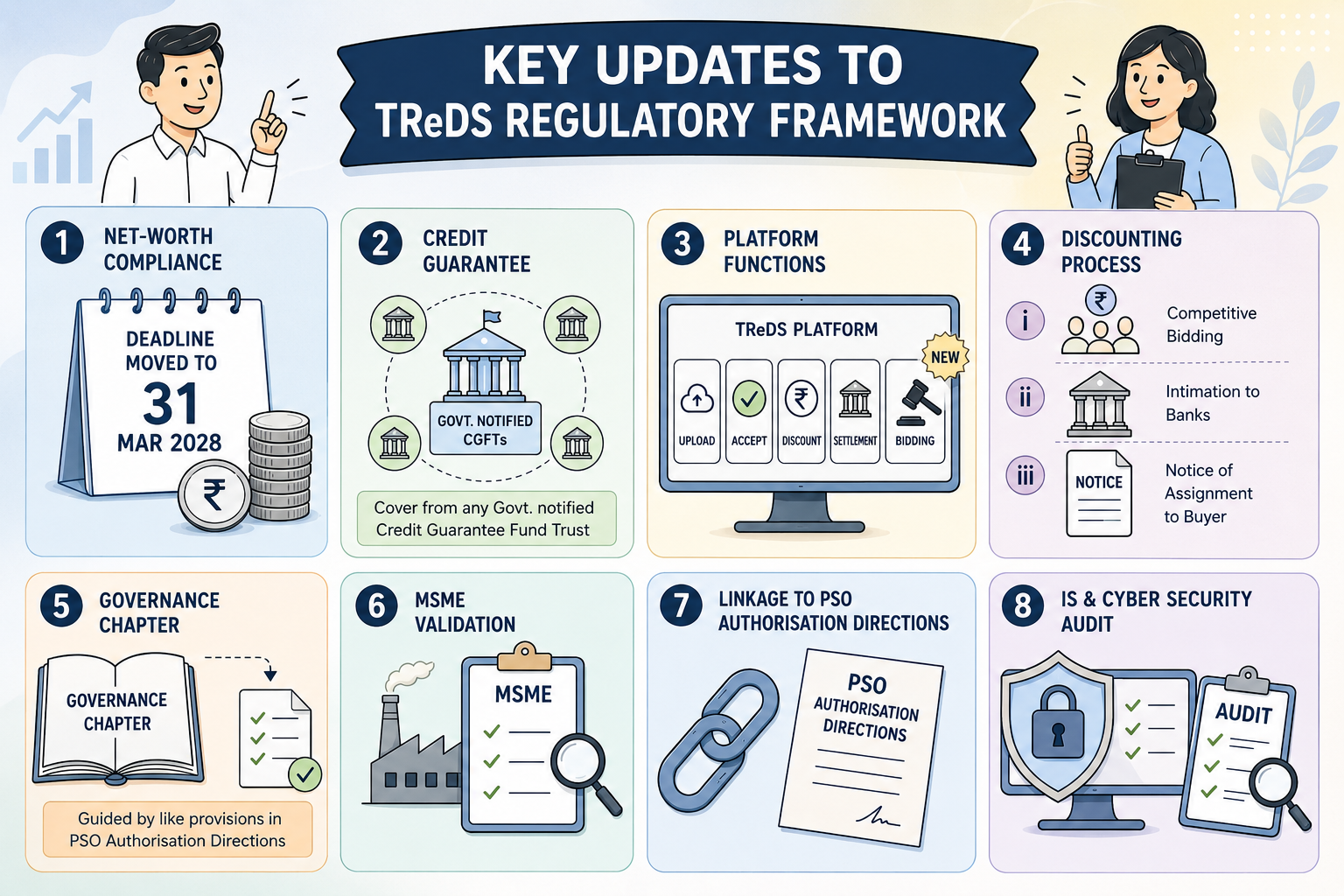
Highlights:
- Net-worth compliance: Prescribed minimum limit of ₹25 crore, deadline being 31st March 2028 for existing entities;
- Credit Guarantee: Financiers may now avail credit guarantee cover from any credit guarantee fund trust notified by the Government of India (earlier draft limited cover to NCGTC);
- Platform Functions: ‘Bidding’ added as a formally recognised core platform function alongside uploading, accepting, discounting and settlement;
- Discounting Process: Three operational obligations for discounting:
(i) transparent multi-financier competitive bidding; (this is similar to multi-lending platform in case of digital lending)
(ii) intimation to the working capital/CC account banks of the buyer and seller; and
(iii) formal service of a notice of assignment to the buyer in favour of the financier;
- Governance Chapter: Deletion of the standalone governance/fit-and-proper chapter proposed in the draft; presumably now guided by the like provisions in the PSO Authorisation Directions;
- MSME Validation: Platforms must implement validation mechanisms to ensure that sellers uploading invoices or bills of exchange are bona fide MSMEs; While the draft recommended a simplified process for onboarding of MSMEs, the Final Directions requires a validation mechanism to ensure that seller is MSME;
- Linkage to PSO Authorisation Directions: Several application and authorisation procedures are cross-referenced to the PSO Authorisation Directions;
- IS & Cyber Security Audit: IS audit and cyber security audit requirements have been aligned with RBI guidance referenced in DPSS.CO.OD.No.1325/06.11.001/2019-20 dated January 10, 2020 (scope and coverage to follow that letter).
Background:
TReDS is a technology-enabled platform for financing trade receivables through multiple financiers. The Draft Directions issued earlier set out proposed regulatory, governance and operational requirements. The Final Directions refine those proposals, streamline supervisory overlaps by cross-referencing existing PSO Authorisation Directions, and add operational safeguards to strengthen transparency and MSME protection.
Discounting Process:
The platform shall facilitate the discounting of factoring units by way of receiving bids from multiple financiers in a transparent manner, resulting in flow of funds to the sellers, providing intimation to banks holding working capital / cash credit accounts of buyer and seller, serving of notice of assignment to buyer in favour of financier, with final payment being made by the buyer to the financier on due date. Since financing a transaction on TReDS will result in assignment of receivables in favour of the financier, the platform shall file the said assignment with the central registry (CERSAI), as provided under Registration of Assignment of Receivables (Reserve Bank) Regulations, 2022 dated January 14, 2022 (as amended from time to time).
Changes at a Glance:
| Basis | Erstwhile Guidelines/Circulars | Draft Directions | Final Directions |
|---|---|---|---|
| Definition of TReDS | Scheme for setting up and operating the institutional mechanism for facilitating the financing of trade receivables of MSMEs from corporate and other buyers, including Government Departments and Public Sector Undertakings (PSUs), through multiple financiers | A system for facilitating financing of trade receivables. It is a technology platform on a digital or electronic network for facilitating factoring of trade receivables through multiple financiers | A technology platform on a digital or electronic network for facilitating factoring of trade receivables through multiple financiers. Although the definition has changed from the erstwhile guidelines, the substance remains the same. |
| Application Mechanism | Application format same as for any non-bank entity to seek authorisation under the PSS Act | PRAVAAH portal, Form A of Appendix 1 of these directions | Subsumed into the consolidated PSO Authorisation Master Direction. Application through the PRAVAAH portal. |
| Capital Requirement | ₹25 crore paid-up equity capital | ₹25 crore Net Worth | ₹25 crore Net Worth |
| Governance / Fit-and-Proper | Specified fit and proper criteria for entities and their promoter/promoter group- sound credentials and integrity, financial soundness and track record of at least 5 years in running the business | Specified fit and proper criteria for directors- fairness and integrity, conviction, insolvency debarment, unsound mind, financially unsound | No such requirement prescribed under the Final Directions, since such aspects are covered under the PSO Authorisation Directions |
| Net-worth Compliance Deadline | Paid-up equity capital to be maintained from the inception itself | 31st March 2027- for existing entities authorised to operate TReDS | 31st March 2028- for existing entities authorised to operate TReDS |
| Participants on TReDS Platform | Seller, Buyer, Financier, and Insurance Companies | Sellers, Buyers, Financiers, Insurance Companies, NCGTC | Sellers, Buyers, Financiers, Insurance Companies, Credit Guarantee Fund Trust notified by Government of India (not restricted to NCGTC) |
| Platform Activities | Uploading, accepting, discounting, bidding, trading and settlement | Uploading, accepting, discounting and settlement of factoring units | Uploading, accepting, bidding, discounting and settlement of factoring units |
| MSME Eligibility Verification | Required as part of the KYC process | Validation mechanisms required to be put in place to ensure that the seller uploading invoices/bills of exchange is an MSME | Validation mechanisms to ensure that the seller is an MSME, and funds due to the seller are credited in the seller’s bank account only. |
| Discounting Process | Facilitate the discounting of the factoring units by the financiers resulting in flow of funds to the MSME with final payment of the factoring unit being made by the buyer to the financier on due date. | Facilitate the discounting of factoring units by the financiers, resulting in flow of funds to the sellers, with final payment of the factoring unit being made by the buyer to the financier on due date | 2 new operational obligations added: (i) intimation to working capital/CC account banks of buyer and seller; (ii) formal serving of notice of assignment to buyer in favour of the financier |
| Credit Guarantee | Credit insurance available, no mention of credit guarantee | Only through NCGTC | Can be provided by any credit guarantee fund trust set up by Government of India |
| IS Audit& Cyber Security Audit | No such mandatory requirement | Conducted by CERT-In empanelled auditors | Scope and coverage shall be as per the RBI’s Letter DPSS.CO.OD.No.1325/06.11.001/2019-20 dated January 10, 2020 |
| Reporting Requirements | No such requirement. | Annually (by 30 Sept): submit audited net-worth certificate and IS/Cyber Security Audit report. Monthly (by 7th): submit TReDS statistics. (Format: Appendix 1)Event-based: report any change in Board along with director declaration/undertaking. (Format: Appendix 2) | Remains unchanged from the draft. |
| Settlement Process | TReDS will generate the payment obligations of all financiers in respect of all factoring units financed on a given date, on T+2 basis. | TReDS to ensure efficient and seamless settlement of transactions amongst the participants | Remains unchanged from the draft |
| KYC | KYC of both the buyer and the MSME seller is required | KYC of the buyer is required. Validation mechanism that the seller is an MSME to be put in place. | Remains unchanged from the draft |
Closing Remarks
The Final Directions strengthen operational transparency, broaden access to government-backed credit guarantees, and place explicit obligations on platforms to verify MSME eligibility and formalise discounting workflows. By folding several requirements into the PSO Authorisation Directions, the RBI has aimed to streamline authorisation and oversight while emphasising operational controls that protect MSMEs and financiers.
Leave a Reply
Want to join the discussion?Feel free to contribute!