
Failure to disclose price sensitive information: SC upholds penalties
– Team Corplaw | corplaw@vinodkothari.com
When it comes to insider trading regulation breaches, it is the adverse headline value which is far more punitive than the amount of penalties.
Bhagavad Gita says:
अकीर्तिं चापि भूतानि
कथयिष्यन्ति तेऽव्ययाम् |
सम्भावितस्य चाकीर्ति
र्मरणादतिरिच्यते 2/34
Reputation damage (अकीर्तिं ) for reputed people (सम्भावित ) is worse than death. That is to say, the more reputed one is, the more is the risk to reputational capital.
Therefore, every precedent teaches a lesson to all insiders and compliance officers to take calculated and conservative views, when it comes to timely disclosure of price sensitive information.
A recent order of the Supreme Court (dated December 2, 2025) dismissed an appeal against SAT on a matter involving selective dissemination of an unpublished price sensitive information, thereby, affirming the penalty of Rs. 30 lakh levied by SAT. The issue revolved around whether or not a media report, resulting into a selective, inadvertent dissemination of unpublished price sensitive information, requires prompt public disclosure by the listed entity.
The whole idea of fair disclosure of inside information is that there is no information asymmetry, as the same kills meaningful price discovery in the market. If there is a leakage of information, before any information is released by the company, that creates an asymmetry and non-democratic spreading of unconfirmed information or so-called rumour. In such a situation, the listed entity has to act and either confirm what is being rumoured, or deny, and it cannot remain silent. There, a stance that the information is not ripe for disclosure, does not work, as the information is already spreading. See our presentation on Verification of Market Rumour by listed entities & other related amendments and FAQs on Verification of Market rumour by Listed Entities.
With the recent amendments in the PIT Regulations clarifying that unverified events or information reported in print or electronic media cannot be considered as “generally available information”, this is no longer a question as to whether such information can escape the ambit of UPSI. In fact, regulations along with the stock exchange guidance have gone a long way in quantifying the market impact.
Prompt dissemination of selectively available information
Reg 8(1) of PIT Regulations requires companies to put in place a Code for Fair Disclosure of Information, in accordance with the model Code provided under Schedule A. Para 1 of Schedule A requires prompt public disclosure of UPSI as soon as credible and concrete information comes into being in order to make such information generally available.This coincides with the requirement of disclosure of material events and information to the stock exchanges under Reg 30 of LODR.
Also, Para 4 of the Schedule 1 requires: Prompt dissemination of unpublished price sensitive information that gets disclosed selectively, inadvertently or otherwise to make such information generally available.
While Principle 1 pertains to a general principle of making material information available to the public, Principle 4 seeks to fill the information asymmetry in case of an inadvertent leak of UPSI.
In a May 2025 order, SAT has discussed the distinction between the application of disclosure requirements in the aforesaid principles:
“Principle-1 requires it to ipso facto make prompt disclosure, as and when a credible and concrete information comes into being in order to make it ‘generally available’. Thus, if the UPSI is concrete and credible, the company would have already made its disclosure to make it generally available. But before such a stage is reached, and the UPSI gets disclosed selectively, then in such a scenario, even though the company was not required to make disclosure in accordance with Principle-1, Principle-4 makes it obligatory to make prompt disclosure to make information generally available to ensure compliance with general Principle–2.”
In the said ruling, one of the contentions of the Appellants was that the material information, on account of being published in media sources, becomes generally available. However, SAT observed that, “Till the information is disclosed by the company, it remains unauthenticated.”. In the absence of a clarity on the matter by the company to the investors and public at large, speculative information will keep floating around. As such, “selective leakage of the information, howsoever accurate or otherwise or complete or in bits and pieces, does not discharge the company from its responsibility of making prompt disclosure to make it generally available, moreso when such information has been classified by company as UPSI.”
Thus, while Reg 30(11) of LODR provides discretion to the listed entities (except top 250 listed entities based on market capitalisation) w.r.t. responding to market rumours, such discretion cannot override the requirements of the PIT Regulations. Also see our FAQs on Verification of Market rumour by Listed Entities.
When does an internal development become good for sharing?
The metamorphosis of an internal development into UPSI and ultimately a disclosable event is based on its probability of occurrence, over that of non-occurrence. Generally speaking, once the probability of occurrence of an event is more than the probability of its non-occurence, UPSI may be said to have been germinated, thus, requiring preservation of such information and all related controls.
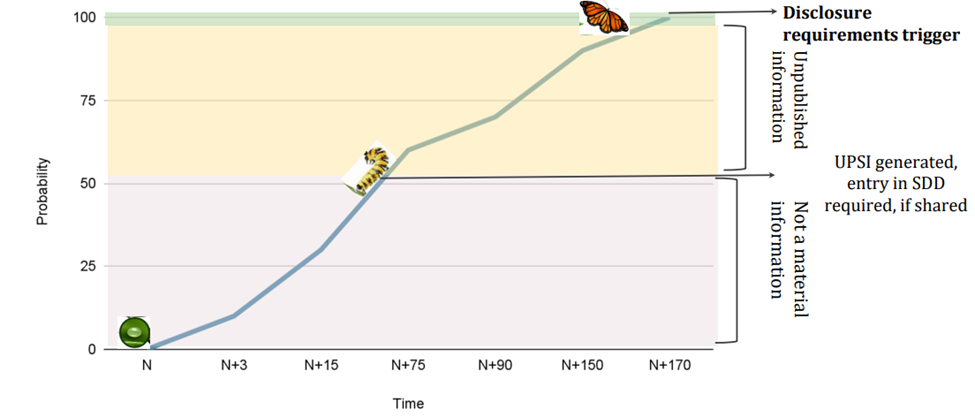
See our presentation on verification of market rumour by listed entities & other related amendments.
Conclusion
While the SEBI Listing Regulations appear to grant leeway to listed entities to remain silent on rumours floating in the market, such leeway is not absolute and the PIT Regulations still require the listed entities to ensure public dissemination of information, where a leak of UPSI has occurred. While the Supreme Court dismissed the appeal, citing that the same has been comprehensively dealt with by SEBI and SAT on the basis of the factual matrix, the proceedings signal the SC’s stand that the principles underlying the PIT Regulations have to be upheld at all times, and if going by the principles, it is essential for the listed entity to speak, it cannot remain silent.
In view of the significance of the subject, we are conducting a 12 hours Certificate Course on Insider Trading for Compliance Officers, see details here – https://vinodkothari.com/2025/11/12-hours-certificate-course-on-insider-trading-for-compliance-officers/
Our other resources:
- Presentation on verification of market rumour by listed entities & other related amendments
- FAQs on Verification of Market rumour by Listed Entities
- Verification of Market Rumour by listed entities & other related amendments
- FAQs on Verification of Market rumour by Listed Entities
- Prohibition of Insider Trading – Resource Centre
